
Image not available
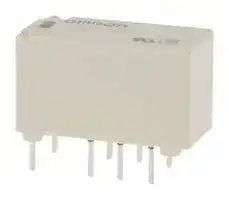
Illustrative purposes only

G6SU-2-DC3
Signal Relay, 3 VDC, DPDT, 2 A, G6S Series, Through Hole, Latching Single Coil
⚠️ Reference pricing provided. In case of supply shortages, we will connect you with our trusted procurement partners to ensure your project's continuity.
- Manufacturer: OMRON / PARTNER STOCK
- Product type: Signal Relays
- SVHC: To Be Advised
- Coil Type: Latching Single Coil
- Coil Voltage: 3VDC
- Product Range: G6S Series
- Relay Mounting: Through Hole
- Coil Resistance: 90ohm
- Contact Current: 2A
- Relay Terminals: PC Pin
- Contact Material: Silver Gold Alloy
- Contact Voltage VAC: -
- Contact Voltage VDC: 30V
- Contact Configuration: DPDT
| Delivery and price | |
|---|---|
| Units per pack | 60 |
| Price | 4.74 € |
| Current stock | 500+ |
| Lead time | 30 days |
Datasheet

## **Low Signal Relay G6S**

## **Surface Mount DPDT Relay**

- High dielectric withstand voltage of 2,000 VAC between coil and contacts (standard type); 1,500 VAC between contacts of different polarity.

- Meets FCC Part 68 and Telcordia 2.5 kV surge withstand.

- Standard models conform to UL/CSA standards. BSI (EN60950) certified models available (-Y versions)

- Low power consumption of 140 mW (Non-latching)

- Available in through-hole and SMT terminals.

- Tape and reel or tube packaging.

- RoHS Compliant.

## **Orderin Information g**

## ■ **Standard Version**

.

|**Terminal**|**Model**<br>**Contact form**|**Non-latching**|**Non-latching**|**Single coil latching**|**Dual coil latching**|
|---|---|---|---|---|---|
|||**Standard**|**European Version***|||
|Gull-wing|DPDT|**G6S-2F**|**G6S-2F-Y**|**G6SU-2F**|**G6SK-2F**|
|Inside “L”||**G6S-2G**|**G6S-2G-Y**|**G6SU-2G**|**G6SK-2G**|
|PCB through-hole||**G6S-2**|**G6S-2-Y**|**G6SU-2**|**G6SK-2**|


* BSI certified for EN60950

**Notes:** 1.  When ordering, add the rated coil voltage to the model number.

Example: G6S-2F DC12

Rated coil voltage

2.   When ordering tape packing (surface mount models), add  "-TR" to the model number. Example: G6S-2F-TR DC12

   - Tape packing

- "-TR" is not part of the relay model number.  Therefore, it is not marked on the relay case.

3.   Dual coil latching models are available with a High-sensitivity coil. (140 mW; 200 mW for DC24) When ordering High-sensitivity dual coil latching models, add "-H” to the model number. Example: G6SK-2G-H-TR DC5

High-sensitivity coil

## **Model Number Legend**

> **G6S     -          -     -      DC** ~~OOUOUU U~~ **1 2 3 4 5 6 1.   Relay Function 3.   Terminal Shape 5.   Packaging** None:   Non-latching None:  Through-hole U:         Single coil latching F:        Gull-wing surface mount K:         Dual coil latching G:        Inside “L” surface mount

None:  Through-hole None:  Tube packaging F:        Gull-wing surface mount TR:      Tape and reel packaging G:        Inside “L” surface mount (Surface mount models)

## **2.   Contact Form**

**4.   Approved Standards 6.   Rated Coil Voltage** None:  UL, CSA 3, 4.5, 5, 12, 24 VDC

2:   DPDT

Y:         UL, CSA, BSI (EN60950) (Standard coil models - 5, 12, 24 VDC )

Low Signal Relay **G6S**

1

**S ecification p**

■ **Contact Data**

**Load Resistive load (cos** f **= 1) Rated load** 0.5 A at 125 VAC 2 A at 30 VDC **Contact type** Bifurcated crossbar **Contact material** Ag (Au-Alloy) **Max. carry current** 2 A **Max. operating voltage** 250 VAC, 220 VDC **Max. operating current** 2 A **Max. switching capacity** 62.5 VA, 60 W ~~po~~ **Min. permissible load** 10 μA, 10 mVDC **Note:** P level: λ60 = 0.1 x 10[-6] /operation This value was measured at a switching frequency of 120 operations/min and the criterion of contact resistance is 50 Ω. This value may vary depending on the operating environment. Always double-check relay suitability under actual operating conditions. ■ **Coil Data G6S - Standard Non-latching (G6S-2F, G6S-2G, G6S-2) Rated Rated Coil Pick-up Dropout Maximum voltage current resistance voltage voltage voltage Power consumption (mW) (VDC) (mA) (** Ω **) % of rated voltage** 3 46.7 64.3 75% max. 10% min. 200% max.@ 23°C Approx. 140 4.5 31.0 145 5 28.1 178 12 11.7 1,028 ~~=~~ 24 8.3 2,880 ~~=~~ 170% max.@ 23°C Approx. 200 **G6SU - Standard Single Coil Latching (G6SU-2F, G6SU-2G, G6SU-2) Rated Rated Coil Coil Inductance (H) Set pick-up Reset pick-up Power Maximum voltvoltage current resistance (ref. value) voltage voltage consumption (VDC) (mA) (** Ω **) Armature OFF Armature ON % of rated voltage age (mW)** 3 33.3 90 0.108 0.069 75% max. 75% max. 180% max. Approx. 100 4.5 22.2 203 0.27 0.14 @ 23°C 5 20.0 250 0.36 0.18 12 8.3 1,440 2.12 1.14 24 6.3 3,840 5.80 3.79 Approx. 150 **G6SK - Standard Dual Coil Latching (G6SK-2F, G6SK-2G, G6SK-2) Coil Inductance (H) Set Reset Rated Rated Coil (ref. value) pick-up pick-up Power** SS ~~S a~~ **Maximum** e **voltage current resistance Set Reset voltage voltage consumption (VDC) (mA) (** Ω **) Armature Armature Armature Armature voltage (mW) OFF ON OFF ON % of rated voltage** 3 66.6 45 0.045 0.035 0.032 0.045 75% max. 75% max. 170% max. Approx. 200 4.5 44.4 101 0.12 0.074 0.082 0.14 @ 23°C 5 40 125 0.14 0.088 0.098 0.16 12 16.7 720 0.60 0.41 0.46 0.54 24 12.5 1,920 1.98 1.23 1.34 2.23 140% max. Approx. 300 @ 23°C **G6S - European Version (EN60950 certified), Non-latching (G6S-2F-Y, G6S-2G-Y, G6S-2-Y) Rated Rated Coil Pick-up Dropout Maximum Power consumption (mW) voltage current resistance voltage voltage voltage (VDC) (mA) (** Ω **) % of rated voltage** 5 40.0 125 75% max. 10% min. 170% max.@ 23°C Approx. 200 12 16.7 720 ~~=~~ 24 9.6 2,504 Approx. 230 **Note: 1.** The rated current and coil resistance are measured at a coil temperature of 23°C with a tolerance of ±10%. **2.** The operating characteristics are measured at a coil temperature of 23°C.

**3.** Pick-up voltage will vary with temperature.

**4.** The maximum voltage is the highest voltage that can be imposed on the relay coil.

Low Signal Relay **G6S**

2

## ■ **Characteristics**

|■**Characteristics**|■**Characteristics**||
|---|---|---|
|**Contact resistance (See note 1)**||75 mΩmax.|
|**Operate (set) time (See note 2)**||4 ms max. (mean value approx. 2.5 ms G6S; 2.0 ms G6SU, G6SK)|
|**Release (reset) time (See note 2)**||4 ms max. (mean value approx. 1.5 ms G6S; 2.0 ms G6SU, G6SK)|
|**Bounce time**||Approx. 0.5 ms|
|**Minimum set / reset pulse width**||10 ms (latching models)|
|**Max. operating frequency**||Mechanical: 36,000 operations/hr<br>Electrical: 1,800 ops/hr (under rated AC load). 1,200 ops/hr (under rated DC load)|
|**Insulation resistance (See note 3)**||1,000 MΩmin. (at 500 VDC)|
|**Dielectric strength**||2,000 VAC, 50/60 Hz for 1 minute (G6S, G6SU, G6S ”-Y”) between coil and contacts<br>1,000 VAC, 50/60 Hz for 1 minute (G6SK) between coil and contacts<br>1,500 VAC, 50/60 Hz for 1 minute between contacts of different and same polarity<br>500 VAC, 50/60 Hz for 1 minute between set and reset coils (G6SK)|
|**Surge withstand voltage**|**Conforming to**<br>**Telcordia specs.**|2,500 V (2 x 10μS) between coil and contacts for G6S, G6SU and G6S “-Y”<br>2,500 V (2 x 10μS) between contacts of different poles|
||**Conforming to**<br>**FCC Part 68**|1,500 V (10 x 160μS) between coil and contacts<br>1,500 V (10 x 160μS) between contacts of different and same polarity|
|**Vibration**|**Mechanical durability**|10 to 55 Hz; 5 mm double amplitude|
||**Malfunction durability**|10 to 55 Hz; 3.3 mm double amplitude|
|**Shock**|**Mechanical durability**|1,000 m/s2; approx. 100 G|
||**Malfunction durability**|750 m/s2; approx. 75 G|
|**Ambient temperature**||-40 to +85°C with no icing or condensation<br>-40 to +70°C with no icing or condensation (G6SK and G6S “-Y” with DC24 coil)|
|**Ambient Humidity**||5% to 85% RH|
|**Service life**|**Mechanical**|100,000,000 operations min. (at 36,000 operations/hour)|
||**Electrical**|100,000 operations min. (2A@30VDC, resistive; 1,200 ops/hr.)<br>100,000 operations min. (0.5A@125VAC, resistive; 1,800 ops/hr.)<br>See “Characteristic Data”|
|**Weight**||Approx. 2g|


**Note: 1.** The contact resistance was measured with 10 mA at 1 VDC with a voltage drop method.

**2.** Values in parentheses are typical values unless otherwise stated.

**3.** The insulation resistance was measured with a 500-VDC megohmmeter applied to the same parts as those used for checking the dielectric strength (except between the set and reset coil).

**4.** Data shown are of initial value.

Low Signal Relay **G6S**

3

## ■ **Characteristic Data**

**Ambient Temperature vs. Ambient Temperature vs. Maximum Voltage (non-Latching) Maximum Voltage (Latching)**

**==> picture [93 x 8] intentionally omitted <==**

**----- Start of picture text -----**<br>
Service Life - G6S-2F(G)<br>**----- End of picture text -----**<br>


**Max. Switching Capacity**

**==> picture [499 x 612] intentionally omitted <==**

**----- Start of picture text -----**<br>
107 |ne 500300 =eeee ee ee 250 G6S4.5 to 12 VDC 250<br>5 G6SU<br>3 ee 100 rT 30 VDC resistive load Ambient temperature 23°C 200 200<br>Switching frequency: 1,200<br>0.70.51 po |_| |eeFHJ |SxqRpaNLl AC resistive load es 503010 ASSPWN———-[ANNp\IN| | NT operations/h fT 150100 SN G6S24 VDCG6S-Y ~~7 G6S-Y NSS i. a » 150100 ———AwPO G6SK12 VDC max. G6SK 24 VDC > SS<br>0.3 po DC resistive load NT 53 a 125 VAC resistive load Ambient temSwitching frequency: 1,800 operations/hperature 23°C —— 50 12 VDC max. 24 VDC 50<br>0.110  a 30  50 70 100  300 500 700 1,000 10  0.5  1  1.5  2  2.5  3 − 0 40  −20  0  20  40  60  80  100 −040  −20  0  20  40  60  80  100<br>Switching voltage (V) Switching current (A) Ambient temperature (°C) Ambient temperature (°C)<br>Note: “Maximum Voltage” is the maximum voltage that can be applied to the relay coil<br>Ambient Temperature vs. Ambient Temperature vs. Ambient Temperature vs.<br>Switching Current (non-Latching) Switching Current (Latching) Pickup or Drop out Voltage - G6S-2F(G) Shock Malfunction - G6S-2F(G)<br>3 3 100 Y<br>Sample: G6S-2F   1,000<br>Number of Relays: 10 pcs Energized<br>80 max. 800<br>2 G6S12 VDC max. 2 G6SU  12 VDC max.G6SU  24 VDCG6SK 60 min.X 1,000X 600400200 De- energized 1,000Z<br> 12 VDC max. i<br>G6S-Y 200<br>24 VDC 40<br>1 NK ALN 1 \ \\ za max. 1,000 400 1,000<br>min.X Z' 600 X'<br>G6S24 VDC G6SK  24 VDC 20 Shock direction 800<br>040  50  G6S-Y12 VDC max.60  70  80  90  100 040  50  60  70  80  90  100 −060  −40  −20  0  20  40 Must operate voltageMust release voltage60  80  100 120 YX X'ZZ' ® 1,000Y' Unit: m/sSample: G6S-2FNumber of Relays: 10 pcs [2]<br>Ambient temperature (°C) Ambient temperature (°C) Ambient temperature (°C) Y' iL ©<br>Conditions:    Shock is applied in ±X, ±Y, and ±Z<br>directions three times each with and with<br>out energizing the Relays to check the<br>number of contact malfunctions.<br>Electrical Endurance - G6S-2F(G) Electrical Endurance - G6S-2F(G) Electrical Endurance - G6S-2F(G) Electrical Endurance - G6S-2F(G)<br>(Pickup and Dropout) *1 (Contact Resistance) *1 (Pickup and Dropout) *1 (Contact Resistance) *1<br>10080 Sample: G6S-2FNumber of Relays: 10 pcsMeasurement conditions: NO contact - wire-spring relaNC contact - resistive load at 48 VDC, 60mASwitching frequency: 3,600 operations/hy load at 48 VDC, 120mA (with ARC-killermax. ) 1,000500300 Sample: G6S-2F Number of Relays: 10 pcsMeasurement conditions: NO contact - wire-spring relay load at 48 VDC, 120mA (with ARCNC contact - resistive load at 48 VDC, 60mA Switching frequency: 3,600 operations/h oe -killer) 10080 Sample: G6S-2FNumber of Relays: 10 pcsTest conditions: 2A resistive load at 30Switching frequency: 1,200 operations/h-VDC with an operation rate of 50% max. 1,000500300 Sample: G6S-2F Number of Relays: 10 pcsTest conditions: 2A resistive load at 30of 50% Switching frequency: 1,200  operations/h-VDC with an operation rate  FA NO contactNC contact<br>60 Must operate voltage min. 100 60 Must operate voltage min. Hl 100 aaa<br>40 40 Contact resistance<br>20 Must release voltage re max.min. 5030 HH Contact resistance NO contact ili max.min. max. min. 4Lh 20 LOE Must release voltage TEE min. max. 5030 ReetPEHE max.max. min. min. PT<br>NC contact<br>0 10 0 10<br>50  100  300 500  1,000  5,000 50  100  300 500  UUM 1,000  TL 5,000 1  3  5  10  30 50  100  300 500 1  ECT 3  5  10  TAI 30 50  100  300 500 ET<br>Operating frequency (×10 [3]  operations) Operating frequency (×10 [3]  operations) Operating frequency (×10 [3]  operations) Operating frequency (×10 [3]  operations)<br>Contact Reliability Test - G6S-2F(G) Pickup and Dropout- G6S-2F(G) Distribution of Bounce Time<br>(Contact Resistance) *1, *2 Time Distribution *1 G6S-2F(G) *1<br>1,000500 Sample: G6S-2F Number of Relays: 10 pcsTest conditions: 10 resistive load at 10 m VDC μA  NO contactNC contact 60 Sample: G6S-2F  Number of Relays: 50 pcs Must operate timeMust release time 60 Sample: G6S-2F  Number of Relays: 50 pcs Operating bounce timeRelease bounce time<br>300 with an operation rate of 50%Switching frequency: 7,200<br>100 operations/h TIaia 40 N 40 ) Y) L g<br>Eat a eee max. U1) |N 4) lale<br>50 LN at max. min. || 20 N Y] 20 ane<br>30 min.<br>10<br>10  30 50 100  300 500 1,000  10,000 50,000 0 0.5  1  1.5  2  2.5  3 0  0.5  1  1.5  2  2.5  3<br>Operating frequency (×10 [3]  operations) Time (ms) Time (ms)<br>4 operations)<br>Switching current (A) Maximum voltage (%) Maximum voltage (%)<br>Durability (×10<br>Switching current (A) Switching current (A) On the basis of rated voltage (%)<br>Contact resistance (m)Ω Contact resistance (m)Ω<br>On the basis of rated voltage (%) On the basis of rated voltage (%)<br>)Ω Number of contacts Number of contacts<br>Contact resistance (m<br>**----- End of picture text -----**<br>


**Ambient Temperature vs. Ambient Temperature vs. Switching Current (non-Latching) Switching Current (Latching)**

**Electrical Endurance - G6S-2F(G) Electrical Endurance - G6S-2F(G) (Pickup and Dropout) *1 (Contact Resistance) *1**

**Contact Reliability Test - G6S-2F(G) (Contact Resistance) *1, *2**

- *1. The tests were conducted at an ambient temperature of 23°C

- *2. The contact resistance data are periodically measured reference values and are not values from each monitoring operation. Contact resistance values will vary according to the switching frequency and operating environment, so be sure to check operation under the actual operating conditions before use.

Low Signal Relay **G6S**

4

**==> picture [507 x 301] intentionally omitted <==**

**----- Start of picture text -----**<br>
Mutual Magnetic Interference External Magnetic Interference<br>G6S-2F(G) G6S-2F(G) (Average value) (Average value) (Average value)<br>Must operate voltage +30 +30 +30<br>Must release voltage S N S N S N S N S N S N<br>2.22 mm +30 Initial stage Test +20 +20 +20<br>+20<br>my ~ +100 FoF +10 eTittyl Fel} +10 dEe e epte +10 EN<br>Sample −−1020 0 0 0<br>Not  −30 Average value<br>energized a= +30 Initial stage Test −10 eesti −10 tenet −10 cae<br>+20<br>+10 −20 −20 −20<br>Sample 0 Sample: G6S-2F   Must operate voltage Sample: G6S-2F   Must operate voltage Sample: G6S-2F   Must operate voltage<br>Energized H o −−1020 r] −−1,200  30 [oePrP Number of Relays:10 pcs−800  −400  0  Pry) 400 Must release voltage800 1,200 J]  6 −−1,200  30 LoS Number of Relays:10 pcs−800  −400  0  Must release voltage400  800 1,200 −−1,200  30 EEN Number of Relays:10 pcs−800  −400  0  Must release voltage400  800 1,200<br>−30 Lo Average value External magnetic field (A/m) External magnetic field (A/m) | Le External magnetic field (A/m)<br>High-frequency Characteristics High-frequency Characteristics High-frequency Characteristics<br>Mutual Magnetic Interference Isolation - G6S-2F(G) *1, *2 Insertion Loss - G6S-2F(G) *1, *3 Return Loss, V.SWR - G6S-2F(G) *1, *3<br>G6S-2F(G) (Average value (initial)) (Average value (initial)) (Average value (initial))<br>Must operate voltageMust release voltage 0 Sample: G6S-2F   0 0 Sample: G6S-2F   2.5<br>4.64 mm ~ ++3020 Initial stage Test 20 vim Number of Relays: 10 pcs 0.4 mm 5 saa Number of Relays: 10 pcs 2.0<br>+10<br>0 10<br>lt Sample energizedNot  −−−+10203030 Initial stage [—] Average valueTest 40 At 0.81.2 SHI NICH 1520 CA V.SWR HuaTHT 1.51.0<br>+20 = 60 ROTI eS aA<br>Sample +10 —— 1.6 PITT 25 ey Return loss rn 0.5<br>−−10200 8010  30 50  100  300 500 1,000  5,000 2.010 Sample: G6S-2F  Number of Relays: 10 pcs30 50  100  300 500 1,000  5,000 3010  30 50  100  300 500 1,000  5,000 0<br>Energized −30 —= Average value CLINI Frequency (MHz) ETE Frequency (MHz) Coc Frequency (MHz)<br>Rate of variability (%) Rate of variability (%) Rate of variability (%)<br>Change rate on the basis of initial value (%)<br>Change rate on the basis of initial value (%)<br>Isolation (dB) Insertion loss (dB) Return loss (dB) V.SWR<br>Change rate on the basis of initial value (%)<br>Change rate on the basis of initial value (%)<br>**----- End of picture text -----**<br>


- *1. The tests were conducted at an ambient temperature of 23°C

- *2. The contact resistance data are periodically measured reference values and are not values from each monitoring operation. Contact resistance values will vary according to the switching frequency and operating environment, so be sure to check operation under the actual operating conditions before use.

- *3. High-frequency characteristics depend on the PCB to which the relay is mounted. Always check these characteristics, including durability, in the actual machine before use.

Low Signal Relay **G6S**

5

## **Dimensions**

**Note: 1.** All units are in millimeters unless otherwise indicated.

**2.** Coplanarity of SMT versions is 0.1 mm max.

## ■ **Standard**

## **G6S-2F, G6S-2F-Y**

Tolerance: ±0.3 unless otherwise indicated

**==> picture [199 x 118] intentionally omitted <==**

**----- Start of picture text -----**<br>
Terminal Arrangement/ Footprint<br>Internal Connections  (Top View)<br>(Top View) Tolerance: ±0.1<br>Orientation mark<br>254<br>[7hi* 109 8 | te<br>iV)vy | - LJ | oe|<br>is sea ea<br>Note: Carefully check the coil<br>          polarity of the relay<br>**----- End of picture text -----**<br>


## **G6S-2G, G6S-2G-Y**

Tolerance: ±0.3 unless otherwise indicated

**==> picture [108 x 115] intentionally omitted <==**

**----- Start of picture text -----**<br>
Terminal Arrangement/<br>Internal Connections<br>(Top View)<br>Orientation mark<br>ge _ ae7 8<br>ieR Tt inal<br>Kae 3 + |<br>Note: Carefully check the coil<br>          polarity of the relay<br>**----- End of picture text -----**<br>


**Footprint (Top View)** Tolerance: ±0.1

## **G6S-2, G6S-2-Y**

Tolerance: ±0.3 unless otherwise indicated

**Terminal Arrangement/ Internal Connections (Bottom View)**

**Footprint (Bottom View)**

**==> picture [226 x 85] intentionally omitted <==**

**----- Start of picture text -----**<br>
Orientation mark Eight, 1-dia. holes<br>1 3.4 5 4<br>if Lt | mheaReeehne<br>if LI | 24 | ete een |<br>9 _ | B<br>iT A ~ iseeeett<br>(1.05) 1o.16e01-—|<br>Note: Carefully check the coil<br>          polarity of the relay<br>**----- End of picture text -----**<br>


Low Signal Relay **G6S**

6

## ■ **Single Coil Latching**

## **G6SU-2F**

Tolerance: ±0.3 unless otherwise indicated

7.3+0.2

## **Terminal Arrangement/ Internal Connections (Top View)**

**==> picture [48 x 6] intentionally omitted <==**

**----- Start of picture text -----**<br>
Orientation mark<br>**----- End of picture text -----**<br>


**Footprint (Top View)**

Tolerance: ±0.1

Note: Carefully check the coil polarity of the relay

## **G6SU-2G**

Tolerance: ±0.3 unless otherwise indicated

br 7.3+0.2

**Terminal Arrangement/ Internal Connections (Top View)**

**Footprint (Top View)** Tolerance: ±0.1

Orientation mark LT] ue inal l Note: Carefully check the coil |e o +. : | polarity of the relay

## **G6SU-2**

Tolerance: ±0.3 unless otherwise indicated

**Terminal Arrangement/ Internal Connections (Bottom View)**

**Footprint (Bottom View)**

Orientation mark Eight, 1-dia. holes “i 3 4 5 _ _Yy vy) ee nee Heseediig Jess; | hao Note: Carefully check the coil ~~ a2 o (1.05) 10.16+01--| polarity of the relay

Low Signal Relay **G6S**

7

## ■ **Dual Coil Latching**

## **G6SK-2F**

Tolerance: ±0.3 unless otherwise indicated

**Terminal Arrangement/ Footprint Internal Connections (Top View) (Top View)** Tolerance: ±0.1

**==> picture [47 x 6] intentionally omitted <==**

**----- Start of picture text -----**<br>
Orientation mark<br>**----- End of picture text -----**<br>


Note: Carefully check the coil polarity of the relay

## **G6SK-2G**

Tolerance: ±0.3 unless otherwise indicated

**==> picture [29 x 18] intentionally omitted <==**

**----- Start of picture text -----**<br>
an 7.3+0.2<br>**----- End of picture text -----**<br>


**Terminal Arrangement/ Internal Connections (Top View)**

**Footprint (Top View)** Tolerance: ±0.1

**==> picture [108 x 79] intentionally omitted <==**

**----- Start of picture text -----**<br>
Orientation mark a<br>He: 10 9 a2<br>iYa [YI ‘A<br>oT 345 4|<br>Note: Carefully check the coil<br>          polarity of the relay<br>**----- End of picture text -----**<br>


## **G6SK-2**

Tolerance: ±0.3 unless otherwise indicated

**Terminal Arrangement/ Internal Connections (Bottom View)**

**Footprint (Bottom View)**

Orientation mark Ten, 1-dia. holes fo 38) #8 SS a m -O-6—-O in1 LL EL | neneaains y | Heap eg. 1210 9 8 7 5.08 -+ ———=(1.05) 254 Note: Carefully check the coil 2.54 2.54 polarity of the relay

## **Recommended Solderin Method g**

**==> picture [446 x 192] intentionally omitted <==**

**----- Start of picture text -----**<br>
(1) IRS Method (Mounting Solder: Lead) (2) IRS Method (Mounting Solder: Lead-free)<br>Upper surface of case (peak):<br>255°C max.<br>220 to SolderingSoldering 250 max. Soldering<br>240<br>230<br>180 to<br>180<br>200<br>Preheating<br>Preheating<br>150 150 Preheating<br>Relay<br>terminal<br>section<br>90 to 120 20 to 30 120 max.<br>30 max.<br>Time (s)<br>Time (s)<br>Note:    The temperature profile indicates the temperature on the PCB.<br>C) C)<br>° °<br>Temperature  ( Temperature  (<br>**----- End of picture text -----**<br>


Low Signal Relay **G6S**

8

## **Packa in g g**

**Tube packing Tape packing (Surface mount versions)** ~~a~~

Standard nomenclature

50 pcs per anti-static tube

When ordering, add “TR” before the rated coil voltage (e.g., G6S-2F- _TR_ -DC12) Note: TR is not part of the relay model number and will not be marked on the relay.

## ■ **Tape and Reel Dimensions (Surface Mount Models)**

- Relays per reel: 400

- Reels per packing carton: 2 (800 relays)

**==> picture [422 x 257] intentionally omitted <==**

**----- Start of picture text -----**<br>
2 [±][0.3] 25.529.5 [±][0.5][±][1.0] G6S-2F, G6SU-2F, G6SK-2F, G6S-2F-Y<br>21 [±][0.5] 13 [±][0.2] aa<br>1.5 [+] − [0.1] 0 42 [±][±][0.1][0.1] 1.75 [±][0.1] 0.4 [±][0.05] 9.7 [±][0.1]<br>80 330 11.5 [±][0.1]<br>24 [±][0.3]<br>15.3<br>R1<br>Oo WH, CBG B<br>16 [±][0.1]<br>9.7<br>G6S-2G, G6SU-2G, G6SK-2G, G6S-2G-Y<br>Cover tape<br>1.5 [+] − [0.1] 0 42 [±][±][0.1][0.1] 1.75 [±][0.1] 0.4 [±][0.05] 9.7 [±][0.1]<br>NY ee<br>Carrier tape Emboss tape 11.5 [±][0.1]<br>24 [±][0.3]<br>15.3<br>Orientation mark<br>16 [±][0.1]<br>7.8<br>**----- End of picture text -----**<br>


**==> picture [40 x 5] intentionally omitted <==**

**----- Start of picture text -----**<br>
Feed direction<br>**----- End of picture text -----**<br>


## ■ **Approvals**

**UL Recognized (File No. E41515) / CSA Certified (File No. LR31928) - - Ambient Temp. = 40** ° **C**

|**Contact form**<br>**Coil rating**<br>**Contact ratings**|**Number of test operations**||
|---|---|---|
|DPDT (2c)<br>2 to 48 VDC<br>3 A at 30 VDC (Resistive)|6,000||
|0.3 A at 110 VDC (Resistive)|||
|0.5 A at 125 VAC (General Use)|||
|**BSI (EN60950) (File No.8064)**|||
|**Contact form**<br>**Isolation Category**<br>**Voltage**<br>DPDT<br>Supplementary Isolation<br>250 VAC<br>~~a~~|||
|**Note: 1.** The rated values approved by each of the safety standards (e.g., UL, CSA and BSI) may be different from the performance characteristics|||
|individually defined in this catalog.|||


**2.** In the interest of product improvement, specifications are subject to change.

Low Signal Relay **G6S**

9

## **Precautions**

- Use a DC power supply with 5% or less ripple factor to operate the coil.

- Do not use the G6S where subject to strong external magnetic fields.

- Do not use the G6S where subject to magnetic particles or excessive amounts of dust.

- Do not reverse the polarity of the coil (+, −).

- Latching types are delivered in the reset position. We recommend that a reset voltage be applied in advance to start operation.

- Do not drop the G6S or otherwise subject it to excessive shock.

- Remove the relay from the packing immediately prior to usage.

- Be sure to read the precautions and information common to all relays, contained in the Technical User’s Guide, “Electromechanical Relays, Technical Information” for correct use.

## ■ **Correct use**

## **Long-term Continuously ON Contacts**

Using the Relay in a circuit where the Relay will be ON continuously for long periods (without switching) can lead to unstable contacts because the heat generated by the coil itself will affect the insulation, causing a film to develop on the contact surfaces. We recommend using a latching relay (magnetic-holding relay) in this kind of circuit. If a single-side stable model must be used in this kind of circuit, we recommend using a fail-safe circuit design that provides protection against contact failure or coil burnout.

## **Relay Handling**

Use the Relay as soon as possible after opening the moisture-proof package. If the Relay is left for a long time after opening the moisture-proof package, the appearance may suffer and seal failure may occur after the solder mounting process. To store the Relay after opening the moisture-proof package, place it into the original package and sealed the package with adhesive tape.

When washing the product after soldering the Relay to a PCB, use a water-based solvent or alcohol-based solvent, and keep the solvent temperature to less than 40°C. Do not put the Relay in a cold cleaning bath immediately after soldering.

## **Claw Securing Force During Automatic Mounting**

During automatic insertion of Relays, be sure to set the securing force of each claw to the following so that the Relay’s characteristics will be maintained.

## **G6S (K) (-U) -2 Soldering**

- Soldering temperature: Approx. 250°C (At 260°C if the DWS method is used.)

- Soldering time: Approx. 5 s max. (Approx. 2 s for the first time and approx. 3 s for the second time if the DWS method is used.)

- Be sure to adjust the level of the molten solder so that the solder will not overflow onto the PCB.

## **G6S (K) (-U) -2F Soldering**

The thickness of cream solder to be applied should be within a range between 150 μm and 200 μm on Omron’s recommended PCB pattern.

In order to perform correct soldering, it is recommended that the correct soldering conditions be maintained as shown below on the left side.

**==> picture [224 x 86] intentionally omitted <==**

**----- Start of picture text -----**<br>
Correct Soldering Incorrect Soldering<br>Relay<br>Terminal<br>Land<br>Heel fillet<br>is formed PCB<br>A=<br>Solder Insufficient amount  Excessive amount<br>of solder of solder<br>**----- End of picture text -----**<br>


Visually check that the relay is properly soldered.

**==> picture [71 x 72] intentionally omitted <==**

**----- Start of picture text -----**<br>
C<br>B<br>A<br>Dimension A: 1.96 N max.<br>Dimension B: 4.90 N max.<br>Dimension C: 1.96 N max.<br>**----- End of picture text -----**<br>


Low Signal Relay **G6S**

10

**MEMO**

Low Signal Relay **G6S**

11

**All sales are subject to Omron Electronic Components LLC standard terms and conditions of sale, which can be found at http://www.components.omron.com/components/web/webfiles.nsf/sales_terms.html** ~~pe~~ **ALL DIMENSIONS SHOWN ARE IN MILLIMETERS.** To convert millimeters into inches, multiply by 0.03937. To convert grams into ounces, multiply by 0.03527. ~~|~~

OMRON. **OMRON ON-LINE** Global - http://www.omron.com **OMRON ELECTRONIC** USA - http://www.components.omron.com **COMPONENTS LLC 847-882-2288** Cat. No. K093-E-07 05/14 (03/14) Specifications subject to change without notice Printed in USA

Low Signal Relay **G6S**

12
Updated at June 10, 2026
About Novapart
Novapart is a B2B electronic component broker specialising in stock shortages and cost reduction. We source hard-to-find parts and identify compliant alternatives across a catalogue of 410,000+ components from 500+ manufacturers.
Learn more →Stock Shortage Specialist
When a component is unavailable, discontinued or has an unacceptable lead time, we tap into our network of vetted European and Asian distributors to source what you need — without compromising on quality or traceability.
Request a quote →Compliant Alternatives
We identify pin-to-pin, electrically equivalent substitutes that meet the same certifications (RoHS, AEC-Q100, REACH) as your original specification — validated against datasheets, not just part numbers. Often at a lower cost.
BOM Analysis service →