
Image not available
Illustrative purposes only

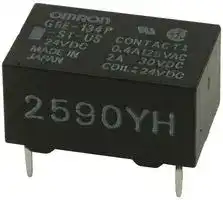
G6E-134P-ST-US-DC24
RELAY, SIGNAL, SPDT, 30VDC, 2A
⚠️ Reference pricing provided. In case of supply shortages, we will connect you with our trusted procurement partners to ensure your project's continuity.
- Manufacturer: OMRON ELECTRONIC COMPONENTS
- Product type: Signal Relays
- Coil Voltage:24VDC; Contact Configuration:SPDT; Contact Current:2A; Product Range:G6E Series; Relay Mounting:Through Hole; Coil Type:Non Latching; Relay Terminals:Solde 52F3886
| Delivery and price | |
|---|---|
| Units per pack | 250 |
| Price | 4.84 € |
| Current stock | 25+ |
| Lead time | 30 days |
Datasheet

G6E Low Signal Relay

G 6 E

## **Subminiature, Sensitive SPDT Signal Switching Relay**

- High sensitivity: 98-mW (Rated power consumption: 200mW) pickup coil power.

- Impulse withstand voltage of 1,500V (10×160 μs) meets FCC requirements.

- Stick packing employed in consideration of supporting automatic implementation.

- Plastic-sealed model that allows automatic soldering.

- New series of ultrasonically cleanable models is available.

- Standard model conforms to UL/CSA standards.

## **RoHS Compliant**

## ■ **Model Number Legend**

## G6E-@ -@@@@@ -@ -@

— — — — — — — — 1 2 3 4 5 6 7 8

**1. Relay Function** 3: Bifurcated crossbar Ag None : Single-side stable (Au-Alloy) contact U : Single-winding **4. Enclosure Rating**

latching 4: Fully sealed

K : Double-winding

latching **5. Terminals Shape**

   **5. Terminals Shape** P: PCB terminals

**2. Number of poles/ Contact Form**

   **6. Classification** None : Standard

- 1: 1-pole/SPDT (1c)

**3. Contact Type**

- L : Low sensitivity coil (400 mW)

**7. Approved Standards** US: UL, CSA UL: FILE No.E41515 ( CSA: FILE No.LR31928[)]

## **8. Special Function**

None : Standard

- U : For ultrasonically cleanable

## ■ **Application Examples**

- Telecommunication equipment

- Office automation machines

- Industrial equipment

- Security equipment

## ■ **Ordering Information**

● **Standard Models (UL, CSA certified)**

Relay Function Single-side stable Single-winding latching Double-winding latching ~~pS~~ Classification ~~GO~~ Standard Low-sensitivity Standard Standard Low-sensitivity Minimum packing Rated coil Rated coil Rated coil Rated coil Rated coil unit Contact form Model Model Model Model Model voltage voltage voltage voltage voltage ~~se~~ 5 VDC ~~es|~~ 5 VDC ~~ee ee|~~ 5 VDC ~~|~~ 5 VDC ~~ri~~ 5 VDC 6 VDC 6 VDC 6 VDC 6 VDC 6 VDC ~~a — SSE]~~ **G6E** 9 VDC **G6E** 9 VDC **G6EU** 9 VDC **G6EK** 9 VDC **G6EK** − SPDT (1c) **-134P-US** ~~|~~ 12 VDC **-134PL-US** ~~|~~ 12 VDC **-134P-US** ~~|~~ 12 VDC **-134P-US** ~~|~~ 12 VDC **-134PL-US** ~~ri~~ 12 VDC 25 pcs/tube 24 VDC 24 VDC 24 VDC 24 VDC 24 VDC 48 VDC − − − − − − − − ~~|= | | | ri PoE a pe — —~~ ● **Models for Ultrasonically Cleanable** ~~es~~ Relay Function Single-side stable Single-winding latching Double-winding latching Classification Standard Low-sensitivity Standard Standard Minimum packing Rated coil Rated coil Rated coil Rated coil unit Contact form Model Model Model Model ~~—a~~ voltage ~~eeee~~ voltage ~~ae~~ voltage voltage ~~|~~ 5 VDC6 VDC ~~|~~ 5 VDC− ~~|~~ 5 VDC− ~~[id~~ 5 VDC− **G6E** 9 VDC **G6E** − **G6EU** − **G6EK** − SPDT (1c) **-134P-US-U** 12 VDC **-134PL-US-U** ~~|~~ 12 VDC **-134P-US-U** ~~|~~ 12 VDC **-134P-US-U** ~~r.._|~~ 12 VDC 25 pcs/tube 24 VDC 24 VDC − 24 VDC SE ~~=8=5=0=|~~ 48 VDC − ~~|~~ − − ~~|~~ − − ~~[|~~ − 0 ~~Po | | C._|~~ Note: When ordering, add the rated coil voltage to the model number. Example: G6E-134P-US DC5

Rated coil voltage

However, the notation of the coil voltage on the product case as well as on the packing will be marked as @@ VDC.

**1**

G6E

**Low Signal Relay**

G 6 E

## ■ **Ratings**

## ● **Coil: Single-side Stable**

|Classification|Rated voltage|Rated<br>current<br>(mA)|Coil<br>resistance<br>(Ω)|<br>Must operate<br>voltage<br>(V)|<br>Must release<br>voltage<br>(V)|<br>Max.<br>voltage<br>(V)|Power<br>consumption<br>(mW)|
|---|---|---|---|---|---|---|---|
|||||% of rated voltage||||
|Standard|5 VDC|40.0|125|70% max.|10% min.|190%<br>(at 23°C)|Approx. 200|
||6 VDC|33.3|180|||||
||9 VDC|22.2|405|||||
||12 VDC|16.7|720|||||
||24 VDC|8.3|2,880|||||
||48 VDC|8.3|5,760|||170%<br>(at 23°C)|Approx. 400|
|Low-sensitivity|5 VDC|79.4|63|70% max.|10% min.|170%<br>(at 23°C)|Approx. 400|
||6 VDC|66.6|90|||||
||9 VDC|44.3|203|||||
||12 VDC|33.3|360|||||
||24 VDC|16.7|1,440|||||


## ● **Coil: Single-winding latching**

|Contact type|Rated voltage|Rated current<br>(mA)|Coil resistance<br>(Ω)|Must set voltage<br>(V)|Must reset voltage<br>(V)|Max. voltage<br>(V)|Power consumption|Power consumption|
|---|---|---|---|---|---|---|---|---|
|||||% of rated voltage|||Set coil (mW)|Reset coil (mW)|
|Bifurcated<br>crossbar|5 VDC|40.0|125|70% max.|70% max.|190%<br>(at 23°C)|Approx. 200|Approx. 200|
||6 VDC|33.3|180||||||
||9 VDC|22.2|405||||||
||12 VDC|16.7|720||||||
||24 VDC|8.3|2,880||||||


## ● **Coil: Double-winding latching**

|Classification|Rated voltage|Rated current (mA)|Rated current (mA)|Coil resistance (Ω)|Coil resistance (Ω)|Must set<br>voltage<br>(V)|Must reset<br>voltage<br>(V)|Max.<br>voltage<br>(V)|Power consumption|Power consumption|
|---|---|---|---|---|---|---|---|---|---|---|
|||Set coil|Reset coil|Set coil|Reset coil|% of rated voltage|||Set coil<br>(mW)|Reset coil<br>(mW)|
|Standard|5 VDC|40.0|40.0|125|125|70% max.|70% max.|190%<br>(at 23°C)|Approx. 200|Approx. 200|
||6 VDC|33.3|33.3|180|180||||||
||9 VDC|22.2|22.2|405|405||||||
||12 VDC|16.7|16.7|720|720||||||
||24 VDC|8.3|8.3|2,880|2,880||||||
|Low-sensitivity|5 VDC|79.4|79.4|63|63|70% max.|70% max.|170%<br>(at 23°C)|Approx. 400|Approx. 400|
||6 VDC|66.6|66.6|90|90||||||
||9 VDC|44.3|44.3|203|203||||||
||12 VDC|33.3|33.3|360|360||||||
||24 VDC|16.7|16.7|1,440|1,440||||||


- Note 1. The rated current and coil resistance are measured at a coil temperature of 23°C with a tolerance of ±10%.

   - 2.Operating characteristics are measured at a coil temperature of 23°C.

   - 3.The maximum voltage is the highest voltage that can be imposed on the relay coil.

   - 4.Refer to the engineering data for relations between the ambient temperature and maximum coil voltage.

## ● **Contacts**

|Load<br>Item|Resistive load|Inductive load<br>(cosφ= 0.4; L/R = 7 ms)|
|---|---|---|
|Contact type|Bifurcated crossbar||
|Contact material|Ag (Au-Alloy)||
|Rated load|0.4 A at 125 VAC;<br>2 A at 30 VDC|0.2 A at 125 VAC;<br>1 A at 30 VDC|
|Rated carry current|3 A||
|Max. switching voltage|250 VAC, 220 VDC||
|Max. switching current|3 A||


**2**

G6E

**Low Signal Relay**

G 6 E

## ■ **Characteristics (Including Models for Ultrasonically Cleanable)**

|Item<br>RelayFunction|Item<br>RelayFunction|Single-side Stable|Single-windingLatching|Double-windingLatching|
|---|---|---|---|---|
|Contact resistance *1||50 mΩmax.|||
|Operate(set)time||5 ms max.|||
|Release(reset)time||5 ms max.|||
|Min. setpulse width||−|15 ms||
|Min. resetpulse width||−|15 ms||
|Insulation resistance *2||1,000 MΩmin.(at 500 VDC)|||
|Impulse withstand<br>voltage|<br>Between coil and contacts<br>Between contacts of samepolarity|2,500 V(10×160μs) (conforms to FCCpart 68)|||
|||1,500 V(10×160μs) (conforms to FCCpart 68)|||
|Dielectric strength|<br>Between coil and contacts<br>Between contacts of samepolarity|1,500 VAC, 50/60 Hz for 1 min|||
|||1,000 VAC, 50/60 Hz for 1 min|||
|Vibration<br>resistance|Destruction<br>Malfunction|10 to 55 to 10 Hz, 2.5 mm single amplitude(5 mm double amplitude)|||
|||10 to 55 to 10 Hz, 1.65 mm single amplitude(3.3 mm double amplitude)|||
|Shock resistance|Destruction<br>Malfunction|1,000 m/s2|||
|||300 m/s2|||
|Durability|Mechanical<br>Electrical|100,000,000 operations min.(at 36,000 operations/hr)|||
|||100,000 operations min. (0.4 A at 125 VAC resistive load; 0.2 A at 125 VAC inductive load)<br>(at 1,800 operations/hr)|||
|||500,000 operations min. (2 A at 30 VDC resistive load; 1 A at 30 VDC inductive load)<br>(at 1,800 operations/hr)|||
|||200,000 operations min.(3 A at 30 VDC resistive load) (at 1,800 operations/hr)|||
|Failure rate(P level) (reference value)*3||10μA at 10 mVDC|||
|Ambient operatingtemperature||-40°C to 70°C(with no icingor condenstion)|||
|Ambient operatinghumidity||5% to 85%|||
|Weight||Approx. 2.7g|||


- Note: The values here are initial values.

- *1. The contact resistance was measured with 1 A at 5 VDC using a voltage-drop method.

- *2. The insulation resistance was measured with a 500 VDC Megger Tester applied to the same parts as those used for checking the dielectric strength.

- *3. This value was measured at a switching frequency of 120 operations/min and the criterion of contact resistance is 50 Ω. This value may vary depending on the switching frequency and operating environment. Always double-check relay suitability under actual operating conditions.

## ■ **Engineering Data**

## ● **Maximum Switching Power**

**==> picture [508 x 207] intentionally omitted <==**

**----- Start of picture text -----**<br>
● Maximum Switching Power ● Durability ● Ambient Temperature vs.<br>Maximum Coil Voltage<br>10 10,000 280<br>5 5,000 260<br>3 DC resistive load 3,000 240 G6E-134P-US G6EK-134P-US<br>2 30 VDC inductive load G6EU-134P-US<br>1 AC resistive load 1,000 (L/R = 7 ms) 220<br>0.5 DC inductive load 500 200<br>0.40.3 (L/R = 7 ms) 300 30 VDC resistive load 180<br>0.2 AC inductive load(cos [φ]  = 0.4) 100 125 VAC 160 G6EG6EK-134PL-US-134PL-US<br>0.1 50 resistive load 140 G6EUOnly at 48VDC-134P-US<br>0.05 30<br>125 VAC  120<br>0.03 inductive load<br>10 (cosφ = 0.4) 100<br>0.01 5 0<br>0  3  5  10  20 30 50 100  300 500 1,000 0 0.2 0.4  1  2  3  4 -50  -40  -20  0  20  40  60  80 100<br>Switching voltage (V) Switching current (A) Ambient temperature (°C)<br>Note: The maximum coil voltage refers to the<br>maximum value in a varying range of<br>operating power voltage, not a continuous<br>voltage.<br>4 operations)<br>Switching current (A) Durability (x10 Maximum coil voltage (%)<br>**----- End of picture text -----**<br>


## ● **Shock Malfunction G6E-134P-US**

## ● **Ambient Temperature vs. Must Operate or Must Release Voltage**

## **G6EK-134P-US**

**==> picture [511 x 148] intentionally omitted <==**

**----- Start of picture text -----**<br>
100 De-energized Y Reset Y<br>Coil is applied with 130% of rated voltage Energized 1,000 Set 1,000<br>80<br>Coil is applied with  X Z X Z<br>100% of rated voltage 1,000 1,000 1,000 600 1,000<br>60 Hot start voltage  500 Shock direction Shock direction<br>(max. value) X X' X X'<br>Voltage not applied to  Cold start voltage  Y Y<br>40 the coil and contacts (max. value)Release voltahot start (min. value)Release voltage at cold start (min. value)ge at  1,000Z' 0 600 X'Y' ZZ' 1,000Z' 0 700 X'Y' ZZ'<br>Coil is applied with  1,000 1,000<br>20 100% of rated voltage<br>1,000 1,000<br>-40 0 -20 Voltage not applied to the coil and contacts0  20  40  60  80  100 120 Sample: G6E-134P-US  24 VDCNumber of Relays: 10 pcsUnit: m/s [2] Y' Sample: G6EK-134P-US  12 VDCNumber of Relays: 20 pcsUnit: m/s [2] Y'<br>Ambient temperature (°C)<br>On the basis of rated voltage (%)<br>Coil terminal Contact terminal Coil terminal Contact terminal<br>**----- End of picture text -----**<br>


Test Conditions: Shock is applied in ±X, ±Y, and ±Z directions three times each with and without energizing the Relays to check the number of contact malfunction.

**3**

**Low Signal Relay**

## G6E

## ● **Contact Reliability Test *1, *2 G6E-134P-US**

## ● **Contact Reliability Test (70°C) *1, *2 G6E-134P-US**

## ● **Mutual Magnetic Interference G6E-134P-US**

**==> picture [546 x 700] intentionally omitted <==**

**----- Start of picture text -----**<br>
80 80 Must operate voltage<br>70 Must operate voltage max. 70 Must operate voltage max. 2.54 mm Must release voltage<br>60 60 2.0 Initial stage Test<br>50 Sample: G6E-134P-US  24 VDCmin. 50 min. 1.0<br>40 Number of Relays: 10 pcs 40 5.08 mm<br>Must  Test conditions: Resistive load at  0<br>3020 release  voltage 10 VDC 0.01 mA Switching frequency: 1,800 operations/h max. 3020 Must release voltage max. Relays other than the testing  −1.0<br>10 min. 10 Sample: G6E-134P-US  24 VDC min. de-energizedmodels are  2.54 mm −2.0 Average value<br>100 100 Number of Relays: 10 pcs Initial stage Test<br>7050 max. 7050 Test conditions: Resistive load at 5 VDC 1 mA Switching frequency: 120  2.0<br>30 NO contact  NC contact max. 30 NO contact  NC contactoperations/min max. 5.08 mm 1.0<br>min. 0<br>min. 10 min. Relays other than the  −1.0<br>10  30 50  100  300 500 1,000  3,000 5,000 0.1  0.3 0.5 1  3 5  10  30 50 100  300 500 testing<br>Operating frequency (×10 [4]  operations) Rotation (×10 [4]  turns) models are  −2.0 Average value<br>de-energized<br>● High-frequency Characteristics  ● High-frequency Characteristics<br>(Isolation) *1, *3 (Insertion Loss) *1, *3<br>G6E-134P-US (Average value (initial)) G6E-134P-US (Average value (initial))<br>0 0<br>Sample: G6E-134P Sample: G6E-134P<br>Number of Relays: 5 pcs Number of Relays: 5 pcs<br>NC contact<br>20 NC contact<br>1<br>G 40<br>6 2<br>E NO contact NO contact<br>60<br>3<br>80<br>100 4<br>1  10  100  1,000 1  10  100  1,000<br>Frequency (MHz) Frequency (MHz)<br>● Must Operate and Must Release<br>Time Distribution *1<br>G6E-134P-US G6E-134PL-US G6E-134P-US 48 VDC<br>50 100 50<br>Sample: G6E-134P-US Must operate time Sample: G6E-134PL-US Must operate time Sample: G6E-134P-US    Must operate time<br>Number of Relays: 100 pcs Number of Relays: 100 pcs 48 VDC<br>Test conditions: 100% of  Must release time Test conditions: 100% of  Must release time Number of Relays: 100 pcs Must release time<br>40 coil voltage applied 80 coil voltage applied 40 Test conditions: 100% of<br>coil voltage applied<br>100<br>30 60 30<br>20 40 20<br>10 20 10<br>0  1.0 1.2 1.4 1.6 1.8 2.1 2.2 2.4 2.6 2.8 3.0 3.2 3.4 3.6 0  1  2  3  4  5 0  1.0 1.2 1.4 1.6 1.8 2.0 2.2 2.4 2.6 2.8 3.0<br>Time (ms) Time (ms) Time (ms)<br>● Distribution of Bounce Time *1<br>G6E-134P-US G6E-134PL-US<br>50 50<br>Sample:  Operating bounce time Sample:  Operating bounce time<br>G6E-134P-US  G6E-134PL-US<br>12 VDC Release bounce time 12 VDC Release bounce time *1. The tests were conducted at an ambient<br>40 Number of Relays:  40 Number of Relays:<br>50 pcs 50 pcs temperature of 23°C.<br>*2. The contact resistance data are periodically<br>measured reference values and are not<br>30 30<br>values from each monitoring operation.<br>Contact resistance values will vary<br>20 20 according to the switching frequency and<br>operating environment, so be sure to check<br>operation under the actual operating<br>conditions before use.<br>10 10 *3. High-frequency characteristics depend on<br>the PCB to which the Relay is mounted.<br>Always check these characteristics,<br>0  0.1  0.2  0.3  0.4 0  0.3  0.6  0.9  1.2  1.5  1.8  2.1 including durability, in the actual machine<br>Time (ms) Time (ms) before use.<br>Change rate on the basis of initial value (%)<br>On the basis of rated voltage (%) On the basis of rated voltage (%)<br>)Ω )Ω<br>Change rate on the basis of initial value (%)<br>Contact resistance (m Contact resistance (m<br>Isolation (dB) Insertion loss (dB)<br>Number of contacts Number of contacts Number of contacts<br>Number of contacts Number of contacts<br>**----- End of picture text -----**<br>


**4**

G6E

**Low Signal Relay**

G 6 E

## ■ **Dimensions**

|■**Dimensions**|||||||||||
|---|---|---|---|---|---|---|---|---|---|---|
|0<br>1.6<br>**Single-side stable**<br>**G6E-134P-US**<br>**G6E-134PL-US**<br>**G6E-134P-US-U**<br>**G6E-134PL-US-U**|.6<br>|16max.<br>(15.9)*<br>10max.<br>(9.9)*<br>0.25<br>.08<br>7.62<br>7.62||Note: O<br>2.<br>8max.<br>(7.9)*<br>3.5<br>0.3<br>* Average value|rientation marks are indicated as follows:<br>54<br>(1.65)<br>5.08<br>~~7~~.62<br>7.62<br>(1.19)<br>2.54<br>7<br>12<br>10<br>−6<br>1+<br>Five, 1.0 dia. holes<br>Note: Be sure to confirm<br>coil polarity.<br>**PCB Mounting Holes**<br>(Bottom View)<br>Tolerance: ±0.1<br>**Terminal Arrangement/**<br>**Internal Connections**<br>(Bottom View)||||||
||||||||||||
||||||54||||||
||||||rient<br>(1.65||||||
||||||||||||
||||||||||||
|||||||ation m<br>)<br>5|||||
||5||||||||||
||||||||||||
||||||||||||
|0<br>1.6<br>**Single-winding latching**<br>**G6EU-134P-US**<br>**G6EU-134P-US-U**|.6<br>|16max.<br>(15.9)*<br>10max.<br>(9.9)*<br>0.25<br>.08<br>7.62<br>7.62||Note: O<br>2.<br>8max.<br>(7.9)*<br>3.5<br>0.3<br>* Average value|rientation marks are indicated as follows:<br>54<br>(1.65)<br>5.08<br>~~7~~.62<br>7.62<br>(1.19)<br>2.54<br>7<br>12<br>10<br>−6<br>+<br>R<br>S<br>+1<br>Five, 1.0 dia. holes<br>−<br>Note: Be sure to confirm<br>coil polarity.<br>**PCB Mounting Holes**<br>(Bottom View)<br>Tolerance: ±0.1<br>**Terminal Arrangement/**<br>**Internal Connections**<br>(Bottom View)||||||
||||||||||||
||||||54||||||
||||||rient<br>(1.6||||||
||||||||||||
||||||||||||
||||||||||||
|||||||ation m<br>5)<br>|||||
||5||||||||||
||||||||||||
||||||||||||
|0<br>1.6<br>**Double-winding latching**<br>**G6EK-134P-US**<br>**G6EK-134PL-US**<br>**G6EK-134P-US-U**||16max.<br>(15.9)*<br>10max.<br>(9.9)*<br>0.25<br>.08<br>7.62<br>7.62||Note: O<br>2.<br>8max.<br>(7.9)*<br>3.5<br>0.3<br>* Average value|rientation marks are indicated as follows:<br>54<br>(1.65)<br>5.08<br>~~7~~.62<br>7.62<br>(1.19)<br>2.54<br>Six, 1.0 dia. holes<br>7<br>12<br>10<br>6<br>+<br>−<br>R<br>S3<br>+1<br>Note: Be sure to confirm coil<br>polarity. The model<br>G6EK-134P-1-US has positive<br>(+) terminal #3 and negative<br>(-) terminals #1 and #6.<br>**PCB Mounting Holes**<br>(Bottom View)<br>Tolerance: ±0.1<br>**Terminal Arrangement/**<br>**Internal Connections**<br>(Bottom View)||||||
||.6<br>|(15.9)*|||54||||(1.||
||||||(16||||7.||
||||||||||||
||||||||||||
||||||||||||
|||||||5)<br>|5.08<br>~~7~~62||||
||5||||rient<br>.|ation m<br>|||||


**5**

G6E

**Low Signal Relay**

## ■ **Approved Standards**

- The approval rating values for overseas standards are different from the performance values determined individually. Confirm the values before use.

**UL recognized: (File No. E41515) CSA certified: (File No. LR31928)**

|Model<br>|Contact<br>form|<br>Coil ratings|Contact ratings|Number of test<br>operations|
|---|---|---|---|---|
|G6E( )-134P( )US|SPDT<br>(1c)|5 to 48<br>VDC|0.2 A, 250 VAC|6,000|
||||0.6 A, 125 VAC||
||||2 A, 30 VDC||
||||0.6 A, 125 VDC||


## ■ **Precautions**

- Please refer to “PCB Relays Common Precautions” for correct use.

## Correct Use

- **Long-term Continuously ON Contacts**

● **Wiring**

- Refer to the following diagram when

- • Using the Relay in a circuit where the wiring to switch a DC load. The Relay will be ON continuously for long difference in polarity applied to the periods (without switching) can lead to contacts will affect the endurance of unstable contacts because the heat the Relay due to the amount of contact

- G generated by the coil itself will affect movement. To extend the endurance 6 E the insulation, causing a film to characteristics beyond the develop on the contact surfaces. We performance ratings, wire the common recommend using a latching relay (pin 7) terminal to the positive (+) side. (magnetic-holding relay) in this kind of 7 circuit. If a single-side stable model + 12 10 −

- must be used in this kind of circuit, we Load Load recommend using a fail-safe circuit design that provides protection against Wiring Diagram contact failure or coil burnout. ● **Ultrasonic Cleaning**

- ● **Mounting** • Do not use ultrasonic cleaning on • Do not reverse the polarity of the coil standard relay models. Doing so may (+, −). result in resonance, coil burnout, and

- • Provide sufficient space between contact adhesion within the Relay. Use Relays when mounting two or more on a model designed for ultrasonic the same PCB, as shown in the cleaning if ultrasonic cleaning is following diagram. required.

## ● **Relay Handling**

- When washing the product after soldering the Relay to a PCB, use a water-based solvent or alcohol-based solvent, and keep the solvent temperature to less than 40°C. Do not put the Relay in a cold cleaning bath immediately after soldering.

**==> picture [105 x 63] intentionally omitted <==**

**----- Start of picture text -----**<br>
Close<br>mounting<br>Distance between terminals:<br>2.54 × 2 (pitch) max.<br>**----- End of picture text -----**<br>


- Application examples provided in this document are for reference only. In actual applications, confirm equipment functions and safety before using the product.

- Consult your OMRON representative before using the product under conditions which are not described in the manual or applying the product to nuclear control systems, railroad systems, aviation systems, vehicles, combustion systems, medical equipment, amusement machines, safety equipment, and other systems or equipment that may have a serious influence on lives and property if used improperly. Make sure that the ratings and performance characteristics of the product provide a margin of safety for the system or equipment, and be sure to provide the system or equipment with double safety mechanisms.

**Note: Do not use this document to operate the Unit.**

**OMRON Corporation Electronic and Mechanical Components Company**

**Contact:  www.omron.com/ecb**

**Cat. No. K024-E1-10** 0316(0207)(O)

**6**
Updated at June 10, 2026
About Novapart
Novapart is a B2B electronic component broker specialising in stock shortages and cost reduction. We source hard-to-find parts and identify compliant alternatives across a catalogue of 410,000+ components from 500+ manufacturers.
Learn more →Stock Shortage Specialist
When a component is unavailable, discontinued or has an unacceptable lead time, we tap into our network of vetted European and Asian distributors to source what you need — without compromising on quality or traceability.
Request a quote →Compliant Alternatives
We identify pin-to-pin, electrically equivalent substitutes that meet the same certifications (RoHS, AEC-Q100, REACH) as your original specification — validated against datasheets, not just part numbers. Often at a lower cost.
BOM Analysis service →