
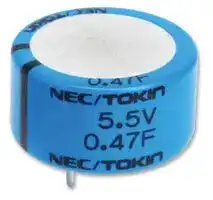


FYH0H223ZF
Supercapacitor, 22000 µF, 5.5 V, Radial Leaded, -20%, +80%, 5.08 mm, 1000 hours @ 70°C
- Manufacturer: KEMET
- Product type: EDLC - Electric Double Layer Capacitors
- ESR: 200ohm
- SVHC: No SVHC (04-Feb-2026)
- Capacitance: 22000µF
- Voltage(DC): 5.5V
- Lead Spacing: 5.08mm
- Product Range: FYH Series
- Product Width: -
- Qualification: -
- Product Height: 7mm
- Product Length: -
- Product Diameter: 11.5mm
- Capacitor Mounting: Through Hole
- Capacitor Terminals: Radial Leaded
- Capacitance Tolerance: -20%, +80%
- Lifetime @ Temperature: 1000 hours @ 70°C
- Capacitor Case / Package: Coin
- Operating Temperature Max: 70°C
- Operating Temperature Min: -25°C
| Delivery and price | |
|---|---|
| Units per pack | 1 |
| Price | 2.46 € |
| Current stock | 10+ |
| Lead time | 30 days |

**Supercapacitors**

FY Series

## Overview

## Applications

FY Series Supercapacitors, also known as Electric DoubleLayer Capacitors (EDLCs), are intended for high energy storage applications.

Supercapacitors have characteristics ranging from traditional capacitors and batteries. As a result, supercapacitors can be used like a secondary battery when applied in a DC circuit. These devices are best suited for use in low voltage DC hold-up applications such as embedded microprocessor systems with flash memory.

## Benefits

- Wide range of temperature from −25°C to +70°C

- Maintenance free

- Maximum operating voltage of 5.5 VDC

- Highly reliable against liquid leakage

- Lead-free and RoHS compliant

## Part Number System

|FY|0H|104|Z|F|
|---|---|---|---|---|
|Series|Maximum Operating Voltage|Capacitance Code|Capacitance<br>Tolerance|Environmental|
|FYD<br>FYH|0H = 5.5 VDC|First two digits represent<br>significant figures. Third digit<br>specifies number of zeros to<br>follow µF code.|Z = −20/+80%|F = Lead-free|


S6015_FY (2026-02-13)

1 | YAGEOGroup.com

**Supercapacitors** FY Series

## Dimensions – Millimeters

**==> picture [175 x 161] intentionally omitted <==**

**----- Start of picture text -----**<br>
ø D ± 0.5<br>Sleeve<br>-<br>○ +○<br>P ± 0.5<br>d1 ± 0.1<br>d2 ± 0.1<br>(Terminal)<br>ℓ Minimum<br>H Maximum (H ±0.5 for FYL)<br>0.3 Minimum<br>**----- End of picture text -----**<br>


**==> picture [272 x 26] intentionally omitted <==**

**----- Start of picture text -----**<br>
Part Number ø D H P ℓ d1 d2<br>**----- End of picture text -----**<br>


|Part Number|ø D|H|P|ℓ|d1|d2|
|---|---|---|---|---|---|---|
||||||||
|FYD0H223ZF|11.5|8.5|5.08|2.7|0.4|1.2|
|FYD0H473ZF|11.5|8.5|5.08|2.7|0.4|1.2|
|FYD0H104ZF|13.0|8.5|5.08|2.2|0.4|1.2|
|FYD0H224ZF|14.5|15.0|5.08|2.4|0.4|1.2|
|FYD0H474ZF|16.5|15.0|5.08|2.7|0.4|1.2|
|FYD0H105ZF|21.5|16.0|7.62|3.0|0.6|1.2|
|FYD0H145ZF|21.5|19.0|7.62|3.0|0.6|1.2|
|FYD0H225ZF|28.5|22.0|10.16|6.1|0.6|1.4|
|FYH0H223ZF|11.5|7.0|5.08|2.7|0.4|1.2|
|FYH0H473ZF|13.0|7.0|5.08|2.2|0.4|1.2|
|FYH0H104ZF|16.5|7.5|5.08|2.7|0.4|1.2|
|FYH0H224ZF|16.5|9.5|5.08|2.7|0.4|1.2|
|FYH0H474ZF|21.5|10.0|7.62|3.0|0.6|1.2|
|FYH0H105ZF|28.5|11.0|10.16|6.1|0.6|1.4|
|FYL0H103ZF|11.0|5.0|5.08|2.7|0.2|1.2|
|FYL0H223ZF|11.0|5.0|5.08|2.7|0.2|1.2|
|FYL0H473ZF|12.0|5.0|5.08|2.7|0.2|1.2|


S6015_FY (2026-02-13)

2 | YAGEOGroup.com

**Supercapacitors** FY Series

## Performance Characteristics

Supercapacitors should not be used for applications such as ripple absorption because of their high internal resistance (several hundred mΩ to a hundred Ω) compared to aluminum electrolytic capacitors. Thus, its main use would be similar to that of secondary battery such as power back-up in DC circuit. The following list shows the characteristics of supercapacitors as compared to aluminum electrolytic capacitors for power back-up and secondary batteries.

**==> picture [542 x 236] intentionally omitted <==**

**----- Start of picture text -----**<br>
Secondary Battery Capacitor<br>NiCd Lithium Ion Aluminum Electrolytic Supercapacitor<br>– – – –<br>Back-up ability<br>Eco-hazard Cd – – –<br>−40 to +85°C<br>Operating Temperature Range −20 to +60°C −20 to +50°C −55 to +105°C<br>(FR, FT, FMR Type)<br>Charge Time Few hours Few hours Few seconds Few seconds<br>Approximately  Approximately<br>Charge/Discharge Life Time Limitless (*1) Limitless (*1)<br>500 times 500 to 1,000 times<br>Restrictions on<br>Yes Yes None None<br>Charge/Discharge<br>Flow Soldering Not applicable Not applicable Applicable Applicable<br>Applicable<br>Automatic Mounting Not applicable Not applicable Applicable<br>(FM and FC series)<br>Leakage, combustion,<br>Safety Risks Leakage, explosion Heat-up, explosion Gas emission (*2)<br>explosion, ignition<br>**----- End of picture text -----**<br>


_(*1) Aluminum electrolytic capacitors and supercapacitors have limited lifetime. However, when used under proper conditions, both can operate within a predetermined lifetime._

_(*2) There is no harm as it is a mere leak of water vapor which transitioned from water contained in the electrolyte (diluted sulfuric acid). However, application of abnormal voltage surge exceeding maximum operating voltage may result in leakage and explosion._

## Typical Applications

**==> picture [542 x 83] intentionally omitted <==**

**----- Start of picture text -----**<br>
Intended Use (Guideline) Power Supply (Guideline) Application Examples of Equipment Series<br>Embedded memory  DVD player, television,<br>backup game console, set-top box<br>Long time back-up 500 μA and below FY series<br>DVD player, printer,<br>Motor driver<br>projector, camera<br>**----- End of picture text -----**<br>


S6015_FY (2026-02-13)

3 | YAGEOGroup.com

**Supercapacitors** FY Series

## Environmental Compliance

All KEMET supercapacitors are RoHS compliant.

**==> picture [72 x 66] intentionally omitted <==**

## Table 1 – Ratings & Part Number Reference

**==> picture [543 x 250] intentionally omitted <==**

**----- Start of picture text -----**<br>
Maximum  Nominal Capacitance Maximum  Voltage Holding<br>Maximum ESR<br>Part Number Operating  Current at 30  Characteristic  Weight (g)<br>Charge  Discharge  at 1 kHz (Ω)<br>Voltage (VDC) Minutes (mA) Minimum (V)<br>System (F) System (F)<br>FYL0H103ZF 5.5 0.01 0.013 300 0.015 4.2 0.9<br>FYL0H223ZF 5.5 0.022 0.028 200 0.033 4.2 1.0<br>FYH0H223ZF 5.5 0.022 0.033 200 0.033 4.2 1.5<br>FYD0H223ZF 5.5 0.022 0.033 220 0.033 4.2 1.6<br>FYH0H473ZF 5.5 0.047 0.075 100 0.071 4.2 2.2<br>FYL0H473ZF 5.5 0.047 0.061 200 0.071 4.2 1.2<br>FYD0H473ZF 5.5 0.047 0.070 220 0.071 4.2 1.7<br>FYH0H104ZF 5.5 0.10 0.16 50 0.15 4.2 3.4<br>FYD0H104ZF 5.5 0.10 0.14 100 0.15 4.2 2.4<br>FYH0H224ZF 5.5 0.22 0.30 60 0.33 4.2 3.6<br>FYD0H224ZF 5.5 0.22 0.35 120 0.33 4.2 4.3<br>FYH0H474ZF 5.5 0.47 0.70 35 0.71 4.2 7.2<br>FYD0H474ZF 5.5 0.47 0.75 65 0.71 4.2 6.0<br>FYH0H105ZF 5.5 1.0 1.5 20 1.5 4.2 13.9<br>FYD0H105ZF 5.5 1.0 1.6 35 1.5 4.2 11.0<br>FYD0H145ZF 5.5 1.4 2.1 45 2.1 4.2 12.0<br>FYD0H225ZF 5.5 2.2 3.3 35 3.3 4.2 22.9<br>**----- End of picture text -----**<br>


_Part numbers in bold type represent popularly purchased components._

S6015_FY (2026-02-13)

4 | YAGEOGroup.com

**Supercapacitors** FY Series

## Specifications

**==> picture [543 x 45] intentionally omitted <==**

**----- Start of picture text -----**<br>
Test Conditions<br>Item FY Type (FYD, FYH)<br>(conforming to JIS C 5160-1)<br>**----- End of picture text -----**<br>


|Item|Item|FY Type (FYD, FYH)|FY Type (FYD, FYH)|Test Conditions<br>(conforming to JIS C 5160-1)|
|---|---|---|---|---|
||||||
|Category Temperature Range||−25°C to +70°C|||
|Maximum Operating Voltage||5.5 VDC|||
|Capacitance||Refer to Table 1||Refer to “Measurement Conditions”|
|Capacitance Allowance||+80%, −20%||Refer to “Measurement Conditions”|
|ESR||Refer to Table 1||Measured at 1 kHz, 10 mA; See also<br>“Measurement Conditions”|
|Current(30 minutes value)||Refer to Table 1||Refer to “Measurement Conditions”|
|Surge|Capacitance|> 90% of initial ratings||Surge voltage:<br>Charge:<br>Discharge:<br>Number of cycles:<br>Series resistance:<br>Discharge<br>resistance:<br>Temperature:<br>6.3 V<br>30 seconds<br>9 minutes 30 seconds<br>1,000<br>0.010 F               1,500 Ω<br>0.022 F<br>560 Ω<br>0.047 F<br>300 Ω<br>0.068 F<br>240 Ω<br>0.10 F<br>150 Ω<br>0.22 F<br>56 Ω<br>0.47 F<br>30 Ω<br>1.0 F, 1.4 F<br>15 Ω<br>2.2 F<br>10 Ω<br>0 Ω<br>70 ±2°C|
||ESR|≤ 120% of initial ratings|||
||Current (30 minutes value)|≤ 120% of initial ratings|||
||Appearance|No obvious abnormality|||
|Characteristics in<br>Different Temperature|Capacitance|Phase 2|≥ 50% of initial value|Conforms to 4.17<br>Phase 1:<br>Phase 2:<br>Phase 4:<br>Phase 5:<br>Phase 6:<br>+25 ±2°C<br>−25 ±2°C<br>+25 ±2°C<br>+70 ±2°C<br>+25 ±2°C|
||ESR||≤ 400% of initial value||
||Capacitance|Phase 3|||
||ESR||||
||Capacitance|Phase 5|≤ 200% of initial value||
||ESR||Satisfy initial ratings||
||Current(30 minutes value)||≤ 1.5 CV(mA)||
||Capacitance|Phase 6|Within ±20% of initial value||
||ESR||Satisfy initial ratings||
||Current(30 minutes value)||Satisfy initial ratings||
|Lead Strength(tensile)||No terminal damage||Conforms to 4.9|
|Vibration Resistance|Capacitance|Satisfy initial ratings||Conforms to 4.13<br>Frequency:<br>Testing Time:<br>10 to 55 Hz<br>6 hours|
||ESR||||
||Current(30 minutes value)||||
||Appearance|No obvious abnormality|||
|Solderability||Over 3/4 of the terminal should be covered by the new<br>solder||Conforms to 4.11<br>Solder temp:<br>Dipping time:<br>+245 ±5°C<br>5 ±0.5 seconds<br>1.6 mm from the bottom should be dipped.|
|Solder Heat Resistance|Capacitance|Satisfy initial ratings||Conforms to 4.10<br>Solder temp:<br>Dipping time:<br>+260 ±10°C<br>10 ±1 seconds<br>1.6 mm from the bottom should be dipped.|
||ESR||||
||Current(30 minutes value)||||
||Appearance|No obvious abnormality|||


S6015_FY (2026-02-13)

5 | YAGEOGroup.com

**Supercapacitors** FY Series

## Specifications cont.

**==> picture [543 x 44] intentionally omitted <==**

**----- Start of picture text -----**<br>
Test Conditions<br>Item FY Type (FYD, FYH)<br>(conforming to JIS C 5160-1)<br>**----- End of picture text -----**<br>


|Item|Item|FY Type (FYD, FYH)|Test Conditions<br>(conforming to JIS C 5160-1)|
|---|---|---|---|
|||||
|Temperature Cycle|Capacitance|Satisfy initial ratings|Conforms to 4.12<br>Temperature<br>Condition:<br>Number of cycles:<br>−25°C» Room<br>temperature » +70°C»<br>Room temperature<br>5 cycles|
||ESR|||
||Current(30 minutes value)|||
||Appearance|No obvious abnormality||
|High Temperature and<br>High Humidity Resistance|Capacitance|Within ±20% of initial value|Conforms to 4.14<br>Temperature:<br>Relative humidity:<br>Testing time:<br>+40 ±2°C<br>90 to 95% RH<br>240 ±8 hours|
||ESR|≤ 120% of initial ratings||
||Current(30 minutes value)|≤ 120% of initial ratings||
||Appearance|No obvious abnormality||
|High Temperature Load|Capacitance|Within ±30% of initial value|Conforms to 4.15<br>Temperature:<br>Voltage applied:<br>Series protection<br>resistance:<br>Testing time:<br>+70 ±2°C<br>Maximum operating<br>voltage<br>0 Ω<br>1,000 +48 (+48/−0)<br>hours|
||ESR|< 200% of initial ratings||
||Current (30 minutes value)|< 200% of initial ratings||
||Appearance|No obvious abnormality||
|Self Discharge Characteristics<br>(Voltage Holding Characteristics)||Voltage between terminal leads > 4.2 V|Charging condition<br>Voltage applied:<br>Series resistance:<br>Charging time:<br>5.0 VDC (Terminal at<br>the case side must be<br>negative)<br>0 Ω<br>24 hours|
||||Storage<br>Let stand for 24 hours in condition described<br>below with terminals opened.<br>Ambient<br>temperature:<br>Relative humidity:<br>< 25°C<br>< 70% RH|


S6015_FY (2026-02-13)

6 | YAGEOGroup.com

**Supercapacitors** FY Series

## Marking

**==> picture [306 x 101] intentionally omitted <==**

**----- Start of picture text -----**<br>
Date A1 Supercapacitor Supercapacitor Maximum<br>Code Operating Voltage<br>001 FYD 5.5 V FYD 5.5 V<br>Serial 0.047 F 0.047 F Nominal<br>Number Capacitance<br>A1 Supercapacitor Supercapacitor<br>Negative Polarity<br>Identification Mark<br>**----- End of picture text -----**<br>


## Packaging Quantities

**==> picture [272 x 255] intentionally omitted <==**

**----- Start of picture text -----**<br>
Part Number Bulk Quantity per Box<br>FYD0H223ZF 1,000 pieces<br>FYD0H473ZF 1,000 pieces<br>FYD0H104ZF 800 pieces<br>FYD0H224ZF 400 pieces<br>FYD0H474ZF 240 pieces<br>FYD0H105ZF 90 pieces<br>FYD0H145ZF 90 pieces<br>FYD0H225ZF 50 pieces<br>FYH0H223ZF 1,600 pieces<br>FYH0H473ZF 800 pieces<br>FYH0H104ZF 600 pieces<br>FYH0H224ZF 500 pieces<br>FYH0H474ZF 90 pieces<br>FYH0H105ZF 50 pieces<br>FYL0H103ZF 2,000 pieces<br>FYL0H223ZF 2,000 pieces<br>FYL0H473ZF 1,600 pieces<br>**----- End of picture text -----**<br>


S6015_FY (2026-02-13)

7 | YAGEOGroup.com

**Supercapacitors** FY Series

## Measurement Conditions

## Capacitance (Charge System)

Capacitance is calculated from expression (9) by measuring the charge time constant (τ) of the capacitor (C). Prior to measurement, the capacitor is discharged by shorting both pins of the device for at least 30 minutes. In addition, use the polarity indicator on the device to determine correct orientation of capacitor for charging.

**==> picture [174 x 113] intentionally omitted <==**

**----- Start of picture text -----**<br>
Capacitance:  τ<br>(F) (9)<br>C = Rc<br>Switch<br>Rc<br>+<br>Eo C Vc<br>–<br>**----- End of picture text -----**<br>


Eo: 3.0 (V) Product with maximum operating voltage of 3.5 V 5.0 (V) Product with maximum operating voltage of 5.5 V 6.0 (V) Product with maximum operating voltage of 6.5 V 10.0 (V) Product with maximum operating voltage of 11 V 12.0 (V) Product with maximum operating voltage of 12 V τ: Time from start of charging until Vc becomes 0.632 Eo (V) (seconds) Rc: See table below (Ω).

Charge Resistor Selection Guide

**==> picture [543 x 335] intentionally omitted <==**

**----- Start of picture text -----**<br>
FY FM, FME FG, FC, FCS,<br>Cap FA FE FS FR FMC FGH FT<br>FYD FYH FMR FGR FCR<br>0.010 F – – – – – – 5,000 Ω  – 5,000 Ω – – –<br>0.022 F 1,000 Ω – 1,000 Ω 2,000 Ω 2,000 Ω 2,000 Ω 2,000 Ω – 2,000 Ω – – Discharge<br>0.033 F – – – – – – Discharge – – – – –<br>0.047 F 1,000 Ω 1,000 Ω 1,000 Ω 2,000 Ω 1,000 Ω 1,000 Ω 2000 Ω 1,000 Ω 2,000 Ω – – –<br>0.10 F 510 Ω 510 Ω 510 Ω 1,000 Ω 510 Ω 1,000 Ω 1000 Ω 1,000 Ω 1,000 Ω Discharge 510 Ω Discharge<br>0.22 F 200 Ω 200 Ω 200 Ω 510 Ω 510 Ω 510 Ω 0H: Discharge – 1,000 Ω Discharge 200 Ω Discharge<br>0V: 1000 Ω<br>0.33 F – – – – – – – Discharge – – – –<br>0.47 F 100 Ω 100 Ω 100 Ω 200 Ω 200 Ω 200 Ω – – 1,000 Ω Discharge 100 Ω Discharge<br>1.0 F 51 Ω 51 Ω 100 Ω 100 Ω 100 Ω 100 Ω – – 510 Ω Discharge 100 Ω Discharge<br>1.4 F – – – 200 Ω – – – – – – – –<br>1.5 F – 51 Ω – – – – – – 510 Ω – – –<br>2.2 F – – – 100 Ω – – – – 200 Ω – 51 Ω –<br>2.7 F – – – – – – – – – – – –<br>3.3 F – – – – – – – – – – 51 Ω –<br>4.7 F – – – – – – – – 100 Ω – – –<br>5.0 F – – 100 Ω – – – – – – – – –<br>5.6 F – – – – – – – – – –  20 Ω –<br>10.0 F – – – – – – – – – – – –<br>22.0 F – – – – – – – – – – – –<br>50.0 F – – – – – – – – – – – –<br>100.0 F – – – – – – – – – – – –<br>200.0 F – – – – – – – – – – – –<br>**----- End of picture text -----**<br>


_*Capacitance values according to the constant current discharge method._

S6015_FY (2026-02-13)

8 | YAGEOGroup.com

**Supercapacitors** FY Series

## Measurement Conditions cont.

## Capacitance (Discharge System)

As shown in the diagram below, charging is performed for a duration of 30 minutes once the voltage of the capacitor terminal reaches 5.5 V. Then, use a constant current load device and measure the time for the terminal voltage to drop from 3.0 to 2.5 V upon discharge at 0.22 mA per 0.22 F, for example, and calculate the static capacitance according to the equation shown below.

_Note: The current value is 1 mA discharged per 1 F._

**==> picture [425 x 75] intentionally omitted <==**

**----- Start of picture text -----**<br>
(V)<br>0.22 mA (I)<br>SW A 5.5 V V 1 : 3.0 V<br>C = I ×V(T 1- 2-V 2T 1)   (F) 5.5 V V C R VV 12 V 2 : 2.5 V<br>T 1 T 2 Time (seconds)<br>30 minutes<br>**----- End of picture text -----**<br>


## Capacitance (Discharge System, 3.5V, 3.6V)

As shown in the diagram below, charging is performed for a duration of 30 minutes once the voltage of the capacitor terminal reaches 3.5 V (3.6V). Then, use a constant current load device and measure the time for the terminal voltage to drop from 1.8 to 1.5 V upon discharge at 1.0 mA per 1.0F, for example, and calculate the static capacitance according to the equation shown below.

**==> picture [425 x 75] intentionally omitted <==**

**----- Start of picture text -----**<br>
(V)<br>SW 3.5 V<br>A (3.6 V) V 1 : 1.8 V<br>I × (T 2-T 1) 3.5 V VV 12 V 2 : 1.5 V<br>C = V 1-V 2   (F) (3.6 V) V C R<br>T 1 T 2 Time (seconds)<br>30 minutes<br>**----- End of picture text -----**<br>


## Equivalent Series Resistance (ESR)

ESR shall be calculated from the equation below.

**==> picture [285 x 71] intentionally omitted <==**

**----- Start of picture text -----**<br>
10mA<br>V C<br>ESR = ( Ω ) f:1kHz C V C<br>0.01<br>**----- End of picture text -----**<br>


S6015_FY (2026-02-13)

9 | YAGEOGroup.com

**Supercapacitors** FY Series

## Measurement Conditions cont.

## Current (at 30 minutes after charging)

In the following circuit, measure the voltage VR at both ends of the series resistor Rc after 30 minutes of applying a voltage to the capacitor C, and calculated from the following formula. (The voltage is applied at least 30 minutes later by shortcircuiting between the capacitor terminals).

Eo: 3.0 VDC (3.5 V type) 3.6 VDC (3.6 V type) 5.0 VDC (5.5 V type) 6.0 VDC (6.5 V type) 10.0 VDC (11 V type) 12.0 VDC (12 V type)

Rc: 1,000 Ω (0.01 F, 0.022 F, 0.047 F) 100 Ω (0.10 F, 0.22 F, 0.33 F, 0.47 F) 10 Ω (1.0 F, 1.4 F, 1.5 F, 2.2 F, 3.3 F, 4.7 F, 5.6 F) However, FS Seres 11 V type and 12 V type 100 Ω 0.47 F, 1.0 F 10 Ω 5.0 F

**==> picture [266 x 63] intentionally omitted <==**

**----- Start of picture text -----**<br>
V R SW<br>Current = RV C R  (A) E O R C C+<br>-<br>**----- End of picture text -----**<br>


## Self-Discharge Characteristic (0H – 5.5 V Products)

The self-discharge characteristic is measured by charging a voltage of 5.0 VDC (charge protection resistance: 0 Ω) according to the capacitor polarity for 24 hours, then releasing between the pins for 24 hours and measuring the pin-topin voltage. The test should be carried out in an environment with an ambient temperature of 25° C or below and relative humidity of 70% RH or below. The soldering is checked.

## 4. Dismantling

There is a small amount of electrolyte stored within the capacitor. Do not attempt to dismantle as direct skin contact with the electrolyte will cause burning. This product should be treated as industrial waste and not is not to be disposed of by fi re.

S6015_FY (2026-02-13)

10 | YAGEOGroup.com

**Supercapacitors**

FY Series

## Notes on Using Supercapacitors or Electric Double-Layer Capacitors (EDLCs)

## 1. Circuitry Design

## 1.1 Useful life

The FC Series Supercapacitor (EDLC) uses an electrolyte in a sealed container. Water in the electrolyte can evaporate while in use over long periods of time at high temperatures, thus reducing electrostatic capacity which in turn will create greater internal resistance. The characteristics of the supercapacitor can vary greatly depending on the environment in which it is used. Basic breakdown mode is an open mode due to increased internal resistance.

## 1.2 Fail rate in the field

Based on field data, the fail rate is calculated at approximately 0.006 Fit. We estimate that unreported failures are ten times this amount. Therefore, we assume that the fail rate is below 0.06 Fit.

## 1.3 Exceeding maximum usable voltage

Performance may be compromised and in some cases leakage or damage may occur if applied voltage exceeds maximum working voltage.

## 1.4 Use of capacitor as a smoothing capacitor (ripple absorption)

As supercapacitors contain a high level of internal resistance, they are not recommended for use as smoothing capacitors in electrical circuits. Performance may be compromised and, in some cases, leakage or damage may occur if a supercapacitor is used in ripple absorption.

## 1.5 Series connections

As applied voltage balance to each supercapacitor is lost when used in series connection, excess voltage may be applied to some supercapacitors, which will not only negatively affect its performance but may also cause leakage and/or damage. Allow ample margin for maximum voltage or attach a circuit for applying equal voltage to each supercapacitor (partial pressure resistor/voltage divider) when using supercapacitors in series connection. Also, arrange supercapacitors so that the temperature between each capacitor will not vary.

## 1.6 Case Polarity

The supercapacitor is manufactured so that the terminal on the outer case is negative (-). Align the (-) symbol during use. Even though discharging has been carried out prior to shipping, any residual electrical charge may negatively affect other parts.

## 1.7 Use next to heat emitters

Useful life of the supercapacitor will be significantly affected if used near heat emitting items (coils, power transistors and posistors, etc.) where the supercapacitor itself may become heated.

## 1.8 Usage environment

This device cannot be used in any acidic, alkaline or similar type of environment.

S6015_FY (2026-02-13)

11 | YAGEOGroup.com

**Supercapacitors**

FY Series

## Notes on Using Supercapacitors or Electric Double-Layer Capacitors (EDLCs) cont.

## 2. Mounting

## 2.1 Mounting onto a reflow furnace

Except for the FC series, it is not possible to mount this capacitor onto an IR / VPS reflow furnace. Do not immerse the capacitor into a soldering dip tank.

## 2.2 Flow soldering conditions

Keep solder under 260°C and soldering time to within 10 seconds when using the flow automatic soldering method. (Except for the FC and HV series)

## 2.3 Installation using a soldering iron

Care must be taken to prevent the soldering iron from touching other parts when soldering. Keep the tip of the soldering iron under 400°C and soldering time to within 3 seconds. Always make sure that the temperature of the tip is controlled. Internal capacitor resistance is likely to increase if the terminals are overheated.

## 2.4 Lead terminal processing

Do not attempt to bend or polish the capacitor terminals with sand paper, etc. Soldering may not be possible if the metallic plating is removed from the top of the terminals.

## 2.5 Cleaning, Coating, and Potting

Except for the FM series, cleaning, coating and potting must not be carried out. Consult KEMET if this type of procedure is necessary. Terminals should be dried at less than the maximum operating temperature after cleaning.

## 3. Storage

## 3.1 Temperature and humidity

Make sure that the supercapacitor is stored according to the following conditions: Temperature: 5 – 35°C (Standard 25°C), Humidity: 20 – 70% (Standard: 50%). Do not allow the build up of condensation through sudden temperature change.

## 3.2 Environment conditions

Make sure there are no corrosive gasses such as sulfur dioxide, as penetration of the lead terminals is possible. Always store this item in an area with low dust and dirt levels. Make sure that the packaging will not be deformed through heavy loading, movement and/or knocks. Keep out of direct sunlight and away from radiation, static electricity and magnetic fields.

## 3.3 Maximum storage period

This item may be stored up to one year from the date of delivery if stored at the conditions stated above.

This product should be safe to use even after being stored for over a 1 year period. However, depending on the storage conditions, we recommend that the soldering is checked.

## Dismantling

There is a small amount of electrolyte stored within the capacitor. Do not attempt to dismantle as direct skin contact with the electrolyte will cause burning. This product should be treated as industrial waste and not is not to be disposed of by fire.

S6015_FY (2026-02-13)

12 | YAGEOGroup.com

**Supercapacitors** FY Series

##

## Disclaimer

YAGEO Corporation and its affi  liates do not recommend the use of commercial or automotive grade products for high reliability applications or manned space fl ight.

All product specifi cations, statements, information and data (collectively, the “Information”) in this datasheet are subject to change. The customer is responsible for checking and verifying the extent to which the Information contained in this publication is applicable to an order at the time the order is placed. All Information given herein is believed to be accurate and reliable, but it is presented without guarantee, warranty, or responsibility of any kind, expressed or implied.

Statements of suitability for certain applications are based on KEMET Electronics Corporation’s (“KEMET”) knowledge of typical operating conditions for such applications, but are not intended to constitute – and KEMET specifi cally disclaims – any warranty concerning suitability for a specifi c customer application or use. The Information is intended for use only by customers who have the requisite experience and capability to determine the correct products for their application. Any technical advice inferred from this Information or otherwise provided by KEMET with reference to the use of KEMET’s products is given gratis, and KEMET assumes no obligation or liability for the advice given or results obtained.

Although KEMET designs and manufactures its products to the most stringent quality and safety standards, given the current state of the art, isolated component failures may still occur. Accordingly, customer applications which require a high degree of reliability or safety should employ suitable designs or other safeguards (such as installation of protective circuitry or redundancies) in order to ensure that the failure of an electrical component does not result in a risk of personal injury or property damage.

Although all product–related warnings, cautions and notes must be observed, the customer should not assume that all safety measures are indicated or that other measures may not be required.

When providing KEMET products and technologies contained herein to other countries,  the customer must abide by the procedures and provisions stipulated in all applicable export laws and regulations, including without limitation the International Traffi  c in Arms Regulations (ITAR), the US Export Administration Regulations (EAR) and the Japan Foreign Exchange and Foreign Trade Act.

_KEMET is a registered trademark of KEMET Electronics Corporation._

S6015_FY (2026-02-13)

13 | YAGEOGroup.com
Updated at April 29, 2026
With over a century of technological innovation, Kemet is a premier global supplier of electronic components, renowned for providing the industry's broadest selection of capacitor technologies. Their high-reliability solutions are trusted in the world's most demanding applications, ranging from spacecraft and life-saving medical devices to everyday consumer electronics and rapidly expanding industrial sectors. Our extensive Kemet portfolio is heavily focused on their industry-leading passive components, particularly their comprehensive range of capacitors. We offer thousands of options to suit diverse design requirements, including high-performance film capacitors, robust aluminium electrolytic capacitors, and advanced polymer capacitors. For specialised applications, a wide selection of RF capacitors and high-capacitance supercapacitors is also available. Beyond capacitors, Kemet excels in electromagnetic compatibility (EMC) and power management solutions. Our selection features a vast array of common mode chokes, power line filters, and shielding materials designed to ensure signal integrity and regulatory compliance. Additionally, we carry a strong lineup of Kemet power and toroidal inductors, alongside circuit protection devices such as TVS varistors, signal relays, and precision sensors, providing a versatile foundation for modern electronic design.
About Novapart
Novapart is a B2B electronic component broker specialising in stock shortages and cost reduction. We source hard-to-find parts and identify compliant alternatives across a catalogue of 410,000+ components from 500+ manufacturers.
Learn more →Stock Shortage Specialist
When a component is unavailable, discontinued or has an unacceptable lead time, we tap into our network of vetted European and Asian distributors to source what you need — without compromising on quality or traceability.
Request a quote →Compliant Alternatives
We identify pin-to-pin, electrically equivalent substitutes that meet the same certifications (RoHS, AEC-Q100, REACH) as your original specification — validated against datasheets, not just part numbers. Often at a lower cost.
BOM Analysis service →