
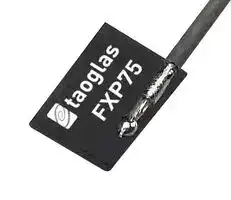
Image not available
Illustrative purposes only

FXP75.07.0045B
PCB Antenna, 2.4GHz to 2.5GHz, 2 VSWR, 2.5dBi Gain, 50ohm, Linear Polarisation, Adhesive
⚠️ Reference pricing provided. In case of supply shortages, we will connect you with our trusted procurement partners to ensure your project's continuity.
- Manufacturer: TAOGLAS
- Product type:
- Antenna Type:PCB; Frequency Min:2.4GHz; Frequency Max:2.5GHz; Antenna Mounting:Adhesive; Gain:2.5dBi; VSWR:2; Input Power:2W; Input Impedance:50ohm; Antenna Polarisation:Linear; Product R
- Gain: 2.5dBi
- SVHC: To Be Advised
- VSWR: 2
- Input Power: 2W
- Antenna Type: PCB
- Frequency Max: 2.5GHz
- Frequency Min: 2.4GHz
- Product Range: Atom 2.4GHz
- Input Impedance: 50ohm
- Antenna Mounting: Adhesive
- Antenna Polarisation: Linear
| Delivery and price | |
|---|---|
| Units per pack | 250 |
| Price | 2.91 € |
| Current stock | 200+ |
| Lead time | 30 days |
Datasheet

## **SPECIFICATION Patent Pending**

Part No. : **FXP75.07.0045B** Product Name : FXP.75 Atom 2.4GHz Series Ultra-Miniaturized 2dBi Bluetooth Antenna

Features : Patent Pending Worldwide smallest cabled 2.4GHz antenna Ideal for Bluetooth earphones Flexible Ultra Low Profile 5.9*4.1*0.24mm Adheres directly to inside of product housing

Form factor and cable routing convenient for integration

IPEX MHF1 Connector (U.FL compatible) 45mm  Ø 0.81mm mini-coaxial cable

## **RoHS Compliant**

SPE-13-8-067/C/EZ      Page 1 of 11

## **1. Introduction**

The FXP75 Atom is a super small monopole ultra-low profile antenna for 2.4GHz band that includes Bluetooth, Wi-Fi, ZigBee and ISM bands application. The FXP75 has a peak gain of 2.5dBi at 2.4GHz and efficiencies of 45%.

This Taoglas patent pending antenna is unique in the market. Two years of constant research and development have created the world's smallest coax cabled true 2.4GHz antenna. Made from poly-flexible material, the antenna has a tiny form factor of 5.9*4.1*0.24mm and has double-sided 3M tape for easy “peel and stick” mounting.

The cable routes conveniently directly out of the bottom of the antenna, reducing the volume the antenna takes up in the device to an absolute minimum compared to other designs. The FXP75 is the ideal all-round antenna solution for fitting into narrow spaces and still maintaining high performance, for example in a Bluetooth earphone where metal and electrical noise degrades onboard SMT antenna performance. The FXP75 is small enough to be routed away from metal and electrical noise to deliver much improved range and reliable sound quality in Bluetooth earphones.

Many module manufacturers specify peak gain limits for any antennas that are to be connected to that module. Those peak gain limits are based on free-space conditions. In practice, the peak gain of an antenna tested in free-space can degrade by at least 1 or 2dBi when put inside a device. So ideally you should go for a slightly higher peak gain antenna than mentioned on the module specification to compensate for this effect, giving you better performance.

Upon testing of any of our antennas with your device and a selection of appropriate layout, integration technique, or cable, Taoglas can make sure any of our antennas’ peak gain will be below the peak gain limits. Taoglas can then issue a specification and/or report for the selected antenna in your device that will clearly show it complying with the peak gain limits, so you can be assured you are meeting regulatory requirements for that module.

For example, a module manufacturer may state that the antenna must have less than 2dBi peak gain, but you don’t need to select an embedded antenna that has a peak gain of less than 2dBi in free-space. This will give you a less optimized solution. It is better to go for a slightly higher free-space peak gain of 3dBi or more if available. Once that antenna gets integrated into your device, performance will degrade below this 2dBi peak gain due to the effects of GND plane, surrounding components, and device housing. If you want to be absolutely sure, contact Taoglas and we will test. Choosing a Taoglas antenna with a higher peak gain than what is specified by

SPE-13-8-067/C/EZ      Page 2 of 11

the module manufacturer and enlisting our help will ensure you are getting the best performance possible without exceeding the peak gain limits.

Due to the potential for detuning in a tiny device environment, Taoglas recommends that you contact us at our regional sales office for integration support and testing and optimization of the antenna in your device before going to production.

SPE-13-8-067/C/EZ      Page 3 of 11

## **2. Specification**

|**Antenna**<br>~~Cn~~<br>~~Co~~|**FXP75**<br>~~Cn~~<br>~~Co~~|
|---|---|
|**Standard**<br>Operation Frequency (MHz)<br>~~Lo~~|**2400-2500MHz**<br>2400-2500 MHz<br>~~Lo~~|
|Polarization|Linear|
|Impedance|50 Ohms|
|Max VSWR|2:1|
|Max Return Loss (dB)|<-10|
|Peak Gain (dBi)|2.5|
|Efficiency (%)|45|
|Average Gain (dB)|-3.4|
|Radiation Properties|Omni|
|Max Input Power|2W max|


* The FXP.75 antenna performance was measured on a 30x30 mm 2mm thick ABS plastic ground plane.

|Dimensions (mm)<br>~~ne~~|5.9*4.1*0.24mm<br>~~ne~~|
|---|---|
|Required Space (mm)|5.9*4.1*0.24mm|
|Material|Polymer|
|Cable|Ø0.81mm coaxial cable|
|Connector|IPEX MHF1|


||**ENVIRONMENTAL**|
|---|---|
|Operation Temperature|-40°C to 85°C|
|Storage Temperature|-40°C to 85°C|
|Relative Humidity|40% to 95%|
|RoHs Compliant|Yes|


SPE-13-8-067/C/EZ      Page 4 of 11

## **3. Antenna Characteristics**

## **3.1 Test set-up**

**==> picture [42 x 38] intentionally omitted <==**

**----- Start of picture text -----**<br>
Y<br>Z  X<br>**----- End of picture text -----**<br>


**Figure 1.** Impedance measurements (left side) and peak gain, efficiency and radiation pattern measurements (right side).

## **3.2 Return Loss**

**Figure 2.** Return loss of the FXP75 antenna from 2200 MHz to 2700 MHz.

SPE-13-8-067/C/EZ      Page 5 of 11

## **3.3 VSWR**

**Figure 3.** VSWR of the FXP75 antenna from 2200 MHz to 2700 MHz.

## **3.4 Efficiency**

**Figure 4.** Efficiency of the FXP75 antenna from 2300 MHz to 2700 MHz.

SPE-13-8-067/C/EZ      Page 6 of 11

## **3.5 Peak Gain**

**Figure 5.** Peak Gain of the FXP75 antenna from 2300 MHz to 2700 MHz.

## **3.6 Average Gain**

**Figure 6.** Average Gain of the FXP75 antenna from 2300 MHz to 2700 MHz.

SPE-13-8-067/C/EZ      Page 7 of 11

## **3.7 3D radiation patterns**

**Figure 7.** 3D Radiation Pattern at 2450 of the FXP75 Antenna.

## **3.8 2D radiation patterns**

SPE-13-8-067/C/EZ      Page 8 of 11

**Figure 8.** 2D Radiation Pattern

SPE-13-8-067/C/EZ      Page 9 of 11

## **4. Antenna Drawing**

**Figure 9.** Antenna drawing

SPE-13-8-067/C/EZ      Page 10 of 11

## **5. Packaging**

**Figure 10.** Package of the FXP75 Antenna.

SPE-13-8-067/C/EZ      Page 11 of 11
Updated at June 9, 2026
About Novapart
Novapart is a B2B electronic component broker specialising in stock shortages and cost reduction. We source hard-to-find parts and identify compliant alternatives across a catalogue of 410,000+ components from 500+ manufacturers.
Learn more →Stock Shortage Specialist
When a component is unavailable, discontinued or has an unacceptable lead time, we tap into our network of vetted European and Asian distributors to source what you need — without compromising on quality or traceability.
Request a quote →Compliant Alternatives
We identify pin-to-pin, electrically equivalent substitutes that meet the same certifications (RoHS, AEC-Q100, REACH) as your original specification — validated against datasheets, not just part numbers. Often at a lower cost.
BOM Analysis service →