
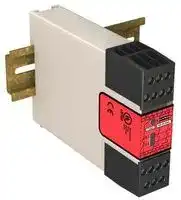


ES-FA-11AA.
RELAY, SAFETY, DPST-NO, 250V, 7A
- Manufacturer: BANNER ENGINEERING
- Product type: Safety Relays
- Coil Voltage:24VAC/VDC; Contact Configuration:DPST-NO; Product Range:ES Series; Relay Mounting:DIN Rail; Contact Current:7A; Relay Terminals:Screw; Contact Voltage AC 98H7885
- Product Range: ES Series
| Delivery and price | |
|---|---|
| Units per pack | 1 |
| Price | 229.42 € |
| Current stock | 10+ |
| Lead time | 30 days |

## **ES-FA-9AA and ES-FA-11AA E-Stop Safety Modules**

_With 3 normally open safety outputs or 2 normally open safety outputs and 1 normally closed auxiliary output_ Original Instructions

- Monitors emergency stop devices, such as palm buttons and rope/cable pulls, and positive-opening safety switches used for guard/gate interlocking

- The safety inputs can monitor:

   - A +24V dc source switched by hard/relay contacts in single-channel hookup, or

   - Hard/relay contacts in a dual-channel hookup using terminals S11-S12 and S21-S22

- The ES-FA-9AA has three normally open output switching channels for connection to control-reliable power interrupt circuits

- The ES-FA-11AA has two normally open output switching channels for connection to control-reliable power interrupt circuits and one normally closed auxiliary output channel

- Automatic reset or monitored manual reset

- Design complies with standards ANSI B11.19, UL991, ISO 13850 (EN418), and ISO 13849-1 (EN954-1) (Safety Category 4)

- For use in functional stop category 0 applications per ANSI NFPA 79 and IEC/ EN60204-1

- 6 or 7 amp safety output contacts, depending on model

- Plug-in terminal blocks

- 24V ac/dc operation

|**Models**|**Supply Voltage**|**Outputs**|**Output Contact Rating**|
|---|---|---|---|
|ES-FA-9AA|24V ac/dc|3 Normally Open (NO)|6 A|
|ES-FA-11AA||2 Normally Open and 1 Normally Closed (NC)|7 A|


## **WARNING: Not a Stand-Alone Safeguarding Device**

**This Banner device is not a stand-alone point-of-operation guarding device, as defined by OSHA regulations.** It is necessary to install point-of-operation guarding devices, such as safety light screens and/or hard guards, to protect personnel from hazardous machinery. **Failure to install point-of-operation guards on hazardous machinery can result in a dangerous condition which could lead to serious injury or death.**

## **Important: Read this First**

**The user is responsible for satisfying all local, state, and national laws,** rules, codes, and regulations relating to the use of this product and its application. Banner Engineering Corp. has made every effort to provide complete application, installation, operation, and maintenance instructions. Please direct any questions regarding the use or installation of this product to the factory applications department at the telephone numbers or address found at _http://www.bannerengineering.com_ .

**The user is responsible** for making sure that all machine operators, maintenance personnel, electricians, and supervisors are thoroughly familiar with and understand all instructions regarding the installation, maintenance, and use of this product, and with the machinery it controls. The user and any personnel involved with the installation and use of this product must be thoroughly familiar with all applicable standards, some of which are listed within the specifications. Banner Engineering Corp. makes no claim regarding a specific recommendation of any organization, the accuracy or effectiveness of any information provided, or the appropriateness of the provided information for a specific application.

## **Applicable U.S. Standards**

ANSI B11 Standards for Machine Tools Safety

Contact: Safety Director, AMT – The Association for Manufacturing Technology, 7901 Westpark Drive, McLean, VA 22102, Tel.: 703-893-2900

ANSI NFPA 79 Electrical Standard for Industrial Machinery

Contact: National Fire Protection Association, 1 Batterymarch Park, P.O. Box 9101, Quincy, MA 02269-9101, Tel.: 800-344-3555

P/N 060606 Rev. F 2/28/2013

0 060606 6

ES-FA-9AA and ES-FA-11AA E-Stop Safety Modules

ANSI/RIA R15.06 Safety Requirements for Industrial Robots and Robot Systems

Contact: Robotic Industries Association, 900 Victors Way, P.O. Box 3724, Ann Arbor, MI 48106, Tel.: 734-994-6088

## **Applicable International Standards**

ISO 12100-1 & -2 (EN 292-1 & -2) Safety of Machinery – Basic Concepts, General Principles for Design

ISO 13849-1 (EN 954-1) Safety-Related Parts of Control Systems

ISO 13850 (EN 418) Emergency Stop Devices, Functional Aspects – Principles for Design

IEC 60204-1 Electrical Equipment of Machines Part 1: General Requirements

Contact: Global Engineering Documents, 15 Inverness Way East, Englewood, CO 80112-5704, Tel.: 800-854- 7179

## **Certificate of Adequacy**

This Safety Module datasheet satisfies the requirements of Machinery Directive 2006/42/EC, Section 1.7.4 — instructions.

## **Overview**

An Emergency Stop Safety Module is used to increase the control reliability of an emergency stop circuit. As shown in the hookup drawings, the models ES-FA-9AA and ESFA-11AA E-Stop Safety Modules are designed to monitor a 1-channel or 2-channel E- stop switch. A 2-channel E-stop switch has two electrically isolated contacts.

## **WARNING: Safety Categories**

The level of safety circuit integrity can be greatly affected by the design and installation of the safety devices and the means of interfacing of those devices. **A risk assessment must be performed to determine the appropriate safety circuit integrity level or safety category as described by ISO 13849-1 (EN 954-1) to ensure the expected risk reduction is achieved and all relevant regulations and standards are complied with.**

**==> picture [80 x 5] intentionally omitted <==**

**----- Start of picture text -----**<br>
ES-FA-9AA ES-FA-11AA<br>**----- End of picture text -----**<br>


**==> picture [29 x 40] intentionally omitted <==**

**----- Start of picture text -----**<br>
Power ON LED<br>Channel 1<br>Active LED<br>Channel 2<br>Active LED<br>**----- End of picture text -----**<br>


**Figure 1. Features and Terminals**

## **Safety Circuit Integrity and ISO 13849-1 (EN954-1) Safety Circuit Principles**

Safety circuits involve the safety-related functions of a machine that minimize the level of risk of harm. These safety-related functions can prevent initiation, or stop or remove a hazard. A failure of a safety-related function or its associated safety circuit may result in an increased risk of harm.

The integrity of a safety circuit depends on several factors, including fault tolerance, risk reduction, reliable and well-tried components, well-tried safety principles, and other design considerations.

Depending on the level of risk associated with the machine or its operation, an appropriate level of safety circuit performance must be incorporated. _ANSI/RIA R15.06 Industrial Robots_ , _ANSI B11 Machine Tools_ , _OSHA 29CFR1910.217 Mechanical Power Presses,_ and _ISO 13849-1 (EN954-1) Safety-Related Parts of a Control System_ standards provide details of the safety performance levels.

## **Safety Circuit Integrity Levels**

Safety circuits in International and European standards have been segmented into categories, depending on their ability to maintain their integrity in the event of a failure. The most recognized standard that details safety circuit integrity levels is ISO 13849-1 (EN954-1), which establishes five levels: Categories B, 1, 2, 3, and the most stringent, Category 4.

In the United States, the typical level of safety circuit integrity has been called ”control reliability.” Control reliability typically incorporates redundant control and self-checking circuitry and has been loosely equated to ISO 13849-1 Categories 3 and 4 (see CSA Z432 and ANSI B11.TR4).

If the requirements described by ISO 13849-1 (EN954-1) are to be implemented, a risk assessment must first be performed to determine the appropriate category, in order to ensure that the expected risk reduction is achieved. This risk assessment must also take into account national regulations, such as U.S. control reliability or European “C” level standards, to ensure that the minimum level of performance that has been mandated is complied with.

P/N 060606 Rev. F

2

www.bannerengineering.com - tel: 763-544-3164

ES-FA-9AA and ES-FA-11AA E-Stop Safety Modules

## **Fault Exclusion**

An important concept within the category requirements of ISO 13849-1 is the probability of the occurrence of the failure, which can be decreased using the "fault exclusion" method. This method assumes that the possibility of certain well-defined failure(s) can be reduced to a point where the resulting fault(s) can be disregarded.

**Fault exclusion** is a tool a designer can use during the development of the safety-related part of the control system and the risk assessment process. It allows the designer to eliminate the possibility of various failures and justify it through the risk assessment process to meet the requirements of Categories 2, 3 or 4. See ISO 13849-1/-2 for further information.

## **Monitoring of Safety Devices**

Requirements vary widely for the level of control reliability or safety category per ISO 13849-1 (EN954-1) in safety applications. While Banner Engineering always recommends the highest level of safety in any application, it is the responsibility of the user to safely install, operate and maintain each safety system and comply with all relevant laws and regulations.

Although only two applications are listed, the Module can monitor a variety of devices as long as the input requirements are complied with (see Electrical Installation and Specifications). The Safety Module does not have 500 ms simultaneity between inputs and thus cannot be used for monitoring a two-hand control. In all cases, the safety performance (integrity) must reduce the risk from identified hazards as determined by the machine's risk assessment .

## **WARNING: Emergency Stop Functions**

**Do not mute or bypass any Emergency Stop device.** ANSI B11.19, ANSI NFPA79 and IEC/EN 60204-1 require that **the Emergency Stop function remain active at all times.**

## **Emergency Stop Push Buttons and Rope/Cable Pull Switches**

The safety inputs can be interfaced with positive-opening switches to monitor an emergency-stop (E-stop) push button or rope/cable pull. The switch must provide one or two contacts for safety which are closed when the switch is armed. Once activated, the E-stop switch must open all its safety-rated contacts, and must require a deliberate action (such as twisting, pulling, or unlocking) to return to the closed-contact, armed position. The switch must be a "positive-opening" (or direct-opening) type, as described by IEC 60947-5-1.

Standards ANSI NFPA 79, IEC/EN 60204-1, and ISO 13850 specify additional emergency stop switch device requirements, including the following:

- Emergency-stop push buttons shall be located at each operator control station and at other operating stations where emergency shutdown is required.

- Stop and emergency-stop push buttons shall be continuously operable and readily accessible from all control and operating stations where located. Do not mute or bypass E-stop buttons or rope/cable pulls.

- Actuators of emergency-stop devices shall be colored red. The background immediately around the device actuator shall be colored yellow (where possible). The actuator of a push-button-operated device shall be of the palm or mushroom-head type.

- The emergency-stop actuator shall be a self-latching type.

## **For Rope/Cable Pull Installations Only:**

- The wire rope should be easily accessible and visible along its entire length. Markers or flags may be fixed on the rope to increase its visibility.

- Mounting points, including support points, must be rigid.

- The rope should be free of friction at all supports. Pulleys are recommended.

Some applications may have additional requirements; comply with all relevant regulations. See the device manufacturer installation instructions for complete information (such as ES-..A-5A p/n 122365, SSA-EB..-.. p/n 111880, or RP-RM83F.. p/n 141245 data sheets).

**WARNING: Emergency Stop Functions Do not mute or bypass any Emergency Stop device.** ANSI B11.19, ANSI NFPA79 and IEC/EN 60204-1 require that **the Emergency Stop function remain active at all times.** _‘*————

## **Interlocked Guards (Gates)**

The safety inputs can be interfaced with positive-opening safety switches to monitor the position of an interlock guard or gate. Each switch must provide electrically isolated contacts: at minimum, one normally closed (N.C.) contact from each individually mounted switch.

P/N 060606 Rev. F

www.bannerengineering.com - tel: 763-544-3164

3

ES-FA-9AA and ES-FA-11AA E-Stop Safety Modules

The contacts must be of "positive-opening" (direct-opening) design, as described by IEC 60947- 5-1, with one or more normally closed contacts rated for safety. In addition, the switches must be mounted in a "positive mode," to move/disengage the actuator from its home position and open the normally closed contact when the guard opens.

In higher levels of safety performance, the design of a dual-channel coded magnetic switch typically uses complementary switching, in which one channel is open and one channel is closed at all times. **The inputs of the Safety Module do not support complementary switching, and thus should not be used with coded magnetic safety switches.**

The design and installation of the interlocked guard and the safety switches should comply with ANSI B11.19, ISO14119, and other applicable standards. See the device manufacturer installation instructions for complete information (such as GM-FA-10J p/n 60998, SILS83/-LS100 p/n 59622, or SI-HG63 p/n 129465 datasheets).

## **Mechanical Installation**

The Safety Module must be installed inside an enclosure.

It is not designed for exposed wiring. It is the user’s responsibility to house the Safety Module in an enclosure with NEMA 3 (IEC IP54) rating, or better. The Safety Module mounts directly to standard 35 mm DIN rail.

**Heat Dissipation Considerations** . For reliable operation, ensure that the operating specifications are not exceeded. The enclosure must provide adequate heat dissipation, so that the air closely surrounding the Module does not exceed the maximum operating temperature stated in the Specifications. Methods to reduce heat build-up include venting, forced airflow (e.g., exhaust fans), adequate enclosure exterior surface area, and spacing between modules and other sources of heat.

## **Electrical Installation**

## **WARNING: Shock Hazard and Hazardous Energy**

**Always disconnect power from the safety system (for example, device, module, interfacing, etc.) and the machine being controlled before making any connections or replacing any component.**

Electrical installation and wiring must be made by Qualified Personnel and must comply with the relevant electrical standards and wiring codes, such as the NEC (National Electrical Code), ANSI NFPA79, or IEC 60204-1, and all applicable local standards and codes.

**Lockout/tagout procedures may be required.** Refer to OSHA 29CFR1910.147, ANSI Z244-1, ISO 14118, or the appropriate standard for controlling hazardous energy.

It is not possible to give exact wiring instructions for a Safety Module that interfaces to a multitude of machine control configurations. The following guidelines are general in nature.

The Safety Module has no delay function. Its output relay contacts open within **25 milliseconds** after a safety input opens. This classifies the Safety Module as a functional stop "Category 0" control, as defined by ANSI NFPA 79 and IEC/EN 60204-1.

The safety inputs can be connected to:

- A +24V dc source that is switched by a hard/relay contact in single-channel hookup configuration, or

- Hard/relay contacts in a dual-channel hookup configuration using terminals S11-S12 and S21-S22.

## **Safety Input Device Hookup Options**

The operation of all dual-channel hookup options is concurrent, meaning that input channel 1 and input channel 2 must be in the same state in both the STOP and RUN condition, but with no simultaneity (i.e. timing) requirement between the channels.

The **dual-channel hookup configuration** is able to detect certain failures and faults, such as short circuits, that could result in a loss of the safety function. Once such a failure or fault is detected, the Safety Module will turn OFF (open) its safety outputs until the problem is fixed. This circuit can meet ISO 13849-1 Category 2, 3, or 4 requirements, depending on the safety rating and the installation of the safety input device. This circuit can detect a short circuit between channels or to another source of power, at a minimum, when the device is actuated.

A single device with redundant outputs that can fail in such a manner to lose the safety function, such as a single safety interlocking switch, can typically meet only a Category 2. See below for means to eliminate or minimize the possibility of failures and faults that could result in the loss of the safety function(s).

The **single-channel hookup configuration** cannot detect short circuits to secondary sources of +24V dc or detect the loss of the switching function of the safety input device (i.e., it is not redundant) and thus this circuit typically can meet only ISO 13849-1 Category 2.

P/N 060606 Rev. F

www.bannerengineering.com - tel: 763-544-3164

4

ES-FA-9AA and ES-FA-11AA E-Stop Safety Modules

It is recommended that in all circumstances the installation of the Safety Module and its associated safety input devices are installed to eliminate or minimize the possibility of failures and faults that could result in the loss of the safety function(s). Methods to eliminate or minimize the possibility of these failures include, but are not limited to:

- Physically separating interconnecting control wires from each other and from secondary sources of power.

- Routing interconnecting control wires in separate conduit, runs, or channels.

- Locating all elements (modules, switches, and devices under control) within one control panel, adjacent to each other, and directly connected with short wires.

- Properly installing multi-conductor cabling and multiple wires through strain-relief fittings. (Over-tightening of a strain-relief can cause short circuits at that point.)

- Using positive-opening components as described by IEC 60947-5-1 that are installed and mounted in a positive mode.

- Periodically checking the functional integrity / safety function and training operators, maintenance personnel, and others associated with the operation of the machine to recognize and immediately correct such failures.

If you have any questions about your intended use, please contact a Banner applications engineer.

## **Connection of Multiple Switches**

**==> picture [462 x 135] intentionally omitted <==**

**----- Start of picture text -----**<br>
Connect the poles of multiple switches, such as e-stop switches, as shown<br>E-Stop E-Stop<br>in the figure at right. The switches are shown in the "armed" position with<br>both contacts closed. Multiple switches connected to one Safety Module<br>must be series connected (see figure at right and the warning, Multiple<br>Switching Devices).<br>S11 S21 S22 S12<br>LS4d<br>**----- End of picture text -----**<br>


**Figure 2. Series Connection of Multiple E-stop Switches**

## **WARNING: Multiple Switching Devices**

**Whenever two or more devices are connected to the same safety module (controller):**

- **Contacts of the corresponding pole of each switch must be connected together in series.** _**Never connect the contacts of multiple switches in parallel.**_ Such a parallel connection defeats the switch contact monitoring ability of the Module and creates an unsafe condition which could result in serious injury or death.

- **Each device must be individually actuated (engaged), then released (or re-armed) and the safety module reset.** This allows the module to check each switch and its wiring to detect faults.

- This check must be performed during the prescribed checkouts. **Failure to test each device individually in this manner could result in undetected faults and create an unsafe condition which could result in serious injury or death.**

P/N 060606 Rev. F

www.bannerengineering.com - tel: 763-544-3164

5

ES-FA-9AA and ES-FA-11AA E-Stop Safety Modules

## **Connection of Safety Switches**

The Safety Module may be used to monitor safety interlocking switches that determine the position of a guard or gate. To achieve Category 4 operation per ISO 13849-1 (EN 954-1), two positive-opening safety switches must operate concurrently when the guard or gate is opened.

The Safety Module verifies concurrent opening of two contacts – one from each safety switch. Reset of the Safety Module is not possible if one switch fails to open or if a short circuit between the safety interlocking switches occurs.

**==> picture [136 x 224] intentionally omitted <==**

**----- Start of picture text -----**<br>
Safety Gate or Guard with<br>end-of-travel stops and two<br>OPEN<br>individually mounted<br> a Safety Interlocking Switches<br>FTC SD<br>| 0<br>SI ToT TTT4<br>[CO<br>| O<br>SS<br>| [I]<br>|lf|I<br>|<br>‘) I [!] I<br>™~ ||T<br>I<br>‘S) | [I]<br>I<br>S11 S21 S22 S12<br>**----- End of picture text -----**<br>


## **Figure 3. Wiring using contacts from two safety switches**

## **Connection of Reset Switch**

The reset circuit switch can be any mechanical switch, such as a normally open momentary switch, or a two-position key switch. The reset switch must be capable of reliably switching 8 to 12V dc at 10 to 15 milliamps. As shown in the hookup drawings, the reset switch connects between Safety Module terminals S33 and S11.

The reset switch must be located outside of – and not be accessible from – the area of dangerous motion, and must be positioned so that any area of dangerous motion may be observed by the switch operator during the reset procedure. See warning below.

## **WARNING: Reset Switch Location**

**All reset switches must be accessible only from outside, and in full view of, the hazardous area. Reset switches must also be out of reach from within the safeguarded space, and must be protected against unauthorized or inadvertent operation** (for example, through the use of rings or guards). If any areas are not visible from the reset switch(es), additional means of safeguarding must be provided. **Failure to do so could result in serious bodily injury or death.**

## **Automatic Reset Mode**

The Safety Module may be configured (via hookup) for automatic reset. If no MSC contacts are monitored, install a jumper between terminals S33 and S34. The Safety Module will reset (and its outputs energize) as soon as the switch returns to its armed (closed-contact) position.

Automatic reset is useful for some automated processes. However, if automatic reset is used, it is necessary to provide a means of preventing resumption of hazardous machine motion, until an alternate reset procedure is performed. The alternate procedure must include a reset/restart switch, located outside the area of dangerous motion, which is positioned so that any area of dangerous motion may be observed by the switch operator during the reset procedure. See Warning below.

P/N 060606 Rev. F

6

www.bannerengineering.com - tel: 763-544-3164

ES-FA-9AA and ES-FA-11AA E-Stop Safety Modules

## **WARNING: Reset Routine Required**

U.S. and international standards require that a reset routine be performed after clearing the cause of a stop condition (for example, arming an E-stop button, closing an interlocked guard, etc.). **Allowing the machine to restart without actuating the normal start command/device can create an unsafe condition which could result in serious injury or death.**

NOTE: The minimum time required for the Module to be in a STOP or OFF condition is 250 ms. This “recovery time” (OFF-state) is required for the internal circuitry of the Safety Module to normalize, allowing a reliable reset to occur. A lockout occurs if the Module is cycled too quickly. To clear the lockout, the Module must be recycled, meeting the minimum OFF time requirements.

## **Wiring**

**==> picture [494 x 521] intentionally omitted <==**

**----- Start of picture text -----**<br>
Auto Reset Manual Reset<br>+V dc common +V dc common<br>24V ac/dc 24V ac/dc<br>A1 A2 A1 A2<br>roo oy<br>E-Stop Reset<br>Switch<br>MSC1 MSC3 MSC1 MSC2 MSC3<br>S1 1 S33 MSC S33<br>Monitor<br>ES-FA-9AA Contacts ES-FA-9AA<br>S2 1 or  S11<br>S34 Jumper S34 (No Connection)<br>MSC2<br>S22 S21<br>See WARNING E-Stop<br>Below Switch<br>S12 S22<br>S12<br>Figure 4. Dual-Channel E-Stop Applications<br>Auto Reset Manual Reset<br>+V dc common +V dc common<br>24V ac/dc 24V ac/dc<br>E-Stop E-Stop<br>Switch Switch<br>A1 A2 A1 A2<br>S ort Se re<br>Reset<br>MSC1 MSC3 MSC1 MSC2 MSC3<br>S11 S33 MSC S33<br>Monitor<br>ES-FA-9AA Contacts ES-FA-9AA<br>S21 or  S11<br>S34 Jumper S34 (No Connection)<br>MSC2<br>S22 S21<br>See Interfacing MSCs<br>S12 Warning S22<br>S12<br>ibd<br>Figure 5. Single-Channel E-Stop Applications<br>Connection to the Machine to be Controlled<br>The machine hookup diagram shows a generic connection of the Safety Module's redundant output circuits to the master stop control<br>elements (MSCs). An MSC is defined as an electrically powered device, external to the Safety Module, which stops the machinery being<br>**----- End of picture text -----**<br>


P/N 060606 Rev. F

www.bannerengineering.com - tel: 763-544-3164

7

ES-FA-9AA and ES-FA-11AA E-Stop Safety Modules

controlled by immediately removing electrical power to the machine and (when necessary) by applying braking to dangerous motion. This stopping action is accomplished by removing power to the actuator of either MSC.

## **External Device Monitoring**

To satisfy the requirements of Control Reliability (OSHA and ANSI), Category 3 and 4 of ISO 13849-1 (EN 954-1), the master stop control elements (MSCs) must each offer a normally closed, forced-guided (mechanically linked) monitor contact. Connect one normally closed monitor contact from each master stop control element as shown in the single-channel wiring diagrams.

In operation, if one of the switching contacts of either MSC fails in the energized condition, the associated monitor contact will remain open. Therefore, it will not be possible to reset the Safety Module. If no MSC-monitor contacts are monitored, a jumper must be installed as shown in the wiring diagrams. It is the user's responsibility to ensure that any single failure will not result in a hazardous condition and will prevent a successive machine cycle.

## **Overvoltage Category II and III Installations (EN 50178 and IEC 60664-1)**

The Safety Module is rated for Overvoltage Category III when voltages of 1V to 150V ac/dc are applied to the output relay contacts. It is rated for Overvoltage Category II when voltages of 151V to 250V ac/dc are applied to the output relay contacts and no additional precautions are taken to attenuate possible overvoltage situations in the supply voltage. The Module can be used in an Overvoltage Category III environment (with voltages of 151V to 250V ac/dc) if care is taken either to reduce the level of electrical disturbances seen by the Module to Overvoltage Category II levels by installing surge suppressor devices (e.g., arc suppressors), or to install extra external insulation in order to isolate both the Safety Module and the user from the higher voltage levels of a Category III environment.

**For Overvoltage Category III installations with applied voltages from 151V to 250V ac/dc applied to the output contact(s):** the Safety Module may be used under the conditions of a higher overvoltage category where appropriate overvoltage reduction is provided. Appropriate methods include:

- An overvoltage protective device

- A transformer with isolated windings

- A distribution system with multiple branch circuits (capable of diverting energy of surges)

- A capacitance capable of absorbing energy of surges

- A resistance or similar damping device capable of dissipating the energy of surges

When switching inductive ac loads, it is good practice to protect the Safety Module outputs by installing appropriately-sized arc suppressors. However, if arc suppressors are used, they must be installed across the load being switched (e. g., across the coils of external safety relays), and never across the Safety Module’s output contacts (see WARNING, Arc Suppressors).

## **Auxiliary Monitor Contact (Model ES-FA-11AA Only)**

The action of the auxiliary monitor contact, terminals 31-32, inversely "follows" the action of the safety outputs. The 31-32 auxiliary monitor contact is to be used only for control functions that are NOT safety-related. A typical use is to communicate the status of the Safety Module output to a programmable logic controller (PLC).

**WARNING: Interfacing MSCs** NEVER wire an intermediate device(s) (for example, PLC, PES, PC) between the Safety Module outputs and the Master Stop Control Element it switches in such a manner that in the event of a failure there is a loss of the safety stop command, OR in such a manner that the safety function can be suspended, overridden, or defeated, unless accomplished with the same or greater degree of safety. Whenever forced-guided, mechanically linked relays are added as intermediate switching devices, a normally closed (N.C.) forced-guided monitor contact from each relay must be added to the series feedback loop between Safety Module terminals S31 and S32. ;SC **WARNING: Wiring of Arc Suppressors If arc suppressors are used, they MUST be installed as shown** across the actuator coil of the stop control elements (MSCs or MPCEs). **NEVER install suppressors directly across the output contacts of the Safety Device or Module.** It is possible for suppressors to fail as a short circuit. If installed directly across the output contacts, **a short-circuited suppressor will create an unsafe condition which could result in serious injury or death.** a www.bannerengineering.com - tel: 763-544-3164

P/N 060606 Rev. F

8

ES-FA-9AA and ES-FA-11AA E-Stop Safety Modules

**==> picture [426 x 189] intentionally omitted <==**

**----- Start of picture text -----**<br>
ES-FA-9AA ES-FA-11AA<br>Machine<br>Machine<br>Master Stop<br>Master Stop<br>Control Elements<br>L1 K1A6A max.K2A L2 L1 K1A7A max.K2A Control Elements L2<br>13 14 MSC1 13 14 MSC1<br>6A max. 7A max.<br>MachineControl 23 K1B K2B 24 MSC2 MachineControl 23 K1B K2B 24 MSC2<br>Circuits<br>Circuits<br>6A max.<br>K1C K2C 7A max. *Arc suppressors<br>33 34 MSC3 31 K1C 32   (see WARNING)<br>K2C<br>Feedback<br>(optional)<br>*Arc suppressors<br>O 01   (see WARNING) Tey<br>* *<br>* *<br>*<br>**----- End of picture text -----**<br>


**Figure 6. Machine Control Circuit Connections**

## **Initial Checkout Procedures**

## **CAUTION: Disconnect Power Prior to Checkout**

**Before performing the initial checkout procedure, make certain all power is disconnected from the machine to be controlled.**

Dangerous voltages may be present along the Safety Module wiring barriers whenever power to the machine control elements is ON. **Exercise extreme caution whenever machine control power is or may be present. Always disconnect power to the machine control elements before opening the enclosure housing of the Safety Module.**

1. Remove power from the machine control elements.

2. Ensure the safety device is in a STOP or "open-contact" state (e.g., actuate the E-stop switch to open its contacts).

3. Apply power to the Safety Module at terminals A1 and A2 (see wiring diagrams). Verify that only the Input Power indicator (see _Figure 1. Features and Terminals_ on page 2) is ON. If either input channel 1 (K1) or input channel 2 (K2) indicators are ON at this point, disconnect the input power and check all wiring. Return to step 2 after the cause of the problem has been corrected.

4. Reset or otherwise cause the safety device to reach an ON or "closed-contact" state (e.g., arm the E-stop switch to close its contacts).

Automatic reset: Ch1 (K1) and Ch2 (K2) indicators should come ON, and the safety output contacts should close.

Manual reset: From an open condition, close the reset switch for approximately ¼ second, and then re-open. The Ch1 (K1) and Ch2 (K2) indicators should both come ON steady at this time. If either indicator comes ON before the reset switch is opened, disconnect the input power and check all wiring. Return to step 2 after correcting the problem.

5. Cause the safety device to generate a STOP or "open-contact" state (e.g., actuate the E-stop switch to open its contacts). The Ch1 (K1) and Ch2 (K2) indicators should turn OFF simultaneously. If either indicator remains ON, disconnect the input power and check all wiring. Return to step 2 after the cause of the problem has been corrected.

6. If more than one safety device is series-connected to the Safety Module, run the above checkout procedure individually for EACH device.

7. Close and secure the enclosure in which the Safety Module is mounted. Apply power to the machine control elements and perform the Periodic Checkout Procedure.

P/N 060606 Rev. F

www.bannerengineering.com - tel: 763-544-3164

9

ES-FA-9AA and ES-FA-11AA E-Stop Safety Modules

**WARNING: Multiple Safety Devices When two or more safety devices are used, each device must be individually actuated, causing a STOP or open-contact condition, then reset/rearmed and the Safety Module reset** (if using manual reset mode). This allows the monitoring circuits to check each device and its wiring to detect faults. **Failure to test each device individually in this manner could result in undetected faults and create an unsafe condition which could result in serious injury or death.** a **Periodic Checkout Procedure** The functioning of the Safety Module and the device(s) connected to it must be verified on a regular periodic basis to ensure proper operation (see also the machine manufacturer’s recommendations).

1. With the machine running, cause the safety device to generate a STOP or "open-contact" state (e.g., actuate the E-stop switch to open its contacts). Verify that the machine stops.

2. Reset or otherwise cause the safety device to reach an ON or "closed-contact" state. Verify that the machine does not restart.

3. If using manual reset mode, close and then open the reset switch within 3 seconds. Verify that the machine can be restarted by normal initiation.

4. If more than one safety device is series-connected to the Safety Module, run the above checkout procedure individually for EACH device.

## **Repairs**

**Do not attempt any repairs to the Module. It contains no field-replaceable components.** Return it to the factory for warranty repair or replacement by contacting Banner Factory Application Engineering. They will attempt to troubleshoot the system from your description of the problem. If they conclude a component is defective, they will issue a return merchandise authorization (RMA) number for your paperwork and give you the proper shipping address.

**Pack the Module carefully. Damage that occurs in return shipping is not covered by warranty. CAUTION: Abuse of Module After Failure** If an internal fault has occurred and the Module will not reset, **do not tap, strike, or otherwise attempt to correct the fault by a physical impact to the housing.** An internal relay may have failed in such a manner that its replacement is required. **If the Module is not immediately replaced or repaired, multiple simultaneous failures may accumulate such that the safety function can not be guaranteed.** ; **Specifications Power General** ~~eee~~ **Supply Voltage and Current Indicators** 24V dc ±10% (SELV-rated supply according to EN IEC 3 green LED indicators: Power ON , K1 energized, K2 60950, NEC Class 2) energized 24V ac ±10% , 50/60Hz (NEC Class 2-rated transform- **Construction** er) Polycarbonate housing. Rated NEMA 1, IEC IP40; TerPower consumption: approx. 2W/2VA minals IP20 **Overvoltage Category Mounting** Output relay contact voltage of 1V to 150V ac/dc: cateMounts to standard 35 mm DIN rail track. Safety Modgory III ule must be installed inside an enclosure rated NEMA Output relay contact voltage of 151V to 250V ac/dc: 3 (IEC IP54), or better. category III, if appropriate overvoltage reduction is pro- **Vibration Resistance** vided, as described in _Overvoltage Category II and III_ 10 to 55Hz @ 0.35 mm displacement per IEC _Installations (EN 50178 and IEC 60664-1)_ on page 8. 60068-2-6

**Pollution Degree**

P/N 060606 Rev. F

10

www.bannerengineering.com - tel: 763-544-3164

ES-FA-9AA and ES-FA-11AA E-Stop Safety Modules

## **Power**

2

## **Supply Protection Circuitry**

Protected against transient voltages and reverse polarity

## **General**

## **Operating Conditions**

Temperature: 0° to +50°C (+32° to 122°F) Max. Relative Humidity: 90% @ +50°C (non-condensing)

## **Output Configuration**

## **Output Configuration**

ES-FA-9AA: 3 normally open (N.O.) output channels ES-FA-11AA: 2 normally open (N.O.) output channels and 1 normally closed (N.C.) auxiliary output

## **Contacts**

Each normally open output channel is a series connection of contacts from two forced-guided (mechanically linked) relays, K1-K2. The normally closed Aux. output channel of the ES-FA-11AA is a parallel connection of contacts from two forced-guided relays, K1K2.

AgNi, 5 μm gold-plated

**Low Current Rating** : The 5 μm gold-plated contacts allow the switching of low current/low voltage. In these low-power applications, multiple contacts can also be switched in series (e.g., “dry switching”). To preserve the gold plating on the contacts, do not exceed the following max. values at any time:

|||**Minimum**|**Maximum**|
|---|---|---|---|
|Voltage||1V ac/dc|60V|
|Current||5 mA ac/dc|300 mA|
|Power|5|mW (5 mVA)|7 W (7 VA)|


## **Mechanical life**

> 20,000,000 operations

**High Current Rating** : If higher loads must be switched through one or more of the contacts, the minimum and maximum values of the contact(s) changes to:

|||**Minimum**|**Maximum**|
|---|---|---|---|
||Voltage|15V ac/dc|250V ac/dc|
||Current|30 mA ac/dc|ES-FA-9AA: 6A|
||||ES-FA-11AA: 7A|
||Power|0.45 W (0.45 VA)|ES-FA-9AA: 200 W (1,500 VA)|
||||ES-FA-11AA: 200 W (1,750 VA)|


## **Output Response Time**

25 milliseconds typical

## **Electrical life (switching cycles of the output contacts, resistive load)**

150,000 cycles @ 1,500 VA; 1,000,000 cycles @ 450 VA; 2,000,000 cycles @ 250 VA; 5,000,000 cycles @ 125 VA

NOTE: Transient suppression is recommended when switching inductive loads. Install suppressors across load. Never install suppressors across output contacts (see Wiring of Arc Suppressors warning in _Auxiliary Monitor Contact (Model ES-FA-11AA Only)_ on page 8).

## **Input Requirements**

Safety input switch: Dual-Channel (contacts) hookup – 10 to 20 mA steady state @ 12V dc. NOTE: Inputs are designed with a brief contact-cleaning current of 100 mA when initially closed.

## **Design Standards**

Cat. 4 PL e per EN ISO 13849-1; SIL 3 per IEC 61508 and IEC 62061

## **Certifications**

Safety input switch: Single-Channel hookup – 40 to 100 mA @ 24V ac/dc +/- 10%; 50/60 Hz Reset switch: 20 mA @ 12V dc, hard contact only

## **Minimum OFF-State Recovery Time**

250 ms

P/N 060606 Rev. F

www.bannerengineering.com - tel: 763-544-3164

11

ES-FA-9AA and ES-FA-11AA E-Stop Safety Modules

## **Dimensions**

**==> picture [286 x 324] intentionally omitted <==**

**----- Start of picture text -----**<br>
22.5 mm<br>(0.89")<br>o- oo<br>—<br>118.0 mm<br>(4.65")<br>S21 S33 S11<br>A1 13Power 23 33<br>ES-FA-9AAMachineSafety 84.0 mm<br>= CH. 1 K1 (3.31")<br>0) CH. 2 K2<br>14 24 34 A2<br>S22 S34 S12<br>QOE<br>S21 S33 S11<br>A1 13 23 33<br>— Power  = ES-FA-9AA fi<br>Ch. 1 K1<br>Ch. 2 K2<br>Jed! A¥<br>14 24 34 A2<br>S22 S34 S12<br>29YL DevicesStop<br>Emergency IF OPENED<br>WARRANTY VOID<br>**----- End of picture text -----**<br>


**Figure 7. Product Label — Model ES-FA-9AA Shown**

## **EC Declaration of Conformity**

Banner Engineering Corp. 9714 Tenth Avenue North Minneapolis, MN 55441-5019 USA

We herewith declare that ES-FA-9AA and ES-FA-11AA Emergency Stop Modules for industrial control are in conformity with the provisions of the Machinery Directive (Directive 98/37/EEC), and all essential Health and Safety Requirements have been met.

Date: 17 Aug 2009

Date: 17 Aug 2009

R. Eagle / Engineering Manager Banner Engineering Corp. 9714 Tenth Avenue North Minneapolis, MN 55441-5019 USA

P. Mertens / Managing Director Banner Engineering Europe Park Lane, Culliganlaan 2F 1831 Diegem, Belgium

Download the complete EC Declaration of Conformity as a PDF file at _www.bannerengineering.com/ESmodule_

## **Banner Engineering Corp Limited Warranty**

Banner Engineering Corp. warrants its products to be free from defects in material and workmanship for one year following the date of shipment. Banner Engineering Corp. will repair or replace, free of charge, any product of its manufacture which, at the time it is returned

P/N 060606 Rev. F

12

www.bannerengineering.com - tel: 763-544-3164

ES-FA-9AA and ES-FA-11AA E-Stop Safety Modules

to the factory, is found to have been defective during the warranty period. This warranty does not cover damage or liability for misuse, abuse, or the improper application or installation of the Banner product.

**THIS LIMITED WARRANTY IS EXCLUSIVE AND IN LIEU OF ALL OTHER WARRANTIES WHETHER EXPRESS OR IMPLIED (INCLUDING, WITHOUT LIMITATION, ANY WARRANTY OF MERCHANTABILITY OR FITNESS FOR A PARTICULAR PURPOSE), AND WHETHER ARISING UNDER COURSE OF PERFORMANCE, COURSE OF DEALING OR TRADE USAGE.**

This Warranty is exclusive and limited to repair or, at the discretion of Banner Engineering Corp., replacement. **IN NO EVENT SHALL BANNER ENGINEERING CORP. BE LIABLE TO BUYER OR ANY OTHER PERSON OR ENTITY FOR ANY EXTRA COSTS, EXPENSES, LOSSES, LOSS OF PROFITS, OR ANY INCIDENTAL, CONSEQUENTIAL OR SPECIAL DAMAGES RESULTING FROM ANY PRODUCT DEFECT OR FROM THE USE OR INABILITY TO USE THE PRODUCT, WHETHER ARISING IN CONTRACT OR WARRANTY, STATUTE, TORT, STRICT LIABILITY, NEGLIGENCE, OR OTHERWISE.**

Banner Engineering Corp. reserves the right to change, modify or improve the design of the product without assuming any obligations or liabilities relating to any product previously manufactured by Banner Engineering Corp.

www.bannerengineering.com - tel: 763-544-3164
Updated at April 23, 2026
Founded in 1966, Banner Engineering is a globally recognized leader in the design and manufacture of industrial automation products. The company is renowned for developing innovative, high-quality solutions that improve operational efficiency, safeguard personnel, and optimize manufacturing processes across a diverse range of industries. Our extensive selection of Banner Engineering components prominently features their industry-leading sensing technologies. We offer a comprehensive array of precision light sensors engineered for accurate detection and measurement in demanding environments. Complementing this core sensing portfolio is a robust offering of automation signaling devices, including visual signal indicator units and essential accessories, which provide clear and immediate communication of machine status. Beyond primary sensing and indication solutions, our range encompasses critical components for broader process control and machine safety. This includes advanced process controllers, reliable pressure sensors and transducers, and dependable safety relays. Supported by a variety of purpose-built sensor accessories and fiber optic lead assemblies, Banner Engineering delivers the durable, high-performance technologies required to build and maintain sophisticated automated systems.
About Novapart
Novapart is a B2B electronic component broker specialising in stock shortages and cost reduction. We source hard-to-find parts and identify compliant alternatives across a catalogue of 410,000+ components from 500+ manufacturers.
Learn more →Stock Shortage Specialist
When a component is unavailable, discontinued or has an unacceptable lead time, we tap into our network of vetted European and Asian distributors to source what you need — without compromising on quality or traceability.
Request a quote →Compliant Alternatives
We identify pin-to-pin, electrically equivalent substitutes that meet the same certifications (RoHS, AEC-Q100, REACH) as your original specification — validated against datasheets, not just part numbers. Often at a lower cost.
BOM Analysis service →