
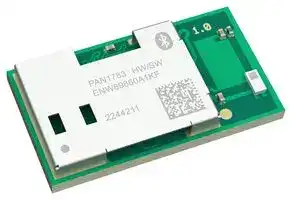


ENW89860C1KF
Bluetooth Module, Bottom-Pad Empty Flash, BLE 5.4, 2 Mbps, 1.7-5.5V, -104 dBm, -40 to 85 °C
- Manufacturer: PANASONIC
- Product type: Bluetooth Modules & Adaptors
- Available until stocks are exhausted
- SVHC: No SVHC (25-Jun-2025)
- Interfaces: I2C, SPI, UART
- Product Range: PAN1783A Series
- Certifications: FCC, ISED, KC, MIC, RCM, RED, SRRC, UKCA
- Bluetooth Class: -
- Supply Voltage Range: 1.7 V to 5.5 V
- Receiver Sensitivity Rx: -104 dBm
- Operating Temperature Range: -40 °C to 85 °C
| Delivery and price | |
|---|---|
| Units per pack | 250 |
| Price | 12.99 € |
| Current stock | 500+ |
| Lead time | 30 days |

## PAN1783 Bluetooth[®] Low Energy Module Product Specification Rev. 1.1 Wireless Connectivity PAN1783 Bluetooth Module ## **Overview** The PAN1783 is a Bluetooth 5.4 Low Energy (LE) module based on the Nordic nRF5340 single chip controller. ## **[Bluetooth Features ]** - [LE 2M and LE Coded ] - [LE Audio and Isochronous Channels ] - [Extended Advertising and Channel Sounding ] - [Mesh Networking ] ## **Features** - [Surface mount type dimensions: ] 15.6 mm × 8.7 mm × 2.2 mm - [Same form factor as PAN1780 with the same ] pitch but one more pin - [Nordic nRF5340 featuring two Cortex][®][-M33 ] processors: one as an application processor (with 128 MHz or 64 MHz operation, 512 kB RAM, built-in 1 MB flash memory), and the other one as a network processor (with 64 MHz operation, 64 kB RAM, 256 kB flash) - [Bluetooth 5.4 LE including LE 2M and LE Coded ] - [Supports 802.15.4 ZigBee][®][ and Thread ] - [Includes ARM TrustZone][®][ CryptoCell™ 312, ] SPU, KMU, ACL - [Security features: Trusted execution, ] root-of-trust, secure key storage, 128-bit AES ## **Characteristics** - [Typical sensitivity: -98 dBm (at 1 Mbps) and ] -104 dBm (at 125 kbps) - [Programmable output power: from 3 dBm ] to -40 dBm - [Typical System current consumption: 0.9 μA (in ] System OFF), 1.3 μA (in System ON), 1.5 μA (in System ON with network core RTC running) - [Typical Radio current consumption: 5.3 mA (at ] 3 dBm Tx power), 4.1 mA (at 0 dBm Tx power), 3.7 mA (in Rx at 1 Mbps), 4.1 mA (in Rx at 2 Mbps) - [On-module DC-DC and LDO regulators with ] automated low current modes - [Voltage range: 1.7 V to 5.5 V ] - [Temperature range: -40 °C to 85 °C ] - [Up to 48× General Purpose I/Os (GPIO), which ] are shared by up to 5× SPI, 4× I²C, 4× UART, 4× PWM, 8× ADC, NFC-A, QSPI, nRESET - [USB 2.0 full-speed device interface] ## **Block Diagram** Product Specification Rev. 1.1 Page 2 of 50 INDUSTRY Panasonic - PAN1783 Bluetooth Module - > ## PAN1783 Bluetooth Module By purchase of any of the products described in this document the customer accepts the document's validity and declares their agreement and understanding of its contents and recommendations. Panasonic Industrial Devices Europe GmbH (Panasonic) reserves the right to make changes as required at any time without notification. Please consult the most recently issued Product Specification before initiating or completing a design. © Panasonic Industrial Devices Europe GmbH 2025. This specification sheet is copyrighted. Reproduction of this document is permissible only if reproduction is without alteration and is accompanied by all associated warranties, conditions, limitations, and notices. Do not disclose it to a third party. All rights reserved. This Product Specification does not lodge the claim to be complete and free of mistakes. If this document is marked as preliminary, please be aware that its final content is not yet concluded and the use of it is at your own risk. ## **Document Acceptance** By signing the Product Specification, you acknowledge that you are a legal representative for your company and that you understand and accept the validity of the contents herein. If the signed version of the Product Specification has not been returned to Panasonic within 30 days after receipt of the product, the specification or approval sheet shall be deemed to be accepted by you. ## **Engineering Samples (ES)** If Engineering Samples are delivered to the customer, these samples have the status “Engineering Samples”. This means that the design of this product is not yet concluded. Engineering Samples may be partially or fully functional, and they may differ from the published Product Specification. Engineering Samples are not qualified and they are not to be used for reliability testing or series production. ## **Disclaimer** The customer acknowledges that samples may deviate from the Product Specification and may bear defects due to their status of development and the lack of qualification mentioned above. Panasonic rejects any liability or product warranty for Engineering Samples. In particular, Panasonic disclaims liability for damages caused by: - The use of the Engineering Sample other than for evaluation purposes, particularly the installation or integration in another product to be sold by the customer, - Deviation or lapse in function of the Engineering Sample, - Improper use of the Engineering Sample. Panasonic Industrial Devices Europe GmbH disclaims any liability for consequential and incidental damages. In case of any queries regarding the Engineering Samples, please contact your local sales partner or the related product manager. ## **Information on Software** The PAN1783 module does not contain any software ex works, i.e. software is provided by 3rd party suppliers only. The essential software resources can be found on the partner website of Nordic Semiconductor https://www.nordicsemi.com/. PIDEU provides a factory software programming service for your customized firmware; for further information please reach out to your local sales contact this regarding 7.2.1 Contact Us. Product Specification Rev. 1.1 Page 3 of 50 - PAN1783 Bluetooth Module - > ## PAN1783 Bluetooth Module ## INDUSTRY Panasonic ## **Table of Contents** |**1**|**About This Document ......................................................................................................................... 5**|**About This Document ......................................................................................................................... 5**| |---|---|---| ||1.1|Purpose and Audience .............................................................................................................. 5| ||1.2|Revision History ......................................................................................................................... 5| ||1.3|Use of Symbols ......................................................................................................................... 5| ||1.4|Related Documents ................................................................................................................... 5| |**2**|**Overview .............................................................................................................................................. 6**|| ||2.1|Block Diagram ........................................................................................................................... 7| ||2.2|Pin Configuration ....................................................................................................................... 8| ||2.3|Peripherals .............................................................................................................................. 11| ||2.4|Bluetooth Features .................................................................................................................. 11| |**3**|**Detailed Description ......................................................................................................................... 12**|| ||3.1|Dimensions .............................................................................................................................. 12| ||3.2|Footprint .................................................................................................................................. 13| ||3.3|Packaging ................................................................................................................................ 14| ||3.4|Case Marking .......................................................................................................................... 17| |**4**|**Specification and Integration Recommendations .......................................................................... 18**|| ||4.1|Default Test Conditions ........................................................................................................... 18| ||4.2|Absolute Maximum Ratings ..................................................................................................... 18| ||4.3|Recommended Operating Conditions ...................................................................................... 19| ||4.4|Current Consumption............................................................................................................... 19| ||4.5|Bluetooth RF Characteristics ................................................................................................... 20| ||4.6|Access Port Protection APPROTECT...................................................................................... 20| ||4.7|Antenna Placement Recommendation .................................................................................... 21| ||4.8|RF Path Recommendation ...................................................................................................... 23| ||4.9|Reliability Tests ....................................................................................................................... 24| ||4.10|Recommended Soldering Profile ............................................................................................. 25| |**5**|**Cautions ............................................................................................................................................ 26**|| ||5.1|Design Notes ........................................................................................................................... 26| ||5.2|Installation Notes ..................................................................................................................... 26| ||5.3|Usage Condition Notes ............................................................................................................ 27| ||5.4|Storage Notes .......................................................................................................................... 27| ||5.5|Safety Cautions ....................................................................................................................... 27| ||5.6|Other Cautions ........................................................................................................................ 28| ||5.7|Restricted Use ......................................................................................................................... 29| |**6**|**Regulatory and Certification Information ....................................................................................... 30**|| ||6.1|For Bluetooth Low Energy ....................................................................................................... 31| ||6.2|For IEEE 802.15.4 ................................................................................................................... 39| ||6.3|RoHS and REACH Declaration ............................................................................................... 48| |**7**|**Appendix ........................................................................................................................................... 49**|| ||7.1|Ordering Information ................................................................................................................ 49| ||7.2|Contact Details ........................................................................................................................ 50| Product Specification Rev. 1.1 Page 4 of 50 1 About This Document - PAN1783 Bluetooth Module - > ## 1 About This Document Panasonic ## **1 About This Document** ## **1.1 Purpose and Audience** This Product Specification provides details on the functional, operational, and electrical characteristics of the Panasonic PAN1783 module. It is intended for hardware design, application, and Original Equipment Manufacturers (OEM) engineers. The product is referred to as “PAN1783” and “module” within this document. ## **1.2 Revision History** |**Revision**|**Date**|**Modifications/Remarks**| |---|---|---| |0.1|2023-04-06|First preliminary version| |0.2|2025-01-23|•Changed Bottom-pad variant Brand Name from “PAN1773” to “PAN1783A”.<br>•Added certification chapter6 Regulatory and Certification Information<br>•Changed Bluetooth version “5.3” to Bluetooth “5.4.| |1.0|2025-02-19|•Added footnotes regarding voltage modes<br>•Corrected current consumptions<br>•Added Transmitter and Receiver Bluetooth RF Characteristics| |1.1|2025-07-29|•Updated info box for RED certification6.2.4 European Conformity According<br>to RED (2014/53/EU)<br>•Changed MOQ for module7.1Ordering Information| ## **1.3 Use of Symbols** |**Symbol**|**Description**| |---|---| ||**Note**<br>Indicates important information for the proper use of the product.<br>Non-observance can lead to errors.| |A|**Attention**<br>Indicates important notes that, if not observed, can put the product’s functionality<br>at risk.| |[chapter number]<br>[chapter title]|**Cross reference**<br>Indicates cross references within the document.<br>**Example:**<br>Description of the symbols used in this document1.3 Use of Symbols.| ## **1.4 Related Documents** For related documents please refer to the Panasonic website 7.2.2 Product Information. Product Specification Rev. 1.1 Page 5 of 50 INDUSTRY PAN1783 Bluetooth Module 2 Overview > Panasonic INDUSTRY 2 Overview Panasonic ## **2 Overview** The PAN1783 is a Bluetooth 5.4 Low Energy (LE) module based on the Nordic nRF5340 single chip controller. It is available with an on-board chip antenna and with a RF-bottom pad. The module supports Bluetooth LE 5.4 features like Isochronous Channels and LE Audio, high throughput of 2 Mbps with LE 2M and long range with LE Coded. The all in one SoC includes a superset of the most prominent nRF52 Series features combined with more performance and memory, while minimizing current consumption. An output power of up to 3 dBm and the improved sensitivity of the nRF5340 in combination with LE Coded make the module very attractive for advanced computer peripherals and I/O devices, advanced wearables, and wireless audio devices. In addition, the ultra-low current consumption of the PAN1783 makes the module an ideal choice for battery powered devices. With two Cortex® M33 processors, one as an application processor (with 128 MHz or 64 MHz operation, 512 kB RAM, built in 1 MB flash memory) and the other one as a network processor (with 64 MHz operation, 64 kB RAM, 256 kB flash), the PAN1783 can easily be used in standalone mode, thereby eliminating the need for an external processor, saving complexity, space, and cost. The rich set of security features from the ARM TrustZone® CryptoCell™ 312 security subsystem provide the necessary means for secure device operation in the IoT space. The PAN1783 supports angle of arrival (AoA) and angle of departure (AoD) direction finding. Additionally, the PAN1783 also supports Type 2 Near Field Communication (NFC A) for use in simplified pairing and payment solutions (external antenna required). For related documents please refer to 7.2.2 Product Information. For further information on the variants and versions please refer to 7.1 Ordering Information. Product Specification Rev. 1.1 Page 6 of 50 2 Overview PAN1783 Bluetooth Module ## **2.1 Block Diagram** Product Specification Rev. 1.1 Page 7 of 50 **==> picture [195 x 89] intentionally omitted <==** **----- Start of picture text -----**<br> <br>PAN1783 Bluetooth Module<br>><br>**----- End of picture text -----**<br> ## INDUSTRY 2 Overview Panasonic ## **2.2 Pin Configuration** ## **Pin Assignment** ## Top View |**G1**<br>**G2**<br>**G3**<br>**G4**<br>**G5**<br>**G6**<br>**G7**<br>**G8**<br>**G9**<br>**G10**<br>**G11**<br>**G12**<br>**G13**<br>OOOVOO0O0O0O0O0C0O00|**G1**<br>**G2**<br>**G3**<br>**G4**<br>**G5**<br>**G6**<br>**G7**<br>**G8**<br>**G9**<br>**G10**<br>**G11**<br>**G12**<br>**G13**<br>OOOVOO0O0O0O0O0C0O00| |---|---| |**F1**<br>**F2**<br>**F3**<br>**F4**<br>**F5**<br>**F6**<br>**F7**<br>**F8**<br>**F9**<br>**F10**<br>OOOVO0OC0CO0O00<br>OC|| |**E1**<br>**E2**<br>**E3**<br>**E4**<br>**E5**<br>**E6**<br>**E7**<br>**E8**<br>**E9**<br>**E10**<br>COROROROROROROROne|| |**D1**<br>**D2**<br>**D3**<br>**D4**<br>**D5**<br>**D6**<br>**D7**<br>**D8**<br>**D9**<br>**D10**<br>OO0OVO0O0O0C0C0<br>CO|| |**C1**<br>**C2**<br>**C3**<br>**C4**<br>**C5**<br>**C6**<br>**C7**<br>**C8**<br>**C9**<br>**C10**<br>OOO0VO0C0O0O0C<br>0 O|| |**B1**<br>**B2**<br>**B3**<br>**B4**<br>**B5**<br>**B6**<br>**B7**<br>**B8**<br>**B9**<br>**B10**<br>COROROROROROROROne|| |**A1**<br>**A2**<br>**A3**<br>**A4**<br>**A5**<br>**A6**<br>**A7**<br>**A8**<br>**A9**<br>**A10**<br>LLOOOOOCC0 CO|**A12**<br>**A13**<br>OO| ||| |**Pin Functions**|| |**No.**<br>**Pin Name**<br>**Pin Type**<br>**Description**|| |A1 P0.29<br>Digital I/O<br>GPIO|| |A2 P1.00<br>Digital I/O<br>GPIO|| |A3 P0.28 / AIN7<br>Digital I/O / Analog Input<br>GPIO / Sensor to ADC|| |A4 P0.05 / AIN1<br>Digital I/O / Analog Input<br>GPIO / Sensor to ADC|| |A5 P0.04 / AIN0<br>Digital I/O / Analog Input<br>GPIO / Sensor to ADC|| |A6 P0.27 / AIN6<br>Digital I/O / Analog Input<br>GPIO / Sensor to ADC|| |A7 P0.26 / AIN5<br>Digital I/O / Analog Input<br>GPIO / Sensor to ADC|| |A8 P0.03 / NFC2<br>Digital I/O / NFC input<br>GPIO / NFC antenna connection|| |A9 P0.02 / NFC1<br>Digital I/O / NFC input<br>GPIO / NFC antenna connection|| |A10 GND<br>Ground<br>Connect to ground|| |A12 GND<br>Ground<br>Connect to ground|| |A13 GND<br>Ground<br>Connect to ground|| |B1 P1.01<br>Digital I/O<br>GPIO|| |B2 P0.01 / XL2<br>Digital I/O / Analog input<br>GPIO / Connection for 32 kHz crystal (option)|GPIO / Connection for 32 kHz crystal (option)| |B3 P0.06 / AIN2<br>Digital I/O / Analog Input<br>GPIO / Sensor to ADC|| ## **Pin Functions** Product Specification Rev. 1.1 Page 8 of 50 ## INDUSTRY PAN1783 Bluetooth Module 2 Overview > Panasonic ## INDUSTRY 2 Overview Panasonic |**No.**|**Pin Name**|**Pin Type**|**Description**| |---|---|---|---| |B4 P0.07 / AIN3|B4 P0.07 / AIN3|Digital I/O / Analog Input|GPIO / Sensor to ADC| |B5 P0.25 / AIN4|B5 P0.25 / AIN4|Digital I/O / Analog Input|GPIO / Sensor to ADC| |B6 P0.24|B6 P0.24|Digital I/O|GPIO| |B7 P0.19|B7 P0.19|Digital I/O|GPIO| |B8 P1.08|B8 P1.08|Digital I/O|GPIO| |B9 P0.22|B9 P0.22|Digital I/O|GPIO| |B10 GND|B10 GND|Ground|Connect to ground| |C1 P1.02/I2C|C1 P1.02/I2C|Digital I/O|GPIO| |C2 P0.00 / XL1|C2 P0.00 / XL1|Digital I/O / Analog input|GPIO / Connection for 32 kHz crystal (option)| |C3 P1.03 / I2C|C3 P1.03 / I2C|Digital I/O|GPIO| |C4 GND|C4 GND|Ground|Connect to ground| |C5 GND|C5 GND|Ground|Connect to ground| |C6 P0.13/QSPI 0|C6 P0.13/QSPI 0|Digital I/O / IO0 for QSPI|GPIO / Dedicated pin for Quad SPI| |C7 P0.14 / QSPI 1|C7 P0.14 / QSPI 1|Digital I/O / IO1 for QSPI|GPIO / Dedicated pin for Quad SPI| |C8 P0.15 / QSPI 2|C8 P0.15 / QSPI 2|Digital I/O / IO2 for QSPI|GPIO / Dedicated pin for Quad SPI| |C9 P0.16 / QSPI 3|C9 P0.16 / QSPI 3|Digital I/O / IO3 for QSPI|GPIO / Dedicated pin for Quad SPI| |C10 GND|C10 GND|Ground|Connect to ground| |D1 GND|D1 GND|Ground|Connect to ground| |D2 P0.21|D2 P0.21|Digital I/O|GPIO| |D3 P0.12|D3 P0.12|Digital I/O|GPIO| ||TRCCLK|Trace clock|Trace buffer clock| ||DCX|DCX for SPIM4|Dedicated pin for high-speed SPI| |D4 GND|D4 GND|Ground|Connect to ground| |D5 GND|D5 GND|Ground|Connect to ground| |D6 P1.10|D6 P1.10|Digital I/O|GPIO| |D7 P0.18 / QSPI_CS|D7 P0.18 / QSPI_CS|Digital I/O / CSN for QSPI|GPIO / Dedicated pin for Quad SPI| |D8 P0.17 / QSPI_SCK|D8 P0.17 / QSPI_SCK|Digital I/O / SCK for QSPI|GPIO / Dedicated pin for Quad SPI| |D9 GND|D9 GND|Ground|Connect to ground| |D10 GND|D10 GND|Ground|Connect to ground| |E1 VDD|E1 VDD1|Supply Voltage|1.7 V to 3.6 V| |E2 P0.08|E2 P0.08|Digital I/O|GPIO| 1 In the normal voltage mode (1.7 V to 3.6 V) the VDD pin (E1) and VDDH pin (G2) are connected together to the external power supply Product Specification Rev. 1.1 Page 9 of 50 ## INDUSTRY PAN1783 Bluetooth Module 2 Overview > Panasonic ## INDUSTRY 2 Overview Panasonic |**No.**|**Pin Name**|**Pin Type**|**Description**| |---|---|---|---| ||TRCDAT3|Trace data|Trace buffer TRACEDATA[3]| ||SCK|SCK for SPIM4|Dedicated pin for high-speed SPI| |E3 GND|E3 GND|Ground|Connect to ground| |E4 P0.23|E4 P0.23|Digital I/O|GPIO| |E5 P1.06|E5 P1.06|Digital I/O|GPIO| |E6 P1.07|E6 P1.07|Digital I/O|GPIO| |E7 P1.09|E7 P1.09|Digital I/O|GPIO| |E8 SWDCLK|E8 SWDCLK|Debug|Serial wire clock input for debug and programming| |E9 P0.20|E9 P0.20|Digital I/O|GPIO| |E10 P1.05|E10 P1.05|Digital I/O|GPIO| |F1 P0.10|F1 P0.10|Digital I/O|GPIO| ||TRCDATA1|Trace data|Trace buffer TRACEDATA[1]| ||MISO|MISO for SPIM4|Dedicated pin for high-speed SPI| |F2 P0.09|F2 P0.09|Digital I/O|GPIO| ||TRCDATA2|Trace data|Trace buffer TRACEDATA[2]| ||MOSI|MOSI for SPIM4|Dedicated pin for high-speed SPI| |F3 P1.15|F3 P1.15|Digital I/O|GPIO| |F4 P1.14|F4 P1.14|Digital I/O|GPIO| |F5 P1.13|F5 P1.13|Digital I/O|GPIO| |F6 P1.12|F6 P1.12|Digital I/O|GPIO| |F7 P1.11|F7 P1.11|Digital I/O|GPIO| |F8 P0.31|F8 P0.31|Digital I/O|GPIO| |F9 P0.30|F9 P0.30|Digital I/O|GPIO| |F10 GND|F10 GND|Ground|Connect to ground| |G1 P1.04|G1 P1.04|Digital I/O|GPIO| |G2 VDDH|G2 VDDH2|Supply Voltage|2.5 V to 5.5 V (optional high voltage mode)| |G3 GND|G3 GND|Ground|Connect to ground| |G4 VBUS|G4 VBUS|USB Supply Voltage|Connect to 4.35 V to 5.5 V when using USB| |G5 D+|G5 D+|USB D+|Use for USB only| |G6 D-|G6 D-|USB D-|Use for USB only| |G7 nRESET|G7 nRESET|Digital I|Reset Signal Low Active| 2 In the high voltage mode (2.5 V to 5.5 V) only the VDDH pin (G2) is connected to the external power supply. The VDD pin (E1) is not connected. Product Specification Rev. 1.1 Page 10 of 50 ## INDUSTRY PAN1783 Bluetooth Module 2 Overview > Panasonic ## INDUSTRY 2 Overview Panasonic |**No.**|**Pin Name**|**Pin Type**|**Description**| |---|---|---|---| |G8 P0.11|G8 P0.11|Digital I/O|GPIO| ||TRCDATA0|Trace data|Trace buffer TRACEDATA[0]| ||CSN|CSN for SPIM4|Dedicated pin for high-speed SPI| |G9 SWDIO|G9 SWDIO|Debug|Serial wire I/O input for debug and programming| |G10 GND|G10 GND|Ground|Connect to ground| |G11 NC|G11 NC|NC|Do not connect for PAN1783 (ENW89860A1KF)| ||RF_PIN|Analog I/O|RF in/out for PAN1783A (ENW89860C1KF)| |G12 GND|G12 GND|Ground|Connect to ground| |G13 GND|G13 GND|Ground|Connect to ground| ## **2.3 Peripherals** - 12 Mbps full-speed USB 2.0 device controller - Up to 4× UART with EasyDMA, 2 or 4 wire with CTS/RTS, 1 200 up to 1 M baud - • Up to 4× I[2] C compatible two-wire master/slave with EasyDMA, 100 kbps up to 1 000 kbps - Audio peripherals – I[2] S, digital microphone interface (PDM) - 32 MHz high-speed SPI - 4× SPI master/slave with EasyDMA SPI - QSPI (96 MHz) - 4× PWM - 8-Channels 12-bit ADC, 200 kSPS - Low-power comparator, general-purpose comparator - 2× QDEC – Quadrature decoder - Temperature sensor - Two 24-bit real-time counters (RTC) - Watchdog timer - 48× GPIOs - AES and CryptoCell ## **2.4 Bluetooth Features** - LE 2M and LE Coded - LE Audio and Isochronous Channels - Extended Advertising and Channel Sounding - Mesh Networking Product Specification Rev. 1.1 Page 11 of 50 - PAN1783 Bluetooth Module - > INDUSTRY 3 Detailed Description Panasonic ## **3 Detailed Description** ## **3.1 Dimensions** The dimensions are in millimeters. ## Top View |**Item**|**Dimension**|**Tolerance**|**Remark**| |---|---|---|---| |Width|8.70|±0.30|±0.30| |Length|15.60|±0.30|±0.30| |Height|2.20|±0.20 With case|±0.20 With case| Product Specification Rev. 1.1 Page 12 of 50 INDUSTRY 3 Detailed Description Panasonic - PAN1783 Bluetooth Module - > ## **3.2 Footprint** ## ®@ All dimensions are in millimeters. ## Top View 1,00 G1 G2 G3 G4 G5 G6 G7 G8 G9 G10 G11 G12 G13 rrOODDOODODOO0000 F1 F2 F3 F4 F5 F6 F7 F8 F9 F10 SCC00000000 E1 E2 E3 E4 E5 E6 E7 E8 E9 E10 Ce000000000 D1 D2 D3 D4 D5 D6 D7 D8 D9 D10 Se000000000 C1 C2 C3 C4 C5 C6 C7 C8 C9 C10 rrOOO0000000 B1 B2 B3 B4 B5 B6 B7 B8 B9 B10 ©CC00000000 A1 A2 A3 A4 A5 A6 A7 A8 A9 A10 A12 A13 Hoeeoego00o OO 0,60 1,10 0,60 2,20 1,40 15,60 ~~fir a Far or AY~~ Product Specification Rev. 1.1 Page 13 of 50 > 3 Detailed Description Panasonic - PAN1783 Bluetooth Module - > ## PAN1783 Bluetooth Module ## **3.3 Packaging** The module will be delivered in the package described below. ## **3.3.1 Tape Dimensions** ## **3.3.2 Packing in Tape** ## Direction of unreeling (for customer) **==> picture [374 x 58] intentionally omitted <==** **----- Start of picture text -----**<br> trailer (empty) component leader (empty) Top cover tape more<br>1 x circumference / packed area minimum 10 pitch than 1 x<br>circumference plus<br>hub standard 100mm to avoid<br>(min 160mm) 1500pcs fixing of tape end on<br>sealed modules.<br>**----- End of picture text -----**<br> Empty spaces in the component packed area shall be less than two per reel and those spaces shall not be consecutive. The top cover tape shall not be found on reel holes and it shall not stick out from the reel. Product Specification Rev. 1.1 Page 14 of 50 PAN1783 Bluetooth Module 3 Detailed Description ## **3.3.3 Component Direction** **==> picture [312 x 115] intentionally omitted <==** **----- Start of picture text -----**<br> Pin 1 Marking<br>(Top Side)<br>Direction of<br>unreeling<br>(for customer)<br>_. x<br>**----- End of picture text -----**<br> ## **3.3.4 Reel Dimension** Product Specification Rev. 1.1 Page 15 of 50 PAN1783 Bluetooth Module wf INDUSTRY 3 Detailed Description Panasonic ## **3.3.5 Package Label** ## **Example:** (1T) Lot code (1P) Customer order number, if applicable (2P) Order number (9D) Date code (Q) Quantity (HW/SW) Hardware/software version ## **3.3.6 Total Package** Product Specification Rev. 1.1 Page 16 of 50 PAN1783 Bluetooth Module > ## 3 Detailed Description Panasonic ## **3.4 Case Marking** ## **Example:** - 1 Brand name - 2 Hardware/software version - 3 Order number - 4 Lot code - 5 Status: ES or empty for MP - 6 2D barcode, for internal usage only - 7 Marking for Pin 1 - 8 Bluetooth logo Product Specification Rev. 1.1 Page 17 of 50 4 Specification and Integration Recommendations PAN1783 Bluetooth Module ## **4 Specification and Integration Recommendations** **==> picture [30 x 30] intentionally omitted <==** **----- Start of picture text -----**<br> ©<br>**----- End of picture text -----**<br> All specifications are over temperature and process, unless indicated otherwise. ## **4.1 Default Test Conditions** © Temperature: 25 °C ± 10 °C Humidity: 40 % to 85 % RH Supply Voltage: 3 V ## **4.2 Absolute Maximum Ratings** The maximum ratings may not be exceeded under any circumstances, not even momentarily or individually, as permanent damage to the module may result. |**Symbol**|**Parameter**|**Condition**|**Min.**|**Typ.**|**Max.**|**Unit**| |---|---|---|---|---|---|---| |VDD|Normal Supply Voltage||-0.3|-0.3|+3.9|V| |VDDH|High Supply Voltage||-0.3|-0.3|+5.8|| |VBUS|USB Bus Voltage||-0.3|-0.3|+5.8|| |I/O Pin|Voltage on any Pin|VDD≤ 3.6 V|-0.3|-0.3|VDD+ 0.3|| |||VDD> 3.6 V|-0.3|-0.3|3.9|| |INFC1/2|NFC antenna pin current|NFC antenna pin current|||80|mA| |ESD|ESD Robustness|HBM 1C|||1 000|1 000<br>V| |||CDM|||500|| |MSL|Moisture Sensitivity Level|Moisture Sensitivity Level|||3|| |PRF|RF Input Level||||+10|dBm| |TSTOR|Storage Temperature||-40|-40|+85|°C| Product Specification Rev. 1.1 Page 18 of 50 PAN1783 Bluetooth Module > 4 Specification and Integration Recommendations ## Panasonic ## **4.3 Recommended Operating Conditions** The maximum ratings may not be exceeded under any circumstances, not even momentarily or individually, as permanent damage to the module may result. |**Symbol**|**Parameter**|**Condition**|**Min.**|**Typ.**|**Max.**|**Unit**| |---|---|---|---|---|---|---| |VDD,POR|Supply Voltage|VDD supply voltage needed<br>during power-on reset|1.75|1.75||V| |VDD (LV Mode)|SupplyVoltage||1.7|1.7<br>3.0|3.0<br>3.6|V| |VDDH (HV Mode)|SupplyVoltage|VDDH- Optional|2.5|2.5<br>3.7|3.7<br>5.5|V| |VBUS|VBUS USB<br>Supply Voltage|VBUS- Optional|4.35|4.35<br>5.0|5.0<br>5.5|V| |TA|Operating<br>Temperature||-40|-40<br>25|25<br>85|°C| ## **4.4 Current Consumption** The current consumption depends on the user scenario and on the setup and timing in the power modes. Assume VDD = 3 V, Tamb = 25 °C, if nothing else stated, DC-DC enabled. |**Parameter**|**Condition**|**Min.**|**Typ.**|**Max.**|**Unit**| |---|---|---|---|---|---| |Sleep Mode|System OFF, wake on reset||0.9|0.9|µA| ||System ON, wake on anyevent||1.3|1.3|µA| ||System ON with network core RTC running||1.5|1.5|µA| ||System OFF, 512 kB application RAM + 64 kB<br>network RAM, wake on reset||2.4|2.4|µA| |CPU executing<br>CoreMark|Application CPU running, CoreMark from flash||3.3|3.3|mA| ||Application CPU running, CoreMark from RAM||3.4|3.4|mA| ||Network CPU running, CoreMark from flash||2.4|2.4|mA| ||Network CPU running, CoreMark from RAM||2.0|2.0|mA| |Rx Current|1 Mbps Bluetooth low energy (BLE) mode,<br>clock = HFXO64M||3.7|3.7|mA| ||2 Mbps Bluetooth low energy (BLE) mode,<br>clock = HFXO64M||4.1|4.1|mA| Product Specification Rev. 1.1 Page 19 of 50 - PAN1783 Bluetooth Module - > ## INDUSTRY Panasonic ## 4 Specification and Integration Recommendations |**Parameter**|**Condition**|**Min.**|**Typ.**|**Max.**|**Unit**| |---|---|---|---|---|---| |Tx Current|+3 dBm output power, 1 Mbps Bluetooth low<br>energy (BLE) mode, clock = HFXO64M||5.3||mA| ||0 dBm output power, 1 Mbps Bluetooth low<br>energy (BLE) mode, clock = HFXO64M||4.1||mA| ||-40 dBm output power, 1 Mbps Bluetooth low<br>energy (BLE) mode, clock = HFXO64M||2.6||mA| ## **4.5 Bluetooth RF Characteristics** ## **4.5.1 Transmitter RF Characteristics** |**Parameter**|**Condition**|**Condition**|**Min.**|**Typ.**|**Max.**|**Unit**| |---|---|---|---|---|---|---| |Frequency Range|Frequency Range||2 402||2 480|MHz| |Output Power||||+3||dBm| |Data Rate|||125||2 000|kbps| |Adjacent Channel<br>Transmit Power|1 Mbps|1stAdjacent Channel||-24||dBc| |||2ndAdjacent Channel||-52||dBc| ||2 Mbps|1stAdjacent Channel||-25||dBc| |||2ndAdjacent Channel||-50||dBc| ## **4.5.2 Receiver RF Characteristics** |**Parameter**|**Condition**|**Condition**|**Min.**|**Typ.**|**Max.**|**Unit**| |---|---|---|---|---|---|---| |Receiver<br>Sensitivity|1 Mbps, BER ≤ 0.1 %|||-98||dBm| ||2 Mbps, BER ≤ 0.1 %|||-95||dBm| ||125 kbps, BER ≤ 0.1 %|||-104||dBm| ||500 kbps, BER ≤ 0.1 %|||-100||dBm| |Interference<br>Characteristics|1 Mbps<br>Signal Level = -67 dBm<br>BER ≤ 0.1 %|C/I (Co-channel)||6.9||dB| |||C/I (-1 MHz)||-2.6||dB| |||C/I (+1 MHz)||-8.5||dB| |||C/I (-2 MHz)||-27||dB| |||C/I (+2 MHz)||-45||dB| |||C/I (≥3 MHz)||-50||dB| |||C/I (Image)||-27||dB| |||C/I (Image,1 MHz)||-41||dB| ## **4.6 Access Port Protection APPROTECT** If using Access Port Protection (APPROTECT) please refer to the “nRF5340 Product Specification” in the Nordic Infocenter https://infocenter.nordicsemi.com/. Product Specification Rev. 1.1 Page 20 of 50 4 Specification and Integration Recommendations PAN1783 Bluetooth Module ## **4.7 Antenna Placement Recommendation** This antenna placement recommendation is related to the PAN1783 with the integrated chip-antenna, ordering number: ENW89860A1KF. ## **Antenna “Keep out Area”** Do not place any ground plane under the marked restricted antenna area in any layer! This would be affecting the performance of the chip antenna in a critical manner. ## **Impact of Placement on the Antenna Radiation Pattern** The placement of the module, surrounding material, and customer components has an impact on the radiation pattern of the antenna. The recommendation for the ground plane is based on a FR4 4-Layer PCB. The following requirements must be met: - ✓ Keep this product away from heat. Heat is the major cause of decreasing the life of these products. - ✓ Keep this product away from other high frequency circuits. The antenna requires a cutout area of 5 mm × 3 mm under the PAN1783 module. This “Keep out Area” shall be located in every layer under the module antenna. Note for example the “Keep out Area” in all four layers of the PAN1783 evaluation board. It is recommended to verify the perfect position of the module in the target application before fixing the design. Product Specification Rev. 1.1 Page 21 of 50 > 4 Specification and Integration Recommendations Panasonic - PAN1783 Bluetooth Module - > ## **Antenna Placement Recommendation** All dimensions are in millimeters. Use a ground plane in the area surrounding the module wherever possible. It is recommended to place the module: - In the center (horizontal) of any mother PCB edge - GND plane on the left and right of the module ## Top View **==> picture [286 x 208] intentionally omitted <==** **----- Start of picture text -----**<br> Min. 15.00 8.70 Min. 15.00<br>5.00<br>Keep out<br>Area<br>Top View<br>| i<br>3.00<br>15.60<br>Min. 40.00<br>**----- End of picture text -----**<br> Product Specification Rev. 1.1 Page 22 of 50 PAN1783 Bluetooth Module > ## Panasonic ## 4 Specification and Integration Recommendations ## **4.8 RF Path Recommendation** This RF-path recommendation for external antennas is related to the PAN1783A with the RF bottom-pad, ordering number: ENW89860C1KF. ## **Antenna Warning** The PAN1783A is tested with a standard U.FL connector and with the antenna listed in the 6.1.2.5 Approved Antenna List. When integrated into the OEM’s product, these fixed antennas require installation preventing end users from replacing them with non-approved antennas. The PAN1783A module has a 50 Ω RF pin (SMD pad). Connect the external antenna via a listed cable to an U.FL-connector, which is connected with a RF trace to this RF pin. This RF trace must be matched to 50 ohm 4.8.1 RF Trace ## **4.8.1 RF Trace** This section describes the required design of the trace. The following design recommendation must be met: - ✓ Trace impedance of 50 Ω - ✓ Via fence around the trace - ✓ Crossing no other lines (power supply, interfaces, or clock traces) - ✓ Coplanar waveguide design - ✓ Substrate Material: FR4 - ✓ Height (H) of dielectric: typ. 100 μm ± 10 μm - ✓ Trace Width (W): typ. 160 μm ± 10 μm - ✓ Copper Gap (G): typ. 150 μm, min. 120 μm - ✓ All inner layers must have the same copper-obstruct pattern as the GND on the top layer. Product Specification Rev. 1.1 Page 23 of 50 ## PAN1783 Bluetooth Module 4 Specification and Integration Recommendations ## **4.9 Reliability Tests** The measurement should be done after the test module has been exposed to room temperature and humidity for one hour. |**No.**|**Item**|**Limit**|**Condition**| |---|---|---|---| |1 Variable Vibration Test Electrical parameters should be|1 Variable Vibration Test Electrical parameters should be|1 Variable Vibration Test Electrical parameters should be<br>within specification|Freq.: 20~2 000 Hz, Acc.: 17-50 G,<br>Sweep: 8 min, 2 hours, For: XYZ axis| |2 Shock Drop Test|2 Shock Drop Test||Drop parts on concrete from a height of<br>1 m for 3 times| |3 Temperature Cycling|3 Temperature Cycling<br>Test||At -40 °C and 85 °C for 1 h/cycle<br>Total = 300 cycles| |4 Temperature Humidity|4 Temperature Humidity<br>Bias Test||At 60 °C, 85 % r.H., 300 h| |5 Low Temperature|5 Low Temperature<br>Storage Life Test||At -40 °C, 300 h| |6 High Temperature|6 High Temperature<br>Storage Life Test||At 85 °C, 300 h| Product Specification Rev. 1.1 Page 24 of 50 4 Specification and Integration Recommendations PAN1783 Bluetooth Module ## **4.10 Recommended Soldering Profile** - Reflow permissible cycles: 2 - Opposite side reflow is prohibited due to module weight - More than 75 percent of the soldering area shall be coated by solder - The soldering profiles should be adhered to in order to prevent electrical or mechanical damage - Soldering profile assumes lead-free soldering Product Specification Rev. 1.1 Page 25 of 50 INDUSTRY 5 Cautions Panasonic PAN1783 Bluetooth Module > ## **5 Cautions** Failure to follow the guidelines set forth in this document may result in degrading of the module functions and damage to the module. ## **5.1 Design Notes** 1. Follow the conditions written in this specification, especially the control signals of this module. 2. The supply voltage should abide by the maximum ratings ( 4.2 Absolute Maximum Ratings). 3. The supply voltage must be free of AC ripple voltage (for example from a battery or a low noise regulator output). For noisy supply voltages, provide a decoupling circuit (for example a ferrite in series connection and a bypass capacitor to ground of at least 47 µF directly at the module). 4. This module should not be mechanically stressed when installed. 5. Keep this module away from heat. Heat is the major cause of decreasing the life time of these modules. 6. Avoid assembly and use of the target equipment in conditions where the module temperature may exceed the maximum tolerance. 7. Keep this module away from other high frequency circuits. 8. Refer to the recommended pattern when designing a board. ## **5.2 Installation Notes** 1. Reflow soldering is possible twice based on the conditions set forth in 4.10 Recommended Soldering Profile. Set up the temperature at the soldering portion of this module according to this reflow profile. 2. Carefully position the module so that the heat will not burn into printed circuit boards or affect other components that are susceptible to heat. 3. Carefully locate the module, to avoid an increased temperature caused by heat generated by neighboring components. 4. If a vinyl-covered wire comes into contact with the module, the wire cover will melt and generate toxic gas, damaging the insulation. Never allow contact between a vinyl cover and these modules to occur. 5. This module should not be mechanically stressed or vibrated when reflowed. 6. To repair the board by hand soldering, follow the conditions set forth in this chapter. 7. Do not wash this product. 8. Pressing on parts of the metal cover or fastening objects to the metal will cause damage to the module. Product Specification Rev. 1.1 Page 26 of 50 INDUSTRY 5 Cautions Panasonic PAN1783 Bluetooth Module 5 Cautions - PAN1783 Bluetooth Module - > ## **5.3 Usage Condition Notes** 1. Take measures to protect the module against static electricity. If pulses or transient loads (a large load, which is suddenly applied) are applied to the modules, check and evaluate their operation before assembly of the final products. 2. Do not use dropped modules. 3. Do not touch, damage, or soil the pins. 4. Follow the recommended condition ratings about the power supply applied to this module. 5. Electrode peeling strength: Do not apply a force of more than 4.9 N in any direction on the soldered module. 6. Pressing on parts of the metal cover or fastening objects to the metal cover will cause damage. 7. These modules are intended for general purpose and standard use in general electronic equipment, such as home appliances, office equipment, information, and communication equipment. ## **5.4 Storage Notes** 1. The module should not be stressed mechanically during storage. 2. Do not store these modules in the following conditions or the performance characteristics of the module, such as RF performance will be adversely affected: - Storage in salty air or in an environment with a high concentration of corrosive gas, such as Cl2, H2S, NH3, SO2, or NOX, - Storage in direct sunlight, - Storage in an environment where the temperature may be outside the range of 5 °C to 35 °C, or where the humidity may be outside the 45 % to 85 % range, - Storage of the modules for more than one year after the date of delivery storage period: Please check the adhesive strength of the embossed tape and soldering after 6 months of storage. 3. Keep this module away from water, poisonous gas, and corrosive gas. 4. This module should not be stressed or shocked when transported. 5. Follow the specification when stacking packed crates (max. 10). ## **5.5 Safety Cautions** These specifications are intended to preserve the quality assurance of products and individual components. Before use, check and evaluate the operation when mounted on your products. Abide by these specifications without deviation when using the products. These products may short-circuit. If electrical shocks, smoke, fire, and/or accidents involving human life are anticipated when a short circuit occurs, provide the following failsafe functions as a minimum: Product Specification Rev. 1.1 Page 27 of 50 INDUSTRY PAN1783 Bluetooth Module 5 Cautions > Panasonic INDUSTRY 5 Cautions Panasonic 1. Ensure the safety of the whole system by installing a protection circuit and a protection device. 2. Ensure the safety of the whole system by installing a redundant circuit or another system to prevent a single fault causing an unsafe status. ## **5.6 Other Cautions** 1. Do not use the module for other purposes than those listed in section 5.3 Usage Condition Notes. 2. Be sure to provide an appropriate fail-safe function on your product to prevent any additional damage that may be caused by the abnormal function or the failure of the module. 3. This module has been manufactured without any ozone chemical controlled under the Montreal Protocol. 4. These modules are not intended for use under the special conditions shown below. Before using these modules under such special conditions, carefully check their performance and reliability under the said special conditions to determine whether or not they can be used in such a manner: - In liquid, such as water, salt water, oil, alkali, or organic solvent, or in places where liquid may splash, - In direct sunlight, outdoors, or in a dusty environment, - In an environment where condensation occurs, - In an environment with a high concentration of harmful gas (e. g. salty air, HCl, Cl2, SO2, H2S, NH3, and NOX). 5. If an abnormal voltage is applied due to a problem occurring in other components or circuits, replace these modules with new modules, because they may not be able to provide normal performance even if their electronic characteristics and appearances appear satisfactory. For further information please refer to the Panasonic website 7.2.2 Product Information. Product Specification Rev. 1.1 Page 28 of 50 PAN1783 Bluetooth Module > INDUSTRY 5 Cautions Panasonic ## **5.7 Restricted Use** ## **5.7.1 Life Support Policy** This Panasonic Industrial Devices Europe GmbH product is not designed for use in life support appliances, devices, or systems where malfunction can reasonably be expected to result in a significant personal injury to the user, or as a critical component in any life support device or system whose failure to perform can be reasonably expected to cause the failure of the life support device or system, or to affect its safety or effectiveness. Panasonic customers using or selling these products for use in such applications do so at their own risk and agree to fully indemnify Panasonic Industrial Devices Europe GmbH for any damages resulting. ## **5.7.2 Restricted End Use** This Panasonic Industrial Devices Europe GmbH product is not designed for any restricted activity that supports the development, production, handling usage, maintenance, storage, inventory or proliferation of any weapons or military use. Transfer, export, re-export, usage or reselling of this product to any destination, end user or any end use prohibited by the European Union, United States or any other applicable law is strictly prohibited. Product Specification Rev. 1.1 Page 29 of 50 PAN1783 Bluetooth Module > INDUSTRY 6 Regulatory and Certification Information Panasonic ## **6 Regulatory and Certification Information** This chapter contains regulatory and certification information for: - Bluetooth Low Energy 6.1 For Bluetooth Low Energy - IEEE 802.15.4 6.2 For IEEE 802.15.4 ## **Bluetooth Low Energy** |**Certification**|**Certification**|**Status**|**Reference**| |---|---|---|---| |FCC|for US|Available|6.1.2 Federal Communications Commission<br>(FCC) for US| |ISED|for Canada|Available|6.1.3 Innovation, Science, and Economic<br>Development (ISED) for Canada| |RED|for Europe|Available|6.1.4 European Conformity According to RED<br>(2014/53/EU)| |UKCA|for United Kingdom Available|for United Kingdom Available|6.1.5 United Kingdom Conformity According to<br>Statutory Instrument SI 2017/1206| |MIC|for Japan|Upon request|| |SRRC|for China|Upon request|| |KCC|for Korea|Upon request|| |RCM|for Australia<br>and New Zealand|Upon request|| ## **IEEE 802.15.4** |**Certification**|**Certification**|**Status**|**Reference**| |---|---|---|---| |FCC|for US|Available|6.2.2 Federal Communications Commission<br>(FCC) for US| |ISED|for Canada|Available|6.2.3 Innovation, Science, and Economic<br>Development (ISED) for Canada| |RED|for Europe|Available|6.2.4 European Conformity According to RED<br>(2014/53/EU)| |UKCA|for United Kingdom Available|for United Kingdom Available|6.2.5 United Kingdom Conformity According to<br>Statutory Instrument SI 2017/1206| |MIC|for Japan|Upon request|| |SRRC|for China|Upon request|| |KCC|for Korea|Upon request|| |RCM|for Australia<br>and New Zealand|Upon request|| For regions “upon request”, please reach out to your Sales contact for the most recent status of the certification process 7.2.1 Contact Us. Product Specification Rev. 1.1 Page 30 of 50 6 Regulatory and Certification Information PAN1783 Bluetooth Module ## **6.1 For Bluetooth Low Energy** ## **6.1.1 General Certification Information** Regulatory certifications are valid for the following radio relevant software: - nRF Connect SDK - sdk-nrfxlib - softdevice_controller - Bluetooth Specification 5.4 For further certification requests for other radio software please contact Panasonic 7.2 Contact Details. ## **6.1.2 Federal Communications Commission (FCC) for US** ## **6.1.2.1** ## **FCC Notice** The PAN1783 including the antennas, which are listed in 6.1.2.5 Approved Antenna List, complies with Part 15 of the FCC Rules. © The device meets the requirements for modular transmitter approval as detailed in FCC public Notice DA00-1407. The transmitter operation is subject to the following two conditions: 1. This device may not cause harmful interference, and 2. This device must accept any interference received, including interference that may cause undesired operation. ## **6.1.2.2 Caution** The FCC requires the user to be notified that any changes or modifications made to this device that are not expressly approved by Panasonic Industrial Devices Europe GmbH may void the user's authority to operate the equipment. Product Specification Rev. 1.1 Page 31 of 50 **==> picture [187 x 89] intentionally omitted <==** **----- Start of picture text -----**<br> <br>PAN1783 Bluetooth Module<br>><br>**----- End of picture text -----**<br> PAN1783 Bluetooth Module ## Panasonic ## 6 Regulatory and Certification Information This equipment has been tested and found to comply with the limits for a Class B digital device, pursuant to Part 15 of the FCC Rules. These limits are designed to provide reasonable protection against harmful interference in a residential installation. This equipment generates uses and can radiate radio frequency energy and, if not installed and used in accordance with the instructions, may cause harmful interference to radio communications. There is no guarantee that interference will not occur in a particular installation. If this equipment does cause harmful interference to radio or television reception, which can be determined by turning the equipment off and on, the user is encouraged to try to correct the interference by one or more of the following measures: - Reorient or relocate the receiving antenna, - Increase the separation between the equipment and receiver, - Connect the equipment into an outlet on a circuit different from that to which the receiver is connected, - Consult the dealer or an experienced radio/TV technician for help. ## **6.1.2.3 Label Requirements** The OEM must ensure that FCC labelling requirements are met. This includes a clearly visible label on the outside of the OEM enclosure specifying the appropriate Panasonic FCC identifier for this product as well as the FCC Notice above. The FCC identifier is **FCC ID: T7V1783** . This FCC identifier is valid for the PAN1783. The end product must in any case be labelled on the exterior with: "Contains FCC ID: T7V1783". Due to the PAN1783 model size, the FCC identifier is displayed in the installation instruction only and it cannot be displayed readable on the module’s label due to the limited size. Product Specification Rev. 1.1 Page 32 of 50 PAN1783 Bluetooth Module > INDUSTRY 6 Regulatory and Certification Information Panasonic ## **6.1.2.4 Antenna Warning** This antenna warning refers to the test devices with the model number PAN1783 and PAN1783A 7.1 Ordering Information. The device is tested with a standard SMA connector and with the antenna listed below. When integrated into the OEM’s product, these fixed antennas require installation preventing end users from replacing them with non-approved antennas. Any antenna not in the following table must be tested to comply with FCC Section 15.203 for unique antenna connectors and with Section 15.247 for emissions. The FCC identifier for the device with the antenna listed in 6.1.2.5 Approved Antenna List is the same ( **FCC ID: T7V1783** ). ## **6.1.2.5 Approved Antenna List** |**Item**|**Part Number**|**Manufacturer**|**Frequency Band**<br>**(GHz)**|**Type**|**Max. Gain**<br>**(dBi)**| |---|---|---|---|---|---| |1 ANT016008LCS2442MA1|1 ANT016008LCS2442MA1|TDK|2.4|Chip antenna|+1.6| |2 Antenna:|2 Antenna:<br>GW.34.5153<br>Cable:<br>CAB.6277 (50mm)<br>CAB.6075 (100mm)<br>CAB.6235 (150mm)<br>CAB.6280 (200mm)<br>CAB.6281 (250mm)<br>CAB.6101 (300mm)|TAOGLAS|2.4|Dipole antenna<br>assembly|+5.9| ## **6.1.2.6 RF Exposure** To comply with FCC RF Exposure requirements, the OEM must ensure that only antennas from the Approved Antenna List are installed 6.1.2.5 Approved Antenna List. The preceding statement must be included as a “CAUTION” statement in manuals for products operating with the approved antennas in the previous table to alert users on FCC RF Exposure compliance. Any notification to the end user of installation or removal instructions about the integrated radio module is not allowed. The radiated output power of the PAN1783 with a mounted ceramic antenna ( **FCC ID: T7V1783** ) is below the FCC radio frequency exposure limits. Nevertheless, the PAN1783 shall be used in such a manner that the potential for human contact during normal operation is minimized. End users may not be provided with the module installation instructions. OEM integrators and end users must be provided with transmitter operating conditions for satisfying RF exposure compliance. Product Specification Rev. 1.1 Page 33 of 50 PAN1783 Bluetooth Module > INDUSTRY 6 Regulatory and Certification Information Panasonic ## **6.1.3 Innovation, Science, and Economic Development (ISED) for Canada** The PAN1783 is licensed to meet the regulatory requirements of ISED. License ID: **IC: 216Q-1783** HVIN: **ENW89860A1KF, ENW89860C1KF** Manufacturers of mobile, fixed or portable devices incorporating this module are advised to clarify any regulatory questions and ensure compliance for SAR and/or RF exposure limits. Users can obtain Canadian information on RF exposure and compliance from www.ic.gc.ca. This device has been designed to operate with the antennas listed in 6.1.2.5 Approved Antenna List, having a maximum gain of +5.9 dBi. Antennas not included in this list or having a gain greater than +5.9 dBi are strictly prohibited for use with this device. The required antenna impedance is 50 Ω. The antenna used for this transmitter must not be co-located or operating in conjunction with any other antenna or transmitter. Due to the model size, the IC identifier is displayed in the installation instruction only and it cannot be displayed on the module’s label due to the limited size. The end customer has to assure that the device has a distance of more than 10 mm from the human body under all circumstances. If the end customer application intends to use the PAN1783 in a distance smaller 10 mm from the human body, SAR evaluation has to be repeated by the OEM. The end customer equipment must meet the actual Safety/Health requirements according to ISED. ## **French** PAN1783 est garanti conforme aux dispositions règlementaires d’Industry Canada (ISED). License: **IC: 216Q-1783** HVIN: **ENW89860A1KF, ENW89860C1KF** Il est recommandé aux fabricants d’appareils fixes, mobiles ou portables de consulter la réglementation en vigueur et de vérifier la conformité de leurs produits relativement aux limites d’exposition aux rayonnements radiofréquence ainsi qu’au débit d’absorption spécifique maximum autorisé. Des informations pour les utilisateurs sur la réglementation Canadienne concernant l’exposition aux rayonnements RF sont disponibles sur le site www.ic.gc.ca. Product Specification Rev. 1.1 Page 34 of 50 6 Regulatory and Certification Information PAN1783 Bluetooth Module Ce produit a été développé pour fonctionner spécifiquement avec les antennes listées dans le tableau 6.1.2.5 Approved Antenna List, présentant un gain maximum de +5.9 dBi. Des antennes autres que celles listées ici, ou présentant un gain supérieur à +5.9 dBi ne doivent en aucune circonstance être utilisées en combinaison avec ce produit. L’impédance des antennes compatibles est 50 Ω. L’antenne utilisée avec ce produit ne doit ni être située à proximité d’une autre antenne ou d’un autre émetteur, ni être utilisée conjointement avec une autre antenne ou un autre émetteur. En raison de la taille du produit, l’identifiant IC est fourni dans le manuel d’installation. Le client final doit s'assurer que l'appareil se trouve en toutes circonstances à une distance de plus de 10 mm du corps humain. Si le client final envisage une application nécessitant d'utiliser le PAN1783 à une distance inférieure à 10 mm du corps humain, alors le FEO doit répéter l'évaluation DAS. L'équipement du client final doit répondre aux exigences actuelles de sécurité et de santé selon l’ISED. ## **6.1.3.1 IC Notice** ## **English** © The device PAN1783 ( 7.1 Ordering Information), including the antennas ( 6.1.2.5 Approved Antenna List), complies with Canada RSS-GEN Rules. The device meets the requirements for modular transmitter approval as detailed in RSS-Gen. Operation is subject to the following two conditions: 1. This device may not cause harmful interference, and 2. This device must accept any interference received, including interference that may cause undesired operation. ## **French** Le présent appareil PAN1783 ( 7.1 Ordering Information), les antennes y compris ( 6.1.2.5 Approved Antenna List), est conforme aux CNR-Gen d'Industrie Canada applicables aux appareils radio exempts de licence. L'exploitation est autorisée aux deux conditions suivantes: 1. L'appareil ne doit pas produire de brouillage, et 2. L'utilisateur de l'appareil doit accepter tout brouillage radioélectrique subi, même si le brouillage est susceptible d'en compromettre le fonctionnement. Product Specification Rev. 1.1 Page 35 of 50 PAN1783 Bluetooth Module > > 6 Regulatory and Certification Information Panasonic ## **6.1.3.2 Labeling Requirements** ## **English** @ ## **Labeling Requirements** The OEM must ensure that IC labelling requirements are met. This includes a clearly visible label on the outside of the OEM enclosure specifying the appropriate Panasonic IC identifier for this product as well as the IC Notice above. The IC identifier is **IC: 216Q-1783** . This IC identifier is valid for all PAN1783 modules 7.1 Ordering Information. In any case, the end product must be labelled on the exterior with: "Contains IC: 216Q-1783”. ## **French** ## **Obligations d’étiquetage** Les fabricants d’équipements d’origine (FEO) – en anglais Original Equipment Manufacturer (OEM) – doivent s’assurer que les obligations d’étiquetage IC du produit final sont remplies. Ces obligations incluent une étiquette clairement visible à l’extérieur de l’emballage externe, comportant l’identifiant IC du module Panasonic inclus, ainsi que la notification ci-dessus. ## L’ identifiant IC est **IC: 216Q-1783** . Cet identifiant est valide pour tous les modules PAN1783 7.1 Ordering Information. Dans tous les cas les produits finaux doivent indiquer sur leur emballage externe la mention suivante: "Contient IC: 216Q-1783”. Product Specification Rev. 1.1 Page 36 of 50 > 6 Regulatory and Certification Information Panasonic - PAN1783 Bluetooth Module - > ## PAN1783 Bluetooth Module ## **6.1.4 European Conformity According to RED (2014/53/EU)** All modules described in this Product Specification comply with the standards according to the following LVD (2014/35/EU), EMC-D (2014/30/EU) together with RED (2014/53/EU) articles: 3.1a Safety/Health: EN 62368-1: 2014/AC: 2015/A11: 2017 EN 62479: 2010 3.1b EMC: EN 301 489-1 V2.2.3: (2019-11) EN 301 489-17 V3.2.2: (2019-02) 3.2 Radio: EN 300 328 V2.2.2: (2019-07) - Due to the model size, the CE marking is displayed in the installation instruction only and it cannot be displayed conform to regulation (EU) No. 765/2008 in 5 mm height on the module’s label due to the limited space. - The RED EU Type Examination Certificate No. **EU23-0139-01-TEC** issued by the Notified Body 0682 can be used for the OEM end product conformity assessment. If a Notified Body has been contracted for the end product conformity assessment, it should be noted that this EU Type Examination Certificate should be used for conformance assessment. As a result of the conformity assessment procedure described in 2014/53/EU Directive, the end customer equipment should be labelled as follows: The requirements for CE marking are described in regulation (EC) No. 765/2008 Annex II. The end customer has to assure that the device has a distance of more than 5 mm from the human body under all circumstances. If the end customer application intends to use the PAN1783 in a distance smaller 5 mm from the human body, SAR evaluation has to be repeated by the OEM. The end customer equipment must meet the actual Safety/Health requirements according to RED. Further analysis must be conducted, as the addition of firmware and other functions requires the evaluation of additional threats and assets. PAN1783 and its model versions in the specified reference design can be used in all countries of the European Economic Area (Member States of the EU, European Free Trade Association States [Iceland, Liechtenstein, Norway]), Monaco, San Marino, Andorra, and Turkey. Product Specification Rev. 1.1 Page 37 of 50 PAN1783 Bluetooth Module > > 6 Regulatory and Certification Information Panasonic ## **6.1.5 United Kingdom Conformity According to Statutory Instrument SI 2017/1206** All modules described in this Product Specification comply with the designated standards according to the following Regulations: Electrical Equipment (Safety) SI 2016/1101, EMC SI 2016/1091 together with Radio Equipment Regulation 2017 (RER) SI 2017/1206: Safety/Health: EN 62368-1: 2014/AC: 2015/A11: 2017 EN 62479: 2010 EMC: EN 301 489-1 V2.2.3: (2019-11) EN 301 489-17 V3.2.2: (2019-02) Radio: EN 300 328 V2.2.2: (2019-07) - Due to the model size, the UK marking is displayed in the installation instruction only and it cannot be displayed conform to SI 2017/1206 on the module’s label due to the limited space. - The RED EU Type Examination Certificate No. **EU23-0139-01-TEC** issued by the EU Notified Body 0682 can be used for the OEM end product conformity assessment. If a Notified Body has been contracted for the end product conformity assessment, it should be noted that this EU Type Examination Certificate should be used for conformance assessment. As a result of the conformity assessment procedure described in SI 2017/1206 Directive, the end customer equipment should be labelled as follows: ## ~~ee~~ ## **Restrictions or Requirements in the UK** The end customer has to assure that the device has a distance of more than 5 mm from the human body under all circumstances. If the end customer application intends to use the PAN1783 in a distance smaller 5 mm from the human body, SAR evaluation has to be repeated by the OEM. The end customer equipment must meet the actual Safety/Health requirements according to SI 2017/1206. PAN1783 and its model versions in the specified reference design can be used in the UK. Product Specification Rev. 1.1 Page 38 of 50 6 Regulatory and Certification Information PAN1783 Bluetooth Module ## **6.1.6 Bluetooth** The final Bluetooth end product listing needs to be created by using the following IDs: |**Bluetooth 5.4**|**Declaration ID**|**QDID**| |---|---|---| |End product (PAN1783 Bluetooth|D066346|214837| |LE LR Module)||215487| ## **Bluetooth Marks** According to the Bluetooth SIG, the PAN1783 fulfills the criteria to label your product as a Bluetooth device: For further information please refer to the Bluetooth website www.bluetooth.com. ## **6.2 For IEEE 802.15.4** ## **6.2.1 General Certification Information** Regulatory certifications are valid for the following radio relevant software: nRF Connect SDK - sdk-nrfxlib - nrf_802154 Due to the bandwidth of the IEEE 802.15.4 250 kbps 2 450 MHz O-QPSK PHY signal and the asymmetric placement of channels [11:26] in the 2.4 GHz ISM band by the IEEE 802.15.4 standard, it is necessary to limit the RF output power to -12 dBm in channel 26 to stay in compliance with the FCC/ISED band edge requirements. Allowed max RF output power to be adjusted by software: |•Channel [11:25]:|+3 dBm| |---|---| |•Channel [26]:|-12 dBm| Product Specification Rev. 1.1 Page 39 of 50 6 Regulatory and Certification Information ## PAN1783 Bluetooth Module ## © For further certification requests for other radio software please contact Panasonic 7.2 Contact Details. ## **6.2.2 Federal Communications Commission (FCC) for US** ## **6.2.2.1 FCC Notice** The PAN1783 including the antennas, which are listed in 6.1.2.5 Approved Antenna List, complies with Part 15 of the FCC Rules. The device meets the requirements for modular transmitter approval as detailed in FCC public Notice DA00-1407. The transmitter operation is subject to the following two conditions: 1. This device may not cause harmful interference, and 2. This device must accept any interference received, including interference that may cause undesired operation. ## **6.2.2.2 Caution** The FCC requires the user to be notified that any changes or modifications made to this device that are not expressly approved by Panasonic Industrial Devices Europe GmbH may void the user's authority to operate the equipment. Product Specification Rev. 1.1 Page 40 of 50 - PAN1783 Bluetooth Module - > PAN1783 Bluetooth Module ## Panasonic 6 Regulatory and Certification Information This equipment has been tested and found to comply with the limits for a Class B digital device, pursuant to Part 15 of the FCC Rules. These limits are designed to provide reasonable protection against harmful interference in a residential installation. This equipment generates uses and can radiate radio frequency energy and, if not installed and used in accordance with the instructions, may cause harmful interference to radio communications. There is no guarantee that interference will not occur in a particular installation. If this equipment does cause harmful interference to radio or television reception, which can be determined by turning the equipment off and on, the user is encouraged to try to correct the interference by one or more of the following measures: - Reorient or relocate the receiving antenna, - Increase the separation between the equipment and receiver, - Connect the equipment into an outlet on a circuit different from that to which the receiver is connected, - Consult the dealer or an experienced radio/TV technician for help. ## **6.2.2.3 Label Requirements** The OEM must ensure that FCC labelling requirements are met. This includes a clearly visible label on the outside of the OEM enclosure specifying the appropriate Panasonic FCC identifier for this product as well as the FCC Notice above. The FCC identifier is **FCC ID: T7V1783** . This FCC identifier is valid for the PAN1783. The end product must in any case be labelled on the exterior with: "Contains FCC ID: T7V1783". Due to the PAN1783 model size, the FCC identifier is displayed in the installation instruction only and it cannot be displayed readable on the module’s label due to the limited size. ## **6.2.2.4 Antenna Warning** This antenna warning refers to the test devices with the model number PAN1783 and PAN1783A 7.1 Ordering Information. Product Specification Rev. 1.1 Page 41 of 50 6 Regulatory and Certification Information - PAN1783 Bluetooth Module - > ## INDUSTRY Panasonic The device is tested with a standard SMA connector and with the antenna listed below. When integrated into the OEM’s product, these fixed antennas require installation preventing end users from replacing them with non-approved antennas. Any antenna not in the following table must be tested to comply with FCC Section 15.203 for unique antenna connectors and with Section 15.247 for emissions. The FCC identifier for the device with the antenna listed in 6.1.2.5 Approved Antenna List is the same ( **FCC ID: T7V1783** ). ## **6.2.2.5 Approved Antenna List** |**Item**|**Part Number**|**Manufacturer**|**Frequency Band**<br>**(GHz)**|**Type**|**Max. Gain**<br>**(dBi)**| |---|---|---|---|---|---| |1 ANT016008LCS2442MA1|1 ANT016008LCS2442MA1|TDK|2.4|Chip antenna|+1.6| |2 Antenna:|2 Antenna:<br>GW.34.5153<br>Cable:<br>CAB.6277 (50mm)<br>CAB.6075 (100mm)<br>CAB.6235 (150mm)<br>CAB.6280 (200mm)<br>CAB.6281 (250mm)<br>CAB.6101 (300mm)|TAOGLAS|2.4|Dipole antenna<br>assembly|+5.9| ## **6.2.2.6 RF Exposure** To comply with FCC RF Exposure requirements, the OEM must ensure that only antennas from the Approved Antenna List are installed 6.1.2.5 Approved Antenna List. The preceding statement must be included as a “CAUTION” statement in manuals for products operating with the approved antennas in the previous table to alert users on FCC RF Exposure compliance. Any notification to the end user of installation or removal instructions about the integrated radio module is not allowed. The radiated output power of the PAN1783 with a mounted ceramic antenna ( **FCC ID: T7V1783** ) is below the FCC radio frequency exposure limits. Nevertheless, the PAN1783 shall be used in such a manner that the potential for human contact during normal operation is minimized. End users may not be provided with the module installation instructions. OEM integrators and end users must be provided with transmitter operating conditions for satisfying RF exposure compliance. Product Specification Rev. 1.1 Page 42 of 50 6 Regulatory and Certification Information PAN1783 Bluetooth Module - PAN1783 Bluetooth Module - > ## INDUSTRY Panasonic ## **6.2.3 Innovation, Science, and Economic Development (ISED) for Canada** ## **English** The PAN1783 is licensed to meet the regulatory requirements of ISED. License ID: **IC: 216Q-1783** HVIN: **ENW89860A1KF, ENW89860C1KF** Manufacturers of mobile, fixed or portable devices incorporating this module are advised to clarify any regulatory questions and ensure compliance for SAR and/or RF exposure limits. Users can obtain Canadian information on RF exposure and compliance from www.ic.gc.ca. This device has been designed to operate with the antennas listed in 6.1.2.5 Approved Antenna List, having a maximum gain of +5.9 dBi. Antennas not included in this list or having a gain greater than +5.9 dBi are strictly prohibited for use with this device. The required antenna impedance is 50 Ω. The antenna used for this transmitter must not be co-located or operating in conjunction with any other antenna or transmitter. Due to the model size, the IC identifier is displayed in the installation instruction only and it cannot be displayed on the module’s label due to the limited size. The end customer has to assure that the device has a distance of more than 10 mm from the human body under all circumstances. If the end customer application intends to use the PAN1783 in a distance smaller 10 mm from the human body, SAR evaluation has to be repeated by the OEM. The end customer equipment must meet the actual Safety/Health requirements according to ISED. ## **French** PAN1783 est garanti conforme aux dispositions règlementaires d’Industry Canada (ISED). License: **IC: 216Q-1783** HVIN: **ENW89860A1KF, ENW89860C1KF** Il est recommandé aux fabricants d’appareils fixes, mobiles ou portables de consulter la réglementation en vigueur et de vérifier la conformité de leurs produits relativement aux limites d’exposition aux rayonnements radiofréquence ainsi qu’au débit d’absorption spécifique maximum autorisé. Des informations pour les utilisateurs sur la réglementation Canadienne concernant l’exposition aux rayonnements RF sont disponibles sur le site www.ic.gc.ca. Product Specification Rev. 1.1 Page 43 of 50 6 Regulatory and Certification Information PAN1783 Bluetooth Module Ce produit a été développé pour fonctionner spécifiquement avec les antennes listées dans le tableau 6.1.2.5 Approved Antenna List, présentant un gain maximum de +5.9 dBi. Des antennes autres que celles listées ici, ou présentant un gain supérieur à +5.9 dBi ne doivent en aucune circonstance être utilisées en combinaison avec ce produit. L’impédance des antennes compatibles est 50 Ω. L’antenne utilisée avec ce produit ne doit ni être située à proximité d’une autre antenne ou d’un autre émetteur, ni être utilisée conjointement avec une autre antenne ou un autre émetteur. En raison de la taille du produit, l’identifiant IC est fourni dans le manuel d’installation. Le client final doit s'assurer que l'appareil se trouve en toutes circonstances à une distance de plus de 10 mm du corps humain. Si le client final envisage une application nécessitant d'utiliser le PAN1783 à une distance inférieure à 10 mm du corps humain, alors le FEO doit répéter l'évaluation DAS. L'équipement du client final doit répondre aux exigences actuelles de sécurité et de santé selon l’ISED. ## **6.2.3.1 IC Notice** ## **English** © The device PAN1783 ( 7.1 Ordering Information), including the antennas ( 6.1.2.5 Approved Antenna List), complies with Canada RSS-GEN Rules. The device meets the requirements for modular transmitter approval as detailed in RSS-Gen. Operation is subject to the following two conditions: 1. This device may not cause harmful interference, and 2. This device must accept any interference received, including interference that may cause undesired operation. ## **French** Le présent appareil PAN1783 ( 7.1 Ordering Information), les antennes y compris ( 6.1.2.5 Approved Antenna List), est conforme aux CNR-Gen d'Industrie Canada applicables aux appareils radio exempts de licence. L'exploitation est autorisée aux deux conditions suivantes: 1. L'appareil ne doit pas produire de brouillage, et 2. L'utilisateur de l'appareil doit accepter tout brouillage radioélectrique subi, même si le brouillage est susceptible d'en compromettre le fonctionnement. Product Specification Rev. 1.1 Page 44 of 50 PAN1783 Bluetooth Module > > 6 Regulatory and Certification Information Panasonic ## **6.2.3.2 Labeling Requirements** ## **English** @ ## **Labeling Requirements** The OEM must ensure that IC labelling requirements are met. This includes a clearly visible label on the outside of the OEM enclosure specifying the appropriate Panasonic IC identifier for this product as well as the IC Notice above. The IC identifier is **IC: 216Q-1783** . This IC identifier is valid for all PAN1783 modules 7.1 Ordering Information. In any case, the end product must be labelled on the exterior with: "Contains IC: 216Q-1783”. ## **French** ## **Obligations d’étiquetage** Les fabricants d’équipements d’origine (FEO) – en anglais Original Equipment Manufacturer (OEM) – doivent s’assurer que les obligations d’étiquetage IC du produit final sont remplies. Ces obligations incluent une étiquette clairement visible à l’extérieur de l’emballage externe, comportant l’identifiant IC du module Panasonic inclus, ainsi que la notification ci-dessus. ## L’ identifiant IC est **IC: 216Q-1783** . Cet identifiant est valide pour tous les modules PAN1783 7.1 Ordering Information. Dans tous les cas les produits finaux doivent indiquer sur leur emballage externe la mention suivante: "Contient IC: 216Q-1783”. Product Specification Rev. 1.1 Page 45 of 50 > 6 Regulatory and Certification Information Panasonic - PAN1783 Bluetooth Module - > PAN1783 Bluetooth Module ## **6.2.4 European Conformity According to RED (2014/53/EU)** All modules described in this Product Specification comply with the standards according to the following LVD (2014/35/EU), EMC-D (2014/30/EU) together with RED (2014/53/EU) articles: ## 3.1a Safety/Health: EN 62368-1: 2014/AC: 2015/A11: 2017 EN 62479: 2010 3.1b EMC: EN 301 489-1 V2.2.3: (2019-11) EN 301 489-17 V3.2.2: (2019-02) 3.2 Radio: EN 300 328 V2.2.2: (2019-07) - Due to the model size, the CE marking is displayed in the installation instruction only and it cannot be displayed conform to regulation (EU) No. 765/2008 in 5 mm height on the module’s label due to the limited space. - The RED EU Type Examination Certificate No. **EU23-0139-01-TEC** issued by the Notified Body 0682 can be used for the OEM end product conformity assessment. If a Notified Body has been contracted for the end product conformity assessment, it should be noted that this EU Type Examination Certificate should be used for conformance assessment. As a result of the conformity assessment procedure described in 2014/53/EU Directive, the end customer equipment should be labelled as follows: The requirements for CE marking are described in regulation (EC) No. 765/2008 Annex II. The end customer has to assure that the device has a distance of more than 5 mm from the human body under all circumstances. If the end customer application intends to use the PAN1783 in a distance smaller 5 mm from the human body, SAR evaluation has to be repeated by the OEM. The end customer equipment must meet the actual Safety/Health requirements according to RED. Further analysis must be conducted, as the addition of firmware and other functions requires the evaluation of additional threats and assets. PAN1783 and its model versions in the specified reference design can be used in all countries of the European Economic Area (Member States of the EU, European Free Trade Association States [Iceland, Liechtenstein, Norway]), Monaco, San Marino, Andorra, and Turkey. Product Specification Rev. 1.1 Page 46 of 50 > 6 Regulatory and Certification Information Panasonic - PAN1783 Bluetooth Module - > PAN1783 Bluetooth Module ## **6.2.5 United Kingdom Conformity According to Statutory Instrument SI 2017/1206** All modules described in this Product Specification comply with the designated standards according to the following Regulations: Electrical Equipment (Safety) SI 2016/1101, EMC SI 2016/1091 together with Radio Equipment Regulation 2017 (RER) SI 2017/1206: Safety/Health: EN 62368-1: 2014/AC: 2015/A11: 2017 EN 62479: 2010 EMC: EN 301 489-1 V2.2.3: (2019-11) EN 301 489-17 V3.2.2: (2019-02) Radio: EN 300 328 V2.2.2: (2019-07) - Due to the model size, the UK marking is displayed in the installation instruction only and it cannot be displayed conform to SI 2017/1206 on the module’s label due to the limited space. - The RED EU Type Examination Certificate No. **EU23-0139-01-TEC** issued by the EU Notified Body 0682 can be used for the OEM end product conformity assessment. If a Notified Body has been contracted for the end product conformity assessment, it should be noted that this EU Type Examination Certificate should be used for conformance assessment. As a result of the conformity assessment procedure described in SI 2017/1206 Directive, the end customer equipment should be labelled as follows: ## ~~ee~~ ## **Restrictions or Requirements in the UK** The end customer has to assure that the device has a distance of more than 5 mm from the human body under all circumstances. If the end customer application intends to use the PAN1783 in a distance smaller 5 mm from the human body, SAR evaluation has to be repeated by the OEM. The end customer equipment must meet the actual Safety/Health requirements according to SI 2017/1206. PAN1783 and its model versions in the specified reference design can be used in the UK. Product Specification Rev. 1.1 Page 47 of 50 INDUSTRY 6 Regulatory and Certification Information Panasonic PAN1783 Bluetooth Module ## PAN1783 Bluetooth Module respective product 7.2.2 Product Information.[>] ## **6.3 RoHS and REACH Declaration** The latest declaration of environmental compatibility (Restriction of Hazardous Substances, RoHS and Registration, Evaluation, Authorisation and Restriction of Chemicals, REACH) for supplied products can be found on the Panasonic website in the “Downloads” section of the respective product 7.2.2 Product Information. Product Specification Rev. 1.1 Page 48 of 50 INDUSTRY > PAN1783 Bluetooth Module Panasonic 7 Appendix INDUSTRY Panasonic 7 Appendix ## **7 Appendix** ## **7.1 Ordering Information** ## **Variants and Versions** |**Order Number**|**Brand Name**|**Description**|**MOQ3**| |---|---|---|---| |ENW89860A1KF4|PAN1783|Bluetooth Low Energy Module with Antenna<br>Empty Flash|500| |ENW89860C1KF4|PAN1783A|Bluetooth Low Energy Module with Bottom-pad<br>Empty Flash|500| |ENW89860AXKF|PAN1783 EVB|Evaluation board with ENW89860A1KF|1| |ENW89860CXKF|PAN1783A EVB|Evaluation board with ENW89860C1KF<br>certified antenna included|1| > 3 Abbreviation for Minimum Order Quantity (MOQ). The default MOQ for mass production is 500 pieces, fewer only on customer demand. Samples for evaluation can be delivered at any quantity via the distribution channels. > 4 Samples available on customer demand Product Specification Rev. 1.1 Page 49 of 50 PAN1783 Bluetooth Module > INDUSTRY Panasonic 7 Appendix ## **7.2 Contact Details** ## **7.2.1 Contact Us** Please contact your local Panasonic Sales office for details on additional product options and services: For Panasonic Sales assistance in the **EU** , visit https://eu.industrial.panasonic.com/about-us/contact-us Email: wireless.connectivity@eu.panasonic.com For Panasonic Sales assistance in **North America** , visit the Panasonic website “Sales & Support” to find assistance near you at https://na.industrial.panasonic.com/distributors For information about evaluation tools, schematics, software development, and more, please visit the “Panasonic Wireless Connectivity Development Hub” https://pideu.panasonic.de/development-hub/. ## **7.2.2 Product Information** Please refer to the Panasonic Wireless Connectivity website for further information on our products and related documents: For complete Panasonic product details in the **EU** , visit https://industry.panasonic.eu/ For complete Panasonic product details in **North America** , visit http://www.panasonic.com/rfmodules Product Specification Rev. 1.1 Page 50 of 50
Updated at April 28, 2026
Panasonic Industry is a global leader in the design and manufacture of high-quality electronic components. Renowned for a commitment to continuous innovation, the company provides the essential building blocks that empower modern engineering. From industrial automation to consumer electronics, Panasonic's components are trusted worldwide for their outstanding reliability, efficiency, and long-term performance. The extensive portfolio is anchored by a massive selection of passive components, featuring an industry-leading range of aluminium electrolytic, film, and polymer capacitors. Alongside these advanced capacitance solutions, engineers rely on Panasonic's robust power inductors and a highly versatile array of electromechanical devices, including solid-state, power, and signal relays engineered to excel in demanding environments. Beyond core passives and switching solutions, the offering encompasses critical circuit protection devices such as TVS varistors and NTC thermistors, as well as sophisticated thermal management materials. Panasonic also delivers precision light and motion sensors, highly reliable batteries, and advanced Bluetooth and WLAN connectivity modules, providing a comprehensive ecosystem of components to support next-generation technological design.
About Novapart
Novapart is a B2B electronic component broker specialising in stock shortages and cost reduction. We source hard-to-find parts and identify compliant alternatives across a catalogue of 410,000+ components from 500+ manufacturers.
Learn more →Stock Shortage Specialist
When a component is unavailable, discontinued or has an unacceptable lead time, we tap into our network of vetted European and Asian distributors to source what you need — without compromising on quality or traceability.
Request a quote →Compliant Alternatives
We identify pin-to-pin, electrically equivalent substitutes that meet the same certifications (RoHS, AEC-Q100, REACH) as your original specification — validated against datasheets, not just part numbers. Often at a lower cost.
BOM Analysis service →