
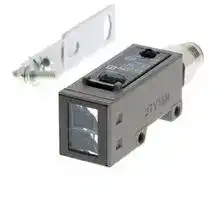


E3S-CD17
Photoelectric Sensor, 2 m, NPN / PNP, 100 mA, 10 VDC to 30 VDC
- Manufacturer: OMRON INDUSTRIAL AUTOMATION
- Product type:
- SVHC: To Be Advised
- Product Range: E3S-C Series
- Sensing Range Max: 2m
- Sensor Output Type: NPN / PNP
- Supply Voltage DC Max: 30V
- Supply Voltage DC Min: 10V
| Delivery and price | |
|---|---|
| Units per pack | 1 |
| Price | 192.1 € |
| Current stock | 10+ |
| Lead time | 30 days |

R

## Long Range Metal Body Sensor

## **E3S-C**

## 30 m Range With Advanced Fuzzy Logic

- H Mutual interference protection

- H NPN/PNP switch selectable output

- H M12 plug-in connector

- H Meets IP67 and NEMA 4X, 6P

- H Vibration resistance of 10 Hz to 2 kHz and a shock resistance of 1,000 m/s[2] (approx. 100 G)

## Ordering Information

## J **SENSORS**

|J **SENSORS**|||||
|---|---|---|---|---|
|Mountin**g**|Method of detection|Sensin**g**distance|**Part number**||
||||**Pre-leaded**|**Connector**|
|Horizontal|Through-beam|30 m (98.43 ft)|**E3S-CT11**|**E3S-CT16**|
||Polarized retroreflective|3 m (9.84 ft)|**E3S-CR11**|**E3S-CR16**|
||Diffuse reflective|70 cm (27.56 in)|**E3S-CD11**|**E3S-CD16**|
|||2 m (6.56 ft)|**E3S-CD12**|**E3S-CD17**|
|**Vertical**|Through-beam|30 m (98.43 ft)|**E3S-CT61**|**E3S-CT66**|
||Polarized retroreflective|3 m (9.84 ft)|**E3S-CR61**|**E3S-CR66**|
||Diffuse reflective|70 cm (27.56 in)|**E3S-CD61**|**E3S-CD66**|
|||2 m(6.56 ft)|**E3S-CD62**|**E3S-CD67**|


## J **ACCESSORIES**

|J **ACCESSORIES**||
|---|---|
|Description|**Part number**|
|Slits for E3S--CTjjsensors (4 pairs: 0.5 mm, 1.0 mm, 2 mm, and 4 mm wide, includes mounting hardware)|**E39-S61**|
|Mounting bracket for E39-R1 reflector|**E39-L7**|


## J **CONNECTOR CABLES**

|Connector type|Cable size|Length|Straight connector|Right angle connector|
|---|---|---|---|---|
|3-wire DC<br>**R**<br>MicroChange|22 AWG|2 m(6.56 ft)|**Y96E-43SD2**|**Y96E-43RD2**|
|||5 m(16.40 ft)|**Y96E-43SD5**|**Y96E-43RD5**|
|||10 m(32.8 ft)|**Y96E-43SD10**|**Y96E-43RD10**|


~~**E3S-C**~~

~~**E3S-C**~~

## J **REPLACEMENT PARTS**

|J **REPLACEMENT PARTS**||
|---|---|
|Description|**Part number**|
|Mounting bracket for E3S--Cj1j(horizontal)|**E39-L102**|
|Mounting bracket for E3S--Cj6j(vertical)|**E39-L103**|
|Reflector(supplied with retroreflective sensors)|**E39-R1**|


## Specifications

|Specifications|Specifications|||||
|---|---|---|---|---|---|
|Part number||E3S-CT11<br>E3S-CT61<br>E3S-CT16<br>E3S-CT66|E3S-CR11<br>E3S-CR61<br>E3S-CR16<br>E3S-CR66|E3S-CD11<br>E3S-CD61<br>E3S-CD16<br>E3S-CD66|E3S-CD12<br>E3S-CD62<br>E3S-CD17<br>E3S-CD67|
|Method of detection||Through-beam|Polarized<br>retroreflective|Diffuse reflective||
|Supply voltage||10 to 30 VDC, ¦10%||||
|Current consumption||50 mA max. (emitter and<br>receiver)|40 mA max.|||
|Sensing distance|White mat paper|0 to 30 m<br>(0 to 98.43 ft)|0 to 3 m<br>(0 to 9.84 ft)|0 to 70 cm<br>(0 to 27.56 in)|0 to 2 m<br>(0 to 6.56 ft)|
||With accessories|4-mm slit: 15 m<br>2-mm slit: 7 m<br>1-mm slit: 3.5 m<br>0.5-mm slit: 1.8 m|E39-R2: 0 to 4 m<br>E39-R3: 0 to 150 cm<br>E39-R4: 0 to 75 cm<br>E39-RSA: 5 to 35 cm<br>E39-RSB: 5 to 60 cm|___||
||Minimum object<br>size|4-mm slit: 2.6-mm dia.<br>2-mm slit: 2-mm dia.<br>1-mm slit: 1-mm dia.<br>0.5-mm slit: 0.5-mm dia.|E39-R1 Reflector:<br>13-mm dia.<br>E39-R3: 8-mm dia.<br>E39-R4: 4-mm dia.|___||
|Light source||Pulse modulated infrared<br>LED (880 nm)|Pulse modulated red<br>LED (700 nm)|Pulse modulated infrared LED (880 nm)||
|Standard ob**j**ect|Type|Opaque materials|Opaque materials|Opaque and transparent materials||
||Size|9 mm (3.54 in) min.|30 mm (1.18 in) min.|30 x 30 cm (11.81 x 11.81 in) white mat<br>paper||
|Operation mode||Light-ON/Dark-ON operation, switch selectable||||
|Variation in sensing|distance|--||¦10% max.||
|Hysteresis||--||20% max. of sensing distance||
|Variation in optical axis and mounting<br>direction||¦2!max.||||
|Sensitivity||Adjustable, 3/4 turn knob||Adjustable, 2-1/2 turn knob with clutch<br>and indicator||
|Mutual interference|protection|Not provided|Provided|||
|Control out**p**ut|Type|NPN or PNP(selectable), open collector current output||||
||Max. load|100 mA max.||||
||Residual voltage|NPN output: 1.2 V max., PNP output: 2.0 V max.||||
|Res**p**onse time|OFF|1 ms max.|||2 ms max.|
||ON|1 ms max.|||2 ms max.|
|Circuit protection||Output short-circuit protection, reversed polarity protection||||
|Vibration<br>resistance|Destruction|10 to 2 kHz, 1.5-mm double amplitude, or 300 m/s2 (approx. 30G) 0.5 hrs each in X, Y, and<br>Z axes||||
|Shock resistance|Destruction|1,000 m/s2 (approx. 100G)3 times each in X, Y, and Z axes||||


(This table continues on the next page.)

2

~~**E3S-C**~~

~~**E3S-C**~~

|Part number|Part number|E3S-CT11<br>E3S-CT61<br>E3S-CT16<br>E3S-CT66|E3S-CR11<br>E3S-CR61<br>E3S-CR16<br>E3S-CR66|E3S-CD11<br>E3S-CD61<br>E3S-CD16<br>E3S-CD66|E3S-CD12<br>E3S-CD62<br>E3S-CD17<br>E3S-CD67|
|---|---|---|---|---|---|
|Indicators|Emitter|Power ON(red)|Stabilit**y**indicator**(g**reen**),**Li**g**ht Incident**(**red**)**|||
||Receiver|Stability indicator (green),<br>Light Incident (red)||||
|Materials|Lens|Acrylic||||
||Case|Zinc die-cast||||
||Operationpanel|Sulfonatedpolyether||||
||Bracket|Stainless steel||||
|Mounting||Either side surface with two threaded holes. Bracket for horizontal (E39-L102) or vertical<br>(E39-L103) sensors and hardware included.||||
|Connections|Emitters|2-conductor cable,<br>2 m (6.56 ft) length or 4<br>pin, 12 mm connector|3-conductor cable, 2 m (6.56 ft) length (for prewired types)|||
||Receiver|3-conductor cable,<br>2 m (6.56 ft) length or 4<br>pin, 12 mm connector||||
|Wei**g**ht|Horizontal model|110g (3.88 oz.)||||
||Vertical model|115g (4.06 oz.)||||
|Enclosure ratin**g**s|IEC 144|IP67||||
||NEMA|1, 4X, 6P, 12, 13||||
|Ambient<br>temperature|Operating|-25!C to 55!C(-13!F to 131!F)||||
||Storage|-40!C to 70!C(-40!F to 158!F)||||


## J **OUTPUT CIRCUIT DIAGRAMS**

|Output<br>configuration<br>~~a~~|Mode switch<br>~~ee~~|Output transistor<br>~~ee~~|Output circuits<br>oe|
|---|---|---|---|
|NPN<br>~~a~~|Light-ON<br>~~ee~~<br>~~ee~~|ON when light is<br>received.<br>~~ee~~<br>~~ee~~|Light<br>indi-<br>cator<br>(Red)<br>Stability<br>indicator<br>(Green)<br>Load<br>Photo-<br>electric<br>sensor<br>**main**<br>10 to 30 VDC<br>PNP output<br>transistor<br>NPN and PNP<br>**output** **selector**<br>Load<br>current<br>**Control** **output**<br>Brown<br>Black<br>**(S**<br>circuit<br>0 V<br>NPN output<br>transistor<br>ZD : VZ= 39 V<br>Blue<br>ee<br>Note.)<br>Note:<br>Set the NPN and PNP output selector to NPN.<br>~~ie~~<br>oe|
||Dark-ON<br>~~ee~~|ON when light is<br>not received.<br>~~ee~~||
|PNP|Light-ON|ON when light is<br>received.|Light<br>indi-<br>cator<br>Stability<br>indicator<br>Photo-<br>electric<br>**sensor**<br>10 to 30 VDC<br>(Red)<br>**(**Green**)**<br>PNP output<br>transistor<br>**NPN** **and** **PNP**<br>**Control** **output**<br>Brown<br>**Black**<br>Load<br>main<br>circuit<br>0 V<br>output selector<br>NPN output<br>transistor<br>Load<br>current<br>(See<br>Note.)<br>Note:<br>Set the NPN and PNP output selector to PNP.<br>ZD : VZ= 39 V<br>Blue|
||Dark-ON|ON when light is<br>not received.||


3

~~**E3S-C**~~

~~**E3S-C**~~

## Engineering Data

## **EXCESS GAIN RATIO**

**==> picture [476 x 165] intentionally omitted <==**

**----- Start of picture text -----**<br>
E3S-CT j 6 E3S-CR j 6 (E39-R1 Reflector) E3S-CD j 6<br>a| a a a a |<br>zop —_____| 3op-___| PT gop[|<br>ee ee ee a ee ee mW | {| {| [| {|<br>OE | EE ——E ———————<br>a Fa ke<br>gi _\]oT 37—___ WJ gf—\[TT<br>ee ee 2 Ne ee ee PVN | ff<br>rr|S<br>ee ee —— ——— ><br>a eb a a a ee<br>Let tt COLEGU Ol<br>0 10 20 30 40 0 1 2 3 4 0 2 440 «246 80 100<br>Distance (m) Distance (m) Distance (cm)<br>Excess gain ratio Excess gain ratio Excess gain ratio<br>**----- End of picture text -----**<br>


**E3S-CT** j **6**

**==> picture [43 x 16] intentionally omitted <==**

**----- Start of picture text -----**<br>
E3S-CD j 2<br>E3S-CD j 7<br>**----- End of picture text -----**<br>


**==> picture [105 x 110] intentionally omitted <==**

**----- Start of picture text -----**<br>
DT ———<br>3ofh_\ | |<br>i ee<br>5 _SS<br>3 a<br>ee ee<br>1ee<br>0 1<br>Distance (m)<br>Excess gain ratio<br>**----- End of picture text -----**<br>


## **OPERATING RANGE**

**==> picture [138 x 172] intentionally omitted <==**

**----- Start of picture text -----**<br>
Parallel Operating Range<br>(Typical)<br>E3S-CT j 6<br>150 - Y |<br>X<br>100 — an |—<br>Ft |<br>Set distance<br>x (cm)<br>50Pp oIN<br>150<br>200ee ee<br>Detecting distance X (m)<br>(cm)<br>Parallel operating range Y<br>**----- End of picture text -----**<br>


## **Operating Range (Typical)**

**E3S-CD** j **6 (Left and Right)**

**==> picture [140 x 112] intentionally omitted <==**

**----- Start of picture text -----**<br>
20<br>Zi | inv<br>10 L Set distancex (cm)<br>| Sensingobject<br>Y<br>30 ea_| X<br>40| | =<br>Detecting distance X (cm)<br>(mm)<br>Operating position Y<br>**----- End of picture text -----**<br>


**E3S-CD** j **7 and E3S-CD** j **2 (Left and Right)**

**==> picture [145 x 112] intentionally omitted <==**

**----- Start of picture text -----**<br>
20<br>YY<br>Set distance<br>~10 / x (cm)Sensing<br>object<br>A | [LA]<br>Y<br>X<br>—30 = -ex_|<br>—40| I<br>Detecting distance X (cm)<br>(mm)<br>Operating position Y<br>**----- End of picture text -----**<br>


4

~~RO~~ ~~**E3S-C**~~

~~ooo~~ ~~**E3S-C**~~

## J **SENSING DISTANCE VS. OBJECT SIZE (TYPICAL)**

**E3S-CD** j **6**

**E3S-CD** j **7 E3S-CD** j **2**

**==> picture [323 x 152] intentionally omitted <==**

**----- Start of picture text -----**<br>
Sensing object: White paper Sensing object: White paper<br>Ue) Ty<br>OFF OFF<br>ON ON<br>in)TZ08lia 7 —<—<br>2<br>ee) A<br>:TEEpp ppt tfOL-<br>0 5X5 1010 20X20 30X30 40X40 0 5x5 10X10 20X20 3030 4040<br>Size of object (cm) Size of object (cm)<br>(m)<br>(m)<br>Sensing distance<br>Sensing distance<br>**----- End of picture text -----**<br>


## J **REFLECTOR PARALLEL MOVEMENT (TYPICAL)**

**==> picture [336 x 166] intentionally omitted <==**

**----- Start of picture text -----**<br>
E3S-CR j 6 E3S-CD j 7 and E3S-CD j 2 (Up and Down)<br>E39-R1<br>Reflector<br>{ Y TRL<br>-e — X ||)| TS/PNT<br>Set distance X (cm) Set distance<br>0 1.0 20 30 40 0——al§ X (cm) —<br>Sensing<br>object<br>Y<br>X<br>Detecting distance X (cm)<br>(cm) (mm)<br>Operating position Y<br>Parallel operating range Y<br>**----- End of picture text -----**<br>


5

~~**E3S-C**~~

~~**E3S-C**~~

## Dimensions

Unit: mm (inch)

## J **SENSORS**

**==> picture [474 x 285] intentionally omitted <==**

**----- Start of picture text -----**<br>
E3S-CT11, E3S-CR11<br>E3S-CD11, E3S-CD12 (0.73)18.5 Light indicator (red)50 (1.97) M3 x 5 Vinyl-insulated cord with three conductors, 4 mm OD;standard length: 2 m (6.56 ft.)<br>20<br>(0.79)20.4<br>(0.80)<br>Mounting holes<br>22.2<br>(0.87) Two, M4<br>Stability indicator (green) 12<br>(0.47)<br>(0.36)9.2 4.2 (0.17) 4.2 (0.17) (0.79)20 25.4(1.00)<br>Two mounting holes 4.2 (0.17)6.2 (0.24) (0.33)8.3<br>25.4 (1.00)<br>38.2 (1.50) a<br>Lens (17 x 11) Receiver**<br>2.2<br>(0.09) 11.5 (0.45)<br>(0.80)20.2 Two, M4 23<br>(0.91)<br>7.7 (0.30) 29.5<br>(1.16)17.3<br>(0.68)<br>Optical axis 9.3 (0.37)<br>Emitter<br>* The mounting bracket can kh be attached to side A. 1.5 : oa (0.82)20.8 25.4(1.00) Ll OF<br>(0.06)<br>**----- End of picture text -----**<br>


- ** For E3S-CT11, optical viewing for the emitter and the receiver are from the top portion of the sensor.

6

~~**E3S-C**~~

~~**E3S-C**~~

**==> picture [480 x 298] intentionally omitted <==**

**----- Start of picture text -----**<br>
E3S-CT61, E3S-CR61 57 (2.24) Vinyl-insulated cord with three conductors, 4 mm OD;<br>E3S-CD61, E3S-CD62 20.8 (0.82) Receiver**Emitter standard length: 2 m (6.56 ft.)<br>20 (0.79) 6.1 (0.24) dia.<br>20.4<br>(0.80)<br>4 (0.16) dia.<br>22.2<br>(0.87)<br>Optical Mounting holes<br>Lens (17 x 11) axis 12<br>(0.47)20 Two, M4<br>(0.79)<br>9.2 (0.36)<br>4.2 (0.17) 25.4<br>(1.00)<br>| Two mounting holes 4.2 (0.17)<br>5.6 (0.22)<br>ps 14.4<br>| 14.4 (0.57) i <0 (0.57)<br>25.4 (1.00)<br>Stability 31 (1.22)<br>indicator J 43.8 (1.72)<br>(green) 7.2 (0.28) Light indicator(red) 5.8 (0.23) (0.09)2.2<br>11.5 (0.45)<br>20.2<br>(0.79) Two, M4 23<br>32.2<br>a SZ (0.91)<br>(1.27)<br>na ae ALL<br>12 (0.47)<br>M3 x 5<br>* The mounting bracket canbe attached to side A. (0.91)23.2 (1.22)31 1.5 (0.06)<br>**----- End of picture text -----**<br>


- ** For E3S-CT61, optical viewing for the emitter and the receiver are from the top portion of the sensor.

7

~~**E3S-C**~~

~~**E3S-C**~~

## **E3S--CT16**

**==> picture [481 x 298] intentionally omitted <==**

**----- Start of picture text -----**<br>
74 (2.91)<br>50 (1.97)<br>18.5 Stability indicator M3 x 5<br>(0.73) (receiver) (green)<br>20<br>(0.79)<br>20.4<br>(0.80)<br>Mounting holes<br>Light indicator (receiver) (red) 22.2<br>Power indicator (emitter) (red) (0.87) 12 Two, M4<br>(0.47)<br>(0.36)9.2 4.2 (0.17)42 (0.79)20<br>25.4<br>(1.00)<br>8.3<br>Two, Mounting holes Ema 4.2 (0.33)  li 9<br>6.2<br>25.4 (1.00)<br>38.2 (1.50)<br>Lens (17 x 11) [Optical axis]<br>11.5<br>20.2 2.2 (0.45)<br>(0.80) (0.09)<br>Two, M4<br>12.7<br>(0.50) 29.5 23<br>(1.16) (0.91)<br>17.3<br>9.3 (0.68)<br>(A) (See Note.) (0.37)<br>Cb 1.5 Pera 20.8 25.4 ¥St<br>(0.06) (0.82) (1.00)<br>Note: Mounting bracket can be<br>attached to side A.<br>**----- End of picture text -----**<br>


## **E3S--CT66**

**==> picture [477 x 312] intentionally omitted <==**

**----- Start of picture text -----**<br>
74<br>57 (2.91) M12<br>15.8 Optical axis(2.24)<br>(0.62)<br>20 20.4<br>(0.79) (0.80)<br>22.2 Mounting holes<br>Lens (17 x 11) (0.87) 12 Two, M4<br>4.2 (0.47) 20<br>9.2 (0.79)<br>(0.36)<br>25.4<br>Smet eo (1.00)<br>Mounting screw holes<br>Two, Mounting holes 4.2 4.2<br>5.6 14.4<br>14.4 (0.57)<br>(0.57) 25.4 (1.00)<br>31 (1.22)<br>Stability indicator(receiver) (green) Light indicator (receiver) (red) 43.8 (1.72)<br>Power indicator<br>7.2 (emitter) (red) 2.2<br>4.4 (0.09)<br>5.8 11.5<br>(0.45)<br>20.2 Two, M4 23<br>(0.80) 32.2 (0.91)<br>(1.27)<br>12<br>(A) (0.47)<br>(See M3 x 5<br>Note.)<br>Note: Mounting bracket can be (0.91)23.2 (1.22)31 (0.06)1.5<br>attached to side A.<br>**----- End of picture text -----**<br>


8

~~**E3S-C**~~

~~**E3S-C**~~

## **E3S-CR16/-CD16/-CD17**

**==> picture [486 x 653] intentionally omitted <==**

**----- Start of picture text -----**<br>
74 (2.91)<br>50 (1.94)<br>18.5<br>(0.73) Stability indicator (green) M3 x 5<br>20<br>(0.79)<br>20.4<br>(0.80)<br>22.2 Mounting holes<br>Light indicator (red)<br>(0.87) 12 Two, M4<br>(0.47)<br>9.2 4.2 20<br>(0.36) 4.2 (0.17) (0.79)<br>25.4<br>(1.00)<br>Two, Mounting holes 4.2 8.3<br>6.2 25.4 (1.00)<br>38.2 (1.50)<br>Lens (17 x 11) Receiver<br>2.2 11.5<br>20.2 (0.09) (0.45)<br>(0.80) Two, M4<br>29.5 23<br>7.7 (1.16) (0.91)<br>17.3<br>9.3 (0.68)<br>(A) (0.37)<br>(See Optical Emitter<br>note) axis<br>pero 1.5 20.8 25.4 yl.<br>(0.06) (0.82) (1.00)<br>Note : Mounting bracket can be<br>attached to side A.<br>E3S-CR66/-CD66/-CD67<br>74 (2.91)<br>57 (2.24)<br>20.8<br>(0.82) 9 Optical axis Emitter<br>(0.35)<br>20<br>(0.79) 20.4<br>(0.80)<br>Receiver Mounting holes<br>22.2 12<br>Lens (17  "  11) (0.87)(0.47) Two, M4<br>20<br>(0.79)<br>4.2  [9.2]<br>25.4<br>(1.00)<br>Two, Mounting holes 4.2 4.2<br>5.6 14.4<br>14.4<br>(0.57)<br>(0.57) 25.4 (1.00)<br>31 (1.22)<br>43.8 (1.72)<br>Stability indicator (green)<br>Light indicator (red) 2.2<br>7.2 4.4 (0.09)<br>5.8 11.5<br>(0.45)<br>23<br>20.2 Two, M4 (0.91)<br>(0.80)<br>32.2<br>(1.27)<br>12<br>(A) (0.47)<br>(See M3 x 5<br>note) a b pao we<br>Lone 23.2 31 _y® 1.5<br>Note : Mounting bracket can be (0.91) (1.22) (0.06)<br>attached to side A.<br>**----- End of picture text -----**<br>


## **E3S-CR66/-CD66/-CD67**

9

~~**E3S-C**~~

~~**E3S-C**~~

## J **CORNER CUBE REFLECTORS**

**==> picture [461 x 328] intentionally omitted <==**

**----- Start of picture text -----**<br>
E39-R1 Retroreflector 40.3<br>(1.59)<br>(Included with E3S- Two, 3.5 dia. 34 7.5<br>CR11/CR61) 7 (1.34) (0.30)<br>oaIG<br>| | |<br>ee |<br>62.1 (2.46)<br>59.9 52<br>(2.36) (2.05)<br>| |<br>| (Art 8 (0.31)<br>1.6 2.7<br>(0.06) (0.11)<br>E39-S61 Slit Kit for E3S-C | See note ain (0.01)0.2<br>11<br>(0.43)<br>(0.79)20 (0.24)6.2 (0.46)11.8<br>3.8<br>f = I (0.15)<br>6.5<br>(0.26)<br>Note : This size is 0.5 mm, 1 mm, 2 mm,<br>20.1 (0.79) _ .| or 4 mm depending on the type.<br>**----- End of picture text -----**<br>


10

~~ORO~~ ~~**E3S-C**~~

~~ooo~~ ~~**E3S-C**~~

## Nomenclature

## J **OPERATION PANEL**

Use the NPN and PNP output selector on the operation panel to select the type of output transistor.

Use the Light-ON and Dark-ON selector on the operation panel to select the operation mode of the E3S-C.

## **Horizontal Model**

## **Vertical Model**

**==> picture [374 x 183] intentionally omitted <==**

**----- Start of picture text -----**<br>
Stability indicator (green)<br>Stability indicator (green)<br>Light incident indicator (red) Light incident indicator (red)<br>Sensitivity<br>adjuster<br>Sensitivity<br>L-ON and D-ON adjuster<br>selector<br>Model Number<br>rl i By<br>Laa PIS L-ON and D-ON selector |<br>NPN and PNP<br>NPN and PNP output selector output selector<br>**----- End of picture text -----**<br>


11

~~**E3S-C**~~

~~**E3S-C**~~

## Operation

## J **FUZZY LOGIC MUTUAL INTERFERENCE PREVENTION FUNCTION**

## **(FOR E3S-CR** jj **AND E3S-CD** jj **ONLY)**

If photoelectric sensors are installed side by side, each Sensor may be influenced (or malfunction) by the light emitted from the other sensors. This is known as mutual interference.

The fuzzy logic mutual interference prevention function of the E3S-C enables the E3S-C to monitor light interference over a certainperiodof time. BeforetheE3S-Cstarts emittinglight, theE3S-C retrieves the intensity and frequency of surrounding light interferenceasdata.Usingthisdata,theE3S-Ccalculates,withfuzzyinference, therisk of theE3S-Cmalfunctioningandcontrols the timingof the E3S-C’s light emission.

When the risk is low, the E3S-C waits until there is no light interference and emits light.

**==> picture [47 x 34] intentionally omitted <==**

**----- Start of picture text -----**<br>
Light interference<br>Emission pattern<br>**----- End of picture text -----**<br>


Whentherisk ishigh, theE3S-Cemitslight betweeneachlightinterference moment.

Light interference Emission pattern

## J **SENSITIVITY ADJUSTMENT (REFLECTIVE SENSORS)**

**==> picture [486 x 292] intentionally omitted <==**

**----- Start of picture text -----**<br>
a Steps Step 1 a Step 2 Step 3<br>CR Function Determine position A GO Determine position B Adjust to optimum setting<br>Sensing Photoelectric sensor Photoelectric sensor Photoelectric sensor<br>condition s l cl = {[e—on || =o -<br>I Hl<br>Sensitivity<br>adjustor A A B<br>B<br>Min. Max. Min. Max. Min. Max.<br>Indicators OFF ON OFF OFF OFF ON<br>STABILITY LIGHT STABILITY LIGHT STABILITY LIGHT<br>(green) (red) (green) (red) (green) (red)<br>pofe Procedure [fee] Place target at the desired sensing Remove the target. Starting from the fm Set the sensitivity indicator to the<br>distance. Set sensitivity adjuster to the maximum scale position, gradually position between Positions A and B (in<br>minimum scale position, and gradually decrease sensitivity by turning the some cases, Positions A and B are<br>increase sensitivity by turning the sensitivity adjuster counterclockwise opposite of the above example). The<br>sensitivity adjuster clockwise until the until the Light Incident indicator (red photoelectric sensor will then work<br>Light Incident indicator (red LED) LED) turns OFF. Position B normally if the stability indicator<br>turns ON. Position A designates the designates the point at which the LED (green) is lit with and without the<br>point at which the LED has turned on. has turned OFF. target. If it is not lit, stable operation<br>cannot be guaranteed,in which case a<br>different detection method should be<br>applied.<br>Sensing object<br>Sensing object Sensing object<br>**----- End of picture text -----**<br>


Unlike conventional photoelectric sensors, the variation in the sensitivity among several E3S-C photoelectric sensors is minimal. This means the sensitivity can be adjusted on only a single photoelectric sensor, and then the adjusters on the other E3S-C photoelectric sensors can be set to the same scale position. There should be no need to adjust the sensitivity of each photoelectric sensor individually.

12

~~**E3S-C**~~

~~**E3S-C**~~

## Precautions

## J **CONNECTION**

If the input/output lines of the photoelectric sensor are placed in the sameconduit orduct as powerlinesorhigh-voltagelines, thephotoelectric sensor could be induced to malfunction, or be damaged, by the electrical noise. Either separate the wiring, or use shielded lines as input/output lines to the photoelectric sensor.

## J **WATER RESISTANCE**

To ensure the water resistance of the E3S-C, tighten the screws of the operation panel cover to a torque of 3.5 to 5.5 kgf S cm (0.34 N S m to 0.54 N S m).

The cord connected to the E3S-C can be extended up to 100 m providedthat thediameterofeachwireof thecordis0.3mm[2] minimum.

## J **POWER SUPPLY**

If the standard switching regulator is used as a power supply, the frame ground (FG) terminal and the ground (G) terminal, on the power supply, must be grounded. If this is not done the E3S-C may malfunction, due to the switching noise of the power supply.

If an inverter motor or servomotor is used with the E3S-C, the frame ground (FG) terminal and the ground (G) terminal, on the motor, must be grounded, otherwise the E3S-C may malfunction.

## Installation

## J **MOUNTING**

Use M4 screws to mount the E3S-C. The tightening torque of each screw must be 12 kgf S m (1.18 N S m) maximum.

## J **DIRECT MOUNTING**

Mount the E3S-C as shown in the following illustrations.

**==> picture [124 x 195] intentionally omitted <==**

**----- Start of picture text -----**<br>
Two, 4.5 dia.<br>through holes<br>—<br>=<br>= .<br>M4 _—<br>a 3<br>M4 hole<br>SE [@] A<br>M4 hole<br>Two, M3<br>M4 hole<br>a AF<br>N ere<br>SS M4 hole<br>M3<br>**----- End of picture text -----**<br>


## J **OPTICAL AXIS OF THROUGH-BEAM SENSOR**

The E3S-C through-beam models incorporate two lenses, one of which will be used as shown inthe followingillustration. Whenusing a slit, the slit must be on the side where the lens is located.

**==> picture [56 x 12] intentionally omitted <==**

**----- Start of picture text -----**<br>
Lens in use. The slit<br>must be on this side.<br>**----- End of picture text -----**<br>


**==> picture [44 x 5] intentionally omitted <==**

**----- Start of picture text -----**<br>
Lens not in use.<br>**----- End of picture text -----**<br>


13

~~**E3S-C**~~

~~**E3S-C**~~

**NOTE: DIMENSIONS SHOWN ARE IN MILLIMETERS. To convert millimeters to inches divide by 25.4.**

R

**OMRON ELECTRONICS LLC** One East Commerce Drive Schaumburg, IL 60173 **1-800-55-OMRON**

## **OMRON ON--LINE**

Global -- http://www.omron.com USA -- http://www.omron.com/oei Canada -- http://www.omron.com/oci

**OMRON CANADA, INC.** 885 Milner Avenue Scarborough, Ontario M1B 5V8 **416-286-6465**

Cat. No. CEDSAX4

Specifications subject to change without notice.

Printed in U.S.A.

11/01
Updated at April 23, 2026
With a legacy spanning over 80 years, Omron Industrial Automation is a globally recognized leader in the manufacture of advanced industrial control and automation components. Renowned for their reliability and engineering excellence, Omron delivers comprehensive solutions that enhance efficiency, machine safety, and precision across a wide range of manufacturing environments. Our extensive portfolio of Omron products is heavily focused on their industry-leading sensing and switching technologies. We offer a vast selection of sensors, excelling specifically in high-performance proximity sensors, light sensors, and temperature sensors. Complementing this range are robust switching solutions, featuring a deep inventory of power relays, solid-state relays, safety relays, and essential relay accessories designed for demanding operational requirements. Beyond sensing and switching, Omron is highly regarded for its precision automation and process control equipment. Our selection features highly accurate temperature controllers, versatile process controllers, and sophisticated panel displays and instrumentation. To support these fundamental systems, we also supply dependable Omron power supplies, notably AC/DC converters, alongside vital connectivity components like DIN rail terminal blocks to ensure secure, efficient, and complete industrial setups.
About Novapart
Novapart is a B2B electronic component broker specialising in stock shortages and cost reduction. We source hard-to-find parts and identify compliant alternatives across a catalogue of 410,000+ components from 500+ manufacturers.
Learn more →Stock Shortage Specialist
When a component is unavailable, discontinued or has an unacceptable lead time, we tap into our network of vetted European and Asian distributors to source what you need — without compromising on quality or traceability.
Request a quote →Compliant Alternatives
We identify pin-to-pin, electrically equivalent substitutes that meet the same certifications (RoHS, AEC-Q100, REACH) as your original specification — validated against datasheets, not just part numbers. Often at a lower cost.
BOM Analysis service →