
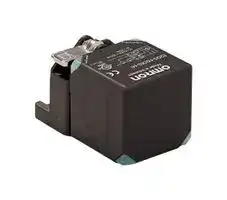


E2Q5-N20F3-M1
Inductive Proximity Sensor, 20 mm, PNP/SPST-NO/NC, M12, 10 V to 30 V
- Manufacturer: OMRON INDUSTRIAL AUTOMATION
- Product type: Inductive Proximity Sensors
- SVHC: To Be Advised
- Product Range: E2Q5 Series
- Sensing Range Max: 20mm
- Sensor Output Type: PNP / SPST-NO / SPST-NC
- Thread Size - Metric: M12
- Supply Voltage DC Max: 30V
- Supply Voltage DC Min: 10V
| Delivery and price | |
|---|---|
| Units per pack | 1 |
| Price | 74.21 € |
| Current stock | 10+ |
| Lead time | 30 days |

## Long Distance Square Inductive Proximity Sensor **E2Q5**

## _Square Proximity Sensor_

- M12 Plug-in connection

- Integrated short circuit and reverse polarity protection

- Active face positioning: Y-axis 15°, X-axis 90° incremets

## Ordering Information

|Sensing<br>distance|Connection|Active<br>face|Output<br>NO<br>NO + NC|Output<br>NO<br>NO + NC|Output<br>NO<br>NO + NC|
|---|---|---|---|---|---|
|20 mm<br>shielded|Plug-in<br>connector|Changable|NPN|E2Q5-N20E1-M1|E2Q5-N20E3-M1|
||||PNP|E2Q5-N20F1-M1|E2Q5-N20F3-M1|
|40 mm<br>non-shielded|||NPN|E2Q5-N40ME1-M1|E2Q5-N40ME3-M1|
||||PNP|E2Q5-N40MF1-M1|E2Q5-N40MF3-M1|


**E2Q5**

D-1

Rating/performance

|Item<br>Model<br>~~Pp~~|shielded<br>~~Pp~~|non-shielded|
|---|---|---|
||E2Q5-N20##-M1<br>~~Pp~~<br>~~DO~~|E2Q5-N40M#3-M1<br>~~DO~~|
|Sensingdistance Sn<br>~~eG~~|20 mm ± 10%<br>~~eG~~|40 mm ± 10%<br>~~eG~~|
|Standard target size, L x W x H, Fe 37<br>~~eG~~<br>~~a~~|60 x 60 x 1 mm<br>~~eG~~|120 x 120 x 1 mm<br>~~eG~~|
|Settingdistance<br>~~a~~<br>~~a~~|0 to 16,2 mm|0 to 32,4 mm|
|Switchingfrequency<br>~~a~~<br>~~a~~|150 Hz||
|Sensingobject<br>~~a~~<br>~~a~~|Ferrous metals||
|Differential travel<br>~~a~~<br>~~a~~|15% max. of sensingdistance Sn||
|Operatingvoltage<br>~~a~~<br>~~a~~|10 to 30 VDC||
|Current consumption<br>~~a~~<br>~~a~~<br>~~——~~|20 mA max.<br>~~pe~~||
|Control output<br>Type<br>Load<br>On-stage voltage drop <br>~~a~~<br>~~——~~|E2Q5-N###E1-##: NPN - NO<br>E2Q5-N###E3-##: NPN - NO + NC<br>E2Q5-N###F1-##: PNP - NO<br>E2Q5-N###F3-##: PNP - NO + NC<br>~~pe~~||
||200 mA max.<br>~~pe~~||
||3 VDC max. (at 200 mA load current)<br>~~pe~~||
|Circuit protection<br>~~——~~<br>~~eG~~|Reverse polarity, output short circuit<br>~~pe~~<br>~~eG~~||
|Indicator<br>~~eG~~<br>~~eG~~|Operatingindicator (yellow LED), operatingvoltage (green LED)<br>~~eG~~<br>~~eG~~||
|Ambient temperature<br>~~eG~~<br>~~eG~~|Operating: -25° to 85°C<br>~~eG~~<br>~~eG~~||
|Ambient humidity<br>~~eG~~|35 to 95% RH<br>~~eG~~||
|Influence of temperature<br>~~eG~~|± 10% max. of Sn at 23° in temperature range of -25° to 70°C<br>~~eG~~||
|Dielectric strength<br>~~eG~~|1.500 VAC, 50/60 Hz for 1 min. between current carryparts and case<br>~~eG~~||
|Electromagnetic compatibilityEMC<br>~~eG~~|EN 60947-5-2<br>~~eG~~||
|Vibration resistance<br>~~eG~~|10 to 55 Hz, 1 mm amplitude accordingIEC 60068-2-6<br>~~eG~~||
|Shock resistance<br>~~GO~~|Approx. 30 G for 11 ms accordingto IEC 60068-2-27<br>~~GO~~||
|Protection degree<br>~~a~~|IP67 IEC 60529, IP69K DIN 40050<br>~~a~~<br>~~(~~||
|Connection<br>Connector<br>~~a~~<br>~~——————~~|M12 plug, 4 pins<br>~~a~~<br>~~G~~<br>~~——————~~||
|Material<br>Case<br>Sensingface<br>~~——————~~|PBT<br>~~——————~~||
||PBT<br>~~——————~~<br>~~Pe~~||
|Approvals<br>~~——————~~<br>~~a~~|**CERTIFIED**<br>~~——————~~|**LISTED**<br>~~——————~~|


Inductive Sensors

D-2

Output Circuit Diagramm

## NPN output

**==> picture [512 x 361] intentionally omitted <==**

**----- Start of picture text -----**<br>
Operation<br>Model Timing chart Output circuit<br>mode<br>Brown<br>+V<br>Non-sensing zone Sensing zone 4.7kΩ Load<br>Sensing Operation<br>object Proximity Indicator<br>Sensor (yellow) Black<br>(%) 100 0 main<br>E2Q5-N20E1-M1 circuits<br>E2Q5-N40ME1-M1 NO Blue<br>0 V<br>ON<br>OFF Yellow indicator Connector Pin Arrangement<br>ON<br>OFF Control output 1<br>2 4<br>3<br>Note: Terminal 2 is not used<br>Brown<br>+V<br>Non-sensing zone Sensing zone<br>4.7kΩ 4.7kΩ Load<br>Sensing<br>object OperationIndicator<br>(yellow) Black<br>(%) 100 0 Proximity Load<br>Sensor NO<br>E2Q5-N20E3-M1E2Q5-N40ME3-M1 NO + NC main circuits   WhiteNC<br>ON<br>Yellow indicator Blue<br>OFF 0 V<br>ON<br>OFF Control output NO<br>ON Connector Pin Arrangement<br>OFF [Control output NC]<br>1<br>2 4<br>3<br>Proximity<br>Sensor<br>Proximity<br>Sensor<br>distance  sensing Rated<br>distance  sensing Rated<br>**----- End of picture text -----**<br>


**E2Q5**

D-3

## PNP output

**==> picture [512 x 363] intentionally omitted <==**

**----- Start of picture text -----**<br>
Operation<br>Model Timing chart Output circuit<br>mode<br>Brown<br>+V<br>Non-sensing zone Sensing zone ProximitySensor Black<br>main  Operation<br>Sensing circuits   Indicator<br>object (yellow)<br>(%) 100 0 4.7kΩ Load<br>E2Q5-N20F1-M1<br>E2Q5-N40MF1-M1 NO Blue 0 V<br>ON<br>OFF Yellow indicator Connector Pin Arrangement<br>ON<br>OFF Control output 1<br>2 4<br>3<br>Note: Terminal 2 is not used<br>Brown<br>+V<br>Non-sensing zone Sensing zone White<br>Sensing ProximitySensor NC<br>object main  Black<br>(%) 100 0 circuits   OperationIndicator NO Load<br>(yellow)<br>E2Q5-N20F3-M1 NO + NC 4.7kΩ 4.7kΩ Load<br>E2Q5-N40MF3-M1<br>ON Yellow indicator Blue<br>OFF 0 V<br>ON<br>OFFON Control output NO Connector Pin Arrangement<br>OFF [Control output NC]<br>1<br>2 4<br>3<br>Proximity<br>Sensor<br>Proximity<br>Sensor<br>distance  sensing Rated<br>distance  sensing Rated<br>**----- End of picture text -----**<br>


## Dimensions (Unit:mm)

## E2Q5-...-M1 type

**==> picture [195 x 229] intentionally omitted <==**

**----- Start of picture text -----**<br>
LED yellow LED green LED yellow<br>67<br>LED green<br>40<br>5.5<br>46 ø 5.5<br>60<br>M12 x 1<br>7<br>40 20 30<br>**----- End of picture text -----**<br>


Inductive Sensors

D-4

Precautions

## ~~Po~~ ! Caution

## Power supply

Do not impose an exessive voltage on the E2Q2, otherwise it may explode or burn.

Do not connect an AC power supply to any DC model. If AC power (100 VAC or more) is supplied to the sensor, it may explode or burn.

**==> picture [167 x 49] intentionally omitted <==**

**----- Start of picture text -----**<br>
Brown<br>Load<br>Sensor Incorrect<br>Black<br>Blue<br>**----- End of picture text -----**<br>


## Mutual Interference

If more than one Sensor is located in parallel, ensure to maintain enough space between adjacent Sensors to suppress mutual interference as provided in the following diagram.

|A<br>Side-by-side<br>ale|A<br>Side-by-side<br>ale|A<br>Side-by-side<br>ale|A<br>Side-by-side<br>ale|A<br>Side-by-side<br>ale|A<br>Side-by-side<br>ale|A<br>Side-by-side<br>ale|A<br>Side-by-side<br>ale|A<br>Side-by-side<br>ale||
|---|---|---|---|---|---|---|---|---|---|
|Mutual Interference(Unit: mm)||||||||||
|Model<br>Length|||||||||A|
|E2Q5-N20##-M1|||||||||40|
|E2Q5-N40M##-M1|||||||||150|


## Power Reset Time

Be sure to abide by the following precautions for the safe operation of the Sensor.

The Sensor is ready to operate within 300 ms after the Sensor is turned ON. If the load and Sensor are connected to independent power supplies respectively, be sure to turn ON the Sensor before supplying power to the load.

## Wiring

Power Supply Voltage and Output Load Power Supply Voltage

Make sure that the power supply to the Sensor is within the rated voltage range. If a voltage exceeding the rated voltage range is supplied to the Sensor, it may explode or burn.

## Power OFF

The Proximity Sensor may output a pulse signal when it is turned OFF. Therefore, it is recommended that the load be turned OFF before turning OFF the Proximity Sensor.

## Power Supply Transformer

## Load Short-circuiting

Do not short-circuit the load, otherwise the Sensor may be damaged.

## Connection without Load

Do not connect the power supply to the Sensor with no load connected, otherwise the internal elements may explode or burn.

When using a DC power supply, make sure that the DC power supply has an insulated transformer. Do not use a DC power supply with an auto-transformer.

## Sensing Object

The sensing distance of the Proximity Sensor vary with the metal coating on sensing objects.

## Wiring

## Operating Environment

Do not use the Sensor in locations with explosive or flammable gas.

## Correct Use ~~Po~~

## Design

High-tension cables Wiring through Metal Conduit:

If there is power or high-tension line near the cable of the Proximity Sensor, wire the cable through an independent metal conduit to prevent against Proximity Sensor damage or malfunction.

## Effects of Surrounding Metal

Provide a minimum distance between the Sensor and the surrounding metal as shown in the table below.

**==> picture [39 x 72] intentionally omitted <==**

**----- Start of picture text -----**<br>
ns<br>B<br>L<br>A<br>C<br>**----- End of picture text -----**<br>


Effects of Surrounding Metal  (Unit: mm)

|Model<br>Length|A|B|C|
|---|---|---|---|
|E2Q5-N20##-M1|45|0|0|
|E2Q5-N40M##-M1|120|300|40|


**E2Q5**

D-5

## Mounting

## Mounting the Sensor

The Proximity Sensor must be subjected to excessive shock with a hammer when it is installed, otherwise the Proximity Sensor may be damaged or lose its water-resistivity.

## Environment

## Water Resistivity

Do not use the Proximity Sensor underwater, outdoors or in the rain.

## Operating Environment

## Maintenance and Inspection

Periodically perform the following checks to ensure stable operation of the Proximity Sensor over a long period of time.

- Check for mounting position, dislocation, looseness or distortion of the Proximity Sensor and sensing objects.

- Check for loose wiring and connections, improper contacts and line breakage.

- Check for attachment or accumulation of metal powder or dust.

- Check for abnormal temperature conditions and other environmental conditions.

Be sure to use the Proximity Sensor within its operating ambient temperature range and do not use the Proximity Sensor outdoors so that its reliability and life expectancy can be maintained. Although the Proximity Sensor is water resistive, a cover to protect the Proximity Sensor from water or water-soluble machining oil is recommended so that its reliability and life expectancy can be maintained.

Do not use the Proximity Sensor in an environment with chemical gas (e.g., strong alkaline or acid gasses including nitric, chromic and concentrated sulfuric acid gases).

Never disassemble or repair the Sensor.

## Inrush Current

A load that has a large inrush current (e.g., a lamp or motor) will damage the Proximity Snesor, in this case connect the load to the Proximity Sensor through a Relay

ALL DIMENSIONS SHOWN ARE IN MILLIMETERS.

To convert millimeters into inches, multiply by 0.03937. To convert grams into ounces, multiply by 0.03527.

In the interest of product improvement, specifications are subject to change without notice.

Cat. No. E47 E-EN-01

Inductive Sensors

D-6
Updated at June 8, 2026
With a legacy spanning over 80 years, Omron Industrial Automation is a globally recognized leader in the manufacture of advanced industrial control and automation components. Renowned for their reliability and engineering excellence, Omron delivers comprehensive solutions that enhance efficiency, machine safety, and precision across a wide range of manufacturing environments. Our extensive portfolio of Omron products is heavily focused on their industry-leading sensing and switching technologies. We offer a vast selection of sensors, excelling specifically in high-performance proximity sensors, light sensors, and temperature sensors. Complementing this range are robust switching solutions, featuring a deep inventory of power relays, solid-state relays, safety relays, and essential relay accessories designed for demanding operational requirements. Beyond sensing and switching, Omron is highly regarded for its precision automation and process control equipment. Our selection features highly accurate temperature controllers, versatile process controllers, and sophisticated panel displays and instrumentation. To support these fundamental systems, we also supply dependable Omron power supplies, notably AC/DC converters, alongside vital connectivity components like DIN rail terminal blocks to ensure secure, efficient, and complete industrial setups.
About Novapart
Novapart is a B2B electronic component broker specialising in stock shortages and cost reduction. We source hard-to-find parts and identify compliant alternatives across a catalogue of 410,000+ components from 500+ manufacturers.
Learn more →Stock Shortage Specialist
When a component is unavailable, discontinued or has an unacceptable lead time, we tap into our network of vetted European and Asian distributors to source what you need — without compromising on quality or traceability.
Request a quote →Compliant Alternatives
We identify pin-to-pin, electrically equivalent substitutes that meet the same certifications (RoHS, AEC-Q100, REACH) as your original specification — validated against datasheets, not just part numbers. Often at a lower cost.
BOM Analysis service →