
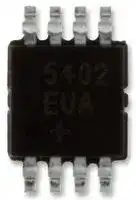


DS1090U-2+T
Timer, Oscillator & Pulse Generator, 4MHz, 3V to 5.5V, µMAX-8
- Manufacturer: ANALOG DEVICES
- Product type: Timers, Oscillators & Pulse Generators
- Digital IC Case: µMAX
- Operating Temperature Max: 85°C
- Operating Temperature Min: -40°C
| Delivery and price | |
|---|---|
| Units per pack | 6000 |
| Price | 1.14 € |
| Current stock | 10+ |
| Lead time | 30 days |

## **DS1090**

## **Low-Frequency, Spread-Spectrum EconOscillator**

## **General Description**

The DS1090 is a low-cost, dithered oscillator intended to be used as an external clock for switched-mode power supplies and other low-frequency applications. The dithering or sweeping function reduces peak-radiated emissions from the power supply at its fundamental frequency, as well as harmonic frequencies. The device consists of a resistor-programmed master oscillator, factory-programmed clock prescaler, and a pin-programmed dither circuit. These features allow the DS1090 to be used in applications where a spread-spectrum clock is desired to reduce radiated emissions. A combination of factory-set prescalers and external resistor allows for output frequencies ranging from 125kHz to 8MHz. Both dither frequency and dither percentage are set using control pins.

## **Applications**

- Switched-Mode Power Supplies

- Servers

- Printers

- Embedded Microcontrollers

- Industrial Controls

## **Typical Operating Circuit**

**==> picture [242 x 170] intentionally omitted <==**

**----- Start of picture text -----**<br>
VIN VOUT<br>VCC<br>DC-DC<br>STEP-DOWN<br>CONVERTER<br>VCC OUT<br>JC0<br>DS1090 JC1<br>RSET J0<br>45kΩ J1<br>TO 91kΩ GND<br>**----- End of picture text -----**<br>


_EconOscillator is a trademark of Maxim Integrated Products, Inc._

## **Features**

- Low-Cost, Spread-Spectrum EconOscillator™

- Simple User Programming

- Output Frequency Programmable from 125kHz  to 8Hz

- Dither Percentage Programmable from 0% to 8%

- Dither Rate Programmable (fMOSC/512, 1024, 2048, or 4096)

- 3.0V to 5.5V Single-Supply Operation

- CMOS/TTL-Compatible Output

- Operating Temperature Range: -40°C to +85°C

## **Ordering Information**

|**PART**|**OUTPUT**<br>**FREQUENCY**<br>**RANGE**|**PRESCALER**|**PIN-**<br>**PACKAGE**|
|---|---|---|---|
|DS1090U-1+|4MHz to 8MHz|1|8µSOP|
|DS1090U-2+|2MHz to 4MHz|2|8µSOP|
|DS1090U-4+|1MHz to 2MHz|4|8µSOP|
|DS1090U-8+|500kHz to<br>1MHz|8|8 µSOP|
|DS1090U-16+|250kHz to<br>500kHz|16|8 µSOP|
|DS1090U-32+|125kHz to<br>250kHz|32|8 µSOP|
|||||


_Add “T” for Tape & Reel orders._

## **Pin Configuration**

**==> picture [242 x 152] intentionally omitted <==**

**----- Start of picture text -----**<br>
TOP VIEW<br>OUT 1 8 JC1<br>RSET 2 DS1090 7 JC0<br>VCC 3 6 J1<br>GND 4 5 J0<br>µSOP<br>**----- End of picture text -----**<br>


**==> picture [125 x 31] intentionally omitted <==**

_19-7500; Rev 2; 2/15_

## DS1090

## Low-Frequency, Spread-Spectrum EconOscillator

## **Absolute Maximum Ratings**

Voltage Range on VCC Relative to Ground .........-0.5V to +6.0V Operating Temperature Range ........................... -40°C to +85°C Voltage Range on Input Pins Storage Temperature Range ............................ -55°C to +125°C Relative to Ground............................... -0.5V to (VCC + 0.5V), Soldering Temperature ......................................See IPC/JEDEC not to exceed 6.0V J-STD-020A Specification

_Stresses beyond those listed under “Absolute Maximum Ratings” may cause permanent damage to the device. These are stress ratings only, and functional operation of the device at these or any other conditions beyond those indicated in the operational sections of the specifications is not implied. Exposure to absolute maximum rating conditions for extended periods may affect device reliability._

## **Recommended DC Operating Conditions**

(TA = -40°C to +85°C)

|(TA= -40°C to +85°C)|||||
|---|---|---|---|---|
|**PARAMETER**|**SYMBOL**|**CONDITIONS**|**MIN**<br>**TYP**<br>**MAX**|**UNITS**|
|SupplyVoltage|VCC|(Note 1)|3.0<br>5.5|V|
|Input Logic 1 (J0, J1, JC0, JC1)|VIH||0.7 x<br>VCC<br>VCC+<br>0.3|V|
|Input Logic 0 (J0, J1, JC0, JC1)|VIL||-0.3<br>+0.3 x<br>VCC|V|


## **DC Electrical Characteristics**

(VCC = +3.0V to +5.5V, TA = -40°C to +85°C, unless otherwise noted.)

|**PARAMETER**|**SYMBOL**|**CONDITIONS**|**MIN**<br>**TYP**<br>**MAX**|**UNITS**|
|---|---|---|---|---|
|Supply Current|ICC|CL= 15pF, VCC= 3.3V, RSET= 40kΩ|1.4|mA|
|||CL= 15pF, VCC= 5.5V, RSET= 40kΩ|1.7<br>3||
|High-Level Output Voltage (OUT)|VOH|IOH= -4mA|2.4|V|
|||VCC= min|||
|Low-Level Output Voltage(OUT)|VOL|IOL= 4mA|0.4|V|
|High-Level Input Current<br>(J0, J1, JC0, JC1)|IIH|VIH= VCC|+1.0|µA|
|Low-Level Input Current<br>(J0, J1, JC0, JC1)|IIL|VIL= 0V|-1.0|µA|
|Resistor Current|IRES|VCC= max|150|µA|


Maxim Integrated  │ 2

www.maximintegrated.com

## DS1090

## Low-Frequency, Spread-Spectrum EconOscillator

## **AC Electrical Characteristics**

(VCC = +3.0V to +5.5V, TA = -40°C to +85°C, unless otherwise noted.)

|**PARAMETER**|**SYMBOL**|**CONDITIONS**|**MIN**<br>**TYP**<br>**MAX**|**UNITS**|
|---|---|---|---|---|
|Internal Master Oscillator<br>Frequency|fMOSC||4.0<br>8.0|MHz|
|Output Frequency Tolerance|∆fOUT|VCC= 3.3V,<br>TA= +25°C|-3.0<br>+3.0|%|
|Voltage Frequency Variation<br>Temperature Frequency Variation|∆fOUT<br>∆fOUT|TA= +25°C, RSET = 60kΩ,<br>VCC= 3.0V to 3.6V  (Notes 2, 3)|-0.5<br>+0.5|%|
|||TA= +25°C, RSET = 60kΩ,<br>VCC= 4.5V to 5.5V  (Notes 2, 3)|-1.25<br>+1.25||
|||VCC= 3.3V<br>(Notes 2, 3, 4)|-2.0<br>+2.0|%|
|Peak-to-Peak Dither (3σ)<br>(Note 5)||J0 = GND, J1 = GND|0|%|
|||J0 = VCC, J1 = GND|2||
|||J0 = GND, J1 = VCC|4||
|||J0 = VCC, J1 = VCC|8||
|Power-Up Time|tPOR+<br>tSTAB|(Note 6)|0.1<br>0.5|ms|
|Load Capacitance|CL|(Note 7)|30|pF|
|Output Duty Cycle||4MHz to 8MHz, TA= +25°C(Note 3)|45<br>55|%|
|||<4MHz(Note 4)|50||
|Output Rise/Fall Time|tR, tF|CL= 15pF|20|ns|


**Note 1:** All voltages referenced to ground.

**Note 2:** This is the change observed in output frequency due to changes in temperature or voltage.

**Note 3:** See the _Typical Operating Characteristics_ section.

**Note 4:** Parameter is guaranteed by design and is not production tested.

**Note 5:** This is a percentage of the output period. Parameter is characterized but not production tested. This can be varied from 0% to 8%.

**Note 6:** This indicates the time between power-up and the outputs becoming active. An on-chip delay is intentionally introduced to allow the oscillator to stabilize. tSTAB is equivalent to ~500 clock cycles and is dependent upon the programmed output frequency.

**Note 7:** Output voltage swings can be impaired at high frequencies combined with high output loading.

Maxim Integrated  │ 3

www.maximintegrated.com

## DS1090

## Low-Frequency, Spread-Spectrum EconOscillator

## **Typical Operating Characteristics**

(VCC = +3.3V, TA = +25°C, unless otherwise noted.)

**==> picture [490 x 341] intentionally omitted <==**

**----- Start of picture text -----**<br>
SUPPLY CURRENT  SUPPLY CURRENT SUPPLY CURRENT<br>vs. SUPPLY VOLTAGE  vs. TEMPERATURE vs. OUTPUT LOADING<br>1.70 1.50 4<br>NO LOAD, TA = +25°C NO LOAD, VCC = 3.3V TA = +25°C, RSET = 40kΩ<br>1.30<br>1.45 40kΩ 3 5V<br>40kΩ 4V<br>1.10<br>1.20 60kΩ 2 3V<br>60kΩ<br>0.90<br>0.95 1<br>0.70<br>80kΩ<br>80kΩ<br>0.70 0.50 0<br>3.0 3.5 4.0 4.5 5.0 5.5 -40 -15 10 35 60 85 5 10 15 20 25 30 35 40<br>SUPPLY VOLTAGE (V) TEMPERATURE (°C) LOAD CAPACITANCE (pF)<br>OUTPUT VOLTAGE HIGH  OUTPUT VOLTAGE LOW  OUTPUT FREQUENCY<br>vs. OUTPUT CURRENT vs. OUTPUT CURRENT vs. SUPPLY VOLTAGE<br>3.1 0.4 10<br>VCC = 3.0V VCC = 3.0V TA = +25°C<br>9<br>3.0 0.3<br>8 40kΩ<br>2.9 0.2 7 60kΩ<br>6 80kΩ<br>2.8 0.1<br>5<br>2.7 0 4<br>-5 -4 -3 -2 -1 0 0 1 2 3 4 5 3.0 3.5 4.0 4.5 5.0 5.5<br>OUTPUT CURRENT (mA) OUTPUT CURRENT (mA) SUPPLY VOLTAGE (V)<br>DS1090 toc01 DS1090 toc02 DS1090 toc03<br>SUPPLY CURRENT (mA) SUPPLY CURRENT (mA) SUPPLY CURRENT (mA)<br>DS1090 toc04 DS1090 toc05 DS1090 toc06<br>FREQUENCY (MHz)<br>OUTPUT VOLTAGE (V) OUTPUT VOLTAGE (V)<br>**----- End of picture text -----**<br>


Maxim Integrated  │ 4

www.maximintegrated.com

## DS1090

## Low-Frequency, Spread-Spectrum EconOscillator

## **Typical Operating Characteristics (continued)**

(VCC = +3.3V, TA = +25°C, unless otherwise noted.)

**==> picture [489 x 343] intentionally omitted <==**

**----- Start of picture text -----**<br>
OUTPUT FREQUENCY  DUTY CYCLE  RESISTOR CURRENT<br>vs. TEMPERATURE vs. TEMPERATURE vs. RESISTOR VALUE<br>10 52 18<br>VCC = 3.3V RSET = 40kΩ VCC = 3.3V, TA = +25°C<br>9<br>16<br>51<br>8 40kΩ<br>VCC = 3.3V 14<br>7 60kΩ 50<br>80kΩ 12<br>6<br>VCC = 5V<br>49<br>10<br>5<br>DS1090U-1<br>4 48 8<br>-40 -15 10 35 60 85 -40 -15 10 35 60 85 40 50 60 70 80<br>TEMPERATURE (°C) TEMPERATURE (°C) RSET (kΩ)<br>FREQUENCY ERROR FREQUENCY ERROR<br>vs. SUPPLY VOLTAGE (FROM 3.3V) vs. TEMPERATURE (FROM +25°C) POWER SPECTRUM vs. SPREAD<br>5.0 2.0 0<br>TA = +25°C VCC = 3.3V 60kΩ -10 OFF V TA CC  = +25°C,  = 3.3V,<br>JC0 = JC1 = 1<br>2.5 1.0 -20<br>2%<br>80kΩ -30<br>4%<br>0 0 -40<br>8%<br>-50<br>80kΩ<br>-2.5 40kΩ -1.0 -60<br>60kΩ 40kΩ<br>-70<br>-5.0 -2.0 -80<br>3.0 3.5 4.0 4.5 5.0 5.5 -40 -15 10 35 60 85 4.80 5.35 5.90<br>SUPPLY VOLTAGE (V) TEMPERATURE (°C) FREQUENCY (MHz)<br>DS1090 toc07 DS1090 toc08 DS1090 toc09<br>FREQUENCY (MHz) DUTY CYCLE (%)<br>RESISTOR CURRENT (mA)<br>DS1090 toc10 DS1090 toc11 DS1090 toc12<br>POWER (dBm)<br>FREQUENCY ERROR (%) FREQUENCY ERROR (%)<br>**----- End of picture text -----**<br>


Maxim Integrated  │ 5

www.maximintegrated.com

## DS1090

## Low-Frequency, Spread-Spectrum EconOscillator

## **Pin Description**

|**PIN**|**NAME**|**FUNCTION**|
|---|---|---|
|1|OUT|Oscillator Output|
|2|RSET|FrequencyControl Resistor Input|
|3|VCC|Positive-SupplyTerminal|
|4|GND|Ground<br>Dither Amplitude (Percentage) Inputs<br>(see Table 2)|
|5|J0||
|6|J1||
|7|JC0|Dither Rate Divisor Inputs (see Table 1)|
|8|JC1||


## **Block Diagram**

**==> picture [504 x 307] intentionally omitted <==**

**----- Start of picture text -----**<br>
DS1090<br>RSET VOLTAGE-<br>BIAS CIRCUIT<br>MASTER<br>+ OSCILLATOR  fMOSC PROGRAMMED FACTORY fOSC fOUT<br>∑ (VCO) PRESCALER BUFFER OUT<br>+<br>( 1, 2, 4, 8, 16, OR 32)<br>4MHz–8MHz<br>VCC<br>VCC<br>DITHER GENERATOR<br>GND +- AMPLITUDEDITHER GENERATORTRIANGLE DITHER RATE<br>(0, 2, 4, OR 8%) fMOD ( 128)  (  4, 8, 16, OR 32)<br>J0<br>J1<br>JC0<br>JC1<br>**----- End of picture text -----**<br>


Maxim Integrated  │ 6

www.maximintegrated.com

Low-Frequency, Spread-Spectrum EconOscillator

## DS1090

**==> picture [242 x 178] intentionally omitted <==**

**----- Start of picture text -----**<br>
MASTER OSCILLATOR FREQUENCY vs.<br>EXTERNAL RESISTOR SELECTION<br>9<br>8<br>7<br>6<br>5<br>4<br>3<br>40 50 60 70 80 90<br>RSET RESISTANCE (kΩ)<br>DS1090 fig01<br> (MHz)<br>fMOSC<br>**----- End of picture text -----**<br>


_Figure 1. Master Oscillator Frequency_

## **Detailed Description**

The DS1090 is a center-dithered, spread-spectrum silicon oscillator for use as an external clock in reduced-EMI applications. With a combination of factory-programmed prescalers and a user-selected external resistor, output frequencies from 125kHz to 8MHz can be achieved. The output center frequency can be dithered by selecting the desired dither rate and amplitude with discrete inputs J0, J1, JC0, and JC1.

The DS1090 contains four basic circuit blocks: master oscillator, factory-programmed prescaler, dither generator, and the voltage-bias circuit that provides the feedback path to the master oscillator for frequency control and dithering functions.

## **Master Oscillator**

The master oscillator is programmable in the application by the use of an external resistor (RSET) tied to ground (GND). Resistor values of 45kΩ to 91kΩ vary the square-wave output frequency of the voltage-controlled master oscillator (fMOSC) from 8MHz down to 4MHz (see Figure 1).

The master oscillator (Hz) frequency can be stated as

3.6461 E+11 fMOSC ≅ Resistor

**==> picture [242 x 109] intentionally omitted <==**

**----- Start of picture text -----**<br>
IF DITHER AMOUNT = 0%<br>(+ 1, 2, or 4% of fMOSC) DITHER<br>Programmed fMOSC<br>AMOUNT<br>(- 1, 2, or 4% of fMOSC) (2, 4, OR 8%)<br>1<br>fMOD<br>TIME<br>fMOSC<br>**----- End of picture text -----**<br>


_Figure 2. Center Frequency Dither Diagram_

## **Factory-Programmed Prescaler**

The prescaler divides the frequency of the master oscillator by 1, 2, 4, 8, 16, or 32 to generate the square-wave output clock (fOSC). This divisor is factory-set and is an ordering option.

## **Dither Generator**

Spread-spectrum functionality is achieved by a user-configurable divider (determines dither rate), a triangle generator, and a user-configurable dither amplitude circuit (see _Block Diagram_ ).

The input to the triangle-wave generator is derived from the internal master oscillator and is fed through a user-configurable divider. The settings of control pins JC0 and JC1 determine this dither rate divisor setting (see Table 1), dividing the master clock by 4, 8, 16, or 32. The clock signal is further divided by 128 in the triangle-wave generator, which results in a triangle-wave signal of either 1/512th, 1/1024th, 1/2048th, or 1/4096th of the master oscillator (fMOD), depending upon the user’s divisor setting.

The dithering frequency can be also expressed as the result of

**==> picture [187 x 31] intentionally omitted <==**

where Divisor is 4, 8, 16, or 32.

**Table 1. Dither Rate Divisor Settings**

|**JC1**|**JC0**|**DITHERING PERCENTAGE**<br>**(fMOSC/n)**|**DIVISOR**<br>**SETTING**|
|---|---|---|---|
|0|0|fMOSC /512|4|
|0|1|fMOSC /1024|8|
|1|0|fMOSC/2048|16|
|1|1|fMOSC/4096|32|


Maxim Integrated  │ 7

www.maximintegrated.com

## DS1090

## Low-Frequency, Spread-Spectrum EconOscillator

**Table 2. Dither Percentage Setting**

|**J1**|**J0**|**DITHER PERCENT(%)**|
|---|---|---|
|0|0|0|
|0|1|2|
|1|0|4|
|1|1|8|


## **Dither Percentage Settings**

Dither amplitude (measured in percent ± from the master oscillator center frequency) is set using input pins J0 and J1. This circuit uses a sense current from the master oscillator bias circuit to adjust the amplitude of the triangle-wave signal to a voltage level that modulates the master oscillator to a percentage of its resistor-set center frequency. This percentage is set in the end application to be 0%, 2%, 4%, or 8% (see Table 2).

## **Application Information**

## **Pin Connection**

The DS1090 is intended to provide a fixed-frequency, dithered clock to be used as a clock driver for DC-DC converters and other applications requiring a lowfrequency EMI-reduced clock oscillator. All control pins must be biased per Tables 1 and 2 for proper operation for the individual application’s requirements. RSET must be tied to ground (GND) by a customer-supplied resistor.

## **RSET Resistor Selection**

The value of the resistor used to select the desired frequency is calculated using the formula in the _Master Oscillator_ section (see also Figure 1). It is recommended to use, at minimum, a 1%-tolerance, 1/16th-watt component with a temperature coefficient that satisfies the overall stability requirements desired of the end-equipment. Place the external RSET resistor as close as possible to minimize lead inductance.

## **Power-Supply Decoupling**

To achieve best results, it is highly recommended that a decoupling capacitor is used on the IC power-supply pins. Typical values of decoupling capacitors are 0.01µF and 0.1µF. Use a high-quality, ceramic, surface-mount capacitor, and mount it as close as possible to the VCC and GND pins of the IC to minimize lead inductance.

## **Chip Information**

SUBSTRATE CONNECTED TO GROUND

## **Package Information**

For the latest package outline information and land patterns (footprints), go to **www.maximintegrated.com/packages** . Note that a “+”, “#”, or “-” in the package code indicates RoHS status only. Package drawings may show a different suffix character, but the drawing pertains to the package regardless of RoHS status.

Maxim Integrated  │ 8

www.maximintegrated.com

## DS1090

## Low-Frequency, Spread-Spectrum EconOscillator

## **Revision History**

|**REVISION**<br>**NUMBER**|**REVISION**<br>**DATE**|**DESCRIPTION**|**PAGES**<br>**CHANGED**|
|---|---|---|---|
|1|2/07|—|—|
|2|2/15|Remove automotive reference from data sheet|1|


For pricing, delivery, and ordering information, please contact Maxim Direct at 1-888-629-4642, or visit Maxim Integrated’s website at www.maximintegrated.com.

_Maxim Integrated cannot assume responsibility for use of any circuitry other than circuitry entirely embodied in a Maxim Integrated product. No circuit patent licenses are implied. Maxim Integrated reserves the right to change the circuitry and specifications without notice at any time. The parametric values (min and max limits) shown in the Electrical Characteristics table are guaranteed. Other parametric values quoted in this data sheet are provided for guidance._

© 2015 Maxim Integrated Products, Inc.  │ 9

Maxim Integrated and the Maxim Integrated logo are trademarks of Maxim Integrated Products, Inc.
Updated at February 9, 2023
Since its inception in 1965, Analog Devices has established itself as a global leader in the design and manufacturing of high-performance analog, mixed-signal, and digital signal processing (DSP) integrated circuits. The company is renowned for solving complex engineering challenges by providing critical technologies that seamlessly convert real-world phenomena into precise electrical signals for the industrial, automotive, communications, and consumer markets. Within its extensive portfolio, Analog Devices provides highly reliable clock, timing, and frequency management solutions, featuring a comprehensive array of precision timers, oscillators, and pulse generators. Complementing this core lineup is a robust offering of driver and interface ICs, particularly high-performance I/O expanders that enable seamless connectivity and streamline complex electronic system architectures. Beyond these foundational integrated circuits, Analog Devices leads the industry in sensor innovation, delivering advanced MEMS accelerometers and integrated MEMS modules designed for exceptional precision in motion sensing. To support complete hardware designs, the company's specialized offerings also encompass discrete bipolar transistors, sub-2.4GHz RF transceivers, temperature-compensated oscillators, and dedicated power management components such as DC/DC converters and LED driver ICs.
About Novapart
Novapart is a B2B electronic component broker specialising in stock shortages and cost reduction. We source hard-to-find parts and identify compliant alternatives across a catalogue of 410,000+ components from 500+ manufacturers.
Learn more →Stock Shortage Specialist
When a component is unavailable, discontinued or has an unacceptable lead time, we tap into our network of vetted European and Asian distributors to source what you need — without compromising on quality or traceability.
Request a quote →Compliant Alternatives
We identify pin-to-pin, electrically equivalent substitutes that meet the same certifications (RoHS, AEC-Q100, REACH) as your original specification — validated against datasheets, not just part numbers. Often at a lower cost.
BOM Analysis service →