
Image not available
Illustrative purposes only

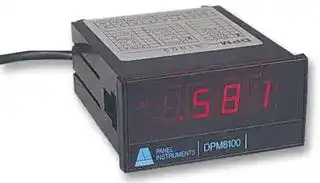
DPM8100A-2
Digital Panel Meter, DPM8000, 3-1/2 Digits, DC Voltage, 0V to 2V
⚠️ Reference pricing provided. In case of supply shortages, we will connect you with our trusted procurement partners to ensure your project's continuity.
- Manufacturer: ANDERS ELECTRONICS
- Product type: Digital Panel Meters
- No. of Digits / Alpha:3-1/2; Meter Function:DC Voltage; Meter Range:0V to 2V; Digit Height:-; Panel Cutout Height:45mm; Panel Cutout Width:92mm; Supply Voltage Min:184VAC; Supply Voltage Max:
- SVHC: No SVHC (15-Jun-2015)
- Meter Range: 0V to 2V
- Digit Height: -
- Product Range: -
- Meter Function: DC Voltage
- Panel Cutout Width: 92mm
- Supply Voltage Max: 253VAC
- Supply Voltage Min: 184VAC
- Panel Cutout Height: 45mm
- No. of Digits / Alpha: 3-1/2
- Operating Temperature Max: 50°C
- Operating Temperature Min: 0°C
| Delivery and price | |
|---|---|
| Units per pack | 50 |
| Price | 80.64 € |
| Current stock | 10+ |
| Lead time | 30 days |
Datasheet

digital panel modules user guide a

DPM 8000 Series-2 Voltmeters and Ammeters

## **Models covered by this instruction sheet**

~~3~~ **DPM8100-2DPM8100A-2** 3.5  DIGIT 200mV DC3.5  DIGIT 2V DC **DPM8120-2** 3.5  DIGIT  200mV AC **DPM8120A-2** 3.5  DIGIT 2V AC **DPM8140-2** 3.5  DIGIT  200mV True RMS AC **DPM8400-2** 4.5  DIGIT 200mV DC **DPM8400A-2** 4.5  DIGIT 2V DC **DPM8420-2** 4.5  DIGIT  200mV AC , **DPM8420A-2** 4.5  DIGIT 2V AC ~~GCL~~

The DPM8100-2 and DPM8400-2 series can be ranged as voltmeters or ammeters by fitting multiplier or shunt resistors (not include into the labelled positions on the main printed circuit board as shown on the diagram overleaf. Wire links"JP1" may need to be removed for some voltmeter ranges.

Using close tolerance resistors, the minimum of recalibration is required. For accurate setting a calibrated supply should be used. The resistors fitted should be adequately rated for the current or voltage range.

For non standard ranging and calibration, application sheet No. AES040 is available on request.

Over range is indicated by -1 on the display for 3.5 digit meters and by flashing zero's on the 4.5 digit meters.

## ~~eee~~ **OPERATING SPECIFICATION**

Accuracy: 81xx: +/- 0.1% of rdg +/-1 digit (AC models +/- 0.2%) 84xx: +/- 0.01% of rdg +/-2 digits DC models 84xx: +/-   0.1% of rdg +/-3 digits AC models Line voltage: 115/ 230 volts +10, -20%,     50 - 60 Hz Temperature: 0 - 50 degrees C Humidity: below 85% RH Power: 4VA Sampling rate: 2.5 / second

## **STEP BY STEP INSTRUCTIONS**

- **1** Remove instrument from its protective plastic bag and clip off ~~ee~~ **TERMINAL DEFINITIONS** front cover. SYMBOL DESCRIPTION

- **2** Pull off the three green safety terminals from the rear of the meter. The complete panel meter assembly  can now be **1** IN HI Apply input to pins 1 and 2. If INLO signal is removed from  its case by carefully levering the base of the **2** IN LO greater than INHI the display will read -ive. LED display board over the plastic retaining lug while pushing gently on the  terminal pins at the rear. **3** n/c Not connected   (unused)

- **3** With reference to the Range Specification table and notes **4** Gnd (sig) digital 0 Volts ( **NOT MAINS EARTH** ) overleaf, determine the resistance values to be fitted for the **5** HOLD connect to terminal 6 (+5V) 8100 series required voltage or current range. Further note whether link (display) connect to terminal 4  (0V)  8400 series "JP1" should be removed. **6** +5V (o/p) internal +5V output  (maximum 50mA)

- Carefully de-solder and remove link JP1 if necessary and solder the required resistors in place  as shown on the main **7** 230V circuit board diagram. **8** 115V AC mains supply

- **4** The decimal point should be set as required by either **9** 0V (N)

- repositioning the PCB jumper link JP2 on the 3.5 digit models or setting a dip switch on the front of the 4.5 digit model, in one of these locations:- ~~eee~~ **DIMENSIONS** DP1   gives   1.999    i.e. **.** XXX DP2   gives   19.99    i.e.    X **.** XX DP3   gives   199.9    i.e     XX **.** X DP4   gives  1999.9   i.e   XXX **.** X  on 4.5 digit version only. *————_ 6 Sh 17—_ 108 —5

- **5** Slide panel meter back into its case along the guide rails taking care to ease bottom of LED display board over protruding lug. Then push the green safety terminals securely |__| | i back into place on the rear of the meter.

- **6** Make electrical connection to the meter with reference to the Terminal Definition table. Note Mains Earth must NOT be **INSTALLATION DIAGRAM**

- connected to pin 4. There is no earth connection required ~~—_ ee~~ with this meter. Note also that Pin 3 is unused.

- **7** The instrument may now be tested. For improved accuracy it can be adjusted by turning the "span adj" potentiometer whilst applying full scale signal from a calibrated source until exactly full scale is shown on the display. On the DPM8140 and DPM8400 only, first set the display to read zero for 0V input using the "offset" potentiometer on the front left hand side of the board.

- **8** Finally, clip the cover back on and insert the meter into the <A panel cut-out. "Snap"  the mounting clips into the side of the case (refer to installation diagram) and tighten the fixing screws until secure in the panel - do not over tighten!

## ~~ee~~ **TERMINAL DEFINITIONS**

DPM8000-2 Rev 3 10/03

VR2

PCB LAYOUT

## NOTES

Decimal point DIP switch on 4.5 digit models Zero offset adjust (where fitted)

**==> picture [257 x 362] intentionally omitted <==**

**----- Start of picture text -----**<br>
on 4.5 digit<br>models<br>SPAN OFFSET<br>ADJUST addition. Zero offset<br>adjust (where<br>fitted)<br>VR1 VR2<br>A to D Converter Chip 1<br>2<br>3<br>JP2<br>Decimal point<br>select jumper<br>on 3.5 digit<br>models<br>F1<br>LINK Power supply<br>JP1 input fuse<br>R17 100mA rated<br>R18<br>(see Note 6)<br>R30<br>1 2 3 4 5 6 7 8 9<br>In In N/c 0v Hold +5V 230 115 0<br>Hi Lo dc i/p dc Vac Vac Vac<br>Important<br>Observe the mains<br>! Warning:<br>input connections<br>Make no connection<br>from pin 4 to mains<br>earth under any<br>conditions.<br>**----- End of picture text -----**<br>


- 1 To measure voltages above the meters basic sensitivity, attenuator resistors R17 and R18 need to be installed. The general equation to determine their values is given by: VIN = VD x (1 + R17/ R18) Where VIN is the input voltage required and VD is the corresponding display voltage. Note, VD max is actually 199.9mV for a nominal 200mV basic sensitivity meter and 1.999V for a nominal 2V meter

|Examples<br>VIN<br>VD<br>Display|R17|R18||
|---|---|---|---|
|20V<br>1.999V<br>19.99V|1M|110K||
|10V<br>1.5V<br>1500rpm|1M|176K||
|For standard input ranges choose the corresponding resistors from||||
|the range specification table below.||||


- 2 For inputs greater than 200V, R17 must be a high voltage resistor such as Philips VR37 Series (1x2M2, 0.5W, RS164-8316) with R18=2k2 Alternatively, use two carbon film resistors in series, such as Multicomp MCF (2x1M2, 0.5W, Farnell 262-195) with R18 as 2K4. See the options for R17 below. The maximum input voltage on this range with correct resistors is 650V.

- 3 For ranges of 200V or less, for R17, use metal film resistors, 1%, 0.5W as Farnell 545-314. For basic 200mV use only existing link JP1

- 4 For R18, on all voltage ranges, use metal film resistors, 1%, 0.25W

- 5 On current ranges, use metal film resistors, 0.5W for R30. The current, using internal shunt resistor R30 must not exceed 2 Amps. Leave link JP1 in place

- 6 The power supply input protection fuse is a 20mm cartridge type rated at 250V / 100mA.

## Options for Resistor R17

**==> picture [248 x 96] intentionally omitted <==**

**----- Start of picture text -----**<br>
200mV and Ranges below Ranges above 200V<br>current 200V<br>Solder<br>R17 R17 R17 R17<br>Link JP1 Metal film Single Hi Two carbon<br>resistor Voltage resistor film resistors<br>**----- End of picture text -----**<br>


## RANGE SPECIFICATION

|RANGE SPECIFICATION|RANGE SPECIFICATION|RANGE SPECIFICATION|RANGE SPECIFICATION|RANGE SPECIFICATION|RANGE SPECIFICATION|RANGE SPECIFICATION|RANGE SPECIFICATION|RANGE SPECIFICATION|RANGE SPECIFICATION|
|---|---|---|---|---|---|---|---|---|---|
|MODEL NUMBER|RESOLUTION<br>(of range required)|BASIC<br>SENSITIVITY|RANGE<br>REQUIRED|OVERLOAD<br>PROTECTION|R17|R18|R30|LINK<br>JP1|INPUT<br>IMPEDANCE|
|8100, 8120, 8140|100 V|200mV|0.2V|100V||||IN|>I00M|
|<br>8400, 8420|10 V|||||||||
|8100, 8120, 8140|1mV|200mV|2V|100V|1M|110K||OUT|1M|
|8400, 8420|100 V|||||||||
|8100, 8120, 8140|10mV|200mV|20V|300V|1M|10K||OUT|IM|
|<br>8400, 8420|1mV|||||||||
|8100A, 8120A|1mV|2V|2V|100V||||IN|>I00M|
|8400A, 8420A|100 V|||||||||
|8100A, 8120A|10mV|2V|20V|100V|1M|110K||OUT|IM|
|8400A, 8420A|1mV|||||||||
|8100A, 8120A|100mV|2V|200V|300V|1M|10K||OUT|IM|
|<br>8400A, 8420A|10mV|||||||||
|8100A, 8120A|1V|2V|650V<br>(see note 2)|700V|2M2|2K2||OUT|2M2|
|<br>8400A, 8420A|100mV|||||||||
|8100, 8120, 8140|0.1 A|200mV|200 A|DO NOT<br>EXCEED<br>DISSIPATION<br>RATING OF<br>SHUNT<br>RESISTOR<br>RC<br>(SEE NOTE 5)|||1K|IN|Ik|
|8400, 8420|10nA|||||||||
|8100, 8120, 8140|1 A|200mV|2mA||||100R|IN|IOOR|
|<br>8400, 8420|0.1 A|||||||||
|8100, 8120, 8140|10 A|200mV|20mA||||10R|IN|IOR|
|8400, 8420|1 A|||||||||
|8100, 8120, 8140|100 A|200mV|200mA||||1R|IN|IR|
|<br>8400, 8420|10 A|||||||||
|8100, 8120, 8140|1mA|200mV|2A||||0R1|IN|R1 (0.1)|
|8400, 8420|100 A|||||||||


**anders** electronics plc Bayham Place, London NW1 OEU UK Tel: +44 (0)20 7380 8167 Fax: +44 (0)20 7874 1908 http://www.anders.co.uk

DP8000-2 Rev3 10/03
Updated at June 9, 2026
About Novapart
Novapart is a B2B electronic component broker specialising in stock shortages and cost reduction. We source hard-to-find parts and identify compliant alternatives across a catalogue of 410,000+ components from 500+ manufacturers.
Learn more →Stock Shortage Specialist
When a component is unavailable, discontinued or has an unacceptable lead time, we tap into our network of vetted European and Asian distributors to source what you need — without compromising on quality or traceability.
Request a quote →Compliant Alternatives
We identify pin-to-pin, electrically equivalent substitutes that meet the same certifications (RoHS, AEC-Q100, REACH) as your original specification — validated against datasheets, not just part numbers. Often at a lower cost.
BOM Analysis service →