
Image not available
Illustrative purposes only

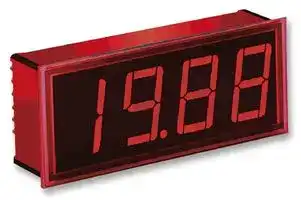
DMS-30PC-1-RS-C
Voltmeter, DMS-30PC Series, DC Voltage, -2V to +2V, 3.5 Digits, 4.75 V to 5.25 V, Red
⚠️ Reference pricing provided. In case of supply shortages, we will connect you with our trusted procurement partners to ensure your project's continuity.
- Manufacturer: MURATA POWER SOLUTIONS
- Product type: Digital Panel Meters
- No. of Digits / Alpha:3-1/2; Meter Function:DC Voltage; Meter Range:-2V to +2V; Digit Height:14.2mm; Panel Cutout Height:21.3mm; Panel Cutout Width:53.1mm; Supply Voltage Min:4.75V; Supply Voltag
- SVHC: No SVHC (17-Jan-2022)
- Meter Range: -2V to +2V
- Digit Height: 14.2mm
- Product Range: -
- Meter Function: DC Voltage
- Panel Cutout Width: 53.1mm
- Supply Voltage Max: 5.25V
- Supply Voltage Min: 4.75V
- Panel Cutout Height: 21.3mm
- No. of Digits / Alpha: 3-1/2
- Operating Temperature Max: 60°C
- Operating Temperature Min: 0°C
| Delivery and price | |
|---|---|
| Units per pack | 10 |
| Price | 46.3 € |
| Current stock | 10+ |
| Lead time | 30 days |
Datasheet

## **www.murata-ps.com**
## **- DMS 30PC Series**
3½ Digit, LED Display Low-Power, Miniature Digital Panel Voltmeters
## **FEATURES**
- Large (0.56"/14.2mm) LED display
- 8 LED colors
- Low-power LED’s optional
- Epoxy-encapsulated, 12-pin DIP with built-in color fi lter and bezel
- Miniature size:
- 2.17" x 0.92" x 0.56"(55mm x 23mm x 14mm)
- Panel or pc-board mountable
- 4 differential input voltage ranges
- Auto-calibration, ±1 count accuracy
- User-selectable decimal point placement
- Single +5V supply (60mW for low-power models)
- 0 to +60°C temperature range
- Numerous "plug-on" application boards
Low cost
The DMS-30PC Series is a broad line of self-contained, fully operational, 3½ digit voltmeters with large, easy-to-read LED displays. The 0.56"(14.2mm) high LED's are available in a wide variety of colors including red, orange, amber, yellow, green, aqua, blue-green, and super-blue. A high-intensity version of the red display is optional, as are low-power versions of the red, orange, and green displays.
The small size (2.17" x 0.92" x 0.56") of DMS-30PC meters is achieved by integrating their display, display drivers, reference circuit, and A/D converter into in a single, epoxyencapsulated assembly. The device's 12-pin, component-like, DIP package is both vibration and moisture proof. Each package incorporates a built-in color fi lter and bezel and is easily mounted in either panels or pc cards.
These meters are available in four differential input voltage ranges (±200mV, ±2V, ±20V and ±200V). Input impedance is 1,000 megohms for the ±200mV and ±2V inputs and 1 megohm for the ±20V and ±200V inputs. CMRR for all devices is 86dB, and inputs are overvoltage protected to ±250V.
Each meter incorporates an extremely stable, double-regulated reference and is fully calibrated prior to potting. We guarantee outstanding initial accuracy (±1 count) and excellent stability (±0.15 counts/°C). All models operate from a single +5V supply, and the low-power models draw as little as 10mA (50mW total power). A DISPLAY TEST function is standard on each device.
For popular applications (4-to-20mA, rms-to-dc conversion, ac line power, J and K thermocouples, etc.), the DMS-30PC Series includes a complete line of optional "plug-on" application boards that conveniently convert your meter into an application-specifi c instrument.
**==> picture [541 x 269] intentionally omitted <==**
**----- Start of picture text -----**<br>
P SIMPLIFIED SCHEMATIC DIAGRAM O<br>+5V<br>1 V+ 12<br>+5V SUPPLY (–) INPUT LO<br>R2 (1)<br>–5V 0.01µF<br>2 DC/DC R1 11<br>DISPLAY TEST CONVERTER V– (+) INPUT HI<br>909k<br>» +2.0V<br>5V RETURN 3 anode A/D 10 ANALOG<br>0 Vdc CONVERTER COMMON<br>Se 1.23V |<br>DATA REF.<br>4 9<br>DP 3 _ U ae +1.23V REFERENCE OUT<br>DP 2 _ 5 Ciel| cl 1.82k 8 REFERENCE OUT<br>Lt. Lf +5V :<br>6 7<br>DP 1 REFERENCE IN<br>J ] —— (1) R2 is not used on ±200mV (-0) models or ±2V (-1) models. 4<br>R2 = 100k on ±20V (-2) models and 9.1k on ±200V (-3) models.<br>©<br>For full details go to Figure 1. DMS-30PC Series simplifi ed schematic<br>www.murata-ps.com/rohs<br>**----- End of picture text -----**<br>
**www.murata-ps.com/support**
**MPM_DMS_30PC.G01** Page 1 of 6
## **- DMS 30PC Series**
## **Performance/Functional Specifi cations**
Typical at TA = +25°C and supply voltage = +5V using the single-ended input circuit, unless otherwise noted.
**==> picture [244 x 589] intentionally omitted <==**
**----- Start of picture text -----**<br>
Analog Inputs Min. Typ. Max. Units<br>Full Scale Input Range:<br> DMS-30PC-0 – ±200 – mV<br> DMS-30PC-1 – ±2 – Volts<br> DMS-30PC-2 – ±20 – Volts<br> DMS-30PC-3 – ±200 – Volts<br>–<br>Input Impedence:<br> DMS-30PC-0, -1 100 1000 – MΩ<br> DMS-30PC-2, -3 0.8 1 – MΩ<br>Overvoltage Protection ➀ – – ±250 Volts<br>Common Mode Voltage Range – – ±2 Volts<br>CMRR (dc to 60Hz) – 86 – dB<br>Control Inputs ➁<br>Decimal Point Placement (Pins 4-6) Tie to pin 3 to activate<br>Display Test (Pin 2) Tie to +5V to activate all segments<br>Performance<br>Sampling Rate 2.5 reading per second<br>Accuracy (3 minute warm-up):<br> DMS-30PC-0 (Vin = +0.19V) – ±1 ±3 Counts<br> DMS-30PC-1 (Vin = +1.9V) – ±1 ±3 Counts<br> DMS-30PC-2 (Vin = +19V) – ±2 ±3 Counts<br> DMS-30PC-3 (Vin = +190V) – ±2 ±3 Counts<br>Zero Reading (Vin = 0 Volts) “–001” “000” “001”<br>Temperature Drift (0 = +60°C) – ±0.2 ±0.4 Cnts/°C<br>+1.23V Reference Output (Pin 9) ➁ +1.20 +1.23 +1.25 Volts<br>Power Supply Requirements<br>Supply Voltage +4.75 +5.00 +5.25 Volts<br>Supply Current:<br> Standard Models – +150 +225 mA<br> Low-Power Models<br> Red Display – +12 +17 mA<br> Green or Orange Display – +60 +100 mA<br>Display<br>Display Type and Size 3½ digit, 0.56"/14.2mm high LED<br>Polarity Indication Autopolarity ("–" for negative Vin)<br>Overrange Indication "–1___" for negative inputs<br>"1___" for positive inputs<br>Physical/Environmental<br>Operating Temperature 0 – +60 °C<br>Storage Temperature –40 – +75 °C<br>Humidity (non-condensing) 0 – 95 %<br>Case Material Polycarbonate<br>Weight 0.75 ounces (21 grams)<br>**----- End of picture text -----**<br>
3½ Digit, LED Display Low-Power, Miniature Digital Panel Voltmeters
## **Ordering Information**
## **DMS-30PC - 1 - R S - C**
Add -C for RoHS **Input Range: 0** = ±200mV **LED Color: 1** = ±2V **AS** = Standard Amber **2** = ±20V **BS** = Super Blue **3** = ±200V **GS** = Standard Green **±200V** available on the **OS** = Standard Orange **QS** = Standard Aqua following models only: **RS** = Standard Red -BS (Super Blue) **YS** = Standard Yellow -GS (Standard Green) **RH** = High-Intensity Red -RS (Standard Red) **GL** = Low-Power Green -RL (Low-Power Red) **OL** = Low-Power Orange -VFS (Blue-Green) **RL** = Low-Power Red **VFS** = Blue-Green
A panel-mount retaining clip is supplied with each model.
## **See www.murata-ps.com/dpm-availability for model-specifi c availability.**
**Accessories: DMS-30-CP** Panel cutout punch **DMS-BZL1-C** DMS-30 bezel assembly **DMS-BZL2-C** DMS-30 bezel assembly with sealing gasket **Add-On Application Boards: DMS-EB-C** Multi-purpose (gain/offset, 4-20mA, etc.) **DMS-EB-HTB** High-accuracy temperature probe sensing for ±200mV models **DMS-EB-DC/DC** Provides isolated +5V power **DMS-EB-RMS-C** For true rms measurements of ac voltages **DMS-EB-AC/DC-C** For ac line-powered applications
## **TECHNICAL NOTES**
**1. +1.23V REFERENCE OUTPUT (Pin 9)** : This pin is the output of the meter’s precision +1.23V internal reference, and it is referenced to ANALOG COMMON (pin 10) which sits at a potential of approximately +2V. This output should be buffered if used to drive external loads since sourcing more than 15μA from pin 9 can affect both the initial accuracy and temperature drift of the meter.
**2. ANALOG COMMON (Pin 10)** : This pin is connected to an internal, low-noise, "relative" ground. It is used in certain differential and "fl oating" measurements as described in the Applications section of this data sheet and Ap Note DMS-AN3 at http://www.murata-ps.com/data/meters/dms-an3.pdf. Pin 10 should not be connected to pin 3 (5V RETURN) or to your system’s analog ground.
**3. REFERENCE OUTPUT (Pin 8) and INPUT (Pin 7)** : Pin 8 is a precision reference actively trimmed at the factory. In normal operation, pin 8 must be tied to pin 7 to achieve all listed accuracy and drift specifi cations.
- ➀ Applies for transient or continuous overvoltages applied to (+) INPUT HI (pin 11) with
- (–) INPUT LO (pin 12) properly connected. Pin 12 is not overvoltage protected
- (see Figure 1). Voltages applied to pin 12 should not exceed the supply voltage.
- ➁ See Technical Notes.
**www.murata-ps.com/support**
**MPM_DMS_30PC.G01** Page 2 of 6
## **- DMS 30PC Series**
## 3½ Digit, LED Display Low-Power, Miniature Digital Panel Voltmeters
## **APPLICATIONS**
**4. DISPLAY TEST (Pin 2)** : Connecting pin 2 to +5V SUPPLY (pin 1) will activate all LED segments, except the decimal points, and the display will read "1888" regardless of the actual applied input. If a negative input is applied, DISPLAY TEST will also activate the minus sign. To protect the LED's, the display should not be left in the "test" mode for more than 10 seconds.
**5. Decimal Point Placement** : The location of the decimal point is userselectable, and the decimal point control pins (DP1-DP3) are active low functions. Select the desired decimal point by tying the appropriate pin (pin 4, 5 or 6) to pin 3 (5V RETURN). Unused decimal point location pins should be left open.
Hard wiring is preferable, however, you can use logic gates to exercise dynamic control over the location of the decimal point if the following drive conditions are met:
|**Model**|**Applied "0" Voltage**|**Load Current***|
|---|---|---|
|DMS-30PC-X-RL|+0.05V max.|0.7mA max.|
|All Others|+0.4V max.|6mA max.|
*The driving gates must be able to sink this much current (IOL) with a logic "0" output.
**6. Gain Adjust** : There is a gain-adjust potentiometer on the back of each meter. It has approximately ±50 counts (±2.5%) of adjustment range. Since these devices essentially have no zero/offset errors, a gain adjustment is effectively an overall accuracy adjustment. Though they may be performed at any point (except zero), accuracy adjustments are most effective when performed with higher level input signals. The circuit shown in Figure 10 provides ±10% range of adjustment.
**7. Soldering Methods:** All models in the DMS-30PC Series easily withstand most common wave soldering operations. We recommend, however, that you evaluate the effects your particular soldering techniques may have on the meter's plastic case and high-precision electrical performance. We recommend the use of no-clean solders.
**8. Suggested Mating Connectors** :
**Panel mounted:**
Connector housing Murata Power Solutions P/N 4320-01069-0 Terminal type Murata Power Solutions P/N 4400-01032-0 Crimping tool Murata Power Solutions P/N 39-2099000 Wire size 22 to 26 AWG Insulation diameter 0.062" (1.57mm) maximum Stripping length 0.100 to 0.125" (2.54 to 3.17mm) **Board mounted:** Socket Murata Power Solutions P/N 4320-01074-0
DMS-30PC meters are highly versatile devices that can be used in hundreds of applications. The application circuits chosen for this section have historically received many inquiries. Every attempt has been made to ensure technical accuracy, and all of the following circuits have been prototyped and tested to ensure functionality. Please keep in mind, however, that real-world applications are seldom as straightforward as the approaches presented here. Most applications have many more components — and many more connections — than the illustrations show.
The simplifi ed schematic shown in Figure 1 can be very useful when debugging a malfunctioning panel meter circuit, particularly if the user has some knowledge of operational amplifi ers (op amps). The meter's high-impedance input consists of an op amp powered from a ±5Vdc power supply (the –5V is internally generated). Knowing this, one can easily see why input signals applied to (–) INPUT LO and (+) INPUT HI have to be kept within the power supply rails of ±5V. Also note that only pin 11 has a current-limiting 909kΩ series resistor. High input voltages that have a common ground with pin 3 (5V RETURN) should only be applied to pin 11 ((+) INPUT HI) and never to pin 12. In these high-voltage cases, pin 12 should always be tied to pin 3 (5V RETURN).
One of the simplifi ed schematic's noteworthy features is that it shows internal voltage values. It also shows that pin 3 is the meter's zero-volt reference point — regardless of the type of power or signal source used. This is an important point to keep in mind when a digital or analog multimeter is used to make system measurements. The multimeter's negative lead (usually the black one) must be connected to pin 3 (5V RETURN).
**1. Single-Ended Input Confi gurations** : True single-ended measurements can be made with any DMS-30PC meter. The circuit of Figure 2 avoids problems normally associated with ground-loop currents. Separate ground runs should be used for 5V RETURN (pin 3) and (–) INPUT LO (pin 12). This will ensure that large LED currents will not fl ow in the wiring that connects VIN to (–) INPUT LO (pin 12). Groundloop currents can cause unstable readings.
**==> picture [229 x 130] intentionally omitted <==**
**----- Start of picture text -----**<br>
DMS-30PC-1<br>11 8<br>(+) IN HI REF OUT<br>+<br>VIN<br>–<br>12 7<br>(–) IN LO REF IN<br>1 6 3<br>+5V SUP DP1 5V RET<br>85-264Vac<br>AC to DC Converter<br>**----- End of picture text -----**<br>
**Figure 2.** Single-Ended Input Confi guration
**www.murata-ps.com/support**
**MPM_DMS_30PC.G01** Page 3 of 6
## **- DMS 30PC Series**
## **APPLICATIONS**
**2. Differential Input Confi gurations:** Differential measurements can be made with all DMS-30PC meters. Figure 3, though not a practical real-world application, uses a voltage divider to demonstrate the concept of a differential input signal. Be careful not to exceed the ±2V common mode voltage limitation for 5V-powered meters.
**==> picture [221 x 146] intentionally omitted <==**
**----- Start of picture text -----**<br>
DMS-30PC-1 11 R1<br>REF OUT 8 1k<br>(+) IN HI<br>REF IN 7 R2<br>12 1k<br>DP1 6 (–) IN LO<br>R3<br>1 3 1k<br>+5V SUP 5V RET<br>85-264Vac<br>AC to DC Converter<br>**----- End of picture text -----**<br>
## 3½ Digit, LED Display Low-Power, Miniature Digital Panel Voltmeters
10 (ANALOG COMMON) or pin 3 (5V RETURN) to (–) INPUT LO (pin 12) provides the reference point for the meter's input.
A "fl oating" input is a signal that has no galvanic connection to the meter's power supply. In the fi gures below, the 1.5V battery illustrates a true fl oating inpu **t.**
**==> picture [227 x 132] intentionally omitted <==**
**----- Start of picture text -----**<br>
11 DMS-30PC-1 8<br>(+) IN HI REF OUT<br>1.5V<br>CELL – 12<br>(–) IN LO<br>7<br>REF IN<br>1 3 6<br>+5V SUP 5V RET DP1<br>85-264Vac<br>AC to DC Converter<br>+<br>**----- End of picture text -----**<br>
**Figure 3.** Differential Input Confi guration
**Figure 5.** Floating Input Measurements
**3. Engineering Scaling** : For measuring voltages greater than the full scale input range of a given meter, the input signal must be attenuated. A simple voltage divider (similar to that shown in Figure 4) will scale the input to within the range of the selected meter. R1 and R2 should be precision, ±1%, metal-fi lm resistors with absolute TCR's less than 50ppm/°C. See Ap Note 4 for more information on engineering scaling.
**==> picture [214 x 198] intentionally omitted <==**
**----- Start of picture text -----**<br>
50kΩ < R1 + R2 < 10MΩ<br>R2<br>x VIN = Reading<br>R1 + R2<br>R1 DMS-30PC-1<br>11<br>(+) IN HI 8<br>VIN REF OUT<br>R2<br>12<br>– (–) IN LO 7<br>REF IN<br>1 3<br>+5V SUP 5V RET<br>85-264Vac<br>AC to DC Converter<br>+<br>**----- End of picture text -----**<br>
**Figure 4.** Input Attenuation Circuit
**4. Floating Signal Source Measurements** : Floating signals can be measured using the circuits shown in Figures 5 and 6. Connecting pin
**==> picture [238 x 133] intentionally omitted <==**
**----- Start of picture text -----**<br>
11 DMS-30PC-1<br>8<br>(+) IN HI REF OUT<br>10<br>1.5V ANA COMM<br>CELL<br>–<br>12<br>7<br>(–) IN LO REF IN<br>1 3 6<br>+5V SUP 5V RET DP1<br>85-264Vac<br>AC to DC Converter<br>+<br>**----- End of picture text -----**<br>
**Figure 6.** Floating Input Measurements (Alternate Confi guration)
**5. Process Control (4-to-20mA) Measurements** : In many common process-control applications, a 4-to-20mA current loop is used to transmit information. Because DMS-30PC meters have such high input impedance, a simple shunt resistor across the meter's input can be used to convert the loop current to a voltage. See Figure 7. The value of the shunt resistor is a function of the scaling requirements of the particular application and can be calculated using the following equation:
RShunt = R1 = VFsr /I Fsr
Where: VFsr = Full scale reading (in Volts) I Fsr = Relative full scale current (in Amps)
**www.murata-ps.com/support**
**MPM_DMS_30PC.G01** Page 4 of 6
## **- DMS 30PC Series**
## **APPLICATIONS**
Example: For a meter with a 2V full scale input (1.999 full scale reading) and a desired display reading of "1000" (with an input of 20mA), VFsr = 1.000 Volts
RShunt = 1.000V/(0.020 – 0.004)A RShunt = 1.000V/0.016A = 62.5 Ohms
To calibrate the circuit of Figure 7, perform the following:
1. With 4mA applied, adjust the 50kΩ potentiometer (R2) to display a reading of "000" (assuming that is the desired reading).
2. With 20mA applied, adjust the gain-adjust potentiometer on the back of the meter to display a reading of "1000". For different full scale readings, alter the value of RShunt accordingly.
**==> picture [240 x 145] intentionally omitted <==**
**----- Start of picture text -----**<br>
DMS-30PC-1<br>11 8<br>(+) IN HI REF OUT<br>10<br>ANA COMM<br>4-20mA R1 12 7<br>(–) IN LO REF IN<br>9 1 3<br>1.23V 5V SUP 5V RET<br>R2 REF<br>–<br>50k<br>85-264Vac<br>AC to DC Converter<br>+<br>**----- End of picture text -----**<br>
**Figure 7.** 4-to-20mA Current Loop Operation
**6. Power Supply Monitoring** : One of the most common digital panel meter applications involves monitoring the output voltage of the system power supply — often this supply also powers the meter itself. The low-power, red LED DMS-30PC-2-RL can be confi gured to allow power supply monitoring over the range of 4.5-18Vdc. The circuit in Figure 8 uses a low-drop-out, three-terminal regulator (LM2931Z-5, available from National Semiconductor) to provide regulated 5V power to the meter. The LM-2931 was chosen because it has the following on-chip protection features: reverse polarity, short circuit
**==> picture [248 x 108] intentionally omitted <==**
**----- Start of picture text -----**<br>
(+) IN HI<br>LM2931Z-5 11 DMS-30PC-2-RL<br>1<br>+5V SUP<br>IN OUT<br>+ GND + 5V RET 3<br>4.5 - 18Vdc<br>– 22µF10V 5<br>DP2<br>7 8 12<br>REF REF (–) IN LO<br>IN OUT<br>**----- End of picture text -----**<br>
## 3½ Digit, LED Display Low-Power, Miniature Digital Panel Voltmeters
and thermal run-away. When using other, higher-power, DMS-30PC models with three-terminal regulators, be sure to consult the regulator manufacturer's data sheet to ensure the regulator is being utilized safely and correctly.
**7. Digital Ammeter** : Digital ammeters are fi nding ever-increasing usage because analog-style ammeters (moving-vane types) now cost roughly the same as their digital counterparts. Additionally, analog ammeters are not nearly as rugged as modern digital panel voltmeters. Figure 9 illustrates a typical ammeter application. The circuit uses a ±200mV input meter
— the preferred range for most ammeters — to measure the voltage developed across a 0.1Ω current shunt. The circuit shown represents a basic ammeter connection diagram. A detailed application note describing digital dc ammeters is included in Murata Power Solutions' new Digital Panel Meter Databook.
**==> picture [225 x 122] intentionally omitted <==**
**----- Start of picture text -----**<br>
1 DMS-30PC-0<br>+5V SUP<br>8<br>REF OUT<br>+<br>5Vdc<br>3<br>– 5V RET<br>7<br>REF IN<br>6<br>DP1 12 11<br>(–) IN LO (+) IN HI<br>0.150V<br>1.5 Amp (Load Current)<br>0.1W Load<br>RShunt (3.3 )W<br>**----- End of picture text -----**<br>
**Figure 9.** Basic DC Ammeter Circuit
**8. External Gain Adjustment** : Connect REFERENCE OUT (pin 8) to REFERENCE IN (pin 7) for normal, factory calibrated, operation. Use the +1.23V REFERENCE OUT (pin 9) for applications needing external gain adjustment. Figure 10 shows the wiring confi guration for each model. Calibration is performed with a precise, near-fullscale, input voltage.
**==> picture [227 x 135] intentionally omitted <==**
**----- Start of picture text -----**<br>
11 DMS-30PC<br>(+) IN HI<br>OUT<br>VOLTAGE 3<br>CALIBRATOR 5V RET<br>12<br>COM<br>(–) IN LO<br>10 8 7 9<br>ANA COMM NC REF IN 1.23V REF<br>8.45k, 1% Connections<br>for ±2V, ±20V<br>1k and ±200V models<br>10 to 20 Turns<br>Connections<br>1k 8.45k, 1% for ±200mV<br>10 to 20 Turns models<br>**----- End of picture text -----**<br>
**Figure 10.** External Gain Adjustment
**Figure 8.** 4.5-18V Power Supply Monitor
**www.murata-ps.com/support**
**MPM_DMS_30PC.G01** Page 5 of 6
## **- DMS 30PC Series**
## **MECHANICAL SPECIFICATIONS**
## 3½ Digit, LED Display Low-Power, Miniature Digital Panel Voltmeters
MECHANICAL DIMENSIONS: Inches (mm) TOLERANCES: 2 PL DEC ±0.02 (±0.51) 3 PL DEC ±0.010 (±0.254) LEAD DIMENSIONS: 0.025 (0.635) x 0.025 (0.635) NOMINAL RECOMMENDED PC BOARD FINISHED HOLE DIAMETER: 0.042 ±0.003 (1.067 ±0.076)
**==> picture [362 x 204] intentionally omitted <==**
**----- Start of picture text -----**<br>
PIN #1<br>IDENTIFIER<br>CALIBRATION POTENTIOMETER HOLE LOCATION FRONT VIEW<br>PIN 1 +5V SUPPLY 1 12 (–) INPUT LO<br>DISPLAY TEST 2 11 (+) INPUT HI<br>5V RETURN 3 10 ANALOG COMMON<br>0.260 DP3 4 9 +1.23V REFERENCE OUT<br>(6.60) DP2 5 8 REFERENCE OUT<br>DP1 6 7 REFERENCE IN<br>0.250<br>(6.35) DP1 DP2 DP3<br>(USE ONLY WHEN PC BOARD MOUNTING)0.125 (3.175) DIAMETER (23.4)0.92 (55.1)2.17<br>0.84 2.09<br>(21.3) (53.1)<br>0.560<br>0.040 (14.22)<br>(1.02)<br>0.25 (6.4) TYP.<br>0.040 0.10<br>(1.02) (4.3)0.17 TYP.(2.5) (1.02)0.040 (45.7)1.80 TYP.(3.7)0.15<br>TYP. 0.50<br>(12.7)<br>MADE IN USA DMS-30PC-X-XX<br>**----- End of picture text -----**<br>
## **BEZEL INSTALLATION AND RECOMMENDED DRILL AND PANEL CUTOUT**
**==> picture [140 x 189] intentionally omitted <==**
**----- Start of picture text -----**<br>
0.187<br>#2-56 INSERT (4.75)<br>0.156 (3.96) DEEP<br>FRONT VIEW 1.270<br>DMS-BZL1 and DMS-BZL2 (32.26)<br>2.55 (64.77)<br>0.116<br>INTERNAL CORNER RADII: (2.95)<br>0.032 (0.81) MAX.<br>1.07 DMS-BZL1 & BZL2 0.878<br>(27.18) PANEL CUTOUT (22.30)<br>2.118 (53.80)<br>2.35 (59.69)<br>0.096<br>0.093 (2.362) DIAMETER (4 REQUIRED) (2.44)<br>**----- End of picture text -----**<br>
**==> picture [171 x 182] intentionally omitted <==**
**----- Start of picture text -----**<br>
BEZEL INSTALLATION<br>PANEL<br>GASKET *<br>BEZEL<br>* Sealing gasket is supplied with the DMS-BZL2 and DMS-BZL4<br>RETAINING CLIP INSTALLATION<br>PANEL<br>MADE IN USA<br>MADE IN USA ®<br>**----- End of picture text -----**<br>
## Murata Power Solutions, Inc.
11 Cabot Boulevard, Mansfi eld, MA 02048-1151 U.S.A. ISO 9001 and 14001 REGISTERED
## **This product is subject to the following operating requirements and the Life and Safety Critical Application Sales Policy: Refer to: http://www.murata-ps.com/requirements/**
Murata Power Solutions, Inc. makes no representation that the use of its products in the circuits described herein, or the use of other technical information contained herein, will not infringe upon existing or future patent rights. The descriptions contained herein do not imply the granting of licenses to make, use, or sell equipment constructed in accordance therewith. Specifi cations are subject to change without notice. _**© 2015 Murata Power Solutions, Inc.**_
**www.murata-ps.com/support**
**MPM_DMS_30PC.G01** Page 6 of 6
Updated at June 9, 2026
About Novapart
Novapart is a B2B electronic component broker specialising in stock shortages and cost reduction. We source hard-to-find parts and identify compliant alternatives across a catalogue of 410,000+ components from 500+ manufacturers.
Learn more →Stock Shortage Specialist
When a component is unavailable, discontinued or has an unacceptable lead time, we tap into our network of vetted European and Asian distributors to source what you need — without compromising on quality or traceability.
Request a quote →Compliant Alternatives
We identify pin-to-pin, electrically equivalent substitutes that meet the same certifications (RoHS, AEC-Q100, REACH) as your original specification — validated against datasheets, not just part numbers. Often at a lower cost.
BOM Analysis service →