
Image not available
Illustrative purposes only

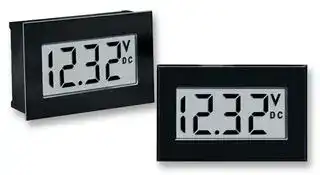
DMS-20LCD-1-5-C
Voltmeter, DMS-20LCD Series, DC Voltage, -2V to +2V, 3.5 Digits, 4.75 V to 5.25 V
⚠️ Reference pricing provided. In case of supply shortages, we will connect you with our trusted procurement partners to ensure your project's continuity.
- Manufacturer: MURATA POWER SOLUTIONS
- Product type: Digital Panel Meters
- No. of Digits / Alpha:3-1/2; Meter Function:DC Voltage; Meter Range:-2V to +2V; Digit Height:9.4mm; Panel Cutout Height:21.34mm; Panel Cutout Width:34.04mm; Supply Voltage Min:4.75V; Supply Voltag
- Meter Range: -2V to +2V
- Digit Height: 9.4mm
- Product Range: -
- Meter Function: DC Voltage
- Panel Cutout Width: 34.04mm
- Supply Voltage Max: 5.25V
- Supply Voltage Min: 4.75V
- Panel Cutout Height: 21.34mm
- No. of Digits / Alpha: 3-1/2
- Operating Temperature Max: 60°C
- Operating Temperature Min: 0°C
| Delivery and price | |
|---|---|
| Units per pack | 20 |
| Price | 25.18 € |
| Current stock | 50+ |
| Lead time | 30 days |
Datasheet

## **www.murata-ps.com**
## **- DMS 20LCD Series**
3½ Digit, LCD Display Digital Panel Voltmeters
## **FEATURES**
- Lowest cost
- Lowest power, 2mW
- Subminiature size:
1.38" x 0.88" x 0.43"
35mm x 22mm x 11mm
- Large (0.37"/9.4mm), enhanced-contrast LCD display
- Epoxy-encapsulated, 12-pin DIP
- Panel or pc-board mountable
- 4 differential input voltage ranges
- High accuracy, ±1 count (±0.05%)
- Single +5V supply or 9V battery
- Low-battery annunciator
- User-selectable decimal point placement
0 to +60°C temperature range
DMS-20LCD Series, 3½ Digit, LCD Display, Digital Voltmeters represent the ultimate combination of low price, low power, small size and high performance in digital meters. Epoxy encapsulated in a subminiature (1.38” x 0.88” x 0.43”), 12-pin DIP package, these completely self-contained, fully operational meters offer a combination of ruggedness, long-term reliability and component-like ease-of-use simply not available in any other meters.
Incorporating a precision reference and a factory-calibrated, autozeroing A/D converter, DMS-20LCD meters are extremely accurate (±1 count) and are only slightly larger than their 0.37"/9.4mm, enhanced-contrast, LCD displays. All models incorporate a built-in bezel and are easily mounted in either panels or pc boards. Both backlit and non-backlit versions are available.
DMS-20LCD meters have 4 differential input voltage ranges (±200mV, ±2V, ±20V and ±200V) and a user-friendly input structure. Input impedance is a minimum 800k . CMRR is typically 86dB with a CMV of ±2V. Non-inverting inputs are overvoltage protected to ±100V (±250V for the ±200V input model).
All DMS-20LCD meters operate from a single +5V supply (drawing 400µA) or a single +9V supply/battery (drawing 230µA). All models have a low-battery ("B") annunciator and feature autopolarity changeover and overrange indication.
Also available is an application/evaluation board (DMS-EB2) that plugs directly onto the back of any DMS-20LCD allowing direct inputs for common applications such as 4-20mA inputs, zero/gain adjust, decimal point location, and input voltage dividing.
**==> picture [540 x 268] intentionally omitted <==**
**----- Start of picture text -----**<br>
T SIMPLIFIED SCHEMATIC DIAGRAM TT<br>+5V<br>+5V SUPPLY/ 1 V+ 12<br>(–) INPUT LO<br>+BATTERY 1<br>2 R2<br>–5V 0.01μF<br>2 DC/DC 3 R1 11<br>N.C. CONVERTER V– (+) INPUT HI<br>909k<br>≈+2.0V<br>5V RETURN/ [ape 3 J1 A/D 10 ANALOG<br>–BATTERY 0 Vdc CONVERTER COMMON<br>DATA<br>—_ DP 3 4 v O 9 N.C./BACKLIGHT O 4<br>5 meee 8<br>DP 2 REFERENCE OUT<br>+5V<br>6 7<br>DP 1 REFERENCE IN<br>1 R2 is not used on ±200mV (-0) models or ±2V (-1) models. 3 DC/DC converter is not used on 9V-powered models,<br>R2 = 100k on ±20V (-2) models and 9.1k on ±200V (-3) models. J1 is connected.<br>2 Only used on ±200mV (-0) and ±2V (-1) models. 4 Used on backlit models only.<br>N.C. for non-backlit models.<br>For full details go to<br>www.murata-ps.com/rohs<br>**----- End of picture text -----**<br>
**www.murata-ps.com/support**
**MPM_DMS20LCD.C01** Page 1 of 6
## **- DMS 20LCD Series**
## 3½ Digit, LCD Display Digital Panel Voltmeters
## **Performance/Functional Specifi cations**
Typical at TA = +25°C and supply voltage = +5V (using the single-ended input circuit) or +9V (using the differential input circuit), unless otherwise noted.
**==> picture [244 x 604] intentionally omitted <==**
**----- Start of picture text -----**<br>
Analog Inputs Min. Typ. Max. Units<br>Full Scale Input Range:<br> DMS-20LCD-0 – ±200 – mV<br> DMS-20LCD-1 – ±2 – Volts<br> DMS-20LCD-2 – ±20 – Volts<br> DMS-20LCD-3 – ±200 – Volts<br>–<br>Input Impedence:<br> DMS-20LCD-0, -1 100 1000 – M <br> DMS-20LCD-2, -3 0.8 1 – M <br>Overvoltage Protection ➀<br> DMS-20LCD-0, -1, -2 – – ±100 Volts<br>DMS-20LCD-3 – – ±250 Volts<br>Common Mode Voltage Range – – ±2 Volts<br>CMRR (dc to 60Hz) – 86 – dB<br>Control Inputs ➁<br>Decimal Pt. Placement (Pins 4-6) Tie to pin 3 to activate<br> Functionality Tie to pin 3 to activate<br> Logic Compatibility TTL (on 5V-powered models)<br>Backlight (Pin 9) Tie to pin 3 to turn on backlight<br>Performance<br>Sampling Rate 2.5 reading per second<br>Accuracy (1 minute warm-up):<br> DMS-20PC-0 (Vin = +0.19V) – ±1 ±2 Counts<br> DMS-20PC-1 (Vin = +1.9V) – ±1 ±2 Counts<br> DMS-20PC-2 (Vin = +19V) – ±2 ±3 Counts<br> DMS-20PC-3 (Vin = +190V) – ±2 ±3 Counts<br>Zero Reading (Vin = 0 Volts) “–001” “000” “001”<br>Temperature Drift (0 = +60°C) – ±0.2 ±0.4 Cnts/°C<br>Power Supply Requirements (5V Models)<br>Supply Voltage +4.75 +5.00 +5.25 Volts<br>Supply Current:<br>Standard Models – +400 +650 µA<br>Backlit Models – +35 +50 mA<br>Power Supply Requirements (9V Models)<br>Supply Voltage +7.5 +9.0 +14.0 Volts<br>Supply Current:<br>Standard Models – +230 +350 µA<br>Backlit Models – +35 +50 mA<br>Display<br>Display Type and Size 3½ digit, 0.37"/9.4mm high LCD<br>Polarity Indication Autopolarity ("–" for negative Vin)<br>Overrange Indication "–1___" for negative Vin<br>"1___" for positive Vin<br>**----- End of picture text -----**<br>
|**Physical/Environmental**|**Physical/Environmental**||||
|---|---|---|---|---|
|**Operating Temperature**|0|–|+60|°C|
|**Storage Temperature**|–20|–|+75|°C|
|**Humidity (non-condensing)**|0|–|95|%|
|**Case Material**||Polycarbonate|||
|**Weight**|0.4 ounces (11 grams)||||
- ➀ Applies for transient or continuous overvoltages applied to (+) INPUT HI (pin 11) with (–) INPUT LO (pin 12) properly connected. Pin 12 is not overvoltage
- protected (see Figure 1). Voltages applied to pin 12 should not exceed the supply voltage.
- ➁ Listed spec applies to 5V-powered models only. For 9V-powered models, both (–) INPUT LO (pin 12) and (+) INPUT HIGH (pin 11) must always be at least
- 1.5V above –BATTERY (pin 3) and at least 1.5V below +BATTERY (pin 1).
- ➂ See Technical Notes.
## **Ordering Information**
## **DMS-20LCD - 1 - 5 - C**
Add -C for RoHS **Input Range:** Leave blank for standard **0** = ±200mV models. **1** = ±2V Add **B** for backlit models.
**2** = ±20V **3** = ±200V **Power Source: 5** = +5V **9** = +9V **Accessories: DMS-20-CP** Panel cutout punch **DMS-BZL3-C** DMS-20 bezel assembly **DMS-BZL4-C** DMS-20 bezel assembly with sealing gasket **DMS-EB2-C** Application/evaluation board with standard MOLEX connector, decimal point solder pads and attenuation resistor pads.
A panel-mount retaining clip is supplied with each model.
**See www.murata-ps.com/dpm-availability for model-specifi c availability.**
## **TECHNICAL NOTES**
**1. REFERENCE OUTPUT (Pin 8) and INPUT (Pin 7):** Pin 8 is a precision reference actively trimmed at the factory. In normal operation, pin 8 must be tied to pin 7 to achieve all listed accuracy and drift specifi cations.
**2. ANALOG COMMON (Pin 10):** This pin is connected to an internal, low-noise, “relative” ground. It is used in certain differential and “fl oating” measurements as described in the Applications section of this data sheet and Ap Note DMS-AN3 at
- http://www.murata-ps.com/data/meters/dms-an3.pdf. **Pin 10 should not be connected to pin 3 (5V RETURN/–BATTERY) or to your system’s analog ground.**
**3. Decimal Point Placement:** The location of the decimal point is userselectable, and the decimal point control pins (DP1-DP3) are active low functions. Select the appropriate decimal point by tying the appropriate
**www.murata-ps.com/support**
**MPM_DMS20LCD.C01** Page 2 of 6
## **- DMS 20LCD Series**
## 3½ Digit, LCD Display Digital Panel Voltmeters
pin (pin 4, 5 or 6) to pin 3 (5V RETURN/–BATTERY). Unused decimal point location pins should be left open. For 5V-powered models, the decimal location pins are TTL compatible and may be hard wired as described above or driven with 5V TTL logic gates.
**4. BACKLIGHT (Pin 9) Function:** Grounding pin 9 (i.e. connecting it to pin 3) turns on the backlighting LED’s. For non-backlit models, pin 9 has no internal connection. All backlit models include internal currentlimiting resistors. With nominal +5V or 9V supplies, backlit devices typically draw 35mA of supply current. The current drawn by the backlight (and therefore the current drawn by the meter) can be reduced by installing a 1/4 Watt resistor between pins 3 and 9. The brightness of the meter will be reduced proportionately.
9V-powered backlit models function with supply voltages up to +14V, however, activating the backlight with voltages greater than 9.2V can damage the meter. Therefore, a 1/4 Watt series resistor must be installed between pins 3 and 9 in these situations. The value of the series resistor is determined using the following formula:
**==> picture [129 x 20] intentionally omitted <==**
Example: If +BATTERY (pin 1 with respect to pin 3) is +12.6V,
**==> picture [104 x 19] intentionally omitted <==**
RSeries = 97 Ohms
**5. Low Battery Annunciator:** The “B” annunciator in the upper left-hand corner of the display turns on when the supply voltage for 5V-powered models falls below approximately +3.7V, or when the supply voltage for 9V-powered models falls below approximately 7.2V. However, the lowbattery annunciator’s turn-on threshold can vary signifi cantly from unitto-unit: as low as 2.7V for 5V-powered meters, and as low as 5.4V for 9V-powered models. Applications that use the LOW BAT annunciator must be fully tested by the user, using a combination of low supply voltages and the input signal’s minimum and maximum levels, to ensure that all display readings are valid as long as the LOW BAT annunciator remains off.
**6. Gain Adjust:** There is a gain-adjust potentiometer on the back of each meter. It has approximately ±50 counts (±2.5%) range of adjustment. Since these devices essentially have no zero/offset errors, a gain adjustment is effectively an overall accuracy adjustment. Though they may be performed at any point (except zero), accuracy adjustments are most effective when performed with higher level input signals. The circuit shown in Figure 9 provides ±10% range of adjustment.
**7. Soldering Methods:** All models in the DMS-20LCD Series easily withstand most common wave soldering operations. We recommend, however, that you evaluate the effects your particular soldering techniques may have on the meter’s plastic case and high-precision electrical performance. We recommend the use of no-clean solders.
## **8. Suggested Mating Connectors:**
## **Panel mounted:**
Connector housing Murata Power Solutions P/N 4320-01069-0 Terminal type Murata Power Solutions P/N 4400-01032-0 Crimping tool Murata Power Solutions P/N 39-2099000 Wire size 22 to 26 AWG Insulation diameter 0.062” (1.57mm) maximum Stripping length 0.100 to 0.125” (2.54 to 3.17mm) **Board mounted:** Socket Murata Power Solutions P/N 4320-01074-0
## **APPLICATIONS**
DMS-20LCD meters are available in either 5V-powered or 9V-powered models. 9V devices operate directly from 7.5V to 14V supplies (usually batteries) without the need for external voltage regulators. 9V devices, however, can not be used to measure voltages referenced to the negative battery terminal (pin 3) because the minus input to the meter (pin 12, (–) INPUT LO) must always be at least 1.5V above pin 3. 9V-powered meters can only be used to make differential and not single-ended measurements.
5V-powered devices operate from any well-regulated +5V supply and will accurately measure voltages both above and below pin 3 (5V RETURN) in either single-ended or differential confi gurations.
**1. Single-Ended Input Confi gurations:** True single-ended measurements can only be made with 5V-powered meters. The circuit of Figure 2 avoids problems normally associated with ground-loop currents. Separate ground runs should be used for 5V RETURN (pin 3) and (–) INPUT LO (pin 12).
**==> picture [184 x 129] intentionally omitted <==**
**----- Start of picture text -----**<br>
11 DMS-20LCD-1-5<br>8<br>+ (+) IN HI REF OUT<br>VIN<br>–<br>12 7<br>(–) IN LO REF IN<br>1 6 3<br>+5V SUP DP1 5V RET<br>120 VAC<br>AC to DC Converter<br>**----- End of picture text -----**<br>
**Figure 2. Single-Ended Input Confi guration (5V-Powered Models)**
**www.murata-ps.com/support**
**MPM_DMS20LCD.C01** Page 3 of 6
## **- DMS 20LCD Series**
## 3½ Digit, LCD Display Digital Panel Voltmeters
## **APPLICATIONS**
**2. Differential Input Confi gurations:** Differential measurements can be made with either 5V-powered or 9V-powered meters. Figure 3, though not a practical real-world application, uses a voltage divider to demonstrate the concept of a differential input signal. Be careful not to exceed the ±2V common mode voltage limitation for 5V powered meters.
**==> picture [201 x 146] intentionally omitted <==**
**----- Start of picture text -----**<br>
R1<br>DMS-20LCD-1-5 11 1k<br>REF OUT 8 (+) IN HI<br>R2<br>REF IN 7 12 1k<br>DP1 6 (–) IN LO<br>R3<br>1 3 1k<br>+5V SUP 5V RET<br>120 VAC<br>AC to DC Converter<br>**----- End of picture text -----**<br>
**Figure 3. Differential Input Confi guration (5V-Powered Models)**
**3. Engineering Scaling:** For measuring voltages greater than the full scale input range of a given meter, the input signal must be attenuated. A simple voltage divider (similar to that shown in Figure 4) will scale the input to within the range of the selected meter. R1 and R2 should be precision, ±1%, metal-fi lm resistors with absolute TCR’s less than 50ppm/°C. See Ap Note 4 for more information on engineering scaling.
**==> picture [173 x 218] intentionally omitted <==**
**----- Start of picture text -----**<br>
50k < R1 + R2 < 10M <br>R2<br>x VIN = Reading<br>R1 + R2<br>R1 11 DMS-20LCD-1-5<br>(+) IN HI 8<br>VIN REF OUT<br>R2<br>12<br>– (–) IN LO 7<br>REF IN<br>1 3<br>+5V SUP 5V RET<br>120 VAC<br>AC to DC Converter<br>+<br>**----- End of picture text -----**<br>
**Figure 4. Input Attenuation Circuit**
**4. Floating Signal Source Measurements:** Floating signals can be measured using the circuits shown in Figures 5 and 6. Figure 5 uses a 5V-powered meter. Figure 6 uses a 9V-powered meter. Connecting pin 10 (ANALOG COMMON) to (–) INPUT LO (pin 12) provides the reference point for the meter’s input.
- A “fl oating” input is a signal that has no galvanic connection to the meter’s power supply. In the fi gures below, the 1.5V battery illustrates a true fl oating input.
**==> picture [190 x 163] intentionally omitted <==**
**----- Start of picture text -----**<br>
11 DMS-20LCD-1-5<br>(+) IN HI 8<br>REF OUT<br>1.5V<br>CELL<br>– 12<br>7<br>(–) IN LO REF IN<br>1 3 6<br>+5V SUP 5V RET DP1<br>120 VAC<br>AC to DC Converter<br>Figure 5. Floating Input Measurements<br>(5V-Powered Models)<br>+<br>**----- End of picture text -----**<br>
**==> picture [181 x 118] intentionally omitted <==**
**----- Start of picture text -----**<br>
11 DMS-20LCD-1-9<br>(+) IN HI 8 REF OUT<br>10<br>1.5V ANA COMM<br>CELL<br>–<br>12<br>7<br>(–) IN LO REF IN<br>1 3 6<br>+ BAT –BAT DP1<br>9V<br>BATTERY<br>–<br>+<br>+<br>**----- End of picture text -----**<br>
**Figure 6. Floating Input Measurements (9V-Powered Models)**
**5. Process Control (4-to-20mA) Measurements:** In many common process-control applications, a 4-to-20mA current loop is used to transmit information. Because DMS-20LCD meters have such high input impedance, a simple shunt resistor across the meter’s input can be used to convert the loop current to a voltage. See Figure 7. The value of the shunt resistor is a function of the scaling requirements of the particular application and can be calculated using the following equation:
**www.murata-ps.com/support**
**MPM_DMS20LCD.C01** Page 4 of 6
## **- DMS 20LCD Series**
3½ Digit, LCD Display Digital Panel Voltmeters
## **APPLICATIONS**
RShunt = R1 = VFsr /I Fsr
Where: VFsr = Full scale reading (in Volts) I Fsr = Relative full scale current (in Amps)
Example: For a meter with a 2V full scale input (1.999 full scale reading) and a desired full scale display reading of 1000 (with an input of 20mA), VFsr = 1.000 Volts
RShunt = 1.000V/(0.020 – 0.004)A RShunt = 1.000V/0.016A = 62.5 Ohms
To calibrate the circuit of Figure 7, perform the following:
1. With 4mA applied, adjust the 50k potentiometer (R2) to display a reading of "000" (assuming that is the desired reading).
2. With 20mA applied, adjust the gain-adjust potentiometer on the back of the meter to display a reading of "1999". For different full scale readings, alter the value of RShunt accordingly.
**==> picture [176 x 131] intentionally omitted <==**
**----- Start of picture text -----**<br>
11 DMS-20LCD-1-5<br>(+) IN HI 8<br>REF OUT<br>10<br>ANA COMM<br>12<br>4-20mA R1 (–) IN LO 7 REF IN<br>1 3<br>R2 +5V SUP 5V RET<br>–<br>50k<br>120 VAC<br>AC to DC Converter<br>+<br>**----- End of picture text -----**<br>
**Figure 7. 4-to-20mA Current Loop Operation (5V-Powered Models)**
**6. Power Supply Monitoring:** A popular application for Murata Power Solutions’ low-power LCD meters is monitoring the supply voltage in battery-operated portable equipment. Figure 8 demonstrates how a 9V-powered DMS-20LCD can be used to monitor its own supply. The meter used is the DMS-20LCD-1-9. A three-resistor voltage divider is used to attenuate the battery voltage and also to satisfy the requirement that the input voltages applied to pins 12 and 11 be at least 1.5 Volts above and below the battery voltage applied to pins 1 (+BATTERY) and 3 (–BATTERY). The divider should be designed so that 1/10th the battery voltage falls across the inputs to the meter:
Therefore, the 9V battery voltage appears to the meter inputs as 0.9V. With the decimal point moved to its DP2 position (pin 5 tied to pin 3), the meter reads 9.00 Volts.
The circuit can be calibrated by fi rst measuring the actual battery voltage with another meter and then adjusting the gain-adjust potentiometer on the back of the DMS-20LCD until a similar reading is obtained. If possible, the resistors in the divider should be ±1% metal-fi lm types with TCR’s less than 50ppm/°C.
**==> picture [253 x 382] intentionally omitted <==**
**----- Start of picture text -----**<br>
DMS-20LCD-1-9<br>11 R1<br>REF OUT 8 (+) IN HI 45.3k<br>R2<br>12 10.1k<br>(–) IN LO<br>REF IN 7<br>1 3 5 45.3kR3<br>+BAT –BAT DP2<br>9V<br>BATTERY<br>–<br>Figure 8. Power Supply Monitor<br>(9V-Powered Models)<br>7. External Gain Adjustment: Connect REFERENCE OUT<br>(pin 8) to REFERENCE IN (pin 7) for normal, factory calibrated,<br>operation. Use the circuit shown in Figure 9 for applications needing<br>external gain adjustment. Calibration is performed with a precise,<br>near-full-scale, input voltage.<br>11 DMS-20LCD<br>(+) IN HI<br>OU T<br>3<br>VOLTAGE 5V RET/ 1<br>12 CALIBRATOR –BAT IN<br>+5V IN/<br>+BAT IN<br>12<br>CO M (–) IN LO for ±2V, ±20VConnections<br>10 8 7 and ±200V models<br>ANA NC REF<br>COMM IN<br>8.06k, 1% 2k 17.4k, 1%<br>For +5V models, tie (–) IN LO to pin 3. Connections<br>For +9V models, tie (–) IN LO to pin 10 for ±200mV<br>models<br>732, 1% 200 24.3k, 1%<br>= 10 to 20 Turns<br>+<br>**----- End of picture text -----**<br>
**Figure 9. External Gain Adjustment**
R2 (R1 + R2 + R3)[= 0.1]
**www.murata-ps.com/support**
**MPM_DMS20LCD.C01** Page 5 of 6
## **- DMS 20LCD Series**
## 3½ Digit, LCD Display Digital Panel Voltmeters
## **MECHANICAL SPECIFICATIONS**
**==> picture [528 x 245] intentionally omitted <==**
**----- Start of picture text -----**<br>
MECHANICAL DIMENSIONS: Inches (mm)<br>TOLERANCES: 2 PL DEC ±0.02 (±0.51) PIN #1<br>3 PL DEC ±0.010 (±0.254) IDENTIFIER<br>LEAD DIMENSIONS: 0.025 (0.635) x 0.025 (0.635) NOMINAL<br>RECOMMENDED PC BOARD FINISHED HOLE DIAMETER:<br>0.042 ±0.003 (1.067 ±0.076)<br>CALIBRATION POTENTIOMETER HOLE LOCATION FRONT VIEW<br>PIN 1 (4.06)0.160 +5V SUPPLY/ +BATTERYN.C. 12 1211 (+) INPUT HI(–) INPUT LO<br>5V RETURN/ –BATTERY 3 10 ANALOG COMMON<br>DP3 4 9 N.C./BACKLIGHT<br>DP2 5 8 REFERENCE OUT<br>DP1 6 7 REFERENCE IN<br>(4.06)0.160 DP1 DP2 DP3<br>0.88 1.38<br>(22.3) (35.1)<br>0.125 (3.175) DIAMETER<br>(USE ONLY WHEN PC 0.80 1.30<br>BOARD MOUNTING) (20.3) (33.0)<br>0.425<br>(10.80)<br>0.040<br>(1.02)<br>0.25<br>(6.4) TYP.<br>0.040<br>(1.02) 0.10 1.10 0.10<br>(3.8)0.15 TYP.(2.5) 0.040 (27.9) TYP.(2.5)<br>TYP. (1.02)<br>0.50<br>(12.7)<br>DMS-20LCD-X-XX<br>**----- End of picture text -----**<br>
## **BEZEL INSTALLATION AND RECOMMENDED DRILL AND PANEL CUTOUT**
**==> picture [430 x 219] intentionally omitted <==**
**----- Start of picture text -----**<br>
OPTIONAL BEZEL (DMS BZL3 and DMS BZL4)<br>#2-56 INSERT 0.187 BEZEL INSTALLATION<br>0.156 (3.96) DEEP (4.75)<br>FRONT VIEW<br>PANEL<br>1.280<br>(32.51)<br>1.826 (46.38)<br>BEZEL<br>RECOMMENDED DRILL AND PANEL CUTOUT DIMENSIONS<br>INTERNAL CORNER RADII:<br>0.032 (0.81) MAX.<br>RETAINING CLIP INSTALLATION<br>1.07 0.838<br>(27.18) (21.29)<br>1.336 (33.93) (3.68)0.145 PANEL<br>1.626 (41.30) 0.116<br>0.093 (2.362) DIAMETER (4 REQUIRED) (2.95)<br>ONLY WHEN USING OPTIONAL BEZEL ASSEMBLY<br>**----- End of picture text -----**<br>
Murata Power Solutions, Inc.
11 Cabot Boulevard, Mansfi eld, MA 02048-1151 U.S.A. ISO 9001 and 14001 REGISTERED
**This product is subject to the following operating requirements and the Life and Safety Critical Application Sales Policy: Refer to: http://www.murata-ps.com/requirements/**
Murata Power Solutions, Inc. makes no representation that the use of its products in the circuits described herein, or the use of other technical information contained herein, will not infringe upon existing or future patent rights. The descriptions contained herein do not imply the granting of licenses to make, use, or sell equipment constructed in accordance therewith. Specifi cations are subject to change without notice. _**© 2015 Murata Power Solutions, Inc.**_
**www.murata-ps.com/support**
**MPM_DMS20LCD.C01** Page 6 of 6
Updated at June 9, 2026
About Novapart
Novapart is a B2B electronic component broker specialising in stock shortages and cost reduction. We source hard-to-find parts and identify compliant alternatives across a catalogue of 410,000+ components from 500+ manufacturers.
Learn more →Stock Shortage Specialist
When a component is unavailable, discontinued or has an unacceptable lead time, we tap into our network of vetted European and Asian distributors to source what you need — without compromising on quality or traceability.
Request a quote →Compliant Alternatives
We identify pin-to-pin, electrically equivalent substitutes that meet the same certifications (RoHS, AEC-Q100, REACH) as your original specification — validated against datasheets, not just part numbers. Often at a lower cost.
BOM Analysis service →