
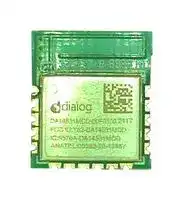


DA14531MOD-00F01002
Bluetooth Module, BLE 5.1, 1 Mbps, -93 dBm, 1.8 V to 3.3 V Supply, -40 °C to 85 °C
- Manufacturer: RENESAS
- Product type: Bluetooth Modules & Adaptors
- SVHC: No SVHC (25-Jun-2025)
- Interfaces: I2C, SPI, UART
- Product Range: -
- Certifications: ANATEL, CE, FCC, IC, MIC, MSIP, NBTC, NCC, RCM, SRRC, WPC
- Bluetooth Class: Class 2
- Bluetooth Version: Bluetooth 5.1
- Supply Voltage Range: 1.8 V to 3.3 V
- Receiver Sensitivity Rx: -93 dBm
- Operating Temperature Range: -40 °C to 85 °C
| Delivery and price | |
|---|---|
| Units per pack | 500 |
| Price | 3.11 € |
| Current stock | 1000+ |
| Lead time | 30 days |

**DA14531MOD**
**Final**
## **SmartBond TINY Bluetooth® LE Module**
## **General Description**
The DA14531 SmartBond TINY[TM] Module is the first Dialog Semiconductor Bluetooth[®] Low Energy module based on world’s lowest power DA14531 SoC.
The module offers a unique combination of the lowest power and the integration of all external components including antenna at a very affordable price.
The module is designed to enable the use of Bluetooth[®] Low Energy in applications where Bluetooth[®] Low Energy could not be used until now because of cost or complexity. The bigger picture is to drive Bluetooth[®] Low Energy technology into every application, turning every product into a connected IoT node to drive the next 1 billion IoT devices in the market.
The SmartBond TINY[TM] Module is supported by software that is easy to work with. This lowers the threshold to use Bluetooth[®] Low Energy technology and significantly speeds up the design time. The module comes with a configurable DSPS (serial port service) and next generation Codeless software to design Bluetooth[®] applications without Bluetooth[®] knowledge or advanced programming skills.
The combination of an affordable price, the lowest power consumption and ease of use makes the DA14531 TINY[TM] Module an ideal product for the mass market, including the makers community.
## **Key Features**
■ Bluetooth[®] □ I2C □ Compatible with Bluetooth[®] v5.1, ■ Power Management ETSI EN 300 328 and EN 300 440 Class 2 □ Operating range (1.8 V - 3.6 V) (Europe), FCC CFR47 Part 15 (US) and □ Inrush current control ARIB STD-T66 (Japan) core ■ Other □ Supports up to three connections □ Real Time Clock □ Renesas registered BD address preprogrammed in OTP □ Trimmed 32 MHz Crystal ■ Processing and memories ■ Packaging □ 16 MHz 32-bit Arm[® ] Cortex[®] M0+ with □ 12.5 mm x 14.5 mm x 2.8 mm package SWD interface ■ Module Software Development Kit □ 128 Kbytes internal FLASH □ Configurable DSPS □ 48 Kbytes RAM □ Codeless v2.0 □ 144 Kbytes ROM □ SDK6 support □ 32 Kbytes OTP ■ Module Software Tools ■ Current Consumption □ Flash/OTP programmer □ 2 mA RX at VBAT = 3 V □ SUOTA support □ 4 mA TX at VBAT = 3 V and 0 dBm □ Battery Life Estimation □ 1.8 µA at sleep with all RAM retained □ Data Rate Monitoring ■ Radio □ Real-Time Power Profiling □ Programmable RF transmit power from □ Production Line Testing -19 to +2.2 dBm ■ Standards Conformance □ -93 dBm receiver sensitivity □ BT SIG QDID 113959 ■ Interfaces □ Europe (CE/RED) and US (FCC) □ Quadrature decoder with 3 channels □ Canada and Japan □ 3 channel 11-bit ENOB ADC □ South Korea and Taiwan □ 2 general purpose timers with PWM □ South Africa and Brazil □ 9 GPIOs □ China and Thailand □ SPI □ India □ 2x UART, 1-wire UART support
**26-Sep-2022**
**Datasheet**
**Revision 3.3**
CFR0011-120-00
1 of 32
© Renesas Electronics
**DA14531MOD**
**Final**
## **SmartBond TINY Bluetooth® LE Module**
## **Applications**
- Beacons
- Remote Controls
- Proximity tags
- Low Power Sensors
- Commissioning/Provisioning
- RF pipe
- Toys
- Industrial applications
- Data acquisition
- Wellness
- Infotainment
- IoT
- Robotics
- Gaming
**26-Sep-2022**
**Datasheet**
**Revision 3.3**
CFR0011-120-00
2 of 32
© Renesas Electronics
**DA14531MOD**
**Final**
## **SmartBond TINY Bluetooth® LE Module**
## **Contents**
|**Contents**|**Contents**|
|---|---|
|**General Description ............................................................................................................................ 1**||
|**Key Features ........................................................................................................................................ 1**||
|**Applications ......................................................................................................................................... 2**||
|**Contents ............................................................................................................................................... 3**||
|**Figures .................................................................................................................................................. 4**||
|**Tables ................................................................................................................................................... 4**||
|**1**|**References ..................................................................................................................................... 5**|
|**2**|**Block Diagram ............................................................................................................................... 6**|
|**3**|**Pinout ............................................................................................................................................. 7**|
|**4**|**Characteristics ............................................................................................................................ 10**|
||4.1<br>Absolute Maximum Ratings ................................................................................................ 10|
||4.2<br>Recommended Operating Conditions ................................................................................. 10|
||4.3<br>Device Characteristics ........................................................................................................ 10|
|**5**|**Mechanical Specifications .......................................................................................................... 13**|
||5.1<br>Dimensions ......................................................................................................................... 13|
||5.2<br>PCB Footprint ...................................................................................................................... 14|
||5.3<br>Marking ............................................................................................................................... 14|
|**6**|**Packaging Information ................................................................................................................ 15**|
||6.1<br>Tape and Reel ..................................................................................................................... 15|
||6.2<br>Labeling ............................................................................................................................... 16|
|**7**|**Application Information .............................................................................................................. 16**|
|**8**|**Design Guidelines ....................................................................................................................... 17**|
||8.1<br>Installation Location ............................................................................................................ 17|
||8.2<br>Antenna Graphs .................................................................................................................. 19|
||8.3<br>Radiation Pattern ................................................................................................................ 20|
|**9**|**Soldering ...................................................................................................................................... 22**|
|**10**|**Ordering Information .................................................................................................................. 23**|
|**11**|**Regulatory Information ............................................................................................................... 23**|
||11.1 CE (Radio Equipment Directive 2014/53/EU (RED)) - (Europe)......................................... 24|
||11.2 FCC - (U.S.A.) ..................................................................................................................... 25|
||11.3 IC (CANADA) ...................................................................................................................... 25|
||11.4 NCC (Taiwan) ..................................................................................................................... 26|
||11.5 MSIP (South Korea) ............................................................................................................ 27|
||11.6 Australia/New Zealand (RCM) ............................................................................................ 27|
||11.7 South Africa (ICASA) .......................................................................................................... 27|
||11.8 Brazil (Anatel) ...................................................................................................................... 27|
||11.9 China (SRRC) ..................................................................................................................... 28|
||11.10 MIC (JAPAN) ....................................................................................................................... 28|
||11.11 Thailand (NBTC) ................................................................................................................. 28|
||11.12 India (WPC) ......................................................................................................................... 29|
|**12**|**Environmental Information ......................................................................................................... 30**|
|**13**|**Bluetooth® SIG Qualification ...................................................................................................... 30**|
**26-Sep-2022**
**Datasheet Revision 3.3**
CFR0011-120-00
3 of 32
© Renesas Electronics
**DA14531MOD**
**Final**
## **SmartBond TINY Bluetooth® LE Module**
**Revision History ................................................................................................................................ 31**
## **Figures**
**==> picture [451 x 265] intentionally omitted <==**
**----- Start of picture text -----**<br>
||||
|---|---|---|
|Figure 1: DA14531 SmartBond TINY|[TM]|Module Block Diagram ........................................................... 6|
|Figure 2: Pinout Diagram Top View ...................................................................................................... 7|
|Figure 3: Mechanical Drawing ............................................................................................................. 13|
|Figure 4: Module Footprint Top View .................................................................................................. 14|
|Figure 5: Module Shield Marking ......................................................................................................... 14|
|Figure 6: Tape and Reel ...................................................................................................................... 15|
|Figure 7: Reel Labeling ....................................................................................................................... 16|
|Figure 8: Installation Locations for Optimum Antenna Performance .................................................. 17|
|Figure 9: Antenna Performance in Proximity of Copper (Left), Laminate (Middle), and Laminate under|
|Antenna (Right) ................................................................................................................................... 18|
|Figure 10: DA14531 TINY|[TM]|Module Evaluation Board ...................................................................... 18|
|Figure 11: VSWR Installed in the Upper Left Corner (Position #1) of Evaluation Board .................... 19|
|Figure 12: VSWR with Module Installed in Center (Position #2) of the Evaluation Board .................. 19|
|Figure 13: VSWR with Module Installed in the Upper Right Corner (Position #3) of the Evaluation|
|Board ................................................................................................................................................... 19|
|Figure 14: Measurement Plane Definition ........................................................................................... 20|
|Figure 15: Radiation Pattern for XY-Plane, Horizontal Polarization .................................................... 21|
|Figure 16: Radiation Pattern for XY-Plane, Vertical Polarization ........................................................ 21|
|Figure 17: Radiation Pattern for XZ-Plane, Horizontal Polarization .................................................... 21|
|Figure 18: Radiation Pattern for XZ-Plane, Vertical Polarization ........................................................ 21|
|Figure 19: Radiation Pattern for YZ-Plane, Horizontal Polarization .................................................... 21|
|Figure 20: Radiation Pattern for YZ-Plane, Vertical Polarization ........................................................ 21|
|Figure 21: Recommended Reflow Profile for Lead Free Solder ......................................................... 22|
**----- End of picture text -----**<br>
## **Tables**
**==> picture [449 x 169] intentionally omitted <==**
**----- Start of picture text -----**<br>
||||
|---|---|---|
|Table 1: Pin Description ........................................................................................................................ 7|
|Table 1: Absolute Maximum Ratings ................................................................................................... 10|
|Table 2: Recommended Operating Conditions ................................................................................... 10|
|Table 3: DC Characteristics................................................................................................................. 10|
|Table 7: XTAL32MHz - Recommended Operating Conditions ........................................................... 12|
|Table 4: Digital IO - Recommended Operating Conditions ................................................................. 12|
|Table 5: Digital IO - DC Characteristics .............................................................................................. 12|
|Table 6: Radio 1Mbps - AC Characteristics ........................................................................................ 12|
|Table 9: Reel Specifications ................................................................................................................ 15|
|Table 10: Antenna Efficiency vs TINY|[TM]|Module Positions ................................................................. 17|
|Table 11: Reflow Profile Specification ................................................................................................. 22|
|Table 12: MSL Level vs Floor Lifetime ................................................................................................ 23|
|Table 13: Ordering Information (Samples) .......................................................................................... 23|
|Table 14: Ordering Information (Production) ....................................................................................... 23|
|Table 15: Standards Conformance ..................................................................................................... 24|
**----- End of picture text -----**<br>
**26-Sep-2022**
**Datasheet**
**Revision 3.3**
CFR0011-120-00
4 of 32
© Renesas Electronics
**DA14531MOD**
**Final**
## **SmartBond TINY Bluetooth® LE Module**
## **1 References**
- [1] DA14531, Datasheet.
- [2] DA14585/DA14531 SW Platform Reference Manual
**26-Sep-2022**
**Datasheet**
**Revision 3.3**
CFR0011-120-00
5 of 32
© Renesas Electronics
**DA14531MOD**
**Final**
## **SmartBond TINY Bluetooth® LE Module**
## **2 Block Diagram**
The SmartBond TINY™ Module is based on the Dialog Semiconductor DA14531 SoC configured in buck mode. With an integrated 1 Mbit flash, 32 MHz XTAL and a printed antenna, the module enables a faster time to market at reduced development costs.
The module, as seen in Figure 1, is comprised of:
- 1 Mbit SPI FLASH
- 32 MHz XTAL
- 2 decoupling capacitors
- A power inductor
- A CLC filter and matching components for the printed antenna
**==> picture [324 x 241] intentionally omitted <==**
**----- Start of picture text -----**<br>
VBAT<br>J7 J12 (RST)<br>2.2uH<br>-_<br>10uF 2.2uF<br>P25Q11U<br>P0_0<br>J10J14 a P0_2P0_5 ne P0_1P0_3 s NOR-SPI 1Mbit<br>J5 P0_6 PROJECT P0_4 Data Flash<br>J13 P0_7 NAME<br>J16 = P0_8 DA14531 — —<br>J15 P0_9<br>J9 P0_10<br>J8 P0_11 RF Filter &<br>Matching<br>32MHz<br>J2, J3, J4,<br>J6, J11, (J1)<br>VBAT_LOW Lx VBAT_HIGH<br>GND<br>**----- End of picture text -----**<br>
**Figure 1: DA14531 SmartBond TINY[TM] Module Block Diagram**
**26-Sep-2022**
**Datasheet**
**Revision 3.3**
CFR0011-120-00
6 of 32
© Renesas Electronics
**DA14531MOD**
**Final**
## **SmartBond TINY Bluetooth® LE Module**
## **3 Pinout**
**==> picture [331 x 326] intentionally omitted <==**
**----- Start of picture text -----**<br>
ANTENNA AREA<br>n.c. J1 J16 P0_8<br>GND J2 J15 P0_9<br>GND J3 MARKING AREA J14 P0_5/RxTx<br>GND J4 J13 P0_7<br>P0_6 J5 J12 P0_0/RST<br>J6 J7 J8 J9 J10 J11<br>GND VBAT P0_11 P0_10/SWDIO P0_2/SWCLK GND<br>**----- End of picture text -----**<br>
**Figure 2: Pinout Diagram Top View**
Note that J1 has no internal connection. J1 should be connected to ground.
**Table 1: Pin Description**
|**Pin #**|**Pin Name**|**Type**|**Reset**<br>**State**|**Description**|
|---|---|---|---|---|
|J1|n.c|||Not internally connected. Recommended<br>to be connected to ground externally|
|J2|GND|GND||Ground|
|J3|GND|GND||Ground|
|J4|GND|GND||Ground|
|J5|P0_6|DIO<br>(Type A)<br>Note 1|I-PD|INPUT/OUTPUT with selectable pull-<br>up/down resistors. Pull-down enabled<br>during and after reset. General purpose<br>I/O port bit or alternate function nodes.<br>Contains a state retention mechanism<br>during power down|
|J6|GND|GND||Ground|
|J7|VBAT|PWR||POWER. Battery connection. IO supply|
**26-Sep-2022**
**Datasheet**
**Revision 3.3**
CFR0011-120-00
7 of 32
© Renesas Electronics
**DA14531MOD**
**Final**
## **SmartBond TINY Bluetooth® LE Module**
|**Pin #**<br>~~Tei~~|**Pin Name**<br>~~Tei~~|**Type**<br>~~Tei~~|**Reset**<br>**State**<br>~~Tei~~|**Description**<br>~~Tei~~|
|---|---|---|---|---|
|J8<br>~~Tei~~|P0_11<br>~~Tei~~|DIO<br>(Type A)<br>~~Tei~~|I-PD<br>~~Tei~~|INPUT/OUTPUT with selectable pull-<br>up/down resistors. Pull-down enabled<br>during and after reset. General purpose<br>I/O port bit or alternate function nodes.<br>Contains a state retention mechanism<br>during power down<br>~~Tei~~|
|J9<br>~~Tei~~|P0_10<br>~~Tei~~|DIO (Type A)<br>~~Tei~~|I-PD<br>~~Tei~~|INPUT/OUTPUT with selectable pull-<br>up/down resistors. Pull-down enabled<br>during and after reset. General purpose<br>I/O port bit or alternate function nodes.<br>Contains a state retention mechanism<br>during power down<br>~~Tei~~|
||SWDIO|||INPUT/OUTPUT. SWI Data input/output.<br>Bidirectional data and control<br>communication (by default)|
|J10<br>~~Ss~~|P0_2|DIO<br>(Type B)<br>~~OO~~|I-PD<br>~~OO~~|INPUT/OUTPUT with selectable pull-<br>up/down resistors. Pull-down enabled<br>during and after reset. General purpose<br>I/O port bit or alternate function nodes.<br>Contains a state retention mechanism<br>during power-down|
||SWCLK<br>~~OO~~|||INPUT SWI clock signal (by default)<br>~~OO~~|
|J11<br>~~Ss~~|GND<br>~~OO~~|GND<br>~~OO~~|~~OO~~|Ground<br>~~OO~~|
|J12<br>~~Ss~~<br>~~ial~~|P0_0<br>~~OO~~<br>~~ial~~|DIO<br>(Type B)<br>Note 2<br>~~OO~~<br>~~ial~~|I-PD<br>~~OO~~<br>~~ial~~|INPUT/OUTPUT with selectable pull-<br>up/down resistors. Pull-down enabled<br>during and after reset. General purpose<br>I/O port bit or alternate function nodes.<br>Contains a state retention mechanism<br>during power-down<br>~~OO~~<br>~~ial~~|
||RST<br>~~ial~~|||RST active high hardware reset (default)<br>~~ial~~|
|J13<br>~~ial~~|P0_7<br>~~ial~~|DIO<br>(Type A)<br>~~ial~~|I-PD<br>~~ial~~|INPUT/OUTPUT with selectable pull-<br>up/down resistors. Pull-down enabled<br>during and after reset. General purpose<br>I/O port bit or alternate function nodes.<br>Contains a state retention mechanism<br>during power down<br>~~ial~~|
|J14|P0_5|DIO<br>(Type B)|I-PD|INPUT/OUTPUT with selectable pull-<br>up/down resistors. Pull-down enabled<br>during and after reset. General purpose<br>I/O port bit or alternate function nodes.<br>Contains a state retention mechanism<br>during power down|
|J15|P0_9|DIO<br>(Type A)|I-PD|INPUT/OUTPUT with selectable pull-<br>up/down resistors. Pull-down enabled<br>during and after reset. General purpose<br>I/O port bit or alternate function nodes.<br>Contains a state retention mechanism<br>during power down|
|J16|P0_8|DIO<br>(Type A)|I-PD|INPUT/OUTPUT with selectable pull-<br>up/down resistors. Pull-down enabled<br>during and after reset. General purpose<br>I/O port bit or alternate function nodes.<br>Contains a state retention mechanism<br>during power down|
**26-Sep-2022**
**Datasheet**
**Revision 3.3**
CFR0011-120-00
8 of 32
© Renesas Electronics
**DA14531MOD**
**Final**
## **SmartBond TINY Bluetooth® LE Module**
**Note 1** There are two types of pads, namely Type A and Type B. Type A is a normal IO pad with a Schmitt trigger on input while Type B has an extra RC Filter with a cutoff frequency of 100 kHz.
- **Note 2** This pin is also used for the communication to the internal SPI FLASH.
- I-PD is Input-Pulled Down
- I-PU is Input-Pulled Up
- DIO is Digital Input-Output
- PWR is power
- GND is Ground
**26-Sep-2022**
**Datasheet**
**Revision 3.3**
CFR0011-120-00
9 of 32
© Renesas Electronics
**DA14531MOD**
**Final**
## **SmartBond TINY Bluetooth® LE Module**
## **4 Characteristics**
All MIN/MAX specification limits are guaranteed by design, production testing, and/or statistical characterization. Typical values are based on characterization results at default measurement conditions and are informative only.
Default measurement conditions (unless otherwise specified): VBAT= 3.0 V, TA = 25[o] C. All radio measurements are done with standard RF measurement equipment.
## **4.1 Absolute Maximum Ratings**
Stresses beyond those listed under Absolute Maximum Ratings may cause permanent damage to the device. These are stress ratings only, so functional operation of the device at these or any other conditions beyond those indicated in the operational sections of the specification are not implied. Exposure to Absolute Maximum Rating conditions for extended periods may affect device reliability.
**Table 2: Absolute Maximum Ratings**
|**Parameter**<br>~~es~~|**Description**<br>~~es~~|**Conditions**<br>~~es~~|**Min**<br>~~es~~|**Max**<br>~~es~~|**Unit**<br>~~es~~|
|---|---|---|---|---|---|
|VBAT_LIM<br>~~es~~|Limiting battery supply voltage<br>~~es~~|~~es~~|-0.1<br>~~es~~|3.6<br>~~es~~|V<br>~~es~~|
## **4.2**
**Recommended Operating Conditions**
**Table 3: Recommended Operating Conditions**
|**Parameter**|**Description**|**Conditions**|**Min**|**Typ**|**Max**|**Unit**|
|---|---|---|---|---|---|---|
|VBAT|Battery supply voltage<br>enabling FLASH<br>programming||1.65||3.6|V|
|VPIN|Voltage on a pin||-0.1||3.6|V|
|TA|Ambient operating<br>temperature||-40|25|85|°C|
## **4.3 Device Characteristics**
**Table 4: DC Characteristics**
|**Parameter**|**Description**|**Conditions**|**Min**|**Typ**|**Max**|**Unit**|
|---|---|---|---|---|---|---|
|IBAT_ACTIVE|Battery supply current with<br>CPU running CoreMark from<br>RAM at 16 MHz|||0.4||mA|
|IBAT_BLE_ADV_<br>100ms|Average battery supply<br>current with system in<br>Advertising state (3<br>channels) every 100 ms and<br>extended sleep with all RAM<br>retained. TX output power at<br>2 dBm. FLASH is off.|||80||μA|
**26-Sep-2022**
**Datasheet**
**Revision 3.3**
CFR0011-120-00
10 of 32
© Renesas Electronics
**DA14531MOD**
**Final**
## **SmartBond TINY Bluetooth® LE Module**
|**Parameter**<br>~~TE~~|**Description**<br>~~TE~~|**Conditions**<br>~~TE~~|**Min**<br>~~TE~~|**Typ**<br>~~TE~~|**Max**<br>~~TE~~|**Unit**<br>~~TE~~|
|---|---|---|---|---|---|---|
|IBAT_BLE_CON<br>N_30ms<br>~~TE~~|Average battery supply<br>current with system in a<br>connection state with 30ms<br>connection interval and<br>extended sleep with all RAM<br>retained. TX output power at<br>2 dBm. FLASH is off.<br>~~TE~~|~~TE~~|~~TE~~|92<br>~~TE~~|~~TE~~|μA<br>~~TE~~|
|IBAT_FLASH|Battery supply current with<br>CPU fetching code from<br>serial FLASH. RF is off.|||0.24||mA|
|IBAT_HIBERN|Battery supply current with<br>system shut down<br>(Hibernation or shipping<br>mode). FLASH is off.|||0.6||μA|
|IBAT_IDLE|Battery supply current with<br>CPU in Wait for Interrupt<br>Mode. FLASH is off.|||0.23||mA|
|IBAT_SLP_20KB|Battery supply current with<br>system in extended sleep<br>mode and 20 kB RAM<br>retained|||1.7||μA|
|IBAT_SLP_48KB<br>~~PE~~|Battery supply current with<br>system in extended sleep<br>mode and all RAM retained<br>~~PE~~|~~PE~~|~~PE~~|2.1<br>~~PE~~|~~PE~~|μA<br>~~PE~~|
|IBAT_RF_RX|Battery supply current|Continuous RX; FLASH in<br>sleep mode; DCDC<br>converter is on;||2.3||mA|
|IBAT_RF_TX_+3<br>dBm|Battery supply current|Continuous TX; FLASH in<br>sleep mode; DCDC<br>converter is on; Output<br>power at 2.5 dBm;<br>Note 1||4.3||mA|
|IBAT_RF_TX_0d<br>Bm|Battery supply current|Continuous TX;FLASH in<br>sleep mode; DCDC<br>converter is on; Output<br>power at 0 dBm;||3.6||mA|
|IBAT_RF_TX_-<br>3dBm|Battery supply current|Continuous TX;FLASH in<br>sleep mode; DCDC<br>converter is on; Output<br>power at -3.5 dBm;||2.8||mA|
|IBAT_RF_TX_-<br>7dBm|Battery supply current|Continuous TX;FLASH in<br>sleep mode; DCDC<br>converter is on; Output<br>power at -7 dBm||2.3||mA|
|IBAT_RF_TX_-<br>19dBm|Battery supply current|Continuous TX;FLASH in<br>sleep mode; DCDC<br>converter is on; Output<br>power at -19.5 dBm||1.5||mA|
**Note 1** The actual TX output power is slightly different than the one indicated in the parameter name
**26-Sep-2022**
**Datasheet**
**Revision 3.3**
CFR0011-120-00
11 of 32
© Renesas Electronics
**DA14531MOD**
**Final**
**SmartBond TINY Bluetooth® LE Module**
**Table 5: XTAL32MHz - Recommended Operating Conditions**
|**Parameter**<br>**Description**<br>**Conditions**|**Min**|**Typ**|**Max**|**Unit**|
|---|---|---|---|---|
|fXTAL_32M<br>Crystal oscillator frequency||32||MHz|
|ΔfXTAL<br>Crystal frequency tolerance<br>After trimming; including<br>aging and temperature drift|-25||25|ppm|
|**Table 6: Digital IO - Recommended Operating Conditions**<br>**Parameter**<br>**Description**<br>**Conditions**<br>**Min**<br>**Typ**<br>**Max**<br>**Unit**<br>VIH<br>HIGH level input voltage<br>0.52<br>V<br>VIL<br>LOW level input voltage<br>0.27<br>V<br>~~SH~~|||||
**Table 7: Digital IO - DC Characteristics**
|**Parameter**|**Description**|**Conditions**|**Min**|**Typ**|**Max**|**Unit**|
|---|---|---|---|---|---|---|
|IIH|HIGH level input current|VI=VBAT_HIGH= 3.0 V|-10||10|μA|
|IIL|LOW level input current|VI=VSS= 0 V|-10||10|μA|
|IIH_PD|HIGH level input current|VI=VBAT= 3.0 V|60||180|μA|
|IIL_PU|LOW level input current|VI=VSS= 0 V, VBAT= 3.0 V|-180||-60|μA|
|VOH|HIGH level output voltage|IO= 3.5 mA, VBAT= 1.8 V|0.8*VB<br>AT|||V|
|VOL|LOW level output voltage|IO= 3.5 mA, VBAT= 1.8 V|||0.2*VB<br>AT|V|
|VOH_LOWDRV|HIGH level output voltage|IO= 0.3 mA, VBAT= 1.8 V|0.8*VB<br>AT|||V|
|VOL_LOWDRV|LOW level output voltage|IO= 0.3 mA, VBAT= 1.8 V|||0.2*VB<br>AT|V|
|**Parameter**<br>~~PPP~~|**Description**<br>~~PPP~~|**Conditions**<br>~~PPP~~|**Min**<br>~~PPP~~|**Typ**<br>~~PPP~~|**Max**<br>~~PPP~~|**Unit**<br>~~PPP~~|
|---|---|---|---|---|---|---|
|PSENS_CLEAN<br>~~PPP~~|Sensitivity level<br>~~PPP~~|Dirty Transmitter disabled;<br>DC-DC converter disabled;<br>PER = 30.8 %;<br>Note 1<br>~~PPP~~|~~PPP~~|-93<br>~~PPP~~|~~PPP~~|dBm<br>~~PPP~~|
|PSENS_EPKT<br>~~PPP~~|Sensitivity level<br>~~PPP~~|Extended packet size (255<br>octets)<br>~~PPP~~|~~PPP~~|-91<br>~~PPP~~|~~PPP~~|dBm<br>~~PPP~~|
**26-Sep-2022**
**Datasheet**
**Revision 3.3**
CFR0011-120-00
12 of 32
© Renesas Electronics
**DA14531MOD**
**Final**
## **SmartBond TINY Bluetooth® LE Module**
## **5 Mechanical Specifications**
## **5.1 Dimensions**
The module’s dimensions are shown in Figure 3.
**==> picture [376 x 167] intentionally omitted <==**
**----- Start of picture text -----**<br>
Top view<br>J1 J16 J16 J1 Common Dimensions<br>J2 J15 J15 J2<br>J3 J14 J14 J3<br>J4 J13 J13 J4<br>J5 J12 J12 J5<br>J11 J10 J9 J8 J7 J6<br>Left side Front view Right side Rear view<br>view view<br>Bottom view<br>**----- End of picture text -----**<br>
**Figure 3: Mechanical Drawing**
**26-Sep-2022**
**Datasheet**
**Revision 3.3**
CFR0011-120-00
13 of 32
© Renesas Electronics
**DA14531MOD**
**Final**
## **SmartBond TINY Bluetooth® LE Module**
## **5.2 PCB Footprint**
The footprint for the PCB is shown in Figure 4.
**==> picture [303 x 277] intentionally omitted <==**
**----- Start of picture text -----**<br>
12.5mm<br>9.5mm<br>0.9mm<br>| [ee |<br>l e J16 |<br>1.5mm<br>J2 7 JIS<br>J3 al —m p J1i4<br>1mm<br>1.75mm<br>qj... & Gc. Ge CL<br>“T 2.0mm _Sa ggyyS8SS5 s” 2.0mm<br>Figure 4: Module Footprint Top View<br>10.15mm<br>14.5mm<br>**----- End of picture text -----**<br>
## **5.3 Marking**
**==> picture [204 x 177] intentionally omitted <==**
**----- Start of picture text -----**<br>
Antenna Area<br>J1 J16<br>J2 J15<br>J3 J14<br>DA14531MOD-00F0100 yyww<br>J4 FCC ID: Y82-DA14531MOD J13<br>IC:9576A-DA14531MOD<br>J5 ANATEL:0538220-12967- J12<br>J6 J7 J8 J9 J10 J11<br>**----- End of picture text -----**<br>
**Figure 5: Module Shield Marking**
**26-Sep-2022**
**Datasheet**
**Revision 3.3**
CFR0011-120-00
14 of 32
© Renesas Electronics
**DA14531MOD**
**Final**
## **SmartBond TINY Bluetooth® LE Module**
## **6 Packaging Information**
## **6.1 Tape and Reel**
**Figure 6: Tape and Reel**
The actual reel specifications are presented in the following table:
**Table 9: Reel Specifications**
|Diameter|13 inch|
|---|---|
|Reel tape width|24 mm|
|Tape material|Antistatic|
|Qty/Reel|100/1000 pcs|
|Leader|400 mm + 10%|
|Trailer|160 mm + 10%|
**26-Sep-2022**
**Datasheet**
**Revision 3.3**
CFR0011-120-00
15 of 32
© Renesas Electronics
**DA14531MOD**
## **SmartBond TINY Bluetooth® LE Module**
**Final**
## **6.2 Labeling**
**Figure 7: Reel Labeling**
## **7 Application Information**
There are some special considerations for the use of the TINY[TM] module, namely:
- The RST signal is shared with the MOSI input of the NOR flash. For this reason, RST must not be driven to GND. When the internal Flash is in use, the reset functionality is not available
- The SPI Bus of DA14531 is used for the communication of the SoC with the NOR Flash at boot time. Three of the four signals are not driven to external module pins. For this reason, a sensor that utilizes the SPI bus must be assigned (by software) to the module pins to communicate with after the boot is completed and when NOR Flash is no longer in use. An example is given in Figure 11
**==> picture [413 x 165] intentionally omitted <==**
**----- Start of picture text -----**<br>
VBAT<br>J5 P0_2 J10 UTX<br>SCK P0_6<br>J14<br>J13 P0_7 P0_5 URX MCU<br> Sensor P0_10 J9<br>J16<br>/CS P0_8 PROJECT J12<br>J15 DA14531NAME GPIO<br>MOSI P0_9 P25Q11U<br>J8 P0_0/RST MOSI<br>MISO P0_11 P0_1 /CS 1Mbit<br>P0_3 MISO NOR<br>P0_4 SCK Flash<br>DA14531 TINY Module<br>J1, J2, J3, J4, J6, J11<br>GND<br>**----- End of picture text -----**<br>
**Figure 11: Example of Connecting a Sensor to the SPI Bus and an MCU to RST and UART**
Note that the P0_0/RST pin (J12) should not be driven while the TINY[TM] module boots from its internal SPI FLASH.
**26-Sep-2022**
**Datasheet**
**Revision 3.3**
CFR0011-120-00
16 of 32
© Renesas Electronics
**DA14531MOD**
**Final**
## **SmartBond TINY Bluetooth® LE Module**
## **8 Design Guidelines**
The DA14531 SmartBond TINY™ Module comes with an integrated PCB trace antenna. The antenna area is 12x4 mm. The antenna’s Voltage Standing Wave Ratio (VSWR) and efficiency depend on the installation location.
The radiation performance of the PCB trace antenna depends on the host PCB layout. The maximum antenna gain is -0.5 dBi when installed on a 50x50 mm reference board, as shown in Figure 19. The radiation pattern is omnidirectional. The RF front end is optimized to achieve the maximum possible efficiency for various installation positions of the module on a host PCB. To obtain a similar performance, follow the guidelines described in the following sections.
## **8.1 Installation Location**
For optimum performance, install the module at the edge of a host PCB with the antenna edge facing out. The module can be located on either of the outer corners or the middle of the host PCB with equivalent performance.
The antenna should have 4 mm free space in all directions. Copper or laminate in the proximity of the PCB trace antenna will affect the efficiency of the antenna. Laminate or copper under the antenna should be avoided as it severely affects the performance of the antenna. The antenna keep-out area can be seen in Figure 9.
Metals close to the antenna will degrade the antenna’s performance. The amount of degradation depends on the host system’s characteristics.
Table 10 summarizes the antenna efficiency at different installation locations on a host PCB as shown in Figure 8.
**Table 10: Antenna Efficiency vs TINY[TM] Module Positions**
||**Position # 1 (Left)**|**Position # 1 (Left)**|**Position # 2 (Middle)**|**Position # 2 (Middle)**|**Position # 3 (Right)**|**Position # 3 (Right)**|
|---|---|---|---|---|---|---|
|Freq|Antenna efficiency||Antenna efficiency||Antenna efficiency||
|[MHz]|[%]|[dB]|[%]|[dB]|[%]|[dB]|
|2405|52|-2,8|40|-4,0|40|-4,0|
|2440|46|-3,4|34|-4,7|41|-3,9|
|2480|50|-3,0|40|-4,0|52|-2,8|
**Figure 8: Installation Locations for Optimum Antenna Performance**
**26-Sep-2022**
**Datasheet**
**Revision 3.3**
CFR0011-120-00
17 of 32
© Renesas Electronics
**DA14531MOD**
## **SmartBond TINY Bluetooth® LE Module**
**==> picture [24 x 8] intentionally omitted <==**
**----- Start of picture text -----**<br>
Final<br>**----- End of picture text -----**<br>
**Figure 9: Antenna Performance in Proximity of Copper (Left), Laminate (Middle), and Laminate under Antenna (Right)**
The actual TINY[TM] module evaluation board layout that has been used to conduct measurements is shown in Figure 10.
**Figure 10: DA14531 TINY[TM] Module Evaluation Board**
**26-Sep-2022**
**Datasheet**
**Revision 3.3**
CFR0011-120-00
18 of 32
© Renesas Electronics
**DA14531MOD**
**Final**
## **SmartBond TINY Bluetooth® LE Module**
## **8.2 Antenna Graphs**
The antenna VSWR measurements for the three installation positions are given in the following figures.
**Figure 11: VSWR Installed in the Upper Left Corner (Position #1) of Evaluation Board**
**Figure 12: VSWR with Module Installed in Center (Position #2) of the Evaluation Board**
**Figure 13: VSWR with Module Installed in the Upper Right Corner (Position #3) of the Evaluation Board**
**26-Sep-2022**
**Datasheet**
**Revision 3.3**
CFR0011-120-00
19 of 32
© Renesas Electronics
**DA14531MOD**
**Final**
## **SmartBond TINY Bluetooth® LE Module**
## **8.3 Radiation Pattern**
The antenna radiation pattern measurements are carried out in an anechoic chamber. Radiation patterns are presented for three measurement planes: XY-, XZ-, and YZ- planes with horizontal and vertical polarization of the receiving antenna.
**Figure 14: Measurement Plane Definition**
Measurements are carried out for the module installed in the upper right corner on the reference board with no laminate below the antenna trace.
**26-Sep-2022**
**Datasheet**
**Revision 3.3**
CFR0011-120-00
20 of 32
© Renesas Electronics
**DA14531MOD**
**Final**
## **SmartBond TINY Bluetooth® LE Module**
## **Radiation Pattern for Antenna Trace**
## Horizontal polarization Vertical polarization
**Figure 15: Radiation Pattern for XY-Plane, Horizontal Figure 16: Radiation Pattern for XY-Plane, Vertical Polarization Polarization**
**Figure 17: Radiation Pattern for XZ-Plane, Horizontal Figure 18: Radiation Pattern for XZ-Plane, Vertical Polarization Polarization**
- **Figure 19: Radiation Pattern for YZ-Plane, Horizontal Figure 20: Radiation Pattern for YZ-Plane, Vertical Polarization Polarization**
**26-Sep-2022**
**Datasheet**
**Revision 3.3**
CFR0011-120-00
21 of 32
© Renesas Electronics
**DA14531MOD**
**Final**
## **SmartBond TINY Bluetooth® LE Module**
## **9 Soldering**
The successful reflow soldering of the DA14531 TINY[TM] Module on a PCB depends on several parameters such as the thickness of the stencil, the pads solder paste aperture, the solder paste characteristics, the reflow soldering profile, size of the PCB, and so on.
The volume of solder paste applied to the board is mainly determined by the aperture size and stencil thickness. An initial solder paste aperture for the pads is provided on the solder paste layer of the PCB footprint. This aperture is modified by the assembly process experts according to stencil thickness, solder paste, and available assembly equipment.
The solder profile depends on the solder paste type used. For example, the soldering profile of a lead-free solder paste, Sn3Ag0.5Cu with no clean Flux (ROL0) and Solder Powder Type 4, is presented below.
No clean flux is recommended because washing must not be applied after assembly to avoid moisture being trapped under the shield.
**Figure 21: Recommended Reflow Profile for Lead Free Solder**
**Table 11: Reflow Profile Specification**
|**Statistic Name**|**Low Limit**|**High Limit**|**Units**|
|---|---|---|---|
|Slope1 (Target=2.0) Between 30.0 and 70.0|1|3|Degrees/Second|
|Slope2 (Target=2.0) Between 70.0 and 150.0|1|3|Degrees/Second|
|Slope3 (Target=-2.8) Between 220.0 and 150.0|-5|-0.5|Degrees/Second|
|Preheat time 110-190C|60|120|Seconds|
|Time above reflow @220C|30|65|Seconds|
|Peak temperature|235|250|Degrees Celsius|
|Total time above @235C|10|30|Second|
**26-Sep-2022**
**Datasheet**
**Revision 3.3**
CFR0011-120-00
22 of 32
© Renesas Electronics
**DA14531MOD**
**Final**
## **SmartBond TINY Bluetooth® LE Module**
Solderability reflow check of five cycles was performed, applying the procedures mentioned in the JESD-A113E standard.
The MSL is an indicator for the maximum allowable time period (floor lifetime) in which a moisturesensitive plastic device, once removed from the dry bag, can be exposed to an environment with a maximum temperature of 30 °C and a maximum relative humidity of 60 % RH before the solder reflow process.
DA14531 TINY Module is qualified for MSL 3.
**Table 12: MSL Level vs Floor Lifetime**
|**MSL Level**|**Floor Lifetime**|
|---|---|
|MSL 4|72 hours|
|MSL 3|168 hours|
|MSL 2A|4 weeks|
|MSL 2|1 year|
|MSL 1|Unlimited at 30 °C/85 %RH|
## **10 Ordering Information**
The ordering number consists of the part number followed by a suffix that indicates the packing method. For details and availability, consult your Dialog Semiconductor local sales representative.
**Table 13: Ordering Information (Samples)**
**Part Number Size (mm) Shipment Form Pack Quantity MOQ** DA14531MOD12.5 x 14.5 x 2.8 Reel 100 3 00F0100C ~~a~~ **Table 14: Ordering Information (Production) Part Number Size (mm) Shipment Form Pack Quantity MOQ** DA14531MOD12.5 x 14.5 x 2.8 Reel 1000 1 00F01002 ~~a~~
## **11 Regulatory Information**
This section outlines the regulatory information for the DA14531 TINY[TM] Module. The module is certified for the global market. This facilitates the user end-product market entry. Please note that the end-product would need to apply for the end-product certification, however, the module certification listed below will facilitate that procedure.
When the end user sends the end product to those markets, the end product may need to follow additional requirements according to the specific market regulation.
For example, some markets have additional testing and/or certification like Korea EMC, South Africa SABS EMC and some have the requirement to put on the end-product label a modular approval ID or mark that consists of an approved Bluetooth[®] Low Energy modular ID on the host label directly, like Japan, Taiwan, Brazil.
A list of the Conformance Standards that DA14531 TINY[TM] Module meets is presented in Table 15.
**26-Sep-2022**
**Datasheet**
**Revision 3.3**
CFR0011-120-00
23 of 32
© Renesas Electronics
**DA14531MOD**
**Final**
## **SmartBond TINY Bluetooth® LE Module**
**Table 15: Standards Conformance**
|**Area**<br>~~a~~|**Item**<br>~~ee~~|**Service**<br>~~ee~~|**Standard**<br>~~ee~~|**Certificate ID**<br>~~ee~~|
|---|---|---|---|---|
|Global<br>~~a~~|Safety for module<br>~~ee~~|CB<br>~~ee~~|IEC 62368-1:2014<br>~~ee~~|SG ITS-21032<br>Note 1<br>~~ee~~|
|Europe<br>~~Ss~~<br>~~a~~|Wireless<br>~~ee~~<br>~~Ss~~|RED<br>~~ee~~<br>~~Ss~~|EN 300 328 v2.2.2<br>EN 62479:2010<br>~~ee~~<br>~~Ss~~|SE-RED-2001958 Ed.1<br>~~ee~~<br>~~Ss~~<br>~~eee~~|
||Safety for module<br>~~Ss~~<br>~~ee~~|CE<br>~~Ss~~<br>~~ee~~|EN 62368-1<br>~~Ss~~<br>~~ee~~||
||EMC<br>~~Ss~~<br>~~a~~|RED<br>~~Ss~~<br>~~a~~<br>~~Se~~|EN 301 489-1 v2.1.1<br>EN 301 489 v3.1.1<br>~~Ss~~<br>~~a~~<br>~~Se~~||
|US/CA<br>~~a~~<br>~~jf~~|Wireless<br>~~jf~~|FCC ID<br>~~Se~~<br>~~jf{|~~|FCC PART 15<br>C:2017<br>~~Se~~<br>~~{|~~|Y82-DA14531MOD<br>~~eee~~<br>~~{| _~~|
|||IC ID<br>~~Se~~<br>~~jf{|~~|RSS-247 Issue 2:<br>February 2017<br>RSS-Gen Issue 4:<br>November 2014<br>~~Se~~<br>~~{|~~|9576A-DA14531MOD<br>~~eee~~<br>~~{| _~~|
|Japan<br>~~a~~<br>~~jf~~|Wireless<br>~~jf~~|MIC<br>~~Se~~<br>~~jf{|~~|JRL<br>~~Se ~~<br>~~{|~~|018-200152<br> ~~eee~~<br>~~{| _~~|
|Taiwan<br>~~jf~~|Wireless<br>~~jf~~|NCC<br>~~jf{|~~|LP0002<br>~~{|~~|CCAG20LP0160T6<br>~~{| _~~|
|South<br>Korea<br>~~jf~~|Wireless<br>~~jf~~|MSIP<br>~~jf {|~~|방송통신표준<br>KS X 3123 "무선<br>설비 적합성 평가<br>시험 방법"<br>KN 301 489<br>~~{|~~|R-R-Dlg-DA14531MOD<br>~~{| _~~|
|South Africa|Wireless|ICASA|Based on RED|TA-2020/5882|
|Brazil<br>~~ee~~<br>~~a~~|Wireless<br>~~ee~~|Anatel<br>~~ee~~|ATO<br>No.14448/2017<br>Resolution No.680<br>~~ee~~<br>~~ee~~|05382-20-12967<br>~~ee~~|
|China<br>~~ee~~<br>~~a~~<br>~~a~~|Wireless<br>~~ee~~<br>~~ee~~|SRRC<br>~~ee~~<br>~~ee~~|信部无<br>【2002】353<br>~~ee~~<br>~~ee~~<br>~~ee~~|2020DP5042<br>~~ee~~|
|Thailand<br>~~a~~<br>~~a~~|Wireless<br>~~ee~~|NBTC<br>~~ee~~|NBTC TS 1035-<br>2562<br>~~ee~~<br>~~ee~~|RT 1768|
|India<br>~~a~~|Wireless<br>~~ee ~~<br>~~a~~|WPC<br> ~~ee~~<br>~~a~~|Based on RED<br>~~ee~~|ETA-SD-20210402433|
**Note 1** Include national differences of US/Canada/Japan/China/Korea/Europe/Australia/South Africa/Taiwan/Brazil/Thailand.
## **11.1 CE (Radio Equipment Directive 2014/53/EU (RED)) - (Europe)**
The DA14531 TINY[TM] Module is a Radio Equipment Directive (RED) assessed radio that is CE marked. The module has been manufactured and tested with the intention of being a sub assembly to a final product. The module has been tested to RED 2014/53/EU Essential Requirements for Health, Safety and Radio. The applicable standards are:
- Radio: EN 300 328 V2.2.2 (2019-07)
- Health: (SAR) EN 62479:2010
- Safety: EN 62368-1
- EMC: EN 301 489-1 v2.1.1, EN 301 489 v3.1.1
End-product will need to perform the radio EMC tests according to EN 301 489. The conducted tests can be inherited from the module test report. It is recommended to repeat the EN 300 328 radiated testing with the end-product assembly.
**26-Sep-2022**
**Datasheet**
**Revision 3.3**
CFR0011-120-00
24 of 32
© Renesas Electronics
**DA14531MOD**
**Final**
## **SmartBond TINY Bluetooth® LE Module**
## **11.2 FCC - (U.S.A.)**
## **FCC ID: Y82-DA14531MOD**
This device complies with Part 15 of the FCC Rules. Operation is subject to the following two conditions: (1) this device may not cause harmful interference, and (2) this device must accept any interference received, including interference that may cause undesired operation.
Warning: Changes or modifications to this unit not expressly approved by the party responsible for compliance could void the user’s authority to operate the equipment.
## **FCC RF Radiation Exposure Statement:**
This device complies with FCC radiation exposure limits set forth for an uncontrolled environment and meets the FCC radio frequency (RF) Exposure Guidelines. This transmitter must not be co-located or operating in conjunction with any other antenna or transmitter.
## **OEM Responsibilities to comply with FCC Regulations:**
OEM integrator is responsible for testing their end-product for any additional compliance requirements needed for the module installation like EMC testing according to FCC Part 15B.
## **Class B Device Notice**
This equipment has been tested and found to comply with the limits for a Class B digital device, pursuant to part 15 of the FCC Rules. These limits are designed to provide reasonable protection against harmful interference in a residential installation. This equipment generates uses and can radiate radio frequency energy and, if not installed and used in accordance with the instructions, may cause harmful interference to radio communications. However, there is no guarantee that interference will not occur in a particular installation. If this equipment does cause harmful interference to radio or television reception, which can be determined by turning the equipment off and on, the user is encouraged to try to correct the interference by one or more of the following measures:
- Reorient or relocate the receiving antenna
- Increase the separation between the equipment and receiver
- Connect the equipment into an outlet on a circuit different from that to which the receiver is connected
- Consult the dealer or an experienced radio/TV technician for help
## **End-product labelling**
The DA14531 TINY[TM] Module is labelled with its own FCC ID: **Y82-DA14531MOD.** If the FCC ID is not visible when the module is installed inside another device, then the outside of the end-product into which the module is installed must also display a label referring to the enclosed module. This exterior label can use the following or similar wording:
## **“Contains FCC ID: Y82-DA14531MOD”**
## **11.3 IC (CANADA)**
## **IC ID: 9576A-DA14531MOD**
The DA14531 TINY[TM] Module is certified for the IC as a single-modular transmitter. The module meets IC modular approval and labelling requirements. The IC follows the same testing and rules as the FCC regarding certified modules in authorized equipment.
The module has been tested according to following standards:
- Radio: RSS-247 Issue 2: February 2017, RSS-Gen Issue 4: November 2014
- Health: RSS-102 Issue 5:2015
This device complies with Industry Canada licence-exempt RSS standard(s). Operation is subject to the following two conditions: (1) this device may not cause interference, and (2) this device must accept any interference, including interference that may cause undesired operation of the device.
_Le présent appareil est conforme aux CNR d'Industrie Canada applicables aux appareils radio exempts de licence. L'exploitation est autorisée aux deux conditions suivantes: (1) l'appareil ne doit pas produire_
**26-Sep-2022**
**Datasheet**
**Revision 3.3**
CFR0011-120-00
25 of 32
© Renesas Electronics
**DA14531MOD**
**Final**
## **SmartBond TINY Bluetooth® LE Module**
_de brouillage, et (2) l'utilisateur de l'appareil doit accepter tout brouillage radioélectrique subi, même si le brouillage est susceptible d'en compromettre le fonctionnement._
## **RF Exposure Statement**
This device complies with IC radiation exposure limits set forth for an uncontrolled environment and meets RSS-102 of the IC radio frequency (RF) Exposure rules. This transmitter must not be co-located or operating in conjunction with any other antenna or transmitter.
Le présent appareil est conforme à l'exposition aux radiations IC définies pour un environnement non contrôlé et répond aux RSS-102 de la fréquence radio (RF) IC règles d'exposition. L'émetteur ne doit pas être colocalisé ni fonctionner conjointement avec à autre antenne ou autre émetteur.
## **OEM Responsibilities to comply with IC Regulations:**
OEM integrator is responsible for testing their end-product for any additional compliance requirements needed for the module installation like IC ES003 (EMC). This can be combined with the FCC Part 15B test.
## **End-product labelling**
The DA14531 TINY[TM] Module is labelled with its own IC ID: **9576A-DA14531MOD.** If the IC ID is not visible when the module is installed inside another device, then the outside of the end-product into which the module is installed must also display a label referring to the enclosed module. This exterior label can use the following or similar wording: **“Contains IC ID: 9576A-DA14531MOD”**
## **11.4 NCC (Taiwan)**
DA14531MOD-00F0100
The DA14531 TINY[TM] Module has received compliance approval in accordance with the Telecommunications Act. The module has been tested according to following standard:
- Radio: Low Power Radio Frequency Devices Technical Regulations (LP0002)
End-product may need to follow additional requirement according to regulation EMC.
注意!
- 依據 低功率電波輻射性電機管理辦法 第十二條
- 經型式認證合格之低功率射頻電機,非經許可,公司、商號或使用者 均不得擅自變更頻率、加大功率或變更原設計之特性及功能。
- 第十四條 低功率射頻電機之使用不得影響飛航安全及干擾合法通信;經發現有 干擾現象時,應立即停用,並改善至無干擾時方得繼續使用。
- 前項合法通信,指依電信法規定作業之無線電通信。 低功率射頻電機須忍受合法通信或工業、科學及醫療用電波輻射性電 機設備之干擾。
## **End-product labelling**
The NCC ID can be applied directly on end-product's label.
**26-Sep-2022**
**Datasheet**
**Revision 3.3**
CFR0011-120-00
26 of 32
© Renesas Electronics
**DA14531MOD**
**Final**
## **SmartBond TINY Bluetooth® LE Module**
## **11.5 MSIP (South Korea)**
## **R-R-Dlg-DA14531MOD**
DA14531 TINY[TM] Module has received certification of conformity in accordance with Radio Waves Act. The module has been tested according to following standard:
- Radio: Ministry of Science and ICT Notice No. 2019-105
For end-product wireless test, you can refer to Dialog's own certification report so that the lab knows the module itself has passed although it still needs to be tested. **Additionally** EMC for **wireless (KN301489** ).
## **End-product labelling**
The MSIP ID can be applied directly on end-product's label. The ID should be clearly visible on the final end-product. The integrator of the module should refer to the labeling requirements for Korea available on the Korea Communications Commission (KCC) website.
## **11.6 Australia/New Zealand (RCM)**
DA14531 TINY[TM] Module has not been certified for the Australian/ New Zealand market. However, the module’s CE test reports can be used in part to demonstrate compliance in accordance with Short Range Devices- SRD Standards. The integrator of the module must construct a compliance folder with all relevant test reports: RF, EMC, Electrical Safety and DoC (Declaration of Conformity).
## **11.7 South Africa (ICASA)**
South Africa certification is based on RED(CE) approval.
**==> picture [70 x 24] intentionally omitted <==**
**----- Start of picture text -----**<br>
TA-2020/5882<br>APPROVED<br>**----- End of picture text -----**<br>
Approval is granted to print labels for the products as described below:
1. For use as Label on the product size: 80 mm (W) X 40 mm (H). To be printed on the product.
2. For use as Label on the package size: 80 mm (W) X 40 mm (H). To be printed on the package
End-product may need to follow additional requirement according to regulation EMC.
## **11.8 Brazil (Anatel)**
## **05382-20-12967**
The module has been tested and found to be compliant according to following Category II standards:
- ATO (Act) No 14448/2017
**26-Sep-2022**
**Datasheet**
**Revision 3.3**
CFR0011-120-00
27 of 32
© Renesas Electronics
**DA14531MOD**
**Final**
## **SmartBond TINY Bluetooth® LE Module**
End-product may need to follow additional requirement according to regulation EMC.
“Este equipamento não tem direito à proteção contra interferência prejudicial e não pode causar interferência em sistemas devidamente autorizados.
## **Translation on the text:**
"This equipment is not entitled to protection against harmful interference and must not cause interference in duly authorized systems."
## **11.9 China (SRRC)**
## **Model no. DA14531MOD-00F0100**
## **CMIIT ID:2020DP5042**
The module has been tested and found to be compliant according to following standards
- 信部无【2002】353 号
End-product may need to follow additional requirement according to regulation EMC.
## **11.10 MIC (JAPAN)**
The DA14531 TINY[TM] Module has received type certification as required to conform to the technical standards regulated by the Ministry of Internal Affairs and Communications (MIC) of Japan pursuant to the Radio Act of Japan.
The module has been tested according to the following standard:
- Radio: JRL “Article 49-20 and the relevant articles of the Ordinance Regulating Radio” Equipment
End-product may need to follow additional requirement according to regulation EMC. **End-product labelling**
The MIC ID can be applied directly on end-product's label. The end-product may bear the GITEKI mark and certification number so that is clear that the end-product contains a certified radio module. The following note may be show next to, below, above the GITEKI mark and certification number in order to indicate the presence of a certified radio module:
`当該機器には電波法に基づく、技術基準適合証明等を受けた特定無線設備を装着している。`
Translation on the text:
“This equipment contains specified radio equipment that has been certified to the Technical Regulation Conformity Certification under the Radio Law.”
## **11.11 Thailand (NBTC)**
## **Model no. DA14531MOD-00F0100 NBTC SDoC ID: RT 1768**
DA14531 TINY[TM] Module is compliant with NBTC requirements in Thailand.
End-product may need to follow additional requirement according to regulation EMC.
## **End-product labelling**
End-products will have their own ID and labelling requirements.
**26-Sep-2022**
**Datasheet**
**Revision 3.3**
CFR0011-120-00
28 of 32
© Renesas Electronics
**DA14531MOD**
**Final**
## **SmartBond TINY Bluetooth® LE Module**
## **11.12 India (WPC)**
## **Model no. DA14531MOD-00F0100 Registration No: ETA-SD-20210402433**
India certification is based on RED(CE) approval/ reports. There are no marking/ labeling requirements.
End-product may need to follow additional requirement according to regulation EMC.
**26-Sep-2022**
**Datasheet**
**Revision 3.3**
CFR0011-120-00
29 of 32
© Renesas Electronics
**DA14531MOD**
**Final**
## **SmartBond TINY Bluetooth® LE Module**
## **12 Environmental Information**
Dialog Semiconductor’s suppliers certify that its products are in compliance with the requirements of REACH and Directive 2015/863/EU of the European Parliament on the restriction of the use of certain hazardous substances in electrical and electronic equipment. RoHS certificates from Dialog’s suppliers are available on request.
## **13 Bluetooth[®] SIG Qualification**
The DA14531 TINY[TM] Module is listed on the Bluetooth[®] SIG Website as a qualified product. The customers can refer to the following QDIDs to qualify their product:
- QDID 113957 for Host Subsystem
- QDID 113959 for Controller Subsystem
- QDID 138960 for Profile Subsystem
**26-Sep-2022**
**Datasheet**
**Revision 3.3**
CFR0011-120-00
30 of 32
© Renesas Electronics
**DA14531MOD**
**Final**
## **SmartBond TINY Bluetooth® LE Module**
## **Revision History**
|**Revision**|**Date**|**Description**|
|---|---|---|
|3.3|27-Sep-2022|●<br>Table 9: Reel tape width changed to 24 mm instead of inches|
|3.2|13-Apr-2022|●<br>Updated Recommended Operating Conditions|
|3.1|31-May-2021|●Corrected number of channels for 11-bit ENOB ADC<br>●Updated Regulatory Information (India)|
|3.0|08-Dec-2020|●Added BD address information to features<br>●Corrected typical ambient temperature in Table 3<br>●Updated Table 4<br>●Updated Regulatory information on ICASA<br>●Added MSL qualification level and description|
|2.3|25-Aug-2020|●Updated Regulatory information|
|2.2|26-Jun-2020|Various updates:<br>●Updated Regulatory information<br>●Various text updates|
|2.1|18-Jun-2020|Various updates:<br>●Added Soldering<br>●Updated Regulatory information<br>●Updated PCB Footprint<br>●Updated Characteristics|
|1.2|18-May-2020|Initial target datasheet version<br>●Various text updates<br>●Electrical Characteristics update from mini-characterization|
|1.1|23-Mar-2020|Initial target datasheet version<br>●<br>Updated Regulatory Information section|
|1.0|6-Mar-2020|Initial target datasheet version|
**26-Sep-2022**
**Datasheet**
**Revision 3.3**
CFR0011-120-00
31 of 32
© Renesas Electronics
**DA14531MOD**
**Final**
## **SmartBond TINY Bluetooth® LE Module**
## **Status Definitions**
|**Revision**|**Datasheet Status**|**Product Status**|**Definition**|
|---|---|---|---|
|1.<n>|Target|Development|This datasheet contains the design specifications for product development.<br>Specifications may be changed in any manner without notice.|
|2.<n>|Preliminary|Qualification|This datasheet contains the specifications and preliminary characterization<br>data for products in pre-production. Specifications may be changed at any<br>time without notice in order to improve the design.|
|3.<n>|Final|Production|This datasheet contains the final specifications for products in volume<br>production. The specifications may be changed at any time in order to<br>improve the design, manufacturing and supply. Major specification changes<br>are communicated via Customer Product Notifications.|
|4.<n>|Obsolete|Archived|This datasheet contains the specifications for discontinued products. The<br>information is provided for reference only.|
## **RoHS Compliance**
Dialog Semiconductor’s suppliers certify that its products are in compliance with the requirements of Directive 2011/65/EU of the European Parliament on the restriction of the use of certain hazardous substances in electrical and electronic equipment. RoHS certificates from our suppliers are available on request.
**26-Sep-2022**
**Datasheet**
**Revision 3.3**
CFR0011-120-00
32 of 32
© Renesas Electronics
## **IMPORTANT NOTICE AND DISCLAIMER**
RENESAS ELECTRONICS CORPORATION AND ITS SUBSIDIARIES (“RENESAS”) PROVIDES TECHNICAL SPECIFICATIONS AND RELIABILITY DATA (INCLUDING DATASHEETS), DESIGN RESOURCES (INCLUDING REFERENCE DESIGNS), APPLICATION OR OTHER DESIGN ADVICE, WEB TOOLS, SAFETY INFORMATION, AND OTHER RESOURCES “AS IS” AND WITH ALL FAULTS, AND DISCLAIMS ALL WARRANTIES, EXPRESS OR IMPLIED, INCLUDING, WITHOUT LIMITATION, ANY IMPLIED WARRANTIES OF MERCHANTABILITY, FITNESS FOR A PARTICULAR PURPOSE, OR NON-INFRINGEMENT OF THIRD-PARTY INTELLECTUAL PROPERTY RIGHTS.
These resources are intended for developers who are designing with Renesas products. You are solely responsible for (1) selecting the appropriate products for your application, (2) designing, validating, and testing your application, and (3) ensuring your application meets applicable standards, and any other safety, security, or other requirements. These resources are subject to change without notice. Renesas grants you permission to use these resources only to develop an application that uses Renesas products. Other reproduction or use of these resources is strictly prohibited. No license is granted to any other Renesas intellectual property or to any third-party intellectual property. Renesas disclaims responsibility for, and you will fully indemnify Renesas and its representatives against, any claims, damages, costs, losses, or liabilities arising from your use of these resources. Renesas' products are provided only subject to Renesas' Terms and Conditions of Sale or other applicable terms agreed to in writing. No use of any Renesas resources expands or otherwise alters any applicable warranties or warranty disclaimers for these products.
(Disclaimer Rev.1.01 Jan 2024)
## **Corporate Headquarters**
TOYOSU FORESIA, 3-2-24 Toyosu, Koto-ku, Tokyo 135-0061, Japan www.renesas.com
## **Contact Information**
For further information on a product, technology, the most up-to-date version of a document, or your nearest sales office, please visit www.renesas.com/contact-us/.
## **Trademarks**
Renesas and the Renesas logo are trademarks of Renesas ~~Electronics Corporation. All trademarks and registered~~ trademarks are the property of their respective owners.
© 2024 Renesas Electronics Corporation. All rights reserved.
Updated at April 28, 2026
Renesas Electronics is a premier global supplier of advanced semiconductor solutions, driving innovation across automotive, industrial, infrastructure, and Internet of Things (IoT) applications. Recognized for a comprehensive portfolio that spans the entire signal chain, Renesas empowers engineers to design secure, intelligent, and highly efficient embedded systems for a rapidly evolving technological landscape. Our selection of Renesas components features a strong emphasis on precision timing and frequency management solutions. We offer a robust range of standard oscillators, timers, and pulse generators engineered to deliver exceptional accuracy and stability. These reliable clocking devices are essential for synchronizing complex digital operations and ensuring optimal performance in demanding circuit designs. In addition to timing components, our inventory includes essential discrete semiconductors and interface solutions. This encompasses high-performance single MOSFETs and bipolar transistors for efficient power routing, alongside versatile I/O expanders that simplify system connectivity. To support modern wireless integration, we also provide select Renesas RF transceivers, WLAN adaptors, and Bluetooth modules, equipping developers with the critical building blocks needed for advanced communication systems.
About Novapart
Novapart is a B2B electronic component broker specialising in stock shortages and cost reduction. We source hard-to-find parts and identify compliant alternatives across a catalogue of 410,000+ components from 500+ manufacturers.
Learn more →Stock Shortage Specialist
When a component is unavailable, discontinued or has an unacceptable lead time, we tap into our network of vetted European and Asian distributors to source what you need — without compromising on quality or traceability.
Request a quote →Compliant Alternatives
We identify pin-to-pin, electrically equivalent substitutes that meet the same certifications (RoHS, AEC-Q100, REACH) as your original specification — validated against datasheets, not just part numbers. Often at a lower cost.
BOM Analysis service →