
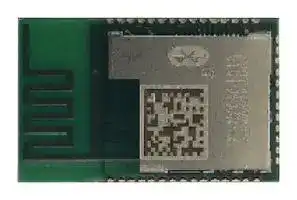


CYBLE-343072-02
Bluetooth Module, 2.4GHz, Bluetooth LE 5.2, 2 Mbps, -94.5 dBm, 2.5 to 3.6 V, -30 °C to 85 °C
- Manufacturer: INFINEON
- Product type: Bluetooth Modules & Adaptors
- SVHC: No SVHC (25-Jun-2025)
- Interfaces: I2C, SPI, UART
- Product Range: AIROC Series
- Certifications: CE, FCC, ISED, MIC
- Bluetooth Class: Class 1, Class 2
- Bluetooth Version: Bluetooth LE 5.2
- Supply Voltage Range: 2.5 V to 3.6 V
- Receiver Sensitivity Rx: -94.5 dBm
- Operating Temperature Range: 85 °C to -30 °C
| Delivery and price | |
|---|---|
| Units per pack | 100 |
| Price | 3.25 € |
| Current stock | 200+ |
| Lead time | 30 days |

**CYBLE-343072-02, CYBLE-333073-02, CYBLE-333074-02** ## **AIROC™ Bluetooth® LE module** ## **General description** The CYBLE-3x307x-02 is a fully integrated Bluetooth® smart ready wireless module. The CYBLE-3x307x-02 includes an onboard crystal oscillator, passive components, flash memory, and the CYW20835 silicon device. Refer to the **CYW20835** datasheet for additional details on the capabilities of the silicon device used in this module. The CYBLE-3x307x-02 supports peripheral functions (ADC and PWM), UART, I[2] C, and SPI communication, and a PCM/I[2] S audio interface. The CYBLE-3x307x-02 includes a royalty-free Bluetooth® stack compatible with Bluetooth® 5.0 in a 13.31 × 21.89 × 1.95 mm package. The CYBLE-3x307x-02 includes 512 KB of onboard serial flash memory and is designed for standalone operation. The CYBLE-3x307x-02 uses an integrated power amplifier to achieve Class I or Class II output power capability. The CYBLE-3x307x-02 is fully qualified by Bluetooth® SIG and is targeted at applications requiring cost-optimized Bluetooth® wireless connectivity. The CYBLE-3x307x-02 is offered in four certified versions CYBLE-343072-02, CYBLE-333073-02, and CYBLE-333074-02. The CYBLE-343072-02 includes an integrated trace antenna. The CYBLE-333073-02 supports an external antenna through a RF solder pad output. The CYBLE-333074-02 supports an external antenna via a u-FL connector. ## **Module description** - Module size: 13.31 × 21.89 × 1.95 mm - Bluetooth® 5.0 qualified smart ready module - QDID: TBD - Declaration ID: TBD - Certified to FCC, ISED, MIC, and CE regulations - Castelated solder pad connections for ease-of-use - 512-KB on-module serial flash memory - Up to 24 GPIOs - Temperature range: –30 °C to +85 °C - Cortex-M4 32-bit processor - Maximum TX output power - +12 dBm for Bluetooth® Low Energy - Bluetooth® LE connection range of up to 250 meters at 12 dBm[[1]] - RX receive sensitivity: - Bluetooth® Low Energy: –94.5 dBm ## **Power consumption** - Bluetooth® LE current consumption - RX current: 8 mA - TX current: 18 mA @ 12 dBm - Interval Bluetooth® LE ADV average current consumption: 30 µA - HIDOFF (Deep Sleep): 1 µA ## **Functional capabilities** - 1x MIPI DMI-C interface - 6x 16-bit PWMs - Programmable key-scan matrix interface, up to 8 × 20 key scanning matrix Please read the Important Notice and Warnings at the end of this document page 1 of 58 Preliminary Datasheet www.infineon.com 002-33419 Rev. ** 2021-08-12 **AIROC™ Bluetooth® LE module** ## Benefits - Quadrature decoder - Watchdog timer (WDT) - 1x peripheral UART, 1x UART for programming and HCI - 1x SPI (master or slave mode) - 1x I2C master - One ADC (10-ENoB for DC measurement and 12-ENOB for audio measurement) - Hardware security engine ## **Benefits** CYBLE-3x307x-02 provides all necessary components required to operate Bluetooth® LE communication standards. - Proven ready-to-use hardware design - Cost optimized for applications without space constraints - Nonvolatile memory for self-sufficient operation and over-the-air updates - Bluetooth® SIG listed with QDID and declaration ID - Fully certified module eliminates the time needed for design, development, and certification processes - ModusToolbox™ provides an easy-to-use integrated design environment (IDE) to configure, develop, and program a Bluetooth® application ## **More information** Infineon provides a wealth of data at **www.cypress.com** to help you to select the right module for your design, and to help you to quickly and effectively integrate the module into your design. ## **References** - Overview: **AIROC™ Bluetooth® LE & Bluetooth® portfolio** , **Module roadmap** - **CYW20835 Bluetooth® silicon datasheet** - Development kits: - **CYBLE-343072-EVAL** , CYBLE-343072-02 evaluation board - **CYBLE-333074-EVAL** , CYBLE-333074-02 evaluation board - Test and debug tools: - **CYSmart** , Bluetooth® LE test and debug tool (Windows) - **CYSmart Mobile** , Bluetooth® LE test and debug tool (Android/iOS Mobile App) - Knowledge base article - **KBA97095** - EZ-Bluetooth® LE module placement - **TBD** - TBD - **KBA213976** - FAQ for Bluetooth® LE and regulatory certifications with EZ-BLE modules - **KBA210802** - Queries on Bluetooth® LE qualification and declaration processes - **KBA218122** - 3D Model Files for EZ-BLE/EZ-BT modules - **TBD** - Platform files for CYBLE-343072-EVAL and CYBLE-333074-EVAL - **KBA223428** - Programming an EZ-BT WICED module ## **Note** 1. Connection range tested module-to-module in full line-of-sight environment, free of obstacles or interference sources with output power of +12.0 dBm. Actual range will vary based on end product design, environment, receive sensitivity, and transmit output power of the central device. 2 of 58 Preliminary Datasheet 002-33419 Rev. ** 2021-08-12 ## **AIROC™ Bluetooth® LE module** Development environments ## **Development environments** ModusToolbox™ software is a modern, extensible development environment supporting a wide range of Infineon microcontroller devices. It provides a flexible set of tools and a diverse, high-quality collection of application-focused software. These include configuration tools, low-level drivers, libraries, and operating system support, most of which are compatible with Linux®, macOS®, and Windows®-hosted environments. ModusToolbox™ software does not include proprietary tools or custom build environments. This means you choose your compiler, your IDE, your RTOS, and your ecosystem without compromising usability or access to our industry leading CAPSENSE™, AIROC™, Bluetooth®, Wi-Fi, security, and low-power features. ## **Technical support** - **Cypress community:** Whether you are a customer, partner, or a developer interested in the latest innovations, the developer community offers you a place to learn, share, and engage with both Infineon experts and other embedded engineers around the world. - **Frequently asked questions (FAQs)** : Learn more about our Bluetooth® ecosystem. - Visit our **support** page and create a **technical support case** or contact a **local sales representatives** . If you are in the United States, you can talk to our technical support team by calling our toll-free number: +1-800-541-4736. Select option 2 at the prompt. 3 of 58 Preliminary Datasheet 002-33419 Rev. ** 2021-08-12 ## **AIROC™ Bluetooth® LE module** Contents ## **Contents** **General description ...........................................................................................................................1 Module description............................................................................................................................1 Power consumption...........................................................................................................................1 Functional capabilities.......................................................................................................................1 Benefits............................................................................................................................................2 More information ..............................................................................................................................2 References........................................................................................................................................2 Development environments...............................................................................................................3 Technical support..............................................................................................................................3 Contents...........................................................................................................................................4 1 Overview .......................................................................................................................................6** 1.1 Functional block diagram.......................................................................................................................................6 1.2 Module description.................................................................................................................................................6 1.2.1 Module dimensions and drawing........................................................................................................................6 **2 Pad connection interface.................................................................................................................8 3 Recommended host PCB layout......................................................................................................10 4 Module connections ......................................................................................................................14 5 Connections and optional external components..............................................................................17** 5.1 Power connections (VDDIN) .................................................................................................................................17 5.2 External reset (XRES) ............................................................................................................................................17 5.3 Critical components list........................................................................................................................................19 5.4 Antenna design .....................................................................................................................................................20 **6 Functional description ..................................................................................................................21** 6.1 Bluetooth® baseband core ...................................................................................................................................21 6.1.1 Link control layer ...............................................................................................................................................21 6.1.2 Test mode support.............................................................................................................................................22 6.1.3 Frequency hopping generator ..........................................................................................................................22 6.2 Microcontroller unit..............................................................................................................................................22 6.2.1 Floating point unit .............................................................................................................................................22 6.2.2 OTP memory ......................................................................................................................................................22 6.2.3 NVRAM configuration data and storage............................................................................................................22 6.2.4 Power-on reset (POR) ........................................................................................................................................23 6.3 External reset (XRES) ............................................................................................................................................23 6.3.1 Brownout detection...........................................................................................................................................23 **7 Integrated radio transceiver..........................................................................................................24** 7.1 Transmitter path...................................................................................................................................................24 7.1.1 Digital modulator...............................................................................................................................................24 7.1.2 Power amplifier..................................................................................................................................................24 7.2 Receiver path ........................................................................................................................................................24 7.2.1 Digital demodulator and bit synchronizer........................................................................................................24 7.2.2 Receiver signal strength indicator ....................................................................................................................24 7.3 Local oscillator generation...................................................................................................................................24 7.4 Calibration.............................................................................................................................................................24 **8 Peripheral and communication interfaces ......................................................................................25** 8.1 I2C communication interface...............................................................................................................................25 8.2 HCI UART interface................................................................................................................................................25 8.3 Triac control..........................................................................................................................................................26 8.4 Peripheral UART interface....................................................................................................................................26 8.5 Serial peripheral interface....................................................................................................................................26 8.6 Infrared modulator ...............................................................................................................................................27 8.7 PDM microphone ..................................................................................................................................................27 4 of 58 Preliminary Datasheet 002-33419 Rev. ** 2021-08-12 ## **AIROC™ Bluetooth® LE module** ## Contents 8.8 Security engine .....................................................................................................................................................27 **9 Keyboard scanner.........................................................................................................................29** 9.1 Theory of operation..............................................................................................................................................29 9.1.1 Idle......................................................................................................................................................................29 9.1.2 Scan ....................................................................................................................................................................29 9.1.3 Scan End.............................................................................................................................................................29 9.2 Mouse quadrature signal decoder .......................................................................................................................29 9.3 Theory of operation..............................................................................................................................................30 9.4 ADC port ................................................................................................................................................................30 **10 Clock frequencies........................................................................................................................31 11 GPIO port ...................................................................................................................................32 12 PWM...........................................................................................................................................33 13 Power management unit .............................................................................................................34** 13.1 RF power management ......................................................................................................................................34 13.2 Host controller power management .................................................................................................................34 13.3 BBC power management....................................................................................................................................34 **14 Electrical characteristics .............................................................................................................35 15 Chipset RF specifications .............................................................................................................36 16 Timing and AC characteristics ......................................................................................................38** 16.1 UART timing ........................................................................................................................................................38 16.2 SPI timing ............................................................................................................................................................39 16.3 I2C interface timing.............................................................................................................................................41 **17 Environmental specifications.......................................................................................................44** 17.1 Environmental compliance................................................................................................................................44 17.2 RF certification....................................................................................................................................................44 17.3 Safety certification..............................................................................................................................................44 17.4 Environmental conditions..................................................................................................................................44 17.5 ESD and EMI protection......................................................................................................................................44 **18 Regulatory information ...............................................................................................................45** 18.1 FCC.......................................................................................................................................................................45 18.2 ISED......................................................................................................................................................................46 18.3 European declaration of conformity..................................................................................................................47 18.4 MIC Japan............................................................................................................................................................48 **19 Packaging ..................................................................................................................................49 20 Ordering information ..................................................................................................................51 21 Acronyms ...................................................................................................................................52 22 Document conventions................................................................................................................56** 22.1 Units of measure.................................................................................................................................................56 **Revision history ..............................................................................................................................57** 5 of 58 Preliminary Datasheet 002-33419 Rev. ** 2021-08-12 **AIROC™ Bluetooth® LE module** Overview ## **1 Overview** ## **1.1 Functional block diagram** **Figure 1** illustrates the CYBLE-3x307x-02 functional block diagram. **==> picture [340 x 197] intentionally omitted <==** **----- Start of picture text -----**<br> XRES<br>UART<br>SPI<br>CYW20835<br>12C<br>Silicon Device<br>PCM/12S<br>ADC<br>UP to 6 PWMs<br>Passive Components 512 KB 24 MHz<br>UP to 24 GPIOs (RES, CAP, IND) SERIAL FLASH XTAL<br>32kHz LPO_In<br>(Optional)<br>1x MIPI DMI‐C<br>interface<br>**----- End of picture text -----**<br> ## **Figure 1 Functional block diagram (GPIOs)** ## **1.2 Module description** The CYBLE-3x307x-02 module is a complete module designed to be soldered to the application’s main board. ## **1.2.1 Module dimensions and drawing** Infineon reserves the right to select components from various vendors to achieve the Bluetooth® module functionality. Such selections will still guarantee that all mechanical specifications and module certifications are maintained. Designs should be held within the physical dimensions shown in the mechanical drawings in **Figure 2 on page 7** . All dimensions are in millimeters (mm). ## **Table 1 Module design dimensions** |**Dimension item**|**Dimension item**|**Specification**| |---|---|---| |Module dimensions|Length (X)<br>~~OS~~|13.31 ± 0.15 mm| ||Width (Y)<br>~~OS~~|21.89 ± 0.15 mm| |Antenna connection location dimensions|Length (X)<br>~~OS~~|13.31 mm| ||Width (Y)<br>~~OS~~|4.65 mm| |PCB thickness|Height (H)<br>~~OS~~|0.50 ± 0.05 mm| |Shield height|Height (H)<br>~~OS~~|1.45-mm typical| |Maximum component height|Height (H)<br>~~OS~~|1.45-mm typical| |Total module thickness (bottom of module to highest<br>component)|Height (H)<br>~~oe~~|1.95-mm typical| 6 of 58 Preliminary Datasheet 002-33419 Rev. ** 2021-08-12 **AIROC™ Bluetooth® LE module** ## Overview ## See **Figure 2** for the mechanical reference drawing for CYBLE-3x307x-02. **Figure 2 Module mechanical drawing** ## **Notes** 2. No metal should be located beneath or above the antenna area. Only bare PCB material should be located beneath the antenna area. For more information on recommended host PCB layout, see **“Recommended host PCB layout”** on page 10. 3. The CYBLE-343072-02, CYBLE-333073-02, CYBLE-333074-02 includes castellated pad connections, denoted as the circular openings at the pad location above. 7 of 58 Preliminary Datasheet 002-33419 Rev. ** 2021-08-12 **AIROC™ Bluetooth® LE module** Pad connection interface ## **2 Pad connection interface** As shown in the bottom view of **Figure 2 on page 7** , the CYBLE-3x307x-02 connects to the host board via solder pads on the backside of the module. **Table 2** and **Figure 3** detail the solder pad length, width, and pitch dimensions of the CYBLE-3x307x-02 module. ## **Table 2 Connection description** |**Part number**|**Name**|**Connections**|**Connection type**|**Pad length**<br>**dimension**|**Pad width**<br>**dimension**|**Pad pitch**| |---|---|---|---|---|---|---| |CYBLE-343072-02|SP|43|Solder pads|1.02 mm|0.61 mm|0.90 mm| |CYBLE-333073-02|SP|45|Solder pads|1.02 mm|0.61 mm|0.90 mm| |CYBLE-333074-02|SP|43|Solder pads|1.02 mm|0.61 mm|0.90 mm| ## **Figure 3 Solder pad dimensions (seen from bottom)** To maximize RF performance, the host layout should follow these recommendations: 1. Antenna Area Keepout: The host board directly below the antenna area of the module (see **Figure 2 on page 7** ) must not contain ground or signal traces. This keepout area requirement applies to all layers of the host board. 2. Module Placement: The ideal placement of the Bluetooth® module is in a corner of the host board with the PCB trace antenna located at the far corner. This placement minimizes the additional recommended keepout area stated in item 2. Refer to **AN96841** for module placement best practices. 8 of 58 Preliminary Datasheet 002-33419 Rev. ** 2021-08-12 **AIROC™ Bluetooth® LE module** Pad connection interface **Figure 4 Recommended host PCB keepout area around the CYBLE-3x307x-02 antenna** 9 of 58 Preliminary Datasheet 002-33419 Rev. ** 2021-08-12 **AIROC™ Bluetooth® LE module** Recommended host PCB layout ## **3 Recommended host PCB layout** **Figure 5** , **Figure 6** , **Figure** , and **Table 3** provide details that can be used for the recommended host PCB layout pattern for the CYBLE-3x307x-02. Dimensions are in millimeters unless otherwise noted. Pad length of 1.26 mm (0.64 mm from center of the pad on either side) shown in **Figure 4** is the minimum recommended host pad length. The host PCB layout pattern can be completed using either **Figure 5** , **Figure 6** , or **Figure** . It is not necessary to use all figures to complete the host PCB layout pattern. **Figure 5 CYBLE-3x307x-02 host layout (dimensioned)** 10 of 58 Preliminary Datasheet 002-33419 Rev. ** 2021-08-12 **AIROC™ Bluetooth® LE module** Recommended host PCB layout **Figure 6 CYBLE-3x307x-02 host layout (relative to origin)** **Table 3** provides the center location for each solder pad on the CYBLE-3x307x-02. All dimensions are referenced to the center of the solder pad. Refer to **Figure 7** for the location of each module solder pad. **Table 3 Module solder pad location** |**Solder pad**<br>**(center of pad)**|**Location (X,Y) from**<br>**origin (mm)**|**Dimension from**<br>**origin (mils)**| |---|---|---| |1|(0.38, 7.21)|(14.96, 283.86)| |2|(0.38, 8.12)|(14.96, 319.68)| |3|(0.38, 9.02)|(14.96, 355.12)| |4|(0.38, 9.92)|(14.96, 390.55)| |5|(0.38, 10.82)|(14.96, 425.98)| |6|(0.38, 11.72)|(14.96, 461.42)| |7|(0.38, 12.62)|(14.96, 496.85)| |8|(0.38, 13.53)|(14.96, 532.68)| |9|(0.38, 14.43)|(14.96, 568.11)| |10|(0.38, 15.33)|(14.96, 603.54)| |11|(0.38, 16.23)|(14.96, 638.54)| |12|(0.38, 17.13)|(14.96, 674.41)| |13|(0.38, 18.03)|(14.96, 709.84)| |14|(0.38, 18.94)|(14.96, 745.67)| |15|(0.38, 19.84)|(14.96, 781.10)| |16|(1.24, 21.51)|(48.82, 846.85)| 11 of 58 Preliminary Datasheet 002-33419 Rev. ** 2021-08-12 ## **AIROC™ Bluetooth® LE module** Recommended host PCB layout **Module solder pad location** _(continued)_ **==> picture [456 x 487] intentionally omitted <==** **----- Start of picture text -----**<br> ||||| |---|---|---|---| |Table 3|Module solder pad location|(continued)| |Solder pad|Location (X,Y) from|Dimension from| |(center of pad)|origin (mm)|origin (mils)| |Pe| |17|oo|(2.15, 21.51)|(84.65, 846.85)| |18|(3.05, 21.51)|(120.08, 846.85)| |19|>|(3.95, 21.51)|(155.51, 846.85)| |20|>|(4.85, 21.51)|(190.94, 846.85)| |21|oo|(5.75, 21.51)|(226.38, 846.85)| |22|(6.65, 21.51)|(261.81, 846.85)| |23|>|(7.56, 21.51)|(297.64, 846.85)| |24|>|(8.46, 21.51)|(333.07, 846.85)| |25|oo|(9.36, 21.51)|(368.50, 846.85)| |26|(10.26, 21.51)|(403.94, 846.85)| |27|>|(11.16, 21.51)|(439.37, 846.85)| |28|>|(12.07, 21.51)|(475.20, 846.85)| |29|oo|(12.93, 19.84)|(509.05, 781.10)| |30|(12.93, 18.94)|(509.05, 745.67)| |31|>|(12.93, 18.03)|(509.05, 709.84)| |32|>|(12.93, 17.13)|(509.05, 674.41)| |33|(12.93, 16.23)|(509.05, 638.98)| |oo| |34|(12.93, 15.33)|(509.05, 603.54)| |35|>|(12.93, 14.43)|(509.05, 568.11)| |36|>|(12.93, 13.53)|(509.05, 532.68)| |37|(12.93, 12.62)|(509.05, 496.85)| |oo| |38|(12.93, 11.72)|(509.05, 461.42)| |39|>|(12.93, 10.82)|(509.05, 425.98)| |40|>|(12.93, 9.92)|(509.05, 390.55)| |41|(12.93, 9.02)|(509.05, 355.12)| |oo| |42|(12.93, 8.12)|(509.05, 319.68)| |43|>|(12.93, 7.21)|(509.05, 283.86)| **----- End of picture text -----**<br> 12 of 58 Preliminary Datasheet 002-33419 Rev. ** 2021-08-12 **AIROC™ Bluetooth® LE module** Recommended host PCB layout **Figure 7 Solder pad reference location** 13 of 58 Preliminary Datasheet 002-33419 Rev. ** 2021-08-12 **AIROC™ Bluetooth® LE module** Module connections ## **4 Module connections** **Table 4** details the solder pad connection definitions and available functions for the pad connections for the CYBLE-3x307x-02 module. **Table 4** lists the solder pads on the CYBLE-3x307x-02 module, the silicon device pin, and denotes what functions are available for each solder pad. |**Power supply**|||||| |---|---|---|---|---|---| |VDD|2<br>~~a~~|2.5V~3.6V<br>~~a~~|||| |**Ground pins**|~~ee~~|**Ground pins**<br>~~ee~~|||| |GND|1 19 22 43<br>~~ee~~<br>~~a~~|HS-VSS<br>~~ee~~<br>~~a~~|I<br>~~a~~|VSS<br>~~a~~|Digitalground| |**UART**|~~a~~<br>~~ee~~<br>~~a~~|**UART**<br>~~a~~<br>~~ee~~<br>~~ee~~|~~a~~<br>~~eeeee~~||| |UART_CTS_N|29<br>~~a~~|UART_CTS_N<br>~~ee~~|I, PU<br>~~ee~~|VDDO<br>~~eee~~|CTS for HCI UART interface: NC if<br>unused.| |UART_RTS_N|30<br>~~a~~|UART_RTS_N<br>~~ee ~~<br>~~TL~~|O, PU<br> ~~ee ~~<br>~~TL |~~|VDDO<br> ~~eee~~<br>~~|~~|RTS for HCI UART interface. NC if<br>unused.| |UART_RXD|32<br>~~ef]~~|UART_RXD<br>~~ef]~~<br>~~TL~~|I<br>~~ef]~~<br>~~TL |~~|VDDO<br>~~ef]~~<br>~~|~~|UART serial input. Serial data input<br>for the HCI| ||||||UART interface.| |UART_TXD|31|UART_TXD<br>~~TL~~|O, PU<br>~~TL |~~|VDDO<br>~~|~~|UART serial input. Serial data input<br>for the HCI| ||||||UART interface.| |**Interface**|~~OO~~|**Serial peripheral**<br>**interface**<br>~~|~~<br>~~OO~~|~~TT~~||| |SPI_MISO<br>~~Se~~|33<br>~~OO~~<br>~~Se~~|SPI_MISO<br>~~|~~<br>~~OO~~|I<br>~~TT~~|VDDO<br>~~TT~~|SPI Master In Slave Out| |NA<br>~~Se~~<br>~~Se~~|NA<br>~~OO~~<br>~~Se~~<br>~~Se~~|SPI_MOSI<br>~~OO ~~|O<br> ~~TT~~|VDDO<br>~~TT~~|SPI Master Out Slave In| |NA<br>~~Se~~<br>~~Se~~|NA<br>~~Se~~<br>~~Se~~|SPI_CSN|O|VDDO|SPI Chip Select| |NA<br>~~Se~~|NA<br>~~Se~~<br>~~a~~|SPI_CLK<br>|O|VDDO|SPI Clock| |**Crystal**|~~ee~~|**Crystal**<br>~~ee~~|||| |NA<br>~~Se~~|NA<br>~~Se~~|BT_XTALI|I|PLLVDD1P2|Crystal oscillator input: see<br>“Crystal Oscillator” on page 12 for<br>options| |NA<br>~~Se~~<br>~~Se~~|NA<br>~~Se~~<br>~~Se~~|BT_XTALO|O|PLLVDD1P2|Crystal oscillator output| |XTALI_32K<br>~~Se~~<br>~~Se~~<br>~~Se~~|20<br>~~Se~~<br>~~Se~~<br>~~Se~~|XTALI_32K|I|VDDO|Low-power oscillator input| |XTALO_32K<br>~~Se~~<br>~~Se~~|21<br>~~Se~~<br>~~Se~~|XTALO_32K|O|VDDO|Low-power oscillator output| |**Others**<br>~~Se~~|~~Se~~<br>~~ee~~|**Others**<br>~~ee~~|||| |NA|NA|DEFAULT_STRAP|I|VDDO|Connect to VDDO| 14 of 58 Preliminary Datasheet 002-33419 Rev. ** 2021-08-12 **AIROC™ Bluetooth® LE module** ## Module connections |**Table 4**|**Pin assignments**_(continued)_||| |---|---|---|---| |**Module pad**<br>**name**<br>**Pad**<br>**number**<br>**Silicon pin name**<br>**I/O**||**Power**<br>**domain**|**Description**| |HOST_WAKE<br>36<br>BT_HOST_WAKE<br>O<br>VDDO|||Host wake-up. This is a signal from| ||||the Bluetooth® device to the host| ||||indicating that the Bluetooth®| ||||device requires attention.| ||||• Asserted: Host device must wake| ||||up or remain awake| ||||• Deasserted: Host device may| ||||sleep when sleep awake criteria| ||||is met. The polarity of this signal| ||||is software configurable and can| ||||be asserted high or low.| |NA|NA<br>BT_RF<br>I/O<br>PAVDD2P5<br>~~a~~||RF antenna port| |NA<br>XRES|NA<br>JTAG_SEL<br>–<br>–<br>3<br>RST_N<br>I<br>VDDO<br>~~|~~<br>~~|~~<br>~~ft |~~||ARM JTAG debug mode control:<br>connect to GND for all applications<br>Active-low system reset with<br>open-drain output and internal<br>pull-up resistor| |**Table 5**|**GPIO pin descriptions**||| |**Module**<br>**pad**<br>**name**<br>P0<br>P1<br>P2<br>P3|**Pad**<br>**number**<br>**Silicon**<br>**pin**<br>**name**<br>**Direction**<br>**Default**<br>**POR**<br>**state**<br>**Power**<br>**domain**<br>10<br>P0<br>Input<br>Floating<br>VDDO<br>9<br>P1<br>Input<br>Floating<br>VDDO<br>34<br>P2<br>Input<br>Floating<br>VDDO<br>35<br>P3<br>Input<br>Floating<br>VDDO<br>~~CEE~~<br>~~|~~<br>~~|~~<br>~~|~~<br>~~>~~|**Default alternate function description**<br>GPIO: P0<br>A/D converter input 29<br>**Note**Not available duringTM1 = 1.<br>GPIO: P1<br>A/D converter input 28<br>GPIO: P2<br>GPIO: P3|| |P4|37<br>P4<br>Input<br>Floating<br>VDDO<br>~~a~~|GPIO: P4|| |P5|38<br>P5<br>Input<br>Floating<br>VDDO<br>~~a~~|GPIO: P5|| |P6|39<br>P6<br>Input<br>Floating<br>VDDO<br>~~a~~|GPIO: P6|| |P7<br>P8<br>P9|40<br>P7<br>Input<br>Floating<br>VDDO<br>41<br>P8<br>Input<br>Floating<br>VDDO<br>17<br>P9<br>Input<br>Floating<br>VDDO<br>~~a~~<br>~~|~~<br>~~|~~<br>~~|~~<br>~~|~~<br>~~||~~|GPIO: P7<br>GPIO: P8<br>A/D converter input 27<br>GPIO: P9<br>A/D converter input 26|| ## **Notes** 4. The CYBLE-3x307x-02 contains a single SPI (SPI1) peripheral supporting both master or slave configurations. SPI2 is used for on-module serial memory interface. 5. In Master mode, any available GPIO can be configured as SPI1_CS. This function is not explicitly shown in **Table 20** . 15 of 58 Preliminary Datasheet 002-33419 Rev. ** 2021-08-12 ## **AIROC™ Bluetooth® LE module** ## Module connections |**Module**<br>**pad**<br>**name**|**Pad**<br>**number**<br>~~Pt~~|**Silicon**<br>**pin**<br>**name**<br>~~Pt~~<br>~~|~~<br>~~|~~|**Direction**<br>**Default**<br>~~Pt~~<br>~~|ft~~<br>~~|~~<br>~~|~~|**POR**<br>**state**<br>~~Pt~~<br>~~ft~~<br>~~|~~|**Power**<br>**domain**<br>~~Pt~~|**Default alternate function description**| |---|---|---|---|---|---|---| |P10|16<br>~~Pt~~<br>~~ef~~|P10<br>~~Pt~~<br>~~|~~<br>~~ef~~<br>~~|~~<br>~~|~~|Input<br>~~Pt~~<br>~~| ft~~<br>~~ef~~<br>~~|~~<br>~~|~~<br>~~|~~<br>~~|~~|Floating<br>~~Pt~~<br>~~ft~~<br>~~ef~~<br>~~|~~<br>~~|~~|VDDO<br>~~Pt~~<br>~~ef~~|GPIO: P10| |||||||A/D converter input 25| |P11|15<br>~~ef~~<br>~~|~~|P11<br>~~ef~~<br>~~|~~<br>~~|~~<br>~~|~~<br>~~|~~|Input<br>~~ef~~<br>~~|~~<br>~~|~~<br>~~|~~<br>~~|~~<br>~~|~~<br>~~|~~<br>~~|~~|Floating<br>~~ef~~<br>~~|~~<br>~~|~~<br>~~|~~<br>~~|~~|VDDO<br>~~ef~~<br>~~|~~|GPIO: P11| |||||||A/D converter input 24| |P12|14<br>~~|~~<br>~~ef~~|P12<br>~~|~~<br>~~|~~<br>~~ef~~<br>~~|~~<br>~~|~~|Input<br>~~|~~<br>~~|~~<br>~~|~~<br>~~ef~~<br>~~|~~<br>~~|~~<br>~~|~~<br>~~|~~|Floating<br>~~|~~<br>~~|~~<br>~~ef~~<br>~~|~~<br>~~|~~|VDDO<br>~~|~~<br>~~ef~~|GPIO: P12| |||||||A/D converter input 23| |P13|13<br>~~ef~~<br>~~|~~|P13<br>~~ef~~<br>~~|~~<br>~~|~~<br>~~|~~<br>~~|~~|Input<br>~~ef~~<br>~~|~~<br>~~|~~<br>~~|~~<br>~~|~~<br>~~|~~<br>~~|~~<br>~~|~~|Floating<br>~~ef~~<br>~~|~~<br>~~|~~<br>~~|~~<br>~~|~~|VDDO<br>~~ef~~<br>~~|~~|GPIO: P13| |||||||A/D converter input 22| |P14|42<br>~~|~~<br>~~ef~~|P14<br>~~|~~<br>~~|~~<br>~~ef~~<br>~~|~~<br>~~|~~|Input<br>~~|~~<br>~~|~~<br>~~|~~<br>~~ef~~<br>~~|~~<br>~~|~~<br>~~|~~<br>~~|~~|Floating<br>~~|~~<br>~~|~~<br>~~ef~~<br>~~|~~<br>~~|~~|VDDO<br>~~|~~<br>~~ef~~|GPIO: P14| |||||||A/D converter input 21| |P15|20<br>~~|~~|P15<br>~~|~~<br>~~|~~<br>~~|~~<br>~~|~~|Input<br>~~|~~<br>~~|~~<br>~~|~~<br>~~|~~<br>~~|~~<br>~~|~~<br>~~|~~|Floating<br>~~|~~<br>~~|~~<br>~~|~~<br>~~|~~|VDDO<br>~~|~~|GPIO: P15| |||||||A/D converter input 20| |P16|18<br>~~|~~<br>~~ef~~|P16<br>~~|~~<br>~~|~~<br>~~ef~~<br>~~|~~|Input<br>~~|~~<br>~~|~~<br>~~|~~<br>~~ef~~<br>~~|~~<br>~~|~~<br>~~ee~~|Floating<br>~~|~~<br>~~|~~<br>~~ef~~<br>~~|~~<br>~~ee~~|VDDO<br>~~|~~<br>~~ef~~<br>~~ee~~|GPIO: P16| |||||||A/D converter input 19| |P26|6<br>~~e~~|P26<br>~~|~~<br>~~e~~|Input<br>~~|~~<br>~~|~~<br>~~ee~~<br>~~ee~~<br>~~ee~~|Floating<br>~~|~~<br>~~e~~<br>~~ee~~|VDDO<br>~~e~~<br>~~ee~~|GPIO: P26| |||PWM0<br>~~e~~<br>~~a~~||||Current: 16 mA sink| |P27|5<br>~~e~~<br>~~ee~~|P27<br>~~e~~<br>~~ee~~<br>~~a~~|Input<br>~~ee~~<br>~~ee ~~<br>~~ee~~<br>~~ee~~|Floating<br>~~e~~<br> ~~ee~~<br>~~ee~~|VDDO<br>~~e~~<br>~~ee~~<br>~~ee~~|GPIO: P27| |||PWM1<br>~~ee~~<br>~~a~~||||Current: 16 mA sink| |P28|12<br>~~ane~~|P28<br>~~a~~<br>~~ane~~|Input<br>~~ee~~<br>~~ane~~|Floating<br>~~ane~~|VDDO<br>~~ane~~|GPIO: P28| |||PWM2<br>~~ane~~||||A/D converter input 11| |||||||Current: 16 mA sink| |P29|11<br>~~ane~~|P29<br>~~a~~<br>~~ane~~|Input<br>~~ane~~<br>~~|~~<br>~~|~~|Floating<br>~~ane~~<br>~~|~~|VDDO<br>~~ane~~|GPIO: P29| |||PWM3<br>~~ane~~<br>~~|~~||||A/D converter input 10| |||||||Current: 16 mA sink| |P32|4<br>~~ane~~<br>~~ef~~|P32<br>~~ane~~<br>~~ef~~<br>~~|~~<br>~~|~~|Input<br>~~ane~~<br>~~ef~~<br>~~|~~<br>~~|~~<br>~~|~~<br>~~|~~|Floating<br>~~ane~~<br>~~ef~~<br>~~|~~<br>~~|~~|VDDO<br>~~ane~~<br>~~ef~~|GPIO: P32| |||||||A/D converter input 7| |P34|8<br>~~|~~|P34<br>~~|~~<br>~~|~~<br>~~|~~<br>~~|~~|Input<br>~~|~~<br>~~|~~<br>~~|~~<br>~~|~~<br>~~|~~<br>~~|~~<br>~~|~~|Floating<br>~~|~~<br>~~|~~<br>~~|~~<br>~~|~~|VDDO<br>~~|~~|GPIO: P34| |||||||A/D converter input 5| |P38|7<br>~~|~~<br>~~ef~~|P38<br>~~|~~<br>~~|~~<br>~~ef~~<br>~~|~~<br>~~|~~|Input<br>~~|~~<br>~~|~~<br>~~|~~<br>~~ef~~<br>~~|~~<br>~~|~~<br>~~|ff~~|Floating<br>~~|~~<br>~~|~~<br>~~ef~~<br>~~|~~<br>~~ff~~|VDDO<br>~~|~~<br>~~ef~~<br>~~ff~~|GPIO: P38| |||||||A/D converter input 1| |NA|NA<br>~~|~~|P39<br>~~|~~<br>~~|~~<br>~~|~~|Input<br>~~|~~<br>~~|~~<br>~~|~~<br>~~|ff~~|Floating<br>~~|~~<br>~~|~~<br>~~ff~~|VDDO<br>~~|~~<br>~~ff~~|Reserved for system use. Leave this GPIO<br>unconnected| 16 of 58 Preliminary Datasheet 002-33419 Rev. ** 2021-08-12 **AIROC™ Bluetooth® LE module** Connections and optional external components ## **5 Connections and optional external components** ## **5.1 Power connections (VDDIN)** The CYBLE-3x307x-02 contains one power supply connection, VDDIN, which accepts a supply input range of 2.5 V to 3.6 V for CYBLE-3x307x-02. **Table 12** provides this specification. The maximum power supply ripple for this power connection is 100 mV, as shown in **Table 12** . It is not required to place any power supply decoupling or noise reduction circuitry on the host PCB. If desired, an external ferrite bead between the supply and the module connection can be included, but is not necessary. If used, the ferrite bead should be positioned as close as possible to the module pin connection and the recommended ferrite bead value is 330 , 100 MHz. ## **Considerations and Optional Components for Brown Out (BO) Conditions** Power supply design must be completed to ensure that the CYBLE-3x307x-02 module does not encounter a Brown Out condition, which can lead to unexpected functionality, or module lock up. A Brown Out condition may be met if power supply provided to the module during power up or reset is in the following range: **==> picture [69 x 9] intentionally omitted <==** Refer to **Table 13** for the VIL and VIH specifications. System design should ensure that the condition above is not encountered when power is removed from the system. In the event that this cannot be guaranteed (that is, battery installation, high-value power capacitors with slow discharge), it is recommended that an external voltage detection device be used to prevent the Brown Out voltage range from occurring during power removal. Refer to **Figure 8** for the recommended circuit design when using an external voltage detection IC. **Figure 8 Reference circuit block diagram for external voltage detection IC** In the event that the module does encounter a Brown Out condition, and is operating erratically or is not responsive, power cycling the module will correct this issue and once reset, the module should operate correctly. Brown Out conditions can potentially cause issues that cannot be corrected, but in general, a power-on-reset operation will correct a Brown Out condition. ## **5.2 External reset (XRES)** The CYBLE-3x307x-02 has an integrated power-on reset circuit, which completely resets all circuits to a known power-on state. This action can also be evoked by an external reset signal, forcing it into a power-on reset state. The XRES signal is an active-low signal, which is an input to the CYBLE-3x307x-02 module (solder pad 3). The CYBLE-3x307x-02 module does not require an external pull-up resistor on the XRES input During power-on operation, the XRES connection to the CYBLE-3x307x-02 is required to be held low 50 ms after the VDD power supply input to the module is stable. This can be accomplished in the following ways: - The host device should connect a GPIO to the XRES of the CYBLE-3x307x-02 module and pull XRES low until VDD is stable. XRES is recommended to be released 50 ms after VDDIN is stable. 17 of 58 Preliminary Datasheet 002-33419 Rev. ** 2021-08-12 **AIROC™ Bluetooth® LE module** Connections and optional external components - If the XRES connection of the CYBLE-3x307x-02 module is not used in the application, a 10-µF capacitor may be connected to the XRES solder pad of the CYBLE-3x307x-02 to delay the XRES release. The capacitor value for this recommended implementation is approximate, and the exact value may differ depending on the VDDIN power supply ramp time of the system. The capacitor value should result in an XRES release timing of 50 ms after VDDIN stability. - The XRES release timing may be controlled by an external voltage detection IC. XRES should be released 50 ms after VDD is stable. Refer to **Figure on page 23** for XRES operating and timing requirements during power-on events. 18 of 58 Preliminary Datasheet 002-33419 Rev. ** 2021-08-12 ## **AIROC™ Bluetooth® LE module** Connections and optional external components ## **Figure 9** illustrates the CYBLE-3x307x-02 schematic. **Figure 9 CYBLE-3x307x-02 schematic diagram** ## **5.3 Critical components list** **Table 6** details the critical components used in the CYBLE-3x307x-02 module. ## **Table 6 Critical component list** |**Component**|**Reference designator**|**description**| |---|---|---| |Silicon|U1|60-pin QFN Bluetooth®/Bluetooth® LE silicon device -<br>CYW20835| |Silicon|U2|8-pin TDF8N, 512K Serial Flash| |Crystal|Y1|24.000 MHz, 12PF| 19 of 58 Preliminary Datasheet 002-33419 Rev. ** 2021-08-12 **AIROC™ Bluetooth® LE module** Connections and optional external components ## **5.4 Antenna design** ## **Table 7** details trace antenna used in the CYBLE-3x307x-02 module. For more information, see **Table 7** . **Table 7 Trace antenna specifications** |**Item**||**Description**| |---|---|---| |Frequency range|2400–2500 MHz|| |Peakgain|–0.5-dBi typical|| |Return loss|10-dB minimum|| 20 of 58 Preliminary Datasheet 002-33419 Rev. ** 2021-08-12 **AIROC™ Bluetooth® LE module** Functional description ## **6 Functional description** ## **6.1 Bluetooth® baseband core** The Bluetooth® baseband core (BBC) implements all of the time-critical functions required for high-performance Bluetooth® LE 5.0 operation. The BBC manages the buffering, segmentation, and routing of data for all connections. It also buffers data that passes through it, handles data flow control, schedules LL and TX/RX transactions, monitors Bluetooth® LE 5.0 slot usage, optimally segments and packages data into baseband packets, manages connection status indicators, and composes and decodes HCI packets. In addition to these functions, it independently handles HCI event types, and HCI command types. |**Table 8**<br>**Bluetooth® features**||| |---|---|---| |**Bluetooth® Low Energy 4.1**|**Bluetooth® Low Energy 4.2**<br>~~J]~~|**Bluetooth® Low Energy 5.0**| |Bluetooth® Low Energy<br>~~—~~|Data packet length extension<br>~~J]~~<br>~~[~~<br>~~—~~|Bluetooth® LE 2 Mbps| |Low duty cycle advertising<br>~~—~~|LE secure connection<br>~~—~~|| |LE-HID<br>~~—~~|~~—~~|| |LE master and slave<br>|~~ee~~|| |**Common profiles**<br><br>~~—~~|**Common profiles**<br>~~ee~~<br>~~[~~<br>~~—~~|**Common profiles**| |GATT<br>~~—~~|GATT<br>~~—~~|GATT, ATT| |ATT<br>~~—~~|ATT<br>~~—~~|MESH| |FMP<br>|FMP<br>~~ee~~|FMP| |HOGP<br><br>~~—~~|HOGP<br>~~ee~~<br>~~[~~<br>~~—~~|HOGP| |HTP<br>~~——~~|HTP<br>~~——~~|HTP| |PXP<br>~~——~~|PXP<br>~~——~~|PXP| ## **6.1.1 Link control layer** The link control layer is part of the Bluetooth® LE 5.0 link control functions that are implemented in dedicated logic in the link control unit (LCU). This layer consists of the command controller that takes commands from the software, and other controllers that are activated or configured by the command controller, to perform the link control tasks. Each task is performed in a different state or substate in the Bluetooth® Low Energy Link Controller. - Bluetooth® LE states: - Advertising - Scanning - Connection - Major states: - Standby - Connection - Substates: - Page - Page Scan - Inquiry - Inquiry Scan 21 of 58 Preliminary Datasheet 002-33419 Rev. ** 2021-08-12 **AIROC™ Bluetooth® LE module** Functional description ## **6.1.2 Test mode support** The CYBLE-3x307x-02 fully supports the Bluetooth® Test mode as described in Part I:1 of the Specification of the Bluetooth® System Version 3.0. This includes the transmitter tests, normal an ~~d~~ delayed loopback tests, and reduced hopping sequence. In addition to the standard Bluetooth® Test Mode, the CYBLE-3x307x-02 also supports enhanced testing features to simplify RF debugging and qualification and type-approval testing. These features include: - Fixed frequency carrier wave (unmodulated) transmission - Simplifies some type-approval measurements (Japan) - Aids in transmitter performance analysis - Fixed frequency constant receiver mode - Receiver output directed to I/O pin - Allows for direct BER measurements using standard RF test equipment - Facilitates spurious emissions testing for receive mode - Fixed frequency constant transmission - 8-bit fixed pattern or PRBS-9 - Enables modulated signal measurements with standard RF test equipment. ## **6.1.3 Frequency hopping generator** The frequency hopping sequence generator selects the correct hopping channel number based on the link controller state, Bluetooth® clock, and device address. ## **6.2 Microcontroller unit** The CYW20835 microprocessor unit runs software from the link control (LC) layer up to the host controller interface (HCI). The microprocessor is a Cortex-M4 32-bit RISC processor with embedded ICE-RT debug and serial wire debug (SWD) interface units. The microprocessor also includes 2 MB of ROM memory for program storage and 384 KB of RAM for data scratch-pad. The internal ROM provides flexibility during power-on reset to enable the same device to be used in various configurations. At powerup, the lower-layer protocol stack is executed from internal ROM. External patches can be applied to the ROM-based firmware to provide flexibility for bug fixes and feature additions. The device also supports the integration of user applications and profiles. ## **6.2.1 Floating point unit** CYW20835 includes the CM4 single precision IEEE-754 compliant floating point unit. For details, see the Cortex-M4 manual. ## **6.2.2 OTP memory** The CYW20835 includes 2 KB of one-time programmable memory that can be used by the factory to store product-specific information. **Note** Use of OTP requires that a 3V supply be present at all times. ## **6.2.3 NVRAM configuration data and storage** NVRAM contains configuration information about the customer application, including the following: - Fractional-N information - BD_ADDR - UART baud rate - SDP service record 22 of 58 Preliminary Datasheet 002-33419 Rev. ** 2021-08-12 **AIROC™ Bluetooth® LE module** Functional description - File system information used for code, code patches, or data. The CYW20835 uses SPI Serial Flash for NVRAM storage. ## **6.2.4 Power-on reset (POR)** The CYW20835 includes POR logic to allow the part to initialize correctly when power is applied. **Figure 10** shows the sequence used by the CYW20835 during initialization. An small external cap may be used on RESET_N to add delay as VDDIO ramps up. ## **6.3 External reset (XRES)** The CYBLE-3x307x-02 has an integrated power-on reset circuit that completely resets all circuits to a known power-on state. An external active low reset signal, XRES, can be used to put the CYBLE-3x307x-02 in the reset state. The XRES pin has an internal pull-up resistor and, in most applications, it does not require anything to be connected to it. **Figure 10 Power-on reset timing** ## **6.3.1 Brownout detection** An external voltage detector reset IC may be used if brownout detection is required. The reset IC should release RESET_N only after the VDDO supply voltage level has been at or above a minimum operating voltage for 50 ms or longer. 23 of 58 Preliminary Datasheet 002-33419 Rev. ** 2021-08-12 **AIROC™ Bluetooth® LE module** Integrated radio transceiver ## **7 Integrated radio transceiver** The CYBLE-3x307x-02 has an integrated radio transceiver that has been optimized for use in 2.4-GHz Bluetooth® wireless systems. It has been designed to provide low-power, low-cost, robust communications for applications operating in the globally available 2.4-GHz unlicensed ISM band. The CYBLE-3x307x-02 is fully compliant with the Bluetooth® LE 5.0 Radio Specification and meets or exceeds the requirements to provide the highest communication link quality of service. ## **7.1 Transmitter path** The CYBLE-3x307x-02 features a fully integrated transmitter. The baseband transmit data is GFSK modulated in the 2.4 GHz ISM band. ## **7.1.1 Digital modulator** The digital modulator performs the data modulation and filtering required for the GFSK signal. The fully digital modulator minimizes any frequency drift or anomalies in the modulation characteristics of the transmitted signal. ## **7.1.2 Power amplifier** The CYW20835 has an integrated power amplifier (PA) that can transmit up to +10 dBm for class 1 operations. ## **7.2 Receiver path** The receiver path uses a low-IF scheme to downconvert the received signal for demodulation in the digital demodulator and bit synchronizer. The receiver path provides a high degree of linearity, an extended dynamic range to ensure reliable operation in the noisy 2.4 GHz ISM band. The front-end topology, with built-in out-of-band attenuation, enables the CYBLE-3x307x-02 to be used in most applications with minimal off-chip filtering. ## **7.2.1 Digital demodulator and bit synchronizer** The digital demodulator and bit synchronizer take the low-IF received signal and perform an optimal frequency tracking and bit synchronization algorithm. ## **7.2.2 Receiver signal strength indicator** The radio portion of the CYBLE-3x307x-02 provides a receiver signal strength indicator (RSSI) to the baseband. This enables the controller to take part in a Bluetooth® power-controlled link by providing a metric of its own receiver signal strength to determine whether the transmitter should increase or decrease its output power. ## **7.3 Local oscillator generation** The local oscillator (LO) provides fast frequency hopping (1600 hops/second) across the 39 maximum available channels. The LO generation sub-block employs an architecture for high immunity to LO pulling during PA operation. The CYBLE-3x307x-02 uses an internal loop filter. ## **7.4 Calibration** The CYBLE-3x307x-02 radio transceiver features an automated calibration scheme that is fully self-contained in the radio. No user interaction is required during normal operation or during manufacturing to provide optimal performance. Calibration tunes the performance of all the major blocks within the radio to within 2% of optimal conditions, including gain and phase characteristics of filters, matching between key components, and key gain blocks. This takes into account process variation and temperature variation. Calibration occurs transparently during normal operation during the settling time of the hops, and calibrates for temperature variations as the device cools and heats during normal operation in its environment. 24 of 58 Preliminary Datasheet 002-33419 Rev. ** 2021-08-12 **AIROC™ Bluetooth® LE module** Peripheral and communication interfaces ## **8 Peripheral and communication interfaces** ## **8.1 I[2] C communication interface** The CYBLE-3x307x-02 provides a 2-pin master I[2] C interface, which can be used to retrieve configuration information from an external EEPROM or to communicate with peripherals such as track-ball or touch-pad modules, and motion tracking ICs used in mouse devices. This interface is compatible with I[2] C slave devices. I[2] C does not support multimaster capability or flexible wait-state insertion by either master or slave devices. The following transfer clock rates are supported by the I[2] C: - 100 kHz - 400 kHz - 800 kHz (not a standard I[2] C-compatible speed.) - 1 MHz (Compatibility with high-speed I[2] C-compatible devices is not guaranteed.) The following transfer types are supported by the I[2] C: - Read (Up to 8 bytes can be read) - Write (Up to 8 bytes can be written) - Read-then-Write (Up to 8 bytes can be read and up to 8 bytes can be written) - Write-then-Read (Up to 8 bytes can be written and up to 8 bytes can be read) Hardware controls the transfers, requiring minimal firmware setup and supervision. The clock pad (I2C_SCL) and data pad 2 (I2C_SDA) are both open-drain I/O pins. Pull-up resistors, external to the CYBLE-3x307x-02, are required on both the SCL and SDA pad for proper operation. ## **8.2 HCI UART interface** The UART physical interface is a standard, 4-wire interface (RX, TX, RTS, and CTS) with adjustable baud rates from 57600 bps to 6 Mbps. During initial boot, UART speeds may be limited to 750 kbps. The baud rate may be selected via a vendor-specific UART HCI command. The CYBLE-3x307x-02 has a 1040-byte receive FIFO and a 1040-byte transmit FIFO to support enhanced data rates. The interface supports the Bluetooth® UART HCI (H4) specification. The default baud rate for H4 is 115.2 kbaud. The UART clock default setting is 24 MHz, and can be configured to run as high as 48 MHz to support up to 6 Mbps. The baud rate of the CYBLE-3x307x-02 UART is controlled by two values. The first is a UART clock divisor (set in the DLBR register) that divides the UART clock by an integer multiple of 16. The second is a baud rate adjustment (set in the DHBR register) that is used to specify a number of UART clock cycles to stuff in the first or second half of each bit time. Up to eight UART cycles can be inserted into the first half of each bit time, and up to eight UART clock cycles can be inserted into the end of each bit time. **Table 9** contains example values to generate common baud rates with a 24 MHz UART clock. ## **Table 9 Common baud rate examples, 24 MHz clock** |**Baud rate (bps)**|**Baud rate adjustment**<br>~~Po~~|**Baud rate adjustment**<br>~~Po~~|**Mode**|**Error (%)**| |---|---|---|---|---| ||**High nibble**<br>~~—~~<br>~~es ee~~|**Low nibble**<br>~~—~~<br>~~ee~~||| |3M|0xFF<br>~~es ee~~|0xF8<br>~~ee~~|High rate|0.00| |2M|0XFF<br>~~es ee~~<br>~~es~~|0XF4<br>~~ee~~<br>~~es~~<br>~~ee~~|High rate<br>~~es~~|0.00| |1M|0X44<br>~~es~~|0XFF<br>~~es~~<br>~~ee~~|Normal<br>~~es~~|0.00| |921600|0x05<br>~~es~~<br>~~es ee~~|0x05<br>~~ee~~<br>~~es~~<br>~~ee~~|Normal<br>~~es~~|0.16| |460800|0x02<br>~~es ee~~|0x02<br>~~ee~~|Normal|0.16| |230400|0x04<br>~~es ee~~<br>~~es~~|0x04<br>~~ee~~<br>~~es~~|Normal<br>~~es~~|0.16| 25 of 58 Preliminary Datasheet 002-33419 Rev. ** 2021-08-12 **AIROC™ Bluetooth® LE module** Peripheral and communication interfaces **Table 9 Common baud rate examples, 24 MHz clock** _(continued)_ |**Baud rate (bps)**|**Baud rate adjustment**|**Baud rate adjustment**|**Mode**|**Error (%)**| |---|---|---|---|---| ||**High nibble**|**Low nibble**||| |115200|0x00|0x00|Normal|0.16| |57600|0x00|0x00|Normal|0.16| |38400|0x01|0x00|Normal|0.00| **Table 10** contains example values to generate common baud rates with a 48 MHz UART clock. |**Baud rate (bps)**|**High rate**<br>~~[C~SSSSOOOCCOSSS~~|**Low rate**<br>~~[C~SSSSOOOCCOSSS~~|**Mode**<br>~~[C~SSSSOOOCCOSSS~~|**Error (%)**<br>~~[C~SSSSOOOCCOSSS~~| |---|---|---|---|---| |6M|0xFF<br>~~[C~SSSSOOOCCOSSS~~<br>~~ee~~|0xF8<br>~~[C~SSSSOOOCCOSSS~~<br>~~ee~~|High rate<br>~~[C~SSSSOOOCCOSSS~~<br>~~ee~~|0<br>~~[C~SSSSOOOCCOSSS~~<br>~~ee~~| |4M<br>~~fF~~|0xFF<br>~~ee~~<br>~~fF~~|0xF4<br>~~ee~~|High rate<br>~~ee~~<br>~~CSCS~~|0<br>~~ee~~<br>~~CSCS~~| |3M<br>~~fF~~|0x0<br>~~fF~~<br>~~TC~SSOSOSOTCNN~~|0xFF<br>~~TC~SSOSOSOTCNN~~|Normal<br>~~TC~SSOSOSOTCNN~~<br>~~CSCS~~|0<br>~~TC~SSOSOSOTCNN~~<br>~~CSCS~~| |2M<br>~~fF~~|0x44<br>~~fF~~<br>~~TC~SSOSOSOTCNN~~<br>~~ee~~|0xFF<br>~~TC~SSOSOSOTCNN~~<br>~~ee~~|Normal<br>~~TC~SSOSOSOTCNN~~<br>~~CSCS~~<br>~~ee~~|0<br>~~TC~SSOSOSOTCNN~~<br>~~CSCS~~<br>~~ee~~| |1.5M|0x0<br>~~ee~~<br>~~ee~~|0xFE<br>~~ee~~<br>~~ee~~|Normal<br>~~ee~~<br>~~ee~~|0<br>~~ee~~<br>~~ee~~| |1M<br>~~fF~~|0x0<br>~~ee~~<br>~~fF~~|0xFD<br>~~ee~~|Normal<br>~~ee~~<br>~~CSCS~~|0<br>~~ee~~<br>~~CSCS~~| |921600<br>~~fF~~|0x22<br>~~fF~~<br>~~TC~SSOSOSOTCNN~~|0xFD<br>~~TC~SSOSOSOTCNN~~|Normal<br>~~TC~SSOSOSOTCNN~~<br>~~CSCS~~|0.16<br>~~TC~SSOSOSOTCNN~~<br>~~CSCS~~| |230400<br>~~fF~~|0x0<br>~~fF~~<br>~~TC~SSOSOSOTCNN~~<br>~~ee~~|0xF3<br>~~TC~SSOSOSOTCNN~~<br>~~ee~~|Normal<br>~~TC~SSOSOSOTCNN~~<br>~~CSCS~~<br>~~ee~~|0.16<br>~~TC~SSOSOSOTCNN~~<br>~~CSCS~~<br>~~ee~~| |115200<br>~~fF~~|0x1<br>~~ee~~<br>~~ee~~<br>~~fF~~|0xE6<br>~~ee~~<br>~~ee~~|Normal<br>~~ee~~<br>~~ee~~|–0.08<br>~~ee~~<br>~~ee~~| |57600<br>~~fF~~|0x1<br>~~fF~~<br>~~TO™~é~<CSSOTCY/SS—SY~~|0xCC<br>~~TO™~é~<CSSOTCY/SS—SY~~|Normal<br>~~TO™~é~<CSSOTCY/SS—SY~~|0.04| Normally, the UART baud rate is set by a configuration record downloaded after reset. Support for changing the baud rate during normal HCI UART operation is included through a vendor-specific command that allows the host to adjust the contents of the baud rate registers. The CYBLE-3x307x-02 UART operates correctly with the host UART as long as the combined baud rate error of the two devices is within ±2%. ## **8.3 Triac control** The CYBLE-3x307x-02 includes hardware support for zero-crossing detection and trigger control for up to four triacs. The CYBLE-3x307x-02 detects zero-crossing on the AC zero detection line and uses that to provide a pulse that is offset from the zero crossing. This allows the CYBLE-3x307x-02 to be used in dimmer applications, as well as any other applications that require a control signal that is offset from an input event. The zero-crossing hardware includes an option to suppress glitches. ## **8.4 Peripheral UART interface** The CYBLE-3x307x-02 has a second UART that may be used to interface to peripherals. This peripheral UART is accessed through the optional I/O ports, which can be configured individually and separately for each functional pin. The CYBLE-3x307x-02 can map the peripheral UART to any LHL GPIO. The peripheral UART clock is fixed at 24 MHz. Both TX and RX have a 256-byte FIFO (see **Table 4 on page 14** ). ## **8.5 Serial peripheral interface** The CYBLE-3x307x-02 has two independent SPI interfaces, both of which support single, dual, and quad mode SPI operations. Either interface can be a master or a slave. Each interface has a 64-byte transmit buffer and a 64-byte receive buffer. To support more flexibility for user applications, the CYBLE-3x307x-02 has optional I/O ports that can be configured individually and separately for each functional pin. The CYBLE-3x307x-02 acts as an 26 of 58 Preliminary Datasheet 002-33419 Rev. ** 2021-08-12 **AIROC™ Bluetooth® LE module** Peripheral and communication interfaces SPI master device that supports 1.8 V or 3.3 V SPI slaves. The CYBLE-3x307x-02 can also act as an SPI slave device that supports a 1.8 V or 3.3 V SPI master. **Note** SPI voltage depends on VDDO/VDDM; therefore, it defines the type of devices that can be supported. ## **8.6 Infrared modulator** The CYBLE-3x307x-02 includes hardware support for infrared TX. The hardware can transmit both modulated and unmodulated waveforms. For modulated waveforms, hardware inserts the desired carrier frequency into all IR transmissions. IR TX can be sourced from firmware-supplied descriptors, a programmable bit, or the peripheral UART transmitter. If descriptors are used, they include IR on/off state and the duration between 1–32767/µs. The CYBLE-3x307x-02 IR TX firmware driver inserts this information in a hardware FIFO and makes sure that all descriptors are played out without a glitch due to under run (see **Figure 11** ). **==> picture [79 x 8] intentionally omitted <==** **----- Start of picture text -----**<br> CYBLE-3x307x-02<br>**----- End of picture text -----**<br> **Figure 11 Infrared TX** ## **8.7 PDM microphone** The CYBLE-3x307x-02 accepts a -based one-bit pulse density modulation (PDM) input stream and outputs filtered samples at either 8 kHz or 16 kHz sampling rates. The PDM signal derives from an external kit that can process analog microphone signals and generate digital signals. The digital signal passes through the chip IO and MUX inputs using an aux ADC signal. The PDM shares the filter path with the aux ADC. Two types of data rates can be supported: - 8 kHz - 16 kHz The external digital microphone accepts a 2.4 MHz clock generated by the CYBLE-3x307x-02 and outputs a PDM signal which is registered by the PDM interface with either the rising or falling edge of the 2.4 MHz clock selectable through a programmable control bit. The design can accommodate two simultaneous PDM input channels, so stereo voice is possible. ## **8.8 Security engine** The CYBLE-3x307x-02 includes a hardware security accelerator that greatly decreases the time required to perform typical security operations. These functions include: - Public key acceleration (PKA) cryptography - AES-CTR/CBC-MAC/CCM acceleration - SHA2 message hash and HMAC acceleration 27 of 58 Preliminary Datasheet 002-33419 Rev. ** 2021-08-12 **AIROC™ Bluetooth® LE module** Peripheral and communication interfaces - RSA encryption and decryption of modulus sizes up to 2048 bits - Elliptic curve Diffie-Hellman in prime field GF(p) - Generic modular math functions 28 of 58 Preliminary Datasheet 002-33419 Rev. ** 2021-08-12 **AIROC™ Bluetooth® LE module** Keyboard scanner ## **9 Keyboard scanner** The keyboard scanner is designed to autonomously sample keys and store them into buffer registers without the need for the host microcontroller to intervene. The scanner has the following features: - Ability to turn off its clock if no keys are pressed. - Sequential scanning of up to 160 keys in an 8 × 20 matrix. - Programmable number of columns from 1 to 20. - Programmable number of rows from 1 to 8. - 16-byte key code buffer (can be augmented by firmware). - 128 kHz clock that allows scanning of full 160-key matrix in about 1.2 ms. - N-key rollover with selective 2-key lockout if ghost is detected. - Keys are buffered until host microcontroller has a chance to read it, or until overflow occurs. - Hardware debouncing and noise/glitch filtering. - Low-power consumption. Single-digit µA-level sleep current. ## **9.1 Theory of operation** The key scan block is controlled by a state machine with the following states: Idle, Scan, and Scan End. ## **9.1.1 Idle** The state machine begins in the idle state. In this state, all column outputs are driven high. If any key is pressed, a transition occurs on one of the row inputs. This transition causes the 128 kHz clock to be enabled (if it is not already enabled by another peripheral) and the state machine to enter the scan state. Also in this state, an 8-bit row-hit register and an 8-bit key-index counter is reset to ‘0’. ## **9.1.2 Scan** In the scan state, a row counter counts from 0 up to a programmable number of rows minus 1. After the last row is reached, the row counter is reset and the column counter is incremented. This cycle repeats until the row and column counters are both at their respective terminal count values. At that point, the state machine moves into the Scan-End state. As the keys are being scanned, the key-index counter is incremented. This counter value is compared to the modifier key codes stored in RAM, or in the key code buffer if the key is not a modifier key. It can be used by the microprocessor as an index into a lookup table of usage codes. Also, as the nth row is scanned, the row-hit register is ORed with the current 8-bit row input values if the current column contains two or more row hits. During the scan of any column, if a key is detected at the current row, and the row-hit register indicates that a hit was detected in that same row on a previous column, then a ghost condition may have occurred, and a bit in the status register is set to indicate this. ## **9.1.3 Scan End** This state determines whether any keys were detected while in the scan state. If yes, the state machine returns to the scan state. If no, the state machine returns to the idle state, and the 128 kHz clock request signal is made inactive. **Note** The microcontroller can poll the key status register. ## **9.2 Mouse quadrature signal decoder** The mouse signal decoder is designed to autonomously sample two quadrature signals commonly generated by an optomechanical mouse. The decoder has the following features: - Three pairs of inputs for X, Y, and Z (typical scroll wheel) axis signals. Each axis has two options: 29 of 58 Preliminary Datasheet 002-33419 Rev. ** 2021-08-12 **AIROC™ Bluetooth® LE module** Keyboard scanner - For the X axis, choose P2 or P32 as X0 and P3 or P33 as X1. - For the Y axis, choose P4 or P34 as Y0 and P5 or P35 as Y1. - For the Z axis, choose P6 or P36 as Z0 and P7 or P37 as Z1. - Control of up to four external high-current GPIOs to power external optoelectronics: - Turn-on and turn-off time can be staggered for each HC-GPIO to avoid simultaneous switching of high currents and having multiple high-current devices on at the same time. - Sample time can be staggered for each axis. - Sense of the control signal can be active high or active low. - Control signal can be tristated for off condition or driven high or low, as appropriate. ## **9.3 Theory of operation** The mouse decoder block has four 10-bit PWMs for controlling external quadrature devices and sampling the quadrature inputs at its core. The GPIO signals may be used to control such items as LEDs, external ICs that may emulate quadrature signals, photodiodes, and photodetectors. ## **9.4** ## **ADC port** The ADC block is a single switched-cap - ADC core for audio and DC measurement. It operates at the 12 MHz clock rate and has 32 DC input channels, including 28 GPIO inputs. The internal bandgap reference has ±5% accuracy without calibration. Different calibration and digital correction schemes can be applied to reduce ADC absolute error and improve measurement accuracy in DC mode. 30 of 58 Preliminary Datasheet 002-33419 Rev. ** 2021-08-12 **AIROC™ Bluetooth® LE module** Clock frequencies ## **10 Clock frequencies** The CYBLE-3x307x-02 has an integrated 24-MHz crystal on the module. There is no need to add an additional crystal oscillator. 31 of 58 Preliminary Datasheet 002-33419 Rev. ** 2021-08-12 **AIROC™ Bluetooth® LE module** GPIO port ## **11 GPIO port** GPIO ports for this device is shown in Table 4-2. The CYBLE-3x307x-02 uses 24 general-purpose I/Os (GPIOs). All GPIOs support programmable pull-ups and are capable of driving up to 8 mA at 3.3 V or 4 mA at 1.8 V, except P26, P27, P28, and P29, which are capable of driving up to 16 mA at 3.3 V or 8 mA at 1.8 V. **P28-P29, P32, P34, P38** : all of these pins can be programmed as ADC inputs. **Port 26-Port 29** : All four of these pins are capable of sinking up to 16 mA for LEDs. These pins also have the PWM function, which can be used for LED dimming. 32 of 58 Preliminary Datasheet 002-33419 Rev. ** 2021-08-12 **AIROC™ Bluetooth® LE module** PWM ## **12 PWM** The CYBLE-3x307x-02 has four PWMs. The PWM module consists of the following: - PWM0-5. Each of the six PWM channels contains the following registers: - 16-bit initial value register (read/write) - 16-bit toggle register (read/write) - 16-bit PWM counter value register (read) - PWM configuration register shared among PWM0-5 (read/write). This 18-bit register is used: - To configure each PWM channel - To select the clock of each PWM channel - To change the phase of each PWM channel **Figure 12** shows the structure of one PWM. **Figure 12 PWM block diagram** 33 of 58 Preliminary Datasheet 002-33419 Rev. ** 2021-08-12 **AIROC™ Bluetooth® LE module** Power management unit ## **13 Power management unit** The Power management unit (PMU) provides power management features that can be invoked by software through power management registers or packet-handling in the baseband core. ## **13.1 RF power management** The BBC generates power-down control signals for the transmit path, receive path, PLL, and power amplifier to the 2.4-GHz transceiver, which then processes the power-down functions accordingly. ## **13.2 Host controller power management** Power is automatically managed by the firmware based on input device activity. As a power-saving task, the firmware controls the disabling of the on-chip regulator when in Deep Sleep (HIDOFF) mode. ## **13.3 BBC power management** There are several low-power operations for the BBC: - Physical layer packet handling turns RF on and off dynamically within packet TX and RX. - Bluetooth®-specified low-power connection mode. While in these low-power connection modes, the CYBLE-3x307x-02 runs on the low power oscillator and wakes up after a predefined time period. The CYBLE-3x307x-02 automatically adjusts its power dissipation based on user activity. The following power modes are supported: - Active mode - Idle mode - Sleep mode - HIDOFF (Deep Sleep) mode The CYBLE-3x307x-02 transitions to the next lower state after a programmable period of user inactivity. Busy mode is immediately entered when user activity resumes. In HIDOFF (Deep Sleep) mode, the CYBLE-3x307x-02 baseband and core are powered off by disabling power to VDDC_OUT and PAVDD. The VDDO domain remains powered up and will turn the remainder of the chip on when it detects user events. This mode minimizes chip power consumption and is intended for long periods of inactivity. 34 of 58 Preliminary Datasheet 002-33419 Rev. ** 2021-08-12 **AIROC™ Bluetooth® LE module** Electrical characteristics ## **14 Electrical characteristics** **Table 11** shows the maximum electrical rating for voltages referenced to VDDIN pad. ## **Table 11 Maximum electrical rating** |**Table 11**<br>**Maximum electrical rating**||||||| |---|---|---|---|---|---|---| |**Rating**|**Symbol**|||**Value**||**Unit**| |VDDIN|–|||3.795||V| |Voltage on input or output pin|–||VSS– 0.3 to V|– 0.3 to VDD+ 0.3||| |Operating ambient temperature range|Topr||–30 to +85|||°C| |Storage temperature range|Tstg||–40 to +85|||| |**Table 12**shows the power supply characteristics for the range TJ= 0 to 125 °C.||||||| |**Table 12**<br>**Power supply**||||||| |**Parameter**<br>**Description**<br>VDDIN<br>Power supply input (CYBLE-3x307x-02)<br>VDDIN_RIPPLE<br>Maximum power supply ripple for VDDINinput voltage<br>~~—~~<br>~~es~~|**Min**[6]<br>**Typ**<br>2.5<br>–<br>–<br>–<br>~~ee~~|||**Max**[6]<br>3.6<br>100||**Unit**<br>V<br>mV| **Table 13** shows the specifications for the digital voltage levels. ## **Table 13 Digital Voltage Levels** |**Characteristics**|**Symbol**|**Min**|**Typ**|**Max**|**Unit**| |---|---|---|---|---|---| |Input low voltage|VIL|–|–|0.8|V| |Input high voltage|VIH|2.0|–|–|| |Output low voltage|VOL|–|–|0.4|| |Output high voltage|VOH|VDDIN– 0.4|–|–|| |Input capacitance (VDDMEMdomain)|CIN|–|–|0.4|pF| **Table 14** shows the current consumption measurements ## **Table 14 Bluetooth® LE current consumption** |**Operational mode**|**Conditions**|**Typ**|**Unit**| |---|---|---|---| |Receiving|Receiver and baseband are both operating, 100% ON.|8|mA| |Transmitting@12 dBm|Transmitter and baseband are both operating, 100% ON.|18|| |Advertising|1.28s direct advertisingin low power idle mode|30|µA| |Scanning|TBD|TBD|mA| |Connecting|1-second connection interval in low power idle mode|25|μA| |HIDOFF (Deep Sleep)|–|1|| ## **Note** > 6. Overall performance degrades beyond minimum and maximum supply voltages.The voltage range specified is determined by the minimum and maximum operating voltage of the SPI Serial Flash included on the module. 35 of 58 Preliminary Datasheet 002-33419 Rev. ** 2021-08-12 **AIROC™ Bluetooth® LE module** Chipset RF specifications ## **15 Chipset RF specifications** All specifications in **Table 15** are for industrial temperatures and are single-ended. Unused inputs are left open. |**Table 15**<br>**Receiver RF Specifications**|**Table 15**<br>**Receiver RF Specifications**|| |---|---|---| |**Parameter**<br>**Conditions**<br>**Min**<br>**Typ**[7]<br>**Max**<br>**Unit**<br>**General**<br>~~oT~~||| |Frequency range|–<br>2402<br>–<br>2480|MHz| |RX sensitivity[8]|–<br>–<br>–91.5<br>–|–| |Maximum input|GFSK, 1 Mbps<br>–<br>–<br>–20|dBm| |TBD<br>~~oT~~|**Interference performance**<br>**Out-of-band blocking performance (CW)**[9]|| |30 MHz–2000 MHz|0.1% BER<br>–<br>–10.0<br>–|| |2000–2399 MHz|0.1% BER<br>–<br>–27<br>–|| |||dBm| |2498–3000 MHz|0.1% BER<br>–<br>–27<br>–|| |3000 MHz–12.75 GHz|0.1% BER<br>–<br>–10.0<br>–|| |Intermodulation performance[10]<br>BT, Df = 4 MHz<br>Spurious Emissions[11]<br>30 MHz to 1 GHz<br>1 GHz to 12.75 GHz<br>~~oT ~~|–<br>–39.0<br>–<br>–<br>–<br>–<br>–<br>–62<br>–<br>–<br>–<br>–47<br> ~~a~~<br>~~LT~~|dBm<br>dBm| |65 MHz to 108 MHz|FM RX<br>–<br>–147<br>–<br>~~a~~|| |746 MHz to 764 MHz|CDMA<br>–<br>–147<br>–<br>~~SO~~|| |851–894 MHz|CDMA<br>–<br>–147<br>–<br>~~a~~|| |925–960 MHz|EDGE/GSM<br>–<br>–147<br>–<br>~~a~~|dBm/Hz| |1805–1880 MHz|EDGE/GSM<br>–<br>–147<br>–<br>~~a~~|| |1930–1990 MHz|PCS<br>–<br>–147<br>–<br>~~a~~|| |2110–2170 MHz|WCDMA<br>–<br>–147<br>–<br>~~a~~|| ## **Notes** 7. Typical operating conditions are 1.22-V operating voltage and 25°C ambient temperature. > 8. The receiver sensitivity is measured at BER of 0.1% on the device interface. > 9. Meets this specification using front-end band pass filter. - 10.f0 = –64 dBm Bluetooth®-modulated signal, f1 = –39 dBm sine wave, f2 = –39 dBm Bluetooth®-modulated signal, f0 = 2f1 – f2, and |f2 – f1| = n*1 MHz, where n is 3, 4, or 5. For the typical case, n = 4. - 11.Includes baseband radiated emissions. 36 of 58 Preliminary Datasheet 002-33419 Rev. ** 2021-08-12 **AIROC™ Bluetooth® LE module** Chipset RF specifications |**Table 16**<br>**Transmitter RF Specifications (TBD)**|**Table 16**<br>**Transmitter RF Specifications (TBD)**||||| |---|---|---|---|---|---| |**Parameter**|**Conditions**|**Min**|**Typ**|**Max**|**Unit**| |General|||||| |Frequency range|–|2402|–|2480|MHz| |Class 1: GFSK TX power|–|–|10|–|dBm| |Power control step|–|2|4|8|dB| |Out-of-Band Spurious Emissions|||||| |30 MHz to 1 GHz|–|–|–|–36.0[12]|| |1 GHz to 12.75 GHz|–|–|–|–30.0[13]|| ||||||dBm| |1.8 GHz to 1.9 GHz|–|–|–|–47.0|| |5.15 GHz to 5.3 GHz|–|–|–|–47.0|| ## **Notes** 12.Maximum value is the value required for Bluetooth® qualification. 13.Meets this spec using a front-end band-pass filter. |**Parameter**|**Conditions**<br>~~a~~|**Min**<br>~~a~~|**Typ**|**Max**|**Unit**| |---|---|---|---|---|---| |Frequency range|N/A<br>~~a~~|2402<br>~~a~~|–|2480|MHz| |RX sense[14]|GFSK, 0.1% BER, 1 Mbps<br>~~a~~|–<br>~~a~~|–94.5|–|dBm| |TX power|N/A<br>~~a~~|–<br>~~a~~|12|–|| |Mod Char: Delta F1 average|N/A<br>~~oO~~|225<br>~~oO~~|255|275|kHz| |Mod Char: Delta F2 max[15]|N/A<br>~~oO~~|99.9<br>~~oO~~|–|–|%| |Mod Char: Ratio|N/A<br>~~oO~~|0.8<br>~~oO~~|0.95|–|| ## **Notes** 14.Dirty TX is OFF. 15.At least 99.9% of all delta F2 max frequency values recorded over 10 packets must be greater than 185 kHz. 37 of 58 Preliminary Datasheet 002-33419 Rev. ** 2021-08-12 ## **AIROC™ Bluetooth® LE module** Timing and AC characteristics ## **16 Timing and AC characteristics** In this section, use the numbers listed in the **Reference** column of each table to interpret the following timing diagrams. ## **16.1 UART timing** |**16.1**|**UART timing**|||| |---|---|---|---|---| |**Table 18**|**UART timing specifications**|||| |**Reference**|**Characteristics**|**Min**|**Max**|**Unit**| |1|Delay time, UART_CTS_N low to UART_TXD valid|–|1.50|| |2|Setup time, UART_CTS_N high before midpoint of stop bit|–|0.67|Baud periods| |3|Delay time, midpoint of stop bit to UART_RTS_N high|–|1.33|| **Figure 13 UART timing** 38 of 58 Preliminary Datasheet 002-33419 Rev. ** 2021-08-12 **AIROC™ Bluetooth® LE module** Timing and AC characteristics ## **16.2 SPI timing** The SPI interface supports clock speeds up to 12 MHz **Table 19** and **Figure 14** show the timing requirements when operating in SPI Mode 0 and 2, and SPI Mode 1 and 3, respectively. ## **Table 19 SPI mode 0 and 2** |**Table 19**|**SPI mode 0 and 2**|||| |---|---|---|---|---| |**Reference**|**Characteristics**|**Min**|**Max**|**Unit**| |1|Time from slave assert SPI_INT to master assert SPI_CSN<br>(DirectRead)|0||ns| |2|Time from master assert SPI_CSN to slave assert SPI_INT<br>(DirectWrite)|0||| |3|Time from master assert SPI_CSN to first clock edge|20||| |4|Setup time for MOSI data lines|8|½ SCK|| |5|Hold time for MOSI data lines|8|½ SCK|| |6|Time from last sample on MOSI/MISO to slave deassert SPI_INT|0|100|| |7|Time from slave deassert SPI_INT to master deassert SPI_CSN|0||| |8|Idle time between subsequent SPI transactions|1 SCK||| **==> picture [397 x 188] intentionally omitted <==** **----- Start of picture text -----**<br> 5<br>SPI_CSN<br>SPI_INT<br>(DirectWrite)<br>SPI_INT<br>(DirectRead)<br>SPI_CLK 1<br>(Mode 0)<br>Ba AL<br>SPI_CLK<br>(Mode 2)<br>eee 2<br>SPI_MOSI First Bit Second Bit Last bit<br>SPI_MISO Not Driven First Bit Second Bit Last bit Not Driven<br>3 4<br>**----- End of picture text -----**<br> **Figure 14 SPI timing – mode 0 and 2** 39 of 58 Preliminary Datasheet 002-33419 Rev. ** 2021-08-12 ## **AIROC™ Bluetooth® LE module** Timing and AC characteristics **Table 20** and **Figure 15** show the timing requirements when operating in SPI Mode 1 and 3. ## **Table 20 SPI mode 1 and 3** |**SPI mode 1 and 3**||| |---|---|---| |**Characteristics**|**Min**|**Max**| |Time from master assert SPI_CSN to first clock edge|45|–| |Hold time for MOSI data lines|12|½ SCK| |Time from last sample on MOSI/MISO to slave deassert SPI_INT|0|100| |Time from slave deassert SPI_INT to master deassert SPI_CSN|0|–| |Idle time between subsequent SPI transactions|1 SCK|–| **==> picture [384 x 194] intentionally omitted <==** **----- Start of picture text -----**<br> SPI_CSN<br>5<br>SPI_INT<br>(DirectWrite)<br>3<br>SPI_INT<br>(DirectRead)<br>SPI_CLK 1<br>(Mode 1)<br>SPI_CLK<br>(Mode 3)<br>2<br>SPI_MOSI Invalid bit First bit Last bit<br>SPI_MISO Not Driven Invalid bit First bit Last bit Not Driven<br>4<br>**----- End of picture text -----**<br> **Figure 15 SPI timing – mode 1 and 3** 40 of 58 Preliminary Datasheet 002-33419 Rev. ** 2021-08-12 ## **AIROC™ Bluetooth® LE module** Timing and AC characteristics |**Reference**|**Characteristics**|**Min**|**Max**|**Unit**| |---|---|---|---|---| |1|Clock frequency|–|100|kHz| ||||400|| ||||800|| ||||1000|| |2|START condition setup time|650|–|ns| |3|START condition hold time|280|–|| |4|Clock low time|650|–|| |5|Clock high time|280|–|| |6|Data input hold time[16]|0|–|| |7|Data input setup time|100|–|| |8|STOP condition setup time|280|–|| |9|Output valid from clock|–|400|| |10|Bus free time[17]|650|–|| ## **Notes** 16.As a transmitter, 125 ns of delay is provided to bridge the undefined region of the falling edge of SCL to avoid unintended generation of START or STOP conditions. 17.Time that the bus must be free before a new transaction can start. **Figure 16 I[2] C Interface timing diagram** 41 of 58 Preliminary Datasheet 002-33419 Rev. ** 2021-08-12 ## **AIROC™ Bluetooth® LE module** Timing and AC characteristics |**Table 22**|**Timing for I2S transmitters and receivers**|**Timing for I2S transmitters and receivers**||||| |---|---|---|---|---|---|---| ||**Transmitter**||**Receiver**|||| ||**Lower limit**|**Upper limit**|**Lower limit**|**Upper limit**||**Notes**| ||**Min**<br>**Max**|**Min**<br>**Max**|**Min**<br>**Max**|**Min**|**Max**|| |Clock Period T|Ttr<br>–|–<br>–|Tr<br>–|–|–|18| ||**Master mode: Clock generated by transmitter or receiver**|||||| |HIGH tHC<br>0.35Ttr<br>–<br>–<br>–<br>0.35Ttr<br>–<br>–<br>–<br>19<br>LOWtLC<br>0.35Ttr<br>–<br>–<br>–<br>0.35Ttr<br>–<br>–<br>–<br>19<br>**Slave mode: Clock accepted by transmitter or receiver**<br>~~EEE~~<br>~~EE~~||||||| |HIGH tHC<br>–<br>0.35Ttr<br>–<br>–<br>–<br>0.35Ttr<br>–<br>–<br>20<br>LOW tLC<br>–<br>0.35Ttr<br>–<br>–<br>–<br>0.35Ttr<br>–<br>–<br>20<br>Rise time tRC<br>–<br>–<br>0.15Ttr<br>–<br>–<br>–<br>–<br>21<br>~~a~~||||||| |||**Transmitter**||||| |Delay tdtr<br>–<br>–<br>Hold time thtr<br>0<br>–<br>~~ee ee ~~||–<br>0.8T<br>–<br>–<br>**Receiver**<br> ~~ee ~~|–<br>–<br>–<br>–<br>–<br>–<br> ~~ee ee~~||–<br>–|22<br>21| |Setup time tsr<br>–<br>–<br>Hold time thr<br>–<br>–<br>**Notes**<br>~~ee~~||–<br>–<br>–<br>–|–<br>0.2Tr<br>–<br>0|–<br>–|–<br>–|23<br>22| **Notes** 18.The system clock period T must be greater than Ttr and Tr because both the transmitter and receiver have to be able to handle the data transfer rate. 19.At all data rates in master mode, the transmitter or receiver generates a clock signal with a fixed mark/space ratio. For this reason, tHC and tLC are specified with respect to T. 20.In slave mode, the transmitter and receiver need a clock signal with minimum HIGH and LOW periods so that they can detect the signal. So long as the minimum periods are greater than 0.35Tr, any clock that meets the requirements can be used. - 21.Because the delay (tdtr) and the maximum transmitter speed (defined by Ttr) are related, a fast transmitter driven by a slow clock edge can result in tdtr not exceeding tRC which means thtr becomes zero or negative. Therefore, the transmitter has to guarantee that thtr is greater than or equal to zero, so long as the clock rise-time tRC is not more than tRCmax, where tRCmax is not less than 0.15Ttr. 22.To allow data to be clocked out on a falling edge, the delay is specified with respect to the rising edge of the clock signal and T, always giving the receiver sufficient setup time. 23.The data setup and hold time must not be less than the specified receiver setup and hold time. **Note** The time periods specified in **Figure 17** and **Figure 18** are defined by the transmitter speed. The receiver specifications must match transmitter performance. 42 of 58 Preliminary Datasheet 002-33419 Rev. ** 2021-08-12 **AIROC™ Bluetooth® LE module** Timing and AC characteristics ## **Figure 17 I[2] S transmitter timing** **Figure 18 I[2] S receiver timing** 43 of 58 Preliminary Datasheet 002-33419 Rev. ** 2021-08-12 **AIROC™ Bluetooth® LE module** Environmental specifications ## **17 Environmental specifications** ## **17.1 Environmental compliance** This CYBLE-3x307x-02 Bluetooth® LE module is produced in compliance with the Restriction of Hazardous Substances (RoHS) and Halogen-Free (HF) directives. The Infineon module and components used to produce this module are RoHS and HF compliant. ## **17.2 RF certification** The CYBLE-3x307x-02 module will be certified under the following RF certification standards at production release. - FCC: TBD - CE - IC: TBD - MIC: TBD ## **17.3 Safety certification** The CYBLE-3x307x-02 module complies with the following safety regulations: - Underwriters Laboratories, Inc. (UL): Filing E331901 - CSA - TUV ## **17.4 Environmental conditions** **Table 23** describes the operating and storage conditions for the Bluetooth® LE module. **Table 23 Environmental conditions for CYBLE-3x307x-02** |**Description**|**Minimum specification**<br>~~OO~~|**Maximum specification**| |---|---|---| |Operatingtemperature|–30 °C<br>~~OO~~|85 °C| |Operatinghumidity (relative, non-condensation)|5%<br>~~OO~~<br>~~OO~~|85%| |Thermal ramp rate|–<br>~~OO~~|3 °C/minute| |Storage temperature|–40 °C<br>~~OO~~|85 °C| |Storage temperature and humidity|–<br>~~OO~~|85 °C at 85%| |ESD: Module integrated into end system<br>Components[24]|–<br>~~OO~~<br>~~OY~~|15 kV Air<br>2.0 kV Contact| ## **Note** 24.This does not apply to the RF pins (ANT). ## **17.5 ESD and EMI protection** Exposed components require special attention to ESD and electromagnetic interference (EMI). A grounded conductive layer inside the device enclosure is suggested for EMI and ESD performance. Any openings in the enclosure near the module should be surrounded by a grounded conductive layer to provide ESD protection and a low-impedance path to ground. **Device handling** : Proper ESD protocol must be followed in manufacturing to ensure component reliability. 44 of 58 Preliminary Datasheet 002-33419 Rev. ** 2021-08-12 **AIROC™ Bluetooth® LE module** Regulatory information ## **18 Regulatory information** ## **18.1 FCC** ## FCC NOTICE: The device CYBLE-3x307x-02 complies with Part 15 of the FCC Rules. The device meets the requirements for modular transmitter approval as detailed in FCC public Notice DA00-1407.transmitter Operation is subject to the following two conditions: (1) This device may not cause harmful interference, and (2) This device must accept any interference received, including interference that may cause undesired operation. ## CAUTION: The FCC requires the user to be notified that any changes or modifications made to this device that are not expressly approved by Infineon may void the user's authority to operate the equipment. This equipment has been tested and found to comply with the limits for a Class B digital device, pursuant to Part 15 of the FCC Rules. These limits are designed to provide reasonable protection against harmful interference in a residential installation. This equipment generates uses and can radiate radio frequency energy and, if not installed and used in accordance with the instructions, may cause harmful interference to radio communications. However, there is no guarantee that interference will not occur in a particular installation. If this equipment does cause harmful interference to radio or television reception, which can be determined by turning the equipment off and on, the user is encouraged to try to correct the interference by one or more of the following measures: - Reorient or relocate the receiving antenna. - Increase the separation between the equipment and receiver. - Connect the equipment into an outlet on a circuit different from that to which the receiver is connected. - Consult the dealer or an experienced radio/TV technician for help This module is only FCC authorized for the specific rule FCC 15.247 listed on the grant, and that the host product manufacturer is responsible for compliance to any other FCC rules that apply to the host not covered by the modular transmitter grant of certification, final host product requires Part 15 Subpart B compliance testing with the modular transmitter installed. ## LABELING REQUIREMENTS: The Original Equipment Manufacturer (OEM) must ensure that FCC labeling requirements are met. This includes a clearly visible label on the outside of the OEM enclosure specifying the appropriate Infineon FCC identifier for this product as well as the FCC Notice above. The FCC identifier is FCC ID: TBD. In any case the end product must be labeled exterior with “Contains FCC ID: TBD”. ## ANTENNA WARNING: This device is tested with a standard SMA connector and with the antenna listed in **Table 7 on page 20** . When integrated in the OEMs product, these fixed antennas require installation preventing end-users from replacing them with non-approved antennas. Any antenna not in the following table must be tested to comply with FCC Section 15.203 for unique antenna connectors and Section 15.247 for emissions. 45 of 58 Preliminary Datasheet 002-33419 Rev. ** 2021-08-12 **AIROC™ Bluetooth® LE module** Regulatory information ## RF EXPOSURE: To comply with FCC RF Exposure requirements, the Original Equipment Manufacturer (OEM) must ensure to install the approved antenna in the previous. The preceding statement must be included as a CAUTION statement in manuals, for products operating with the approved antenna in **Table 7** , to alert users on FCC RF Exposure compliance. Any notification to the end user of installation or removal instructions about the integrated radio module is not allowed. The radiated output power of CYBLE-3x307x-02 with the trace antenna is far below the FCC radio frequency exposure limits. Nevertheless, use CYBLE-3x307x-02 in such a manner that minimizes the potential for human contact during normal operation. End users may not be provided with the module installation instructions. OEM integrators and end users must be provided with transmitter operating conditions for satisfying RF exposure compliance. ## **18.2 ISED** ## **Innovation, Science and Economic Development Canada (ISED) Certification** CYBLE-3x307x-02 is licensed to meet the regulatory requirements of Innovation, Science and Economic Development Canada (ISED), ## License: IC: TBD Manufacturers of mobile, fixed, or portable devices incorporating this module are advised to clarify any regulatory questions and ensure compliance for SAR and/or RF exposure limits. Users can obtain Canadian information on RF exposure and compliance from **www.ic.gc.ca** . This device has been designed to operate with the antennas listed in **Table 7 on page 20** , having a maximum gain of –0.5 dBi. Antennas not included in this list or having a gain greater than –0.5 dBi are strictly prohibited for use with this device. The required antenna impedance is 50 ohms. The antenna used for this transmitter must not be co-located or operating in conjunction with any other antenna or transmitter. ## ISED NOTICE: The device CYBLE-3x307x-02 including the built-in trace antenna complies with Canada RSS-GEN Rules. The device meets the requirements for modular transmitter approval as detailed in RSS-GEN. Operation is subject to the following two conditions: (1) This device may not cause harmful interference, and (2) This device must accept any interference received, including interference that may cause undesired operation. L'appareil CYBLE-3x307x-02, y compris l'antenne intégrée, est conforme aux Règles RSS-GEN de Canada. L'appareil répond aux exigences d'approbation de l'émetteur modulaire tel que décrit dans RSS-GEN. L'opération est soumise aux deux conditions suivantes: (1) Cet appareil ne doit pas causer d'interférences nuisibles, et (2) Cet appareil doit accepter toute interférence reçue, y compris les interférences pouvant entraîner un fonctionnement indésirable. ## ISED INTERFERENCE STATEMENT FOR CANADA This device complies with Innovation, Science and Economic Development (ISED) Canada licence-exempt RSS standard(s). Operation is subject to the following two conditions: (1) this device may not cause interference, and (2) this device must accept any interference, including interference that may cause undesired operation of the device. 46 of 58 Preliminary Datasheet 002-33419 Rev. ** 2021-08-12 **AIROC™ Bluetooth® LE module** Regulatory information Cet appareil est conforme à la norme sur l'innovation, la science et le développement économique (ISED) norme RSS exempte de licence. L'exploitation est autorisée aux deux conditions suivantes : (1) l'appareil ne doit pas produire de brouillage, et (2) l'utilisateur de l'appareil doit accepter tout brouillage radioélectrique subi, même si le brouillage est susceptible d'en compromettre le fonctionnement. ## ISED RADIATION EXPOSURE STATEMENT FOR CANADA This equipment complies with ISED radiation exposure limits set forth for an uncontrolled environment. This equipment should be installed and operated with a minimum distance of 15 mm between the radiator and your body. Cet équipement est conforme aux limites d'exposition aux radiations ISED prévues pour un environnement incontrôlé. Cet équipement doit être installé et utilisé avec un minimum de 15 mm de distance entre la source de rayonnement et votre corps. ## LABELING REQUIREMENTS: The Original Equipment Manufacturer (OEM) must ensure that ISED labeling requirements are met. This includes a clearly visible label on the outside of the OEM enclosure specifying the appropriate Infineon IC identifier for this product as well as the ISED Notices above. The IC identifier is TBD. In any case, the end product must be labeled in its exterior with “Contains IC: TBD“ ## **18.3 European declaration of conformity** Hereby, Infineon declares that the Bluetooth® module CYBLE-3x307x-02 complies with the essential requirements and other relevant provisions of Directive 2014. As a result of the conformity assessment procedure described in Annex III of the Directive 2014, the end-customer equipment should be labeled as follows: All versions of the CYBLE-3x307x-02 in the specified reference design can be used in the following countries: Austria, Belgium, Cyprus, Czech Republic, Denmark, Estonia, Finland, France, Germany, Greece, Hungary, Ireland, Italy, Latvia, Lithuania, Luxembourg, Malta, Poland, Portugal, Slovakia, Slovenia, Spain, Sweden, The Netherlands, the United Kingdom, Switzerland, and Norway. 47 of 58 Preliminary Datasheet 002-33419 Rev. ** 2021-08-12 **AIROC™ Bluetooth® LE module** Regulatory information ## **18.4 MIC Japan** CYBLE-3x307x-02 is certified as a module with certification number 203-JN1038. End products that integrate CYBLE-3x307x-02 do not need additional MIC Japan certification for the end product. End product can display the certification label of the embedded module. ## TBD **Figure 19 MIC label** 48 of 58 Preliminary Datasheet 002-33419 Rev. ** 2021-08-12 **AIROC™ Bluetooth® LE module** Packaging ## **19 Packaging** ## **Table 24 Solder Reflow peak temperature** |**Module**<br>**part number**|**Package**|**Maximum peak**<br>**temperature**|**Maximum time at peak**<br>**temperature**|**No. of cycles**| |---|---|---|---|---| |CYBLE-343072-02|43-pad SMT|260 °C|30 seconds|2| |CYBLE-333073-02|45-pad SMT|260 °C|30 seconds|2| |CYBLE-333074-02|43-pad SMT|260 °C|30 seconds|2| ## **Table 25 Package Moisture Sensitivity Level (MSL), IPC/JEDEC J-STD-2** |**Module part number**|**Package**|**MSL**| |---|---|---| |CYBLE-343072-02|43-pad SMT|MSL 3| |CYBLE-333073-02|45-pad SMT|MSL 3| |CYBLE-333074-02|43-pad SMT|MSL 3| The CYBLE-3x307x-02 is offered in tape and reel packaging. **Figure 20** details the tape dimensions used for the CYBLE-3x307x-02. **Figure 20 CYBLE-3x307x-02 tape dimensions** **Figure 21** details the orientation of the CYBLE-3x307x-02 in the tape as well as the direction for unreeling. **Figure 21 Component orientation in tape and unreeling direction** 49 of 58 Preliminary Datasheet 002-33419 Rev. ** 2021-08-12 **AIROC™ Bluetooth® LE module** Packaging **Figure 22** details reel dimensions used for the CYBLE-3x307x-02. **Figure 22 Reel dimensions** The CYBLE-3x307x-02 is designed to be used with pick-and-place equipment in an SMT manufacturing environment. The center-of-mass for the CYBLE-3x307x-02 is detailed in **Figure 23** . ## TBD **Figure 23 CYBLE-3x307x-02 center of mass** 50 of 58 Preliminary Datasheet 002-33419 Rev. ** 2021-08-12 **AIROC™ Bluetooth® LE module** Ordering information ## **20 Ordering information** **Table 26** lists the CYBLE-3x307x-02 part number and features. **Table 27** lists the reel shipment quantities for the CYBLE-3x307x-02. ## **Table 26 Ordering information** |**CPU**<br>**speed**<br>**(MHz)**|**Flash**<br>**size**<br>**(KB)**|**RAM**<br>**size**<br>**(KB)**|**UART**|**I2C**<br>**(BSC)**|**PWM **|**Antenna**|**Package**| |---|---|---|---|---|---|---|---| |96|512|384|Yes|Yes|6|Trace|43-SMT| |96|512|384|Yes|Yes|6|Pad|45-SMT| |96|512|384|Yes|Yes|6|u.FL|43-SMT| |**Description**|**Minimum**<br>**reel quantity**|**Maximum**<br>**reel quantity**|**Comments**| |---|---|---|---| |Reel quantity|500|500|Ships in 500 unit reel quantities.| |Minimum order quantity<br>(MOQ)|500|–|–| |Order increment (OI)|500|–|–| The CYBLE-3x307x-02 is offered in tape and reel packaging. The CYBLE-3x307x-02 ships in a reel size of 500. For additional information and a complete list of Infineon Wireless products, contact your local Infineon sales representative. To locate the nearest Infineon office, visit our website. |U.S. headquarters address|198 Champion Court, San Jose, CA 95134| |---|---| |U.S. headquarter contact info|(408) 943-2600| |Website address|**https://www.cypress.com**| 51 of 58 Preliminary Datasheet 002-33419 Rev. ** 2021-08-12 ## **AIROC™ Bluetooth® LE module** Acronyms |**Acronym**|**Description**| |---|---| |ADC|analog-to-digital converter| |ADV|advertising| |ALU|arithmetic logic unit| |AMUXBUS|analog multiplexer bus| |API|application programminginterface| |Arm®|advanced RISC machine, a CPU architecture| |BLE|Bluetooth® Low Energy| |Bluetooth® SIG|Bluetooth® Special Interest Group| |BW|bandwidth| |CAN|Controller Area Network, a communications protocol| |CE|European Conformity| |CMRR|common-mode rejection ratio| |CPU|central processingunit| |CRC|cyclic redundancy check, an error-checkingprotocol| |CSA|Canadian Standards Association| |ECC|error correctingcode| |ECO|external crystal oscillator| |EEPROM|electrically erasable programmable read-only memory| |EMI|electromagnetic interference| |EMIF|external memory interface| |EOC|end of conversion| |EOF|end of frame| |ESD|electrostatic discharge| |FCC|Federal Communications Commission| |FET|field-effect transistor| |FIR|finite impulse response, see also IIR| |FPB|flash patch and breakpoint| |FS|full-speed| |GPIO|general-purpose input/output, applies to a PSoC pin| |HCI|host controller interface| |HVI|high-voltage interrupt, see also LVI, LVD| |I/O|input/output, see also GPIO, DIO, SIO, USBIO| |I2C, or IIC|Inter-Integrated Circuit, a communications protocol| |IC|integrated circuit| |IC|Industry Canada| |IDAC|current DAC, see also DAC, VDAC| |IDE|integrated development environment| |IIR|infinite impulse response, see also FIR| 52 of 58 Preliminary Datasheet 002-33419 Rev. ** 2021-08-12 ## **AIROC™ Bluetooth® LE module** Acronyms **Table 28 Acronyms used in this document** _(continued)_ |**Acronym**|**Description**| |---|---| |ILO|internal low-speed oscillator, see also IMO| |IMO|internal main oscillator, see also ILO| |INL|integral nonlinearity, see also DNL| |IPOR|initial power-on reset| |IPSR|interrupt program status register| |IRQ|interrupt request| |ITM|instrumentation trace macrocell| |KC|Korea Certification| |LCD|liquid crystal display| |LIN|Local Interconnect Network, a communications protocol.| |LNA|low noise amplifier| |LR|link register| |LUT|lookup table| |LVD|low-voltage detect, see also LVI| |LVI|low-voltage interrupt, see also HVI| |LVTTL|low-voltage transistor-transistor logic| |MAC|multiply-accumulate| |MCU|microcontroller unit| |MIC|Ministry of Internal Affairs and Communications (Japan)| |MISO|master-in slave-out| |NC|no connect| |NMI|nonmaskable interrupt| |NRZ|non-return-to-zero| |NVIC|nested vectored interrupt controller| |NVL|nonvolatile latch, see also WOL| |Opamp|operational amplifier| |PA|power amplifier| |PAL|programmable array logic, see also PLD| |PC|program counter| |PCB|printed circuit board| |PGA|programmable gain amplifier| |PHUB|peripheral hub| |PHY|physical layer| |PICU|port interrupt control unit| |PLA|programmable logic array| |PLD|programmable logic device, see also PAL| |PLL|phase-locked loop| |PMDD|package material declaration data sheet| |POR|power-on reset| |PRES|precise power-on reset| 53 of 58 Preliminary Datasheet 002-33419 Rev. ** 2021-08-12 ## **AIROC™ Bluetooth® LE module** Acronyms ## **Table 28 Acronyms used in this document** _(continued)_ |**Acronym**|**Description**| |---|---| |PRS|pseudo random sequence| |PS|port read data register| |PSoC®|Programmable System-on-Chip™| |PSRR|power supply rejection ratio| |PWM|pulse-width modulator| |QDID|qualification design ID| |RAM|random-access memory| |RISC|reduced-instruction-set computing| |RMS|root-mean-square| |RTC|real-time clock| |RTL|register transfer language| |RTR|remote transmission request| |RX|receive| |S/H|sample and hold| |SAR|successive approximation register| |SC/CT|switched capacitor/continuous time| |SCL|I2C serial clock| |SDA|I2C serial data| |SINAD|signal to noise and distortion ratio| |SIO|special input/output, GPIO with advanced features. See GPIO.| |SMT|surface-mount technology; a method for producing electronic circuitry in which the compo-<br>nents are placed directly onto the surface of PCBs| |SOC|start of conversion| |SOF|start of frame| |SPI|Serial Peripheral Interface, a communications protocol| |SR|slew rate| |SRAM|static random access memory| |SRES|software reset| |STN|super twisted nematic| |SWD|serial wire debug, a test protocol| |SWV|single-wire viewer| |TD|transaction descriptor, see also DMA| |THD|total harmonic distortion| |TIA|transimpedance amplifier| |TN|twisted nematic| |TRM|technical reference manual| |TTL|transistor-transistor logic| |TUV|Germany: Technischer Überwachungs-Verein (Technical Inspection Association)| |TX|transmit| |UART|Universal Asynchronous Transmitter Receiver, a communications protocol| 54 of 58 Preliminary Datasheet 002-33419 Rev. ** 2021-08-12 ## **AIROC™ Bluetooth® LE module** Acronyms ## **Table 28 Acronyms used in this document** _(continued)_ |**Acronym**|**Description**| |---|---| |UDB|universal digital block| |USB|Universal Serial Bus| |USBIO|USB input/output, PSoC pins used to connect to a USB port| |VDAC|voltage DAC, see also DAC, IDAC| |WDT|watchdogtimer| |WOL|write once latch, see also NVL| |WRES|watchdogtimer reset| |XRES|external reset I/O pin| |XTAL|crystal| 55 of 58 Preliminary Datasheet 002-33419 Rev. ** 2021-08-12 ## **AIROC™ Bluetooth® LE module** Document conventions |**Symbol**|**Unit of Measure**| |---|---| |°C|degrees Celsius| |dB|decibel| |dBm|decibel-milliwatts| |fF|femtofarads| |Hz|hertz| |KB|1024 bytes| |kbps|kilobits per second| |Khr|kilohour| |kHz|kilohertz| |k|kilo ohm| |ksps|kilosamples per second| |LSB|least significant bit| |Mbps|megabits per second| |MHz|megahertz| |M|mega-ohm| |Msps|megasamples per second| |µA|microampere| |µF|microfarad| |µH|microhenry| |µs|microsecond| |µV|microvolt| |µW|microwatt| |mA|milliampere| |ms|millisecond| |mV|millivolt| |nA|nanoampere| |ns|nanosecond| |nV|nanovolt| ||ohm| |pF|picofarad| |ppm|parts per million| |ps|picosecond| |s|second| |sps|samples per second| |sqrtHz|square root of hertz| |V|volt| 56 of 58 Preliminary Datasheet 002-33419 Rev. ** 2021-08-12 **AIROC™ Bluetooth® LE module** Revision history ## **Revision history** **Document Date of release version** ** 2021-08-12 Initial release **Description of changes** 57 of 58 Preliminary Datasheet 002-33419 Rev. ** 2021-08-12 ## **Trademarks** All referenced product or service names and trademarks are the property of their respective owners. ## **IMPORTANT NOTICE** **Edition 2021-08-12** The information given in this document shall in no For further information on the product, technology, event be regarded as a guarantee of conditions or delivery terms and conditions and prices please **Published by** characteristics (“Beschaffenheitsgarantie”). contact your nearest Infineon Technologies office **Infineon Technologies AG** ( **www.infineon.com** ). **81726 Munich, Germany** With respect to any examples, hints or any typical values stated herein and/or any information **WARNINGS** regarding the application of the product, Infineon Due to technical requirements products may contain Technologies hereby disclaims any and all dangerous substances. For information on the types warranties and liabilities of any kind, including in question please contact your nearest Infineon **© 2021 Infineon Technologies AG.** without limitation warranties of non-infringement of Technologies office. **All Rights Reserved.** intellectual property rights of any third party. Except as otherwise explicitly approved by Infineon **Do you have a question about this document?** obligations stated in this document and anyIn addition, any information given in this documentis subject to customer’s compliance with its Technologies in a written document signed byauthorized Technologies, Infineon Technologies’ products mayrepresentatives of Infineon **Go to www.cypress.com/support** applicable legal requirements, norms and standards not be used in any applications where a failure of the concerning customer’s products and any use of the product or any consequences of the use thereof can product of Infineon Technologies in customer’s reasonably be expected to result in personal injury. **Document reference** applications. **002-33419 Rev. **** The data contained in this document is exclusively intended for technically trained staff. It is the responsibility of customer’s technical departments to evaluate the suitability of the product for the intended application and the completeness of the product information given in this document with respect to such application.
Updated at April 28, 2026
Infineon Technologies is a globally recognized leader in semiconductor solutions, renowned for driving innovation in power management, energy efficiency, and modern mobility. With a strong legacy of engineering excellence, the company provides highly reliable components designed to meet the rigorous demands of industrial, automotive, and advanced commercial applications. The core of our Infineon portfolio is centered on their industry-leading discrete semiconductors. We offer an extensive selection of single and dual MOSFETs, alongside a robust range of single IGBTs and advanced IGBT modules. These flagship power transistors are essential for high-efficiency power conversion and motor control, providing engineers with superior thermal performance and minimized switching losses. Beyond advanced field-effect transistors, the selection includes a comprehensive array of diodes and rectifiers, heavily featuring Schottky diodes, as well as fast-recovery and RF/PIN diodes. This power foundation is further supported by bipolar transistors, intelligent power modules, and thyristor SCR modules, delivering the critical building blocks required for complex power system designs. To support broader system integration, the portfolio also encompasses specialized solutions such as solid-state relays, AC/DC LED driver ICs, and Bluetooth communications modules. From high-power industrial rectifiers to wireless connectivity adapters, Infineon equips designers with the precision components needed to build efficient, scalable, and fully connected electronic systems.
About Novapart
Novapart is a B2B electronic component broker specialising in stock shortages and cost reduction. We source hard-to-find parts and identify compliant alternatives across a catalogue of 410,000+ components from 500+ manufacturers.
Learn more →Stock Shortage Specialist
When a component is unavailable, discontinued or has an unacceptable lead time, we tap into our network of vetted European and Asian distributors to source what you need — without compromising on quality or traceability.
Request a quote →Compliant Alternatives
We identify pin-to-pin, electrically equivalent substitutes that meet the same certifications (RoHS, AEC-Q100, REACH) as your original specification — validated against datasheets, not just part numbers. Often at a lower cost.
BOM Analysis service →