
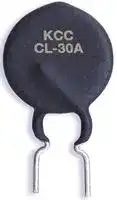


CL-30A
NTC INRUSH CURRENT LIMITER, 2.5R, TH
- Manufacturer: AMPHENOL ADVANCED SENSORS
- Product type: Inrush Current Limiting (ICL) NTC Thermistors
- SVHC: No SVHC (07-Jul-2017)
- Approvals: UL
- Disc Size: 19.56mm
- Product Range: Inrush Current Limiter
- Resistance (25°C): 2.5ohm
- Maximum Energy Rating at 25°C: 43.2J
- Maximum Steady State Current at 25°C: 8A
| Delivery and price | |
|---|---|
| Units per pack | 1000 |
| Price | 0.896 € |
| Current stock | 10+ |
| Lead time | 30 days |

## NTC Inrush Current Limiter

## Thermometrics Thermistors

## **Features**

- UL Approval (UL 1434 File# E82830)

- Small physical size offers design-in benefits over larger passive components

- Low cost, solid state device for inrush current suppression

- Best-in-class capacitance ratings

- Low steady resistance and accompanying power loss

- Excellent mechanical strength

## **Applications**

Control of the inrush current in switching power supplies, fluorescent lamp, inverters, motors, etc.

- Wide operating temperature range: -58°F to 347°F (-50°C to 175°C)

- Suitable for PCB mounting

- Available with kinked or straight leads and tape and reel to EIS RS-468A for automatic insertion

## **Amphenol Advanced Sensors**

## **Inrush Current Limiters In Switching Power Supplies**

The problem of current surges in switch-mode power supplies is caused by the large filter capacitors used to smooth the ripple in the rectified 60 Hz current prior to being chopped at a high frequency. The diagram above illustrates a circuit commonly used in switching power supplies.

In the circuit above the maximum current at turn-on is the peak line voltage divided by the value of R; for 120 V, it is approximately 120 x √2/RI. Ideally, during turn-on RI should be very large, and after the supply is operating, should be reduced to zero. The NTC thermistor is ideally suited for this application. It limits surge current by functioning as a power resistor which drops from a high cold resistance to a low hot resistance when heated by the current flowing through it. Some of the factors to consider when designing NTC thermistor as an inrush current limiter are:

**==> picture [237 x 108] intentionally omitted <==**

**----- Start of picture text -----**<br>
~<br>Typical Power Supply Circuit<br>Converter DC/DC<br>**----- End of picture text -----**<br>


Input Energy = Energy Stored + Energy Dissipated or in differential form:

Pdt = HdT + δ(T – TA)dt

where:

P = Power generated in the NTC t = Time H = Heat capacity of the thermistor T = Temperature of the thermistor body δ = Dissipation constant TA = Ambient temperature

- Maximum permissible surge current at turn-on

- Matching the thermistor to the size of the filter capacitors

- Maximum value of steady state current

- Maximum ambient temperature

- Expected life of the power supply

## **Maximum Surge Current**

The main purpose of limiting inrush current is to prevent components in series with the input to the DC/DC convertor from being damaged. Typically, inrush protection prevents nuisance blowing of fuses or breakers as well as welding of switch contacts. Since most thermistor materials are very nearly ohmic at any given temperature, the minimum no-load resistance of the thermistor is calculated by dividing the peak input voltage by the maximum permissible surge current in the power supply (Vpeak/Imax surge).

## **Energy Surge at Turn-On**

At the moment the circuit is energized, the filter caps in a switcher appear like a short circuit which, in a relatively short period of time, will store an amount of energy equal to 1/2CV[2] . All of the charge that the filter capacitors store must flow through the thermistor. The net effect of this large current surge is to increase the temperature of the thermistor very rapidly during the period the capacitors are charging. The amount of energy generated in the thermistor during this capacitor-charging period is dependent on the voltage waveform of the source charging the capacitors. However, a good approximation for the energy generated by the thermistor during this period is 1/2CV[2] (energy stored in the filter capacitor). The ability of the NTC thermistor to handle this energy surge is largely a function of the mass of the device. This logic can be seen in the energy balance equation for a thermistor being self-heated:

During the short time that the capacitors are charging (usually less than 0.1 second), very little energy is dissipated. Most of the input energy is stored as heat in the thermistor body. In the table of standard inrush limiters there is listed a recommended value of maximum capacitance at 120 V and 240 V. This rating is not intended to define the absolute capabilities of the thermistors; instead, it is an experimentally determined value beyond which there may be some reduction in the life of the inrush current limiter.

## **Maximum Steady-State Current**

The maximum steady-state current rating of a thermistor is mainly determined by the acceptable life of the final products for which the thermistor becomes a component. In the steady-state condition, the energy balance in the differential equation already given reduces to the following heat balance formula:

## Power = I[2] R = δ(T – TA)

As more current flows through the device, its steady-state operating temperature will increase and its resistance will decrease. The maximum current rating correlates to a maximum allowable temperature. In the table of standard inrush current limiters is a list of values for resistance under load for each unit, as well as a recommended maximum steady-state current. These ratings are based upon standard PC board heat sinking, with no air flow, at an ambient temperature of 77° (25°C). However, most power supplies have some air flow, which further enhances the safety margin that is already built into the maximum current rating. To derate the maximum steady state current for operation at elevated ambient temperatures, use the following equation:

Iderated = √(1.1425–0.0057 x TA) x Imax @ 77°F (25°C)

Type CL Specifications NTC discs for inrush current limiting

## **Description**

Disc thermistor with uninsulated lead-wires.

## **Options**

- For kinked leads, add suffix “A”

- For tape and reel, add suffix “B”

- Other tolerances in the range 0.7 Ω to 120 Ω

- Other tolerances, tolerances at other temperatures

- Alternative lead lengths, lead materials, insulations

## **Data**

*maximum rating at 77°F (25ºC) or Iderated = √(1.1425–0.0057 x TA) x Imax @ 77°F (25°C) for ambient temperatures other than 77°F (25ºC).

**maximum ratings

***R0=X1[Y] where X and Y are found in the table below

**==> picture [556 x 91] intentionally omitted <==**

**----- Start of picture text -----**<br>
CxMax ** Equation Constants for resistance  Approximate Resistance Load at %<br>(μ Farads) under load *** Maximum Rated<br>Max .<br>*Max.  Current<br>Steady  Max.  Max.  Flow<br>State  Disc   Disc  @ 25°C<br>Resistance  Current  Dia.   Thick.  @120  @240  Max. Dissip.  Time  and 240<br>@ 25°C (Ω)  (Amps  in in  (VAC  (VAC  Energy  Current Range  Constant  Constant  V Rms<br>Type ±25%  RMS) (mm) (mm) Rms) Rms) (Joules) X Y Min I    Max I 25% 50% 75% 100% (mW/°C) (sec.) (Amps)<br>**----- End of picture text -----**<br>


|CL-11|0.7|12|0.77|0.22|2700|675|19.44|0.5|-1.18|4<1<12|0.14|0.06|0.04|0.03|25|100|457|
|---|---|---|---|---|---|---|---|---|---|---|---|---|---|---|---|---|---|
||||(19.56)|(5.59)||||||||||||||
|CL-21|1.3|8|0.55|0.21|800|200|5.76|0.6|-1.25|3<1<8|0.25|0.11|0.06|0.04|15|60|246|
||||(13.97|(5.33)||||||||||||||
|CL-30|2.5|8|0.77|0.22|6000|1500|43.20|0.81|-1.25|2.5<1<8|0.34|0.14|0.09|0.06|25|100|128|
||||(19.56)|(5.59)||||||||||||||
|CL-40|5|6|0.77|0.22|5200|1300|37.44|1.09|-1.27|1.5<1<6|0.65|0.27|0.16|0.11|25|100|64|
||||(19.56)|(5.59)||||||||||||||
|CL-50|7|5|0.77|0.26|5000|1250|36.00|1.28|-1.27|1.5<1<5|0.96|0.40|0.24|0.17|25|120|46|
||||(19.56)|(6.60)||||||||||||||
|CL-60|10|5|0.77|0.22|5000|1250|36.00|1.45|-1.3|1.2<1<5|1.08|0.44|0.26|0.18|25|100|32|
||||(19.56)|(5.59)||||||||||||||
|CL-70|16|4|0.77|0.22|5000|1250|36.00|1.55|-1.26|1<1<4|1.55|0.65|0.39|0.27|25|100|20|
||||(19.56)|(5.59)||||||||||||||
|CL-80|47|3|0.77|0.22|5000|1250|36.00|2.03|-1.29|0.5<1<3|2.94|1.20|0.71|0.49|25|100|7|
||||(19.56)|(5.59)||||||||||||||
|CL-90|120|2|0.93|0.22|5000|1250|36.00|3.04|-1.36|0.5<1<2|7.80|3.04|1.75|1.18|30|120|3|
||||(23.62)|(5.59)||||||||||||||
|CL-101|0.5|16|0.93|0.22|4000|1000|28.80|0.44|-1.12|4<1<16|0.09|0.04|0.03|0.02|30|120|640|
||||(23.62)|(5.59)||||||||||||||
|CL-110|10|3.2|0.40|0.17|600|150|4.32|0.83|-1.29|0.7<1<3.2|1.11|0.45|0.27|0.19|8|30|32|
||||(10.16)|(4.32)||||||||||||||
|CL-120|10|1.7|0.40|0.17|600|150|4.32|0.61|-1.09|0.4<1<1.7|1.55|0.73|0.47|0.34|4|90|32|
||||(10.16)|(4.32)||||||||||||||
|CL-130|50|1.6|0.45|0.17|600|150|4.32|1.45|-1.38|0.4<1<1.6|5.13|1.97|1.13|0.76|8|30|6|
||||(11.43)|(4.32)||||||||||||||
|CL-140|50|1.1|0.45|0.17|600|150|4.32|1.01|-1.28|0.2<1<1.1|5.27|2.17|1.29|0.89|4|90|6|
||||(11.43)|(4.32)||||||||||||||
|CL-150|5|4.7|0.55|0.18|1600|400|11.52|0.81|-1.26|1<1<4.7|0.66|0.28|0.17|0.12|15|110|64|
||||(13.97)|(4.57)||||||||||||||
|CL-160|5|2.8|0.55|0.18|1600|400|11.52|0.6|-1.05|0.8<1<2.8|0.87|0.42|0.28|0.20|9|130|64|
||||(13.97)|(4.57)||||||||||||||
|CL-170|16|2.7|0.55|0.18|1600|400|11.52|1.18|-1.28|0.5<1<2.7|1.95|0.80|0.48|0.33|15|110|20|
||||(13.97)|(4.57)||||||||||||||
|CL-180|16|1.7|0.55|0.18|1600|400|11.52|0.92|-1.18|0.4<1<1.7|2.53|1.11|0.69|0.49|9|130|20|
||||(13.97)|(4.57)||||||||||||||
|CL-190|25|2.4|0.55|0.18|800|200|5.76|1.33|-1.34|0.5<1<2.4|2.64|1.04|0.61|0.41|15|110|13|
||||(13.97)|(4.57)||||||||||||||
|CL-200|25|1.7|0.55|0.18|800|200|5.76|0.95|-1.24|0.4<1<1.7|2.74|1.16|0.70|0.49|9|130|13|
||||(13.97)|(4.57)||||||||||||||
|CL-210|30|1.5|0.40|0.2|600|150|4.32|1.02|-1.35|0.3<1<1.5|3.83|1.50|0.87|0.59|8|30|11|
||||(10.16)|(5.08)||||||||||||||


## **Selection Criteria for Thermometrics CL-Products**

1. I max - Thermometrics CLs are rated for maximum steady state current.  The maximum steady current is mainly determined by the acceptable life of the final products for which the thermistor becomes a component. The differential equation Pdt = HdT + δ(T – TA)dt reduces to Power = I[2] R = δ(T – TA).  An example in the case of a 100 watt power supply with an efficiency rating of 80%,  100% load is calculated to be 125 watts.  The maximum input  current is calculated from the minimum supply voltage.  For a standard 120V supply, this could be rated as low at 110V.  Therefore, input current would be calculated by 125 watts/110 V = 1.14 Amps.  Selection of the CL should have an I max rating of at least 1.14 Amps.

2. The second step of selection of the CL is to understand the desired maximum inrush current allowable.  This is generally specificed by the components in line of the CL, such as the diode bridge.  In the case of the diode bridge rated at 200 Amps, one would should select a CL that would limit max surge current to 50% of the rating, therefore limit surge to a maximum of 100 Amps.  The listed maximum current flow is rated at 25°C, so derating is required if the ambient temperture is greater than 25°C.

3. The next selection of criteria for the CL is to understand the bulk Capacitance of the device to be protected.  On power, the bulk capacitance of the device appears as a short to the system.  The designer needs to understand the bulk capacitance at the RMS voltage rating of the system.  Assuming the input capacitance is approximately 500 μFds, the selection of the CL needs to be able to absorb input energy.

Using the above criteria, the selection of the CL provides multiple solutions.   One would opt for the smallest size CL to achieve the required protection. The selection criteria is as follows:

1.  I max >1.14 Amps

2.  Max allowable Inrush current 100 Amps

3.  Bulk Capacitance listed as 500 μfd

4.  Choose smallest physical size that will allow protection for the device.

Criteria indicates that either the CL-150 or CL-160 would be suitable for the application.  In the case of the CL-150 less heat is dissipated allowing  the operating resistance to drop but at a higher temperature.  This increases efficiency of the system but may lead to shorter component life.

## **Amphenol Advanced Sensors**

www.amphenol-sensors.com

> © 2014 Amphenol Corporation. All Rights Reserved. Specifications are subject to change without notice. Other company names and product names used in this document are the registered trademarks or trademarks of their respective owners.

**AAS-920-325D-03/2014**
Updated at April 28, 2026
Amphenol Advanced Sensors is a leading innovator in sensor technologies and measurement solutions, serving the highly regulated and demanding needs of the transportation, medical, and industrial markets. Through its renowned legacy brands—including Thermometrics for temperature sensing, NovaSensor for pressure, and Telaire for air quality—the company delivers a diverse portfolio of critical components designed to provide accurate environmental data for real-time decision-making. The core of this manufacturer's offering focuses heavily on highly reliable circuit protection and transducer components. Engineers will find an extensive selection of temperature sensing and compensation NTC thermistors, alongside a comprehensive range of high-performance pressure sensors and transducers. These precision-engineered devices are essential for ensuring thermal stability, accurate fluid measurement, and reliable operational feedback in complex commercial and industrial applications. Beyond these primary lines, the selection includes vital power management devices such as inrush current limiting (ICL) NTC thermistors and PTC thermistors engineered to safeguard sensitive electronics. The portfolio is further complemented by specialized temperature sensors, light sensors, and dataloggers, providing a robust, integrated suite of measurement and protection solutions for modern hardware design.
About Novapart
Novapart is a B2B electronic component broker specialising in stock shortages and cost reduction. We source hard-to-find parts and identify compliant alternatives across a catalogue of 410,000+ components from 500+ manufacturers.
Learn more →Stock Shortage Specialist
When a component is unavailable, discontinued or has an unacceptable lead time, we tap into our network of vetted European and Asian distributors to source what you need — without compromising on quality or traceability.
Request a quote →Compliant Alternatives
We identify pin-to-pin, electrically equivalent substitutes that meet the same certifications (RoHS, AEC-Q100, REACH) as your original specification — validated against datasheets, not just part numbers. Often at a lower cost.
BOM Analysis service →