
Image not available
Illustrative purposes only

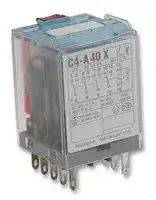
C4-A40X230A
General Purpose Relay, C4 Series, Power, 4PDT, 230 VAC, 10 A
⚠️ Reference pricing provided. In case of supply shortages, we will connect you with our trusted procurement partners to ensure your project's continuity.
- Manufacturer: RELECO
- Product type: Power Relays
- Contact Configuration:4PDT; Coil Voltage:230VAC; Contact Current:10A; Product Range:C4 Series; Relay Mounting:Socket; Coil Type:-; Contact Voltage VAC:250VAC; Relay Terminals:Quick Connec
- SVHC: No SVHC (16-Jan-2020)
- Coil Type: -
- Coil Voltage: 230VAC
- Product Range: C4 Series
- Relay Mounting: Socket
- Coil Resistance: 7.2kohm
- Contact Current: 10A
- Relay Terminals: Quick Connect
- Contact Material: Silver Nickel
- Contact Voltage VAC: 250VAC
- Contact Voltage VDC: 30VDC
- Contact Configuration: 4PDT
| Delivery and price | |
|---|---|
| Units per pack | 20 |
| Price | 25.66 € |
| Current stock | 10+ |
| Lead time | 30 days |
Datasheet

1.3 Industrial Relays - pluggable **1** ## **C4-A4x** ## **4 pole | changeover contact | faston** ## **Main circuit** Available contact materials AgNi for C4-A40 Recommended minimum contact load °e AgNi + 5 µ Au for C4-A4810 mA / 5 V for C4-A40 5 mA / 5 V for C4-A48 Maximum contact load AC 10 A / 250 V AC-1 Maximum contact load DC 10 A / 30 V DC-1 Rated current 10 A Inrush current 30 A, 20 ms AC load 2500 VA DC load fig. 3. Mechanical endurance (cycles) ≥ 20 000 000 Electrical endurance at rated load AC-1 (cycles) ≥ 500 000 **Control circuit** Nominal voltage see table product references Operating voltage range 0.8 UN … 1.1 UN Pick-up voltage ≤ 0.8 UN Release voltage ≥ 0.1 UN Power consumption AC / DC 2.4 VA / 1.4 W ~~**fig. 1. Wiring diagram**~~ **==> picture [122 x 52] intentionally omitted <==** **----- Start of picture text -----**<br> 1 2 4 5 7 8 10 11 13<br>12 14 22 24 32 34 42 44 A1(+)<br>11 21 31 41 A2<br>3 6 9 12 14<br>**----- End of picture text -----**<br> ## ~~**fig. 2. AC voltage endurance**~~ **==> picture [157 x 100] intentionally omitted <==** **----- Start of picture text -----**<br> 10<br>AC-1 AC 1<br>Cos ϕ AC15 0.4<br>1<br>Ne t<br>=<br>0.1 Pt | tT | | | | |<br>kVA 0.5 1 1.5 2 2.5<br>switching cycles x106<br>**----- End of picture text -----**<br> ## **Coil table** **==> picture [149 x 71] intentionally omitted <==** **----- Start of picture text -----**<br> ||||||| |---|---|---|---|---|---| |V AC|Ω|mA|V DC|Ω|mA| |12|16|214|12|105|114| |24|65|103|24|414|58| |48|286|51|48|1 664|29| |115|1 697|22|60|2 581|23| |230|6 850|10.4|110|8 117|13.6| |400|18 802|6|220|30 307|6.2| **----- End of picture text -----**<br> ## **Insulation** Test voltage open contact 1 kV / 1 min Test voltage contact / contact 2.5 kV / 1 min Test voltage contact / coil 2.5 kV / 1 min Pollution degree 3 Overvoltage category III Insulation resistance at 500 V ≥ 1 GΩ **General data** Ambient temperature storage (no ice) -40 … 80 °C Ambient temperature operation -40 … 60 °C Pick-up time / bounce time 20 ms / ≤ 3 ms Release time / bounce time 8 ms / ≤ 1 ms Maximum switching frequency at rated load 1200 / h Dimension fig. 4. Weight 90 g Housing material PA / PC ~~**fig. 3. DC load limit curve**~~ **==> picture [144 x 103] intentionally omitted <==** **----- Start of picture text -----**<br> 10<br>DC-1 DC1<br>L/R 40 msDC13<br>1 VI<br>=—<==—=—<br>0.1 P| Pp [eR]<br>Volt 50 100 150 200<br>Amps.<br>**----- End of picture text -----**<br> ~~**fig. 4. Dimension (mm)**~~ ## ~~Ta SS~~ **==> picture [139 x 102] intentionally omitted <==** **----- Start of picture text -----**<br> = 1 4 7 10<br>2 5 8 11<br>6 9<br>3 12<br>13 14<br>|_______ 35<br>ub<br>| 3<br>FASTON .110<br>35<br>52.5<br>**----- End of picture text -----**<br> ## **Product references** **==> picture [340 x 125] intentionally omitted <==** **----- Start of picture text -----**<br> ||||||||||| |---|---|---|---|---|---|---|---|---|---| |Type|(x refers to| |Description|12|24|48|60|110|115|220|230|400| |contact material)| |AC 50 Hz|C4-A4x/AC…V|✓|✓|✓|✓|✓|✓| |LED|C4-A4xX/AC…V|✓|✓|✓|✓|✓|✓| |RC Suppressor|C4-A4xR/AC…V|✓|✓|✓|✓|✓|✓| |DC|C4-A4x/DC…V|✓|✓|✓|✓|✓|✓| |LED|C4-A4xX/DC…V|✓|✓|✓|✓|✓|✓| |LED & Free wheeling diode|C4-A4xDX/DC…V|✓|✓|✓|✓|✓|✓| |LED & Polarity & Free wheeling diode|C4-A4xFX/DC…V|✓|✓|✓|✓|✓|✓| |AC / DC bridge recifier & LED|C4-A4xBX/UC…V|✓|✓|✓| **----- End of picture text -----**<br> ## ~~**Technical approvals, conformities**~~ Standards IEC/EN 61810; IEC/EN 60947 Approvals C€ FAL C4-A40 only _AC relays also available as 60 Hz. Other voltages on request. Please contact support@comatreleco.com. «…» List coil voltage to complete product references_ ## **Accessories** Socket Blanking plug Wall mounting adapter S4-J, S4-L, S4-P SO-NP (BAG 10 PCS) S5-R (BAG 5 PCS) WoR 2.1 | 49 1 Relays & Contactors ## **Relays** ## **General Information** ## **Product range** ComatReleco offers a wide range of relay types and versions and associated sockets and accessories. ## **Relays C2, C3, C4, C5, R4** 35 x 35 mm round plug-in relay, 8- or 11- terminals multipole connectors with 2 or 3 contacts up to 10 A and different contact types and contact materials. Standard relay 35 x 35 mm with flat blade connectors with up to 4 contacts and up to 16 A with 4 contacts. ## **Relays C7, C9, R7, R9** 22.5 mm series with up to 4 contacts and up to 10 A with 1 or 2 contacts. ## **Interface Relays, C10, C12, C16, C18, R10, R12** Overall width 13 mm with up to 2 electromechanical contacts, or fully electronic switches. ## **Special relays, remanence relays** While "normal" relays are monostable, i.e. they return to the idle state when the excitation is switched off, remanence relays are bistable, i.e. the current switching state is retained irrespective of the excitation. Relays of this type are available in different versions. ## **Solid State Relay SSR** Solid State Relays are suitabe to either switch AC or DC loads up to 6 A. For AC relays a distinction is made between synchronously (zero crossing) and asynchronously switching versions. For switching transformer loads we recommended using asynchronously switching semiconductor switches. For incandescent lamp loads etc. synchronously switching switches are ideal for avoiding high switch-on currents. ## **Basic identification principle (type designation code electromechanical relays)** **==> picture [337 x 36] intentionally omitted <==** **----- Start of picture text -----**<br> 1 2 3 4 5 6 7 8 9 10<br>C n(n) - T 1 0 z ( ) X - /...V RF-nnnn<br>**----- End of picture text -----**<br> |**1. Relay application**|**7. (****) Special requirements**| |---|---| |**C**<br>= Industrial relays|**H**<br>= Orange button. No lockable function| |**R**<br>= Railway relays|**N**<br>= Black button. No function| ||**PT**= PCB pins, 3.5mm grid,| |**2. Product family**|transparent cover| |**n(n)**= Basic type refers to the product line|**PTL**= PCB pins, 5mm grid,| ||transparent cover| |**3. Relay type**|| |**A**<br>=Standard (general-purpose) contact|**8. Relay with LED**| |**G**<br>=Refers to a NO contact|**X**<br>= relays with LED| - **A** = Standard (general-purpose) contact **G** = Refers to a NO contact **N** = Sensitive drive 800 mW coil power **S** = Sensitive drive with 250 mW exciter input **R** = Code for remanence relays, drive-specific ID **T** = Twin contact for signal and control circuit **X** = Relay high power, double make contact. **W** = With tungsten contact for maximum switch-on currents - **Z** = Solid State **E** = Sensitive drive with 500 mW coil power **H** = Single-point contact + twin contact load to signal current circuit for switching state feed back. Mixed contact configuration **9. Nominal coil voltage specification** - AC...V = AC 50/60 HZ, voltage 6 - 250 (400) V - AC...V 60 Hz = AC 60 Hz, 120, 240 V DC...V = DC, voltage 5 - 220 V UC...V = AC/DC ## **10. Ref. nnnn** Relays with a reference number are versions with special (e.g. customised) features. These features may relate to special test criteria, tolerances or other properties. - **M** = Relay with highly effective neodymium blow magnet for fast quenching of the arc. This relay is particularly suitable for high DC loads. - **B** = Single C.O. contact with two pins per connection Availability of such relays may be limited to certain customers or applications. ## **Accessories** Suitable sockets are available for the different relay series for DIN rail mounting or panel mounting. In addition, retaining clips are available for the relays, some of which are included in the scope of supply. Suitable bridges for cost-saving wiring in series are also available. ## **4. Number of contacts** **1-4** = Number of contacts ## **5. Definition of contact material / SSR type** This code may differ depending on type. Examples: - **0** = In the standard range stands for AgNi - **1-9** = See contact material for each type - **N** = NPN negative common (DC) **P** = PNP positive common (DC) **I** = Instantaneous, random-on (AC) **Z** = Zero-crossing synchronised (AC) ## **6. Describes the options** D = Integrated free-wheeling diode - F = Integrated free-wheeling diode and series - diode e.g. for common alarm circuits - R = RC connection for the coil B = Bridge rectifier 8 | WoR 2.1 1 Relays & Contactors **1** ## **Coil accessories General Information** ## **Relays C2-C9, R4, R7, R9** ## **Protection against transients** When the coil is disconnected from an electromagnet, peaks of inverse voltage appear at the terminals which can reach very high values. These pulses can be transmitted down the line associated with the coil and could possibly affect other components. In the case of a realy being operated by such devices as transistors, Triacs, etc; it may be necessary to protect against transients. ## **Transients carried in the line** High voltage surges can be carried in the supply line to the relay coil. These may appear in the form of peaks or bursts and are generated by the connection and disconnection of electric motors, transformers, capacitors etc. Normally a relay is unaffected by these pulses, but if a diode is connected in association with the coil, it must be capable of withstanding an inverse voltage higher than those of the incoming peaks. ## **Protection circuits** A protection circuit must efficiently cope with pulses generated by the coil as well as incoming line surges (surges U1.2/50µs.) ComatReleco Relays are available with integrated protection circuits. **X** LED indication with rectifier. For DC and AC relays up to 250 V **DX** Free-wheeling diode + LED Dampens transients caused by the relay coil on de-energisation. **FX** Polarity + free wheeling diode + LED A diode in series with the coil protects the relay from reverse connection. **BX** Bridge rectifier + LED indication Allows the relay to operate in both AC or DC without any polarity inconvience. Available only in voltages up to 60 V. - **R** Resistor and capacitor. **==> picture [164 x 191] intentionally omitted <==** **----- Start of picture text -----**<br> X(C7/R7, C9/R9) X<br>A1 A1<br>A2 A2<br>FX DX<br>A1 A1<br>+ +<br>A2– A2–<br>BX R<br>A1 A1 A2<br>A2<br>**----- End of picture text -----**<br> ## **Relays C10-C12, R10, R12** **LED and protection circuit connected to coil.** - **X** LED with no polarity, (standard) Coils ≤ 12 V A DC coils LED rectifier bridge in parallel - **X** LED with no polarity, (standard) Coils ≥ 24 V A DC coils LED rectifier bridge in series - **FX** LED with polarity A1+ (option) Every DC coil voltage Polarity and Free-wheeling diodes - **BX** LED with no polarity, (option) Only 24 V and 48 V A DC coils Rectifier bridge for AC/DC relays - **R** LED not available (option) RC protection against pulses on AC ## **Protection against pulses** When a relay coil is disconnected, reverse voltage peaks may arise and reach very high values. Said peaks can transmit to the coil associated line and other relays or semiconductors can be affected. If Triac, transistor, etc. controls a relay, appropiate steps must be taken to avoid or decrease peaks down to a non risky level. Both Polarity and Free-wheeling diodes (FX), must protect coils, to avoid malfunctions provided DC relays in battery are installed. Making or breaking engines, transformers or contactors in an industrial environmental, may generate high voltage pulses, either isolated or burst, through the main line. The voltage level of those pulse may be high enough to affect the isolation of the coil. **==> picture [147 x 63] intentionally omitted <==** **----- Start of picture text -----**<br> BX FX<br>A1 A1<br>+<br>A2 A2–<br>**----- End of picture text -----**<br> **==> picture [91 x 129] intentionally omitted <==** **----- Start of picture text -----**<br> R<br>A1 A1<br>A2<br>A2<br>X≥24V<br>A1<br>A2<br>**----- End of picture text -----**<br> **==> picture [27 x 7] intentionally omitted <==** **----- Start of picture text -----**<br> X≤12V<br>**----- End of picture text -----**<br> **==> picture [56 x 31] intentionally omitted <==** WoR 2.1 | 9 1 Relays & Contactors ## **Relays General Information** ## **Contacts** There are different contact types. The main distinction is between single contacts and twin contacts. While single contacts are more suitable for higher loads, twin contacts are significantly more reliable at small loads, i.e. < 24V, < 100mA. ## **Contact Material** There is no all-purpose contact! AgNi is used as standard material for a wide range of applications. AgNi contacts with hard gold plating (up to 5µm) are offered for applications in aggressive atmosphere. Relays with gold contacts are approved for relatively high currents (e.g. 6A, 250V), but in practice values of 200mA, 30V should not be exceeded for operation with intact gold plating. Relays with a tungsten pre-contact are available for very high switch-on currents (up to 500A, 2.5ms). For some applications AgNi contacts with gold flashing (0.2µm) are available. The purpose is corrosion protection during storage. Tin oxide is specially appropiated for load with high-inrush current. ## **Minimum load** The minimum load value is a recommended value under normal conditions such as regular switching, no special ambient conditions, etc. Under these conditions reliable switching behaviour can be expected. ## **Contact resistance** Initial values of resistance of contact can vary with the use, load and others conditions. Typical values when the relay is new is about 50mΩ. ## **Contact spacing** Normally all contacts have an air gap between 0.5 … 1.5mm when they are open. They are referred to as µ contacts. According to the Low-Voltage Directive and the associated standards these contacts are not suitable for safe disconnection. For switching of DC loads large contact clearances are beneficial for quenching the arc. See relays with "Cx-Gyz" naming. "G" stands for extended contact gap of 3mm. ## **Switching capacity** The contact switching capacity is the product of switching voltage and switching current. For AC the permitted switching capacity is generally high enough to handle the max. continuous AC-1 current over the whole voltage range. For DC the load limit curve must never be exceeded, because this would lead to a remaining switch-off arc and immediate destruction of the relay. The order of magnitude of the DC switching capacity is a few 100W (DC-1). ## **Drive (coil)** The drive of a relay refers to the coil plus connections. The coil has special characteristics, depending on the rated voltage and the type of current. ## **Coil design** The coil consists of a plastic former (resistant up to about 130°C) and doubly insulated high-purity copper wire, temperature class F. The winding must withstand threshold voltages (EN 61000-4-5) of more than 2000V. This is ensured through forced separation of the start and end of the winding. ## **Coil resistance and other properties** Each coil has an ohmic coil resistance that can be verified with an ohmmeter. The specified coil resistance applies to a temperature of 20°C. The tolerance is ±10%. For AC operation the coil current will not match the ohmic value, because self-inductance plays a dominant role. At 230V this may reach more than 90H. When a relay is switched off, self-inductance results in a self-induced voltage that may affect the switching source (destruction of transistors, EMC problems). ## **Drive voltages** A distinction is made between the standardised voltages according to EN 60947 as guaranteed values, and typical values that can be expected with a high degree of probability. ## **Pick-up voltage, Release voltage** The pick-up voltage is the voltage at which the relay engages safely. For DC the typical trip voltage is approx. 65% of Unom, for AC approx. 75%. The release voltage, on the other hand, is approx. 25% or 60% respectively. For DC these voltages are strongly temperature-dependent, according to the temperature coefficient of Cu (See curve 1). This is not the case for AC, where the inductive resistance is the controlling factor, which is practically constant over a wide temperature range. With AC, in a certain undervoltage range the relay may hum, and the armature may flutter. This voltage range must be avoided. ## **Operating voltage range** Unless specified otherwise, the following characteristic curve applies for the operating voltage range (See curve 2). The upper limit of the coil voltage is determined by self-heating and the ambient temperature. Self-heating through contacts under high load must not be underestimated. It may be higher than the power dissipation in the drive. During intermittent operation significantly higher overvoltages temporary may occur for short periods. If in doubt please consult our specialists. **==> picture [158 x 106] intentionally omitted <==** **----- Start of picture text -----**<br> UN<br> 1.7<br> 1.5 2<br> 1.3<br> 1.1<br>[0.9] 1<br> 0.7<br> 0.5<br>All -20 -5 10 25 40 55 70 T ºC<br>**----- End of picture text -----**<br> ## **General design** ComatReleco Relays are made from high-quality, carefully selected materials. They comply with the latest environmental regulations such as RohS. Their meticulous design makes them particularly suitable for industrial applications and installation engineering. They are particularly service-friendly through robust terminals, mechanical position indicating device a standard, manual operation, dynamic, permanent characteristics. Colour coding for manual operation as a function of the coil voltage is another useful feature. Further options such as different coil connections, free-wheeling diode, LED display, bridge rectifier for AC/DC drives etc., and short-term availability of special versions for practically any drive voltage up to DC 220V /AC 400V leave nothing to be desired. Apart from a few special versions, in general, ComatReleco industrial relays feature manual operation (push/pull) and a mechanical position indicating device. For safety reasons, manual operation may be replaced with a black button, if required. ## **Coil connections** Different coil connections can be integrated in the relay as an option. For DC a cost-effective free-wheeling diode is available. Please note that the stated release times are generally specified without the coil connection. While an additional LED status indicator has practically no effect, a free-wheeling diode (D) will lead to an increase in release time by a factor 2 to 5, or 10ms to 30ms. For AC VDRs or RC elements may be used. In this case resonance effects may have to be considered. VDRs and common RC elements may increase release times by less than 5 ms. 10 | WoR 2.1 1 Relays & Contactors ## **Relays General Information** ## **Standards, conformities** All ComatReleco relays feature the CE mark to indicate that CE standards apply e.g. 2kV surge resistance according to EN 61000-4-5. A significant and not generally available characteristic is that the coils and in particular the connections are able to withstand the voltage spikes that may occur in practice. In addition, the relays feature various technical approvals depending on the respective relay code, and they comply with further standards and guidelines. The main technical approvals include cURus, CCC, Lloyd‘s Register, cULus and EAC.The associated information is provided in the data sheets. ## **Switching classes** EN 60947 defines different switching classes that specify the suitability of contacts for different load types. ## **Example:** AC-1 = Ohmic AC load AC-3 = Motor loads AC-15 = Power contactors, solenoid valves, solenoids DC-1 = Ohmic DC load DC-13 = DC contactors, solenoids UL60947 contains different technical approval criteria such as general purpose, control application etc. Switching classes are defined based on the electrical switching capacity, e.g. B600 etc. **Main technical approvals and standards** ~~ee~~ **Country Technical approval** Authority: CQC _China_ Specification GB14048.5-2001 ~~|e~~ Authority: KORPORATSIA _Russia_ STANDART Specification TP TC 004/2011 _Wordwide /_ Authority: UL Specification _USA / Canada_ C 22.2; UL 60947 ~~ss~~ ¢@)us _United_ Authority: GB Lloyd´s Register of _Kingdom_ Shipping ~~8~~ _Europe /_ Railway EN 50155 _Worldwide_ ~~ee~~ **Utilisation categories according to** EN 60947-4-1/-5-1 ## **Pollution category Cat. 1** Dry, non-conductive contamination without further effect ## **Cat. 2** Occasional conductive contamination, short duration due to moisture condensation ## **Further information and tips** The main operational criteria for relays such as number of cycles, switching frequency, ambient conditions, reliability requirements, load type, switch-on current, load switch-off energy must be clarified in order to ensure reliable operation and long service life. ## **Example** If the number of cycles is expected to exceed several 100.000 operations per year (e.g. clock generators, fast running machines), an electronic solution is no doubt more appropriate, although we also offer solutions for this type of application. In AC applications crosstalk caused by long control leads is often a problem and can result in constant humming of the relay or even inadvertent triggering due to interference. Different harmless loads may lead to very high switchon currents or switch-off energy values, resulting in an unacceptable reduction in service life. Particularly tricky are DC inductive loads. ## **Characteristics of various loads:** ## **Heating circuits** No higher switch-on currents, no higher switch-off loads. ## **Incandescent lamps, halogen lamps** Switch-on currents during a few ms in the range 10 … 18 x rated. Switch-off at rated load. **1** ## **Low-energy lamps** ## **Choosing the right Socket** For plug-in industry, interface, time, and monitoring relays, we offer sockets with the corresponding pin configuration and various layouts for the terminal connectors. For easy identification, you'll find those symbol referring to the matching socket. ## **Cat. 3** Dry, non-conductive and conductive contamination with moisture condensation ## **Cat. 4** Contamination with persistent conductivity through conductive dust, rain **Protection class IP** according to EN 60529 and other standards. Industrial relays and their sockets can be classified as follows: Socket IP20: Contact safety Relay IP40/IP50: not watertight, but protected against ingress of coarse contaminants. Very high, but very short switch-on currents due to built-in decoupling capacitors. Contacts have a tendency to fuse. ## **Transformers, AC contactors** Switching on during zero-transition may lead to switch-on currents of 8 … 15 x rated values. High inductive switch-off energy is possible. The load must be connected. ## **Electrical Distributor DIN 45mm** All devices with a housing fitting in an electrical distributor with a front of 45mm are marked with the following symbol. WoR 2.1 | 11 1 Relays & Contactors **Relays Full Features System** **==> picture [487 x 281] intentionally omitted <==** **----- Start of picture text -----**<br> Time module Colour code = coil voltage<br>Marking label Manual actuator (lockable)<br>Mechanical status display Retaining clip<br>v "<br>Optical status display (optional LED) —*<br>o| go _ -<br>Coil voltage marking Time cube<br><7 =. |<br><= | Jui =) »4 a<br>, wha ! \<br>Coil and power bridge bus bars Type & options<br>X LED<br>DX Freewheeling diode, LED<br>BX Bridge rectifier, LED<br>FX Polarity protection,<br>freewheeling diose, LED<br>**----- End of picture text -----**<br> ## **Five colours for an easier identification of coil voltage** If you don´t want to have the lockable function, you can use the orange button. **AC** red: 230 V AC (North America 120 V AC) fl Orange button, no lockable function, push only **AC** dark red: others V AC Black button, no function **UC** grey: V AC/DC i **DC** blue: 24 V DC **DC** dark blue: others V DC ## **Comprehensive technical label** **==> picture [158 x 158] intentionally omitted <==** **----- Start of picture text -----**<br> 01<br>- Part number<br>C7 A20X<br> DC 0.9 W Coil details<br>z=<br>10 A / 250 V AC-1 Maximum<br>µ 10A / 30 V D C-1<br>——— switching capacity<br>A2 A1 according to<br>8 7 EN 60947<br>B : A (IEC 947)<br>6 21 11 5<br>Aditional<br>4 24 14 3 circuit dia-<br>gram for coil<br>2 2 22 12 2 1<br>Electric dia-<br>gram showing<br>all additions<br>to the coil<br>**----- End of picture text -----**<br> Wiring diagram with sequential and DIN numbers 12 | WoR 2.1 1 Relays & Contactors **Relays Select the correct Relay** **1** **==> picture [523 x 489] intentionally omitted <==** **----- Start of picture text -----**<br> Level of switching current and DC or AC switching?<br>voltage of the application? Inductive or capacitive<br>load?<br>Expected number of<br>switching cycles?<br>Symbol Voltage Current Use Type Material<br>Gold-plated<br>AgNi + Au<br>Low-level signals, double contact<br>100 mV…5 V 10 uA…1 mA Standard signals<br>Signal relays ( 0…10 V / 4…20 mA ) Gold-plated<br>AgNi + Au<br>Single Contact<br>double contact AgNi<br>PLC inputs,<br>Control circuits<br>Gold-plated<br>5 V…30 V 1 mA…100 mA AgNi + Au<br>Control relays Single Contact<br>Frequent, rapid switching MOSFET (DC)<br>Semiconductor<br>procedures Triac (AC)<br>Increased AC or DC loads Single Contact AgNi<br>Electromagnets<br>( utilisation cat. AC-15 / Single Contact AgSnO2<br>30 V …400 V 100 mA…16 A<br>Power relays DC-13 )<br>Frequent, rapid switching<br>MOSFET (DC)<br>procedures, high reliability, Semiconductor<br>Triac (AC)<br>noiseless switching<br>Early make AgNi + W<br>Capacitive loads<br>contact AgSnO2+ W<br>High DC loads, inductive AgNi<br>Series contacts<br>12 V …400 V 100 mA…16 A loads AgSnO2<br>High-power relays<br>Frequent, rapid switching<br>MOSFET (DC)<br>procedures, high reliability, Semiconductor<br>Triac (AC)<br>noiseless switching<br>**----- End of picture text -----**<br> WoR 2.1 | 13
Updated at June 10, 2026
About Novapart
Novapart is a B2B electronic component broker specialising in stock shortages and cost reduction. We source hard-to-find parts and identify compliant alternatives across a catalogue of 410,000+ components from 500+ manufacturers.
Learn more →Stock Shortage Specialist
When a component is unavailable, discontinued or has an unacceptable lead time, we tap into our network of vetted European and Asian distributors to source what you need — without compromising on quality or traceability.
Request a quote →Compliant Alternatives
We identify pin-to-pin, electrically equivalent substitutes that meet the same certifications (RoHS, AEC-Q100, REACH) as your original specification — validated against datasheets, not just part numbers. Often at a lower cost.
BOM Analysis service →