
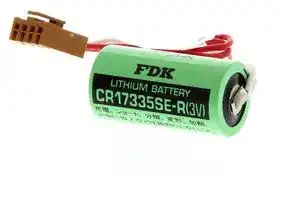


C200H-BAT09
Rechargeable Battery, C200H/C200HS RAM Memory Unit
- Manufacturer: OMRON INDUSTRIAL AUTOMATION
- Product type: Batteries - Rechargeable
- SVHC: To Be Advised
- Weight: 0.6oz
- Pack Quantity: 1
- Product Range: -
- Battery Voltage: 3V
- External Height: 17.78mm
- Battery Capacity: 1.8Ah
- Battery IEC Code: -
- Battery NEDA Code: -
- Battery Size Code: -
- Battery Terminals: Connector
- External Diameter: 33.02mm
- Battery Compliance: -
- Battery Technology: Lithium Manganese Dioxide
- Battery Type / Size: -
| Delivery and price | |
|---|---|
| Units per pack | 1 |
| Price | 63.34 € |
| Current stock | 10+ |
| Lead time | 30 days |

**PLC-based Process Control** Series **Programmable Controllers CS1W-LC       Loop Control Boards/Units** i Ver. 3.5 **CS1D-CPU      P CS1D Process CPU Units** OO (for Duplex-CPU Systems)

Fully Integrated Sequence and Process Control for the Ideal Control System for Every Application

## General-purpose PLCs provide everything from

## = A Breakthrough

The accelerating wave of globalization calls for rebuilding systems to cope with changes in demand. And now OMRON has taken its wealth of technical know-how in factory automation and process control technology to create a PLC-based process control system. Dow ~~n~~ .

_**DCS functionality in a PLC Analog Units with signal conversion functions A scaleable system configuration**_

_**Function block programming Sequence programming using either step ladders or sequence tables A direct link to HMI products**_

_**Duplex operation supported Complete maintenance functions**_

**2**

## ess Control

## meet customer needs.

**The open nature of the PLCs is joined by integrating hardware, software, and networking to meet your needs.**

Increasing amounts of information, standardization, and open standards form the basis for achieving hardware and networking capabilities for process control. A wide range of software that can be easily used by design, development, and maintenance personnel makes operating and maintaining the system far easier.

**==> picture [502 x 397] intentionally omitted <==**

**----- Start of picture text -----**<br>
HH Operation, Monitoring, and Data Logging<br>Dp Touch Panels > User Application > HMI Software<br>NS-series PT Special HMI software<br>   CX-Process Monitor Plus<br>Commercially available<br>HMI software<br>oe    HMI software<br>   compatible with<br>Application Software    FinsGateway 2003<br>   PLC Reporter 32<br>   Compolet<br>Communications<br>Middleware<br>e See Se<br>   FinsGateway 2003 @<br>Ethernet or Controller Link<br>PLC PLC<br>—k—— —L=E<br>| | CS1 Duplex || CS/CJ-series  *<br>Loop Control Boards/Units<br>CS1D Process-control CPU Unit<br>CJ-series Loop-control CPU Units<br>t +e (for Duplex-CPU Systems) ar :<br>Process Analog I/O Units<br>Process Analog I/O Units<br>® sa° DeviceNet .<br>**----- End of picture text -----**<br>


*[For details on the CJ Series, refer to the ] _[Loop-control CPU Units Catalog]_[ (R128-E1-01).]

**3**

## Going Beyond the Traditional Limits of PLCs with PLC-based Process Control

**Reducing the Total Cost of Ownership from Initial Costs through Running Costs. PLC-based Process Control Meets Customer Needs**

## **Systems are large, meaning high initial costs.**

## **Cut costs, Save space, Reduce labor**

The over-spec nature of a distributed control system (DCS) increased costs. PLCs, however, could not provide the required process control capabilities, and signal conversion with isolators and other devices was required for I/O. It was just not possible to achieve the ideal system for a specific application.

PLCs provide the same functionality and performance as DCS while also providing the advanced features of PLCs: Open specs, easy maintenance, and cost performance. A wide range of Isolated-type Analog Units helps to save space and greatly reduces system costs.

## **Running costs are high because maintenance and modifications require specialists.**

The manufacturer must be relied upon for everything from system construction to maintenance. Even simple changes to parameters cannot be performed in-house. And, it's nearly impossible to use generalpurpose devices and software (such as HMI devices or Windows-based software) when modifying the system.

## **Engineering is simple when you can program with function blocks.** My AIG TTCgang

Paste function blocks in a window just like you were creating a flow sheet, and then connect the blocks with the mouse to graphically program a wide range of process control. And with a PLC, it's easy to incorporate general-purpose HMI devices and software (such as touch panels and SCADA software).

**4**

## **Avoid Problems and Minimize Risks with a Duplex System**

## **Increase the reliability of the facilities and devices with a Duplex PLC-based Process Control System.**

If an error occurs in the active CPU Unit, the standby CPU Unit takes over in an instant (using the hot standby method) so that system operation continues essentially unaffected. Other duplex variations are also possible. For example, instead of duplexing the CPU Unit, Power Supply Unit, and Controller Link Unit, a system can be constructed with a Single-CPU Unit and only a duplex Power Supply Unit or only a duplex Controller Link Unit.

## **A duplex system means rapid recovery for errors without stopping system operation.**

Replace Units with power supplied or even while the system is running, including CPU Units (Duplex-CPU system), Power Supply Units, Communications Units, Basic I/O Units, and Special I/O Units.

**==> picture [238 x 172] intentionally omitted <==**

**----- Start of picture text -----**<br>
Duplex PLC, the basis of<br>a continuous-operation system<br>ee<br>Duplex Communications Units  Duplex Power Supply<br>Loop Control Boards<br>(e.g., Controller Link Units or  Units to handle power<br>Ethernet Units) to increase  supply problems<br>network reliability<br>**----- End of picture text -----**<br>


## **PLC-based Process Control Application Examples**

**==> picture [199 x 14] intentionally omitted <==**

**----- Start of picture text -----**<br>
In-line Blending in a Food Plant<br>**----- End of picture text -----**<br>


## **Batch Control in a Chemical Plant**

**==> picture [496 x 283] intentionally omitted <==**

**----- Start of picture text -----**<br>
Personal computer<br>Personal computer HMI Software<br>HMI Software<br>Ethernet<br>Ethernet<br>SYSMAC CS1 PLC with advanced  SYSMAC CS1 Duplex<br>(CS1D Process-control CPU Unit)<br>Loop Control Board<br>Flowrate control (blended  ETT Ger PTEtoe Reaction control<br>PID control)<br>Materials tanks ) Ls b<br>Flowrate Control outputs<br>A Motor<br>i" (Qt +X} re meen e |e<br>B<br>Motor Product tanks<br>Motor Motor<br>C A<br>(©) NA + z ‘T d o L o<br>B<br>Intermediate tank<br>Drying equipment<br>Q a<br>Motor<br>**----- End of picture text -----**<br>


**5**

## A Revolutionary Solution to Process Control Advanced Controller Functions in a PLC

**For easier loop control, for advanced PLC-based analog control: The New SYSMAC CS1-based Solution**

## **Existing System Problems** D>

## **PLC-based Process Control** —E>

## **Excessive installation space is required.**

When using more than one controller for multi-loop control, the control panel is just too big. And specification changes required altering the control panel, making changes difficult.

## **Consolidate the functions of many controllers**

Programming is as simple as combining the function blocks required by the application. To increase the number of controlled loops, just add them to the program. HMI windows can also be created easily

using a wide range of utility software.

&

## **Programming communications with the controllers is extremely difficult.**

Communications must be programmed to input data to the PLC. And communications time can restrict control performance. The more controllers that are used, the more difficult maintenance becomes.

## **Advanced controller functions are built into the CS1 PLCs. No programming is required for communications.**

The Loop Control Boards and Units were designed for the CS1 PLCs and require no communications programming. High-speed, flexible data links can be created with the PLC to increase control performance.

**6**

## **Gradient Temperature Control for Planar Temperature Control Across Multiple Points**

**==> picture [307 x 136] intentionally omitted <==**

**----- Start of picture text -----**<br>
Example: Planar Temperature Control of Multi-stage Furnaces,<br>                 Wafer and Glass Surface Temperatures, and Other Applications.<br>Gradient temperature<br>control<br>Interference at other<br>control output points<br>suppressed.<br>Temperature<br>Average  differences<br>temperature  controlled.<br>controlled.<br>**----- End of picture text -----**<br>


**Note** : CS1W-LCB05-GTC only.

Gradient temperature control equalizes the temperatures at multiple points, providing high-quality heat processing, reducing energy loss until temperatures stabilize, and saving labor in adjustments due to interference between heaters.

For details, refer to the _SYSMAC CS/CJ Series Controllers for Gradient Temperature Control Catalog_ (R141).

**Compact CJ-series Loop-control CPU Units ideal for equipment built-in controller applications have been added to the series, further expanding the selection to suit the application.**

**==> picture [496 x 299] intentionally omitted <==**

**----- Start of picture text -----**<br>
CS1D<br>Process-control CPU Unit<br>CS1W-LCB01/05<br>CS-series/CS1D-S<br>| Titel we<br>Loop Control Board<br>CJ1G-CPU4   P<br>CJ-series Loop-control<br>CPU Unit<br>CJ1W-TC<br>CJ-series Temperature<br>Control Unit<br>Easy High-speed and highly reliable (duplex) zp<br>Processing facility<br>Machinery (built-in devices)<br>**----- End of picture text -----**<br>


For details on the CJ Series, refer to the _Loop-control CPU Units Catalog_ (R128).

**7**

## **The Smart Products that Configure OMRON P**

## **Loop Control Boards (LCBs) and Loop Control Units (LCUs)**

Packed with complete DCS functionality, the LCBs/LCUs are programmed with function blocks designed specifically for process control. By combining function blocks, a wide array of control methods, from basic PID control to cascade and feed-forward control can be easily configured.

Example: Cascade Control (Heating/Cooling)

PID1 Analog Analog Loop Control With Function Blocks: Input Unit Output Unit Unit/Board PV1 PID1 Isolated-type Ai4 Terminal Basic PID Split Converter Isolated-type Ao4 Terminal Y1 PV SP X1 Y1 X1 Y1 MV1 Y2 PVE Y1 Y2 X2 Y2 Y3 RSP MV X3 Y3 RSP1 ~~SS~~ PV2 PID2 S Y4 MIEMVE = X4 Y4 MV2 Split conversion it ~~e~~ =| 6/55 == Basic PID | PV SP Temperature PVE Y1 RSP MV MIE Temperature MVE Heat exchange Steam PID2 Cooling water ~~La~~ J Drain

The LCB/LCU is used in combination with I/O Units to perform I/O operations.

## **Process  Analog I/O Units**

These Analog I/O Units provide the functionality of isolators, power supplies, signal converters, and other devices. The built-in functions, such as measurement value alarms, rate-ofchange calculations, and square roots, have enabled major savings in cost and space compared with previous systems. High-resolution Models and 8-point Input Models are also available. By combining the Units, logging/monitoring systems can be constructed, or the Units can be used together with LCBs/LCUs to construct complete process control systems. Parameters can be easily displayed and set in an easy-to-understand form without special tools.

**==> picture [168 x 125] intentionally omitted <==**

**----- Start of picture text -----**<br>
Existing DCS's, PLCs, etc.<br>Process I/O Units<br>Isolator Power supply Signal converter Other functions<br>**----- End of picture text -----**<br>


**==> picture [27 x 5] intentionally omitted <==**

**----- Start of picture text -----**<br>
I/O tables<br>**----- End of picture text -----**<br>


Parameter settings

## **SYSMAC CS1D-series Duplex PLCs**

Process control system redundancy is easily achieved by mounting Process-control CPU Units to the SYSMAC CS1D system. A duplex system can greatly reduce risk in chemical plants, ship boiler systems, semiconductor utilities, or anywhere reliability is demanded.

**==> picture [419 x 147] intentionally omitted <==**

**----- Start of picture text -----**<br>
Process control system redundancy is  Replace Units without Stopping the System.<br>easily achieved by mounting  Problem<br>Process-control CPU Units to the  Active Standby corrected<br>SYSMAC CS1D system. A duplex<br>system can greatly reduce risk in<br>chemical plants, ship boiler systems,<br>semiconductor utilities, or anywhere<br>tt h e<br>reliability is demanded.<br>Active Standby<br>i o| 2.<br>iia! ©.- ~ =.<br>Error<br>**----- End of picture text -----**<br>


**8**

## **rocess Control**

**The required number of engineering steps is reduced by software that enables analog control programming by combining function blocks and easy connection to HMI devices.**

## **CX-One**

The CX-One is an integrated software package that includes the CX-Programmer PLC Support Software and CX-Process Loop Controller Support Software, as well as the CX-Designer PT Support Software. The CX-One provides inter-software information and settings inheritance for complete system-level support. Even advanced parameters from CPU Unit to CPU Bus Unit parameters through FA network startup can be easily set without relying on user manuals.

## **CX-Process Tool**

Network Support Software: CX-Integrator

Program graphically by pasting function blocks for PID control, square root calculations, or other functions in a window and then connect them with the mouse. Multiple function blocks can be grouped together to define a single user-defined function block. Function blocks can also be used in sequence tables and step ladders for sequence control programming.

Sequence table ITEM list

Block connection diagrams

Engineering is simplified by a host of debugging functions that help in setting up the program.

ITEM lists for individual function blocks can be monitored or settings can be changed. Parameters can be easily monitored or changed on tuning windows (up to 4 windows can be started simultaneously). Tuning data can be saved in CSV format. Individual function blocks can be added or deleted during operation.

- Connection, tag, and comment data can be downloaded to or uploaded from a Memory Card in a Loop Control Board (see note) or CPU Unit.

**==> picture [91 x 19] intentionally omitted <==**

**----- Start of picture text -----**<br>
Soe ee Tool tuning<br>**----- End of picture text -----**<br>


**==> picture [132 x 27] intentionally omitted <==**

**----- Start of picture text -----**<br>
= Operation check<br>Connection map<br>**----- End of picture text -----**<br>


**Note** : Except for CS1D Process-control CPU Units.

## **CX-Process Monitor Plus**

This Windows-based utility is used to download function block data from Loop Controllers and to monitor the system with control windows (images of the on-site functions), trend windows, graphic windows, annunciator windows, and more. Window configurations can be easily produced by simply selecting the desired tags.

Overview window

Trend window

**9**

## Progressively Easier Handling **New Functions for the LCB01/05 Unit Ver. 3.5 with CX-Process Tool Ver. 5.2**

## **Even Easier to Use**

## **Display Values in Engineering Units** _——

With a simple setting, analog data in the PLC can easily be converted to any engineering unit for display. There is no longer any need for a program to convert from normalized data (0% to 100%) to engineering data.

**==> picture [144 x 7] intentionally omitted <==**

**----- Start of picture text -----**<br>
Engineering Unit Mode Switching Function<br>**----- End of picture text -----**<br>


**==> picture [73 x 7] intentionally omitted <==**

**----- Start of picture text -----**<br>
ITEM Setting Window<br>**----- End of picture text -----**<br>


## **Even Easier to Use**

## **Segment Program 3**

The maximum number of steps has been increased from 30 to 100 to support a wider range of temperature control applications.

## Up to 100 Steps for Program Operation

Set the set point, time width, and PID bank (PID set) for up to 100 steps in the Loop Controller to automatically switch these parameters at the specified times. Setting up to 100 steps makes program control ideal for controlling complex batch processing. And uploading and downloading program data makes it easy to save and update parameter settings.

**==> picture [228 x 126] intentionally omitted <==**

**----- Start of picture text -----**<br>
Set point (SP)<br>T0 T1 T2 T3 T4 T5 T6 T97 T98 T99 T100 Time<br>**----- End of picture text -----**<br>


## **Even Easier to Use**

## **Segment Program Edit Window**

The display format of the Segment Program Setting Window has been changed to the table format, making it easier to understand intuitively and thus saving time.

Previous Program Setting Window

New Program Setting Window

**10**

## **Utility Software**

**==> picture [494 x 296] intentionally omitted <==**

**----- Start of picture text -----**<br>
Face Plate Auto-Builder for NS Created screens are easily transferred to the<br>Engineering steps can be  PT using a Memory Card or network connection.<br>drastically reduced by combining a  NS-series PT<br>Loop Controller with an NS-series<br>Programmable Terminal (PT).<br>ed | be<br>Automatically Generate Control and<br>Tuning Windows The software  CS1 + LCB/LCU<br>generates NS touch panel screen data<br>from tag information created on the<br>CX-Process Tool (tag names, tag<br>comments, scaling, I/O allocations,<br>etc.). Pe a<br>e There is no need for troublesome<br>communications address settings on  CX-Designer<br>the PT or ladder programming. (NS screen creation software)<br>   Editing of created data.<br>The generated data can be edited on<br>   Creating other screens as<br>the CX-Designer (NS screen creation     required.<br>software) as required. (Some screens<br>cannot be edited.)<br>CX-Process Tool<br>(function block programming<br>software)<br>   Loop Controller programming<br>Face Plate Auto-Builder<br>   CSV tag file output _=<br>for NS<br>oy<br>**----- End of picture text -----**<br>


**==> picture [475 x 305] intentionally omitted <==**

**----- Start of picture text -----**<br>
Segment Program 2 Screen<br>Version 2.0 Upgrade<br>CX-Process Monitor Plus<br>Lower Costs for the Screens Required in  Control Screen Graphic Screen Version 2.0 Upgrade<br>Process Monitoring and Control.<br>CX-Process Monitor Plus is Windows-based Support  CX-Process<br>Software that monitors process control systems based  Monitor Plus<br>on OMRON CS/CJ-series PLCs.<br>@ Tag information allocated in the monitor and control<br>programs in the Loop Controller can be allocated to  Trend Screen<br>dynamic objects in a Control Screen. Tuning Screen Version 2.0 Upgrade<br>Flexible screens can be created inexpensively and<br>easily to achieve Easy Monitoring of PLC-based process<br>control.<br>Various functions of the Graphic and Trend Screens<br>have been improved in the version 2.0 upgrade.<br>CX-Process Monitor Plus<br>Support Software: CX-Process Tool CS/CJ-series PLC<br>Functions<br>Monitor and control the operating<br>status of function blocks in the Loop<br>Controller.<br>Monitor the alarm status of function  PID1<br>Assign tags.<br>blocks in the Loop Controller. MV1<br>Configure screens. RSP1<br>PID2<br>MV2<br>Split<br>Create a monitor/control program. La > converter i<br>Heating/cooling outputs Loop Controller<br>**----- End of picture text -----**<br>


**11**

**System Configuration**

Mounting Position

## **System Configuration**

## **Mounting Position**

## **Loop Control Boards/Units**

## **Process Analog I/O Units**

Process Analog I/O Units are classified as CS-series Special I/O Units and are mounted to the CPU Rack or a CS-series Expansion Rack. The number of Units that can be mounted to a single Rack (CPU Rack or Expansion Rack) depends on the maximum supply current of the Power Supply Unit and the current consumption of other Units mounted to the Rack. Process Analog I/O Units can be mounted in any position on the Racks.

## **CS1W-LCB01/05(-GTC)**

The CS1W-LCB01/05(-GTC) Loop Control Board is an Inner Board for CS-series CPU Units. Only one Loop Control Board can be mounted to a CS1@-CPU@@H or CS1D-CPU@@S CPU Unit.

**==> picture [435 x 307] intentionally omitted <==**

**----- Start of picture text -----**<br>
CS1-H CPU Unit<br>CPU Rack position on the Racks.<br>CPU Rack<br>PORT<br>The Loop Control Board is  PORT<br>mounted in the Inner Board slot. I/O Unit CPU  Power<br>@ P Unit Supply Unit<br>The LCB05D Duplex Loop Control Board is mounted in the Inner CS-series Expansion Rack 1<br>@H and cannot be removed.H and cannot be removed.<br>Process-control CPU Unit<br>CS1D<br>CPU Rack<br>LEFT CPU I/O Unit Power<br>RIGHT CPUDPL SW Supply<br>INIT.ON Unit<br>SW<br>TD DUPL ON EX EX PORT CS-series Expansion Rack 2<br>One Loop Control Board is mounted in each of the Inner Board slots<br>(and cannot be removed). Up to seven<br>Expansion<br>Racks can be<br>connected.<br>The CS1W-LC001 Loop Control Unit is a CS-series CPU Bus Unit. Up I/O Unit Power<br>Supply<br>to three Loop Control Units can be mounted to the CPU Rack of a CS- Unit<br>CPU Unit CS-series Expansion Rack 7<br>CPU Rack<br>WE PORT MIT) I/O Unit Power<br>\ Supply Unit<br>**----- End of picture text -----**<br>


## **CS1D-CPU6** @ **P**

The LCB05D Duplex Loop Control Board is mounted in the Inner Board slot of the CS1D-CPU6@H and cannot be removed.H and cannot be removed.

## **CS1W-LC001**

The CS1W-LC001 Loop Control Unit is a CS-series CPU Bus Unit. Up to three Loop Control Units can be mounted to the CPU Rack of a CSseries or CS1D CPU Unit.

CPU Unit CPU Rack ~~WE~~ PORT \ Up to three Loop Control Units can be mounted in any position on the CPU Rack.

## **PLC-based Process Control Confi uration Exam le g p**

The process control system is configured using Loop Control Boards/Units, Process Analog I/O Units, and Analog I/O Units to control the functions of the peripheral instruments.

**==> picture [352 x 140] intentionally omitted <==**

**----- Start of picture text -----**<br>
PLC<br>Personal computer<br>for monitoring<br>Personal computer<br>used for programming<br>and monitoring<br>PT<br>Compensating<br>conductor<br>4 to 20 mA 4 to 20 mA Pulse signal 4 to 20 mA Thermocouple 4 to 20 mA<br>Sensor Flow Rate Sensor Capacitive Flow<br>Rate Sensor Process<br>QO —Q —Q he —_<br>**----- End of picture text -----**<br>


12

**Loop Control Boards and Units**

General Specifications

## **Loop Control Boards and Units**

## **General S ecifications p**

|**Item**|**Item**|**Specification**|**Specification**|**Specification**|**Specification**|
|---|---|---|---|---|---|
|Name||Loop Control Boards|||Loop Control Unit (See note 1.)|
|Unit classification||CS-series Inner Boards|||CS-series CPU Bus Unit|
|Model number||**CS1W-LCB01**:<br>Standard Inner Board|**CS1W-LCB05(-GTC)**:<br>Special Inner Board|**LCB05D**:<br>Duplex Inner Board|**CS1W-LC001**|
|Applicable CPU Units||CS1G/H-CPU@@H<br>CS1D-CPU@@S<br>(See note 2.)|CS1G/H-CPU@@H<br>CS1D-CPU@@S<br>(See note 2.)|Built into the CS1D-<br>CPU6@P.|CS-series CPU Units|
|Mountinglocation||Inner Board slot in CPU Unit|||CPU Rack only|
|Number of Boards/<br>Units||1 Board max. per CPU Unit|||3 Units max. per CPU Unit|
|Data ex-<br>change<br>with CPU<br>Unit|I/O memory|User Link Tables: ITEM data for function blocks can be allocated in any<br>part of I/O memory (CIO, WR, HR, or DM Areas, or EM Area bank 0).|||CPU Terminal Blocks: ITEM data for function<br>blocks can be allocated in any part of I/O memory<br>in the CPU Unit. (CIO, WR, HR, or DM Areas, or<br>EM Area bank 0)|
||All data|HMI function used to allocate function block ITEM data for Control, Op-<br>eration, and External Controller blocks in the specified bank of the EM<br>Area in the CPU Unit. (Default: Bank 0)|||Send/Receive All Blocks: Can be allocated in any<br>part of I/O memory. (CIO, WR, HR, or DM Areas,<br>or EM Area bank 0) (Default: No data allocated.)|
|Settingswitches||None|||Rotaryswitch on front panel: Unit number (0 to F)|
|Indicators||3 LEDs: RUN, ready, and communications port send/receive|||5 LEDs: RUN operation, communications port<br>send, communications port receive, CPU Unit er-<br>ror, and Unit error|
|Front panel connec-<br>tions||RS-232C port x 1 (The CS1D-LCB05D cannot be used to connect to the ES100X Controller.)||||
|Data backup||By super capacitor: All function block data (including sequence tables<br>and step ladder instructions)|||By battery: All function block data (including step<br>ladder instructions) and error logdata|
|Battery/capacitor life||24 hours at 25°C (life shortened by use at higher temperatures)|||5 years at 25°C (life shortened by use at higher<br>temperatures)|
|Data storage in flash<br>memory||Function block data (RAM data backup and recovery can be per-<br>formed whenever necessary.)<br>Error logdata|||Function block data (RAM data backup and re-<br>covery can be performed whenever necessary.)|
|Effect on CPU Unit cy-<br>cle time||0.8 ms max.||25 ms max.<br>(See note 3.)|0.2 ms|
|Current consumption<br>(supplied from Power<br>Supply Unit)||220 mA at 5 V DC (Increased by 150 mA when NT-AL001-E Link<br>Adapter is used.)|||360 mA max. at 5 V DC<br>**Note:**Increased by 150 mA when NT-AL001-E<br>Link Adapter is used.|
|Dimensions||34.5×130×100.5 mm (W×H×D)||||
|Weight||100gmax.|||220gmax.|
|Standard accessories||None|||C200H-BAT09 Battery (mounted at time of ship-<br>ment)|


**Note: 1.** The functions described here are for the Loop Control Board Ver. 2.5.

**2.** A Loop Control Board Unit Ver. 1.5 or later is required for use. Do not use a Loop Control Board with a unit version earlier than 1.5.

**3.** During duplex initialization: 2.1 s max.

13

Function Specifications

## **Loop Control Boards and Units**

## **Function S ecifications p**

|**Item**|**Item**||**Specification**|**Specification**||
|---|---|---|---|---|---|
|Model numbers|||**CS1W-LCB01**|**CS1W-LCB05(-GTC)**<br>**LCB05D**<br>**(Built into the CS1D-CPU6**@**P.)**|**CS1W-LC001**|
|Operation method|||Function block method|||
|Operation cycle|||Settable cycles:<br>0.01, 0.02, 0.05, 0.1, 0.2, 0.5, 1, or 2 s (default: 1 s) (See note 1.)<br>Can be set for each function block.||Settable cycles:<br>0.1, 0.2, 0.5, 1, or 2 s (default: 1 s)<br>Can be set for each function block.|
|Number<br>of<br>function<br>blocks|Analog<br>operation|Control<br>blocks<br>(See note 2.)|50 blocks max.|500 blocks max.|32 blocks max.|
|||Operation<br>blocks<br>(See note 3.)|||249 blocks max.|
|||External con-<br>troller blocks|32 blocks max. (LCB05D not included).|||
||Sequence<br>control|<br>Sequence<br>tables|None|200 tables max.<br>32 conditions and 32 actions per ta-<br>ble max. (expandable to 64 condi-<br>tions and 64 actions per table)<br>6,400 rules total max.|None|
|||Step ladder<br>program<br>blocks|20 blocks max.<br>2,000 commands total<br>100 commands max. per block<br>Separable into a 100 steps max.|200 blocks max.<br>4,000 commands total<br>100 commands max. per block<br>Separable into a 100 steps max.||
||I/O blocks|Field termi-<br>nal blocks|80 blocks max|||
|||User link ta-<br>bles|2,400 data items max.||None|
|||All data|HMI functions<br>Allocated 1 EM Area bank||Send/Receive All Blocks:<br>1 block each max.|
|||CPU termi-<br>nal blocks|None||16 blocks max.|
|||Node termi-<br>nal blocks|None||100 blocks max.|
||System co|mmon blocks|1 block max.|||
|Method for creating and transfer-<br>ringfunction blocks|||Created and transferred using CX-Process Tool (purchased separately).|||
|Control<br>methods|PID control method||PID with 2 degrees of freedom (with auto-tuning)|||
||Control combinations||Any of the following function blocks can be combined:<br>Basic PID control, cascade control, feed-forward control, sample PI control, Smith dead time compensation<br>control, PID control with differentialgap, override control, program control, time-proportional control, etc.|||
|Alarms|PID block internal alarms||4 PV alarms (upper upper-limit, upper limit, lower limit, lower lower-limit) and 1 deviation alarm per PID block|||
||Alarm blocks||High/low alarm blocks, deviation alarm blocks|||


- **Note: 1.** Operation cycles of 0.01, 0.02, and 0.05 s cannot be set for the LCB05D.

   **2.** Control blocks such as those for PID control.

   **3.** Operation blocks for process control such as those for alarms, square roots, time/date calculations, and pulse-train computations.

14

**CX-Process Tool and Monitor**

Software Specifications

## **CX-Process Tool and Monitor**

## **Software S ecifications p**

|**Item**|**Item**|**Specifications**|**Specifications**|
|---|---|---|---|
|||**CX-Process Tool**|**CX-Process Monitor Plus**|
|Name||CX-Process|CX-Process Monitor Plus|
|Model number||**WS02-LCTC1-EV5**|**WS02-LCMC1-EV2**|
|Applicable PLCs||CS-series PLCs||
|Applicable Units||CJ-series Loop-control CPU Units<br>CS-series Loop Control Units/Boards<br>CS1D Process-control CPU Units|CJ-series Loop-control CPU Units<br>CS-series Loop Control Units/Boards<br>CS1D Process-control CPU Units|
|Compatible<br>computers|Computer|IBM PC/AT or compatible||
||CPU|Intel CPU (Core, Pentium, or Celeron family)<br>For Windows Vista: 1 GHz min.<br>For anyother OS: 333 MHz min. required, 1 GHz min. recommended||
||OS|Microsoft Windows Vista Ultimate or Business, XP<br>Professional (up to Service Pack 2), 2000 Professional<br>(Service Pack 3 or higher), ME, NT Workstation (Ser-<br>vice Pack 6a or higher), 98 SE (See note 2.)|Microsoft Windows 2000, NT4.0 or XP|
||Memory|For Windows Vista:1 GB min.<br>For any other OS: 256 MB min. required,<br>512 MB min. recommended|Minimum:<br>96 Mbytes<br>Recommended:<br>128 Mbytes min.|
||Hard disk storage|Minimum:<br>350 Mbytes free space<br>(Including approximately 280 Mbytes used for commu-<br>nications middleware and other purposes)|Minimum:<br>650 Mbytes free space<br>(Including approximately 50 Mbytes used for commu-<br>nications middleware and other purposes)|
||Monitor|Minimum: XGA<br>Recommended: SXGA 65,536 colors or more|Minimum requirement: XGA<br>(XGA or above recommended)|
||CD-ROM drive|1 drive min.||
||Sound board|---|1|
||Mouse|Recommended: Microsoft mouse or compatible pointingdevice||
|Communica-<br>tions method|Connection with<br>CPU Unit (or Serial<br>Communications<br>Board/Unit)|When FinsGateway Serial Unit driver is used:<br>Communications protocol with PLC: Host Link or Peripheral Bus (See note 3.)<br>**•** Connect the computer to the peripheral port or built-in RS-232C port of the CPU Unit, or to the RS-232C<br>port of the Serial Communications Board/Unit.<br>**•** Connecting cable:<br>For connecting to peripheral port of CPU Unit: CS1W-CN@@@(2 m or 6 m)<br>For connectingto RS-232C port of CPU Unit: XW2Z-@@@-@(2 m or 5 m)||
|||When CX-Server is used:<br>Communications protocol with PLC: Host Link or Pe-<br>ripheral Bus<br>Connecting cable:<br>**•** For connecting to peripheral port of CPU Unit:<br>CS1W-CN@@@(2 m or 6 m)<br>For connecting to RS-232C port of CPU Unit:<br>XW2Z-@@@-@(2 m or 5 m)|CX-Server is not supported.|
||Connection via<br>Controller Link|When FinsGateway Controller Link driver or CX-Server is used:<br>Install the software in a computer with a Controller Link Support Board to communicate with a PLC with a<br>Controller Link Unit mounted.||
||Connection via<br>Ethernet|When FinsGateway ETN_UNIT driver or CX-Server is used:<br>Install the software in a computer with an Ethernet Board to communicate with a PLC with an Ethernet Unit<br>mounted.||


15

**CX-Process Tool and Monitor**

Connections to PLC

|**Item**|**Specifications**|**Specifications**|
|---|---|---|
||**CX-Process Tool**|**CX-Process Monitor Plus**|
|Offline functions|ITEM data settings for function blocks<br>**•** Software connections for analog signals<br>**•** Displaying and printing text strings (annotation)<br>pasted on function block diagrams and ladder<br>diagrams.<br>**•** Instructions for step ladder blocks and commands<br>for sequence table blocks<br>**•** Tag settings for CX-Process Monitor<br>**•** Engineering unit display setting<br>**•** Segment Program parameter setting|Construction of user screens|
|Online functions|**•** Transfer of function block data (Downloading/<br>Uploading for Loop Control Boards/Units.)<br>**•** Starting/stopping all function blocks (LCU/LCB)<br>**•** Monitoring system operation: Monitoring and<br>controlling the System Common block (including<br>LCB/LCU load rates)<br>**•** Validating LCB/LCU operation: Checking function<br>block connections (including starting and starting<br>individual function blocks), validating ladder<br>diagrams and sequence tables, and monitoring<br>ITEMs<br>**•** Tuning PID constants and other parameters<br>(fine tuning and autotuning)<br>**•** Initialization of Loop Control Unit memory (RAM)<br>**•** External backup specifications|User screens<br>**•** Overview screen<br>**•** Control screen<br>**•** Tuning screen<br>**•** Trend screen<br>**•** Graphic screen<br>**•** Operating guide message screen<br>System screens<br>**•** Alarm history screen<br>**•** System monitor screen<br>**•** Operation log screen|


- **Note: 1.** The CX-Process functions that can be used depend on the version. For details, refer to the _operation manuals_ (Cat. No.: W372-E1-@ and W373-E1-@).

   **2.** The Windows Vista 64-bit version and Windows XP x64 Edition are not supported.

   **3.** Peripheral Bus cannot be used when FinsGateway V3 is used.

## **Connections to PLC**

The following 4 methods can be used to connect to a PLC.

||**Communications network**|**Communication driver**|**Communication driver**|**Communication driver**|
|---|---|---|---|---|
|||**FinsGateway V3**|**FinsGateway**<br>**Version2003**<br>**(See note 1.)**|**CX-Server**|
|Host Link|Connection via PLC’s peripheral port or<br>RS-232C port|Supported. (Serial Unit version is used.)||Supported.|
|Peripheral Bus||Not supported.|Supported.|Supported.|
|Controller Link|Connection to PLC with Controller Link Unit via<br>Controller Link Support Board (PCI board).|Supported. (See note 2.)<br>(CLK (PCI) version is used.)||Supported.|
||Connection to PLC with Controller Link Unit via<br>Controller Link Support Board (ISA board).|Supported. (CLK (ISA) version is used.)||Supported.|
|Ethernet|Connection to PLC with Ethernet Unit via Ethernet<br>Board.|Supported. (Ethernet version is used.)||Supported.|


- **Note: 1.** Windows 2000 and XP are supported. (Windows 95, 98, and Me are not supported.)

   **2.** The Windows 95 operating system cannot be used.

16

**Function Blocks (Unit Ver. 3.5)**

System Common Blocks

## **Function Blocks (Unit Ver. 3.5)**

## **S stem Common Blocks y**

|**Type**|**Block Name**|**Function**|
|---|---|---|
|System|System Common|Makes settings common to all function blocks and outputs signals for the system.|


## **Control Blocks**

|**Type**|**Block Name**|**Function**|
|---|---|---|
|Controller|2-position ON/OFF<br>(See note 1.)|2-position type ON/OFF controller|
||3-position ON/OFF<br>(See note 1.)|3-position type ON/OFF controller for heating/cooling ON/OFF control|
||Basic PID (See note 1.)|Performs basic PID control.|
||Advanced PID<br>(See note 1.)|Performs PID with two degrees of freedom control for enabling deviation/MV compensation,<br>MV tracking, etc.|
||Blended PID (See note 2.)|Performs PID control on the cumulative value (cumulative deviation) between the accumu-<br>lated value PV and accumulated value Remote Set Point.|
||Batch Flowrate Capture<br>(See note 2.)|Functions to open the valve at a fixed opening until a fixed batch accumulated value is<br>reached.|
||Fuzzy Logic<br>(See note 2.)|Outputs up to two analog outputs based on fuzzy logic performed on up to 8 analog inputs.|
||Indication and Setting<br>(See note 1.)|Manual setter with PV indication and SP setting functions|
||Indication and Operation<br>(See note 1.)|Manual setter with PV indication and MV setting functions|
||Ratio Setting(See note 1.)|Ratio and bias setter with PV indication and ratio settingfunction|
||Indicator (See note 1.)|PV indicator with PV alarm|


**Note: 1.** High-speed control of function blocks is supported (the operation cycle can be set to 0.01 s, 0.02 s, or 0.05 s), except when using the LCB05D.

**2.** Cannot be used with the CS1W-LCB05-GTC.

## **External Controller Blocks**

|**Type**|**Block Name**|**Function**|
|---|---|---|
|External Controller<br>Block|ES100X Controller Termi-<br>nal (See note.)|Performs monitoring and setting for an ES100X Controller connected directly to the RS-<br>232C port on the Loop Control Unit.|


**Note:** LCB05D not supported.

17

**Function Blocks (Unit Ver. 3.5)**

Operation Blocks

## **O eration Blocks p**

|**Type**|**Block Name**|**Function**|
|---|---|---|
|Alarm/ Signal re-<br>strictions/Hold|4-Point Warning Indicator<br>(See note 4.)|Provides the alarm contact outputs for the high/high, high, low, and low/low limits of single ana-<br>logsignals. This function block provides the same function as the Indicator block (model 034).|
||High/Low Alarm<br>(See note 1.)|Provides the alarm contact outputs for the high and low limits of single analog signals.|
||Deviation Alarm<br>(See note 1.)|Provides the alarm contact outputs for the deviation of two analog signals.|
||Rate-of-change Operation<br>and Alarm (See note 1.)|Provides the alarm contact outputs for the high and low limits of rate-of-change operation when<br>the analogsignal rate-of-change is output.|
||High/Low Limit<br>(See note 1.)|Limits the high and low limits of single analog signals.|
||Deviation Limit<br>(See note 1.)|Calculates the deviation between two analog signals, and limits the deviation within that range.|
||Analog Signal Hold<br>(See note 1.)|Holds the maximum, minimum or instantaneous value of single analog signals.|
|Arithmetic|Addition or Subtraction<br>(See note 1.)|Performs addition/subtraction with gain and bias on up to 4 analog signals.|
||Multiplication (See note 1.)|Performs multiplication withgain and bias on up to 2 analogsignals.|
||Division (See note 1.)|Performs division withgain and bias on up to 2 analogsignals.|
||Range Conversion<br>(See note 1.)|Easily converts up to 8 analog signals simply by inputting the 0% and 100% input values and<br>0% and 100% output values.|
||Arithmetic Operation<br>(See note 1.)|Performs various math operation (trigonometric. logarithmic, etc.) on floating-point decimal val-<br>ues converted (to industrial units) from up to 8 analoginputs.|
|Functions|Square Root (See note 1.)|Performs square root extraction (with low-end cutout) on single analogsignals.|
||Absolute Value<br>(See note 1.)|Outputs the absolute value of single analog signals.|
||Non-linear Gain (Dead<br>Band) (See note 1.)|Performs non-linear (3 gain values) operation on single analog signals. Analog signals can also<br>set as a dead band (with differentgap).|
||Low-end Cutout<br>(See note 1.)|Sets output to zero close to the zero point of single analog signals.|
||Segment Linearizer<br>(See note 1.)|Converts single analog signals to 15 segments before the signals is output.|
||Temperature And Pressure<br>Correction (See note 1.)|Performs temperature and pressure correction.|
|Time Function|First-order Lag<br>(See note 1.)|Performs first-order lag operation on single analog signals.|
||Rate-of-change Limit<br>(See note 1.)|Performs rate-of-change restriction on single analog signals.|
||Moving Average<br>(See note 1.)|Performs moving average operation on single analog signals.|
||Lead/Delay(See note 1.)|Performs lead/delayoperation on single analogsignals.|
||Dead Time (See note 1.)|Performs dead time and first-order lagoperations on single analogsignals.|
||Dead Time Compensation|Used for Smith’s dead time compensation PID control|
||Accumulator for Instanta-<br>neous Value Input|Accumulates analog signals, and outputs 8-digit accumulated value signals.|
||Run Time Accumulator|Accumulates the operatingtime, and outputs the pulse signal per specified time.|
||Time Sequence Data Sta-<br>tistics (See note 1.)|Records time sequence data from analog signals and calculates statistics, such as averages<br>and standard deviations.|
||Ramp Program|Ramp program setter for combiningramps for time and hold values.|
||Segment Program|Segment program setter settingthe output values with respect to time.|
||Segment Program 2|Segment program setting with wait function for setting the output values with respect to time|
||Segment Program 3<br>(See note 5.)||
|Signal Selection/<br>Switching|Rank Selector<br>(See note 1.)|Selects the rank of up to 8 analog signals.|
||Input Selector<br>(See note 1.)|Selects the specified analog signals specified by the contact signal from up to 8 analog signals.|
||3-input Selector<br>(See note 1.)|Selects and outputs one of three analog input signals.|


18

Operation Blocks

## **Function Blocks (Unit Ver. 3.5)**

|**Type**|**Block Name**|**Function**|
|---|---|---|
|Signal Selection/<br>Switching|3-output Selector<br>(See note 1.)|Outputs one analog input signal in one of three switched directions.|
||Constant Selector<br>(See note 1.)|Selects 8 preset constants by the contact signal.|
||Constant Generator<br>(See note 1.)|Outputs 8 independent constants.|
||Ramped Switch|Switches two analoginputs (or constants) with a ramp.|
||Bank Selector<br>(See note 3.)|Stores a maximum of eight sets of PID parameters (SP, P, I, D, MH, ML) in advance, and switch-<br>es them to basic PID, advanced PID, or blended PID parameters in response to the analog input<br>zone or input bit.|
||Split Converter<br>(See note 3.)|Takes an operating amount input from a basic PID or advanced PID block and converts the V<br>characteristics or parallel characteristics into two analog outputs (e.g., heating and cooling op-<br>eratingamounts).|
|ITEM Settings|Constant ITEM Setting<br>(See note 1.)|Writes the constant to the specified ITEM at the rising edge of the send command contact.|
||Variable ITEM Setting<br>(See note 1.)|Writes the analog signal to the specified ITEM at the rising edge of the send command contact.|
||Batch Data Collector<br>(See note 1.)|Stores each of max. 8 analog inputs to buffer by a certain timing within sequential processing.|
|Pulse Train Opera-<br>tion|Accumulated Value Input<br>Adder|Adds up to four accumulated value signals.|
||Accumulated Value Analog<br>Multiplier|Multiplies analog signals by the accumulated value signals.|
||Accumulator for Accumu-<br>lated Value Input|Converts 4-digit accumulated value signals to 8 digits.|
||Contact input/Accumulat-<br>ed Value Output|Counts low-speed contact pulses, and outputs 8-digit accumulated signals.|
||Accumulated Value Input/<br>Contact Output|Converts 4-digit accumulated value signals to low-speed contact pulses before they are output.|
|Others|Analog/Pulse Width Con-<br>verter (See note 1.)|Changes the ON/OFF duration ratio in a constant cycle duration so that it is proportional to the<br>analogsignal.|
|Sequence Opera-<br>tion|Contact Distributor|Connect contact signals between function blocks in a 1:1 connection.|
||Constant Comparator<br>(See note 1.)|Compares up to eight sets of analog signals and constants, and outputs the comparison results<br>as contacts.|
||Variable Comparator<br>(See note 1.)|Compares up to eight pairs of analog signals, and outputs the comparison results as contacts.|
||Timer (See note 1.)|2-stage output type addition timer for forecast values and reached values. Can also output the<br>present value.|
||ON/OFF Timer<br>(See note 1.)|Timer for performing ON-OFF operation at preset ON and OFF times.|
||Clock Pulse (See note 1.)|Manipulates and monitors ON/OFF valves with open/close limit switches.|
||Counter (See note 1.)|2-stage output type addition timer for forecast values and arrival values. Can also output the<br>current value.|
||Internal Switch<br>(See note 1.)|Temporary storage contact for accepting relays in the Step Ladder Program block.<br>(**Note:**One internal switch is alreadyallocated as “temporarystorage” in CX-Process Tool.)|
||Level Check (See note 1.)|Checks an analog input for 8 levels and outputs a contact corresponding to the level. The level<br>number is also output as an analogvalue.|
|Contact Type Con-<br>trol Target|ON/OFF Valve Manipulator|Manipulates and monitors ON/OFF valves with open/close limit switches.|
||Motor Manipulator|Manipulates and monitors motor operation.|
||Reversible Motor Manipula-<br>tor|Manipulates and monitors reversible motor operation.|
||Motor OpeningManipulator|Inputs a target opening, and manipulates an electric positional-proportional motor.|
||Switch Meter<br>(See note 2.)|Manipulates and monitors multiple (up to 8) devices such as ON/OFF valves, motors, or pumps.|


- **Note: 1.** High-speed control of function blocks is supported (the operation cycle can be set to 0.01 s, 0.02 s, or 0.05 s), except when using the LCB05D.

   **2.** Cannot be used with the CS1W-LCB05-GTC.

   **3.** LCB05D not supported.

   **4.** Supported by the CS1W-LC001 only.

   **5.** Supported by the CS1W-LCB01/05 only.

19

**Function Blocks (Unit Ver. 3.5)**

Sequence Control Blocks

## **Se uence Control Blocks q**

|**Type**|**Block Name**|**Function**|
|---|---|---|
|Sequence Control|Step Ladder Program<br>(See note.)|Performs logic sequence and step progression control.|
||Sequence Table<br>(See note.)|Performs logic sequence and step progression control based on conditions and actions listed in<br>tabular form.|


**Note:** High-speed control of function blocks is supported (the operation cycle can be set to 0.01 s, 0.02 s, or 0.05 s), except when using the CS1DLCB05D.

## **Field Terminal Blocks**

|**Type**|**Block Name**|**Function**|
|---|---|---|
|Contact I/O|DI 8-point Terminal<br>(See note.)|Inputs 8 contacts from 8-point Input Unit.|
||DI 16-point Terminal<br>(See note.)|Inputs 16 contacts from 16-point Input Unit.|
||DI 32-point Terminal<br>(See note.)|Inputs 32 contacts from 32-point Input Unit.|
||DI 64-point Terminal<br>(See note.)|Inputs 64 contacts from 64-point Input Unit.|
||DO 5-point Terminal<br>(See note.)|Outputs 5 contacts from 5-point Output Unit.|
||DO 8-point Terminal<br>(See note.)|Outputs 8 contacts from 8-point Output Unit.|
||DO12-point Terminal<br>(See note.)|Outputs 12 contacts from 12-point Output Unit.|
||DO16-point Terminal<br>(See note.)|Outputs 16 contacts from 16-point Output Unit.|
||DO32-point Terminal<br>(See note.)|Outputs 32 contacts from 32-point Output Unit.|
||DO64-point Terminal<br>(See note.)|Outputs 64 contacts from 64-point Output Unit.|
||DI 16-point/DO 16-point<br>Terminal (See note.)|Inputs and outputs 16 contacts each from 16-point Input/16-point Output Units.|
||DI 96-point Terminal<br>(See note.)|Inputs 96 contacts from 96-contact Input Units.|
||DO 96-point Terminal<br>(See note.)|Outputs 96 contacts from 96-contact Output Units.|
||DI 48-point/DO 48-point<br>Terminal (See note.)|Inputs and outputs 48 contacts each from 48-point Input/48-point Output Units.|
|Analog I/O|AI 8-point Terminal<br>(AD003) (See note.)|Inputs 8 analog signals from the C200H-AD003.|
||AO 8-point Terminal<br>(DA003/4) (See note.)|Inputs 8 analog signals from the C200H-DA003/DA004.|
||AI 2-point/AO 2-point Ter-<br>minal (MAD01)<br>(See note.)|Inputs and outputs 2 analog signals each from the C200H-MAD01.|
||AI 4-point Terminal<br>(PTS01-V1/02/03, PDC01,<br>PTW01) (See note.)|Inputs 4 analog signals from one of CS1W-PTS01-V1 (Isolated-type Thermocouple Input Unit),<br>CS1W-PTS02/03 (Isolated-type Temperature-resistance Thermometer Input Unit), CS1W-<br>PDC01 (Isolated-type AnalogInput Unit) or CS1W-PTW01 (2-lead Transmitter Input Unit).|
||PI 4-point Terminal<br>(PPS01) (See note.)|Inputs 4 instantaneous values and accumulated values each from CS1W-PPS01 (Isolated-type<br>Pulse Input Unit).|
||AO 4-point Terminal<br>(PMV01) (See note.)|Outputs 4 analog signals from CS1W-PMV01 (Isolated-type Control Output Unit).|
||AI 8-point Terminal<br>(PTR01/02) (See note.)|Inputs 8 analog signals from CS1W-PTR01 (Power Transducer Input Unit) or CS1W-PTR02<br>(AnalogInput Unit (100 mV)).|
||AO 4-point Terminal<br>(PMV02) (See note.)|Outputs 4 analog signals from CS1W-PMV02 (Isolated-type Control Output Unit).|
||AI 4-point Terminal<br>(PTS51) (See note.)|Inputs 4 analog signals from CS1W-PTS51 or CJ1W-PTS51 (isolated-type thermocouple Input<br>Unit).|
||AI 4-point Terminal<br>(PTS52) (See note.)|Inputs 4 analog signals from CS1W-PTS52 or CJ1W-PTS52 (isolated-type thermocouple input<br>Unit).|


20

**Function Blocks (Unit Ver. 3.5)**

Node Terminal Blocks

|**Type**|**Block Name**|**Function**|
|---|---|---|
|Analog I/O|AI 8-point Terminal<br>(PTS55) (See note.)|Inputs 8 analog signals from CS1W-PTS55 (isolated-type thermocouple Input Unit).|
||AI 8-point Terminal<br>(PTS56) (See note.)|Inputs 8 analog signals from CS1W-PTS56 (isolated-type thermocouple Input Unit).|
||AI 8-point Terminal<br>(PDC55) (See note.)|Inputs 8 analog signals from CS1W-PDC55 (Direct current Input Unit).|
||AI 4-point/AO 4-point<br>Terminal (MAD44)<br>(See note.)|Inputs and outputs 4 analog signals each from the CS1W-MAD44.|
||AI 16-point Terminal<br>(AD161) (See note.)|Inputs 16 analog signals from CS1W-AD161.|
||AI 8-point Terminal<br>(AD081) (See note.)|Inputs 8 analog signals from the CS1W-AD081(-V1) or CJ1W-AD081(-V1).|
||AO 8-point Terminal<br>(DA08V/C) (See note.)|Outputs 8 analog signals from the CS1W-DA08V/C or CJ1W-DA08V/C.|
||AI 4-point Terminal<br>(AD041) (See note.)|Inputs 4 analog signals from the CS1W-AD041(-V1) or CJ1W-AD041(-V1).|
||AO 4-point Terminal<br>(DA041) (See note.)|Outputs 4 analog signals from the CS1W-DA041 or CJ1W-DA041.|
||AI 4-point Terminal (DRT1-<br>AD04) (See note.)|Inputs four analog signals from a DRT1-AD04 DeviceNet Slave Analog Input Unit.<br>Input Unit.|
||AO 2-point Terminal<br>(DRT1-DA02) (See note.)|Outputs two analog signals from a DRT1-DA02 DeviceNet Slave Analog Output Unit.|


**Note:** High-speed control of function blocks is supported (the operation cycle can be set to 0.01 s, 0.02 s, or 0.05 s), except when using the LCB05D.

## **Node Terminal Blocks**

|**Type**|**Block Name**|**Function**|
|---|---|---|
|Send to Computer|DO to Computer|Sends 128 contacts to the send-to-computer area. When CX-Process Monitor is used, the con-<br>tact signals to be monitored are connected to this function block.|
||AO to Computer|Sends 16 analog values to the send-to-computer area. When CX-Process Monitor is used, the<br>analogsignals to be monitored are connected to this function block.|
||1-Block Send Terminal to<br>Computer|Sends a specified 1 block to the send-to-computer area. When CX-Process Monitor is used, the<br>1 block to be monitored are connected to this function block.|
||4-Block Send Terminal to<br>Computer|Sends a specified 4 block to the send-to-computer area. When CX-Process Monitor is used, the<br>4 block to be monitored are connected to this function block.|
|Send to All Nodes|DO Terminal to All Nodes|Sends 32 contacts to nodes on the Controller Link Data Link.|
||AO Terminal to All Nodes|Sends 2 analogvalues to nodes on the Controller Link Data Link.|
||DO Terminal Settings from<br>Computer|Receives 32 contacts sent from the computer. (Can also be downloaded to the send-to-all<br>nodes area.)|
||AO Terminal Settings from<br>Computer|Receives 2 analog values sent from the computer. (Can also be downloaded to the send-to-all<br>nodes area.)|
|Receive from All<br>Nodes|DI Terminal from All Nodes|Receives 32 contacts sent from nodes on the Controller Link Data Link.|
||AI Terminal from All Nodes|Receives 2 analogvalues sent from nodes on the Controller Link Data Link.|


## **CPU Unit Terminal Blocks**

|**Type**|**Block Name**|**Function**|
|---|---|---|
|CPU Unit Terminals|DI Terminal from CPU Unit|Inputs max. 128 points from any leading address in CPU Unit I/O memory (one of CIO, WR,<br>HR, DM and EM area types). (read)|
||DO Terminal to CPU Unit|Outputs max. 128 points from any leading address in CPU Unit I/O memory (one of CIO, WR,<br>HR, DM and EM area types). (read and write)|
||AI Terminal from CPU Unit|Inputs max. 8 words from any leading address in CPU Unit I/O memory (one of CIO, WR, HR,<br>DM and EM area types). (read)|
||AO Terminal to CPU Unit|Outputs max. 8 words from any leading address in CPU Unit I/O memory (one of CIO, WR,<br>HR, DM and EM area types). (read and write)|


21

**Function Blocks (Unit Ver. 3.5)**

SCADA Interface Blocks

## **SCADA Interface Blocks**

|**Type**|**Block Name**|**Function**|
|---|---|---|
|Expanded CPU Unit<br>Terminals|Expanded DI Terminal from<br>CPU Unit|Inputs any contact data in CPU Unit I/O Memory, and writes max. 64 points on another func-<br>tion block.|
||Expanded DO Terminal<br>from CPU Unit|Inputs the contact data of another function block, and writes max. 64 points on any I/O Memory<br>in the CPU Unit.|
||Expanded AI Terminal from<br>CPU Unit|Inputs any analog data in CPU Unit I/O Memory, and writes max. 64 words on another function<br>block.|
||Expanded AO Terminal<br>from CPU Unit|Inputs the analog data of another function block, and writes max. 64 words on any CPU Unit<br>I/O Memory.|
|Send/<br>Receive All Blocks|Receive All Blocks|Reads ITEM data specified for Send/ Receive All Blocks for up to 32 Control Blocks, 249 Op-<br>eration Blocks, and 32 External Controller Blocks starting from a specified address in the I/O<br>memoryof the CPU Unit.|
||Send All Blocks|Writes ITEM data specified for Send/ Receive All Blocks for up to 32 Control Blocks, 249 Op-<br>eration Blocks, and 32 External Controller Blocks starting to a specified address in the I/O<br>memoryof the CPU Unit.|


**Note: 1.** Node Terminal Blocks, CPU Unit Terminal Blocks, and SCADA Interface Blocks are supported by the CS1W-LC001 only. **2.** The CS1@-LCB@@@ supports User Link Tables and an HMI instead.

22

**Process and Analog I/O Units**

Overview

## **Process and Analog I/O Units**

## **Overview**

## **Features**

A wide range of 25 I/O Units, including 16 Isolated-type Units, covers almost all typical applications. Also featuring high-speed (10 ms) and high-resolution (1/64,000) types, this line-up meets a diverse array of potential uses, from data logging to high-speed measurement control.

**==> picture [228 x 100] intentionally omitted <==**

**----- Start of picture text -----**<br>
CS1W-PTS11 CS1W-PTS12 CS1W-AD161<br>**----- End of picture text -----**<br>


- Dramatic reductions in installation cost, space, and set-up steps are attained by eliminating the need for external setters and converters.

- Process value alarms and rate-of-change calculations can be executed from temperature and analog inputs.

- Rate-of-change limits and high/low output limits calculated for analog output.

- Peak/bottom hold and top/valley hold functions can be used for process values (CS1W-P@@1@ only).

- Zero point and span can be adjusted for any specified range, and adjustment days and times can be automatically saved. The adjustment deadline and adjustment deadline expiration notice can also be set and notification given (CS1W-P@@1@ only).

- Changes exceeding a set threshold can be counted, and analog input values can be integrated (CS1W-P@@1@ only).

- Reduced wiring with MIL connectors (CS1W-AD161 only). XW2D-34G6 Connector-Terminal Block Conversion Unit can be used.

## **Overview of Process Analo I/O Units g**

|**Name**|**Model**|**Number**<br>**of I/O**|**Field I/O**<br>**isolatio**|<br>**n**<br>**I/O type**|**Main specifications**<br>**(See note.)**|**Main functions**|
|---|---|---|---|---|---|---|
|Isolated-type<br>Thermocouple<br>Input Unit (high-<br>resolution)|CS1W-PTS11|4 inputs|All inputs a<br>isolated.|re<br>B, E, J, K, L, N, R,<br>S, T, U, WRe5-26,<br>PLII,±100 mV|Standard accuracy:±0.05% of F.S.<br>Temperature coefficient:±0.01%/°C<br>Resolution: 1/64,000<br>Conversion period:20 ms/4 pts,<br>10 ms/2 pts|Output scaling (±32,000)<br>Process value alarms (HH, H, L, LL)<br>Rate-of-change calculation and alarm<br>Input disconnection alarm<br>Top/bottom/valley hold<br>Zero/span adjustment for any specified<br>range|
|Isolated-type<br>Resistance<br>Thermometer<br>Input Unit (high-<br>resolution)|CS1W-PTS12|4 inputs|All inputs a<br>isolated.|re<br>Pt100Ω(JIS, IEC),<br>JPt100Ω, Pt50Ω,<br>Ni508.4Ω|Standard accuracy:±0.05% of F.S. or<br>±0.1°C, whichever is larger<br>Temperature coefficient:±0.009%/°C<br>Resolution: 1/64,000<br>Conversion period: 20 ms/4 pts,<br>10 ms/2 pts|Output scaling (±32,000)<br>Process value alarms (HH, H, L, LL)<br>Rate-of-change calculation and alarm<br>Input disconnection alarm<br>Top/bottom/valley hold<br>Zero/span adjustment for any specified<br>range|
|Isolated-type DC<br>Input Unit (high-<br>resolution)|<br>CS1W-PDC11|4 inputs|All inputs a<br>isolated.|re<br>4 to 20 mA, 0 to<br>20 mA, 0 to 10 V,<br>±10 V, 0 to 5 V,<br>±5 V, 1 to 5 V,<br>0 to 1.25 V,<br>±1.25 V|Standard accuracy:±0.05% of F.S.<br>Temperature coefficient:±0.008%/°C<br>Resolution: 1/64,000<br>Conversion period: 20 ms/4 pts,<br>10 ms/2 pts|Output scaling (±32,000)<br>Process value alarms (HH, H, L, LL)<br>Rate-of-change calculation and alarm<br>Input disconnection alarm<br>Top/bottom/valley hold<br>Zero/span adjustment for any specified<br>range|
|Isolated-type<br>Thermocouple<br>Input Unit (eco-<br>nomical type)|CS1W-PTS51|4 inputs|All inputs a<br>isolated.|re<br>R, S, K, J, T, L, B|Centigrade Selected<br>Total accuracy:±0.3% of PV or±1°C<br>whichever is larger,±1 digit max.<br>Conversion period: 250 ms/Unit|Process value alarms (H, L)<br>Input disconnection detection|
||CS1W-PTS55|8 inputs|||||
|Isolated-type<br>Resistance<br>Thermometer<br>Input Unit (eco-<br>nomical type)|CS1W-PTS52|4 inputs|All inputs a<br>isolated.|re<br>JPt100, Pt100<br>(JIS, IEC)|Centigrade Selected<br>Total accuracy:<br>±0.3% of PV or±0.8°C,<br>whichever larger,±1 digit max.<br>Conversion period: 250 ms/Unit|Process value alarms (H, L)<br>Input disconnection detection|
||CS1W-PTS56|8 inputs|||||
|Isolated-type<br>DC Input Unit<br>(economical<br>type)|CS1W-PDC55|8 inputs|All inputs a<br>isolated.|re<br>4 to 20 mA, 0 to<br>10 V,<br>0 to 5 V, 1 to 5 V|Standard accuracy:±0.3% of F.S.<br>Resolution: 1/16,000<br>Conversion period:<br>250 ms/8 inputs|Process value alarms (H, L)<br>Input disconnection alarm|
|Isolated-type<br>Thermocouple<br>Input Unit|CS1W-PTS01-V1|4 inputs|All inputs a<br>isolated.|re<br>B, E, J, K, N, R, S,<br>T<br>Variable range:<br>±80 mV DC|Standard accuracy:±0.1%<br>Temp. coefficient:±0.015%/°C<br>Resolution: 1/4,096<br>Conversion cycle: 150 ms/4 pts|Variable range setting<br>Scaling (±32,000)<br>Process value alarms (HH, H, L, LL)<br>Rate-of-change calculation and alarm<br>Input disconnection detection|
|Isolated-type<br>Resistance<br>Thermometer<br>Input Unit|CS1W-PTS02|4 inputs|All inputs a<br>isolated.|re<br>Pt100<br>(JIS, IEC), JPt100|Standard accuracy:±0.1% or±0.1°C,<br>whichever is larger<br>Temperature coefficient:±0.015%/°C<br>Resolution: 1/4,096<br>Conversion period: 100 ms/4 pts|Variable range setting<br>Output scaling (±32,000)<br>Process value alarms (HH, H, L, LL)<br>Rate-of-change calculation and alarm<br>Input disconnection alarm|


23

Overview of Process Analog I/O Units

## **Process and Analog I/O Units**

|**Name**|**Model**|**Number**<br>**of I/O**|**Field I/O**<br>**isolation**|**I/O type**|**Main specifications**<br>**(See note.)**|**Main functions**|
|---|---|---|---|---|---|---|
|Isolated-type<br>Resistance<br>Thermometer<br>Input Unit<br>(Ni508.4Ω)|CS1W-PTS03|4 inputs|All inputs are<br>isolated.|Ni508.4Ω|Standard accuracy:±0.2% or±0.2°C,<br>whichever is larger<br>Temperature coefficient:±0.015%/°C<br>Resolution: 1/4,096<br>Conversion period: 100 ms/4 pts|Variable range setting<br>Output scaling (±32,000)<br>Process value alarms (HH, H, L, LL)<br>Rate-of-change calculation and alarm<br>Input disconnection detection|
|Isolated-type 2-<br>Wire Transmitter<br>Input Unit|<br>CS1W-PTW01|4 inputs|All inputs are<br>isolated.|4 to 20 mA,<br>1 to 5 V|Standard accuracy:±0.2%<br>Temp. coefficient:±0.015%/°C<br>Resolution: 1/4,096<br>Conversion period: 100 ms/4 pts|Built-in power supply for 2-wire transmitter<br>Output scaling (±32,000)<br>Process value alarms (HH, H, L, LL)<br>Rate-of-change calculation and alarm<br>Square root<br>Input error detection|
|Isolated-type<br>Analog Input Unit|<br>CS1W-PDC01|4 inputs|All inputs are<br>isolated.|–10 to 10 V, 0 to<br>10 V, –5 to 5 V, 0 to<br>5 V, 1 to 5 V,±10 V<br>DC variable range,<br>4 to 20 mA,<br>0 to 20 mA|Standard accuracy:±0.1%<br>Temp. coefficient:±0.015%/°C<br>Resolution: 1/4,096<br>Conversion cycle: 100 ms/4 pts|Process value alarms (HH, H, L, LL)<br>Output scaling (±32,000)<br>Square root<br>Rate-of-change calculation and alarm<br>Input error detection|
|Isolated-type<br>Pulse Input Unit|CS1W-PPS01|4 inputs|All inputs are<br>isolated.|Max. counting<br>speed:<br>20 k pulses/s (volt-<br>age input or no-<br>voltage<br>semiconductor in-<br>put)<br>20 pulses/s<br>(contact input)|---|Built-in sensor power supply<br>Contact bounce filter<br>Unit pulse conversion<br>Accumulated value output<br>Instantaneous value output and 4 instanta-<br>neous value alarms|
|Isolated-type<br>Analog Output<br>Unit|CS1W-PMV01|4 outputs|All outputs<br>are isolated.|4 to 20 mA,<br>1 to 5 V|Standard accuracy:<br>±0.1% (4 to 20 mA)<br>Standard accuracy:<br>±0.2% (1 to 5 V)<br>Temperature coefficient:±0.015%/°C<br>4,000 (outputs)<br>Conversion period: 100 ms/4 pts|Output disconnection alarm<br>Control output answer input<br>Output rate-of-change limit<br>Output high/low limits|
||CS1W-PMV02|4 outputs|All outputs<br>are isolated.|0 to 10 V,<br>±10 V, 0 to 5 V,<br>±5 V, 0 to 1 V,±1 V|Standard accuracy:±0.1%<br>Temp. coefficient:±0.015%/°C<br>Resolution (full scale):<br>±10 V,±1 V: 1/16,000<br>0 to 10 V, 0 to 1 V, and±5 V:<br>1/8,000<br>0 to 5 V: 1/4,000<br>Conversion period: 40 ms/4 pts|Output rate-of-change limit<br>Output high/low limits<br>Output scaling (±32,000)|
|Power Transduc-<br>er Input Unit|<br>CS1W-PTR01|8 inputs|Inputs and<br>PLC signals<br>are isolated.|±1 mA,<br>0 to 1 mA|Standard accuracy:±0.2%<br>Temp. coefficient:±0.015%/°C<br>Resolution: 1/4,096<br>Conversion cycle: 200 ms/8 pts|Anti-overshooting at motor startup<br>Process value alarms (H, L)<br>Output scaling (±32,000)|
|Analog Input Unit<br>(100 mV)|<br>CS1W-PTR02|8 inputs|Inputs and<br>PLC signals<br>are isolated.|±100 mV,<br>0 to 100 mV|Standard accuracy:±0.2%<br>Temp. coefficient:±0.015%/°C<br>Resolution: 1/4,096<br>Conversion period: 200 ms/8 pts|Process value alarms (H, L)<br>Output scaling (±32,000)|


**Note:** Varies depending on usage conditions. Refer to the _Analog I/O Units User’s Manual_ (W368) for details.

24

**Process and Analog I/O Units**

Overview of Analog I/O Units

## **Overview of Analo I/O Units g**

|**Name**|**Model**|**Number**<br>**of I/O**|**Field I/O isolation**|**I/O signal ranges**|**Overall accuracy**|
|---|---|---|---|---|---|
|Analog<br>Input Unit|CS1W-AD041-V1|4 inputs|Isolated between<br>inputs and PLC<br>signals.<br>No isolation be-<br>tween inputs.|1 to 5 V, 0 to 5 V,<br>0 to 10 V, –10 to 10 V,<br>4 to 20 mA|Voltage input: ±0.2% of F.S.: current input ±0.4% of F.S.<br>(23±2°C)<br>Voltage input: ±0.4% of F.S.: current input ±0.6% of F.S.<br>(0 to 55°C)<br>Resolution: 1/8,000 (See note 1.)<br>Conversion speed: 250 µs/point max. (See note 1.)<br>(Can be used with a resolution of 1/4,000 and conversion<br>speed of 1 ms.)|
||CS1W-AD081-V1|8 inputs|Isolated between<br>inputs and PLC<br>signals.<br>No isolation be-<br>tween inputs.|1 to 5 V, 0 to 5 V,<br>0 to 10 V, –10 to 10 V,<br>4 to 20 mA|Voltage input: ±0.2% of F.S.: current input ±0.4% of F.S.<br>(23±2°C)<br>Voltage input: ±0.4% of F.S.: current input ±0.6% of F.S.<br>(0 to 55°C)<br>Resolution: 1/8,000 (See note 1.)<br>Conversion speed: 250 µs/point max. (See note 1.)<br>(Can be used with a resolution of 1/4,000 and conversion<br>speed of 1 ms.)|
||CS1W-AD161<br>(See note 2.)|16 inputs|Isolated between<br>inputs and PLC<br>signals.<br>No isolation be-<br>tween inputs.|1 to 5 V, 0 to 5 V,<br>0 to 10 V, –10 to 10 V,<br>4 to 20 mA|Voltage input: ±0.2% of F.S.: current input ±0.2% of F.S.<br>(23±2°C)<br>Voltage input: ±0.4% of F.S.: current input ±0.4% of F.S.<br>(0 to 55°C)<br>Resolution: 1/8,000 (See note 1.)<br>Conversion speed: 250 µs/point max. (See note 1.)<br>(Can be used with a resolution of 1/4,000 and conversion<br>speed of 1 ms.)|
|Analog<br>Output Unit|CS1W-DA041|4 outputs|Isolated between<br>inputs and PLC<br>signals.<br>No isolation be-<br>tween inputs.|1 to 5 V, 0 to 5 V,<br>0 to 10 V, –10 to 10 V,<br>4 to 20 mA|Voltage output: ±0.3% of F.S.: current output ±0.5% of F.S.<br>(23±2°C)<br>Voltage output: ±0.5% of F.S.: current output ±0.8% of F.S.<br>(0 to 55°C)<br>Resolution: 1/4,000<br>Conversion speed: 1 ms/point max.|
||CS1W-DA08V|8 outputs|Isolated between<br>inputs and PLC<br>signals.<br>No isolation be-<br>tween inputs.|1 to 5 V, 0 to 5 V,<br>0 to 10 V, –10 to 10 V|±0.3% of F.S. (23±2°C)<br>±0.5% of F.S. (0 to 55°C)<br>Resolution: 1/4,000<br>Conversion speed: 1 ms/point max.|
||CS1W-DA08C|8 outputs|Isolated between<br>inputs and PLC<br>signals.<br>No isolation be-<br>tween inputs.|4 to 20 mA|±0.5% of F.S. (23±2°C)<br>±0.8% of F.S. (0 to 55°C)<br>Resolution: 1/4,000<br>Conversion speed: 1 ms/point max.|
|Analog I/O<br>Unit|CS1W-MAD44|4 inputs<br>4 outputs|Isolated between<br>inputs and PLC<br>signals.<br>No isolation be-<br>tween inputs.|Input:<br>1 to 5 V, 0 to 5 V,<br>0 to 10 V, –10 to 10 V,<br>4 to 20 mA<br>Output:<br>1 to 5 V, 0 to 5 V, 0 to<br>10 V, –10 to 10 V|Voltage input: ±0.2% of F.S.: current input ±0.4% of F.S.<br>(23±2°C)<br>Voltage input: ±0.4% of F.S.: current input ±0.6% of F.S.<br>(0 to 55°C)<br>Output: ±0.3% of F.S. (23±2°C)<br>Output: ±0.5% of F.S. (0 to 55°C)<br>I/O resolution: 1/4,000<br>Conversion speed: 1 ms/point max.|


- **Note: 1.** The resolution and conversion speed can be switched with a DM setting. If it isn’t necessary to change the setting, the Unit can be used with the earlier model’s mode (resolution of 1/4,000 and conversion speed of 1 ms) just like the conventional model.

   **2.** Use the OMRON XW2D-34G6 Connector-Terminal Block Conversion Unit and XW2Z-200C Connecting Cable to wire inputs.

25

**Process and Analog I/O Units**

Common Specifications for Process and Analog I/O Units

## **Common S ecifications for Process and Analo I/O Units p g**

|**Item**|**Specifications**|**Specifications**|**Specifications**|**Specifications**|**Specifications**|
|---|---|---|---|---|---|
|Unit classification|CS-series Special I/O Unit|||||
|Dimensions|35×130×126 mm (W×H×D)|||||
|Weight|450 g max.|||||
|External connection termi-<br>nals|CS1W-PTS55/56, PDC55: 24-point detachable terminal block (lever type)<br>CS1W-AD161: MIL connectors (34-pin×2)<br>Other models: 21-point detachable terminal block (M3 screws, with tightening torque of 0.5 N⋅m)|||||
|Unit number switch|00 to 95|||||
|Self-diagnostic function|Results shown by LED indicators.|||||
|Mounting position|CS-series CPU Rack or CS-series Expansion Rack|||||
|Internal current consump-<br>tion|Confirm that the total current consumption of all the Units (including the CPU Unit) mounted t<br>not exceed the maximum power supplied by the Power Supply Unit.|||o a single CPU Rack or Expansion Rack does||
||Name||Model|Current consumption (power)||
|||||5 V|26 V|
||Isolated-type Thermocouple Input Unit||CS1W-PTS01-V1|0.15 A (0.75 W)|0.15 A (3.9 W)|
||||CS1W-PTS11|0.12 A (0.6 W)|0.08 A (2.08 W)|
||||CS1W-PTS51|0.25 A (1.25 W)|Unused.|
||||CS1W-PTS55|0.18 A (0.9 W)|0.06 A (1.56 W)|
||Isolated-type Resistance Thermometer Input Unit (Pt100, JPt100)||CS1W-PTS02|0.15 A (0.75 W)|0.15 A (3.9 W)|
||Isolated-type Resistance Thermometer Input Unit (Ni508.4Ω)||CS1W-PTS03|0.15 A (0.75 W)|0.15 A (3.9 W)|
||Isolated-type Resistance Thermometer Input Unit<br>(Pt100, JPt100, Ni508.4Ω)||CS1W-PTS12|0.12 A (0.6 W)|0.07 A (1.82 W)|
||Isolated-type Resistance Thermometer Input Unit (Pt100, JPt100)||CS1W-PTS52|0.25 A (1.25 W)|Unused.|
||||CS1W-PTS56|0.18 A (0.9 W)|0.06 A (1.56 W)|
||Isolated-type 2-Wire Transmitter Input Unit||CS1W-PTW01|0.15 A (0.75 W)|0.16 A (4.2 W)|
||Isolated-type DC Input Unit||CS1W-PDC01|0.15 A (0.75 W)|0.15 A (3.9 W)|
||||CS1W-PDC11|0.12 A (0.6 W)|0.12 A (3.12 W)|
||||CS1W-PDC55|0.18 A (0.9 W)|0.06 A (1.56 W)|
||Power Transducer Input Unit||CS1W-PTR01|0.15 A (0.75 W)|0.08 A (2.1 W)|
||Analog Input Unit (100 mV)||CS1W-PTR02|0.15 A (0.75 W)|0.08 A (2.1 W)|
||Isolated-type Pulse Input Unit||CS1W-PPS01|0.20 A (1.0 W)|0.16 A (4.2 W)|
||Isolated-type Analog Output Units||CS1W-PMV01|0.15 A (0.75 W)|0.16 A (4.2 W)|
||||CS1W-PMV02|0.12 A (0.6 W)|0.12 A (3.2 W)|
||Analog Input Units||CS1W-AD041-V1|0.12 A (0.6 W)|0.09 A (2.34 W)|
||||CS1W-AD081-V1|||
||||CS1W-AD161|0.15 A (0.75 W)|0.06 A (1.56 W)|
||Analog Output Units||CS1W-DA041|0.13 A (0.65 W)|0.18 A (4.68 W)|
||||CS1W-DA08V|||
||||CS1W-DA08C||0.25 A (6.5 W)|
||Analog I/O Unit||CS1W-MAD44|0.2 A (1.0 W)|0.2 A (5.2 W)|
||(Reference) Maximum current and total power supplied|||||
||Power Supply Unit|Maximum current supplied (power)|||Maximum total power|
|||5 V|26 V|24 V||
||C200HW-PA204|4.6 A (23 W)|0.6 A (15.6 W)|None|30 W|
||C200HW-PA204S|||0.8 A (19.2 W)||
||C200HW-PA204R|||None||
||C200HW-PD024|||||
||C200HW-PD025|5.3 A (26.5 W)|1.3 A (33. 8 W)||40 W|
||C200HW-PA209R|9 A (45 W)|1.3 A (33.8 W)||45 W|
||CS1D-PA207R|7 A (35 W)|1.3 A (33.8 W)||35 W|
||CS1D-PD024|4.3 A (21.5 W)|0.56 A (14.6 W)||28 W|
||CS1D-PD025|5.3 A (26.5 W)|1.3 A (33.8 W)||40 W|
|Ambient operating temper-<br>ature|<br>0 to 55°C|||||
|Ambient operating humidi-<br>ty|10% to 90% (no condensation)|||||
|Isolation|Between I/O, and between inputs and the Backplane. There is no isolation, however, between inputs for Power Supply Transducer Input<br>Units, Current Input Units (100 mV), Analog Input Units, Analog Output Units, and I/O Units.|||||
|Insulation resistance|20 MΩmin. (at 500 V DC) between isolated sections|||||
|Dielectric strength|1,000 V AC between isolated sections|||||


**Note:** Process Analog I/O Units can be used even if a Loop Control Board or Loop Control Unit is not used.

26

**Utility Software**

Touch Panel Software

## **Utility Software**

## **Touch Panel Software**

## ■ **Face Plate Auto-Builder for NS**

Simply specify the CSV tag file created using the CX-Process Tool to automatically create a project constructed with a Face Plate for Loop-control CPU Units for use with OMRON's NS-series Programmable Terminals.

## **Function Overview**

- Create windows for monitoring and tuning PID and other function blocks for up to 100 loops (NS System version 4 or higher).

- NS project files for monitoring multiple Loop-control CPU Units from a single NS-series PT can be generated from CX-Process projects for up to 32 multiple nodes.

- When a Segment Program 2 or 3 function block is used for program operation, the Detailed Setting Windows (Time Interval vs. Output Value Setting Window, Wait Interval Setting Window) used for the parameter settings are also automatically generated.

## **Basic Specifications**

|**Basic Specifications**|**Basic Specifications**||
|---|---|---|
|**Item**||**Specifications**|
|Name||Face Plate Auto-Builder for NS|
|Model number||(Included in CX-One Package)|
|Applicable PLC products||CJ-series Loop-control CPU Units<br>CS-series Loop Control Boards (unit version 1.0 or later)<br>CS-series Loop Control Units (unit version 2.0 or later)<br>CS1D Process-control CPU Units|
|Applicable PTs||NS-series NS12, NS10, and NS8 (PT version 2.0 or later)<br>CX-Designer|
|System requirements|Computer|IBM PC/AT or compatible|
||CPU|Intel Pentium III 1 GHz or better recommended|
||OS|Microsoft Windows 2000 (Service Pack 3 or higher), XP, or Vista|
||Memory|Recommended: 512 Mbytes min.|
||Hard disk storage|Recommended: 450 Mbytes free space min.|
||Monitor|Minimum: XGA 256 colors|
|Basic functions||Number of generated loops:100 max., control windows and tuning windows<br>Applicable face plates:<br>2-position ON/OFF, 3-position ON/OFF, Basic PID, Advanced PID, Indication and Opera-<br>tion, Indicator, Segment Program 2 (includes the parameter setting windows), Segment<br>Program 3 (includes the parameter setting windows)<br>Number of loops in control windows: 6 loops per window for NS12, 4 loops per window for NS10/NS8<br>Realtime trend in tuning window: 1-second cycle|


## **Example of Automatically Created Windows**

**==> picture [390 x 231] intentionally omitted <==**

**----- Start of picture text -----**<br>
To Tuning Window Alarm setting Parameter settings To Control  Window<br>Tag No. a . Tuning 7<br>Tag comment Switch status<br>trot om<br>Status display 1  Status display 2<br>(AUTO, MAN, CAS) (PV error, MV error)<br>PV numerical value display Function<br>Alarm status indicatorsPV bar display 11'H sp1't| /=5009,190.08cot99=—— SP numerical value display/inputUnit displayCAS button/display Realtime trend display = a*-' Block Face Plate<br>1 1 a Wa c=<br>11 1 {eS SP bar display ce ja im ia Pecpa ed<br>Alarm set value display ——4111111 ta)!!14 t1' Up/Down buttons to change SP = Tuning Window<br>AAA | i eaH Write/read setting data<br>A |e<br>|| eaee [|<br>MV indicator I' H sirea———_ AUTO button/displayMAN button/display Time interval,   ACTCoc]<br>MV bar display MV numerical value  output value,<br>Up/Down  display/input and unit for  each step<br>buttons to change<br>MV<br>Basic PID Block Screen<br>Setting confirmation<br>graph (horizontal axis shows steps) Ati PAL A ats 4 =e ===—--<br>Segment program details setting window<br>**----- End of picture text -----**<br>


27

**Utility Software**

RSView 32-related Software

## **RSView 32-related Software**

## ■ **SYSMAC OPC Server**

The SYSMAC OPC Server is an application that runs on Windows 2000, NT, or XP as a local/remote server for OPC Data Access 2.0. It is required to connect to RSView32.

## **Basic Specifications**

|**Basic Specifications**|**Basic Specifications**||
|---|---|---|
|**Item**||**Specifications**|
|Name||SYSMAC OPC Server V2|
|Model number||WS02-OPCC1-E|
|Applicable PLC products||CS, CJ, CV, CMV1, C200HX/HG/HE, CQM1H|
|System requirements|Computer|IBM PC/AT or compatible|
||CPU|Intel Pentium, Celeron 400 MHz or better recommended|
||OS|Microsoft Windows  NT4.0, 2000, or XP|
||Memory|Recommended: 128 Mbytes min.|
||Hard disk storage|Recommended: 100 Mbytes free space min.|


**Note:** FinsGateway version 3 is included with this product, so there is no need to purchase it separately.

## ■ **Faceplate Components for Loop Controllers**

Function block control and monitoring is enabled by simply pasting faceplate objects corresponding to Loop Controller function blocks into RSView32. (SYSMAC OPC Server is required to use this function.)

## **Basic Specifications**

|**Basic Specifications**|**Basic Specifications**||
|---|---|---|
|**Item**||**Specifications**|
|Name||Loop Controller Faceplate Objects (CX-Process 2 Control)|
|Model number||WS02-LCFC1-EV2|
|Applicable PLC products||CS-series Loop Control Boards<br>CS-series Loop Control Units (unit version 2.0 or later)<br>CS1D Process-control CPU Units<br>CJ-series Loop-control CPU Units|
|System requirements|Computer|IBM PC/AT or compatible|
||CPU|SYSMAC OPC Server version 2.6 or later and RSView32 version 7.0 or later|
||OS||
||Memory||
||Hard disk storage|Recommended: 10 Mbytes min.|
|Basic functions||Applicable face plates:<br>2-position ON/OFF (See note.), 3-position ON/OFF (See note.), Basic PID (See note.),<br>Advanced PID (See note.), Blended PID (See note.), Batch Flowrate Capture (See note.),<br>Indication and Setting (See note.),  Indication and Operation (See note.), Ratio Setting<br>(See note.), Indicator (See note.), ES100X Controller Terminal (See note.), High/Low<br>Alarm, Segment Program 2, Timer, Counter, ON/OFF Valve Manipulator, Motor Manipu-<br>lator, Reversible Motor Manipulator, Motor Opening Manipulator, User Link Table tags<br>Number of loops in control windows: 8 loops per window<br>Realtime trend in tuning window: 1-second cycle<br>The control log from the faceplate can be recorded in the RSView32 activity log.|


**Note:** Includes the Tuning Parameter Screen. Enabled when using the sample project included with the product.

28

**Dimensions**

CPU Units

## **Dimensions**

## **CPU Units**

## ■ **CS1D Process-control CPU Units (Unit: mm)**

CS1D-CPU65P CS1D-CPU67P

**==> picture [289 x 120] intentionally omitted <==**

**----- Start of picture text -----**<br>
RUN<br>ERR/ALM<br>INH BKUP<br>PRPHL COMM<br>SYSMACCS1D-CPU67HPROGRAMMABLE CONTROLLER<br>OPEN<br>MCPWR BUSY<br>130 OPEN<br>PERIPHERAL<br>PORT<br>71 100.5<br>RDY<br>EXEC<br>COMM<br>LCB05D<br>**----- End of picture text -----**<br>


## **Inner Boards**

## ■ **Loop Control Boards (Unit: mm)**

CS1W-LCB01 CS1W-LCB05(-GTC)

**==> picture [242 x 127] intentionally omitted <==**

**----- Start of picture text -----**<br>
RDY<br>EXEC<br>COMM<br>130<br>34.5 101.4<br>RDY<br>EXEC<br>COMM<br>PORT<br>LCB01<br>**----- End of picture text -----**<br>


## **CPU Bus Units**

## ■ **Loop Control Unit (Unit: mm)**

CS1W-LC001

**==> picture [55 x 111] intentionally omitted <==**

**==> picture [182 x 124] intentionally omitted <==**

**----- Start of picture text -----**<br>
130<br>34.5 100.5<br>**----- End of picture text -----**<br>


29

**Dimensions**

Special I/O Units

## **S ecial I/O Units p**

## ■ **Analog I/O Units (Unit: mm)**

**Process Analog I/O Units Standard Analog I/O Units** CS1W-PTS11 CS1W-AD041-V1 CS1W-PTS12 CS1W-AD081-V1 CS1W-PDC11 CS1W-DA041 CS1W-PTS51 CS1W-DA08V CS1W-PTS52 CS1W-DA08C CS1W-PTS55 CS1W-PTS56 CS1W-PTS01-V1 CS1W-PTS02 CS1W-PTS03 CS1W-PTW01 CS1W-PDC01 CS1W-PDC55 CS1W-PPS01 CS1W-PMV01 CS1W-PMV02 CS1W-PTR01 CS1W-PTR02

**==> picture [55 x 115] intentionally omitted <==**

**==> picture [183 x 124] intentionally omitted <==**

**----- Start of picture text -----**<br>
130<br>35 126<br>**----- End of picture text -----**<br>


**Analog Input Units** CS1W-AD161

**==> picture [358 x 154] intentionally omitted <==**

**----- Start of picture text -----**<br>
130<br>34.5 100.5<br>118.03<br>**----- End of picture text -----**<br>


30

**Ordering Information**

International Standards

## **Ordering Information**

**Selection Guide . . . . . . . . . . . . . . . . . . . . . . . . . . . . . . . . . 32 Basic PLC Components  . . . . . . . . . . . . . . . . . . . . . . . . . . 33 CS1D Duplex Systems. . . . . . . . . . . . . . . . . . . . . . . . . . . . 34 Loop Control Boards and Loop Control Units  . . . . . . . . 35 Process Analog I/O Units  . . . . . . . . . . . . . . . . . . . . . . . . . 35 Standard Analog I/O Units. . . . . . . . . . . . . . . . . . . . . . . . . 36 Connector-Terminal Block Conversion Unit and Connecting Cable for CS1W-AD161. . . . . . . . . . . . . . . . . 36 SYSMAC SPU Units (Storage and Processing Units). . . 36 Basic I/O Units . . . . . . . . . . . . . . . . . . . . . . . . . . . . . . . . . . 37 CPU Bus Units (Network Units)  . . . . . . . . . . . . . . . . . . . . 38 Support Software and Connecting Cables  . . . . . . . . . . . 39 NS-series Programmable Terminals  . . . . . . . . . . . . . . . . 40 NS-Runtime. . . . . . . . . . . . . . . . . . . . . . . . . . . . . . . . . . . . . 40 Utility Software. . . . . . . . . . . . . . . . . . . . . . . . . . . . . . . . . . 41 Middleware . . . . . . . . . . . . . . . . . . . . . . . . . . . . . . . . . . . . . 41**

## **International Standards**

- The standards are abbreviated as follows: U: UL, U1: UL (Class I Division 2 Products for Hazardous Locations), C: CSA, UC: cULus, UC1: cULus (Class I Division 2 Products for Hazardous Locations), CU: cUL, N: NK, L: Lloyd, and CE: EC Directives.

- Contact your OMRON representative for further details and applicable conditions for these standards.

## ■ **EC Directives**

The EC Directives applicable to PLCs include the EMC Directives and the Low Voltage Directive. OMRON complies with these directives as described below.

## **EMC Directives**

## **Applicable Standards**

EMI:EN61000-6-4

EMS:EN61131-2 and EN61000-6-2 (See note.)

PLCs are electrical devices that are incorporated in machines and manufacturing installations. OMRON PLCs conform to the related EMC standards so that the devices and machines into which they are built can more easily conform to EMC standards. The actual PLCs have been checked for conformity to EMC standards. Whether these standards are satisfied for the actual system, however, must be checked by the customer.

## **Low Voltage Directive**

## **Applicable Standard**

EN61131-2

Devices that operate at voltages from 50 to 1,000 VAC or 75 to 150 VDC must satisfy the appropriate safety requirements. With PLCs, this applies to Power Supply Units and I/O Units that operate in these voltage ranges.

These Units have been designed to conform to EN61131-2, which is the applicable standard for PLCs.

EMC-related performance will vary depending on the configuration, wiring, and other conditions of the equipment or control panel in which the PLC is installed. The customer must, therefore, perform final checks to confirm that the overall machine or device conforms to EMC standards.

**Note:** The applicable EMI standard depends on the product.

31

Selection Guide

## **Ordering Information**

## **Selection Guide**

## ■ **Process Control**

**==> picture [512 x 461] intentionally omitted <==**

**----- Start of picture text -----**<br>
CS1D Process-control CPU Units: CS1D-CPU6@P (See note.)<br>Yes CPU Unit with built-in Loop Control Board.<br>Is a Duplex-CPU system required? Duplex CPU Units, power supplies, and networks are possible.<br>Note:  Cannot be used with CS1D-S (independent CPU Unit system).<br>           Use a CS1W-LCB01/05 for the CS1D-S.<br>No<br>Loop Control Board (LCB): CS1W-LCB01<br>Provides advanced controller functions in a PLC.<br>How many control loops are required? Less than 20 loops Function blocks can be set with a control cycle as fast as 10 ms,<br>(Less than 20 loops, 20 to 199 loops,   enabling precision control of high-speed temperature increases and<br>200 loops or more) similar applications.<br>Loop Control Board (LCB): CS1W-LCB05(-GTC)<br>20 to 199 loops Enables the same control functions as DCS in a PLC.<br>When mounted in a CS1D-CPU@@S, duplex power supplies and<br>networks are also possible.<br>More than 200 loops Construct a system with the PLC connected to the network.<br>Use Controller Link to enable high-volume data links between PLCs.<br>Large-scale systems can be configured with up to 62 CS1 nodes (LCBs).<br>■ Analog Input<br>Isolated-type Thermocouple Input Unit (high-resolution type):<br>CS1W-PTS11 (thermocouple input)<br>Temperature input? Temperature input Yes CS1W-PTS12 (resistance thermometer input)<br>Pulse signals? Is high precision required? High-speed, high-definition Temperature Input Units.<br>Analog signals? Suitable for high-speed temperature control in machinery<br>such as semiconductor devices and industrial furnaces.<br>Resolution: 64,000; Conversion cycle: 20 ms/4 points (10 ms/2 points)<br>Isolated-type Thermocouple Input Unit (economical type):<br>No CS1W-PTS51/55 (thermocouple input)<br>CS1W-PTS52/56 (resistance thermometer input)<br>Connect temperature sensors directly to the Unit.<br>A low-cost solution for reading sensor data.<br>Isolated-type Pulse Input Unit: CS1W-PPS01<br>Pulse Input Inputs up to 4 inputs from a Capacitive Flow Rate Sensor<br>(oval flow rate sensor)<br>Isolated between channels<br>Analog Input Is power supply from the  Yes Isolated-type 2-Wire Transmitter Input Unit: CS1W-PTW01<br> Unit required? Inputs up to 4 points from the transmitter without requiring an external<br>DC power supply.<br>Isolated-type DC Input Units:<br>Is isolation between   CS1W-PDC11: High-speed, high-resolution Analog Input Unit that<br>channels required? No reads up to 4 analog input signals using a single Unit.<br>CS1W-PDC55: A low-cost solution for reading up to 8 analog input<br>signals using a single Unit.<br>Non-isolated between inputs (isolated between input and PLC signals)  Analog Input Unit: CS1W-AD@@@<br>Reads up to 16 analog signals with a single Unit.<br>**----- End of picture text -----**<br>


**Note:** Models with power supply transducer inputs (±1 mA, 0 to 1 mA), for 0 to 100 mV are also available. Refer to _“Process and Analog I/O Units” on page 23_ for details.

## ■ **Analog Output**

**==> picture [512 x 101] intentionally omitted <==**

**----- Start of picture text -----**<br>
Isolated-type Analog Output Unit:<br>Isolated between channels CS1W-PMV01 (4 to 20 mA, 1 to 5 V)<br>Is isolation between channels required?<br>CS1W-PMV02 (0 to 10 V,  ±10 V, 0 to 5 V,  ±5 V, 0 to 1 V,  ±1 V)<br>Outputs up to 4 analog signals from a single Unit.<br>Non-isolated between outputs<br> (isolated between outputs and PLC signals) Analog Output Unit: CS1W-DA@@@<br>Outputs up to 8 analog signals using a single Unit.<br>**----- End of picture text -----**<br>


32

**Ordering Information**

Basic PLC Components

## **Basic PLC Com onents p**

|**Basic PLC Components**|**Basic PLC Components**|**Basic PLC Components**|**Basic PLC Components**|**Basic PLC Components**|**Basic PLC Components**|
|---|---|---|---|---|---|
|||||||
|**Name**|**Specifications**|||**Model**|**Standards**|
|CPU Units<br>~~_————~~|**I/O bits**|**Program**<br>**capacity**|**Data memory capacity**|**---**|**---**|
||5,120|250K steps|448K words(DM: 32K words, EM: 32K words×13 banks)|CS1H-CPU67H|UC1, N, L, CE<br>~~ee~~|
||5,120|120K steps|256K words(DM: 32K words, EM: 32K words×7 banks)|CS1H-CPU66H||
||5,120|60K steps|128K words(DM: 32K words, EM: 32K words×3 banks)|CS1H-CPU65H||
||5,120<br>~~a~~|30K steps<br>~~a~~|64K words(DM: 32K words, EM: 32K words×1 bank)<br>~~a~~|CS1H-CPU64H<br>~~a~~||
||5,120<br>~~a~~|20K steps<br>~~a~~|64K words(DM: 32K words, EM: 32K words×1 bank)<br>~~a~~|CS1H-CPU63H<br>~~a~~||
||5,120<br>~~a~~|60K steps<br>~~a~~|128K words(DM: 32K words, EM: 32K words×3 banks)<br>~~a~~|CS1G-CPU45H<br>~~a~~||
||1,280<br>~~a~~|30K steps<br>~~a~~|64K words(DM: 32K words, EM: 32K words×1 bank)<br>~~a~~|CS1G-CPU44H<br>~~a~~||
||960<br>~~a~~|20K steps<br>~~a~~|64K words(DM: 32K words, EM: 32K words×1 bank)<br>~~a~~|CS1G-CPU43H<br>~~a~~||
||960<br>~~a~~<br>~~————~~|10K steps<br>~~a~~<br>~~————~~|64K words(DM: 32K words, EM: 32K words×1 bank)<br>~~a~~<br>~~————~~|CS1G-CPU42H<br>~~a~~<br>~~ee~~||
|CPU Backplanes<br>~~_————~~|2 slots(Does not connect to Expansion Rack.)<br>3 slots<br>~~a~~<br>~~————~~|||CS1W-BC023<br>CS1W-BC033<br>~~a~~<br>~~ee~~|U, C, N, L, CE<br>~~ee~~<br>~~a~~<br>~~a~~|
||3 slots<br>~~————~~|||CS1W-BC033<br>~~ee~~||
||5 slots<br>~~————~~|||CS1W-BC053<br>~~ee~~||
||8 slots<br>~~————~~<br>~~a~~|||CS1W-BC083<br>~~ee~~<br>~~a~~||
||10 slots<br>~~————~~<br>~~a~~|||CS1W-BC103<br>~~ee~~<br>~~a~~||
|Power Supply Units<br>~~_————~~<br>~~_———————~~|100 to 240 V AC (wide range)<br>Output capacity: 4.6 A, 5 VDC, with maintenance forecast function<br>~~————~~|||C200HW-PA204C<br>~~ee~~|UC1, N, L, CE<br>~~ee~~|
||100 to 120 V AC or 200 to 240 V AC, Output capacity: 4.6 A, 5 V DC, 0.625 A, 26 V DC,<br>Total: 30 W max.|||C200HW-PA204|U, C, N, L, CE|
||100 to 120 V AC or 200 to 240 V AC (with 0.8 A 24 V DC service power supply)<br>Output capacity: 4.6 A, 5 V DC, 0.625 A, 26 V DC, Total: 30 W max.|||C200HW-PA204S||
||100 to 120 V AC or 200 to 240 V AC (with RUN output)<br>Output capacity: 4.6 A, 5 V DC, 0.625 A, 26 V DC, Total: 30 W max.<br>~~a~~|||C200HW-PA204R<br>~~a~~|U, C<br>~~a~~|
||100 to 120 V AC or 200 to 240 V AC (with RUN output) Output capacity: 9 A, 5 VDC,<br>1.3 A, 26 V DC, Total: 45 W max.<br>~~a~~|||C200HW-PA209R<br>~~a~~<br>~~a~~|U, C, N, L, CE<br>~~a~~|
||24 V DC, Output capacity: 4.6 A, 5 V DC, 0.625 A, 26 V DC, Total: 30 W max.<br>~~a~~|||C200HW-PD024<br>~~a~~<br>~~a~~|UC1, N, L, CE<br>~~a~~|
||24 V DC, Output capacity: 5.3 A, 5 V DC, 1.3 A, 26 V DC, Total: 40 W max.<br>~~a~~|||C200HW-PD025<br>~~a~~<br>~~a~~|UC1, N, L, CE<br>~~a~~|
||100 V DC, Output capacity: 6 A, 5 V DC, 1.0 A, 26 V DC, Total: 30 W max.<br>~~a~~<br>~~———————~~|||C200HW-PD106R<br>~~a~~<br>~~———————~~|UC<br>~~a~~<br>~~————————~~|
|Memory Cards<br>~~_———————~~<br>a~~Aa~~|Flash memory, 128 MB<br>~~———————~~<br>|||HMC-EF183<br>~~———————~~<br>|N, L, CE<br>~~————————~~<br>|
||Memory Card Adapter (for computer PCMCIA slot)<br>~~———————~~<br>|||HMC-AP001<br>~~———————~~<br>|N, L, CE<br>~~————————~~<br>|
|Serial<br>Communications<br>Boards<br>~~_———————~~<br>~~Aaee~~|2×RS-232C ports, protocol macro function<br>~~———————~~<br>~~ee~~|||CS1W-SCB21-V1<br>~~———————~~<br>~~ee~~|U, C, N, L, CE<br>~~————————~~<br>~~ee~~|
||1×RS-232C port + 1×RS-422/485 port, protocol macro function<br>~~ee~~<br>~~Re~~|||CS1W-SCB41-V1<br>~~ee~~<br>~~Re~~||
|Programming<br>Consoles<br>~~ee~~<br>~~a~~|An English Keyboard Sheet (CS1W-KS001-E) is required.<br>**Note:** Connects to peripheral port on CPU Unit only. (Cannot connect to RS-232C port.)<br>~~ee~~<br>~~ee~~|||CQMH1-PRO01-E<br>~~ee~~<br>~~————~~|U, C, CE<br>~~ee~~|
|||||CQM1-PRO01-E<br>~~————~~|U, C, N, CE|
|||||C200H-PRO27-E<br>~~————~~<br>~~ee~~||
|Programming<br>Console KeySheet<br>~~a~~|For C200H-PRO27 and CQM1-PRO01<br>~~ee~~|||CS1W-KS001-E<br>~~ee~~|CE|
|Programming<br>Console Connecting<br>Cables<br>~~a ~~|Connects the CQM1-PRO01-E Programming Console. (Length: 0.05 m)<br> ~~ee~~|||CS1W-CN114<br>~~ee~~||
||Connects the C200H-PRO27-E Programming Console. (Length: 2.0 m)|||CS1W-CN224||
||Connects the C200H-PRO27-E Programming Console. (Length: 6.0 m)<br>~~a~~|||CS1W-CN624<br>~~a~~||
|Connector Cover<br>~~SS~~|Protects unused Backplane connectors (Power Supply Unit connectors)<br>~~SS~~|||C500-COV01<br>~~SS~~|---|
||Protects unused Backplane connectors (I/O Unit connectors)<br>~~SS~~<br>~~Re~~|||CV500-COV01<br>~~SS~~<br>~~Re~~||
|Space Unit|For unused I/O slot spaces<br>~~ee~~|||CS1W-SP001<br>~~ee~~||
||For unused power supply slot spaces (same shape as PA207R)<br>~~ee~~|||CS1D-SP001<br>~~ee~~||
||For unused power supply slot spaces (same shape as PA204)<br>~~Re~~|||CS1D-SP002<br>~~Re~~||


33

**Ordering Information**

CS1D Duplex Systems

## **CS1D Du lex S stems p y**

## ■ **For Duplex-CPU Systems**

|**Name**||**Specifications**|**Specifications**|**Model**|**Standards**|
|---|---|---|---|---|---|
|CS1D CPU Units<br>(For Duplex-CPU Systems)|**I/O**<br>**bits**|**Program**<br>**capacity**|**Data memory capacity**|**---**|**---**|
||5,120|60K steps|128K words|CS1D-CPU65H|UC1, N, L, CE|
|||250K steps|448K words|CS1D-CPU67H||
|CS1D Process-control CPU<br>Units (For Duplex-CPU<br>Systems)|CPU Unit: CS1D-CPU65H<br>LoopControl Board: CS1D-LCB05D, 500 function blocks max.|||CS1D-CPU65P|UC1, N, CE|
||CPU Unit: CS1D-CPU67H<br>LoopControl Board: CS1D-LCB05D, 500 function blocks max.|||CS1D-CPU67P||
|Duplex Unit<br>(For Duplex-CPU Systems)|Unit for Duplex CPU Systems|||CS1D-DPL01|UC1, N, L, CE|
||Unit for Duplex CPU Systems(Can be replaced online.)|||CS1D-DPL02D|UC1, CE|
|CPU Backplane<br>(For Duplex-CPU Systems)|5 slots|||CS1D-BC052|UC1, N, L, CE|
|CS1D Power Supply Unit (Used<br>for both Duplex-CPU Systems<br>and Single-CPU Systems)|<br>100 to 120 V AC or 200 to 240 V AC (supports output during operation) Output ca-<br>pacity: 7 A, 5 V DC, 1.3 A, 26 V DC, Total: 35 W max. (Used for both Duplex-CPU<br>Systems and Single-CPU Systems)|||CS1D-PA207R||
||24 V DC, Output capacity: 4.3 A, 5 V DC, 0.56 A, 26 V DC, Total: 28 W max. (Used<br>for both Duplex-CPU Systems and Single-CPU Systems)|||CS1D-PD024||
||24 V DC, Output capacity: 5.3 A, 5 V DC, 1.3 A, 26 V DC, Total: 40 W max. (Used<br>for both Duplex-CPU Systems and Single-CPU Systems)|||CS1D-PD025|UC1, N, L, CE|


## ■ **For Single-CPU Systems (See note.)**

|**Name**||**Specifications**|**Specifications**|**Model**|**Standards**|
|---|---|---|---|---|---|
|CS1D CPU Units<br>(for Single-CPU Systems)|**I/O**<br>**bits**|**Program**<br>**capacity**|**Data memory capacity**|**---**|UC1, N, L, CE|
||5,120|60K steps|128K words|CS1D-CPU65S||
|||250K steps|448K words|CS1D-CPU67S||
||1,280|30K steps|64 K words|CS1D-CPU44S||
||960|10K steps|64 K words|CS1D-CPU42S||
|CPU Backplane<br>(for Single-CPU Systems)|8 slots|||CS1D-BC082S||
|CS1D Power Supply Unit<br>(Used for both Duplex-CPU<br>Systems and Single-CPU<br>Systems)|100 to 120 V AC or 200 to 240 V AC (supports output during operation) Output ca-<br>pacity: 7 A, 5 V DC, 1.3 A, 26 V DC, Total: 35 W max. (Used for both Duplex-CPU<br>Systems and Single-CPU Systems)|||CS1D-PA207R||
||24 V DC, Output capacity: 4.3 A, 5 V DC, 0.56 A, 26 V DC, Total: 28 W max.<br>(Used for both Duplex-CPU Systems and Single-CPU Systems)|||CS1D-PD024||
||24 V DC, Output capacity: 5.3 A, 5 V DC, 1.3 A, 26 V DC, Total: 40 W max.<br>(Used for both Duplex-CPU Systems and Single-CPU Systems)|||CS1D-PD025||


**Note:** Loop Control Board Unit Ver. 1.5 or later is required when using the Loop Control Board. Do not use a unit version earlier than Unit Ver. 1.5.

## ■ **Expansion Units**

|■**Expansion Units**||||
|---|---|---|---|
|**Name**|**Specifications**|**Model**|**Standards**|
|I/O Control Unit|For distances exceeding12 m(50 m max.), equipped with two terminatingresistors|CS1W-IC102|U, C, N, L, CE|
|I/O Interface Unit|For distances exceeding12 m(50 m max.)|CS1W-II102||
|Expansion Backplane<br>(supports online replacement)<br>(Used for both Duplex-CPU<br>Systems and Single-CPU<br>Systems)|9 slots|CS1D-BI092|UC1, N, L, CE|


34

Loop Control Boards and Loop Control Units

## **Ordering Information**

## **Loo Control Boards and Loo Control Units p p**

|**Unit name**|**Specifications**|**Model**|**Standards**|
|---|---|---|---|
|Loop Control Boards|No. of function blocks: 50 blocks max.|CS1W-LCB01|UC1, N, CE|
||No. of function blocks: 500 blocks max.|CS1W-LCB05||
|||CS1W-LCB05-<br>GTC||
|Loop Control Unit|No. of control loops: 32 loops max.<br>No. of operations: 249 max.|CS1W-LC001|UC1, N, CE|


**Note:** Use a CS1D-CPU6@P CSID Process-control CPU Unit (for Duplex-CPU System) when duplex operation is required. Use the CS1W-LCB0@ Loop Control Board when using a CS1D CPU Unit for a Single-CPU System

## **Process Analo I/O Units g**

|**Name**|**Specifications**|**Model**|**Standards**|
|---|---|---|---|
|Isolated-type Thermocouple Input Unit<br>(high-resolution type)|4 inputs, B, E, J, K, L, N, R, S, T, U, WRe5-26,<br>PL II,±100 mV|CS1W-PTS11|UC1, N, CE|
|Isolated-type Resistance Thermometer Input Unit<br>(high-resolution type)|4 inputs, Pt100Ω(JIS, IEC), JPt100Ω, Pt50Ω, Ni508.4Ω|CS1W-PTS12||
|Isolated-type DC Input Unit (high-resolution type)|4 inputs, 4 to 20 mA, 0 to 20 mA, 0 to 10 V,±10 V, 0 to 5 V,±5<br>V, 1 to 5 V, 0 to 1.25 V,±1.25 V|CS1W-PDC11||
|Isolated-type Thermocouple Input Unit<br>(economical type)|4 inputs, R, S, K, J, T, L, B|CS1W-PTS51|UC1, CE|
||8 inputs, R, S, K, J, T, L, B|CS1W-PTS55||
|Isolated-type Resistance Thermometer Input Unit<br>(economical type)|4 inputs, JPt100, Pt100(JIS, IEC)|CS1W-PTS52||
||8 inputs, JPt100, Pt100(JIS, IEC)|CS1W-PTS56||
|Isolated-type AnalogInput Unit(economical type)|8 inputs, 4 to 20 mA, 0 to 10 V, 0 to 5 V, 1 to 5 V|CS1W-PDC55||
|Isolated-type Thermocouple Input Unit|4 inputs, B, E, J, K, N, R, S, T;±80 mV|CS1W-PTS01-V1||
|Isolated-type Resistance Thermometer Input Unit|4 inputs, Pt100, JPt100|CS1W-PTS02||
|Isolated-type Resistance Thermometer Input Unit<br>(Ni508.4Ω)|4 inputs, Ni508.4Ω|CS1W-PTS03||
|Isolated-type 2-Wire Transmitter Input Unit|4 inputs, 4 to 20 mA, 1 to 5 V|CS1W-PTW01||
|Isolated-type Analog Input Unit|4 inputs, 4 to 20 mA, 0 to 20 mA, 1 to 5 V, 0 to 5 V,±5 V,<br>0 to 10 V,±10 V|CS1W-PDC01||
|Isolated-type Pulse Input Unit|4 inputs|CS1W-PPS01||
|Isolated-type Analog Output Unit|4 outputs, 4 to 20 mA, 1 to 5 V|CS1W-PMV01||
||4 outputs, 0 to 10 V,±10 V, 0 to 5 V,±5 V, 0 to 1 V,±1 V|CS1W-PMV02||
|Power Transducer Input Unit|8 inputs, 0 to 1 mA,±1 mA|CS1W-PTR01||
|AnalogInput Unit(100 mV)|8 inputs, 0 to 100 mV,±100 mV|CS1W-PTR02||


35

Standard Analog I/O Units

## **Ordering Information**

## **Standard Analo I/O Units g**

|**Name**|**Specifications**|**Model**|**Standards**|
|---|---|---|---|
|Analog Input Units|4 inputs (1 to 5 V, 0 to 5 V, 0 to 10 V, –10 to 10 V, 4 to 20 mA),<br>Resolution: 1/8,000(See note.)|CS1W-AD041-V1|UC1, N, L, CE|
||8 inputs (1 to 5 V, 0 to 5 V, 0 to 10 V, –10 to 10 V, 4 to 20 mA),<br>Resolution: 1/8,000(See note.)|CS1W-AD081-V1||
||16 inputs (1 to 5 V, 0 to 5 V, 0 to 10 V, –10 to 10 V, 4 to 20 mA),<br>Resolution: 1/8,000(See note.)|CS1W-AD161|UC1, CE|
|Analog Output Units|4 outputs (1 to 5 V, 0 to 5 V, 0 to 10 V, –10 to 10 V, 4 to 20 mA),<br>Resolution: 1/4,000|CS1W-DA041|UC1, N, L, CE|
||8 outputs(1 to 5 V, 0 to 5 V, 0 to 10 V, –10 to 10 V), Resolution: 1/4,000|CS1W-DA08V|U, C, N, L, CE|
||8 outputs(4 to 20 mA), Resolution: 1/4,000|CS1W-DA08C||
|Analog I/O Unit|4 inputs (1 to 5 V, 0 to 5 V, 0 to 10 V, –10 to 10 V, 4 to 20 mA),<br>Resolution: 1/4,000<br>4 outputs(1 to 5 V, 0 to 5 V, 0 to 10 V, –10 to 10 V), Resolution: 1/4,000|CS1W-MAD44|U, C, N, L, CE|


**Note:** Resolution: 1/4,000 is also possible.

## **Connector-Terminal Block Conversion Unit and Connecting Cable for CS1W-AD161**

|**Name**|**Specifications**|**Model**|**Standards**|
|---|---|---|---|
|Connector-Terminal Block<br>Conversion Unit|34 terminal, dimensions: 128×40×39 mm|XW2D-34G6|---|
|Connector-Terminal Block<br>Conversion Unit Connecting<br>Cable|Length: 2 m|XW2Z-200C||


## **SYSMAC SPU Units (Storage and Processing Units)**

|**Name**|**Specifications**|**Model**|**Standards**|
|---|---|---|---|
|SYSMAC SPU Unit|One Ethernet port, one PC card slot|CS1W-SPU01-V2|UC1, CE|
||Two Ethernet ports, one PC card slot|CS1W-SPU02-V2||
|SPU Basic Software<br>(See note 1.)|SPU Unit Setting Software|WS02-SPTC1-V2|---|
|Memory Cards|128-MB compact flash card|HMC-EF183|L, CE|
||256-MB compact flash card|HMC-EF283||
||512-MB compact flash card|HMC-EF583|CE|
|Memory Card Adapter<br>(See note 2.)|For PC card slot|HMC-AP001||
|Ethernet Cross Cables|2-m cable(made bycorega KK)|CG-UTP02WXA|---|
||3-m cable(made bycorega KK)|CG-UTP03WXA||


**Note: 1.** Required for data collection settings.

**2.** Required to install the Memory Card in the SPU Unit.

36

Basic I/O Units

## **Ordering Information**

## **Basic I/O Units**

|**Classification**|**Name**|**Specifications**|**Model**|**Standards**|
|---|---|---|---|---|
|Input Units|DC Input Units|24 V DC, 16 inputs, 7 mA|CS1W-ID211|UC1, N, L, CE|
|||24 V DC, 32 inputs, 6 mA|CS1W-ID231||
|||24 V DC, 64 inputs, 6 mA|CS1W-ID261||
|||24 V DC, 96 inputs, approx. 5 mA|CS1W-ID291|U, C, N, L, CE|
||AC Input Units|100 to 120 V AC, 100 to 120 V DC, 16 inputs|CS1W-IA111|UC1, N, L, CE|
|||200 to 240 V AC, 16 inputs|CS1W-IA211|UC, N, L, CE|
||Interrupt Input Unit|24 V DC, 16 inputs, 7 mA|CS1W-INT01|UC1, N, L, CE|
||High-speed Input<br>Unit|24 V DC, 16 inputs, 7 mA|CS1W-IDP01||
|Output Units|Relay Output Units|250 V AC, 2 A max.; 24 VDC, 2 A max.; 120 V DC,<br>0.1 A max.; independent contacts, 8 outputs|CS1W-OC201|UC1, N, L, CE|
|||250 V AC, 2 A max.; 24 VDC, 2 A max.; 120 V DC,<br>0.1 A max.; 16 outputs|CS1W-OC211||
||Transistor Output<br>Units|12 to 24 V DC, 0.5 A, 16sinkingoutputs|CS1W-OD211|UC1, N, L, CE|
|||24 V DC, 0.5A, 16sourcing outputs (load short-circuit protection, with<br>alarm)|CS1W-OD212|U, C, N, L, CE|
|||12 to 24 V DC, 0.5 A, 32sinkingoutputs|CS1W-OD231|UC1, N, L, CE|
|||24 V DC, 0.5 A, 32 sourcing outputs (load short-circuit protection, with<br>alarm)|CS1W-OD232|U, C, N, L, CE|
|||12 to 24 V DC, 0.3 A, 64 sinkingoutputs|CS1W-OD261|UC1, N, L, CE|
|||24 V DC, 0.3 A, 64 sourcing outputs (load short-circuit protection, with<br>alarm)|CS1W-OD262||
|||12 to 24 V DC, 0.1 A, 96 sinkingoutputs|CS1W-OD291|U, C, N, L, CE|
|||12 to 24 V DC, 0.1 A, 96 sourcingoutputs|CS1W-OD292||
||Triac Output Units|250 V AC, 1.2 A max., 8 outputs|CS1W-OA201|UC, N, L, CE|
|||250 V AC, 0.5 A max., 16 outputs|CS1W-OA211||
|I/O Units|DC Input/ Transistor<br>Output Units|24 V DC, 6 mA, 32 inputs, 12 to 24 V DC, 0.3 A, 32 sinkingoutputs|CS1W-MD261|UC1, N, L, CE|
|||24 V DC, 6 mA, 32 inputs, 24 V DC, 0.3 A, 32 sourcing outputs<br>(load short-circuitprotection, with alarm)|CS1W-MD262|U, C, N, L, CE|
|||24 V DC, approx. 5 A, 48 inputs, 12 to 24 V DC, 0.1 A, 48 outputs,<br>sinkinginputs/outputs|CS1W-MD291|U, C, N, L, CE|
|||24 V DC, approx. 5 A, 48 inputs, 12 to 24 V DC, 0.1 A, 48 outputs,<br>sourcinginputs/outputs|CS1W-MD292||
||TTL I/O Unit|5 V DC, 32 inputs, 32 outputs|CS1W-MD561|UC, N, L, CE|


**Note:** C200H/C200HW Basic I/O Units can also be mounted.

37

**Ordering Information**

CPU Bus Units (Network Units)

## **CPU Bus Units (Network Units)**

|**Name**|**Specifications**|**Model**|**Standards**|
|---|---|---|---|
|Controller Link Units|Wired Unit, shielded twisted-pair cable (See note 1.)|CS1W-CLK23|UC1, N, L, CE|
||Optical ring for H-PCF cable (See note 2.), supports duplex communications|CS1W-CLK13||
||Optical ring for GI cable (See note 3.), supports duplex communications|CS1W-CLK53||
|SYSMAC LINK Units|Coaxial cable(5C-2V cable)|CS1W-SLK21|U, C, CE|
||Optical cable(H-PCF cable)|CS1W-SLK11|U, C, N, CE|
|Serial Communications Unit|Two RS-232C Ports|CS1W-SCU21-V1|U, C, N, L, CE|
||Two RS-422A/485ports|CS1W-SCU31-V1|UC1, N, L, CE|
|Ethernet Unit|100Base-TX (10Base-T)<br>FINS communications (TCP/IP and UDP/IP format), socket service, FTP server,<br>mail transmission|CS1W-ETN21|UC1, N, L, CE|
||100Base-TX (10Base-T), supports duplex communications<br>(FINS communications (TCP/IP, UDP/IP), socket service, FTP server, mail<br>send/receive)|CS1D-ETN21D||
|FL-net Unit|FL-net (OPCN-2), 100Base-TX|CS1W-FLN22|UC1, CE|
|DeviceNet Unit|Functions as remote I/O master and/or slave.|CS1W-DRM21-V1|U, C, CE|
|CompoNet Master Unit|Word Slaves: 2,048 max. (1,024 inputs and 1,024 outputs)<br>Bit Slaves: 512 max.(256 inputs and 256 outputs)|CS1W-CRM21|U, U1, L, CE,<br>UC, UC1 (pending)|


**Note: 1.** Use the following special cable for shielded, twisted-pair cable.

- ESVC0.5 x 2C-13262 (Bando Electric Wire: Japanese Company)

- ESNC0.5 x 2C-99-087B (Nihon Electric Wire & Cable Corporation: Japanese Company)

- ESPC 1P x 0.5 mm[2] (Nagaoka Electronic Wire Co., Ltd.: Japanese Company)

- Li2Y-FCY2 x 0.56qmm (Kromberg & Schubert, Komtec Department: German Company)

- 1 x 2 x AWG-20PE + Tr.CUSN + PVC (Draka Cables Industrial: Spanish Company)

- #9207 (Belden: US Company)

**2.** When using wire-to-optical (H-PCF) cable, use a H-PCF cable (for both Controller Link and SYSMAC LINK) or a H-PCF optical fiber cable with connector.

**3.** When using wire-to-optical (GI) cable, use a GI optical cable (for Controller Link)

38

Support Software and Connecting Cables

## **Ordering Information**

## **Su ort Software and Connectin Cables pp g**

|**Name**|**Name**|**Specifications**|||**Model**|**Standards**|
|---|---|---|---|---|---|---|
||||**Number of**<br>**licenses**|**Media**|||
|CX-One FA Integrated Tool<br>Package Ver. 3.@<br>CX-Protocol Ver. 1.@<br>CX-Programmer Ver. 8.@<br>CX-Designer Ver. 3.@||The CX-One is an integrated tool package that pro-<br>vides programming and monitoring software for<br>OMRON PLCs and components. The CX-One runs<br>on any of the following operating systems:<br>Windows 2000 (Service Pack 3 or higher), XP, or<br>Vista.<br>The following Support Software is included:<br>CX-Protocol version 1.@,CX-Programmer version<br>8.@, CX-Designer version 3.@,  CX-Process Tool<br>version 5.@, NS Faceplate Auto-Builder version<br>3.@|<br>1 license|CD|CXONE-AL01C-EV3|---|
|||||DVD|CXONE-AL01D-EV3||
||||<br>3 licenses|CD|CXONE-AL03C-EV3||
|||||DVD|CXONE-AL03D-EV3||
||||10 licenses|CD|CXONE-AL10C-EV3||
|||||DVD|CXONE-AL10D-EV3||
||||30 licenses|CD|CXONE-AL30C-EV3||
|||||DVD|CXONE-AL30D-EV3||
||||50 licenses|CD|CXONE-AL50C-EV3||
|||||DVD|CXONE-AL50D-EV3||
|||The CX-Programmer, CX-Protocol, and CX-Designer, can also be ordered individuallyusingthe followingmodel numbers.|||||
||CX-Protocol Ver. 1.@|Protocol creation software for Windows 2000 (Ser-<br>vice Pack 3 or higher), XP, or Vista<br>**Note:**Use with CJ1G/CJ1H CPU Unit version<br>1.2 or higher, or CJ1M CPU Unit version<br>1.3 or higher.|1 license|CD|WS02-PSTC1-E|---|
||CX-Programmer Ver. 8.@|Windows-based Support Software for ladder pro-<br>gramming on Windows 2000 (Service Pack 3 or<br>higher), XP, or Vista|1 license|CD|WS02-CXPC1-E-V8@||
||||3 licenses|CD|WS02-CXPC1-E03-V8@||
||||10 licenses|CD|WS02-CXPC1-E10-V8@||
||CX-Designer Ver. 3.@|NS-series PT screen creation software for Win-<br>dows 2000 (Service Pack 3 or higher), XP, or Vista<br>CX-Designer version 3.@or higher includes the<br>Ladder Monitor Software.<br>**Note:** The Ladder Monitor software allows ladder<br>programming in a CS/CJ-series PLC to be<br>monitored on an NS-series PT. To use Sys-<br>tem Program version 6.6 or earlier with the<br>NS8/10/12-V1 or NS8/10/12-V2, a Memory<br>Card and Memory Card Adapter must be or-<br>dered separately.|1 license|CD|NS-CXDC1-V3||
|CX-Process Monitor Plus<br>Ver. 2.0||Windows-based monitoring software for Loop Con-<br>trollers for Windows NT 4.0, 2000,  or XP|1 license||WS02-LCMC1-EV2||
||||3 licenses||WS02-LCMC1-JV2L03||
|Peripheral Device Connect-<br>ing Cables (for peripheral<br>port)||Connects DOS computers, D-Sub 9-pin receptacle (Length: 0.1 m)<br>(Conversion cable to connect RS-232C cable toperipheralport)|||CS1W-CN118|CE|
|||Connects DOS computers, D-Sub 9-pin<br>(Length: 2.0 m)|Used for Peripheral Bus or Host<br>Link.||CS1W-CN226||
|||Connects DOS computers, D-Sub 9-pin<br>(Length: 6.0 m)|||CS1W-CN626||
|Peripheral Device Connect-<br>ing Cables (for RS-232C<br>port)||Connects DOS computers, D-Sub 9-pin<br>(Length: 2.0 m)|Used for Peripheral Bus or Host<br>Link.<br>Anti-static connector||XW2Z-200S-CV|---|
|||Connects DOS computers, D-Sub 9-pin<br>(Length: 5.0 m)|||XW2Z-500S-CV||
|||Connects DOS computers, D-Sub 9-pin<br>(Length: 2.0 m)|Used for Host Link only.<br>Peripheral Bus not supported.||XW2Z-200S-V||
|||Connects DOS computers, D-Sub 9-pin<br>(Length: 5.0 m)|||XW2Z-500S-V||
|USB-Serial Conversion<br>Cable||USB-RS-232C Conversion Cable (Length: 0.5 m) and PC driver (on a CD-ROM<br>disc), Complies with USB Specification 1.1<br>On personal computer side: USB (A plug connector, male)<br>On PLC side: RS-232C(D-Sub 9-pin, male)|||CS1W-CIF31|N|


- **Note: 1.** Site licenses are available for users who will run CX-One on multiple Computers. Ask your OMRON sales representative for details.

   **2.** When purchasing the DVD format, verify the computer model and DVD drive specifications before purchasing.

This eco label is displayed only on products that satisfy stringent environmental standards established by OMRON.

**==> picture [46 x 50] intentionally omitted <==**

39

**Ordering Information**

NS-series Programmable Terminals

## **NS-series Pro rammable Terminals g**

|**Model name**|**Specifications**|||**Model number**|**Standards**|
|---|---|---|---|---|---|
|||**Ethernet**|**Case color**|||
|NS5-V2|5.7-inch STN monochrome,<br>320 x 240 dots|No|Ivory|NS5-MQ10-V2|UC1, CE, N, L<br>UL Type4|
||||Black|NS5-MQ10B-V2||
|||Yes|Ivory|NS5-MQ11-V2||
||||Black|NS5-MQ11B-V2||
||5.7-inch STN, 320 x 240 dots|No|Ivory|NS5-SQ10-V2||
||||Black|NS5-SQ10B-V2||
|||Yes|Ivory|NS5-SQ11-V2||
||||Black|NS5-SQ11B-V2||
||5.7-inch TFT, 320 x 240 dots|No|Ivory|NS5-TQ10-V2||
||||Black|NS5-TQ10B-V2||
|||Yes|Ivory|NS5-TQ11-V2||
||||Black|NS5-TQ11B-V2||
|NS8-V2|8.4-inch TFT, 640 x 480 dots|No|Ivory|NS8-TV00-V2|UC1, CE, N, L|
||||Black|NS8-TV00B-V2||
|||Yes|Ivory|NS8-TV01-V2||
||||Black|NS8-TV01B-V2||
|NS10-V2|10.4-inch TFT, 640 x 480 dots|No|Ivory|NS10-TV00-V2||
||||Black|NS10-TV00B-V2||
|||Yes|Ivory|NS10-TV01-V2||
||||Black|NS10-TV01B-V2||
|NS12-V2|12.1-inch TFT, 800 x 600 dots|No|Ivory|NS12-TS00-V2||
||||Black|NS12-TS00B-V2||
|||Yes|Ivory|NS12-TS01-V2||
||||Black|NS12-TS01B-V2||
|NS5-V2 Hand-held|5.7-inch STN, 320 x 240 dots|No|Black (Emergency stop<br>switch: red)|NSH5-SQR10B-V2|UC, CE|
||||Black (Stop switch: gray)|NSH5-SQG10B-V2||
|Cable|Screen transfer cable for DOS/V|||XW2Z-S002|---|
|PT-to-PLC Connecting<br>Cable|PT connection: 9 pins<br>PLC connection: 9 pins|Length: 2 m||XW2Z-200T||
|||Length: 5 m||XW2Z-500T||
|NSH5 Cables|RS-422A cable(loose wires)|Length: 10 m||NSH5-422CW-10M||
||RS-232C cable(loose wires|Length: 3 m||NSH5-232CW-3M||
||RS-232C cable(loose wires|Length: 10 m||NSH5-232CW-10M||


## **NS-Runtime**

|**Model name**|**Specifications**||**Media**|**Model number**|**Standards**|
|---|---|---|---|---|---|
|NS-Runtime|NS-Runtime Installer, manual PDF, hardware<br>key (See note.)|1 license|CD|NS-NSRCL1|---|
|||3 licenses||NS-NSRCL3||
|||10 licenses||NS-NSRCL10||


**Note:** A hardware key (USB dongle) is required to run NS-Runtime.

40

**Ordering Information**

Utility Software

## **Utilit Software y**

|**Utility Software**|||
|---|---|---|
|Loop Controller Faceplate Objects|ActiveX Control Objects (for RSView32)<br>OS: Windows 2000 or XP|WS02-LCFC1-JV2|
|SYSMAC OPC Server V2|Local/Remote Server for OPC Data Access 2.0<br>OS: Windows NT4.0, 2000, or XP(FinsGatewayversion 3 is included.)|WS02-OPCC1-E|
|Process Analog I/O Unit Support Software|Setting Tool Software for Process Analog I/O Unit<br>OS: Windows 95, 98, NT4.0, 2000, or XP|WS02-PUTC1-E|


## **Middleware**

|**Middleware**||||
|---|---|---|---|
|**Name**|**Specifications**|**Model number**|**Standards**|
|SYSMAC Compolet Version<br>2003|Software for communications with OMRON PLCs<br>C/CV/CS/CJ-series compatible<br>Multi-network version of FinsGateway Runtime Software<br>OS: Windows 2000 or XP|SCPL-SYS-2003E|---|
|PLC Reporter 32|Host Link version of easy data collection software<br>OS: Windows 98, Me, 2000, or XP|SDKY-95HLK-E97||
||Multi-network version of easy data collection software<br>OS: Windows 98, Me, 2000, or XP|SDKY-95MLT-E97||
|FinsGateway Version 2003|Communications middleware<br>OS: Windows 2000, or XP|SFGW-RT-2003E||


**Note:** Refer to the SYSMAC CS1-series PLC Catalog (Cat. No. P047) for common and general specifications for SYSMAC CS-series Special I/O Units and Basic I/O Units. Refer to the NS-series PT Catalog (Cat. No. V078) for more information on NS-series PTs.

41

MEMO

**42**

## **Read and Understand this Catalog**

Please read and understand this catalog before purchasing the products. Please consult your OMRON representative if you have any questions or comments.

## **Warranty and Limitations of Liability**

## **WARRANTY**

OMRON's exclusive warranty is that the products are free from defects in materials and workmanship for a period of one year (or other period if specified) from date of sale by OMRON.

OMRON MAKES NO WARRANTY OR REPRESENTATION, EXPRESS OR IMPLIED, REGARDING NON-INFRINGEMENT, MERCHANTABILITY, OR FITNESS FOR PARTICULAR PURPOSE OF THE PRODUCTS. ANY BUYER OR USER ACKNOWLEDGES THAT THE BUYER OR USER ALONE HAS DETERMINED THAT THE PRODUCTS WILL SUITABLY MEET THE REQUIREMENTS OF THEIR INTENDED USE. OMRON DISCLAIMS ALL OTHER WARRANTIES, EXPRESS OR IMPLIED.

## **LIMITATIONS OF LIABILITY**

OMRON SHALL NOT BE RESPONSIBLE FOR SPECIAL, INDIRECT, OR CONSEQUENTIAL DAMAGES, LOSS OF PROFITS, OR COMMERCIAL LOSS IN ANY WAY CONNECTED WITH THE PRODUCTS, WHETHER SUCH CLAIM IS BASED ON CONTRACT, WARRANTY, NEGLIGENCE, OR STRICT LIABILITY.

In no event shall the responsibility of OMRON for any act exceed the individual price of the product on which liability is asserted. IN NO EVENT SHALL OMRON BE RESPONSIBLE FOR WARRANTY, REPAIR, OR OTHER CLAIMS REGARDING THE PRODUCTS UNLESS OMRON'S ANALYSIS CONFIRMS THAT THE PRODUCTS WERE PROPERLY HANDLED, STORED, INSTALLED, AND MAINTAINED AND NOT SUBJECT TO CONTAMINATION, ABUSE, MISUSE, OR INAPPROPRIATE MODIFICATION OR REPAIR.

## **Application Considerations SUITABILITY FOR USE**

OMRON shall not be responsible for conformity with any standards, codes, or regulations that apply to the combination of products in the customer's application or use of the products.

Take all necessary steps to determine the suitability of the product for the systems, machines, and equipment with which it will be used. Know and observe all prohibitions of use applicable to the products. NEVER USE THE PRODUCTS FOR AN APPLICATION INVOLVING SERIOUS RISK TO LIFE OR PROPERTY WITHOUT ENSURING THAT THE SYSTEM AS A WHOLE HAS BEEN DESIGNED TO ADDRESS THE RISKS, AND THAT THE OMRON PRODUCTS ARE PROPERLY RATED AND INSTALLED FOR THE INTENDED USE WITHIN THE OVERALL EQUIPMENT OR SYSTEM. **PROGRAMMABLE PRODUCTS** OMRON shall not be responsible for the user’s programming of a programmable product, or any consequence thereof.

**Disclaimers CHANGE IN SPECIFICATIONS** Product specifications and accessories may be changed at any time based on improvements and other reasons. Consult with your OMRON representative at any time to confirm actual specifications of purchased products. **DIMENSIONS AND WEIGHTS** Dimensions and weights are nominal and are not to be used for manufacturing purposes, even when tolerances are shown. **PERFORMANCE DATA** Performance data given in this catalog is provided as a guide for the user in determining suitability and does not constitute a warranty. It may represent the result of OMRON's test conditions, and the users must correlate it to actual application requirements. Actual performance is subject to the OMRON _Warranty and Limitations of Liability._

## **Note: Do not use this document to operate the Unit.**

## **OMRON ELECTRONICS LLC**

**OMRON Corporation Industrial Automation Company Control Devices Division H.Q. Automation & Drive Division Automation Department 1** Shiokoji Horikawa, Shimogyo-ku, Kyoto, 600-8530 Japan Tel: (81) 75-344-7084/Fax: (81) 75-344-7149

**Authorized Distributor:**

One Commerce Drive Schaumburg, IL 60173-5302 U.S.A. Tel: (1) 847-843-7900/Fax: (1) 847-843-7787

## **OMRON ASIA PACIFIC PTE. LTD.**

No. 438A Alexandra Road # 05-05/08 (Lobby 2), Alexandra Technopark, Singapore 119967 Tel: (65) 6835-3011/Fax: (65) 6835-2711

_**Regional Headquarters**_ **OMRON EUROPE B.V.** Wegalaan 67-69-2132 JD Hoofddorp The Netherlands Tel: (31)2356-81-300/Fax: (31)2356-81-388 OMRON Industrial Automation Global: **www.ia.omron.com**

## **OMRON (CHINA) CO., LTD.**

Room 2211, Bank of China Tower, © OMRON Corporation 2009  All Rights Reserved. 200 Yin Cheng Zhong Road, In the interest of product improvement, PuDong New Area, Shanghai, 200120, Chin **a** specifications are subject to change without notice. Tel: (86) 21-5037-2222/Fax: (86) 21-5037-2200 Printed in Japan **Cat. No. P051-E1-09** 0609 (0500)
Updated at June 4, 2026
With a legacy spanning over 80 years, Omron Industrial Automation is a globally recognized leader in the manufacture of advanced industrial control and automation components. Renowned for their reliability and engineering excellence, Omron delivers comprehensive solutions that enhance efficiency, machine safety, and precision across a wide range of manufacturing environments. Our extensive portfolio of Omron products is heavily focused on their industry-leading sensing and switching technologies. We offer a vast selection of sensors, excelling specifically in high-performance proximity sensors, light sensors, and temperature sensors. Complementing this range are robust switching solutions, featuring a deep inventory of power relays, solid-state relays, safety relays, and essential relay accessories designed for demanding operational requirements. Beyond sensing and switching, Omron is highly regarded for its precision automation and process control equipment. Our selection features highly accurate temperature controllers, versatile process controllers, and sophisticated panel displays and instrumentation. To support these fundamental systems, we also supply dependable Omron power supplies, notably AC/DC converters, alongside vital connectivity components like DIN rail terminal blocks to ensure secure, efficient, and complete industrial setups.
About Novapart
Novapart is a B2B electronic component broker specialising in stock shortages and cost reduction. We source hard-to-find parts and identify compliant alternatives across a catalogue of 410,000+ components from 500+ manufacturers.
Learn more →Stock Shortage Specialist
When a component is unavailable, discontinued or has an unacceptable lead time, we tap into our network of vetted European and Asian distributors to source what you need — without compromising on quality or traceability.
Request a quote →Compliant Alternatives
We identify pin-to-pin, electrically equivalent substitutes that meet the same certifications (RoHS, AEC-Q100, REACH) as your original specification — validated against datasheets, not just part numbers. Often at a lower cost.
BOM Analysis service →