
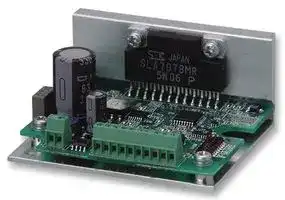


BS1D200P10
Stepper Motor Driver, Microstepping, Bipolar, Two Phase, 3 A, 24 Vdc to 36 Vdc
- Manufacturer: SANYO DENKI
- Product type: Stepper Motor Drives
- Supply Voltage Min:24VDC; Supply Voltage Max:36VDC; No. of Phases:Two Phase; Power Rating:-; Output Voltage Max:40V; Output Current:10mA; Product Range:-; SVHC:No SVHC (15-Jun-2015); Approv
- No. of Phases: Two Phase
- Product Range: -
- Output Current Max: 3A
- Supply Voltage Max: 36VDC
- Supply Voltage Min: 24VDC
- Control / Drive Type: Microstep Drive
| Delivery and price | |
|---|---|
| Units per pack | 1 |
| Price | 184.89 € |
| Current stock | 10+ |
| Lead time | 30 days |

**DC Input Set Models/Drivers**

## **Driver Specifcations**

- **General specifications**

**==> picture [511 x 462] intentionally omitted <==**

**----- Start of picture text -----**<br>
Unipolar Bipolar<br>Model no. US1D200P10 BS1D200P10<br>Input source 24/36 VDC ±10%<br>Source current 3 A<br>Protection class Class Ⅲ<br>Operation<br>Installation category (over-voltage category): Ⅰ, pollution degree: 2<br>environment<br>Ambient operation<br>0 to +50°C<br>temperature<br>Storage<br>-20 to +70°C<br>temperature<br>Operating ambient<br>35 to 85% RH (no condensation)<br>humidity<br>Storage humidity 10 to 90% RH (no condensation)<br>Operation altitude 1000 m (3281 feet) or less above sea level<br>Vibration  Tested under the following conditions: 5 m/s [2]  frequency range 10 to 55 Hz, direction along X, Y and Z axes,<br>resistance for 2 hours each<br>“ ”<br>Impact resistance Not influenced at NDS-C-0110 standard section 3.2.2 division C .<br>Withstandable  Not influenced when 0.5 kVAC is applied between power input terminal and cabinet for one minute.<br>voltage<br>Insulation<br>10 MΩ min. when measured with 500 VDC megohmmeter between input terminal and cabinet.<br>resistance<br>Mass 0.09 kg<br>Step angle, pulse input mode, low vibration mode, step current, operating current, original excitation<br>Selection functions<br>phase<br>Protection functions Open phase protection, Main circuit power source voltage decrease<br>LED indication Power monitor, alarm display<br>Command pulse input  Photocoupler input system, input resistance: 220 Ω“ ” “ ”<br>input-signal H level: 4.0 to 5.5 V, input-signal L level: 0 to 0.5 V<br>signal<br>Maximum input frequency: 150 kpulse/s<br>Power down input signal input-signalPhotocoupler input system, input resistance: 220 Ω“H”level: 4.0 to 5.5V, input-signal“L”level: 0 to 0.5 V<br>Phase origin monitor  From the photocoupler by the open collector output<br>output signal Output specification: Vceo = 40 V max., Ic = 10 mA max.<br>From the photocoupler by the open collector output<br>Alarm output signal Output specification: Vceo = 40 V max., Ic = 10 mA max.<br>Basic specifications Environment<br>Functions<br>I/O signals<br>**----- End of picture text -----**<br>


## ■ **Safety standards**

**==> picture [511 x 149] intentionally omitted <==**

**----- Start of picture text -----**<br>
Directives Category Standard Name<br>Low-voltage directives - EN 61010-1 -<br>EN 55011-A Terminal disturbance voltage<br>Emission<br>CE EN 55011-A Electromagnetic radiation disturbance<br>(TÜV) EN 61000-4-2 ESD (Electrostatic discharge)<br>EMC directives<br>EN 61000-4-3 RS (Radio-frequency amplitude modulated electromagnetic field)<br>Immunity<br>EN 61000-4-4 Fast transients/burst<br>EN 61000-4-6 Conducted disturbances<br>Applicable<br>Acquired standards File no.<br>standard<br>UL<br>UL<br>UL 508C E179775<br>UL for Canada<br>**----- End of picture text -----**<br>


- ・ EMC characteristics may vary depending on the configuration of the users’ control panel, which contains the driver or stepping motor, or the arrangement and wiring of other electrical devices.

Parts for EMC noise suppression like noise filters and toroidal type ferrite cores may be required depending on circumstances.

- ・ Validation test of driver has been performed for low-voltage EMC directives at TÜV (TÜV product service) for self-declaration of CE marking.

・ Drivers are available for separate purchase. Connector-type drivers are also available. Contact us for details.

28

## **Driver Controls and Connectors**

**Unipolar**

## **Bipolar**

**==> picture [134 x 18] intentionally omitted <==**

**----- Start of picture text -----**<br>
97) wes 6 ci77 PCS POS PC4 ALM =<br>7 /MWSOFVENSOS 5 4 €S)<br>**----- End of picture text -----**<br>


**==> picture [141 x 14] intentionally omitted <==**

**----- Start of picture text -----**<br>
| 7 HENS 5 SINGSOS 4 4.)<br>**----- End of picture text -----**<br>


## 1  Operating current selection switch (RUN)

- The value of the motor current can be set when operating.

|Dial|0|1|2|3|4|5|6|7|
|---|---|---|---|---|---|---|---|---|
|Stepping motor<br>current(A)|2.0|1.9|1.8|1.7|1.6|1.5|1.4|1.3|
|Dial|8|9|A|B|C|D|E|F|
|Stepping motor<br>current(A)|1.2|1.1|1.0|0.9|0.8|0.7|0.6|0.5|


- ・ The factory setting is F (0.5 A).

Select the current after checking the rated current of the combination motor.

## 2  Function selection DIP switchpack

Select the function depending on your specification.

## Factory settings

**==> picture [220 x 115] intentionally omitted <==**

**----- Start of picture text -----**<br>
OFF  ON<br>EX1 OFF<br>EX2 OFF  Partition number: 8<br>EX3 OFF<br>F/R OFF  Input method 2 (CW/CCW pulse input)<br>ACD1 OFF<br>Stopping current: 40% of driving current<br>ACD2 OFF<br>LV OFF  Micro step operation<br>EORG OFF  Phase origin<br>**----- End of picture text -----**<br>


## 1. Step angle select (EX1, EX2, EX3)

Select the partition number of the basic step angle.

|EX1|EX2|EX3|Partition no.|
|---|---|---|---|
|ON|ON|ON|1-division|
|OFF|ON|OFF|2-division|
|ON|OFF|OFF|4-division|
|OFF|OFF|OFF|8-division|
|OFF|OFF|ON|16-division|


2. Input method select (F/R) Select input pulse type.

|F / R|Inputpulse type|
|---|---|
|ON|1 input(CK,U/D)|
|OFF|2 input(CW,CCW)|


## 3. Current selection when stopping (ACD1, ACD2)

## 4. Low-vibration mode select (LV)

Provides low-vibration, smooth operation even if resolution is coarse (1-division, 2-division, etc).

|LV<br>Operation<br>ON<br>Auto-micro function<br>OFF<br>Micro-step<br>5. Excitation select (EORG)<br>The excitation phase when the power supply is engaged is<br>selected.<br>EORG<br>Original excitationphase<br>ON<br>Excitationphase atpower shut off<br>OFF<br>Phase origin|
|---|


## 5. Excitation select (EORG)

The excitation phase when the power supply is engaged is selected.

- ・ By turning on the EORG, the excitation phase during power OFF will be saved. Therefore, there will be no shaft displacement when turning the power ON.

## 3  LED for power supply monitor (POW)

Lit up when the main circuit power supply is connected.

## 4  LED for alarm display (ALM)

Lights in the following conditions:

- ・ Motor cable is broken.

- ・ Switching element in driver is faulty.

- ・ The main circuit voltage is out of specifications range (19 VDC max.).

When “ALM” is displayed, the winding current of the stepping motor is cut off and it is in a “non-excitation” state. At the same time, an output signal (photocoupler ON) is transmitted from the alarm output terminal (AL) to an external source. When the alarm circuit is operating, this state is maintained until it is reset by switching on the power supply again. When an alarm condition has occurred, please take corrective actions to rectify the cause of the alarm before switching on the power supply again.

- 5   I/O signal terminal block (CN1) Connect the I/O signal.

6  Motor terminal block (CN2) Connect the motor’s power line.

## 7  Power supply terminal block (CN3)

Connect the main circuit power supply.

Select the current value of the motor when stopping.

|ACD2|ACD1|Current value of the motor|
|---|---|---|
|ON|ON|100% of drivingcurrent|
|ON|OFF|60% of drivingcurrent|
|OFF|ON|50% of drivingcurrent|
|OFF|OFF|40% of drivingcurrent|


- ・ Initial configuration of factory shipment is set to 40% of rated value. Driver and motor should be operated at around 50% of rated value to reduce heat.

**29**

**DC Input Set Models/Drivers**

## **Connections and Signals**

## ■ **External wiring diagram**

## **Unipolar**

## **Bipolar**

**==> picture [509 x 156] intentionally omitted <==**

**----- Start of picture text -----**<br>
Driver Driver<br>CN1 CN2 CN1 CN2<br>1 1 White 1 1 Orange<br>CW pulse input  (CW) 2 2 Black CW pulse input  (CW) 2 2 Blue<br>3 3 Orange 3 3 Red M<br>CCW pulse input (CCW) 4 4 Blue M CCW pulse input (CCW) 4 4 Yellow<br>Red<br>5 5 5<br>Power down input (PD) 6 6 Yellow Power down input (PD) 6<br>Phase origin monitor 7 Phase origin monitor 7<br>output (MON) 8 output (MON) 8<br>9 9<br>Alarm output (AL) 10 Alarm output (AL) 10<br>CN3 CN3<br>24 to 36 VDC 1 24 to 36 VDC 1<br>24 to 36 GDC 2 24 to 36 GDC 2<br>**----- End of picture text -----**<br>


## ■ **Applicable wire sizes**

**==> picture [368 x 46] intentionally omitted <==**

**----- Start of picture text -----**<br>
Part Wire sizes Allowable wire length<br>For power supply AWG22 (0.3 mm [2] ) 2 m max.<br>For input/output signal AWG24 (0.2 mm [2] ) to AWG22 (0.3 mm [2] ) 2 m max.<br>For motor AWG22 (0.3 mm [2] ) Under 3 m<br>**----- End of picture text -----**<br>


**==> picture [512 x 208] intentionally omitted <==**

**----- Start of picture text -----**<br>
■ Specification summary of input/output signals<br>Signal CN1 Pin no. Function summary<br>1 When in "2 input type",<br>CW pulse input (CW) (Standard)<br>2 input the drive pulse that rotates in a CW direction.<br>1 When in "1 input type",<br>Pulse train input (CK)<br>2 input the drive pulse train for motor rotation.<br>3 When in "2 input type",<br>CCW pulse input (CCW) (Standard)<br>4 input the drive pulse train that rotates in a CCW direction.<br>When in "1 input type",<br>3 input the motor rotational direction signal.<br>Rotational direction input (U/D) 4 Internal photocoupler ON … CW direction<br>Internal photocoupler OFF … CCW direction<br>Inputting PD signal will cut off (power off) the current flowing to the motor (With DIP<br>5 switch select, change to the Power low function is possible).<br>Power down input (PD)<br>6 PD input signal on (internal photocoupler on) … PD function is valid.<br>PD input signal off (internal photocoupler off) … PD function is invalid.<br>When the excitation phase is at the origin (during power on) this function turns on.<br>7<br>Phase origin monitor output (MON) When FULL step, ON once for 4 pulses;<br>8<br>when HALF step, ON once for 8 pulses.<br>9 When alarm circuits are actuated inside the driver, outputs signals to outside, after<br>Alarm output (AL)<br>10 which the stepping motor changes to unexcited status.<br>**----- End of picture text -----**<br>


・As for the motor rotational direction, CW direction is regarded as the clockwise rotation, and CCW direction is regarded as the counterclockwise rotation by viewing the motor from output shaft side.

30

## **Circuit Confguration of Pulse Input CW (CK), CCW (U/D)**

**==> picture [205 x 81] intentionally omitted <==**

**----- Start of picture text -----**<br>
1 (3) 220 Ω<br>+5 V<br>1000 pF<br>Input signal 2 (4)<br>R<br>Driver<br>**----- End of picture text -----**<br>


- Pulse duty 50% max.

- Maximum input frequency: 150 kpulse/s

- If the peak voltage of the input signal exceeds 5.5 V, please add an external current-limiting resistor R to limit the input current to around 15 mA. (Take the photocoupler forward voltage of 1.5 V into consideration.)

## ■ **Input signal specifications**

**==> picture [155 x 147] intentionally omitted <==**

**----- Start of picture text -----**<br>
Photocoupler type<br>3 μs min.<br>4.0 to 5.5 V<br>90%<br>50%<br>Rotation<br>10%<br>0 to 0.5 V<br>1 μs max. 1 μs max.<br>**----- End of picture text -----**<br>


## ■ **Timing of the command pulse**

## **2 input mode (CW, CCW)**

**==> picture [120 x 72] intentionally omitted <==**

**----- Start of picture text -----**<br>
ON<br>CW<br>OFF<br>ON<br>CCW<br>OFF<br>**----- End of picture text -----**<br>


**==> picture [37 x 7] intentionally omitted <==**

**----- Start of picture text -----**<br>
50 μs min.<br>**----- End of picture text -----**<br>


- Shaded area indicates internal photocoupler ON. Internal circuit (motor) starts operating at leading edge of the photocoupler ON.

- • To apply pulse to CW, set CCW side internal photocoupler to OFF.

- To apply pulse to CCW, set CW side internal photocoupler to OFF.

## **1 input mode (CK, U/D)**

**==> picture [191 x 65] intentionally omitted <==**

**----- Start of picture text -----**<br>
ON<br>CK OFF<br>50 μs min. 10 μs min.<br>ON<br>U/D OFF<br>**----- End of picture text -----**<br>


- Shaded area indicates internal photocoupler ON. Internal circuit (motor) starts operating at leading edge of CK side photocoupler ON.

- • Switching of U/D input signal must be done while CK side internal photocoupler is OFF.

## **Input Circuit Confguration of Power Down Input (PD)**

**==> picture [207 x 81] intentionally omitted <==**

**----- Start of picture text -----**<br>
5 220 Ω<br>+5 V<br>1000 pF<br>Input signal 6<br>R<br>Driver<br>**----- End of picture text -----**<br>


- If the peak voltage of the input signal exceeds 5.5 V, please add an external current-limiting resistor R to limit the input current to around 15 mA. (Take the photocoupler forward voltage of 1.5 V into consideration.)

## **Output Signal Configuration of Phase Origin Monitor Output (MON) and Alarm Output (AL)**

**==> picture [149 x 81] intentionally omitted <==**

**----- Start of picture text -----**<br>
max. 10 mA<br>7 (9)<br>max. 40 V<br>8 (10)<br>Driver<br>**----- End of picture text -----**<br>


## **MON output**

CW pulse CCW pulse

**==> picture [196 x 53] intentionally omitted <==**

- Photocoupler is set to ON at phase origin of motor excitation (setting when number of divisions is 2).

- MON output is taken at every 7.2 degrees of motor output shaft from phase origin.

MON output

**31**
Updated at April 24, 2026
Established in 1927, Sanyo Denki is a globally recognized manufacturer specializing in advanced thermal management and precision motion control solutions. The company is renowned for engineering highly reliable equipment cooling systems and motors that serve critical applications across industrial machinery, telecommunications, and medical electronics. Sanyo Denki's industry-leading thermal management portfolio is highlighted by its robust selection of fans and blowers. Engineered for exceptional durability, these blowers are designed to deliver high airflow and static pressure in demanding environments. To ensure optimal temperature regulation and system safety, this comprehensive cooling range is fully supported by essential accessories, including fan cooled heat sinks and protective finger guards. Beyond specialized thermal solutions, Sanyo Denki is also a trusted provider in automation and process control. The company's high-performance motor drives and related control technologies offer seamless system integration, delivering the exact positioning, efficiency, and reliability required for sophisticated instrumentation and automated industrial equipment.
About Novapart
Novapart is a B2B electronic component broker specialising in stock shortages and cost reduction. We source hard-to-find parts and identify compliant alternatives across a catalogue of 410,000+ components from 500+ manufacturers.
Learn more →Stock Shortage Specialist
When a component is unavailable, discontinued or has an unacceptable lead time, we tap into our network of vetted European and Asian distributors to source what you need — without compromising on quality or traceability.
Request a quote →Compliant Alternatives
We identify pin-to-pin, electrically equivalent substitutes that meet the same certifications (RoHS, AEC-Q100, REACH) as your original specification — validated against datasheets, not just part numbers. Often at a lower cost.
BOM Analysis service →