
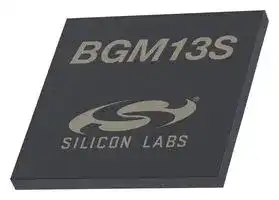


BGM13S22F512GA-V3
Bluetooth Module, BLE 5.0, 2 Mbps, 1.8 V to 3.8 V, -90.2 dBm, -40 °C to 85 °C
- Manufacturer: SILICON LABS
- Product type: Bluetooth Modules & Adaptors
- SVHC: To Be Advised
- Interfaces: I2C, SPI, UART, USART
- Product Range: BGM13S Series
- Certifications: CE, FCC, IC, ISED, MIC
- Bluetooth Class: -
- Bluetooth Version: Bluetooth LE 5.0
- Supply Voltage Range: 1.8 V to 3.8 V
- Receiver Sensitivity Rx: -90.2 dBm
- Operating Temperature Range: -40 °C to 85 °C
| Delivery and price | |
|---|---|
| Units per pack | 250 |
| Price | 5.52 € |
| Current stock | 10+ |
| Lead time | 30 days |

## **BGM13S Blue Gecko** _**Bluetooth**_ **[®] SiP Module Data Sheet**

The BGM13S is Silicon Labs’ first SiP module solution for Bluetooth 5 connectivity. It supports 2 Mbps, 1 Mbps and coded LE Bluetooth PHYs. Also, with 512 kB of flash and 64 kB of RAM, the BGM13S is suited to meet Bluetooth Mesh networking memory requirements effectively.

Based on the EFR32BG13 Blue Gecko SoC, the BGM13S delivers robust RF performance, low energy consumption, a wide selection of MCU peripherals, regulatory test certificates for various regions and countries, and a simplified development experience, all in a 6.5 × 6.5 mm package. Together with the certified software stacks and powerful tools also offered by Silicon Labs, the BGM13S minimizes the area requirements, engineering efforts and development costs associated with adding Bluetooth 5.0 or Bluetooth Mesh connectivity to any product, accelerating its time-to-market.

The BGM13S is intended for a broad range of applications, including:

- Wearables

- IoT end-node devices and gateways

- Health, sports, and wellness

- Industrial, home, and building automation

- Beacons

## **KEY FEATURES**

   - Bluetooth 5 compliant

   - Fit for Bluetooth Mesh

   - Antenna or RF Pin variants

   - Up to +19 dBm TX power

   - -94.1 dBm RX sensitivity at 1 Mbps

   - 32-bit ARM® Cortex®-M4 core at 38.4 MHz

   - 512/64 kB of flash/RAM memory

   - Precision Low Frequency Oscillator meets Bluetooth Low Energy Sleep Clock accuracy requirements

   - Autonomous Hardware Crypto Accelerators

   - Integrated DC-DC converter

   - 32 GPIO pins

   - 6.5 mm × 6.5 mm × 1.4 mm

- Smart phone, tablet, and PC accessories

**==> picture [520 x 237] intentionally omitted <==**

**----- Start of picture text -----**<br>
Core / Memory Crystal Clock Management Energy Management Other<br>38.4 MHz H-F Crystal Oscillator RC OscillatorH-F RegulatorVoltage  Voltage Monitor CRYPTO<br>with DSP extensions, FPU and MPUARM Cortex [TM]  M4 processor Flash Program Memory Auxiliary H-F RC L-F Crystal Oscillator Precision L-F RC OscillatorL-F ConverterDC-DC  Power-On Reset True Random CRC<br>Oscillator RC Oscillator Number Generator<br>ETM Debug Interface RAM Memory ControllerLDMA  Ultra L-F RC Oscillator Brown-Out Detector SMU<br>32-bit bus<br>Peripheral Reflex System<br>Antenna Radio Transceiver Serial  I/O Ports Timers and Triggers Analog I/F<br>Interfaces<br>Chip Antenna DEMOD USART InterruptsExternal  Timer/Counter Protocol Timer ADC<br>Analog<br>Matching LNARF Frontend I PGA IFADC Low Energy UART [TM] Purpose I/OGeneral  Low Energy Timer Sensor InterfaceLow Energy  ComparatorIDAC<br>PA AGC Capacitive<br>Q Frequency  I [2] C Pin Reset Pulse Counter Watchdog Timer Touch<br>Synthesizer<br>MOD Real Time  VDAC<br>Pin Wakeup Counter and  Cryotimer<br>Calendar Op-Amp<br>Lowest power mode with peripheral operational:<br>EM0—Active EM1—Sleep EM2—Deep Sleep EM3—Stop EM4—Hibernate EM4—Shutoff<br>FRC BUFC<br>BALUN<br>CRC RAC<br>**----- End of picture text -----**<br>


**silabs.com** | Building a more connected world.

Rev. 1.1

BGM13S Blue Gecko _Bluetooth_[®] SiP Module Data Sheet Feature List

## **1.  Feature List**

- **Supported Protocols**

   - Bluetooth 5

   - Bluetooth Mesh

- **Wireless System-on-Chip**

   - 2.4 GHz radio

   - TX power up to +19 dBm

   - High Performance 32-bit 38.4 MHz ARM Cortex[®] -M4 with DSP instruction and floating-point unit for efficient signal processing

   - 512 kB flash program memory

   - 64 kB RAM data memory

   - Embedded Trace Macrocell (ETM) for advanced debugging

   - Integrated DC-DC converter

- **High Receiver Performance**

   - -102.1 dBm sensitivity at 125 kbit/s GFSK

   - -97.9 dBm sensitivity at 500 kbit/s GFSK

   - -94.1 dBm sensitivity at 1 Mbit/s GFSK

   - -90.2 dBm sensitivity at 2 Mbit/s GFSK

- **Low Energy Consumption**

   - 9.7 mA RX current at 1 Mbps, GFSK

   - 8.9 mA TX current at 0 dBm output power

   - 87 μA/MHz in Active Mode (EM0)

   - 1.4 μA EM2 DeepSleep current (full RAM retention and RTCC running from LFXO)

   - 1.14 μA EM3 Stop current (State/RAM retention)

   - Wake on Radio with signal strength detection, preamble pattern detection, frame detection and timeout

- **Regulatory Certifications**

   - FCC

   - CE

   - IC / ISEDC

   - MIC / Telec

- **Wide Operating Range**

   - 1.8 V to 3.8 V single power supply

   - -40 °C to +85 °C

- **Dimensions**

   - **Support for Internet Security**

      - General Purpose CRC

      - True Random Number Generator (TRNG)

      - 2 × Hardware Cryptographic Accelerators (CRYPTO) for AES 128/256, SHA-1, SHA-2 (SHA-224 and SHA-256) and ECC

   - **Wide Selection of MCU Peripherals**

      - 12-bit 1 Msps SAR Analog to Digital Converter (ADC)

      - 2 × Analog Comparator (ACMP)

      - 2 × Digital to Analog Converter (VDAC)

      - 3 × Operational Amplifier (Opamp)

      - Digital to Analog Current Converter (IDAC)

      - Low-Energy Sensor Interface (LESENSE)

      - Multi-channel Capacitive Sense Interface (CSEN)

      - 32 pins connected to analog channels (APORT) shared between analog peripherals

      - 32 General Purpose I/O pins with output state retention and asynchronous interrupts

      - 8 Channel DMA Controller

      - 12 Channel Peripheral Reflex System (PRS)

      - 2 ×16-bit Timer/Counter

         - 3 or 4 Compare/Capture/PWM channels

      - 1 × 32-bit Timer/Counter

         - 3 Compare/Capture/PWM channels

      - Precision Low Frequency RC Oscillator (PLFRCO)

      - 32-bit Real Time Counter and Calendar

      - 16-bit Low Energy Timer for waveform generation

      - 32-bit Ultra Low Energy Timer/Counter for periodic wake-up from any Energy Mode

      - 16-bit Pulse Counter with asynchronous operation

      - 2 × Watchdog Timer

      - 3 × Universal Synchronous/Asynchronous Receiver/Transmitter (UART/SPI/SmartCard (ISO 7816)/IrDA/I[2] S)

      - Low Energy UART (LEUART[™] )

      - 2 × I[2] C interface with SMBus support and address recognition in EM3 Stop

- 6.5 mm × 6.5 mm × 1.4 mm

**silabs.com** | Building a more connected world.

Rev. 1.1  |  2

BGM13S Blue Gecko _Bluetooth_[®] SiP Module Data Sheet Ordering Information

## **2.  Ordering Information**

**Table 2.1.  Ordering Information**

|**Ordering Code**|**Protocol Stack**|**Max TX Power**|**Antenna**|**Flash**<br>**(kB)**|**RAM**<br>**(kB)**|**GPIO**|**Packaging**|
|---|---|---|---|---|---|---|---|
|BGM13S32F512GA-V3|Bluetooth LE|19 dBm|Built-in|512|64|32|Cut Tape|
|BGM13S32F512GA-V3R|Bluetooth LE|19 dBm|Built-in|512|64|32|Reel|
|BGM13S32F512GN-V3|Bluetooth LE|19 dBm|RF pin|512|64|32|Cut Tape|
|BGM13S32F512GN-V3R|Bluetooth LE|19 dBm|RF pin|512|64|32|Reel|
|BGM13S22F512GA-V3|Bluetooth LE|8 dBm|Built-in|512|64|32|Cut Tape|
|BGM13S22F512GA-V3R|Bluetooth LE|8 dBm|Built-in|512|64|32|Reel|
|BGM13S22F512GN-V3|Bluetooth LE|8 dBm|RF pin|512|64|32|Cut Tape|
|BGM13S22F512GN-V3R|Bluetooth LE|8 dBm|RF pin|512|64|32|Reel|


Radio board development hardware is also available:

- **SLWRB4305A** for BGM13S32 Blue Gecko Module Radio Board

- **SLWRB4305C** for BGM13S22 Blue Gecko Module Radio Board

End-product manufacturers must verify that the module is configured to meet regulatory limits for each region in accordance with the formal certification test reports.

Devices ship with the Gecko UART DFU bootloader 1.4.1 + NCP application from Bluetooth SDK 2.8.1.0. The firmware settings conform to the diagram shown in .

**silabs.com** | Building a more connected world.

Rev. 1.1  |  3

## **Table of Contents**

|**1.**|**Feature List .**<br>**.**<br>**.**<br>**.**<br>**.**<br>**.**<br>**.**<br>**.**<br>**.**<br>**.**|**.**|**.**|**.**|**.**|**.**|**.**|**.**|**.**|**.**|**.**|**.**|**.**|**.**|**.**|**.**|**.**|**.**|**.**|**.**|**.**|**.**|**. 2**|
|---|---|---|---|---|---|---|---|---|---|---|---|---|---|---|---|---|---|---|---|---|---|---|---|
|**2.**|**Ordering Information**<br>**.**<br>**.**<br>**.**<br>**.**<br>**.**<br>**.**|**.**|**.**|**.**|**.**|**.**|**.**|**.**|**.**|**.**|**.**|**.**|**.**|**.**|**.**|**.**|**.**|**.**|**.**|**.**|**.**|**.**|**. 3**|
|**3.**|**System Overview .**<br>**.**<br>**.**<br>**.**<br>**.**<br>**.**<br>**.**<br>**.**|**.**|**.**|**.**|**.**|**.**|**.**|**.**|**.**|**.**|**.**|**.**|**.**|**.**|**.**|**.**|**.**|**.**|**.**|**.**|**.**|**.**|**. 7**|
||3.1  Introduction .<br>.<br>.<br>.<br>.<br>.<br>.<br>.<br>.|.|.|.|.|.|.|.|.|.|.|.|.|.|.|.|.|.|.|.|.|.|. 7|
||3.2  Radio .<br>.<br>.<br>.<br>.<br>.<br>.<br>.<br>.<br>.<br>.|.|.|.|.|.|.|.|.|.|.|.|.|.|.|.|.|.|.|.|.|.|. 7|
||3.2.1  Antenna Interface<br>.<br>.<br>.<br>.<br>.|.|.|.|.|.|.|.|.|.|.|.|.|.|.|.|.|.|.|.|.|.|. 7|
||3.2.2  RFSENSE .<br>.<br>.<br>.<br>.<br>.<br>.<br>.|.|.|.|.|.|.|.|.|.|.|.|.|.|.|.|.|.|.|.|.|.|. 8|
||3.2.3  Packet and State Trace<br>.<br>.<br>.|.|.|.|.|.|.|.|.|.|.|.|.|.|.|.|.|.|.|.|.|.|. 8|
||3.2.4  Random Number Generator .<br>.|.|.|.|.|.|.|.|.|.|.|.|.|.|.|.|.|.|.|.|.|.|. 8|
||3.3  Power .<br>.<br>.<br>.<br>.<br>.<br>.<br>.<br>.<br>.<br>.|.|.|.|.|.|.|.|.|.|.|.|.|.|.|.|.|.|.|.|.|.|. 9|
||3.3.1  Energy Management Unit (EMU)|.|.|.|.|.|.|.|.|.|.|.|.|.|.|.|.|.|.|.|.|.|.10|
||3.3.2  DC-DC Converter<br>.<br>.<br>.<br>.<br>.|.|.|.|.|.|.|.|.|.|.|.|.|.|.|.|.|.|.|.|.|.|.10|
||3.3.3  Power Domains .<br>.<br>.<br>.<br>.<br>.|.|.|.|.|.|.|.|.|.|.|.|.|.|.|.|.|.|.|.|.|.|.10|
||3.4  General Purpose Input/Output (GPIO)|.|.|.|.|.|.|.|.|.|.|.|.|.|.|.|.|.|.|.|.|.|.10|
||3.5  Clocking .<br>.<br>.<br>.<br>.<br>.<br>.<br>.<br>.<br>.|.|.|.|.|.|.|.|.|.|.|.|.|.|.|.|.|.|.|.|.|.|.10|
||3.5.1  Clock Management Unit (CMU) .|.|.|.|.|.|.|.|.|.|.|.|.|.|.|.|.|.|.|.|.|.|.10|
||3.5.2  Internal Oscillators and Crystal .|.|.|.|.|.|.|.|.|.|.|.|.|.|.|.|.|.|.|.|.|.|.11|
||3.6  Counters/Timers and PWM .<br>.<br>.<br>.|.|.|.|.|.|.|.|.|.|.|.|.|.|.|.|.|.|.|.|.|.|.11|
||3.6.1  Timer/Counter (TIMER)<br>.<br>.<br>.|.|.|.|.|.|.|.|.|.|.|.|.|.|.|.|.|.|.|.|.|.|.11|
||3.6.2  Wide Timer/Counter (WTIMER) .|.|.|.|.|.|.|.|.|.|.|.|.|.|.|.|.|.|.|.|.|.|.11|
||3.6.3  Real Time Counter and Calendar (RTCC)||||.|.|.|.|.|.|.|.|.|.|.|.|.|.|.|.|.|.|.11|
||3.6.4  Low Energy Timer (LETIMER)<br>.|.|.|.|.|.|.|.|.|.|.|.|.|.|.|.|.|.|.|.|.|.|.11|
||3.6.5  Ultra Low Power Wake-up Timer (CRYOTIMER)||||||.|.|.|.|.|.|.|.|.|.|.|.|.|.|.|.|.11|
||3.6.6  Pulse Counter (PCNT) .<br>.<br>.<br>.|.|.|.|.|.|.|.|.|.|.|.|.|.|.|.|.|.|.|.|.|.|.12|
||3.6.7  Watchdog Timer (WDOG) .<br>.<br>.|.|.|.|.|.|.|.|.|.|.|.|.|.|.|.|.|.|.|.|.|.|.12|
||3.7  Communications and Other Digital Peripherals||||.|.|.|.|.|.|.|.|.|.|.|.|.|.|.|.|.|.|.12|
||3.7.1  Universal Synchronous/Asynchronous|||Receiver/Transmitter (USART)||||||||||.|.|.|.|.|.|.|.|.|.12|
||3.7.2  Low Energy Universal Asynchronous Receiver/Transmitter (LEUART)|||||||||||||.|.|.|.|.|.|.|.|.|.12|
||3.7.3  Inter-Integrated Circuit Interface (I2C) .|||.|.|.|.|.|.|.|.|.|.|.|.|.|.|.|.|.|.|.|.12|
||3.7.4  Peripheral Reflex System (PRS)|.|.|.|.|.|.|.|.|.|.|.|.|.|.|.|.|.|.|.|.|.|.12|
||3.7.5  Low Energy Sensor Interface (LESENSE)||||.|.|.|.|.|.|.|.|.|.|.|.|.|.|.|.|.|.|.12|
||3.8  Security Features .<br>.<br>.<br>.<br>.<br>.<br>.|.|.|.|.|.|.|.|.|.|.|.|.|.|.|.|.|.|.|.|.|.|.12|
||3.8.1  General Purpose Cyclic Redundancy Check|||||(GPCRC)|||.|.|.|.|.|.|.|.|.|.|.|.|.|.|.12|
||3.8.2  Crypto Accelerator (CRYPTO)<br>.|.|.|.|.|.|.|.|.|.|.|.|.|.|.|.|.|.|.|.|.|.|.13|
||3.8.3  True Random Number Generator|(TRNG)|||.|.|.|.|.|.|.|.|.|.|.|.|.|.|.|.|.|.|.13|
||3.8.4  Security Management Unit (SMU)|.|.|.|.|.|.|.|.|.|.|.|.|.|.|.|.|.|.|.|.|.|.13|
||3.9  Analog.<br>.<br>.<br>.<br>.<br>.<br>.<br>.<br>.<br>.<br>.|.|.|.|.|.|.|.|.|.|.|.|.|.|.|.|.|.|.|.|.|.|.13|
||3.9.1  Analog Port (APORT) .<br>.<br>.<br>.|.|.|.|.|.|.|.|.|.|.|.|.|.|.|.|.|.|.|.|.|.|.13|
||3.9.2  Analog Comparator (ACMP) .<br>.|.|.|.|.|.|.|.|.|.|.|.|.|.|.|.|.|.|.|.|.|.|.13|
||3.9.3  Analog to Digital Converter (ADC) .||.|.|.|.|.|.|.|.|.|.|.|.|.|.|.|.|.|.|.|.|.13|
||3.9.4  Capacitive Sense (CSEN).<br>.<br>.|.|.|.|.|.|.|.|.|.|.|.|.|.|.|.|.|.|.|.|.|.|.13|
||3.9.5  Digital to Analog Current Converter (IDAC)||||.|.|.|.|.|.|.|.|.|.|.|.|.|.|.|.|.|.|.14|


**silabs.com** | Building a more connected world.

Rev. 1.1 |  4

||3.9.6  Digital to Analog Converter (VDAC)|3.9.6  Digital to Analog Converter (VDAC)|3.9.6  Digital to Analog Converter (VDAC)|3.9.6  Digital to Analog Converter (VDAC)|.|.|.|.|.||.||.||.||.||.||.||.||.||.||.||.||.||.||.||.|.14|
|---|---|---|---|---|---|---|---|---|---|---|---|---|---|---|---|---|---|---|---|---|---|---|---|---|---|---|---|---|---|---|---|---|---|---|---|---|---|---|---|---|
||3.9.7  Operational Amplifiers .<br>.|.|.|.|.|.|.|.|.||.||.||.||.||.||.||.||.||.||.||.||.||.||.||.|.14|
||3.10  Reset Management Unit (RMU) .||.|.|.|.|.|.|.||.||.||.||.||.||.||.||.||.||.||.||.||.||.||.|.14|
||3.11  Core and Memory<br>.<br>.<br>.<br>.|.|.|.|.|.|.|.|.||.||.||.||.||.||.||.||.||.||.||.||.||.||.||.|.14|
||3.11.1  Processor Core .<br>.<br>.<br>.|.|.|.|.|.|.|.|.||.||.||.||.||.||.||.||.||.||.||.||.||.||.||.|.14|
||3.11.2  Memory System Controller (MSC)||||.|.|.|.|.||.||.||.||.||.||.||.||.||.||.||.||.||.||.||.|.14|
||3.11.3  Linked Direct Memory Access||Controller||||(LDMA)||||.||.||.||.||.||.||.||.||.||.||.||.||.||.||.|.14|
||3.12  Memory Map .<br>.<br>.<br>.<br>.<br>.|.|.|.|.|.|.|.|.||.||.||.||.||.||.||.||.||.||.||.||.||.||.||.|.15|
||3.13  Configuration Summary<br>.<br>.|.|.|.|.|.|.|.|.||.||.||.||.||.||.||.||.||.||.||.||.||.||.||.|.16|
|**4.**|**Electrical Specifications**<br>**.**<br>**.**<br>**.**|**.**|**.**|**.**|**.**||**.**|**.**|**.**|**.**||**.**||**.**||**.**||**.**||**.**||**.**||**.**||**.**||**.**||**.**||**.**||**.**||**.**||**.**||**. 17**|
||4.1  Electrical Characteristics<br>.<br>.|.|.|.|.|.|.|.|.||.||.||.||.||.||.||.||.||.||.||.||.||.||.||.|.17|
||4.1.1  Absolute Maximum Ratings|.|.|.|.|.|.|.|.||.||.||.||.||.||.||.||.||.||.||.||.||.||.||.|.18|
||4.1.2  Operating Conditions<br>.<br>.|.|.|.|.|.|.|.|.||.||.||.||.||.||.||.||.||.||.||.||.||.||.||.|.19|
||4.1.3  DC-DC Converter<br>.<br>.<br>.|.|.|.|.|.|.|.|.||.||.||.||.||.||.||.||.||.||.||.||.||.||.||.|.20|
||4.1.4  Current Consumption<br>.<br>.|.|.|.|.|.|.|.|.||.||.||.||.||.||.||.||.||.||.||.||.||.||.||.|.22|
||4.1.5  Wake Up Times .<br>.<br>.<br>.|.|.|.|.|.|.|.|.||.||.||.||.||.||.||.||.||.||.||.||.||.||.||.|.28|
||4.1.6  Brown Out Detector (BOD)|.|.|.|.|.|.|.|.||.||.||.||.||.||.||.||.||.||.||.||.||.||.||.|.28|
||4.1.7  Frequency Synthesizer.<br>.|.|.|.|.|.|.|.|.||.||.||.||.||.||.||.||.||.||.||.||.||.||.||.|.29|
||4.1.8  2.4 GHz RF Transceiver Characteristics|||||.|.|.|.||.||.||.||.||.||.||.||.||.||.||.||.||.||.||.|.30|
||4.1.9  Oscillators .<br>.<br>.<br>.<br>.<br>.|.|.|.|.|.|.|.|.||.||.||.||.||.||.||.||.||.||.||.||.||.||.||.|.39|
||4.1.10  Flash Memory Characteristics||.|.|.|.|.|.|.||.||.||.||.||.||.||.||.||.||.||.||.||.||.||.|.42|
||4.1.11  General-Purpose I/O (GPIO)||.|.|.|.|.|.|.||.||.||.||.||.||.||.||.||.||.||.||.||.||.||.|.43|
||4.1.12  Voltage Monitor (VMON).|.|.|.|.|.|.|.|.||.||.||.||.||.||.||.||.||.||.||.||.||.||.||.|.45|
||4.1.13  Analog to Digital Converter|(ADC)|||.|.|.|.|.||.||.||.||.||.||.||.||.||.||.||.||.||.||.||.|.46|
||4.1.14  Analog Comparator (ACMP)||.|.|.|.|.|.|.||.||.||.||.||.||.||.||.||.||.||.||.||.||.||.|.48|
||4.1.15  Digital to Analog Converter|(VDAC)|||.|.|.|.|.||.||.||.||.||.||.||.||.||.||.||.||.||.||.||.|.51|
||4.1.16  Current Digital to Analog Converter (IDAC)|||||||.|.||.||.||.||.||.||.||.||.||.||.||.||.||.||.||.|.54|
||4.1.17  Capacitive Sense (CSEN)|.|.|.|.|.|.|.|.||.||.||.||.||.||.||.||.||.||.||.||.||.||.||.|.56|
||4.1.18  Operational Amplifier (OPAMP)|||.|.|.|.|.|.||.||.||.||.||.||.||.||.||.||.||.||.||.||.||.|.58|
||4.1.19  Pulse Counter (PCNT)<br>.|.|.|.|.|.|.|.|.||.||.||.||.||.||.||.||.||.||.||.||.||.||.||.|.61|
||4.1.20  Analog Port (APORT) .<br>.|.|.|.|.|.|.|.|.||.||.||.||.||.||.||.||.||.||.||.||.||.||.||.|.61|
||4.1.21  I2C .<br>.<br>.<br>.<br>.<br>.<br>.<br>.|.|.|.|.|.|.|.|.||.||.||.||.||.||.||.||.||.||.||.||.||.||.||.|.62|
||4.1.22  USART SPI .<br>.<br>.<br>.<br>.|.|.|.|.|.|.|.|.||.||.||.||.||.||.||.||.||.||.||.||.||.||.||.|.65|
|**5.**|**Typical Connection Diagrams**<br>**.**|**.**|**.**|**.**|**.**||**.**|**.**|**.**|**.**||**.**||**.**||**.**||**.**||**.**||**.**||**.**||**.**||**.**||**.**||**.**||**.**||**.**||**.**||**. 67**|
||5.1  Typical BGM13S Connections .|.|.|.|.|.|.|.|.||.||.||.||.||.||.||.||.||.||.||.||.||.||.||.|.67|
|**6.**|**Layout Guidelines**<br>**.**<br>**.**<br>**.**<br>**.**|**.**|**.**|**.**|**.**|**.**|**.**|**.**|**.**||**.**||**.**||**.**||**.**||**.**||**.**||**.**||**.**||**.**||**.**||**.**||**.**||**.**||**.**||**.**|**. 69**|
||6.1  Layout Guidelines .<br>.<br>.<br>.<br>.|.|.|.|.|.|.|.|.||.||.||.||.||.||.||.||.||.||.||.||.||.||.||.|.69|
||6.2  Effect of PCB Width<br>.<br>.<br>.<br>.|.|.|.|.|.|.|.|.||.||.||.||.||.||.||.||.||.||.||.||.||.||.||.|.70|
||6.3  Effect of Plastic and Metal Materials .|||.|.|.|.|.|.||.||.||.||.||.||.||.||.||.||.||.||.||.||.||.|.70|
||6.4  Effects of Human Body .<br>.<br>.|.|.|.|.|.|.|.|.||.||.||.||.||.||.||.||.||.||.||.||.||.||.||.|.71|
||6.5  2D Radiation Pattern Plots .<br>.|.|.|.|.|.|.|.|.||.||.||.||.||.||.||.||.||.||.||.||.||.||.||.|.71|
|**7.**|**Pin Definitions .**<br>**.**<br>**.**<br>**.**<br>**.**<br>**.**<br>**.**|**.**|**.**|**.**|**.**|**.**|**.**|**.**|**.**||**.**||**.**||**.**||**.**||**.**||**.**||**.**||**.**||**.**||**.**||**.**||**.**||**.**||**.**||**.**|**73**|
||7.1  BGM13S Device Pinout .<br>.<br>.|.|.|.|.|.|.|.|.||.||.||.||.||.||.||.||.||.||.||.||.||.||.||.|.73|


**silabs.com** | Building a more connected world.

Rev. 1.1 |  5

|7.2  GPIO Functionality Table<br>.<br>.|7.2  GPIO Functionality Table<br>.<br>.|.|.|.|.|.|.|.|.|.|.|.|.|.|.|.|.|.|.|.|.|.|.|.|.|.|.|.|.75|
|---|---|---|---|---|---|---|---|---|---|---|---|---|---|---|---|---|---|---|---|---|---|---|---|---|---|---|---|---|---|
|7.3  Alternate Functionality Overview||.|.|.||.|.|.|.|.||.|.|.|.|.||.|.|.|.|.||.|.|.|.|. 103||
|7.4  Analog Port (APORT) Client Maps||||.|.|.|.|.||.|.|.|.|.||.|.|.|.|.||.|.|.|.|.||.|.115|
|**8.  Package Specifications**<br>**.**<br>**.**|**.**||**.**|**.**|**.**|**.**|**.**||**.**|**.**|**.**|**.**|**.**||**.**|**.**|**.**|**.**|**.**||**.**|**.**|**.**|**.**|**.**||**.**|**.**|**.124**|
|8.1  BGM13S Package Dimensions|||.|.|.|.|.||.|.|.|.|.||.|.|.|.|.||.|.|.|.|.||.|.|.124|
|8.2   BGM13S Recommeded PCB Land|||Pattern||||.|.|.||.|.|.|.|.||.|.|.|.|.||.|.|.|.|.||.127|
|8.3   BGM13S Package Marking|.||.|.|.|.|.||.|.|.|.|.||.|.|.|.|.||.|.|.|.|.||.|.|.131|
|**9.  Tape and Reel Specifications**|**.**|**.**||**.**|**.**|**.**|**.**|**.**||**.**|**.**|**.**|**.**|**.**||**.**|**.**|**.**|**.**|**.**||**.**|**.**|**.**|**.**|**.**||**.**|**.132**|
|9.1  Tape and Reel Packaging<br>.|.|.|.||.|.|.|.|.||.|.|.|.|.||.|.|.|.|.||.|.|.|.|.||.132|
|9.2  Reel and Tape Specifications|.|.|.|.||.|.|.|.|.||.|.|.|.|.||.|.|.|.|.||.|.|.|.|. 132||
|9.3  Orientation and Tape Feed .|.|.|.|.|.||.|.|.|.|.||.|.|.|.|.||.|.|.|.|.||.|.|.|.|133|
|9.4  Tape and Reel Box Dimensions||.|.||.|.|.|.|.||.|.|.|.|.||.|.|.|.|.||.|.|.|.|.||.134|
|9.5  Moisture Sensitivity Level<br>.|.|.||.|.|.|.|.||.|.|.|.|.||.|.|.|.|.||.|.|.|.|.||.|.134|
|**10.  Soldering Recommendations **|**.**|**.**|**.**|**.**|**.**||**.**|**.**|**.**|**.**|**.**||**.**|**.**|**.**|**.**|**.**||**.**|**.**|**.**|**.**|**.**||**.**|**.**|**.**|**. **|**135**|
|10.1  Soldering Recommendations.||.|.|.|.|.||.|.|.|.|.||.|.|.|.|.||.|.|.|.|.||.|.|.|135|
|**11.  Certifications .**<br>**.**<br>**.**<br>**.**<br>**.**<br>**.**|**.**|**.**|**.**|**.**|**.**||**.**|**.**|**.**|**.**|**.**||**.**|**.**|**.**|**.**|**.**||**.**|**.**|**.**|**.**|**.**||**.**|**.**|**.**|**. 136**||
|11.1  Qualified Antenna Types<br>.|.|.|.||.|.|.|.|.||.|.|.|.|.||.|.|.|.|.||.|.|.|.|.||.136|
|11.2  Bluetooth<br>.<br>.<br>.<br>.<br>.<br>.|.|.||.|.|.|.|.||.|.|.|.|.||.|.|.|.|.||.|.|.|.|.||.|.136|
|11.3  CE<br>.<br>.<br>.<br>.<br>.<br>.<br>.<br>.|.||.|.|.|.|.||.|.|.|.|.||.|.|.|.|.||.|.|.|.|.||.|.|.136|
|11.4  FCC<br>.<br>.<br>.<br>.<br>.<br>.<br>.<br>.|.|.|.|.||.|.|.|.|.||.|.|.|.|.||.|.|.|.|.||.|.|.|.|. 137||
|11.5  ISED Canada .<br>.<br>.<br>.<br>.|.|.|.|.||.|.|.|.|.||.|.|.|.|.||.|.|.|.|.||.|.|.|.|. 138||
|11.6  Japan<br>.<br>.<br>.<br>.<br>.<br>.<br>.|.||.|.|.|.|.||.|.|.|.|.||.|.|.|.|.||.|.|.|.|.||.|.|.140|
|11.7  KC South Korea<br>.<br>.<br>.<br>.|.|.|.|.||.|.|.|.|.||.|.|.|.|.||.|.|.|.|.||.|.|.|.|. 140||
|**12.  Revision History.**<br>**.**<br>**.**<br>**.**<br>**.**<br>**.**||**.**|**.**|**.**|**.**|**.**||**.**|**.**|**.**|**.**|**.**||**.**|**.**|**.**|**.**|**.**||**.**|**.**|**.**|**.**|**.**||**.**|**.**|**. **|**141**|


**silabs.com** | Building a more connected world.

Rev. 1.1 |  6

BGM13S Blue Gecko _Bluetooth_[®] SiP Module Data Sheet System Overview

## **3.  System Overview**

## **3.1  Introduction**

The BGM13S product family combines an energy-friendly MCU with a highly integrated radio transceiver and a high performance, ultra robust antenna. The devices are well suited for any battery operated application, as well as other system where ultra-small size, reliable high performance RF, low-power consumption and easy application development are key requirements. This section gives a short introduction to the full radio and MCU system.

A detailed block diagram of the BGM13S module is shown in the figure below.

**==> picture [505 x 322] intentionally omitted <==**

**----- Start of picture text -----**<br>
Antenna Radio Transciever Port I/O Configuration IOVDD<br>Chip  DEMOD<br>Antenna Digital Peripherals<br>RF Frontend<br>LNA I PGA IFADC LETIMER Port A PAn<br>Matching TIMER Drivers<br>PA Q SynthesizerFrequency  AGC CRYOTIMER<br>MOD PCNT Port B  PBn<br>Drivers<br>RTC / RTCC<br>RESETn Management Reset  ARM Cortex-M4 Core USART MapperPort  DriversPort C  PCn<br>Unit LEUART<br>Serial Wire  512 KB ISP Flash<br>(shared w/GPIO)Debug Signals Programmingand ETM Debug /  Brown Out / Power-On Reset Program Memory64 KB RAM CRYPTOI2C DriversPort D  PDn<br>Memory Protection Unit A A CRC<br>H P LESENSE Port F  PFn<br>Energy Management Floating Point Unit B B Drivers<br>IOVDD DMA Controller Analog Peripherals<br>1V8 PAVDD / RFVDD / DVDD MonitorVoltage  Watchdog  IDAC<br>bypass Timer<br>DC-DC  VDAC<br>VBATT<br>Converter<br>Voltage  Internal  Op-Amp<br>Regulator Clock Management Reference<br>VREGVDD / AVDD<br>ULFRCO VDD<br>LFXTAL_P<br>LFXO 12-bit ADC<br>LFXTAL_N AUXHFRCO Temp<br>Sense<br>Internal Crystal LFRCO Capacitive<br>HFRCO Touch<br>38.4 MHz Crystal HFXO +<br>PLFRCO -<br>Analog Comparator<br>FRC BUFC<br>BALUN<br>CRC RAC<br>Mux & FB<br>APORT<br>Input Mux<br>-<br>+<br>**----- End of picture text -----**<br>


**Figure 3.1.   BGM13S Block Diagram**

## **3.2  Radio**

The BGM13S features a radio transceiver supporting Bluetooth[®] low energy protocol. It features a memory buffer and a low-voltage circuit that can withstand extremely high data rates.

## **3.2.1  Antenna Interface**

The BGM13S has two antenna solution variants. One of them is a high-performance integrated chip antenna (BGM13SxxFxxxxA) and the other is a 50 Ohm matched RF pin to attach an external antenna to the module (BGM13SxxFxxxxN).

**silabs.com** | Building a more connected world.

Rev. 1.1  |  7

BGM13S Blue Gecko _Bluetooth_[®] SiP Module Data Sheet System Overview

## **Table 3.1.  Antenna Efficiency and Peak Gain**

|**Parameter**|**With optimal layout **|**Note**|
|---|---|---|
|Efficiency|-1 to -2 dB|Antenna efficiency, gain and radiation pattern are highly depend-<br>ent on the application PCB layout and mechanical design. Refer<br>to for PCB layout and antenna integration guidelines for optimal<br>performance.|
|Peak gain|1 dBi||


## **3.2.2  RFSENSE**

The RFSENSE block generates a system wakeup interrupt upon detection of wideband RF energy at the antenna interface, providing true RF wakeup capabilities from low energy modes including EM2, EM3 and EM4.

RFSENSE triggers on a relatively strong RF signal and is available in the lowest energy modes, allowing exceptionally low energy consumption. RFSENSE does not demodulate or otherwise qualify the received signal, but software may respond to the wakeup event by enabling normal RF reception.

Various strategies for optimizing power consumption and system response time in presence of false alarms may be employed using available timer peripherals.

## **3.2.3  Packet and State Trace**

The BGM13S Frame Controller has a packet and state trace unit that provides valuable information during the development phase. It features:

- Non-intrusive trace of transmit data, receive data and state information

- Data observability on a single-pin UART data output, or on a two-pin SPI data output

- Configurable data output bitrate / baudrate

- Multiplexed transmitted data, received data and state / meta information in a single serial data stream

## **3.2.4  Random Number Generator**

The Frame Controller (FRC) implements a random number generator that uses entropy gathered from noise in the RF receive chain. The data is suitable for use in cryptographic applications.

Output from the random number generator can be used either directly or as a seed or entropy source for software-based random number generator algorithms such as Fortuna.

**silabs.com** | Building a more connected world.

Rev. 1.1  |  8

BGM13S Blue Gecko _Bluetooth_[®] SiP Module Data Sheet System Overview

## **3.3  Power**

The BGM13S has an Energy Management Unit (EMU) and efficient integrated regulators to generate internal supply voltages. Only a single external supply voltage is required, from which all internal voltages are created. An integrated DC-DC buck regulator is utilized to further reduce the current consumption. Figure 3.2 Power Supply Configuration for BGM13S22xxx Devices on page 9 and Figure 3.3 Power Supply Configuration for BGM13S32xxx Devices on page 9 show how the external and internal supplies of the module are connected for different part numbers.

**==> picture [242 x 241] intentionally omitted <==**

**----- Start of picture text -----**<br>
BGM13S22 Module<br>EFR32BG13 SoC<br>IOVDD<br>IOVDD I/O Interfaces<br>220nF<br>RFVDD<br>RF<br>PAVDD<br>RF PA<br>DVDD<br>1V8 Digital<br>4.7µF 10nF<br>VREGSW<br>DC-DC DECOUPLE<br>4.7µH<br>VREGVDD 2.2µF<br>VBATT<br>4.9µF AVDD<br>Analog<br>**----- End of picture text -----**<br>


**Figure 3.2.  Power Supply Configuration for BGM13S22xxx Devices**

**==> picture [242 x 242] intentionally omitted <==**

**----- Start of picture text -----**<br>
BGM13S32 Module<br>EFR32BG13 SoC<br>IOVDD<br>IOVDD I/O Interfaces<br>220nF<br>RFVDD<br>RF<br>DVDD<br>1V8 Digital<br>4.7µF 10nF<br>VREGSW<br>DC-DC DECOUPLE<br>4.7µH<br>VREGVDD 2.2µF<br>VBATT<br>4.9µF AVDD<br>Analog<br>PAVDD<br>RF PA<br>**----- End of picture text -----**<br>


**Figure 3.3.  Power Supply Configuration for BGM13S32xxx Devices**

**silabs.com** | Building a more connected world.

Rev. 1.1  |  9

BGM13S Blue Gecko _Bluetooth_[®] SiP Module Data Sheet System Overview

## **3.3.1  Energy Management Unit (EMU)**

The Energy Management Unit manages transitions of energy modes in the device. Each energy mode defines which peripherals and features are available and the amount of current the device consumes. The EMU can also be used to turn off the power to unused RAM blocks, and it contains control registers for the dc-dc regulator and the Voltage Monitor (VMON). The VMON is used to monitor multiple supply voltages. It has multiple channels which can be programmed individually by the user to determine if a sensed supply has fallen below a chosen threshold.

## **3.3.2  DC-DC Converter**

The DC-DC buck converter covers a wide range of load currents and provides up to 90% efficiency in energy modes EM0, EM1, EM2 and EM3. Patented RF noise mitigation allows operation of the DC-DC converter without degrading sensitivity of radio components. Protection features include programmable current limiting, short-circuit protection, and dead-time protection. The DC-DC converter may also enter bypass mode when the input voltage is too low for efficient operation. In bypass mode, the DC-DC input supply is internally connected directly to its output through a low resistance switch. Bypass mode also supports in-rush current limiting to prevent input supply voltage droops due to excessive output current transients.

## **3.3.3  Power Domains**

The BGM13S has two peripheral power domains for operation in EM2 and EM3. If all of the peripherals in a peripheral power domain are configured as unused, the power domain for that group will be powered off in the low-power mode, reducing the overall current consumption of the device.

**Table 3.2.  Peripheral Power Subdomains**

|**Peripheral Power Domain 1**|**Peripheral Power Domain 2**|
|---|---|
|ACMP0|ACMP1|
|PCNT0|CSEN|
|ADC0|VDAC0|
|LETIMER0|LEUART0|
|LESENSE|I2C0|
|APORT|I2C1|
|-|IDAC|


## **3.4  General Purpose Input/Output (GPIO)**

BGM13S has up to 32 General Purpose Input/Output pins. Each GPIO pin can be individually configured as either an output or input. More advanced configurations including open-drain, open-source, and glitch-filtering can be configured for each individual GPIO pin. The GPIO pins can be overridden by peripheral connections, like SPI communication. Each peripheral connection can be routed to several GPIO pins on the device. The input value of a GPIO pin can be routed through the Peripheral Reflex System to other peripherals. The GPIO subsystem supports asynchronous external pin interrupts.

## **3.5  Clocking**

## **3.5.1  Clock Management Unit (CMU)**

The Clock Management Unit controls oscillators and clocks in the BGM13S. Individual enabling and disabling of clocks to all peripherals is performed by the CMU. The CMU also controls enabling and configuration of the oscillators. A high degree of flexibility allows software to optimize energy consumption in any specific application by minimizing power dissipation in unused peripherals and oscillators.

**silabs.com** | Building a more connected world.

Rev. 1.1  |  10

BGM13S Blue Gecko _Bluetooth_[®] SiP Module Data Sheet System Overview

## **3.5.2  Internal Oscillators and Crystal**

The BGM13S fully integrates two crystal oscillators, four RC oscillators, and a 38.4 MHz crystal.

- The high-frequency crystal oscillator (HFXO) and integrated 38.4 MHz crystal provide a precise timing reference for the MCU and radio.

- The low-frequency crystal oscillator (LFXO) provides an accurate timing reference for low energy modes and the real-time-clock circuits.

- An integrated high frequency RC oscillator (HFRCO) is available for the MCU system, when crystal accuracy is not required. The HFRCO employs fast startup at minimal energy consumption combined with a wide frequency range.

- An integrated auxilliary high frequency RC oscillator (AUXHFRCO) is available for timing the general-purpose ADC and the Serial Wire Viewer port with a wide frequency range.

- An integrated low frequency 32.768 kHz RC oscillator (LFRCO) for low power operation where high accuracy is not required.

- An integrated low frequency precision 32.768 kHz RC oscillator (PLFRCO) can be used as a timing reference in low energy modes, with 500 ppm accuracy.

- An integrated ultra-low frequency 1 kHz RC oscillator (ULFRCO) is available to provide a timing reference at the lowest energy consumption in low energy modes.

## **3.6  Counters/Timers and PWM**

## **3.6.1  Timer/Counter (TIMER)**

TIMER peripherals keep track of timing, count events, generate PWM outputs and trigger timed actions in other peripherals through the PRS system. The core of each TIMER is a 16-bit counter with up to 4 compare/capture channels. Each channel is configurable in one of three modes. In capture mode, the counter state is stored in a buffer at a selected input event. In compare mode, the channel output reflects the comparison of the counter to a programmed threshold value. In PWM mode, the TIMER supports generation of pulse-width modulation (PWM) outputs of arbitrary waveforms defined by the sequence of values written to the compare registers, with optional dead-time insertion available in timer unit TIMER_0 only.

## **3.6.2  Wide Timer/Counter (WTIMER)**

WTIMER peripherals function just as TIMER peripherals, but are 32 bits wide. They keep track of timing, count events, generate PWM outputs and trigger timed actions in other peripherals through the PRS system. The core of each WTIMER is a 32-bit counter with up to 4 compare/capture channels. Each channel is configurable in one of three modes. In capture mode, the counter state is stored in a buffer at a selected input event. In compare mode, the channel output reflects the comparison of the counter to a programmed threshold value. In PWM mode, the WTIMER supports generation of pulse-width modulation (PWM) outputs of arbitrary waveforms defined by the sequence of values written to the compare registers, with optional dead-time insertion available in timer unit WTIMER_0 only.

## **3.6.3  Real Time Counter and Calendar (RTCC)**

The Real Time Counter and Calendar (RTCC) is a 32-bit counter providing timekeeping in all energy modes. The RTCC includes a Binary Coded Decimal (BCD) calendar mode for easy time and date keeping. The RTCC can be clocked by any of the on-board oscillators with the exception of the AUXHFRCO, and it is capable of providing system wake-up at user defined instances. When receiving frames, the RTCC value can be used for timestamping. The RTCC includes 128 bytes of general purpose data retention, allowing easy and convenient data storage in all energy modes down to EM4H.

A secondary RTC is used by the RF protocol stack for event scheduling, leaving the primary RTCC block available exclusively for application software.

## **3.6.4  Low Energy Timer (LETIMER)**

The unique LETIMER is a 16-bit timer that is available in energy mode EM2 Deep Sleep in addition to EM1 Sleep and EM0 Active. This allows it to be used for timing and output generation when most of the device is powered down, allowing simple tasks to be performed while the power consumption of the system is kept at an absolute minimum. The LETIMER can be used to output a variety of waveforms with minimal software intervention. The LETIMER is connected to the Real Time Counter and Calendar (RTCC), and can be configured to start counting on compare matches from the RTCC.

## **3.6.5  Ultra Low Power Wake-up Timer (CRYOTIMER)**

The CRYOTIMER is a 32-bit counter that is capable of running in all energy modes. It can be clocked by either the 32.768 kHz crystal oscillator (LFXO), the 32.768 kHz RC oscillator (LFRCO), or the 1 kHz RC oscillator (ULFRCO). It can provide periodic Wakeup events and PRS signals which can be used to wake up peripherals from any energy mode. The CRYOTIMER provides a wide range of interrupt periods, facilitating flexible ultra-low energy operation.

**silabs.com** | Building a more connected world.

Rev. 1.1  |  11

BGM13S Blue Gecko _Bluetooth_[®] SiP Module Data Sheet System Overview

## **3.6.6  Pulse Counter (PCNT)**

The Pulse Counter (PCNT) peripheral can be used for counting pulses on a single input or to decode quadrature encoded inputs. The clock for PCNT is selectable from either an external source on pin PCTNn_S0IN or from an internal timing reference, selectable from among any of the internal oscillators, except the AUXHFRCO. The peripheral may operate in energy mode EM0 Active, EM1 Sleep, EM2 Deep Sleep, and EM3 Stop.

## **3.6.7  Watchdog Timer (WDOG)**

The watchdog timer can act both as an independent watchdog or as a watchdog synchronous with the CPU clock. It has windowed monitoring capabilities, and can generate a reset or different interrupts depending on the failure mode of the system. The watchdog can also monitor autonomous systems driven by PRS.

## **3.7  Communications and Other Digital Peripherals**

## **3.7.1  Universal Synchronous/Asynchronous Receiver/Transmitter (USART)**

The Universal Synchronous/Asynchronous Receiver/Transmitter is a flexible serial I/O interface. It supports full duplex asynchronous UART communication with hardware flow control as well as RS-485, SPI, MicroWire and 3-wire. It can also interface with devices supporting:

- ISO7816 SmartCards

- IrDA

- I[2] S

## **3.7.2  Low Energy Universal Asynchronous Receiver/Transmitter (LEUART)**

The unique LEUART[TM] provides two-way UART communication on a strict power budget. Only a 32.768 kHz clock is needed to allow UART communication up to 9600 baud. The LEUART includes all necessary hardware to make asynchronous serial communication possible with a minimum of software intervention and energy consumption.

## **3.7.3  Inter-Integrated Circuit Interface (I[2] C)**

The I[2] C interface enables communication between the MCU and a serial I[2] C bus. It is capable of acting as both a master and a slave and supports multi-master buses. Standard-mode, fast-mode and fast-mode plus speeds are supported, allowing transmission rates from 10 kbit/s up to 1 Mbit/s. Slave arbitration and timeouts are also available, allowing implementation of an SMBus-compliant system. The interface provided to software by the I[2] C peripheral allows precise timing control of the transmission process and highly automated transfers. Automatic recognition of slave addresses is provided in active and low energy modes.

## **3.7.4  Peripheral Reflex System (PRS)**

The Peripheral Reflex System provides a communication network between different peripherals without software involvement. Peripherals producing Reflex signals are called producers. The PRS routes Reflex signals from producers to consumer peripherals, which in turn perform actions in response. Edge triggers and other functionality such as simple logic operations (AND, OR, NOT) can be applied by the PRS to the signals. The PRS allows peripheral to act autonomously without waking the MCU core, saving power.

## **3.7.5  Low Energy Sensor Interface (LESENSE)**

The Low Energy Sensor Interface LESENSE[TM] is a highly configurable sensor interface with support for up to 16 individually configurable sensors. By controlling the analog comparators, ADC, and DAC, LESENSE is capable of supporting a wide range of sensors and measurement schemes, and can for instance measure LC sensors, resistive sensors and capacitive sensors. LESENSE also includes a programmable finite state machine which enables simple processing of measurement results without CPU intervention. LESENSE is available in energy mode EM2, in addition to EM0 and EM1, making it ideal for sensor monitoring in applications with a strict energy budget.

## **3.8  Security Features**

## **3.8.1  General Purpose Cyclic Redundancy Check (GPCRC)**

The GPCRC block implements a Cyclic Redundancy Check (CRC) function. It supports both 32-bit and 16-bit polynomials. The supported 32-bit polynomial is 0x04C11DB7 (IEEE 802.3), while the 16-bit polynomial can be programmed to any value, depending on the needs of the application.

**silabs.com** | Building a more connected world.

Rev. 1.1  |  12

BGM13S Blue Gecko _Bluetooth_[®] SiP Module Data Sheet System Overview

## **3.8.2  Crypto Accelerator (CRYPTO)**

The Crypto Accelerator is a fast and energy-efficient autonomous hardware encryption and decryption accelerator. EFR32 devices support AES encryption and decryption with 128- or 256-bit keys, ECC over both GF(P) and GF(2[m] ), SHA-1 and SHA-2 (SHA-224 and SHA-256).

Supported block cipher modes of operation for AES include: ECB, CTR, CBC, PCBC, CFB, OFB, GCM, CBC-MAC, GMAC and CCM.

Supported ECC NIST recommended curves include P-192, P-224, P-256, K-163, K-233, B-163 and B-233.

The CRYPTO1 block is tightly linked to the Radio Buffer Controller (BUFC) enabling fast and efficient autonomous cipher operations on data buffer content. It allows fast processing of GCM (AES), ECC and SHA with little CPU intervention.

CRYPTO also provides trigger signals for DMA read and write operations.

## **3.8.3  True Random Number Generator (TRNG)**

The TRNG is a non-deterministic random number generator based on a full hardware solution. The TRNG is validated with NIST800-22 and AIS-31 test suites as well as being suitable for FIPS 140-2 certification (for the purposes of cryptographic key generation).

## **3.8.4  Security Management Unit (SMU)**

The Security Management Unit (SMU) allows software to set up fine-grained security for peripheral access, which is not possible in the Memory Protection Unit (MPU). Peripherals may be secured by hardware on an individual basis, such that only priveleged accesses to the peripheral's register interface will be allowed. When an access fault occurs, the SMU reports the specific peripheral involved and can optionally generate an interrupt.

## **3.9  Analog**

## **3.9.1  Analog Port (APORT)**

The Analog Port (APORT) is an analog interconnect matrix allowing access to many analog peripherals on a flexible selection of pins. Each APORT bus consists of analog switches connected to a common wire. Since many clients can operate differentially, buses are grouped by X/Y pairs.

## **3.9.2  Analog Comparator (ACMP)**

The Analog Comparator is used to compare the voltage of two analog inputs, with a digital output indicating which input voltage is higher. Inputs are selected from among internal references and external pins. The tradeoff between response time and current consumption is configurable by software. Two 6-bit reference dividers allow for a wide range of internally-programmable reference sources. The ACMP can also be used to monitor the supply voltage. An interrupt can be generated when the supply falls below or rises above the programmable threshold.

## **3.9.3  Analog to Digital Converter (ADC)**

The ADC is a Successive Approximation Register (SAR) architecture, with a resolution of up to 12 bits at up to 1 Msps. The output sample resolution is configurable and additional resolution is possible using integrated hardware for averaging over multiple samples. The ADC includes integrated voltage references and an integrated temperature sensor. Inputs are selectable from a wide range of sources, including pins configurable as either single-ended or differential.

## **3.9.4  Capacitive Sense (CSEN)**

The CSEN peripheral is a dedicated Capacitive Sensing block for implementing touch-sensitive user interface elements such a switches and sliders. The CSEN peripheral uses a charge ramping measurement technique, which provides robust sensing even in adverse conditions including radiated noise and moisture. The peripheral can be configured to take measurements on a single port pin or scan through multiple pins and store results to memory through DMA. Several channels can also be shorted together to measure the combined capacitance or implement wake-on-touch from very low energy modes. Hardware includes a digital accumulator and an averaging filter, as well as digital threshold comparators to reduce software overhead.

**silabs.com** | Building a more connected world.

Rev. 1.1  |  13

BGM13S Blue Gecko _Bluetooth_[®] SiP Module Data Sheet System Overview

## **3.9.5  Digital to Analog Current Converter (IDAC)**

The IDAC can source or sink a configurable constant current. This current can be driven on an output pin or routed to the selected ADC input pin for capacitive sensing. The full-scale current is programmable between 0.05 µA and 64 µA with several ranges consisting of various step sizes.

## **3.9.6  Digital to Analog Converter (VDAC)**

The Digital to Analog Converter (VDAC) can convert a digital value to an analog output voltage. The VDAC is a fully differential, 500 ksps, 12-bit converter. The opamps are used in conjunction with the VDAC, to provide output buffering. One opamp is used per singleended channel, or two opamps are used to provide differential outputs. The VDAC may be used for a number of different applications such as sensor interfaces or sound output. The VDAC can generate high-resolution analog signals while the MCU is operating at low frequencies and with low total power consumption. Using DMA and a timer, the VDAC can be used to generate waveforms without any CPU intervention. The VDAC is available in all energy modes down to and including EM3.

## **3.9.7  Operational Amplifiers**

The opamps are low power amplifiers with a high degree of flexibility targeting a wide variety of standard opamp application areas, and are available down to EM3. With flexible built-in programming for gain and interconnection they can be configured to support multiple common opamp functions. All pins are also available externally for filter configurations. Each opamp has a rail to rail input and a rail to rail output. They can be used in conjunction with the VDAC peripheral or in stand-alone configurations. The opamps save energy, PCB space, and cost as compared with standalone opamps because they are integrated on-chip.

## **3.10  Reset Management Unit (RMU)**

The RMU is responsible for handling reset of the BGM13S. A wide range of reset sources are available, including several power supply monitors, pin reset, software controlled reset, core lockup reset, and watchdog reset.

## **3.11  Core and Memory**

## **3.11.1  Processor Core**

The ARM Cortex-M processor includes a 32-bit RISC processor integrating the following features and tasks in the system:

- ARM Cortex-M4 RISC processor achieving 1.25 Dhrystone MIPS/MHz

- Memory Protection Unit (MPU) supporting up to 8 memory segments

- Up to 512 kB flash program memory

- Up to 64 kB RAM data memory

- Configuration and event handling of all peripherals

- 2-pin Serial-Wire debug interface

## **3.11.2  Memory System Controller (MSC)**

The Memory System Controller (MSC) is the program memory unit of the microcontroller. The flash memory is readable and writable from both the Cortex-M and DMA. The flash memory is divided into two blocks; the main block and the information block. Program code is normally written to the main block, whereas the information block is available for special user data and flash lock bits. There is also a read-only page in the information block containing system and device calibration data. Read and write operations are supported in energy modes EM0 Active and EM1 Sleep.

## **3.11.3  Linked Direct Memory Access Controller (LDMA)**

The Linked Direct Memory Access (LDMA) controller allows the system to perform memory operations independently of software. This reduces both energy consumption and software workload. The LDMA allows operations to be linked together and staged, enabling sophisticated operations to be implemented.

**silabs.com** | Building a more connected world.

Rev. 1.1  |  14

BGM13S Blue Gecko _Bluetooth_[®] SiP Module Data Sheet System Overview

## **3.12  Memory Map**

The BGM13S memory map is shown in the figures below. RAM and flash sizes are for the largest memory configuration.

**==> picture [540 x 406] intentionally omitted <==**

**Figure 3.4.  BGM13S Memory Map — Core Peripherals and Code Space**

**silabs.com** | Building a more connected world.

Rev. 1.1  |  15

BGM13S Blue Gecko _Bluetooth_[®] SiP Module Data Sheet System Overview

**==> picture [540 x 406] intentionally omitted <==**

**Figure 3.5.  BGM13S Memory Map — Peripherals**

## **3.13  Configuration Summary**

Many peripherals on the BGM13S are available in multiple instances. However, certain USART, TIMER and WTIMER instances implement only a subset of the full features for that peripheral type. The table below describes the specific features available on these peripheral instances. All remaining peripherals support full configuration.

**Table 3.3.  Configuration Summary**

|**Peripheral**|**Configuration**<br>**Pin**|**Connections**|
|---|---|---|
|USART0|IrDA SmartCard<br>US0|_TX, US0_RX, US0_CLK, US0_CS|
|USART1|IrDA I2S SmartCard<br>US1|_TX, US1_RX, US1_CLK, US1_CS|
|USART2|IrDA SmartCard<br>US2|_TX, US2_RX, US2_CLK, US2_CS|
|TIMER0|with DTI<br>TIM|0_CC[2:0], TIM0_CDTI[2:0]|
|TIMER1|-<br>TIM|1_CC[3:0]|
|WTIMER0|with DTI<br>WTI|M0_CC[2:0], WTIM0_CDTI[2:0]|


**silabs.com** | Building a more connected world.

Rev. 1.1  |  16

BGM13S Blue Gecko _Bluetooth_[®] SiP Module Data Sheet Electrical Specifications

## **4.  Electrical Specifications**

## **4.1  Electrical Characteristics**

All electrical parameters in all tables are specified under the following conditions, unless stated otherwise:

- Typical values are based on TAMB=25 °C and VDD= 3.3 V, by production test and/or technology characterization.

- Radio performance numbers are measured in conducted mode, based on Silicon Laboratories reference designs using output power-specific external RF impedance-matching networks for interfacing to a 50 Ω antenna.

- Minimum and maximum values represent the worst conditions across supply voltage, process variation, and operating temperature, unless stated otherwise.

The BGM13S module is powered primarily from the VBATT supply pin. GPIO are powered from the IOVDD supply pin. There are also several internal supply rails mentioned in the electrical specifications, whose connections vary based on transmit power configuration. Refer to 3.3 Power for the relationship between the module's external supply pins and the internal voltage supply rails.

Refer to Table 4.2 General Operating Conditions on page 19 for more details about operational supply and temperature limits.

**silabs.com** | Building a more connected world.

Rev. 1.1  |  17

BGM13S Blue Gecko _Bluetooth_[®] SiP Module Data Sheet Electrical Specifications

## **4.1.1  Absolute Maximum Ratings**

Stress levels beyond those listed below may cause permanent damage to the device. This is a stress rating only and functional operation of the devices at those or any other conditions beyond those indicated in the operation listings of this specification is not implied. Exposure to maximum rating conditions for extended periods may affect device reliability. For more information on the available quality and reliability data, see the Quality and Reliability Monitor Report at http://www.silabs.com/support/quality/pages/default.aspx.

**Table 4.1.  Absolute Maximum Ratings**

|**Parameter**|**Symbol**|**Test Condition**|**Min**|**Typ**|**Max**|**Unit**|
|---|---|---|---|---|---|---|
|Storage temperature range|TSTG||-40|—|85|°C|
|Voltage on any supply pin|VDDMAX||-0.3|—|3.8|V|
|Voltage ramp rate on any<br>supply pin|VDDRAMPMAX||—|—|1|V / µs|
|DC voltage on any GPIO pin|VDIGPIN|5V tolerant GPIO pins1 2 3|-0.3|—|Min of 5.25<br>and IOVDD<br>+2|V|
|||Standard GPIO pins|-0.3|—|IOVDD+0.3|V|
|Maximum RF level at input|PRFMAX2G4||—|—|10|dBm|
|Total current into supply pins|IVDDMAX|Source|—|—|200|mA|
|Total current into VSS<br>ground lines|IVSSMAX|Sink|—|—|200|mA|
|Current per I/O pin|IIOMAX|Sink|—|—|50|mA|
|||Source|—|—|50|mA|
|Current for all I/O pins|IIOALLMAX|Sink|—|—|200|mA|
|||Source|—|—|200|mA|
|Junction temperature|TJ||-40|—|105|°C|
|**Note:**<br>1. When a GPIO pin is routed to the analog block through the APORT, the maximum voltage = IOVDD.<br>2. Valid for IOVDD in valid operating range or when IOVDD is undriven (high-Z). If IOVDD is connected to a low-impedance source<br>below the valid operating range (e.g. IOVDD shorted to VSS), the pin voltage maximum is IOVDD + 0.3 V, to avoid exceeding the<br>maximum IO current specifications.<br>3. To operate above the IOVDD supply rail, over-voltage tolerance must be enabled according to the GPIO_Px_OVTDIS register.<br>Pins with over-voltage tolerance disabled have the same limits as Standard GPIO.|||||||


**silabs.com** | Building a more connected world.

Rev. 1.1  |  18

BGM13S Blue Gecko _Bluetooth_[®] SiP Module Data Sheet Electrical Specifications

## **4.1.2  Operating Conditions**

The following subsections define the operating conditions for the module.

## **4.1.2.1  General Operating Conditions**

**Table 4.2.  General Operating Conditions**

|**Parameter**|**Symbol**|**Test Condition**|**Min**|**Typ**|**Max**|**Unit**|
|---|---|---|---|---|---|---|
|Operating ambient tempera-<br>ture range|TA|-G temperature grade|-40|25|85|°C|
|VBATT operating supply<br>voltage1|VVBATT|DCDC in regulation|2.4|3.3|3.8|V|
|||DCDC in bypass 50mA load|1.8|3.3|3.8|V|
|VBATT current|IVBATT|DCDC in bypass, T ≤ 85 °C|—|—|200|mA|
|IOVDD operating supply volt-<br>age|VIOVDD||1.62|—|VVBATT|V|
|HFCORECLK frequency|fCORE|VSCALE2, MODE = WS1|—|—|40|MHz|
|||VSCALE0, MODE = WS2|—|—|20|MHz|
|HFCLK frequency|fHFCLK|VSCALE2|—|—|40|MHz|
|||VSCALE0|—|—|20|MHz|
|**Note:**<br>1. The minimum voltage required in bypass mode is calculated using RBYPfrom the DCDC specification table. Requirements for<br>other loads can be calculated as VVBATT_min+ILOAD* RBYP_max.|||||||


**silabs.com** | Building a more connected world.

Rev. 1.1  |  19

BGM13S Blue Gecko _Bluetooth_[®] SiP Module Data Sheet Electrical Specifications

## **4.1.3  DC-DC Converter**

Test conditions: V_DCDC_I=3.3 V, V_DCDC_O=1.8 V, I_DCDC_LOAD=50 mA, Heavy Drive configuration, F_DCDC_LN=7 MHz, unless otherwise indicated.

**Table 4.3.  DC-DC Converter**

|**Parameter**|**Symbol**|**Test Condition**|**Min**|**Typ**|**Max**|**Unit**|
|---|---|---|---|---|---|---|
|Input voltage range|VDCDC_I|Bypass mode, IDCDC_LOAD= 50<br>mA|1.8|—|VVREGVDD_<br>MAX|V|
|||Low noise (LN) mode, 1.8 V out-<br>put, IDCDC_LOAD= 100 mA, or<br>Low power (LP) mode, 1.8 V out-<br>put, IDCDC_LOAD= 10 mA|2.4|—|VVREGVDD_<br>MAX|V|
|Output voltage programma-<br>ble range1|VDCDC_O||1.8|—|VVREGVDD|V|
|Regulation DC accuracy|ACCDC|Low Noise (LN) mode, 1.8 V tar-<br>get output|1.7|—|1.9|V|
|Regulation window2|WINREG|Low Power (LP) mode,<br>LPCMPBIASEMxx3= 0, 1.8 V tar-<br>get output, IDCDC_LOAD≤ 75 µA|1.63|—|2.2|V|
|||Low Power (LP) mode,<br>LPCMPBIASEMxx3= 3, 1.8 V tar-<br>get output, IDCDC_LOAD≤ 10 mA|1.63|—|2.1|V|
|Steady-state output ripple|VR|Radio disabled|—|3|—|mVpp|
|Output voltage under/over-<br>shoot|VOV|CCM Mode (LNFORCECCM3=<br>1), Load changes between 0 mA<br>and 100 mA|—|25|60|mV|
|||DCM Mode (LNFORCECCM3=<br>0), Load changes between 0 mA<br>and 10 mA|—|45|90|mV|
|||Overshoot during LP to LN<br>CCM/DCM mode transitions com-<br>pared to DC level in LN mode|—|200|—|mV|
|||Undershoot during BYP/LP to LN<br>CCM (LNFORCECCM3= 1) mode<br>transitions compared to DC level<br>in LN mode|—|40|—|mV|
|||Undershoot during BYP/LP to LN<br>DCM (LNFORCECCM3= 0) mode<br>transitions compared to DC level<br>in LN mode|—|100|—|mV|
|DC line regulation|VREG|Input changes between<br>VVREGVDD_MAXand 2.4 V|—|0.1|—|%|
|DC load regulation|IREG|Load changes between 0 mA and<br>100 mA in CCM mode|—|0.1|—|%|


**silabs.com** | Building a more connected world.

Rev. 1.1  |  20

BGM13S Blue Gecko _Bluetooth_[®] SiP Module Data Sheet Electrical Specifications

|**Parameter**|**Symbol**|**Test Condition**|**Min**|**Typ**|**Max**|**Unit**|
|---|---|---|---|---|---|---|
|Max load current|ILOAD_MAX|Low noise (LN) mode, Medium or<br>Heavy Drive4|—|—|80|mA|
|||Low noise (LN) mode, Light<br>Drive4|—|—|50|mA|
|||Low power (LP) mode,<br>LPCMPBIASEMxx3= 0|—|—|75|µA|
|||Low power (LP) mode,<br>LPCMPBIASEMxx3= 3|—|—|10|mA|
|**Note:**<br>1. Due to internal dropout, the DC-DC output will never be able to reach its input voltage, VVREGVDD.<br>2. LP mode controller is a hysteretic controller that maintains the output voltage within the specified limits.<br>3. LPCMPBIASEMxx refers to either LPCMPBIASEM234H in the EMU_DCDCMISCCTRL register or LPCMPBIASEM01 in the<br>EMU_DCDCLOEM01CFG register, depending on the energy mode.<br>4. Drive levels are defined by configuration of the PFETCNT and NFETCNT registers. Light Drive: PFETCNT=NFETCNT=3; Medi-<br>um Drive: PFETCNT=NFETCNT=7; Heavy Drive: PFETCNT=NFETCNT=15.|||||||


**silabs.com** | Building a more connected world.

Rev. 1.1  |  21

BGM13S Blue Gecko _Bluetooth_[®] SiP Module Data Sheet Electrical Specifications

## **4.1.4  Current Consumption**

## **4.1.4.1  Current Consumption 3.3 V using DC-DC Converter**

Unless otherwise indicated, typical conditions are: VBATT = 3.3 V. T = 25 °C. Minimum and maximum values in this table represent the worst conditions across process variation at T = 25 °C.

**Table 4.4.  Current Consumption 3.3 V using DC-DC Converter**

|**Parameter**|**Symbol**|**Test Condition**|**Min**|**Typ**|**Max**|**Unit**|
|---|---|---|---|---|---|---|
|Current consumption in EM0<br>mode with all peripherals dis-<br>abled, DCDC in Low Noise<br>DCM mode1|IACTIVE_DCM|38.4 MHz crystal, CPU running<br>while loop from flash2|—|87|—|µA/MHz|
|||38 MHz HFRCO, CPU running<br>Prime from flash|—|69|—|µA/MHz|
|||38 MHz HFRCO, CPU running<br>while loop from flash|—|70|—|µA/MHz|
|||38 MHz HFRCO, CPU running<br>CoreMark from flash|—|82|—|µA/MHz|
|||26 MHz HFRCO, CPU running<br>while loop from flash|—|76|—|µA/MHz|
|||1 MHz HFRCO, CPU running<br>while loop from flash|—|615|—|µA/MHz|
|Current consumption in EM0<br>mode with all peripherals dis-<br>abled, DCDC in Low Noise<br>CCM mode3|IACTIVE_CCM|38.4 MHz crystal, CPU running<br>while loop from flash2|—|97|—|µA/MHz|
|||38 MHz HFRCO, CPU running<br>Prime from flash|—|80|—|µA/MHz|
|||38 MHz HFRCO, CPU running<br>while loop from flash|—|81|—|µA/MHz|
|||38 MHz HFRCO, CPU running<br>CoreMark from flash|—|92|—|µA/MHz|
|||26 MHz HFRCO, CPU running<br>while loop from flash|—|94|—|µA/MHz|
|||1 MHz HFRCO, CPU running<br>while loop from flash|—|1145|—|µA/MHz|
|Current consumption in EM0<br>mode with all peripherals dis-<br>abled and voltage scaling<br>enabled, DCDC in Low<br>Noise CCM mode3|IACTIVE_CCM_VS|19 MHz HFRCO, CPU running<br>while loop from flash|—|101|—|µA/MHz|
|||1 MHz HFRCO, CPU running<br>while loop from flash|—|1124|—|µA/MHz|
|Current consumption in EM1<br>mode with all peripherals dis-<br>abled, DCDC in Low Noise<br>DCM mode1|IEM1_DCM|38.4 MHz crystal2|—|56|—|µA/MHz|
|||38 MHz HFRCO|—|39|—|µA/MHz|
|||26 MHz HFRCO|—|46|—|µA/MHz|
|||1 MHz HFRCO|—|588|—|µA/MHz|
|Current consumption in EM1<br>mode with all peripherals dis-<br>abled and voltage scaling<br>enabled, DCDC in Low<br>Noise DCM mode1|IEM1_DCM_VS|19 MHz HFRCO|—|50|—|µA/MHz|
|||1 MHz HFRCO|—|572|—|µA/MHz|


**silabs.com** | Building a more connected world.

Rev. 1.1  |  22

BGM13S Blue Gecko _Bluetooth_[®] SiP Module Data Sheet Electrical Specifications

|**Parameter**|**Symbol**|**Test Condition**|**Min**|**Typ**|**Max**|**Unit**|
|---|---|---|---|---|---|---|
|Current consumption in EM2<br>mode, with voltage scaling<br>enabled, DCDC in LP mode4|IEM2_VS|Full 64 kB RAM retention and<br>RTCC running from LFXO|—|1.4|—|µA|
|||Full 64 kB RAM retention and<br>RTCC running from LFRCO|—|1.5|—|µA|
|||Full 64 kB RAM retention and<br>PRORTCC running from PLFRCO|—|2.0|—|µA|
|||1 bank RAM retention and<br>PRORTCC running from PLFRCO|—|1.9|—|µA|
|||1 bank RAM retention and RTCC<br>running from LFRCO5|—|1.3|—|µA|
|Current consumption in EM3<br>mode, with voltage scaling<br>enabled|IEM3_VS|Full 64 kB RAM retention and<br>CRYOTIMER running from ULFR-<br>CO|—|1.14|—|µA|
|Current consumption in<br>EM4H mode, with voltage<br>scaling enabled|IEM4H_VS|128 byte RAM retention, RTCC<br>running from LFXO|—|0.75|—|µA|
|||128 byte RAM retention, CRYO-<br>TIMER running from ULFRCO|—|0.44|—|µA|
|||128 byte RAM retention, no RTCC|—|0.42|—|µA|
|Current consumption in<br>EM4S mode|IEM4S|No RAM retention, no RTCC|—|0.07|—|µA|
|**Note:**<br>1. DCDC Low Noise DCM Mode = Light Drive (PFETCNT=NFETCNT=3), F=3.0 MHz (RCOBAND=0), ANASW=DVDD.<br>2. CMU_HFXOCTRL_LOWPOWER=0.<br>3. DCDC Low Noise CCM Mode = Light Drive (PFETCNT=NFETCNT=3), F=6.4 MHz (RCOBAND=4), ANASW=DVDD.<br>4. DCDC Low Power Mode = Medium Drive, LPOSCDIV=1, LPCMPBIASEM234H=0, LPCLIMILIMSEL=1, ANASW=DVDD.<br>5. CMU_LFRCOCTRL_ENVREF = 1, CMU_LFRCOCTRL_VREFUPDATE = 1|||||||


**silabs.com** | Building a more connected world.

Rev. 1.1  |  23

BGM13S Blue Gecko _Bluetooth_[®] SiP Module Data Sheet Electrical Specifications

## **4.1.4.2  Current Consumption 1.8 V (DC-DC Converter in Bypass Mode)**

Unless otherwise indicated, typical conditions are: VBATT = 1.8 V. T = 25 °C. Minimum and maximum values in this table represent the worst conditions across process variation at T = 25 °C.

**Table 4.5.  Current Consumption 1.8 V (DC-DC Converter in Bypass Mode)**

|**Parameter**|**Symbol**|**Test Condition**|**Min**|**Typ**|**Max**|**Unit**|
|---|---|---|---|---|---|---|
|Current consumption in EM0<br>mode with all peripherals dis-<br>abled|IACTIVE|38.4 MHz crystal, CPU running<br>while loop from flash1|—|128|—|µA/MHz|
|||38 MHz HFRCO, CPU running<br>Prime from flash|—|97|—|µA/MHz|
|||38 MHz HFRCO, CPU running<br>while loop from flash|—|98|—|µA/MHz|
|||38 MHz HFRCO, CPU running<br>CoreMark from flash|—|119|—|µA/MHz|
|||26 MHz HFRCO, CPU running<br>while loop from flash|—|100|—|µA/MHz|
|||1 MHz HFRCO, CPU running<br>while loop from flash|—|243|—|µA/MHz|
|Current consumption in EM0<br>mode with all peripherals dis-<br>abled and voltage scaling<br>enabled|IACTIVE_VS|19 MHz HFRCO, CPU running<br>while loop from flash|—|86|—|µA/MHz|
|||1 MHz HFRCO, CPU running<br>while loop from flash|—|206|—|µA/MHz|
|Current consumption in EM1<br>mode with all peripherals dis-<br>abled|IEM1|38.4 MHz crystal1|—|76|—|µA/MHz|
|||38 MHz HFRCO|—|47|—|µA/MHz|
|||26 MHz HFRCO|—|48|—|µA/MHz|
|||1 MHz HFRCO|—|191|—|µA/MHz|
|Current consumption in EM1<br>mode with all peripherals dis-<br>abled and voltage scaling<br>enabled|IEM1_VS|19 MHz HFRCO|—|43|—|µA/MHz|
|||1 MHz HFRCO|—|163|—|µA/MHz|
|Current consumption in EM2<br>mode, with voltage scaling<br>enabled|IEM2_VS|Full 64 kB RAM retention and<br>RTCC running from LFXO|—|1.8|—|µA|
|||Full 64 kB RAM retention and<br>RTCC running from LFRCO|—|2.0|—|µA|
|||Full 64 kB RAM retention and<br>PRORTCC running from PLFRCO|—|2.7|—|µA|
|||1 bank (16 kB) RAM retention and<br>PRORTCC running from PLFRCO|—|2.5|—|µA|
|||1 bank (16 kB) RAM retention and<br>RTCC running from LFRCO2|—|1.6|—|µA|
|Current consumption in EM3<br>mode, with voltage scaling<br>enabled|IEM3_VS|Full 64 kB RAM retention and<br>CRYOTIMER running from ULFR-<br>CO|—|1.43|—|µA|


**silabs.com** | Building a more connected world.

Rev. 1.1  |  24

BGM13S Blue Gecko _Bluetooth_[®] SiP Module Data Sheet Electrical Specifications

|**Parameter**|**Symbol**|**Test Condition**|**Min**|**Typ**|**Max**|**Unit**|
|---|---|---|---|---|---|---|
|Current consumption in<br>EM4H mode, with voltage<br>scaling enabled|IEM4H_VS|128 byte RAM retention, RTCC<br>running from LFXO|—|0.83|—|µA|
|||128 byte RAM retention, CRYO-<br>TIMER running from ULFRCO|—|0.37|—|µA|
|||128 byte RAM retention, no RTCC|—|0.36|—|µA|
|Current consumption in<br>EM4S mode|IEM4S|no RAM retention, no RTCC|—|0.05|—|µA|
|**Note:**<br>1. CMU_HFXOCTRL_LOWPOWER=0.<br>2. CMU_LFRCOCTRL_ENVREF = 1, CMU_LFRCOCTRL_VREFUPDATE = 1|||||||


**silabs.com** | Building a more connected world.

Rev. 1.1  |  25

BGM13S Blue Gecko _Bluetooth_[®] SiP Module Data Sheet Electrical Specifications

## **4.1.4.3  Current Consumption 3.3 V (DC-DC Converter in Bypass Mode)**

Unless otherwise indicated, typical conditions are: VBATT = 3.3 V. T = 25 °C. Minimum and maximum values in this table represent the worst conditions across process variation at T = 25 °C.

**Table 4.6.  Current Consumption 3.3 V (DC-DC Converter in Bypass Mode)**

|**Parameter**|**Symbol**|**Test Condition**|**Min**|**Typ**|**Max**|**Unit**|
|---|---|---|---|---|---|---|
|Current consumption in EM0<br>mode with all peripherals dis-<br>abled|IACTIVE|38.4 MHz crystal, CPU running<br>while loop from flash1|—|128|—|µA/MHz|
|||38 MHz HFRCO, CPU running<br>Prime from flash|—|97|—|µA/MHz|
|||38 MHz HFRCO, CPU running<br>while loop from flash|—|98|107|µA/MHz|
|||38 MHz HFRCO, CPU running<br>CoreMark from flash|—|119|—|µA/MHz|
|||26 MHz HFRCO, CPU running<br>while loop from flash|—|100|109|µA/MHz|
|||1 MHz HFRCO, CPU running<br>while loop from flash|—|246|430|µA/MHz|
|Current consumption in EM0<br>mode with all peripherals dis-<br>abled and voltage scaling<br>enabled|IACTIVE_VS|19 MHz HFRCO, CPU running<br>while loop from flash|—|86|—|µA/MHz|
|||1 MHz HFRCO, CPU running<br>while loop from flash|—|209|—|µA/MHz|
|Current consumption in EM1<br>mode with all peripherals dis-<br>abled|IEM1|38.4 MHz crystal1|—|76|—|µA/MHz|
|||38 MHz HFRCO|—|47|51|µA/MHz|
|||26 MHz HFRCO|—|49|55|µA/MHz|
|||1 MHz HFRCO|—|195|374|µA/MHz|
|Current consumption in EM1<br>mode with all peripherals dis-<br>abled and voltage scaling<br>enabled|IEM1_VS|19 MHz HFRCO|—|43|—|µA/MHz|
|||1 MHz HFRCO|—|167|—|µA/MHz|
|Current consumption in EM2<br>mode, with voltage scaling<br>enabled|IEM2_VS|Full 64 kB RAM retention and<br>RTCC running from LFXO|—|1.9|—|µA|
|||Full 64 kB RAM retention and<br>RTCC running from LFRCO|—|2.2|—|µA|
|||1 bank (16 kB) RAM retention and<br>PRORTCC running from PLFRCO|—|2.6|—|µA|
|||Full 64 kB RAM retention and<br>PRORTCC running from PLFRCO|—|2.8|—|µA|
|||1 bank (16 kB) RAM retention and<br>RTCC running from LFRCO2|—|1.9|3.3|µA|
|Current consumption in EM3<br>mode, with voltage scaling<br>enabled|IEM3_VS|Full 64 kB RAM retention and<br>CRYOTIMER running from ULFR-<br>CO|—|1.53|3.0|µA|


**silabs.com** | Building a more connected world.

Rev. 1.1  |  26

BGM13S Blue Gecko _Bluetooth_[®] SiP Module Data Sheet Electrical Specifications

|**Parameter**|**Symbol**|**Test Condition**|**Min**|**Typ**|**Max**|**Unit**|
|---|---|---|---|---|---|---|
|Current consumption in<br>EM4H mode, with voltage<br>scaling enabled|IEM4H_VS|128 byte RAM retention, RTCC<br>running from LFXO|—|0.93|—|µA|
|||128 byte RAM retention, CRYO-<br>TIMER running from ULFRCO|—|0.45|—|µA|
|||128 byte RAM retention, no RTCC|—|0.44|0.9|µA|
|Current consumption in<br>EM4S mode|IEM4S|No RAM retention, no RTCC|—|0.04|0.18|µA|
|**Note:**<br>1. CMU_HFXOCTRL_LOWPOWER=0.<br>2. CMU_LFRCOCTRL_ENVREF = 1, CMU_LFRCOCTRL_VREFUPDATE = 1|||||||


## **4.1.4.4  Current Consumption Using Radio**

Unless otherwise indicated, typical conditions are: VBATT = 3.3 V. T = 25 °C. DC-DC on. Minimum and maximum values in this table represent the worst conditions across process variation at T = 25 °C.

**Table 4.7.  Current Consumption Using Radio**

|**Parameter**|**Symbol**|**Test Condition**|**Min**|**Typ**|**Max**|**Unit**|
|---|---|---|---|---|---|---|
|Current consumption in re-<br>ceive mode, active packet<br>reception (MCU in EM1 @<br>38.4 MHz, peripheral clocks<br>disabled), T ≤ 85 °C|IRX_ACTIVE|125 kbit/s, 2GFSK, F = 2.4 GHz,<br>Radio clock prescaled by 4|—|9.4|—|mA|
|||500 kbit/s, 2GFSK, F = 2.4 GHz,<br>Radio clock prescaled by 4|—|9.4|—|mA|
|||1 Mbit/s, 2GFSK, F = 2.4 GHz,<br>Radio clock prescaled by 4|—|9.7|—|mA|
|||2 Mbit/s, 2GFSK, F = 2.4 GHz,<br>Radio clock prescaled by 4|—|10.5|—|mA|
|Current consumption in re-<br>ceive mode, listening for<br>packet (MCU in EM1 @ 38.4<br>MHz, peripheral clocks disa-<br>bled), T ≤ 85 °C|IRX_LISTEN|125 kbit/s, 2GFSK, F = 2.4 GHz,<br>No radio clock prescaling|—|10.4|—|mA|
|||500 kbit/s, 2GFSK, F = 2.4 GHz,<br>No radio clock prescaling|—|10.4|—|mA|
|||1 Mbit/s, 2GFSK, F = 2.4 GHz, No<br>radio clock prescaling|—|10.7|—|mA|
|||2 Mbit/s, 2GFSK, F = 2.4 GHz, No<br>radio clock prescaling|—|11.5|—|mA|
|Current consumption in<br>transmit mode (MCU in EM1<br>@ 38.4 MHz, peripheral<br>clocks disabled), T ≤ 85 °C|ITX|F = 2.4 GHz, CW, 0 dBm output<br>power, Radio clock prescaled by 3|—|8.9|—|mA|
|||F = 2.4 GHz, CW, 0 dBm output<br>power, Radio clock prescaled by 1|—|9.7|—|mA|
|||F = 2.4 GHz, CW, 8 dBm output<br>power|—|27.4|—|mA|


**silabs.com** | Building a more connected world.

Rev. 1.1  |  27

BGM13S Blue Gecko _Bluetooth_[®] SiP Module Data Sheet Electrical Specifications

## **4.1.5  Wake Up Times**

**Table 4.8.  Wake Up Times**

|**Parameter**|**Symbol**|**Test Condition**|**Min**|**Typ**|**Max**|**Unit**|
|---|---|---|---|---|---|---|
|Wake up time from EM1|tEM1_WU||—|3|—|AHB<br>Clocks|
|Wake up from EM2|tEM2_WU|Code execution from flash|—|10.9|—|µs|
|||Code execution from RAM|—|3.8|—|µs|
|Wake up from EM3|tEM3_WU|Code execution from flash|—|10.9|—|µs|
|||Code execution from RAM|—|3.8|—|µs|
|Wake up from EM4H1|tEM4H_WU|Executing from flash|—|90|—|µs|
|Wake up from EM4S1|tEM4S_WU|Executing from flash|—|300|—|µs|
|Time from release of reset<br>source to first instruction ex-<br>ecution|tRESET|Soft Pin Reset released|—|51|—|µs|
|||Any other reset released|—|358|—|µs|
|Power mode scaling time|tSCALE|VSCALE0 to VSCALE2, HFCLK =<br>19 MHz2 3|—|31.8|—|µs|
|||VSCALE2 to VSCALE0, HFCLK =<br>19 MHz4|—|4.3|—|µs|
|**Note:**<br>1. Time from wake up request until first instruction is executed. Wakeup results in device reset.<br>2. Scaling up from VSCALE0 to VSCALE2 requires approximately 30.3 µs + 28 HFCLKs.<br>3. VSCALE0 to VSCALE2 voltage change transitions occur at a rate of 10 mV/µs for approximately 20 µs. During this transition,<br>peak currents will be dependent on the value of the DECOUPLE output capacitor, from 35 mA (with a 1 µF capacitor) to 70 mA<br>(with a 2.7 µF capacitor).<br>4. Scaling down from VSCALE2 to VSCALE0 requires approximately 2.8 µs + 29 HFCLKs.|||||||


## **4.1.6  Brown Out Detector (BOD)**

**Table 4.9.  Brown Out Detector (BOD)**

|**Parameter**|**Symbol**|**Test Condition**|**Min**|**Typ**|**Max**|**Unit**|
|---|---|---|---|---|---|---|
|AVDD BOD threshold|VAVDDBOD|AVDD rising|—|—|1.8|V|
|||AVDD falling (EM0/EM1)|1.62|—|—|V|
|||AVDD falling (EM2/EM3)|1.53|—|—|V|
|AVDD BOD hysteresis|VAVDDBOD_HYST||—|20|—|mV|
|AVDD BOD response time|tAVDDBOD_DELAY|Supply drops at 0.1V/µs rate|—|2.4|—|µs|
|EM4 BOD threshold|VEM4DBOD|AVDD rising|—|—|1.7|V|
|||AVDD falling|1.45|—|—|V|
|EM4 BOD hysteresis|VEM4BOD_HYST||—|25|—|mV|
|EM4 BOD response time|tEM4BOD_DELAY|Supply drops at 0.1V/µs rate|—|300|—|µs|


**silabs.com** | Building a more connected world.

Rev. 1.1  |  28

BGM13S Blue Gecko _Bluetooth_[®] SiP Module Data Sheet Electrical Specifications

## **4.1.7  Frequency Synthesizer**

**Table 4.10.  Frequency Synthesizer**

|**Parameter**|**Symbol**|**Test Condition**|**Min**|**Typ**|**Max**|**Unit**|
|---|---|---|---|---|---|---|
|RF synthesizer frequency<br>range|fRANGE|2400 - 2483.5 MHz|2400|—|2483.5|MHz|
|LO tuning frequency resolu-<br>tion with 38.4 MHz crystal|fRES|2400 - 2483.5 MHz|—|—|73|Hz|
|Frequency deviation resolu-<br>tion with 38.4 MHz crystal|dfRES|2400 - 2483.5 MHz|—|—|73|Hz|
|Maximum frequency devia-<br>tion with 38.4 MHz crystal|dfMAX|2400 - 2483.5 MHz|—|—|1677|kHz|


**silabs.com** | Building a more connected world.

Rev. 1.1  |  29

BGM13S Blue Gecko _Bluetooth_[®] SiP Module Data Sheet Electrical Specifications

## **4.1.8  2.4 GHz RF Transceiver Characteristics**

## **4.1.8.1  RF Transmitter General Characteristics for 2.4 GHz Band**

Unless otherwise indicated, typical conditions are: T = 25 °C, VBATT = 3.3 V. DC-DC on. Crystal frequency = 38.4 MHz. RF center frequency 2.45 GHz. Conducted measurement from the antenna feedpoint.

**Table 4.11.  RF Transmitter General Characteristics for 2.4 GHz Band**

|**Parameter**|**Symbol**|**Test Condition**|**Min**|**Typ**|**Max**|**Unit**|
|---|---|---|---|---|---|---|
|Maximum TX power1|POUTMAX|19 dBm-rated part numbers.<br>PAVDD connected directly to ex-<br>ternal 3.3V supply|—|18.9|—|dBm|
|||8 dBm-rated part numbers|—|7.8|—|dBm|
|Minimum active TX Power|POUTMIN|CW||-30|—|dBm|
|Output power step size|POUTSTEP|-5 dBm< Output power < 0 dBm|—|1|—|dB|
|||0 dBm < output power <<br>POUTMAX|—|0.5|—|dB|
|Output power variation vs<br>supply at POUTMAX|POUTVAR_V|1.8 V < VVREGVDD< 3.3 V,<br>PAVDD connected directly to ex-<br>ternal supply, for output power ><br>10 dBm.|—|4.5|—|dB|
|||1.8 V < VVREGVDD< 3.3 V using<br>DC-DC converter|—|2.1|—|dB|
|Output power variation vs<br>temperature at POUTMAX|POUTVAR_T|From -40 to +85 °C, PAVDD con-<br>nected to DC-DC output|—|1.7|—|dB|
|||From -40 to +85 °C, PAVDD con-<br>nected to external supply|—|1.7|—|dB|
|Output power variation vs RF<br>frequency at POUTMAX|POUTVAR_F|Over RF tuning frequency range,<br>PAVDD connected to external<br>supply|—|0.3|—|dB|
|RF tuning frequency range|FRANGE||2400|—|2483.5|MHz|
|**Note:**<br>1. Supported transmit power levels are determined by the ordering part number (OPN). Transmit power ratings for all devices cov-<br>ered in this datasheet can be found in the Max TX Power column of the Ordering Information Table.|||||||


**silabs.com** | Building a more connected world.

Rev. 1.1  |  30

BGM13S Blue Gecko _Bluetooth_[®] SiP Module Data Sheet Electrical Specifications

## **4.1.8.2  RF Receiver General Characteristics for 2.4 GHz Band**

Unless otherwise indicated, typical conditions are: T = 25 °C, VBATT = 3.3 V. DC-DC on. Crystal frequency = 38.4 MHz. RF center frequency 2.45 GHz. Conducted measurement from the antenna feedpoint.

**Table 4.12.  RF Receiver General Characteristics for 2.4 GHz Band**

|**Parameter**|**Symbol**|**Test Condition**|**Min**|**Typ**|**Max**|**Unit**|
|---|---|---|---|---|---|---|
|RF tuning frequency range|FRANGE||2400|—|2483.5|MHz|
|Receive mode maximum<br>spurious emission|SPURRX|30 MHz to 1 GHz|—|-57|—|dBm|
|||1 GHz to 12 GHz|—|-47|—|dBm|
|Max spurious emissions dur-<br>ing active receive mode, per<br>FCC Part 15.109(a)|SPURRX_FCC|216 MHz to 960 MHz, Conducted<br>Measurement|—|-55.2|—|dBm|
|||Above 960 MHz, Conducted<br>Measurement|—|-47.2|—|dBm|
|Level above which<br>RFSENSE will trigger1|RFSENSETRIG|CW at 2.45 GHz|—|-24|—|dBm|
|Level below which<br>RFSENSE will not trigger1|RFSENSETHRES|CW at 2.45 GHz|—|-50|—|dBm|
|**Note:**<br>1. RFSENSE performance is only valid from 0||to 85 °C. RFSENSE should be disabled outside this temperature range.|||||


## **4.1.8.3  RF Transmitter Characteristics for Bluetooth Low Energy in the 2.4GHz Band, 125 kbps Data Rate**

Unless otherwise indicated, typical conditions are: T = 25 °C, VBATT = 3.3 V. DC-DC on. Crystal frequency = 38.4 MHz. RF center frequency 2.45 GHz. Conducted measurement from the antenna feedpoint.

**Table 4.13.  RF Transmitter Characteristics for Bluetooth Low Energy in the 2.4GHz Band, 125 kbps Data Rate**

|**Parameter**|**Symbol**|**Test Condition**|**Min**|**Typ**|**Max**|**Unit**|
|---|---|---|---|---|---|---|
|Power spectral density limit|PSDLIMIT|Per FCC part 15.247 at 10 dBm|—|—|8|dBm/<br>3kHz|
|||Per FCC part 15.247 at 20 dBm1|—|—|8|dBm/<br>3kHz|
|Spurious emissions out-of-<br>band, excluding harmonics<br>captured in SPURHARM,FCC.<br>Emissions taken at<br>POUTMAX, PAVDD connec-<br>ted to external 3.3 V supply|SPUROOB_FCC|Per FCC part 15.205/15.209,<br>Above 2.483 GHz or below 2.4<br>GHz; continuous transmission of<br>CW carrier, Restricted Bands2 3|—|-47|—|dBm|
|**Note:**<br>1. Output power limited to 14 dBm to ensure compliance with FCC specifications.<br>2. For 2476 MHz, 1.2 dB of power backoff is used to achieve this value.<br>3. For 2478 MHz, 5.8 dB of power backoff is used to achieve this value.|||||||


**silabs.com** | Building a more connected world.

Rev. 1.1  |  31

BGM13S Blue Gecko _Bluetooth_[®] SiP Module Data Sheet Electrical Specifications

## **4.1.8.4  RF Receiver Characteristics for Bluetooth Low Energy in the 2.4GHz Band, 125 kbps Data Rate**

Unless otherwise indicated, typical conditions are: T = 25 °C, VBATT = 3.3 V. DC-DC on. Crystal frequency = 38.4 MHz. RF center frequency 2.45 GHz. Conducted measurement from the antenna feedpoint.

**Table 4.14.  RF Receiver Characteristics for Bluetooth Low Energy in the 2.4GHz Band, 125 kbps Data Rate**

|**Parameter**|**Symbol**|**Test Condition**|**Min**|**Typ**|**Max**|**Unit**|
|---|---|---|---|---|---|---|
|Max usable receiver input<br>level, 0.1% BER|SAT|Signal is reference signal1. Packet<br>length is 20 bytes.|—|10|—|dBm|
|Sensitivity, 0.1% BER|SENS|Signal is reference signal1. Using<br>DC-DC converter.|—|-102.1|—|dBm|
|||With non-ideal signals as speci-<br>fied in RF-PHY.TS.4.2.2, section<br>4.6.1.|—|-101.8|—|dBm|
|N+1 adjacent channel selec-<br>tivity, 0.1% BER, with allowa-<br>ble exceptions. Desired is<br>reference signal at -79 dBm|C/I1+|Interferer is reference signal at +1<br>MHz offset. Desired frequency<br>2402 MHz ≤ Fc ≤ 2480 MHz|—|-14.0|—|dB|
|N-1 adjacent channel selec-<br>tivity, 0.1% BER, with allowa-<br>ble exceptions. Desired is<br>reference signal at -79 dBm|C/I1-|Interferer is reference signal at -1<br>MHz offset. Desired frequency<br>2402 MHz ≤ Fc ≤ 2480 MHz|—|-13.6|—|dB|
|Selectivity to image frequen-<br>cy, 0.1% BER. Desired is ref-<br>erence signal at -79 dBm|C/IIM|Interferer is reference signal at im-<br>age frequency with 1 MHz preci-<br>sion|—|-51.6|—|dB|
|Selectivity to image frequen-<br>cy ± 1 MHz, 0.1% BER. De-<br>sired is reference signal at<br>-79 dBm|C/IIM+1|Interferer is reference signal at im-<br>age frequency ± 1 MHz with 1<br>MHz precision|—|-55.5|—|dB|
|**Note:**<br>1. Reference signal is defined 2GFSK at -79 dBm, Modulation index = 0.5, BT = 0.5, Bit rate = 125 kbps, desired data = PRBS9;<br>interferer data = PRBS15; frequency accuracy better than 1 ppm.|||||||


**silabs.com** | Building a more connected world.

Rev. 1.1  |  32

BGM13S Blue Gecko _Bluetooth_[®] SiP Module Data Sheet Electrical Specifications

## **4.1.8.5  RF Transmitter Characteristics for Bluetooth Low Energy in the 2.4GHz Band, 500 kbps Data Rate**

Unless otherwise indicated, typical conditions are: T = 25 °C, VBATT = 3.3 V. DC-DC on. Crystal frequency = 38.4 MHz. RF center frequency 2.45 GHz. Conducted measurement from the antenna feedpoint.

**Table 4.15.  RF Transmitter Characteristics for Bluetooth Low Energy in the 2.4GHz Band, 500 kbps Data Rate**

|**Parameter**|**Symbol**|**Test Condition**|**Min**|**Typ**|**Max**|**Unit**|
|---|---|---|---|---|---|---|
|Power spectral density limit|PSDLIMIT|Per FCC part 15.247 at 10 dBm|—|-9.8|—|dBm/<br>3kHz|
|||Per FCC part 15.247 at 20 dBm1|—|—|8|dBm/<br>3kHz|
|Spurious emissions out-of-<br>band, excluding harmonics<br>captured in SPURHARM,FCC.<br>Emissions taken at<br>POUTMAX, PAVDD connec-<br>ted to external 3.3 V supply|SPUROOB_FCC|Per FCC part 15.205/15.209,<br>Above 2.483 GHz or below 2.4<br>GHz; continuous transmission of<br>CW carrier, Restricted Bands2 3|—|-47|—|dBm|
|**Note:**<br>1. Output power limited to 14 dBm to ensure compliance with FCC specifications.<br>2. For 2476 MHz, 1.2 dB of power backoff is used to achieve this value.<br>3. For 2478 MHz, 5.8 dB of power backoff is used to achieve this value.|||||||


**silabs.com** | Building a more connected world.

Rev. 1.1  |  33

BGM13S Blue Gecko _Bluetooth_[®] SiP Module Data Sheet Electrical Specifications

## **4.1.8.6  RF Receiver Characteristics for Bluetooth Low Energy in the 2.4GHz Band, 500 kbps Data Rate**

Unless otherwise indicated, typical conditions are: T = 25 °C, VBATT = 3.3 V. DC-DC on. Crystal frequency = 38.4 MHz. RF center frequency 2.45 GHz. Conducted measurement from the antenna feedpoint.

**Table 4.16.  RF Receiver Characteristics for Bluetooth Low Energy in the 2.4GHz Band, 500 kbps Data Rate**

|**Parameter**|**Symbol**|**Test Condition**|**Min**|**Typ**|**Max**|**Unit**|
|---|---|---|---|---|---|---|
|Max usable receiver input<br>level, 0.1% BER|SAT|Signal is reference signal1. Packet<br>length is 20 bytes.|—|10|—|dBm|
|Sensitivity, 0.1% BER|SENS|Signal is reference signal1. Using<br>DC-DC converter.|—|-97.9|—|dBm|
|||With non-ideal signals as speci-<br>fied in RF-PHY.TS.4.2.2, section<br>4.6.1.|—|-97.0|—|dBm|
|N+1 adjacent channel selec-<br>tivity, 0.1% BER, with allowa-<br>ble exceptions. Desired is<br>reference signal at -72 dBm|C/I1+|Interferer is reference signal at +1<br>MHz offset. Desired frequency<br>2402 MHz ≤ Fc ≤ 2480 MHz|—|-9.2|—|dB|
|N-1 adjacent channel selec-<br>tivity, 0.1% BER, with allowa-<br>ble exceptions. Desired is<br>reference signal at -72 dBm|C/I1-|Interferer is reference signal at -1<br>MHz offset. Desired frequency<br>2402 MHz ≤ Fc ≤ 2480 MHz|—|-9.0|—|dB|
|Alternate selectivity, 0.1%<br>BER, with allowable excep-<br>tions. Desired is reference<br>signal at -72 dBm|C/I2|Interferer is reference signal at ± 2<br>MHz offset. Desired frequency<br>2402 MHz ≤ Fc ≤ 2480 MHz|—|-46.5|—|dB|
|Selectivity to image frequen-<br>cy, 0.1% BER. Desired is ref-<br>erence signal at -72 dBm|C/IIM|Interferer is reference signal at im-<br>age frequency with 1 MHz preci-<br>sion|—|-46.5|—|dB|
|Selectivity to image frequen-<br>cy ± 1 MHz, 0.1% BER. De-<br>sired is reference signal at<br>-72 dBm|C/IIM+1|Interferer is reference signal at im-<br>age frequency ± 1 MHz with 1<br>MHz precision|—|-50.7|—|dB|
|**Note:**<br>1. Reference signal is defined 2GFSK at -72 dBm, Modulation index = 0.5, BT = 0.5, Bit rate = 500 kbps, desired data = PRBS9;<br>interferer data = PRBS15; frequency accuracy better than 1 ppm.|||||||


**silabs.com** | Building a more connected world.

Rev. 1.1  |  34

BGM13S Blue Gecko _Bluetooth_[®] SiP Module Data Sheet Electrical Specifications

## **4.1.8.7  RF Transmitter Characteristics for Bluetooth Low Energy in the 2.4GHz Band, 1 Mbps Data Rate**

Unless otherwise indicated, typical conditions are: T = 25 °C, VBATT = 3.3 V. DC-DC on. Crystal frequency = 38.4 MHz. RF center frequency 2.45 GHz. Conducted measurement from the antenna feedpoint.

**Table 4.17.  RF Transmitter Characteristics for Bluetooth Low Energy in the 2.4GHz Band, 1 Mbps Data Rate**

|**Parameter**|**Symbol**|**Test Condition**|**Min**|**Typ**|**Max**|**Unit**|
|---|---|---|---|---|---|---|
|In-band spurious emissions,<br>with allowed exceptions1|SPURINB|At ± 2 MHz, 10 dBm|—|-39.7|—|dBm|
|||At ± 3 MHz, 10 dBm|—|-43.6|—|dBm|
|||At ± 2 MHz, 20 dBm|—|—|-20|dBm|
|||At ± 3 MHz, 20 dBm|—|—|-30|dBm|
|Spurious emissions out-of-<br>band, excluding harmonics<br>captured in SPURHARM,FCC.<br>Emissions taken at<br>POUTMAX, PAVDD connec-<br>ted to external 3.3 V supply|SPUROOB_FCC|Per FCC part 15.205/15.209,<br>Above 2.483 GHz or below 2.4<br>GHz; continuous transmission of<br>CW carrier, Restricted Bands2 3|—|-47|—|dBm|
|**Note:**<br>1. Per Bluetooth Core_5.0, Vol.6 Part A, Section 3.2.2, exceptions are allowed in up to three bands of 1 MHz width, centered on a<br>frequency which is an integer multiple of 1 MHz. These exceptions shall have an absolute value of -20 dBm or less.<br>2. For 2476 MHz, 1.5 dB of power backoff is used to achieve this value.<br>3. For 2478 MHz, 4.2 dB of power backoff is used to achieve this value.|||||||


**silabs.com** | Building a more connected world.

Rev. 1.1  |  35

BGM13S Blue Gecko _Bluetooth_[®] SiP Module Data Sheet Electrical Specifications

## **4.1.8.8  RF Receiver Characteristics for Bluetooth Low Energy in the 2.4GHz Band, 1 Mbps Data Rate**

Unless otherwise indicated, typical conditions are: T = 25 °C, VBATT = 3.3 V. DC-DC on. Crystal frequency = 38.4 MHz. RF center frequency 2.45 GHz. Conducted measurement from the antenna feedpoint.

**Table 4.18.  RF Receiver Characteristics for Bluetooth Low Energy in the 2.4GHz Band, 1 Mbps Data Rate**

|**Parameter**|**Symbol**|**Test Condition**|**Min**|**Typ**|**Max**|**Unit**|
|---|---|---|---|---|---|---|
|Max usable receiver input<br>level, 0.1% BER|SAT|Signal is reference signal1. Packet<br>length is 20 bytes.|—|10|—|dBm|
|Sensitivity, 0.1% BER|SENS|Signal is reference signal1. Using<br>DC-DC converter.|—|-94.1|—|dBm|
|||With non-ideal signals as speci-<br>fied in RF-PHY.TS.4.2.2, section<br>4.6.1.|—|-93.8|—|dBm|
|Signal to co-channel interfer-<br>er, 0.1% BER|C/ICC|Desired signal 3 dB above refer-<br>ence sensitivity.|—|9.0|—|dB|
|N+1 adjacent channel selec-<br>tivity, 0.1% BER, with allowa-<br>ble exceptions. Desired is<br>reference signal at -67 dBm|C/I1+|Interferer is reference signal at +1<br>MHz offset. Desired frequency<br>2402 MHz ≤ Fc ≤ 2480 MHz|—|-3.3|—|dB|
|N-1 adjacent channel selec-<br>tivity, 0.1% BER, with allowa-<br>ble exceptions. Desired is<br>reference signal at -67 dBm|C/I1-|Interferer is reference signal at -1<br>MHz offset. Desired frequency<br>2402 MHz ≤ Fc ≤ 2480 MHz|—|-1.6|—|dB|
|Alternate selectivity, 0.1%<br>BER, with allowable excep-<br>tions. Desired is reference<br>signal at -67 dBm|C/I2|Interferer is reference signal at ± 2<br>MHz offset. Desired frequency<br>2402 MHz ≤ Fc ≤ 2480 MHz|—|-42.0|—|dB|
|Alternate selectivity, 0.1%<br>BER, with allowable excep-<br>tions. Desired is reference<br>signal at -67 dBm|C/I3|Interferer is reference signal at ± 3<br>MHz offset. Desired frequency<br>2404 MHz ≤ Fc ≤ 2480 MHz|—|-46.4|—|dB|
|Selectivity to image frequen-<br>cy, 0.1% BER. Desired is ref-<br>erence signal at -67 dBm|C/IIM|Interferer is reference signal at im-<br>age frequency with 1 MHz preci-<br>sion|—|-42.0|—|dB|
|Selectivity to image frequen-<br>cy ± 1 MHz, 0.1% BER. De-<br>sired is reference signal at<br>-67 dBm|C/IIM+1|Interferer is reference signal at im-<br>age frequency ± 1 MHz with 1<br>MHz precision|—|-47.1|—|dB|
|Intermodulation performance|IM|Per Core_4.1, Vol 6, Part A, Sec-<br>tion 4.4 with n = 3|—|-18.4|—|dBm|
|**Note:**<br>1. Reference signal is defined 2GFSK at -67 dBm, Modulation index = 0.5, BT = 0.5, Bit rate = 1 Mbps, desired data = PRBS9;<br>interferer data = PRBS15; frequency accuracy better than 1 ppm.|||||||


**silabs.com** | Building a more connected world.

Rev. 1.1  |  36

BGM13S Blue Gecko _Bluetooth_[®] SiP Module Data Sheet Electrical Specifications

## **4.1.8.9  RF Transmitter Characteristics for Bluetooth Low Energy in the 2.4GHz Band, 2 Mbps Data Rate**

Unless otherwise indicated, typical conditions are: T = 25 °C, VBATT = 3.3 V. DC-DC on. Crystal frequency = 38.4 MHz. RF center frequency 2.45 GHz. Conducted measurement from the antenna feedpoint.

**Table 4.19.  RF Transmitter Characteristics for Bluetooth Low Energy in the 2.4GHz Band, 2 Mbps Data Rate**

|**Parameter**|**Symbol**|**Test Condition**|**Min**|**Typ**|**Max**|**Unit**|
|---|---|---|---|---|---|---|
|In-band spurious emissions,<br>with allowed exceptions1|SPURINB|At ± 4 MHz, 10 dBm|—|-38.2|—|dBm|
|||At ± 6 MHz, 10 dBm|—|-41.1|—|dBm|
|||At ± 4 MHz, 20 dBm|—|-30.1|—|dBm|
|||At ± 6 MHz, 20 dBm|—|-31.4|—|dBm|
|Spurious emissions out-of-<br>band, excluding harmonics<br>captured in SPURHARM,FCC.<br>Emissions taken at<br>POUTMAX, PAVDD connec-<br>ted to external 3.3 V supply|SPUROOB_FCC|Per FCC part 15.205/15.209,<br>Above 2.483 GHz or below 2.4<br>GHz; continuous transmission of<br>CW carrier, Restricted Bands2 3 4<br>5|—|-47|—|dBm|
|**Note:**<br>1. Per Bluetooth Core_5.0, Vol.6 Part A, Section 3.2.2, exceptions are allowed in up to three bands of 1 MHz width, centered on a<br>frequency which is an integer multiple of 1 MHz. These exceptions shall have an absolute value of -20 dBm or less.<br>2. For 2472 MHz, 1.3 dB of power backoff is used to achieve this value.<br>3. For 2474 MHz, 3.8 dB of power backoff is used to achieve this value.<br>4. For 2476 MHz, 7 dB of power backoff is used to achieve this value.<br>5. For 2478 MHz, 11.2 dB of power backoff is used to achieve this value.|||||||


**silabs.com** | Building a more connected world.

Rev. 1.1  |  37

BGM13S Blue Gecko _Bluetooth_[®] SiP Module Data Sheet Electrical Specifications

## **4.1.8.10  RF Receiver Characteristics for Bluetooth Low Energy in the 2.4GHz Band, 2 Mbps Data Rate**

Unless otherwise indicated, typical conditions are: T = 25 °C, VBATT = 3.3 V. DC-DC on. Crystal frequency = 38.4 MHz. RF center frequency 2.45 GHz. Conducted measurement from the antenna feedpoint.

**Table 4.20.  RF Receiver Characteristics for Bluetooth Low Energy in the 2.4GHz Band, 2 Mbps Data Rate**

|**Parameter**|**Symbol**|**Test Condition**|**Min**|**Typ**|**Max**|**Unit**|
|---|---|---|---|---|---|---|
|Max usable receiver input<br>level, 0.1% BER|SAT|Signal is reference signal1. Packet<br>length is 20 bytes.|—|10|—|dBm|
|Sensitivity, 0.1% BER|SENS|Signal is reference signal1. Using<br>DC-DC converter.|—|-90.2|—|dBm|
|||With non-ideal signals as speci-<br>fied in RF-PHY.TS.4.2.2, section<br>4.6.1.|—|-89.9|—|dBm|
|Signal to co-channel interfer-<br>er, 0.1% BER|C/ICC|Desired signal 3 dB above refer-<br>ence sensitivity.|—|8.6|—|dB|
|N+1 adjacent channel selec-<br>tivity, 0.1% BER, with allowa-<br>ble exceptions. Desired is<br>reference signal at -67 dBm|C/I1+|Interferer is reference signal at +2<br>MHz offset. Desired frequency<br>2402 MHz ≤ Fc ≤ 2480 MHz|—|-7.6|—|dB|
|N-1 adjacent channel selec-<br>tivity, 0.1% BER, with allowa-<br>ble exceptions. Desired is<br>reference signal at -67 dBm|C/I1-|Interferer is reference signal at -2<br>MHz offset. Desired frequency<br>2402 MHz ≤ Fc ≤ 2480 MHz|—|-11.4|—|dB|
|Alternate selectivity, 0.1%<br>BER, with allowable excep-<br>tions. Desired is reference<br>signal at -67 dBm|C/I2|Interferer is reference signal at ± 4<br>MHz offset. Desired frequency<br>2402 MHz ≤ Fc ≤ 2480 MHz|—|-40.3|—|dB|
|Alternate selectivity, 0.1%<br>BER, with allowable excep-<br>tions. Desired is reference<br>signal at -67 dBm|C/I3|Interferer is reference signal at ± 6<br>MHz offset. Desired frequency<br>2404 MHz ≤ Fc ≤ 2480 MHz|—|-45.1|—|dB|
|Selectivity to image frequen-<br>cy, 0.1% BER. Desired is ref-<br>erence signal at -67 dBm|C/IIM|Interferer is reference signal at im-<br>age frequency with 1 MHz preci-<br>sion|—|-7.6|—|dB|
|Selectivity to image frequen-<br>cy ± 2 MHz, 0.1% BER. De-<br>sired is reference signal at<br>-67 dBm|C/IIM+1|Interferer is reference signal at im-<br>age frequency ± 2 MHz with 2<br>MHz precision|—|-40.30|—|dB|
|Intermodulation performance|IM|Per Core_4.1, Vol 6, Part A, Sec-<br>tion 4.4 with n = 3|—|-18.4|—|dBm|
|**Note:**<br>1. Reference signal is defined 2GFSK at -67 dBm, Modulation index = 0.5, BT = 0.5, Bit rate = 2 Mbps, desired data = PRBS9;<br>interferer data = PRBS15; frequency accuracy better than 1 ppm.|||||||


**silabs.com** | Building a more connected world.

Rev. 1.1  |  38

BGM13S Blue Gecko _Bluetooth_[®] SiP Module Data Sheet Electrical Specifications

## **4.1.9  Oscillators**

## **4.1.9.1  Low-Frequency Crystal Oscillator (LFXO)**

**Table 4.21.  Low-Frequency Crystal Oscillator (LFXO)**

|**Parameter**|**Symbol**|**Test Condition**|**Min**|**Typ**|**Max**|**Unit**|
|---|---|---|---|---|---|---|
|Crystal frequency|fLFXO||—|32.768|—|kHz|
|Supported crystal equivalent<br>series resistance (ESR)|ESRLFXO||—|—|70|kΩ|
|Supported range of crystal<br>load capacitance1|CLFXO_CL||6|—|18|pF|
|On-chip tuning cap range2|CLFXO_T|On each of LFXTAL_N and<br>LFXTAL_P pins|8|—|40|pF|
|On-chip tuning cap step size|SSLFXO||—|0.25|—|pF|
|Current consumption after<br>startup3|ILFXO|ESR = 70 kOhm, CL= 7 pF,<br>GAIN4= 2, AGC4= 1|—|273|—|nA|
|Start- up time|tLFXO|ESR = 70 kOhm, CL= 7 pF,<br>GAIN4= 2|—|308|—|ms|
|**Note:**<br>1. Total load capacitance as seen by the crystal.<br>2. The effective load capacitance seen by the crystal will be CLFXO_T/2. This is because each XTAL pin has a tuning cap and the<br>two caps will be seen in series by the crystal.<br>3. Block is supplied by AVDD if ANASW = 0, or DVDD if ANASW=1 in EMU_PWRCTRL register.<br>4. In CMU_LFXOCTRL register.|||||||


## **4.1.9.2  High-Frequency Crystal Oscillator (HFXO)**

**Table 4.22.  High-Frequency Crystal Oscillator (HFXO)**

|**Parameter**|**Symbol**|**Test Condition**|**Min**|**Typ**|**Max**|**Unit**|
|---|---|---|---|---|---|---|
|Crystal frequency|fHFXO|38.4 MHz required for radio trans-<br>ciever operation|—|38.4|—|MHz|
|Frequency tolerance for the<br>crystal|FTHFXO||-40|—|40|ppm|


**silabs.com** | Building a more connected world.

Rev. 1.1  |  39

BGM13S Blue Gecko _Bluetooth_[®] SiP Module Data Sheet Electrical Specifications

## **4.1.9.3  Low-Frequency RC Oscillator (LFRCO)**

**Table 4.23.  Low-Frequency RC Oscillator (LFRCO)**

|**Parameter**|**Symbol**|**Test Condition**|**Min**|**Typ**|**Max**|**Unit**|
|---|---|---|---|---|---|---|
|Oscillation frequency|fLFRCO|ENVREF1= 1|31.3|32.768|33.6|kHz|
|||ENVREF1= 0|31.3|32.768|33.4|kHz|
|Startup time|tLFRCO||—|500|—|µs|
|Current consumption2|ILFRCO|ENVREF = 1 in<br>CMU_LFRCOCTRL|—|342|—|nA|
|||ENVREF = 0 in<br>CMU_LFRCOCTRL|—|494|—|nA|
|**Note:**<br>1. In CMU_LFRCOCTRL register.<br>2. Block is supplied by AVDD if ANASW = 0, o||r DVDD if ANASW=1 in EMU_PWRCTRL register.|||||


## **4.1.9.4  Precision Low-Frequency RC Oscillator (PLFRCO)**

**Table 4.24.  Precision Low-Frequency RC Oscillator (PLFRCO)**

|**Parameter**|**Symbol**|**Test Condition**|**Min**|**Typ**|**Max**|**Unit**|
|---|---|---|---|---|---|---|
|Oscillation frequency|fPLFRCO||—|32.768|—|kHz|
|Frequency accuracy1 2|fPLFRCO_ACC|Across operating temperature<br>range|-500|—|500|ppm|
|Startup time|tPLFRCO||—|64.2|—|ms|
|**Note:**<br>1. The Frequency accuracy limits, calculated with 3-sigma standard deviation, apply for temperatures -20 °C to 85 °C for G temp-<br>grade and -20 °C to 125 °C for I temp-grade.<br>2. 99.953% (3.5 sigma) of the overall device population comply to the Max. and Min. limits.|||||||


**silabs.com** | Building a more connected world.

Rev. 1.1  |  40

BGM13S Blue Gecko _Bluetooth_[®] SiP Module Data Sheet Electrical Specifications

## **4.1.9.5  High-Frequency RC Oscillator (HFRCO)**

**Table 4.25.  High-Frequency RC Oscillator (HFRCO)**

|**Parameter**|**Symbol**|**Test Condition**|**Min**|**Typ**|**Max**|**Unit**|
|---|---|---|---|---|---|---|
|Frequency accuracy|fHFRCO_ACC|At production calibrated frequen-<br>cies, across supply voltage and<br>temperature|-2.5|—|2.5|%|
|Start-up time|tHFRCO|fHFRCO≥ 19 MHz|—|300|—|ns|
|||4 < fHFRCO< 19 MHz|—|1|—|µs|
|||fHFRCO≤ 4 MHz|—|2.5|—|µs|
|Current consumption on all<br>supplies|IHFRCO|fHFRCO= 38 MHz|—|267|299|µA|
|||fHFRCO= 32 MHz|—|224|248|µA|
|||fHFRCO= 26 MHz|—|189|211|µA|
|||fHFRCO= 19 MHz|—|154|172|µA|
|||fHFRCO= 16 MHz|—|133|148|µA|
|||fHFRCO= 13 MHz|—|118|135|µA|
|||fHFRCO= 7 MHz|—|89|100|µA|
|||fHFRCO= 4 MHz|—|34|44|µA|
|||fHFRCO= 2 MHz|—|29|40|µA|
|||fHFRCO= 1 MHz|—|26|36|µA|
|Coarse trim step size (% of<br>period)|SSHFRCO_COARS<br>E||—|0.8|—|%|
|Fine trim step size (% of pe-<br>riod)|SSHFRCO_FINE||—|0.1|—|%|
|Period jitter|PJHFRCO||—|0.2|—|% RMS|
|Frequency limits|fHFRCO_BAND|FREQRANGE = 0, FINETUNIN-<br>GEN = 0|3.47|—|6.15|MHz|
|||FREQRANGE = 3, FINETUNIN-<br>GEN = 0|6.24|—|11.45|MHz|
|||FREQRANGE = 6, FINETUNIN-<br>GEN = 0|11.3|—|19.8|MHz|
|||FREQRANGE = 7, FINETUNIN-<br>GEN = 0|13.45|—|22.8|MHz|
|||FREQRANGE = 8, FINETUNIN-<br>GEN = 0|16.5|—|29.0|MHz|
|||FREQRANGE = 10, FINETUNIN-<br>GEN = 0|23.11|—|40.63|MHz|
|||FREQRANGE = 11, FINETUNIN-<br>GEN = 0|27.27|—|48|MHz|
|||FREQRANGE = 12, FINETUNIN-<br>GEN = 0|33.33|—|54|MHz|


**silabs.com** | Building a more connected world.

Rev. 1.1  |  41

BGM13S Blue Gecko _Bluetooth_[®] SiP Module Data Sheet Electrical Specifications

## **4.1.9.6  Ultra-low Frequency RC Oscillator (ULFRCO)**

**Table 4.26.  Ultra-low Frequency RC Oscillator (ULFRCO)**

|**Parameter**|**Symbol**|**Test Condition**|**Min**|**Typ**|**Max**|**Unit**|
|---|---|---|---|---|---|---|
|Oscillation frequency|fULFRCO||0.95|1|1.07|kHz|


## **4.1.10  Flash Memory Characteristics[1]**

**Table 4.27.  Flash Memory Characteristics[1]**

|**Parameter**|**Symbol**|**Test Condition**|**Min**|**Typ**|**Max**|**Unit**|
|---|---|---|---|---|---|---|
|Flash erase cycles before<br>failure|ECFLASH||10000|—|—|cycles|
|Flash data retention|RETFLASH||10|—|—|years|
|Word (32-bit) programming<br>time|tW_PROG|Burst write, 128 words, average<br>time per word|20|26.3|30|µs|
|||Single word|62|68.9|80|µs|
|Page erase time2|tPERASE||20|29.5|40|ms|
|Mass erase time3|tMERASE||20|30|40|ms|
|Device erase time4 5|tDERASE||—|56.2|70|ms|
|Erase current6|IERASE|Page Erase|—|—|2.0|mA|
|Write current6|IWRITE||—|—|3.5|mA|
|Supply voltage during flash<br>erase and write|VFLASH||1.62|—|3.6|V|
|**Note:**<br>1. Flash data retention information is published in the Quarterly Quality and Reliability Report.<br>2. From setting the ERASEPAGE bit in MSC_WRITECMD to 1 until the BUSY bit in MSC_STATUS is cleared to 0. Internal setup<br>and hold times for flash control signals are included.<br>3. Mass erase is issued by the CPU and erases all flash.<br>4. Device erase is issued over the AAP interface and erases all flash, SRAM, the Lock Bit (LB) page, and the User data page Lock<br>Word (ULW).<br>5. From setting the DEVICEERASE bit in AAP_CMD to 1 until the ERASEBUSY bit in AAP_STATUS is cleared to 0. Internal setup<br>and hold times for flash control signals are included.<br>6. Measured at 25 °C.|||||||


**silabs.com** | Building a more connected world.

Rev. 1.1  |  42

BGM13S Blue Gecko _Bluetooth_[®] SiP Module Data Sheet Electrical Specifications

## **4.1.11  General-Purpose I/O (GPIO)**

**Table 4.28.  General-Purpose I/O (GPIO)**

|**Parameter**|**Symbol**|**Test Condition**|**Min**|**Typ**|**Max**|**Unit**|
|---|---|---|---|---|---|---|
|Input low voltage1|VIL|GPIO pins|—|—|IOVDD*0.3|V|
|Input high voltage1|VIH|GPIO pins|IOVDD*0.7|—|—|V|
|Output high voltage relative<br>to IOVDD|VOH|Sourcing 3 mA, IOVDD ≥ 3 V,<br>DRIVESTRENGTH2= WEAK|IOVDD*0.8|—|—|V|
|||Sourcing 1.2 mA, IOVDD ≥ 1.62<br>V,<br>DRIVESTRENGTH2= WEAK|IOVDD*0.6|—|—|V|
|||Sourcing 20 mA, IOVDD ≥ 3 V,<br>DRIVESTRENGTH2= STRONG|IOVDD*0.8|—|—|V|
|||Sourcing 8 mA, IOVDD ≥ 1.62 V,<br>DRIVESTRENGTH2= STRONG|IOVDD*0.6|—|—|V|
|Output low voltage relative to<br>IOVDD|VOL|Sinking 3 mA, IOVDD ≥ 3 V,<br>DRIVESTRENGTH2= WEAK|—|—|IOVDD*0.2|V|
|||Sinking 1.2 mA, IOVDD ≥ 1.62 V,<br>DRIVESTRENGTH2= WEAK|—|—|IOVDD*0.4|V|
|||Sinking 20 mA, IOVDD ≥ 3 V,<br>DRIVESTRENGTH2= STRONG|—|—|IOVDD*0.2|V|
|||Sinking 8 mA, IOVDD ≥ 1.62 V,<br>DRIVESTRENGTH2= STRONG|—|—|IOVDD*0.4|V|
|Input leakage current|IIOLEAK|All GPIO except LFXO pins, GPIO<br>≤ IOVDD|—|0.1|30|nA|
|||LFXO Pins, GPIO ≤ IOVDD|—|0.1|50|nA|
|Input leakage current on<br>5VTOL pads above IOVDD|I5VTOLLEAK|IOVDD < GPIO ≤ IOVDD + 2 V|—|3.3|15|µA|
|I/O pin pull-up/pull-down re-<br>sistor3|RPUD||30|40|65|kΩ|
|Pulse width of pulses re-<br>moved by the glitch suppres-<br>sion filter|tIOGLITCH||15|25|45|ns|


**silabs.com** | Building a more connected world.

Rev. 1.1  |  43

BGM13S Blue Gecko _Bluetooth_[®] SiP Module Data Sheet Electrical Specifications

|**Parameter**|**Symbol**|**Test Condition**|**Min**|**Typ**|**Max**|**Unit**|
|---|---|---|---|---|---|---|
|Output fall time, From 70%<br>to 30% of VIO|tIOOF|CL= 50 pF,<br>DRIVESTRENGTH2= STRONG,<br>SLEWRATE2= 0x6|—|1.8|—|ns|
|||CL= 50 pF,<br>DRIVESTRENGTH2= WEAK,<br>SLEWRATE2= 0x6|—|4.5|—|ns|
|Output rise time, From 30%<br>to 70% of VIO|tIOOR|CL= 50 pF,<br>DRIVESTRENGTH2= STRONG,<br>SLEWRATE = 0x62|—|2.2|—|ns|
|||CL= 50 pF,<br>DRIVESTRENGTH2= WEAK,<br>SLEWRATE2= 0x6|—|7.4|—|ns|
|**Note:**<br>1. GPIO input threshold are proportional to the IOVDD supply, except for RESETn which is proportional to AVDD.<br>2. In GPIO_Pn_CTRL register.<br>3. GPIO pull-ups are referenced to the IOVDD supply, except for RESETn, which connects to AVDD.|||||||


**silabs.com** | Building a more connected world.

Rev. 1.1  |  44

BGM13S Blue Gecko _Bluetooth_[®] SiP Module Data Sheet Electrical Specifications

## **4.1.12  Voltage Monitor (VMON)**

**Table 4.29.  Voltage Monitor (VMON)**

|**Parameter**|**Symbol**|**Test Condition**|**Min**|**Typ**|**Max**|**Unit**|
|---|---|---|---|---|---|---|
|Supply current (including<br>I_SENSE)|IVMON|In EM0 or EM1, 1 active channel|—|6.3|8|µA|
|||In EM0 or EM1, All channels ac-<br>tive|—|12.5|15|µA|
|||In EM2, EM3 or EM4, 1 channel<br>active and above threshold|—|62|—|nA|
|||In EM2, EM3 or EM4, 1 channel<br>active and below threshold|—|62|—|nA|
|||In EM2, EM3 or EM4, All channels<br>active and above threshold|—|99|—|nA|
|||In EM2, EM3 or EM4, All channels<br>active and below threshold|—|99|—|nA|
|Loading of monitored supply|ISENSE|In EM0 or EM1|—|2|—|µA|
|||In EM2, EM3 or EM4|—|2|—|nA|
|Threshold range|VVMON_RANGE||1.62|—|3.4|V|
|Threshold step size|NVMON_STESP|Coarse|—|200|—|mV|
|||Fine|—|20|—|mV|
|Response time|tVMON_RES|Supply drops at 1V/µs rate|—|460|—|ns|
|Hysteresis|VVMON_HYST||—|26|—|mV|


**silabs.com** | Building a more connected world.

Rev. 1.1  |  45

BGM13S Blue Gecko _Bluetooth_[®] SiP Module Data Sheet Electrical Specifications

## **4.1.13  Analog to Digital Converter (ADC)**

Specified at 1 Msps, ADCCLK = 16 MHz, BIASPROG = 0, GPBIASACC = 0, unless otherwise indicated.

**Table 4.30.  Analog to Digital Converter (ADC)**

|**Parameter**|**Symbol**|**Test Condition**|**Min**|**Typ**|**Max**|**Unit**|
|---|---|---|---|---|---|---|
|Resolution|VRESOLUTION||6|—|12|Bits|
|Input voltage range1|VADCIN|Single ended|—|—|VFS|V|
|||Differential|-VFS/2|—|VFS/2|V|
|Input range of external refer-<br>ence voltage, single ended<br>and differential|VADCREFIN_P||1|—|VAVDD|V|
|Power supply rejection2|PSRRADC|At DC|—|80|—|dB|
|Analog input common mode<br>rejection ratio|CMRRADC|At DC|—|80|—|dB|
|Current from all supplies, us-<br>ing internal reference buffer.<br>Continuous operation. WAR-<br>MUPMODE3= KEEPADC-<br>WARM|IADC_CONTINU-<br>OUS_LP|1 Msps / 16 MHz ADCCLK, BIA-<br>SPROG = 0, GPBIASACC = 14|—|270|290|µA|
|||250 ksps / 4 MHz ADCCLK, BIA-<br>SPROG = 6, GPBIASACC = 14|—|125|—|µA|
|||62.5 ksps / 1 MHz ADCCLK, BIA-<br>SPROG = 15, GPBIASACC = 14|—|80|—|µA|
|Current from all supplies, us-<br>ing internal reference buffer.<br>Duty-cycled operation. WAR-<br>MUPMODE3= NORMAL|IADC_NORMAL_LP|35 ksps / 16 MHz ADCCLK, BIA-<br>SPROG = 0, GPBIASACC = 14|—|45|—|µA|
|||5 ksps / 16 MHz ADCCLK BIA-<br>SPROG = 0, GPBIASACC = 14|—|8|—|µA|
|Current from all supplies, us-<br>ing internal reference buffer.<br>Duty-cycled operation.<br>AWARMUPMODE3= KEEP-<br>INSTANDBY or KEEPIN-<br>SLOWACC|IADC_STAND-<br>BY_LP|125 ksps / 16 MHz ADCCLK, BIA-<br>SPROG = 0, GPBIASACC = 14|—|105|—|µA|
|||35 ksps / 16 MHz ADCCLK, BIA-<br>SPROG = 0, GPBIASACC = 14|—|70|—|µA|
|Current from all supplies, us-<br>ing internal reference buffer.<br>Continuous operation. WAR-<br>MUPMODE3= KEEPADC-<br>WARM|IADC_CONTINU-<br>OUS_HP|1 Msps / 16 MHz ADCCLK, BIA-<br>SPROG = 0, GPBIASACC = 04|—|325|—|µA|
|||250 ksps / 4 MHz ADCCLK, BIA-<br>SPROG = 6, GPBIASACC = 04|—|175|—|µA|
|||62.5 ksps / 1 MHz ADCCLK, BIA-<br>SPROG = 15, GPBIASACC = 04|—|125|—|µA|
|Current from all supplies, us-<br>ing internal reference buffer.<br>Duty-cycled operation. WAR-<br>MUPMODE3= NORMAL|IADC_NORMAL_HP|35 ksps / 16 MHz ADCCLK, BIA-<br>SPROG = 0, GPBIASACC = 04|—|85|—|µA|
|||5 ksps / 16 MHz ADCCLK BIA-<br>SPROG = 0, GPBIASACC = 04|—|16|—|µA|
|Current from all supplies, us-<br>ing internal reference buffer.<br>Duty-cycled operation.<br>AWARMUPMODE3= KEEP-<br>INSTANDBY or KEEPIN-<br>SLOWACC|IADC_STAND-<br>BY_HP|125 ksps / 16 MHz ADCCLK, BIA-<br>SPROG = 0, GPBIASACC = 04|—|160|—|µA|
|||35 ksps / 16 MHz ADCCLK, BIA-<br>SPROG = 0, GPBIASACC = 04|—|125|—|µA|
|Current from HFPERCLK|IADC_CLK|HFPERCLK = 16 MHz|—|140|—|µA|


**silabs.com** | Building a more connected world.

Rev. 1.1  |  46

BGM13S Blue Gecko _Bluetooth_[®] SiP Module Data Sheet Electrical Specifications

|**Parameter**|**Symbol**|**Test Condition**|**Min**|**Typ**|**Max**|**Unit**|
|---|---|---|---|---|---|---|
|ADC clock frequency|fADCCLK||—|—|16|MHz|
|Throughput rate|fADCRATE||—|—|1|Msps|
|Conversion time5|tADCCONV|6 bit|—|7|—|cycles|
|||8 bit|—|9|—|cycles|
|||12 bit|—|13|—|cycles|
|Startup time of reference<br>generator and ADC core|tADCSTART|WARMUPMODE3= NORMAL|—|—|5|µs|
|||WARMUPMODE3= KEEPIN-<br>STANDBY|—|—|2|µs|
|||WARMUPMODE3= KEEPINSLO-<br>WACC|—|—|1|µs|
|SNDR at 1Msps and fIN=<br>10kHz|SNDRADC|Internal reference6, differential<br>measurement|58|67|—|dB|
|||External reference7, differential<br>measurement|—|68|—|dB|
|Spurious-free dynamic range<br>(SFDR)|SFDRADC|1 MSamples/s, 10 kHz full-scale<br>sine wave|—|75|—|dB|
|Differential non-linearity<br>(DNL)|DNLADC|12 bit resolution, No missing co-<br>des|-1|—|2|LSB|
|Integral non-linearity (INL),<br>End point method|INLADC|12 bit resolution|-6|—|6|LSB|
|Offset error|VADCOFFSETERR||-3|0|3|LSB|
|Gain error in ADC|VADCGAIN|Using internal reference|—|-0.2|3.5|%|
|||Using external reference|—|-1|—|%|
|Temperature sensor slope|VTS_SLOPE||—|-1.84|—|mV/°C|
|**Note:**<br>1. The absolute voltage allowed at any ADC input is dictated by the power rail supplied to on-chip circuitry, and may be lower than<br>the effective full scale voltage. All ADC inputs are limited to the ADC supply (AVDD or DVDD depending on<br>EMU_PWRCTRL_ANASW). Any ADC input routed through the APORT will further be limited by the IOVDD supply to the pin.<br>2. PSRR is referenced to AVDD when ANASW=0 and to DVDD when ANASW=1 in EMU_PWRCTRL.<br>3. In ADCn_CTRL register.<br>4. In ADCn_BIASPROG register.<br>5. Derived from ADCCLK.<br>6. Internal reference option used corresponds to selection 2V5 in the SINGLECTRL_REF or SCANCTRL_REF register field. The<br>differential input range with this configuration is ± 1.25 V. Typical value is characterized using full-scale sine wave input. Minimum<br>value is production-tested using sine wave input at 1.5 dB lower than full scale.<br>7. External reference is 1.25 V applied externally to ADCnEXTREFP, with the selection CONF in the SINGLECTRL_REF or<br>SCANCTRL_REF register field and VREFP in the SINGLECTRLX_VREFSEL or SCANCTRLX_VREFSEL field. The differential<br>input range with this configuration is ± 1.25 V.|||||||


**silabs.com** | Building a more connected world.

Rev. 1.1  |  47

BGM13S Blue Gecko _Bluetooth_[®] SiP Module Data Sheet Electrical Specifications

## **4.1.14  Analog Comparator (ACMP)**

## **Table 4.31.  Analog Comparator (ACMP)**

|**Parameter**|**Symbol**|**Test Condition**|**Min**|**Typ**|**Max**|**Unit**|
|---|---|---|---|---|---|---|
|Input voltage range|VACMPIN|ACMPVDD =<br>ACMPn_CTRL_PWRSEL1|—|—|VACMPVDD|V|
|Supply voltage|VACMPVDD|BIASPROG2≤ 0x10 or FULL-<br>BIAS2= 0|1.8|—|VVREGVDD_<br>MAX|V|
|||0x10 < BIASPROG2≤ 0x20 and<br>FULLBIAS2= 1|2.1|—|VVREGVDD_<br>MAX|V|
|Active current not including<br>voltage reference3|IACMP|BIASPROG2= 1, FULLBIAS2= 0|—|50|—|nA|
|||BIASPROG2= 0x10, FULLBIAS2<br>= 0|—|306|—|nA|
|||BIASPROG2= 0x02, FULLBIAS2<br>= 1|—|6.1|11|µA|
|||BIASPROG2= 0x20, FULLBIAS2<br>= 1|—|74|92|µA|
|Current consumption of inter-<br>nal voltage reference3|IACMPREF|VLP selected as input using 2.5 V<br>Reference / 4 (0.625 V)|—|50|—|nA|
|||VLP selected as input using VDD|—|20|—|nA|
|||VBDIV selected as input using<br>1.25 V reference / 1|—|4.1|—|µA|
|||VADIV selected as input using<br>VDD/1|—|2.4|—|µA|


**silabs.com** | Building a more connected world.

Rev. 1.1  |  48

BGM13S Blue Gecko _Bluetooth_[®] SiP Module Data Sheet Electrical Specifications

|**Parameter**|**Symbol**|**Test Condition**|**Min**|**Typ**|**Max**|**Unit**|
|---|---|---|---|---|---|---|
|Hysteresis (VCM= 1.25 V,<br>BIASPROG2= 0x10, FULL-<br>BIAS2= 1)|VACMPHYST|HYSTSEL4= HYST0|-3|0|3|mV|
|||HYSTSEL4= HYST1|5|18|27|mV|
|||HYSTSEL4= HYST2|12|33|50|mV|
|||HYSTSEL4= HYST3|17|46|67|mV|
|||HYSTSEL4= HYST4|23|57|86|mV|
|||HYSTSEL4= HYST5|26|68|104|mV|
|||HYSTSEL4= HYST6|30|79|130|mV|
|||HYSTSEL4= HYST7|34|90|155|mV|
|||HYSTSEL4= HYST8|-3|0|3|mV|
|||HYSTSEL4= HYST9|-27|-18|-5|mV|
|||HYSTSEL4= HYST10|-50|-33|-12|mV|
|||HYSTSEL4= HYST11|-67|-45|-17|mV|
|||HYSTSEL4= HYST12|-86|-57|-23|mV|
|||HYSTSEL4= HYST13|-104|-67|-26|mV|
|||HYSTSEL4= HYST14|-130|-78|-30|mV|
|||HYSTSEL4= HYST15|-155|-88|-34|mV|
|Comparator delay5|tACMPDELAY|BIASPROG2= 1, FULLBIAS2= 0|—|30|95|µs|
|||BIASPROG2= 0x10, FULLBIAS2<br>= 0|—|3.7|10|µs|
|||BIASPROG2= 0x02, FULLBIAS2<br>= 1|—|360|1000|ns|
|||BIASPROG2= 0x20, FULLBIAS2<br>= 1|—|35|—|ns|
|Offset voltage|VACMPOFFSET|BIASPROG2=0x10, FULLBIAS2<br>= 1|-35|—|35|mV|
|Reference voltage|VACMPREF|Internal 1.25 V reference|1|1.25|1.47|V|
|||Internal 2.5 V reference|1.98|2.5|2.8|V|
|Capacitive sense internal re-<br>sistance|RCSRES|CSRESSEL6= 0|—|infinite|—|kΩ|
|||CSRESSEL6= 1|—|15|—|kΩ|
|||CSRESSEL6= 2|—|27|—|kΩ|
|||CSRESSEL6= 3|—|39|—|kΩ|
|||CSRESSEL6= 4|—|51|—|kΩ|
|||CSRESSEL6= 5|—|102|—|kΩ|
|||CSRESSEL6= 6|—|164|—|kΩ|
|||CSRESSEL6= 7|—|239|—|kΩ|


**silabs.com** | Building a more connected world.

Rev. 1.1  |  49

BGM13S Blue Gecko _Bluetooth_[®] SiP Module Data Sheet Electrical Specifications

|**Parameter**|**Symbol**|**Test Condition**|**Min**|**Typ**|**Max**|**Unit**|
|---|---|---|---|---|---|---|
|**Note:**<br>1. ACMPVDD is a supply chosen by the setting in ACMPn_CTRL_PWRSEL and may be IOVDD, AVDD or DVDD.<br>2. In ACMPn_CTRL register.<br>3. The total ACMP current is the sum of the contributions from the ACMP and its internal voltage reference. IACMPTOTAL= IACMP+<br>IACMPREF.<br>4. In ACMPn_HYSTERESIS registers.<br>5. ± 100 mV differential drive.<br>6. In ACMPn_INPUTSEL register.|||||||


**silabs.com** | Building a more connected world.

Rev. 1.1  |  50

BGM13S Blue Gecko _Bluetooth_[®] SiP Module Data Sheet Electrical Specifications

## **4.1.15  Digital to Analog Converter (VDAC)**

DRIVESTRENGTH = 2 unless otherwise specified. Primary VDAC output.

**Table 4.32.  Digital to Analog Converter (VDAC)**

|**Parameter**|**Symbol**|**Test Condition**|**Min**|**Typ**|**Max**|**Unit**|
|---|---|---|---|---|---|---|
|Output voltage|VDACOUT|Single-Ended|0|—|VVREF|V|
|||Differential1|-VVREF|—|VVREF|V|
|Current consumption includ-<br>ing references (2 channels)2|IDAC|500 ksps, 12-bit, DRIVES-<br>TRENGTH = 2, REFSEL = 4|—|396|—|µA|
|||44.1 ksps, 12-bit, DRIVES-<br>TRENGTH = 1, REFSEL = 4|—|72|—|µA|
|||200 Hz refresh rate, 12-bit Sam-<br>ple-Off mode in EM2, DRIVES-<br>TRENGTH = 2, REFSEL = 4,<br>SETTLETIME = 0x02, WARMUP-<br>TIME = 0x0A|—|1.2|—|µA|
|Current from HFPERCLK3|IDAC_CLK||—|5.8|—|µA/MHz|
|Sample rate|SRDAC||—|—|500|ksps|
|DAC clock frequency|fDAC||—|—|1|MHz|
|Conversion time|tDACCONV|fDAC= 1MHz|2|—|—|µs|
|Settling time|tDACSETTLE|50% fs step settling to 5 LSB|—|2.5|—|µs|
|Startup time|tDACSTARTUP|Enable to 90% fs output, settling<br>to 10 LSB|—|—|12|µs|
|Output impedance|ROUT|DRIVESTRENGTH = 2, 0.4 V ≤<br>VOUT≤ VOPA- 0.4 V, -8 mA <<br>IOUT< 8 mA, Full supply range|—|2|—|Ω|
|||DRIVESTRENGTH = 0 or 1, 0.4 V<br>≤ VOUT≤ VOPA- 0.4 V, -400 µA <<br>IOUT< 400 µA, Full supply range|—|2|—|Ω|
|||DRIVESTRENGTH = 2, 0.1 V ≤<br>VOUT≤ VOPA- 0.1 V, -2 mA <<br>IOUT< 2 mA, Full supply range|—|2|—|Ω|
|||DRIVESTRENGTH = 0 or 1, 0.1 V<br>≤ VOUT≤ VOPA- 0.1 V, -100 µA <<br>IOUT< 100 µA, Full supply range|—|2|—|Ω|
|Power supply rejection ratio4|PSRR|Vout = 50% fs. DC|—|65.5|—|dB|


**silabs.com** | Building a more connected world.

Rev. 1.1  |  51

BGM13S Blue Gecko _Bluetooth_[®] SiP Module Data Sheet Electrical Specifications

|**Parameter**|**Symbol**|**Test Condition**|**Min**|**Typ**|**Max**|**Unit**|
|---|---|---|---|---|---|---|
|Signal to noise and distortion<br>ratio (1 kHz sine wave),<br>Noise band limited to 250<br>kHz|SNDRDAC|500 ksps, single-ended, internal<br>1.25V reference|—|60.4|—|dB|
|||500 ksps, single-ended, internal<br>2.5V reference|—|61.6|—|dB|
|||500 ksps, single-ended, 3.3V<br>VDD reference|—|64.0|—|dB|
|||500 ksps, differential, internal<br>1.25V reference|—|63.3|—|dB|
|||500 ksps, differential, internal<br>2.5V reference|—|64.4|—|dB|
|||500 ksps, differential, 3.3V VDD<br>reference|—|65.8|—|dB|
|Signal to noise and distortion<br>ratio (1 kHz sine wave),<br>Noise band limited to 22 kHz|SNDRDAC_BAND|500 ksps, single-ended, internal<br>1.25V reference|—|65.3|—|dB|
|||500 ksps, single-ended, internal<br>2.5V reference|—|66.7|—|dB|
|||500 ksps, single-ended, 3.3V<br>VDD reference|—|70.0|—|dB|
|||500 ksps, differential, internal<br>1.25V reference|—|67.8|—|dB|
|||500 ksps, differential, internal<br>2.5V reference|—|69.0|—|dB|
|||500 ksps, differential, 3.3V VDD<br>reference|—|68.5|—|dB|
|Total harmonic distortion|THD||—|70.2|—|dB|
|Differential non-linearity5|DNLDAC||-0.99|—|1|LSB|
|Intergral non-linearity|INLDAC||-4|—|4|LSB|
|Offset error6|VOFFSET|T = 25 °C|-8|—|8|mV|
|||Across operating temperature<br>range|-25|—|25|mV|
|Gain error6|VGAIN|T = 25 °C, Low-noise internal ref-<br>erence (REFSEL = 1V25LN or<br>2V5LN)|-2.5|—|2.5|%|
|||T = 25 °C, Internal reference (RE-<br>FSEL = 1V25 or 2V5)|-5|—|5|%|
|||T = 25 °C, External reference<br>(REFSEL = VDD or EXT)|-1.8|—|1.8|%|
|||Across operating temperature<br>range, Low-noise internal refer-<br>ence (REFSEL = 1V25LN or<br>2V5LN)|-3.5|—|3.5|%|
|||Across operating temperature<br>range, Internal reference (RE-<br>FSEL = 1V25 or 2V5)|-7.5|—|7.5|%|
|||Across operating temperature<br>range, External reference (RE-<br>FSEL = VDD or EXT)|-2.0|—|2.0|%|


**silabs.com** | Building a more connected world.

Rev. 1.1  |  52

BGM13S Blue Gecko _Bluetooth_[®] SiP Module Data Sheet Electrical Specifications

|**Parameter**|**Symbol**|**Test Condition**|**Min**|**Typ**|**Max**|**Unit**|
|---|---|---|---|---|---|---|
|External load capactiance,<br>OUTSCALE=0|CLOAD||—|—|75|pF|
|**Note:**<br>1. In differential mode, the output is defined as the difference between two single-ended outputs. Absolute voltage on each output is<br>limited to the single-ended range.<br>2. Supply current specifications are for VDAC circuitry operating with static output only and do not include current required to drive<br>the load.<br>3. Current from HFPERCLK is dependent on HFPERCLK frequency. This current contributes to the total supply current used when<br>the clock to the DAC peripheral is enabled in the CMU.<br>4. PSRR calculated as 20 * log10(ΔVDD / ΔVOUT), VDAC output at 90% of full scale<br>5. Entire range is monotonic and has no missing codes.<br>6. Gain is calculated by measuring the slope from 10% to 90% of full scale. Offset is calculated by comparing actual VDAC output at<br>10% of full scale to ideal VDAC output at 10% of full scale with the measured gain.|||||||


**silabs.com** | Building a more connected world.

Rev. 1.1  |  53

BGM13S Blue Gecko _Bluetooth_[®] SiP Module Data Sheet Electrical Specifications

## **4.1.16  Current Digital to Analog Converter (IDAC)**

**Table 4.33.  Current Digital to Analog Converter (IDAC)**

|**Parameter**|**Symbol**|**Test Condition**|**Min**|**Typ**|**Max**|**Unit**|
|---|---|---|---|---|---|---|
|Number of ranges|NIDAC_RANGES||—|4|—|ranges|
|Output current|IIDAC_OUT|RANGESEL1= RANGE0|0.05|—|1.6|µA|
|||RANGESEL1= RANGE1|1.6|—|4.7|µA|
|||RANGESEL1= RANGE2|0.5|—|16|µA|
|||RANGESEL1= RANGE3|2|—|64|µA|
|Linear steps within each<br>range|NIDAC_STEPS||—|32|—|steps|
|Step size|SSIDAC|RANGESEL1= RANGE0|—|50|—|nA|
|||RANGESEL1= RANGE1|—|100|—|nA|
|||RANGESEL1= RANGE2|—|500|—|nA|
|||RANGESEL1= RANGE3|—|2|—|µA|
|Total accuracy, STEPSEL1=<br>0x10|ACCIDAC|EM0 or EM1, AVDD=3.3 V, T = 25<br>°C|-3|—|3|%|
|||EM0 or EM1, Across operating<br>temperature range|-18|—|22|%|
|||EM2 or EM3, Source mode, RAN-<br>GESEL1= RANGE0, AVDD=3.3<br>V, T = 25 °C|—|-2|—|%|
|||EM2 or EM3, Source mode, RAN-<br>GESEL1= RANGE1, AVDD=3.3<br>V, T = 25 °C|—|-1.7|—|%|
|||EM2 or EM3, Source mode, RAN-<br>GESEL1= RANGE2, AVDD=3.3<br>V, T = 25 °C|—|-0.8|—|%|
|||EM2 or EM3, Source mode, RAN-<br>GESEL1= RANGE3, AVDD=3.3<br>V, T = 25 °C|—|-0.5|—|%|
|||EM2 or EM3, Sink mode, RAN-<br>GESEL1= RANGE0, AVDD=3.3<br>V, T = 25 °C|—|-0.7|—|%|
|||EM2 or EM3, Sink mode, RAN-<br>GESEL1= RANGE1, AVDD=3.3<br>V, T = 25 °C|—|-0.6|—|%|
|||EM2 or EM3, Sink mode, RAN-<br>GESEL1= RANGE2, AVDD=3.3<br>V, T = 25 °C|—|-0.5|—|%|
|||EM2 or EM3, Sink mode, RAN-<br>GESEL1= RANGE3, AVDD=3.3<br>V, T = 25 °C|—|-0.5|—|%|


**silabs.com** | Building a more connected world.

Rev. 1.1  |  54

BGM13S Blue Gecko _Bluetooth_[®] SiP Module Data Sheet Electrical Specifications

|**Parameter**|**Symbol**|**Test Condition**|**Min**|**Typ**|**Max**|**Unit**|
|---|---|---|---|---|---|---|
|Start up time|tIDAC_SU|Output within 1% of steady state<br>value|—|5|—|µs|
|Settling time, (output settled<br>within 1% of steady state val-<br>ue),|tIDAC_SETTLE|Range setting is changed|—|5|—|µs|
|||Step value is changed|—|1|—|µs|
|Current consumption2|IIDAC|EM0 or EM1 Source mode, ex-<br>cluding output current, Across op-<br>erating temperature range|—|11|15|µA|
|||EM0 or EM1 Sink mode, exclud-<br>ing output current, Across operat-<br>ing temperature range|—|13|18|µA|
|||EM2 or EM3 Source mode, ex-<br>cluding output current, T = 25 °C|—|0.023|—|µA|
|||EM2 or EM3 Sink mode, exclud-<br>ing output current, T = 25 °C|—|0.041|—|µA|
|||EM2 or EM3 Source mode, ex-<br>cluding output current, T ≥ 85 °C|—|11|—|µA|
|||EM2 or EM3 Sink mode, exclud-<br>ing output current, T ≥ 85 °C|—|13|—|µA|
|Output voltage compliance in<br>source mode, source current<br>change relative to current<br>sourced at 0 V|ICOMP_SRC|RANGESEL1= RANGE0, output<br>voltage = min(VIOVDD,<br>VAVDD2-100 mV)|—|0.11|—|%|
|||RANGESEL1= RANGE1, output<br>voltage = min(VIOVDD,<br>VAVDD2-100 mV)|—|0.06|—|%|
|||RANGESEL1= RANGE2, output<br>voltage = min(VIOVDD,<br>VAVDD2-150 mV)|—|0.04|—|%|
|||RANGESEL1= RANGE3, output<br>voltage = min(VIOVDD,<br>VAVDD2-250 mV)|—|0.03|—|%|
|Output voltage compliance in<br>sink mode, sink current<br>change relative to current<br>sunk at IOVDD|ICOMP_SINK|RANGESEL1= RANGE0, output<br>voltage = 100 mV|—|0.12|—|%|
|||RANGESEL1= RANGE1, output<br>voltage = 100 mV|—|0.05|—|%|
|||RANGESEL1= RANGE2, output<br>voltage = 150 mV|—|0.04|—|%|
|||RANGESEL1= RANGE3, output<br>voltage = 250 mV|—|0.03|—|%|
|**Note:**<br>1. In IDAC_CURPROG register.<br>2. The IDAC is supplied by either AVDD, DVDD, or IOVDD based on the setting of ANASW in the EMU_PWRCTRL register and<br>PWRSEL in the IDAC_CTRL register. Setting PWRSEL to 1 selects IOVDD. With PWRSEL cleared to 0, ANASW selects be-<br>tween AVDD (0) and DVDD (1).|||||||


**silabs.com** | Building a more connected world.

Rev. 1.1  |  55

BGM13S Blue Gecko _Bluetooth_[®] SiP Module Data Sheet Electrical Specifications

## **4.1.17  Capacitive Sense (CSEN)**

**Table 4.34.  Capacitive Sense (CSEN)**

|**Parameter**|**Symbol**|**Test Condition**|**Min**|**Typ**|**Max**|**Unit**|
|---|---|---|---|---|---|---|
|Single conversion time (1x<br>accumulation)|tCNV|12-bit SAR Conversions|—|20.2|—|µs|
|||16-bit SAR Conversions|—|26.4|—|µs|
|||Delta Modulation Conversion (sin-<br>gle comparison)|—|1.55|—|µs|
|Maximum external capacitive<br>load|CEXTMAX|IREFPROG=7 (Gain = 1x), includ-<br>ing routing parasitics|—|68|—|pF|
|||IREFPROG=0 (Gain = 10x), in-<br>cluding routing parasitics|—|680|—|pF|
|Maximum external series im-<br>pedance|REXTMAX||—|1|—|kΩ|
|Supply current, EM2 bonded<br>conversions, WARMUP-<br>MODE=NORMAL, WAR-<br>MUPCNT=0|ICSEN_BOND|12-bit SAR conversions, 20 ms<br>conversion rate, IREFPROG=7<br>(Gain = 1x), 10 channels bonded<br>(total capacitance of 330 pF)1|—|326|—|nA|
|||Delta Modulation conversions, 20<br>ms conversion rate, IRE-<br>FPROG=7 (Gain = 1x), 10 chan-<br>nels bonded (total capacitance of<br>330 pF)1|—|226|—|nA|
|||12-bit SAR conversions, 200 ms<br>conversion rate, IREFPROG=7<br>(Gain = 1x), 10 channels bonded<br>(total capacitance of 330 pF)1|—|33|—|nA|
|||Delta Modulation conversions,<br>200 ms conversion rate, IRE-<br>FPROG=7 (Gain = 1x), 10 chan-<br>nels bonded (total capacitance of<br>330 pF)1|—|25|—|nA|
|Supply current, EM2 scan<br>conversions, WARMUP-<br>MODE=NORMAL, WAR-<br>MUPCNT=0|ICSEN_EM2|12-bit SAR conversions, 20 ms<br>scan rate, IREFPROG=0 (Gain =<br>10x), 8 samples per scan1|—|690|—|nA|
|||Delta Modulation conversions, 20<br>ms scan rate, 8 comparisons per<br>sample (DMCR = 1, DMR = 2),<br>IREFPROG=0 (Gain = 10x), 8<br>samples per scan1|—|515|—|nA|
|||12-bit SAR conversions, 200 ms<br>scan rate, IREFPROG=0 (Gain =<br>10x), 8 samples per scan1|—|79|—|nA|
|||Delta Modulation conversions,<br>200 ms scan rate, 8 comparisons<br>per sample (DMCR = 1, DMR =<br>2), IREFPROG=0 (Gain = 10x), 8<br>samples per scan1|—|57|—|nA|


**silabs.com** | Building a more connected world.

Rev. 1.1  |  56

BGM13S Blue Gecko _Bluetooth_[®] SiP Module Data Sheet Electrical Specifications

|**Parameter**|**Symbol**|**Test Condition**|**Min**|**Typ**|**Max**|**Unit**|
|---|---|---|---|---|---|---|
|Supply current, continuous<br>conversions, WARMUP-<br>MODE=KEEPCSENWARM|ICSEN_ACTIVE|SAR or Delta Modulation conver-<br>sions of 33 pF capacitor, IRE-<br>FPROG=0 (Gain = 10x), always<br>on|—|90.5|—|µA|
|HFPERCLK supply current|ICSEN_HFPERCLK|Current contribution from<br>HFPERCLK when clock to CSEN<br>block is enabled.|—|2.25|—|µA/MHz|
|**Note:**<br>1. Current is specified with a total external capacitance of 33 pF per channel. Average current is dependent on how long the periph-<br>eral is actively sampling channels within the scan period, and scales with the number of samples acquired. Supply current for a<br>specific application can be estimated by multiplying the current per sample by the total number of samples per period (total_cur-<br>rent = single_sample_current * (number_of_channels * accumulation)).|||||||


**silabs.com** | Building a more connected world.

Rev. 1.1  |  57

BGM13S Blue Gecko _Bluetooth_[®] SiP Module Data Sheet Electrical Specifications

## **4.1.18  Operational Amplifier (OPAMP)**

Unless otherwise indicated, specified conditions are: Non-inverting input configuration, VDD = 3.3 V, DRIVESTRENGTH = 2, MAINOUTEN = 1, CLOAD = 75 pF with OUTSCALE = 0, or CLOAD = 37.5 pF with OUTSCALE = 1. Unit gain buffer and 3X-gain connection as specified in table footnotes[1][2] .

**Table 4.35.  Operational Amplifier (OPAMP)**

|**Parameter**|**Symbol**|**Test Condition**|**Min**|**Typ**|**Max**|**Unit**|
|---|---|---|---|---|---|---|
|Supply voltage (from AVDD)|VOPA|HCMDIS = 0, Rail-to-rail input<br>range|2|—|3.8|V|
|||HCMDIS = 1|1.62|—|3.8|V|
|Input voltage|VIN|HCMDIS = 0, Rail-to-rail input<br>range|VVSS|—|VOPA|V|
|||HCMDIS = 1|VVSS|—|VOPA-1.2|V|
|Input impedance|RIN||100|—|—|MΩ|
|Output voltage|VOUT||VVSS|—|VOPA|V|
|Load capacitance3|CLOAD|OUTSCALE = 0|—|—|75|pF|
|||OUTSCALE = 1|—|—|37.5|pF|
|Output impedance|ROUT|DRIVESTRENGTH = 2 or 3, 0.4 V<br>≤ VOUT≤ VOPA- 0.4 V, -8 mA <<br>IOUT< 8 mA, Buffer connection,<br>Full supply range|—|0.25|—|Ω|
|||DRIVESTRENGTH = 0 or 1, 0.4 V<br>≤ VOUT≤ VOPA- 0.4 V, -400 µA <<br>IOUT< 400 µA, Buffer connection,<br>Full supply range|—|0.6|—|Ω|
|||DRIVESTRENGTH = 2 or 3, 0.1 V<br>≤ VOUT≤ VOPA- 0.1 V, -2 mA <<br>IOUT< 2 mA, Buffer connection,<br>Full supply range|—|0.4|—|Ω|
|||DRIVESTRENGTH = 0 or 1, 0.1 V<br>≤ VOUT≤ VOPA- 0.1 V, -100 µA <<br>IOUT< 100 µA, Buffer connection,<br>Full supply range|—|1|—|Ω|
|Internal closed-loop gain|GCL|Buffer connection|0.99|1|1.01|-|
|||3x Gain connection|2.93|2.99|3.05|-|
|||16x Gain connection|15.07|15.7|16.33|-|
|Active current4|IOPA|DRIVESTRENGTH = 3, OUT-<br>SCALE = 0|—|580|—|µA|
|||DRIVESTRENGTH = 2, OUT-<br>SCALE = 0|—|176|—|µA|
|||DRIVESTRENGTH = 1, OUT-<br>SCALE = 0|—|13|—|µA|
|||DRIVESTRENGTH = 0, OUT-<br>SCALE = 0|—|4.7|—|µA|


**silabs.com** | Building a more connected world.

Rev. 1.1  |  58

BGM13S Blue Gecko _Bluetooth_[®] SiP Module Data Sheet Electrical Specifications

|**Parameter**|**Symbol**|**Test Condition**|**Min**|**Typ**|**Max**|**Unit**|
|---|---|---|---|---|---|---|
|Open-loop gain|GOL|DRIVESTRENGTH = 3|—|135|—|dB|
|||DRIVESTRENGTH = 2|—|137|—|dB|
|||DRIVESTRENGTH = 1|—|121|—|dB|
|||DRIVESTRENGTH = 0|—|109|—|dB|
|Loop unit-gain frequency5|UGF|DRIVESTRENGTH = 3, Buffer<br>connection|—|3.38|—|MHz|
|||DRIVESTRENGTH = 2, Buffer<br>connection|—|0.9|—|MHz|
|||DRIVESTRENGTH = 1, Buffer<br>connection|—|132|—|kHz|
|||DRIVESTRENGTH = 0, Buffer<br>connection|—|34|—|kHz|
|||DRIVESTRENGTH = 3, 3x Gain<br>connection|—|2.57|—|MHz|
|||DRIVESTRENGTH = 2, 3x Gain<br>connection|—|0.71|—|MHz|
|||DRIVESTRENGTH = 1, 3x Gain<br>connection|—|113|—|kHz|
|||DRIVESTRENGTH = 0, 3x Gain<br>connection|—|28|—|kHz|
|Phase margin|PM|DRIVESTRENGTH = 3, Buffer<br>connection|—|67|—|°|
|||DRIVESTRENGTH = 2, Buffer<br>connection|—|69|—|°|
|||DRIVESTRENGTH = 1, Buffer<br>connection|—|63|—|°|
|||DRIVESTRENGTH = 0, Buffer<br>connection|—|68|—|°|
|Output voltage noise|NOUT|DRIVESTRENGTH = 3, Buffer<br>connection, 10 Hz - 10 MHz|—|146|—|µVrms|
|||DRIVESTRENGTH = 2, Buffer<br>connection, 10 Hz - 10 MHz|—|163|—|µVrms|
|||DRIVESTRENGTH = 1, Buffer<br>connection, 10 Hz - 1 MHz|—|170|—|µVrms|
|||DRIVESTRENGTH = 0, Buffer<br>connection, 10 Hz - 1 MHz|—|176|—|µVrms|
|||DRIVESTRENGTH = 3, 3x Gain<br>connection, 10 Hz - 10 MHz|—|313|—|µVrms|
|||DRIVESTRENGTH = 2, 3x Gain<br>connection, 10 Hz - 10 MHz|—|271|—|µVrms|
|||DRIVESTRENGTH = 1, 3x Gain<br>connection, 10 Hz - 1 MHz|—|247|—|µVrms|
|||DRIVESTRENGTH = 0, 3x Gain<br>connection, 10 Hz - 1 MHz|—|245|—|µVrms|


**silabs.com** | Building a more connected world.

Rev. 1.1  |  59

BGM13S Blue Gecko _Bluetooth_[®] SiP Module Data Sheet Electrical Specifications

|**Parameter**|**Symbol**|**Test Condition**|**Min**|**Typ**|**Max**|**Unit**|
|---|---|---|---|---|---|---|
|Slew rate6|SR|DRIVESTRENGTH = 3,<br>INCBW=17|—|4.7|—|V/µs|
|||DRIVESTRENGTH = 3,<br>INCBW=0|—|1.5|—|V/µs|
|||DRIVESTRENGTH = 2,<br>INCBW=17|—|1.27|—|V/µs|
|||DRIVESTRENGTH = 2,<br>INCBW=0|—|0.42|—|V/µs|
|||DRIVESTRENGTH = 1,<br>INCBW=17|—|0.17|—|V/µs|
|||DRIVESTRENGTH = 1,<br>INCBW=0|—|0.058|—|V/µs|
|||DRIVESTRENGTH = 0,<br>INCBW=17|—|0.044|—|V/µs|
|||DRIVESTRENGTH = 0,<br>INCBW=0|—|0.015|—|V/µs|
|Startup time8|TSTART|DRIVESTRENGTH = 2|—|—|12|µs|
|Input offset voltage|VOSI|DRIVESTRENGTH = 2 or 3, T =<br>25 °C|-2|—|2|mV|
|||DRIVESTRENGTH = 1 or 0, T =<br>25 °C|-2|—|2|mV|
|||DRIVESTRENGTH = 2 or 3,<br>across operating temperature<br>range|-12|—|12|mV|
|||DRIVESTRENGTH = 1 or 0,<br>across operating temperature<br>range|-30|—|30|mV|
|DC power supply rejection<br>ratio9|PSRRDC|Input referred|—|70|—|dB|
|DC common-mode rejection<br>ratio9|CMRRDC|Input referred|—|70|—|dB|
|Total harmonic distortion|THDOPA|DRIVESTRENGTH = 2, 3x Gain<br>connection, 1 kHz, VOUT= 0.1 V<br>to VOPA- 0.1 V|—|90|—|dB|
|||DRIVESTRENGTH = 0, 3x Gain<br>connection, 0.1 kHz, VOUT= 0.1 V<br>to VOPA- 0.1 V|—|90|—|dB|


**silabs.com** | Building a more connected world.

Rev. 1.1  |  60

BGM13S Blue Gecko _Bluetooth_[®] SiP Module Data Sheet Electrical Specifications

|**Parameter**|**Symbol**|**Test Condition**|**Min**|**Typ**|**Max**|**Unit**|
|---|---|---|---|---|---|---|
|**Note:**<br>1. Specified configuration for Unit gain buffer configuration is: INCBW = 0, HCMDIS = 0, RESINSEL = DISABLE. VINPUT= 0.5 V,<br>VOUTPUT= 0.5 V.<br>2. Specified configuration for 3X-Gain configuration is: INCBW = 1, HCMDIS = 1, RESINSEL = VSS, VINPUT= 0.5 V, VOUTPUT= 1.5<br>V. Nominal voltage gain is 3.<br>3. If the maximum CLOADis exceeded, an isolation resistor is required for stability. See AN0038 for more information.<br>4. Current into the load resistor is excluded. When the OPAMP is connected with closed-loop gain > 1, there will be extra current to<br>drive the resistor feedback network. The internal resistor feedback network has total resistance of 143.5 kOhm, which will cause<br>another ~10 µA current when the OPAMP drives 1.5 V between output and ground.<br>5. In unit gain connection, UGF is the gain-bandwidth product of the OPAMP. In 3x Gain connection, UGF is the gain-bandwidth<br>product of the OPAMP and 1/3 attenuation of the feedback network.<br>6. Step between 0.2V and VOPA-0.2V, 10%-90% rising/falling range.<br>7. When INCBW is set to 1 the OPAMP bandwidth is increased. This is allowed only when the non-inverting close-loop gain is ≥ 3,<br>or the OPAMP may not be stable.<br>8. From enable to output settled. In sample-and-off mode, RC network after OPAMP will contribute extra delay. Settling error < 1mV.<br>9. When HCMDIS=1 and input common mode transitions the region from VOPA-1.4V to VOPA-1V, input offset will change. PSRR<br>and CMRR specifications do not apply to this transition region.|||||||


## **4.1.19  Pulse Counter (PCNT)**

## **Table 4.36.  Pulse Counter (PCNT)**

|**Parameter**|**Symbol**|**Test Condition**|**Min**|**Typ**|**Max**|**Unit**|
|---|---|---|---|---|---|---|
|Input frequency|FIN|Asynchronous Single and Quad-<br>rature Modes|—|—|10|MHz|
|||Sampled Modes with Debounce<br>filter set to 0.|—|—|8|kHz|


## **4.1.20  Analog Port (APORT)**

## **Table 4.37.  Analog Port (APORT)**

|**Parameter**|**Symbol**|**Test Condition**|**Min**|**Typ**|**Max**|**Unit**|
|---|---|---|---|---|---|---|
|Supply current1 2|IAPORT|Operation in EM0/EM1|—|7|—|µA|
|||Operation in EM2/EM3|—|63|—|nA|
|**Note:**<br>1. Supply current increase that occurs when an analog peripheral requests access to APORT. This current is not included in repor-<br>ted peripheral currents. Additional peripherals requesting access to APORT do not incur further current.<br>2. Specified current is for continuous APORT operation. In applications where the APORT is not requested continuously (e.g. peri-<br>odic ACMP requests from LESENSE in EM2), the average current requirements can be estimated by mutiplying the duty cycle of<br>the requests by the specified continuous current number.|||||||


**silabs.com** | Building a more connected world.

Rev. 1.1  |  61

BGM13S Blue Gecko _Bluetooth_[®] SiP Module Data Sheet Electrical Specifications

## **4.1.21  I2C**

## **4.1.21.1  I2C Standard-mode (Sm)[1]**

**Table 4.38.  I2C Standard-mode (Sm)[1]**

|**Parameter**|**Symbol**|**Test Condition**|**Min**|**Typ**|**Max**|**Unit**|
|---|---|---|---|---|---|---|
|SCL clock frequency2|fSCL||0|—|100|kHz|
|SCL clock low time|tLOW||4.7|—|—|µs|
|SCL clock high time|tHIGH||4|—|—|µs|
|SDA set-up time|tSU_DAT||250|—|—|ns|
|SDA hold time3|tHD_DAT||100|—|3450|ns|
|Repeated START condition<br>set-up time|tSU_STA||4.7|—|—|µs|
|(Repeated) START condition<br>hold time|tHD_STA||4|—|—|µs|
|STOP condition set-up time|tSU_STO||4|—|—|µs|
|Bus free time between a<br>STOP and START condition|tBUF||4.7|—|—|µs|
|**Note:**<br>1. For CLHR set to 0 in the I2Cn_CTRL register.<br>2. For the minimum HFPERCLK frequency required in Standard-mode, refer to the I2C chapter in the reference manual.<br>3. The maximum SDA hold time (tHD_DAT) needs to be met only when the device does not stretch the low time of SCL (tLOW).|||||||


**silabs.com** | Building a more connected world.

Rev. 1.1  |  62

BGM13S Blue Gecko _Bluetooth_[®] SiP Module Data Sheet Electrical Specifications

## **4.1.21.2  I2C Fast-mode (Fm)[1]**

**Table 4.39.  I2C Fast-mode (Fm)[1]**

|**Parameter**|**Symbol**|**Test Condition**|**Min**|**Typ**|**Max**|**Unit**|
|---|---|---|---|---|---|---|
|SCL clock frequency2|fSCL||0|—|400|kHz|
|SCL clock low time|tLOW||1.3|—|—|µs|
|SCL clock high time|tHIGH||0.6|—|—|µs|
|SDA set-up time|tSU_DAT||100|—|—|ns|
|SDA hold time3|tHD_DAT||100|—|900|ns|
|Repeated START condition<br>set-up time|tSU_STA||0.6|—|—|µs|
|(Repeated) START condition<br>hold time|tHD_STA||0.6|—|—|µs|
|STOP condition set-up time|tSU_STO||0.6|—|—|µs|
|Bus free time between a<br>STOP and START condition|tBUF||1.3|—|—|µs|
|**Note:**<br>1. For CLHR set to 1 in the I2Cn_CTRL register.<br>2. For the minimum HFPERCLK frequency required in Fast-mode, refer to the I2C chapter in the reference manual.<br>3. The maximum SDA hold time (tHD,DAT) needs to be met only when the device does not stretch the low time of SCL (tLOW).|||||||


**silabs.com** | Building a more connected world.

Rev. 1.1  |  63

BGM13S Blue Gecko _Bluetooth_[®] SiP Module Data Sheet Electrical Specifications

## **4.1.21.3  I2C Fast-mode Plus (Fm+)[1]**

**Table 4.40.  I2C Fast-mode Plus (Fm+)[1]**

|**Parameter**|**Symbol**|**Test Condition**|**Min**|**Typ**|**Max**|**Unit**|
|---|---|---|---|---|---|---|
|SCL clock frequency2|fSCL||0|—|1000|kHz|
|SCL clock low time|tLOW||0.5|—|—|µs|
|SCL clock high time|tHIGH||0.26|—|—|µs|
|SDA set-up time|tSU_DAT||50|—|—|ns|
|SDA hold time|tHD_DAT||100|—|—|ns|
|Repeated START condition<br>set-up time|tSU_STA||0.26|—|—|µs|
|(Repeated) START condition<br>hold time|tHD_STA||0.26|—|—|µs|
|STOP condition set-up time|tSU_STO||0.26|—|—|µs|
|Bus free time between a<br>STOP and START condition|tBUF||0.5|—|—|µs|
|**Note:**<br>1. For CLHR set to 0 or 1 in the I2Cn_CTRL register.<br>2. For the minimum HFPERCLK frequency required in Fast-mode Plus, refer to the I2C chapter in the reference manual.|||||||


**silabs.com** | Building a more connected world.

Rev. 1.1  |  64

BGM13S Blue Gecko _Bluetooth_[®] SiP Module Data Sheet Electrical Specifications

## **4.1.22  USART SPI**

## **SPI Master Timing**

## **Table 4.41.  SPI Master Timing**

|**Parameter**|**Symbol**|**Test Condition**|**Min**|**Typ**|**Max**|**Unit**|
|---|---|---|---|---|---|---|
|SCLK period1 2 3|tSCLK||2 *<br>tHFPERCLK|—|—|ns|
|CS to MOSI1 2|tCS_MO||-12.5|—|14|ns|
|SCLK to MOSI1 2|tSCLK_MO||-8.5|—|10.5|ns|
|MISO setup time1 2|tSU_MI|IOVDD = 1.62 V|90|—|—|ns|
|||IOVDD = 3.0 V|42|—|—|ns|
|MISO hold time1 2|tH_MI||-9|—|—|ns|
|**Note:**<br>1. Applies for both CLKPHA = 0 and CLKPHA = 1 (figure only shows CLKPHA = 0).<br>2. Measurement done with 8 pF output loading at 10% and 90% of VDD(figure shows 50% of VDD).<br>3. tHFPERCLKis one period of the selected HFPERCLK.|||||||


**==> picture [211 x 128] intentionally omitted <==**

**----- Start of picture text -----**<br>
CS tCS_MO<br>tSCKL_MO<br>SCLK<br>CLKPOL = 0<br>tSCLK<br>SCLK<br>CLKPOL = 1<br>MOSI<br>tSU_MI tH_MI<br>MISO<br>**----- End of picture text -----**<br>


**Figure 4.1.  SPI Master Timing Diagram**

**silabs.com** | Building a more connected world.

Rev. 1.1  |  65

BGM13S Blue Gecko _Bluetooth_[®] SiP Module Data Sheet Electrical Specifications

## **SPI Slave Timing**

## **Table 4.42.  SPI Slave Timing**

|**Parameter**|**Symbol**|**Test Condition**|**Min**|**Typ**|**Max**|**Unit**|
|---|---|---|---|---|---|---|
|SCLK period1 2 3|tSCLK||6 *<br>tHFPERCLK|—|—|ns|
|SCLK high time1 2 3|tSCLK_HI||2.5 *<br>tHFPERCLK|—|—|ns|
|SCLK low time1 2 3|tSCLK_LO||2.5 *<br>tHFPERCLK|—|—|ns|
|CS active to MISO1 2|tCS_ACT_MI||4|—|70|ns|
|CS disable to MISO1 2|tCS_DIS_MI||4|—|50|ns|
|MOSI setup time1 2|tSU_MO||12.5|—|—|ns|
|MOSI hold time1 2 3|tH_MO||13|—|—|ns|
|SCLK to MISO1 2 3|tSCLK_MI||6 + 1.5 *<br>tHFPERCLK|—|45 + 2.5 *<br>tHFPERCLK|ns|
|**Note:**<br>1. Applies for both CLKPHA = 0 and CLKPHA = 1 (figure only shows CLKPHA = 0).<br>2. Measurement done with 8 pF output loading at 10% and 90% of VDD(figure shows 50% of VDD).<br>3. tHFPERCLKis one period of the selected HFPERCLK.|||||||


**==> picture [371 x 125] intentionally omitted <==**

**----- Start of picture text -----**<br>
CS tCS_ACT_MI<br>tCS_DIS_MI<br>SCLK<br>CLKPOL = 0 tSCLK_HI tSCLK_LO<br>SCLK<br>CLKPOL = 1 tSU_MO tH_MO tSCLK<br>MOSI<br>tSCLK_MI<br>MISO<br>**----- End of picture text -----**<br>


**Figure 4.2.  SPI Slave Timing Diagram**

**silabs.com** | Building a more connected world.

Rev. 1.1  |  66

BGM13S Blue Gecko _Bluetooth_[®] SiP Module Data Sheet Typical Connection Diagrams

## **5.  Typical Connection Diagrams**

## **5.1  Typical BGM13S Connections**

Typical connections for the BGM13S module are shown in Figure 5.1 Typical Connections for BGM13S with UART Network Co-Processor on page 67. This diagram shows connections for:

- Power supplies

**Note:** The 1V8 pin is the 1.8V output of the internal DC-DC converer. This pin should be left unconnected. Do not add external decoupling or power external circuits from this pin.

- Antenna loop for internal antenna usage or external antenna connection - The RF and ANTENNA pins should be tied together for correct operation of the module. An optional 0R resistor can be added between RF and ANTENNA, making it possible to measure the signal between these pins.

- Reset line

## **Note:**

It is recommended to connect the RESETn line to an open-drain IO pin on the host CPU when NCP mode is used.

RESETn includes an internal pull-up to the VBATT supply and input logic levels on RESETn are referenced to VBATT. In systems where IOVDD is not equal to VBATT, additional considerations may need to be taken.

- UART connection to an external host for Network Co-Processor (NCP) usage (optional)

- 32.768 kHz crystal - Required in applications that must meet 500 ppm Bluetooth Sleep Clock accuracy requirement. More accurate crystals can be used to reduce the listening window and thereby reduce overall current consumption. Recommended crystal is KDS part number _1TJG125DP1A0012_ or equivalent.

**==> picture [401 x 178] intentionally omitted <==**

**----- Start of picture text -----**<br>
Battery / Supply Voltage Battery or Regulator<br>Inductor or capacitor<br>for antenna fine tuning<br>RESETn GPIO<br>ANTENNA<br>Use 0R to connect the PA0 / UART_TX RX Host CPU<br>antenna to the RF output RF PA1 / UART_RX TX<br>PA2 / UART_CTS RTS<br>Wireless PA3 / UART_RTS CTS<br>Module<br>TCK / SWCLK PF0 / TCK / SWCLK (optional)<br>TMS / SWDIO PF1 / TMS / SWDIO PB15 / LFXTAL_P 32.768 kHz XTAL<br>TDO / SWO PF2 / TDO / SWO PB14 / LFXTAL_N<br>TDI PF3 / TDI<br>PB13 / PTI_FRAME PTI_FRAME<br>PB12 / PTI_DATA PTI_DATA<br>1V8 VBATT IOVDD VDD<br>R1 (0R)<br>VSS<br>VSS<br>**----- End of picture text -----**<br>


**Figure 5.1.  Typical Connections for BGM13S with UART Network Co-Processor**

**Note:** It is possible to power the IOVDD pin at 1.8 V from the DC-DC output (1V8). However, the 1V8 output is off by default, and IOVDD must be powered when programming the device. Any system that powers IOVDD directly from 1V8 must power IOVDD externally during initial programming.

**silabs.com** | Building a more connected world.

Rev. 1.1  |  67

BGM13S Blue Gecko _Bluetooth_[®] SiP Module Data Sheet Typical Connection Diagrams

Two common debug interface options are shown in Figure 5.2 Common Debug Connections on page 68. Refer to AN958 for more information and additional options.

**==> picture [442 x 165] intentionally omitted <==**

**----- Start of picture text -----**<br>
3 V<br>1 2<br>TMS / SWDIO / PF1<br>3 4<br>TCK / SWCLK / PF0<br>5 6 TDO / SWO / PF2<br>7 8<br>TDI / PF3<br>9 10 RESETn 3 V<br>11 12<br>13 14 1 2<br>15 16 RESETn 3 4 UART_RX / PA1<br>17 18 UART_TX / PA0 5 6 TDO / SWO / PF2<br>19 20 TMS / SWDIO / PF1 7 8 TCK / SWCLK / PF0<br>9 10<br>PTI_FRAME / PB13 PTI_DATA / PB12<br>Standard ARM Cortex Debug Connector Mini Simplicity Debug Connector<br>**----- End of picture text -----**<br>


**Figure 5.2.  Common Debug Connections**

**silabs.com** | Building a more connected world.

Rev. 1.1  |  68

BGM13S Blue Gecko _Bluetooth_[®] SiP Module Data Sheet Layout Guidelines

## **6.  Layout Guidelines**

For optimal performance of the BGM13S, please follow the PCB layout guidelines and ground plane recommendations indicated in this section.

## **6.1  Layout Guidelines**

This section contains generic PCB layout and design guidelines for the BGM13S module. For optimal performance:

- Place the module at the edge of the PCB, as shown in the figures in this chapter.

- Do not place any metal (traces, components, etc.) in the antenna clearance area.

- Connect all ground pads directly to a solid ground plane.

- Place the ground vias as close to the ground pads as possible.

**Figure 6.1.  BGM13S PCB Top Layer Design**

The following rules are recommended for the PCB design:

- Trace to copper clearance 150um

- PTH drill size 300um

- PTH annular ring 150um

## **Important** :

The antenna area must align with the pads precisely. Please refer to the recommended PCB land pattern for exact dimensions.

**Figure 6.2.  BGM13S PCB Middle and Bottom Layer Design**

**Figure 6.3.  Practical Installation of BGM13S on Application PCB**

**silabs.com** | Building a more connected world.

Rev. 1.1  |  69

BGM13S Blue Gecko _Bluetooth_[®] SiP Module Data Sheet Layout Guidelines

## **Figure 6.4.  Poor Layout Designs for the BGM13S**

## Layout checklist for BGM13S:

1. Antenna area is aligned relative to the module pads as shown in the recommended PCB land pattern.

2. Clearance area within the inner layers and bottom layer is covering the whole antenna area as shown in the layout guidelines.

3. The antenna loop is implemented on the top layer as shown in the layoyt guidelines.

4. All dimensions within the antenna area are precisely as shown in the recommended PCB land pattern.

5. The module is placed near the edge of the PCB with max 1mm indentation.

6. The module is not placed in the corner of the PCB.

## **6.2  Effect of PCB Width**

The BGM13S module should be placed at the center of the PCB edge. The width of the board has an impact to the radiated efficiency and, more importantly, there should be enough ground plane on both sides of the module for optimal antenna performance. Figure 6.5 BGM13S PCB Top Layer Design on page 70 gives an indcation of ground plane size vs. maximum achievable range.

## **Figure 6.5.  BGM13S PCB Top Layer Design**

The impact of the board size to the radiated performance is a generic feature of all PCB and chip antennas and it is not a unique feature of the BGM13S. For the BGM13S the depth of the board is not important and does not impact the radiated performance.

## **6.3  Effect of Plastic and Metal Materials**

The antenna on the BGM13S is insensitive to the effects of nearby plastic and other materials with low dielectric constant. No separation between the BGM13S and plastic or other materials is needed. The board thickness has an impact on the module and the additional inductor/capacitor will help to tune the antenna to any board thickness.

In some cases, it may be necessary to fine tune the antenna to optimize for any specific application layout or mechanical design. A capacitor or an inductor in parallel with the antenna input can be used for optimizing the antenna for any PCB layouts. A capacitor moves the antenna frequency lower and an inductor moves the antenna frequency higher. Capacitor values between 0.1 pF-10 pF and inductor values 3.6 nH-10 nH can be used.

The antenna is extremely robust against any objects in close proximity or in direct contact with the antenna and it is recommended not to adjust the dimensions of the antenna area unless it is clear that a metal object, such as a coin cell battery, within the antenna area is detuning the antenna.

**silabs.com** | Building a more connected world.

Rev. 1.1  |  70

BGM13S Blue Gecko _Bluetooth_[®] SiP Module Data Sheet Layout Guidelines

## **6.4  Effects of Human Body**

Placing the module in contact with or very close to the human body will negatively impact antenna efficiency and reduce range.

## **6.5  2D Radiation Pattern Plots**

**Figure 6.6.  Typical 2D Radiation Pattern – Front View**

**Figure 6.7.  Typical 2D Radiation Pattern – Side View**

**silabs.com** | Building a more connected world.

Rev. 1.1  |  71

BGM13S Blue Gecko _Bluetooth_[®] SiP Module Data Sheet Layout Guidelines

**Figure 6.8.  Typical 2D Radiation Pattern – Top View**

**silabs.com** | Building a more connected world.

Rev. 1.1  |  72

BGM13S Blue Gecko _Bluetooth_[®] SiP Module Data Sheet Pin Definitions

## **7.  Pin Definitions**

## **7.1  BGM13S Device Pinout**

**==> picture [576 x 433] intentionally omitted <==**

## **Figure 7.1.  BGM13S Device Pinout**

The following table provides package pin connections and general descriptions of pin functionality. For detailed information on the supported features for each GPIO pin, see 7.2 GPIO Functionality Table or 7.3 Alternate Functionality Overview.

**silabs.com** | Building a more connected world.

Rev. 1.1  |  73

BGM13S Blue Gecko _Bluetooth_[®] SiP Module Data Sheet Pin Definitions

## **Table 7.1.  BGM13S Device Pinout**

|**Pin Name**|**Pin(s)**|**Description**||**Pin Name**|**Pin(s)**|**Description**|
|---|---|---|---|---|---|---|
|VSS|1<br>4<br>5<br>20<br>31<br>45<br>46<br>48<br>49<br>50<br>51|Ground||ANTENNA|2|50 Ohm input pin for internal antenna.|
|RF|3|50 Ohm I/O for external antenna con-<br>nection.||PD9|6|GPIO (5V)|
|PD10|7|GPIO (5V)||PD11|8|GPIO (5V)|
|PD12|9|GPIO (5V)||PD13|10|GPIO|
|PD14|11|GPIO||PD15|12|GPIO|
|PA0|13|GPIO||PA1|14|GPIO|
|PA2|15|GPIO||PA3|16|GPIO|
|PA4|17|GPIO||PA5|18|GPIO (5V)|
|PB15|19|GPIO||PB14|21|GPIO|
|VBATT|22|Battery supply voltage input to the inter-<br>nal DC-DC and analog supply.||1V8|23|1.8V output of the internal DC-DC con-<br>verter. Internally decoupled - do not add<br>external decoupling.|
|IOVDD|24|Digital IO power supply.||NC|25|No Connect.|
|PC6|26|GPIO (5V)||PC7|27|GPIO (5V)|
|PC8|28|GPIO (5V)||PF2|29|GPIO (5V)|
|PC9|30|GPIO (5V)||PC10|32|GPIO (5V)|
|PC11|33|GPIO (5V)||PF0|34|GPIO (5V)|
|PF1|35|GPIO (5V)||PB13|36|GPIO|
|PB12|37|GPIO||PB11|38|GPIO|
|PF3|39|GPIO (5V)||PF4|40|GPIO (5V)|
|PF5|41|GPIO (5V)||PF6|42|GPIO (5V)|
|PF7|43|GPIO (5V)||RESETn|44|Reset input, active low. This pin is inter-<br>nally pulled up to AVDD. To apply an<br>external reset source to this pin, it is re-<br>quired to only drive this pin low during<br>reset, and let the internal pull-up ensure<br>that reset is released.|
|ANT_GND|47|Antenna ground.|||||
|**Note:**<br>1. GPIO with 5V tolerance are indicated by (5V).|||||||


**silabs.com** | Building a more connected world.

Rev. 1.1  |  74

BGM13S Blue Gecko _Bluetooth_[®] SiP Module Data Sheet Pin Definitions

## **7.2  GPIO Functionality Table**

A wide selection of alternate functionality is available for multiplexing to various pins. The following table shows the name of each GPIO pin, followed by the functionality available on that pin. Refer to 7.3 Alternate Functionality Overview for a list of GPIO locations available for each function.

**Table 7.2.  GPIO Functionality Table**

|**GPIO Name**|**Pin Alternate Functionality / Description**|**Pin Alternate Functionality / Description**|**Pin Alternate Functionality / Description**|**Pin Alternate Functionality / Description**|**Pin Alternate Functionality / Description**|
|---|---|---|---|---|---|
||**Analog**|**Timers**|**Communication**|**Radio**|**Other**|
|PA0|BUSDY<br>BUSCX<br>ADC0_EXTN|TIM0_CC0 #0<br>TIM0_CC1 #31<br>TIM0_CC2 #30<br>TIM0_CDTI0 #29<br>TIM0_CDTI1 #28<br>TIM0_CDTI2 #27<br>TIM1_CC0 #0<br>TIM1_CC1 #31<br>TIM1_CC2 #30<br>TIM1_CC3 #29<br>WTIM0_CC0 #0<br>LETIM0_OUT0 #0<br>LETIM0_OUT1 #31<br>PCNT0_S0IN #0<br>PCNT0_S1IN #31|US0_TX #0<br>US0_RX #31<br>US0_CLK #30<br>US0_CS #29<br>US0_CTS #28<br>US0_RTS #27<br>US1_TX #0<br>US1_RX #31<br>US1_CLK #30<br>US1_CS #29<br>US1_CTS #28<br>US1_RTS #27<br>LEU0_TX #0<br>LEU0_RX #31<br>I2C0_SDA #0<br>I2C0_SCL #31|FRC_DCLK #0<br>FRC_DOUT #31<br>FRC_DFRAME #30<br>MODEM_DCLK #0<br>MODEM_DIN #31<br>MODEM_DOUT #30|CMU_CLK1 #0<br>PRS_CH6 #0<br>PRS_CH7 #10<br>PRS_CH8 #9<br>PRS_CH9 #8<br>ACMP0_O #0<br>ACMP1_O #0<br>LES_CH8|


**silabs.com** | Building a more connected world.

Rev. 1.1  |  75

BGM13S Blue Gecko _Bluetooth_[®] SiP Module Data Sheet

Pin Definitions

|**GPIO Name**|**Pin Alternate Functionality / Description**|**Pin Alternate Functionality / Description**|**Pin Alternate Functionality / Description**|**Pin Alternate Functionality / Description**|**Pin Alternate Functionality / Description**|
|---|---|---|---|---|---|
||**Analog**|**Timers**|**Communication**|**Radio**|**Other**|
|PA1|BUSCY<br>BUSDX<br>ADC0_EXTP<br>VDAC0_EXT|TIM0_CC0 #1<br>TIM0_CC1 #0<br>TIM0_CC2 #31<br>TIM0_CDTI0 #30<br>TIM0_CDTI1 #29<br>TIM0_CDTI2 #28<br>TIM1_CC0 #1<br>TIM1_CC1 #0<br>TIM1_CC2 #31<br>TIM1_CC3 #30<br>WTIM0_CC0 #1<br>LETIM0_OUT0 #1<br>LETIM0_OUT1 #0<br>PCNT0_S0IN #1<br>PCNT0_S1IN #0|US0_TX #1<br>US0_RX #0<br>US0_CLK #31<br>US0_CS #30<br>US0_CTS #29<br>US0_RTS #28<br>US1_TX #1<br>US1_RX #0<br>US1_CLK #31<br>US1_CS #30<br>US1_CTS #29<br>US1_RTS #28<br>LEU0_TX #1<br>LEU0_RX #0<br>I2C0_SDA #1<br>I2C0_SCL #0|FRC_DCLK #1<br>FRC_DOUT #0<br>FRC_DFRAME #31<br>MODEM_DCLK #1<br>MODEM_DIN #0<br>MODEM_DOUT #31|CMU_CLK0 #0<br>PRS_CH6 #1<br>PRS_CH7 #0<br>PRS_CH8 #10<br>PRS_CH9 #9<br>ACMP0_O #1<br>ACMP1_O #1<br>LES_CH9|
|PA2|VDAC0_OUT1ALT /<br>OPA1_OUTALT #1<br>BUSDY<br>BUSCX<br>OPA0_P|TIM0_CC0 #2<br>TIM0_CC1 #1<br>TIM0_CC2 #0<br>TIM0_CDTI0 #31<br>TIM0_CDTI1 #30<br>TIM0_CDTI2 #29<br>TIM1_CC0 #2<br>TIM1_CC1 #1<br>TIM1_CC2 #0<br>TIM1_CC3 #31<br>WTIM0_CC0 #2<br>WTIM0_CC1 #0<br>LETIM0_OUT0 #2<br>LETIM0_OUT1 #1<br>PCNT0_S0IN #2<br>PCNT0_S1IN #1|US0_TX #2<br>US0_RX #1<br>US0_CLK #0<br>US0_CS #31<br>US0_CTS #30<br>US0_RTS #29<br>US1_TX #2<br>US1_RX #1<br>US1_CLK #0<br>US1_CS #31<br>US1_CTS #30<br>US1_RTS #29<br>LEU0_TX #2<br>LEU0_RX #1<br>I2C0_SDA #2<br>I2C0_SCL #1|FRC_DCLK #2<br>FRC_DOUT #1<br>FRC_DFRAME #0<br>MODEM_DCLK #2<br>MODEM_DIN #1<br>MODEM_DOUT #0|PRS_CH6 #2<br>PRS_CH7 #1<br>PRS_CH8 #0<br>PRS_CH9 #10<br>ACMP0_O #2<br>ACMP1_O #2<br>LES_CH10|


**silabs.com** | Building a more connected world.

Rev. 1.1  |  76

BGM13S Blue Gecko _Bluetooth_[®] SiP Module Data Sheet

Pin Definitions

|**GPIO Name**|**Pin Alternate Functionality / Description**|**Pin Alternate Functionality / Description**|**Pin Alternate Functionality / Description**|**Pin Alternate Functionality / Description**|**Pin Alternate Functionality / Description**|
|---|---|---|---|---|---|
||**Analog**|**Timers**|**Communication**|**Radio**|**Other**|
|PA3|BUSCY<br>BUSDX<br>VDAC0_OUT0 /<br>OPA0_OUT|TIM0_CC0 #3<br>TIM0_CC1 #2<br>TIM0_CC2 #1<br>TIM0_CDTI0 #0<br>TIM0_CDTI1 #31<br>TIM0_CDTI2 #30<br>TIM1_CC0 #3<br>TIM1_CC1 #2<br>TIM1_CC2 #1<br>TIM1_CC3 #0<br>WTIM0_CC0 #3<br>WTIM0_CC1 #1<br>LETIM0_OUT0 #3<br>LETIM0_OUT1 #2<br>PCNT0_S0IN #3<br>PCNT0_S1IN #2|US0_TX #3<br>US0_RX #2<br>US0_CLK #1<br>US0_CS #0<br>US0_CTS #31<br>US0_RTS #30<br>US1_TX #3<br>US1_RX #2<br>US1_CLK #1<br>US1_CS #0<br>US1_CTS #31<br>US1_RTS #30<br>LEU0_TX #3<br>LEU0_RX #2<br>I2C0_SDA #3<br>I2C0_SCL #2|FRC_DCLK #3<br>FRC_DOUT #2<br>FRC_DFRAME #1<br>MODEM_DCLK #3<br>MODEM_DIN #2<br>MODEM_DOUT #1|PRS_CH6 #3<br>PRS_CH7 #2<br>PRS_CH8 #1<br>PRS_CH9 #0<br>ACMP0_O #3<br>ACMP1_O #3<br>LES_CH11<br>GPIO_EM4WU8|
|PA4|VDAC0_OUT1ALT /<br>OPA1_OUTALT #2<br>BUSDY<br>BUSCX<br>OPA0_N|TIM0_CC0 #4<br>TIM0_CC1 #3<br>TIM0_CC2 #2<br>TIM0_CDTI0 #1<br>TIM0_CDTI1 #0<br>TIM0_CDTI2 #31<br>TIM1_CC0 #4<br>TIM1_CC1 #3<br>TIM1_CC2 #2<br>TIM1_CC3 #1<br>WTIM0_CC0 #4<br>WTIM0_CC1 #2<br>WTIM0_CC2 #0<br>LETIM0_OUT0 #4<br>LETIM0_OUT1 #3<br>PCNT0_S0IN #4<br>PCNT0_S1IN #3|US0_TX #4<br>US0_RX #3<br>US0_CLK #2<br>US0_CS #1<br>US0_CTS #0<br>US0_RTS #31<br>US1_TX #4<br>US1_RX #3<br>US1_CLK #2<br>US1_CS #1<br>US1_CTS #0<br>US1_RTS #31<br>LEU0_TX #4<br>LEU0_RX #3<br>I2C0_SDA #4<br>I2C0_SCL #3|FRC_DCLK #4<br>FRC_DOUT #3<br>FRC_DFRAME #2<br>MODEM_DCLK #4<br>MODEM_DIN #3<br>MODEM_DOUT #2|PRS_CH6 #4<br>PRS_CH7 #3<br>PRS_CH8 #2<br>PRS_CH9 #1<br>ACMP0_O #4<br>ACMP1_O #4<br>LES_CH12|


**silabs.com** | Building a more connected world.

Rev. 1.1  |  77

BGM13S Blue Gecko _Bluetooth_[®] SiP Module Data Sheet

Pin Definitions

|**GPIO Name**|**Pin Alternate Functionality / Description**|**Pin Alternate Functionality / Description**|**Pin Alternate Functionality / Description**|**Pin Alternate Functionality / Description**|**Pin Alternate Functionality / Description**|
|---|---|---|---|---|---|
||**Analog**|**Timers**|**Communication**|**Radio**|**Other**|
|PA5|VDAC0_OUT0ALT /<br>OPA0_OUTALT #0<br>BUSCY<br>BUSDX|TIM0_CC0 #5<br>TIM0_CC1 #4<br>TIM0_CC2 #3<br>TIM0_CDTI0 #2<br>TIM0_CDTI1 #1<br>TIM0_CDTI2 #0<br>TIM1_CC0 #5<br>TIM1_CC1 #4<br>TIM1_CC2 #3<br>TIM1_CC3 #2<br>WTIM0_CC0 #5<br>WTIM0_CC1 #3<br>WTIM0_CC2 #1<br>LETIM0_OUT0 #5<br>LETIM0_OUT1 #4<br>PCNT0_S0IN #5<br>PCNT0_S1IN #4|US0_TX #5<br>US0_RX #4<br>US0_CLK #3<br>US0_CS #2<br>US0_CTS #1<br>US0_RTS #0<br>US1_TX #5<br>US1_RX #4<br>US1_CLK #3<br>US1_CS #2<br>US1_CTS #1<br>US1_RTS #0<br>US2_TX #0<br>US2_RX #31<br>US2_CLK #30<br>US2_CS #29<br>US2_CTS #28<br>US2_RTS #27<br>LEU0_TX #5<br>LEU0_RX #4<br>I2C0_SDA #5<br>I2C0_SCL #4|FRC_DCLK #5<br>FRC_DOUT #4<br>FRC_DFRAME #3<br>MODEM_DCLK #5<br>MODEM_DIN #4<br>MODEM_DOUT #3|CMU_CLKI0 #4<br>PRS_CH6 #5<br>PRS_CH7 #4<br>PRS_CH8 #3<br>PRS_CH9 #2<br>ACMP0_O #5<br>ACMP1_O #5<br>LES_CH13<br>ETM_TCLK #1|


**silabs.com** | Building a more connected world.

Rev. 1.1  |  78

BGM13S Blue Gecko _Bluetooth_[®] SiP Module Data Sheet

Pin Definitions

|**GPIO Name**|**Pin Alternate Functionality / Description**|**Pin Alternate Functionality / Description**|**Pin Alternate Functionality / Description**|**Pin Alternate Functionality / Description**|**Pin Alternate Functionality / Description**|
|---|---|---|---|---|---|
||**Analog**|**Timers**|**Communication**|**Radio**|**Other**|
|PB11|BUSCY<br>BUSDX<br>OPA2_P|TIM0_CC0 #6<br>TIM0_CC1 #5<br>TIM0_CC2 #4<br>TIM0_CDTI0 #3<br>TIM0_CDTI1 #2<br>TIM0_CDTI2 #1<br>TIM1_CC0 #6<br>TIM1_CC1 #5<br>TIM1_CC2 #4<br>TIM1_CC3 #3<br>WTIM0_CC0 #15<br>WTIM0_CC1 #13<br>WTIM0_CC2 #11<br>WTIM0_CDTI0 #7<br>WTIM0_CDTI1 #5<br>WTIM0_CDTI2 #3<br>LETIM0_OUT0 #6<br>LETIM0_OUT1 #5<br>PCNT0_S0IN #6<br>PCNT0_S1IN #5|US0_TX #6<br>US0_RX #5<br>US0_CLK #4<br>US0_CS #3<br>US0_CTS #2<br>US0_RTS #1<br>US1_TX #6<br>US1_RX #5<br>US1_CLK #4<br>US1_CS #3<br>US1_CTS #2<br>US1_RTS #1<br>LEU0_TX #6<br>LEU0_RX #5<br>I2C0_SDA #6<br>I2C0_SCL #5|FRC_DCLK #6<br>FRC_DOUT #5<br>FRC_DFRAME #4<br>MODEM_DCLK #6<br>MODEM_DIN #5<br>MODEM_DOUT #4|PRS_CH6 #6<br>PRS_CH7 #5<br>PRS_CH8 #4<br>PRS_CH9 #3<br>ACMP0_O #6<br>ACMP1_O #6|


**silabs.com** | Building a more connected world.

Rev. 1.1  |  79

BGM13S Blue Gecko _Bluetooth_[®] SiP Module Data Sheet

Pin Definitions

|**GPIO Name**|**Pin Alternate Functionality / Description**|**Pin Alternate Functionality / Description**|**Pin Alternate Functionality / Description**|**Pin Alternate Functionality / Description**|**Pin Alternate Functionality / Description**|
|---|---|---|---|---|---|
||**Analog**|**Timers**|**Communication**|**Radio**|**Other**|
|PB12|BUSDY<br>BUSCX<br>OPA2_OUT|TIM0_CC0 #7<br>TIM0_CC1 #6<br>TIM0_CC2 #5<br>TIM0_CDTI0 #4<br>TIM0_CDTI1 #3<br>TIM0_CDTI2 #2<br>TIM1_CC0 #7<br>TIM1_CC1 #6<br>TIM1_CC2 #5<br>TIM1_CC3 #4<br>WTIM0_CC0 #16<br>WTIM0_CC1 #14<br>WTIM0_CC2 #12<br>WTIM0_CDTI0 #8<br>WTIM0_CDTI1 #6<br>WTIM0_CDTI2 #4<br>LETIM0_OUT0 #7<br>LETIM0_OUT1 #6<br>PCNT0_S0IN #7<br>PCNT0_S1IN #6|US0_TX #7<br>US0_RX #6<br>US0_CLK #5<br>US0_CS #4<br>US0_CTS #3<br>US0_RTS #2<br>US1_TX #7<br>US1_RX #6<br>US1_CLK #5<br>US1_CS #4<br>US1_CTS #3<br>US1_RTS #2<br>LEU0_TX #7<br>LEU0_RX #6<br>I2C0_SDA #7<br>I2C0_SCL #6|FRC_DCLK #7<br>FRC_DOUT #6<br>FRC_DFRAME #5<br>MODEM_DCLK #7<br>MODEM_DIN #6<br>MODEM_DOUT #5|PRS_CH6 #7<br>PRS_CH7 #6<br>PRS_CH8 #5<br>PRS_CH9 #4<br>ACMP0_O #7<br>ACMP1_O #7|


**silabs.com** | Building a more connected world.

Rev. 1.1  |  80

BGM13S Blue Gecko _Bluetooth_[®] SiP Module Data Sheet

Pin Definitions

|**GPIO Name**|**Pin Alternate Functionality / Description**|**Pin Alternate Functionality / Description**|**Pin Alternate Functionality / Description**|**Pin Alternate Functionality / Description**|**Pin Alternate Functionality / Description**|
|---|---|---|---|---|---|
||**Analog**|**Timers**|**Communication**|**Radio**|**Other**|
|PB13|BUSCY<br>BUSDX<br>OPA2_N|TIM0_CC0 #8<br>TIM0_CC1 #7<br>TIM0_CC2 #6<br>TIM0_CDTI0 #5<br>TIM0_CDTI1 #4<br>TIM0_CDTI2 #3<br>TIM1_CC0 #8<br>TIM1_CC1 #7<br>TIM1_CC2 #6<br>TIM1_CC3 #5<br>WTIM0_CC0 #17<br>WTIM0_CC1 #15<br>WTIM0_CC2 #13<br>WTIM0_CDTI0 #9<br>WTIM0_CDTI1 #7<br>WTIM0_CDTI2 #5<br>LETIM0_OUT0 #8<br>LETIM0_OUT1 #7<br>PCNT0_S0IN #8<br>PCNT0_S1IN #7|US0_TX #8<br>US0_RX #7<br>US0_CLK #6<br>US0_CS #5<br>US0_CTS #4<br>US0_RTS #3<br>US1_TX #8<br>US1_RX #7<br>US1_CLK #6<br>US1_CS #5<br>US1_CTS #4<br>US1_RTS #3<br>LEU0_TX #8<br>LEU0_RX #7<br>I2C0_SDA #8<br>I2C0_SCL #7|FRC_DCLK #8<br>FRC_DOUT #7<br>FRC_DFRAME #6<br>MODEM_DCLK #8<br>MODEM_DIN #7<br>MODEM_DOUT #6|CMU_CLKI0 #0<br>PRS_CH6 #8<br>PRS_CH7 #7<br>PRS_CH8 #6<br>PRS_CH9 #5<br>ACMP0_O #8<br>ACMP1_O #8<br>DBG_SWO #1<br>GPIO_EM4WU9|


**silabs.com** | Building a more connected world.

Rev. 1.1  |  81

BGM13S Blue Gecko _Bluetooth_[®] SiP Module Data Sheet

Pin Definitions

|**GPIO Name**|**Pin Alternate Functionality / Description**|**Pin Alternate Functionality / Description**|**Pin Alternate Functionality / Description**|**Pin Alternate Functionality / Description**|**Pin Alternate Functionality / Description**|
|---|---|---|---|---|---|
||**Analog**|**Timers**|**Communication**|**Radio**|**Other**|
|PB14|BUSDY<br>BUSCX<br>LFXTAL_N|TIM0_CC0 #9<br>TIM0_CC1 #8<br>TIM0_CC2 #7<br>TIM0_CDTI0 #6<br>TIM0_CDTI1 #5<br>TIM0_CDTI2 #4<br>TIM1_CC0 #9<br>TIM1_CC1 #8<br>TIM1_CC2 #7<br>TIM1_CC3 #6<br>WTIM0_CC0 #18<br>WTIM0_CC1 #16<br>WTIM0_CC2 #14<br>WTIM0_CDTI0 #10<br>WTIM0_CDTI1 #8<br>WTIM0_CDTI2 #6<br>LETIM0_OUT0 #9<br>LETIM0_OUT1 #8<br>PCNT0_S0IN #9<br>PCNT0_S1IN #8|US0_TX #9<br>US0_RX #8<br>US0_CLK #7<br>US0_CS #6<br>US0_CTS #5<br>US0_RTS #4<br>US1_TX #9<br>US1_RX #8<br>US1_CLK #7<br>US1_CS #6<br>US1_CTS #5<br>US1_RTS #4<br>LEU0_TX #9<br>LEU0_RX #8<br>I2C0_SDA #9<br>I2C0_SCL #8|FRC_DCLK #9<br>FRC_DOUT #8<br>FRC_DFRAME #7<br>MODEM_DCLK #9<br>MODEM_DIN #8<br>MODEM_DOUT #7|CMU_CLK1 #1<br>PRS_CH6 #9<br>PRS_CH7 #8<br>PRS_CH8 #7<br>PRS_CH9 #6<br>ACMP0_O #9<br>ACMP1_O #9|


**silabs.com** | Building a more connected world.

Rev. 1.1  |  82

BGM13S Blue Gecko _Bluetooth_[®] SiP Module Data Sheet

Pin Definitions

|**GPIO Name**|**Pin Alternate Functionality / Description**|**Pin Alternate Functionality / Description**|**Pin Alternate Functionality / Description**|**Pin Alternate Functionality / Description**|**Pin Alternate Functionality / Description**|
|---|---|---|---|---|---|
||**Analog**|**Timers**|**Communication**|**Radio**|**Other**|
|PB15|BUSCY<br>BUSDX<br>LFXTAL_P|TIM0_CC0 #10<br>TIM0_CC1 #9<br>TIM0_CC2 #8<br>TIM0_CDTI0 #7<br>TIM0_CDTI1 #6<br>TIM0_CDTI2 #5<br>TIM1_CC0 #10<br>TIM1_CC1 #9<br>TIM1_CC2 #8<br>TIM1_CC3 #7<br>WTIM0_CC0 #19<br>WTIM0_CC1 #17<br>WTIM0_CC2 #15<br>WTIM0_CDTI0 #11<br>WTIM0_CDTI1 #9<br>WTIM0_CDTI2 #7<br>LETIM0_OUT0 #10<br>LETIM0_OUT1 #9<br>PCNT0_S0IN #10<br>PCNT0_S1IN #9|US0_TX #10<br>US0_RX #9<br>US0_CLK #8<br>US0_CS #7<br>US0_CTS #6<br>US0_RTS #5<br>US1_TX #10<br>US1_RX #9<br>US1_CLK #8<br>US1_CS #7<br>US1_CTS #6<br>US1_RTS #5<br>LEU0_TX #10<br>LEU0_RX #9<br>I2C0_SDA #10<br>I2C0_SCL #9|FRC_DCLK #10<br>FRC_DOUT #9<br>FRC_DFRAME #8<br>MODEM_DCLK #10<br>MODEM_DIN #9<br>MODEM_DOUT #8|CMU_CLK0 #1<br>PRS_CH6 #10<br>PRS_CH7 #9<br>PRS_CH8 #8<br>PRS_CH9 #7<br>ACMP0_O #10<br>ACMP1_O #10|


**silabs.com** | Building a more connected world.

Rev. 1.1  |  83

BGM13S Blue Gecko _Bluetooth_[®] SiP Module Data Sheet

Pin Definitions

|**GPIO Name**|**Pin Alternate Functionality / Description**|**Pin Alternate Functionality / Description**|**Pin Alternate Functionality / Description**|**Pin Alternate Functionality / Description**|**Pin Alternate Functionality / Description**|
|---|---|---|---|---|---|
||**Analog**|**Timers**|**Communication**|**Radio**|**Other**|
|PC6|BUSBY<br>BUSAX|TIM0_CC0 #11<br>TIM0_CC1 #10<br>TIM0_CC2 #9<br>TIM0_CDTI0 #8<br>TIM0_CDTI1 #7<br>TIM0_CDTI2 #6<br>TIM1_CC0 #11<br>TIM1_CC1 #10<br>TIM1_CC2 #9<br>TIM1_CC3 #8<br>WTIM0_CC0 #26<br>WTIM0_CC1 #24<br>WTIM0_CC2 #22<br>WTIM0_CDTI0 #18<br>WTIM0_CDTI1 #16<br>WTIM0_CDTI2 #14<br>LETIM0_OUT0 #11<br>LETIM0_OUT1 #10<br>PCNT0_S0IN #11<br>PCNT0_S1IN #10|US0_TX #11<br>US0_RX #10<br>US0_CLK #9<br>US0_CS #8<br>US0_CTS #7<br>US0_RTS #6<br>US1_TX #11<br>US1_RX #10<br>US1_CLK #9<br>US1_CS #8<br>US1_CTS #7<br>US1_RTS #6<br>LEU0_TX #11<br>LEU0_RX #10<br>I2C0_SDA #11<br>I2C0_SCL #10|FRC_DCLK #11<br>FRC_DOUT #10<br>FRC_DFRAME #9<br>MODEM_DCLK #11<br>MODEM_DIN #10<br>MODEM_DOUT #9|CMU_CLK0 #2<br>CMU_CLKI0 #2<br>PRS_CH0 #8<br>PRS_CH9 #11<br>PRS_CH10 #0<br>PRS_CH11 #5<br>ACMP0_O #11<br>ACMP1_O #11<br>ETM_TCLK #3|


**silabs.com** | Building a more connected world.

Rev. 1.1  |  84

BGM13S Blue Gecko _Bluetooth_[®] SiP Module Data Sheet

Pin Definitions

|**GPIO Name**|**Pin Alternate Functionality / Description**|**Pin Alternate Functionality / Description**|**Pin Alternate Functionality / Description**|**Pin Alternate Functionality / Description**|**Pin Alternate Functionality / Description**|
|---|---|---|---|---|---|
||**Analog**|**Timers**|**Communication**|**Radio**|**Other**|
|PC7|BUSAY<br>BUSBX|TIM0_CC0 #12<br>TIM0_CC1 #11<br>TIM0_CC2 #10<br>TIM0_CDTI0 #9<br>TIM0_CDTI1 #8<br>TIM0_CDTI2 #7<br>TIM1_CC0 #12<br>TIM1_CC1 #11<br>TIM1_CC2 #10<br>TIM1_CC3 #9<br>WTIM0_CC0 #27<br>WTIM0_CC1 #25<br>WTIM0_CC2 #23<br>WTIM0_CDTI0 #19<br>WTIM0_CDTI1 #17<br>WTIM0_CDTI2 #15<br>LETIM0_OUT0 #12<br>LETIM0_OUT1 #11<br>PCNT0_S0IN #12<br>PCNT0_S1IN #11|US0_TX #12<br>US0_RX #11<br>US0_CLK #10<br>US0_CS #9<br>US0_CTS #8<br>US0_RTS #7<br>US1_TX #12<br>US1_RX #11<br>US1_CLK #10<br>US1_CS #9<br>US1_CTS #8<br>US1_RTS #7<br>LEU0_TX #12<br>LEU0_RX #11<br>I2C0_SDA #12<br>I2C0_SCL #11|FRC_DCLK #12<br>FRC_DOUT #11<br>FRC_DFRAME #10<br>MODEM_DCLK #12<br>MODEM_DIN #11<br>MODEM_DOUT #10|CMU_CLK1 #2<br>PRS_CH0 #9<br>PRS_CH9 #12<br>PRS_CH10 #1<br>PRS_CH11 #0<br>ACMP0_O #12<br>ACMP1_O #12<br>ETM_TD0|


**silabs.com** | Building a more connected world.

Rev. 1.1  |  85

BGM13S Blue Gecko _Bluetooth_[®] SiP Module Data Sheet

Pin Definitions

|**GPIO Name**|**Pin Alternate Functionality / Description**|**Pin Alternate Functionality / Description**|**Pin Alternate Functionality / Description**|**Pin Alternate Functionality / Description**|**Pin Alternate Functionality / Description**|
|---|---|---|---|---|---|
||**Analog**|**Timers**|**Communication**|**Radio**|**Other**|
|PC8|BUSBY<br>BUSAX|TIM0_CC0 #13<br>TIM0_CC1 #12<br>TIM0_CC2 #11<br>TIM0_CDTI0 #10<br>TIM0_CDTI1 #9<br>TIM0_CDTI2 #8<br>TIM1_CC0 #13<br>TIM1_CC1 #12<br>TIM1_CC2 #11<br>TIM1_CC3 #10<br>WTIM0_CC0 #28<br>WTIM0_CC1 #26<br>WTIM0_CC2 #24<br>WTIM0_CDTI0 #20<br>WTIM0_CDTI1 #18<br>WTIM0_CDTI2 #16<br>LETIM0_OUT0 #13<br>LETIM0_OUT1 #12<br>PCNT0_S0IN #13<br>PCNT0_S1IN #12|US0_TX #13<br>US0_RX #12<br>US0_CLK #11<br>US0_CS #10<br>US0_CTS #9<br>US0_RTS #8<br>US1_TX #13<br>US1_RX #12<br>US1_CLK #11<br>US1_CS #10<br>US1_CTS #9<br>US1_RTS #8<br>LEU0_TX #13<br>LEU0_RX #12<br>I2C0_SDA #13<br>I2C0_SCL #12|FRC_DCLK #13<br>FRC_DOUT #12<br>FRC_DFRAME #11<br>MODEM_DCLK #13<br>MODEM_DIN #12<br>MODEM_DOUT #11|PRS_CH0 #10<br>PRS_CH9 #13<br>PRS_CH10 #2<br>PRS_CH11 #1<br>ACMP0_O #13<br>ACMP1_O #13<br>ETM_TD1|


**silabs.com** | Building a more connected world.

Rev. 1.1  |  86

BGM13S Blue Gecko _Bluetooth_[®] SiP Module Data Sheet

Pin Definitions

|**GPIO Name**|**Pin Alternate Functionality / Description**|**Pin Alternate Functionality / Description**|**Pin Alternate Functionality / Description**|**Pin Alternate Functionality / Description**|**Pin Alternate Functionality / Description**|
|---|---|---|---|---|---|
||**Analog**|**Timers**|**Communication**|**Radio**|**Other**|
|PC9|BUSAY<br>BUSBX|TIM0_CC0 #14<br>TIM0_CC1 #13<br>TIM0_CC2 #12<br>TIM0_CDTI0 #11<br>TIM0_CDTI1 #10<br>TIM0_CDTI2 #9<br>TIM1_CC0 #14<br>TIM1_CC1 #13<br>TIM1_CC2 #12<br>TIM1_CC3 #11<br>WTIM0_CC0 #29<br>WTIM0_CC1 #27<br>WTIM0_CC2 #25<br>WTIM0_CDTI0 #21<br>WTIM0_CDTI1 #19<br>WTIM0_CDTI2 #17<br>LETIM0_OUT0 #14<br>LETIM0_OUT1 #13<br>PCNT0_S0IN #14<br>PCNT0_S1IN #13|US0_TX #14<br>US0_RX #13<br>US0_CLK #12<br>US0_CS #11<br>US0_CTS #10<br>US0_RTS #9<br>US1_TX #14<br>US1_RX #13<br>US1_CLK #12<br>US1_CS #11<br>US1_CTS #10<br>US1_RTS #9<br>LEU0_TX #14<br>LEU0_RX #13<br>I2C0_SDA #14<br>I2C0_SCL #13|FRC_DCLK #14<br>FRC_DOUT #13<br>FRC_DFRAME #12<br>MODEM_DCLK #14<br>MODEM_DIN #13<br>MODEM_DOUT #12|PRS_CH0 #11<br>PRS_CH9 #14<br>PRS_CH10 #3<br>PRS_CH11 #2<br>ACMP0_O #14<br>ACMP1_O #14<br>ETM_TD2|


**silabs.com** | Building a more connected world.

Rev. 1.1  |  87

BGM13S Blue Gecko _Bluetooth_[®] SiP Module Data Sheet

Pin Definitions

|**GPIO Name**|**Pin Alternate Functionality / Description**|**Pin Alternate Functionality / Description**|**Pin Alternate Functionality / Description**|**Pin Alternate Functionality / Description**|**Pin Alternate Functionality / Description**|
|---|---|---|---|---|---|
||**Analog**|**Timers**|**Communication**|**Radio**|**Other**|
|PC10|BUSBY<br>BUSAX|TIM0_CC0 #15<br>TIM0_CC1 #14<br>TIM0_CC2 #13<br>TIM0_CDTI0 #12<br>TIM0_CDTI1 #11<br>TIM0_CDTI2 #10<br>TIM1_CC0 #15<br>TIM1_CC1 #14<br>TIM1_CC2 #13<br>TIM1_CC3 #12<br>WTIM0_CC0 #30<br>WTIM0_CC1 #28<br>WTIM0_CC2 #26<br>WTIM0_CDTI0 #22<br>WTIM0_CDTI1 #20<br>WTIM0_CDTI2 #18<br>LETIM0_OUT0 #15<br>LETIM0_OUT1 #14<br>PCNT0_S0IN #15<br>PCNT0_S1IN #14|US0_TX #15<br>US0_RX #14<br>US0_CLK #13<br>US0_CS #12<br>US0_CTS #11<br>US0_RTS #10<br>US1_TX #15<br>US1_RX #14<br>US1_CLK #13<br>US1_CS #12<br>US1_CTS #11<br>US1_RTS #10<br>LEU0_TX #15<br>LEU0_RX #14<br>I2C0_SDA #15<br>I2C0_SCL #14<br>I2C1_SDA #19<br>I2C1_SCL #18|FRC_DCLK #15<br>FRC_DOUT #14<br>FRC_DFRAME #13<br>MODEM_DCLK #15<br>MODEM_DIN #14<br>MODEM_DOUT #13|CMU_CLK1 #3<br>PRS_CH0 #12<br>PRS_CH9 #15<br>PRS_CH10 #4<br>PRS_CH11 #3<br>ACMP0_O #15<br>ACMP1_O #15<br>ETM_TD3<br>GPIO_EM4WU12|


**silabs.com** | Building a more connected world.

Rev. 1.1  |  88

BGM13S Blue Gecko _Bluetooth_[®] SiP Module Data Sheet

Pin Definitions

|**GPIO Name**|**Pin Alternate Functionality / Description**|**Pin Alternate Functionality / Description**|**Pin Alternate Functionality / Description**|**Pin Alternate Functionality / Description**|**Pin Alternate Functionality / Description**|
|---|---|---|---|---|---|
||**Analog**|**Timers**|**Communication**|**Radio**|**Other**|
|PC11|BUSAY<br>BUSBX|TIM0_CC0 #16<br>TIM0_CC1 #15<br>TIM0_CC2 #14<br>TIM0_CDTI0 #13<br>TIM0_CDTI1 #12<br>TIM0_CDTI2 #11<br>TIM1_CC0 #16<br>TIM1_CC1 #15<br>TIM1_CC2 #14<br>TIM1_CC3 #13<br>WTIM0_CC0 #31<br>WTIM0_CC1 #29<br>WTIM0_CC2 #27<br>WTIM0_CDTI0 #23<br>WTIM0_CDTI1 #21<br>WTIM0_CDTI2 #19<br>LETIM0_OUT0 #16<br>LETIM0_OUT1 #15<br>PCNT0_S0IN #16<br>PCNT0_S1IN #15|US0_TX #16<br>US0_RX #15<br>US0_CLK #14<br>US0_CS #13<br>US0_CTS #12<br>US0_RTS #11<br>US1_TX #16<br>US1_RX #15<br>US1_CLK #14<br>US1_CS #13<br>US1_CTS #12<br>US1_RTS #11<br>LEU0_TX #16<br>LEU0_RX #15<br>I2C0_SDA #16<br>I2C0_SCL #15<br>I2C1_SDA #20<br>I2C1_SCL #19|FRC_DCLK #16<br>FRC_DOUT #15<br>FRC_DFRAME #14<br>MODEM_DCLK #16<br>MODEM_DIN #15<br>MODEM_DOUT #14|CMU_CLK0 #3<br>PRS_CH0 #13<br>PRS_CH9 #16<br>PRS_CH10 #5<br>PRS_CH11 #4<br>ACMP0_O #16<br>ACMP1_O #16<br>DBG_SWO #3|


**silabs.com** | Building a more connected world.

Rev. 1.1  |  89

BGM13S Blue Gecko _Bluetooth_[®] SiP Module Data Sheet

Pin Definitions

|**GPIO Name**|**Pin Alternate Functionality / Description**|**Pin Alternate Functionality / Description**|**Pin Alternate Functionality / Description**|**Pin Alternate Functionality / Description**|**Pin Alternate Functionality / Description**|
|---|---|---|---|---|---|
||**Analog**|**Timers**|**Communication**|**Radio**|**Other**|
|PD9|BUSCY<br>BUSDX|TIM0_CC0 #17<br>TIM0_CC1 #16<br>TIM0_CC2 #15<br>TIM0_CDTI0 #14<br>TIM0_CDTI1 #13<br>TIM0_CDTI2 #12<br>TIM1_CC0 #17<br>TIM1_CC1 #16<br>TIM1_CC2 #15<br>TIM1_CC3 #14<br>WTIM0_CC1 #31<br>WTIM0_CC2 #29<br>WTIM0_CDTI0 #25<br>WTIM0_CDTI1 #23<br>WTIM0_CDTI2 #21<br>LETIM0_OUT0 #17<br>LETIM0_OUT1 #16<br>PCNT0_S0IN #17<br>PCNT0_S1IN #16|US0_TX #17<br>US0_RX #16<br>US0_CLK #15<br>US0_CS #14<br>US0_CTS #13<br>US0_RTS #12<br>US1_TX #17<br>US1_RX #16<br>US1_CLK #15<br>US1_CS #14<br>US1_CTS #13<br>US1_RTS #12<br>LEU0_TX #17<br>LEU0_RX #16<br>I2C0_SDA #17<br>I2C0_SCL #16|FRC_DCLK #17<br>FRC_DOUT #16<br>FRC_DFRAME #15<br>MODEM_DCLK #17<br>MODEM_DIN #16<br>MODEM_DOUT #15|CMU_CLK0 #4<br>PRS_CH3 #8<br>PRS_CH4 #0<br>PRS_CH5 #6<br>PRS_CH6 #11<br>ACMP0_O #17<br>ACMP1_O #17<br>LES_CH1|


**silabs.com** | Building a more connected world.

Rev. 1.1  |  90

BGM13S Blue Gecko _Bluetooth_[®] SiP Module Data Sheet

Pin Definitions

|**GPIO Name**|**Pin Alternate Functionality / Description**|**Pin Alternate Functionality / Description**|**Pin Alternate Functionality / Description**|**Pin Alternate Functionality / Description**|**Pin Alternate Functionality / Description**|
|---|---|---|---|---|---|
||**Analog**|**Timers**|**Communication**|**Radio**|**Other**|
|PD10|BUSDY<br>BUSCX|TIM0_CC0 #18<br>TIM0_CC1 #17<br>TIM0_CC2 #16<br>TIM0_CDTI0 #15<br>TIM0_CDTI1 #14<br>TIM0_CDTI2 #13<br>TIM1_CC0 #18<br>TIM1_CC1 #17<br>TIM1_CC2 #16<br>TIM1_CC3 #15<br>WTIM0_CC2 #30<br>WTIM0_CDTI0 #26<br>WTIM0_CDTI1 #24<br>WTIM0_CDTI2 #22<br>LETIM0_OUT0 #18<br>LETIM0_OUT1 #17<br>PCNT0_S0IN #18<br>PCNT0_S1IN #17|US0_TX #18<br>US0_RX #17<br>US0_CLK #16<br>US0_CS #15<br>US0_CTS #14<br>US0_RTS #13<br>US1_TX #18<br>US1_RX #17<br>US1_CLK #16<br>US1_CS #15<br>US1_CTS #14<br>US1_RTS #13<br>LEU0_TX #18<br>LEU0_RX #17<br>I2C0_SDA #18<br>I2C0_SCL #17|FRC_DCLK #18<br>FRC_DOUT #17<br>FRC_DFRAME #16<br>MODEM_DCLK #18<br>MODEM_DIN #17<br>MODEM_DOUT #16|CMU_CLK1 #4<br>PRS_CH3 #9<br>PRS_CH4 #1<br>PRS_CH5 #0<br>PRS_CH6 #12<br>ACMP0_O #18<br>ACMP1_O #18<br>LES_CH2|


**silabs.com** | Building a more connected world.

Rev. 1.1  |  91

BGM13S Blue Gecko _Bluetooth_[®] SiP Module Data Sheet

Pin Definitions

|**GPIO Name**|**Pin Alternate Functionality / Description**|**Pin Alternate Functionality / Description**|**Pin Alternate Functionality / Description**|**Pin Alternate Functionality / Description**|**Pin Alternate Functionality / Description**|
|---|---|---|---|---|---|
||**Analog**|**Timers**|**Communication**|**Radio**|**Other**|
|PD11|BUSCY<br>BUSDX|TIM0_CC0 #19<br>TIM0_CC1 #18<br>TIM0_CC2 #17<br>TIM0_CDTI0 #16<br>TIM0_CDTI1 #15<br>TIM0_CDTI2 #14<br>TIM1_CC0 #19<br>TIM1_CC1 #18<br>TIM1_CC2 #17<br>TIM1_CC3 #16<br>WTIM0_CC2 #31<br>WTIM0_CDTI0 #27<br>WTIM0_CDTI1 #25<br>WTIM0_CDTI2 #23<br>LETIM0_OUT0 #19<br>LETIM0_OUT1 #18<br>PCNT0_S0IN #19<br>PCNT0_S1IN #18|US0_TX #19<br>US0_RX #18<br>US0_CLK #17<br>US0_CS #16<br>US0_CTS #15<br>US0_RTS #14<br>US1_TX #19<br>US1_RX #18<br>US1_CLK #17<br>US1_CS #16<br>US1_CTS #15<br>US1_RTS #14<br>LEU0_TX #19<br>LEU0_RX #18<br>I2C0_SDA #19<br>I2C0_SCL #18|FRC_DCLK #19<br>FRC_DOUT #18<br>FRC_DFRAME #17<br>MODEM_DCLK #19<br>MODEM_DIN #18<br>MODEM_DOUT #17|PRS_CH3 #10<br>PRS_CH4 #2<br>PRS_CH5 #1<br>PRS_CH6 #13<br>ACMP0_O #19<br>ACMP1_O #19<br>LES_CH3|
|PD12|VDAC0_OUT1ALT /<br>OPA1_OUTALT #0<br>BUSDY<br>BUSCX|TIM0_CC0 #20<br>TIM0_CC1 #19<br>TIM0_CC2 #18<br>TIM0_CDTI0 #17<br>TIM0_CDTI1 #16<br>TIM0_CDTI2 #15<br>TIM1_CC0 #20<br>TIM1_CC1 #19<br>TIM1_CC2 #18<br>TIM1_CC3 #17<br>WTIM0_CDTI0 #28<br>WTIM0_CDTI1 #26<br>WTIM0_CDTI2 #24<br>LETIM0_OUT0 #20<br>LETIM0_OUT1 #19<br>PCNT0_S0IN #20<br>PCNT0_S1IN #19|US0_TX #20<br>US0_RX #19<br>US0_CLK #18<br>US0_CS #17<br>US0_CTS #16<br>US0_RTS #15<br>US1_TX #20<br>US1_RX #19<br>US1_CLK #18<br>US1_CS #17<br>US1_CTS #16<br>US1_RTS #15<br>LEU0_TX #20<br>LEU0_RX #19<br>I2C0_SDA #20<br>I2C0_SCL #19|FRC_DCLK #20<br>FRC_DOUT #19<br>FRC_DFRAME #18<br>MODEM_DCLK #20<br>MODEM_DIN #19<br>MODEM_DOUT #18|PRS_CH3 #11<br>PRS_CH4 #3<br>PRS_CH5 #2<br>PRS_CH6 #14<br>ACMP0_O #20<br>ACMP1_O #20<br>LES_CH4|


**silabs.com** | Building a more connected world.

Rev. 1.1  |  92

BGM13S Blue Gecko _Bluetooth_[®] SiP Module Data Sheet

Pin Definitions

|**GPIO Name**|**Pin Alternate Functionality / Description**|**Pin Alternate Functionality / Description**|**Pin Alternate Functionality / Description**|**Pin Alternate Functionality / Description**|**Pin Alternate Functionality / Description**|
|---|---|---|---|---|---|
||**Analog**|**Timers**|**Communication**|**Radio**|**Other**|
|PD13|VDAC0_OUT0ALT /<br>OPA0_OUTALT #1<br>BUSCY<br>BUSDX<br>OPA1_P|TIM0_CC0 #21<br>TIM0_CC1 #20<br>TIM0_CC2 #19<br>TIM0_CDTI0 #18<br>TIM0_CDTI1 #17<br>TIM0_CDTI2 #16<br>TIM1_CC0 #21<br>TIM1_CC1 #20<br>TIM1_CC2 #19<br>TIM1_CC3 #18<br>WTIM0_CDTI0 #29<br>WTIM0_CDTI1 #27<br>WTIM0_CDTI2 #25<br>LETIM0_OUT0 #21<br>LETIM0_OUT1 #20<br>PCNT0_S0IN #21<br>PCNT0_S1IN #20|US0_TX #21<br>US0_RX #20<br>US0_CLK #19<br>US0_CS #18<br>US0_CTS #17<br>US0_RTS #16<br>US1_TX #21<br>US1_RX #20<br>US1_CLK #19<br>US1_CS #18<br>US1_CTS #17<br>US1_RTS #16<br>LEU0_TX #21<br>LEU0_RX #20<br>I2C0_SDA #21<br>I2C0_SCL #20|FRC_DCLK #21<br>FRC_DOUT #20<br>FRC_DFRAME #19<br>MODEM_DCLK #21<br>MODEM_DIN #20<br>MODEM_DOUT #19|PRS_CH3 #12<br>PRS_CH4 #4<br>PRS_CH5 #3<br>PRS_CH6 #15<br>ACMP0_O #21<br>ACMP1_O #21<br>LES_CH5|
|PD14|BUSDY<br>BUSCX<br>VDAC0_OUT1 /<br>OPA1_OUT|TIM0_CC0 #22<br>TIM0_CC1 #21<br>TIM0_CC2 #20<br>TIM0_CDTI0 #19<br>TIM0_CDTI1 #18<br>TIM0_CDTI2 #17<br>TIM1_CC0 #22<br>TIM1_CC1 #21<br>TIM1_CC2 #20<br>TIM1_CC3 #19<br>WTIM0_CDTI0 #30<br>WTIM0_CDTI1 #28<br>WTIM0_CDTI2 #26<br>LETIM0_OUT0 #22<br>LETIM0_OUT1 #21<br>PCNT0_S0IN #22<br>PCNT0_S1IN #21|US0_TX #22<br>US0_RX #21<br>US0_CLK #20<br>US0_CS #19<br>US0_CTS #18<br>US0_RTS #17<br>US1_TX #22<br>US1_RX #21<br>US1_CLK #20<br>US1_CS #19<br>US1_CTS #18<br>US1_RTS #17<br>LEU0_TX #22<br>LEU0_RX #21<br>I2C0_SDA #22<br>I2C0_SCL #21|FRC_DCLK #22<br>FRC_DOUT #21<br>FRC_DFRAME #20<br>MODEM_DCLK #22<br>MODEM_DIN #21<br>MODEM_DOUT #20|CMU_CLK0 #5<br>PRS_CH3 #13<br>PRS_CH4 #5<br>PRS_CH5 #4<br>PRS_CH6 #16<br>ACMP0_O #22<br>ACMP1_O #22<br>LES_CH6<br>GPIO_EM4WU4|


**silabs.com** | Building a more connected world.

Rev. 1.1  |  93

BGM13S Blue Gecko _Bluetooth_[®] SiP Module Data Sheet

Pin Definitions

|**GPIO Name**|**Pin Alternate Functionality / Description**|**Pin Alternate Functionality / Description**|**Pin Alternate Functionality / Description**|**Pin Alternate Functionality / Description**|**Pin Alternate Functionality / Description**|
|---|---|---|---|---|---|
||**Analog**|**Timers**|**Communication**|**Radio**|**Other**|
|PD15|VDAC0_OUT0ALT /<br>OPA0_OUTALT #2<br>BUSCY<br>BUSDX<br>OPA1_N|TIM0_CC0 #23<br>TIM0_CC1 #22<br>TIM0_CC2 #21<br>TIM0_CDTI0 #20<br>TIM0_CDTI1 #19<br>TIM0_CDTI2 #18<br>TIM1_CC0 #23<br>TIM1_CC1 #22<br>TIM1_CC2 #21<br>TIM1_CC3 #20<br>WTIM0_CDTI0 #31<br>WTIM0_CDTI1 #29<br>WTIM0_CDTI2 #27<br>LETIM0_OUT0 #23<br>LETIM0_OUT1 #22<br>PCNT0_S0IN #23<br>PCNT0_S1IN #22|US0_TX #23<br>US0_RX #22<br>US0_CLK #21<br>US0_CS #20<br>US0_CTS #19<br>US0_RTS #18<br>US1_TX #23<br>US1_RX #22<br>US1_CLK #21<br>US1_CS #20<br>US1_CTS #19<br>US1_RTS #18<br>LEU0_TX #23<br>LEU0_RX #22<br>I2C0_SDA #23<br>I2C0_SCL #22|FRC_DCLK #23<br>FRC_DOUT #22<br>FRC_DFRAME #21<br>MODEM_DCLK #23<br>MODEM_DIN #22<br>MODEM_DOUT #21|CMU_CLK1 #5<br>PRS_CH3 #14<br>PRS_CH4 #6<br>PRS_CH5 #5<br>PRS_CH6 #17<br>ACMP0_O #23<br>ACMP1_O #23<br>LES_CH7<br>DBG_SWO #2|


**silabs.com** | Building a more connected world.

Rev. 1.1  |  94

BGM13S Blue Gecko _Bluetooth_[®] SiP Module Data Sheet

Pin Definitions

|**GPIO Name**|**Pin Alternate Functionality / Description**|**Pin Alternate Functionality / Description**|**Pin Alternate Functionality / Description**|**Pin Alternate Functionality / Description**|**Pin Alternate Functionality / Description**|
|---|---|---|---|---|---|
||**Analog**|**Timers**|**Communication**|**Radio**|**Other**|
|PF0|BUSBY<br>BUSAX|TIM0_CC0 #24<br>TIM0_CC1 #23<br>TIM0_CC2 #22<br>TIM0_CDTI0 #21<br>TIM0_CDTI1 #20<br>TIM0_CDTI2 #19<br>TIM1_CC0 #24<br>TIM1_CC1 #23<br>TIM1_CC2 #22<br>TIM1_CC3 #21<br>WTIM0_CDTI1 #30<br>WTIM0_CDTI2 #28<br>LETIM0_OUT0 #24<br>LETIM0_OUT1 #23<br>PCNT0_S0IN #24<br>PCNT0_S1IN #23|US0_TX #24<br>US0_RX #23<br>US0_CLK #22<br>US0_CS #21<br>US0_CTS #20<br>US0_RTS #19<br>US1_TX #24<br>US1_RX #23<br>US1_CLK #22<br>US1_CS #21<br>US1_CTS #20<br>US1_RTS #19<br>US2_TX #14<br>US2_RX #13<br>US2_CLK #12<br>US2_CS #11<br>US2_CTS #10<br>US2_RTS #9<br>LEU0_TX #24<br>LEU0_RX #23<br>I2C0_SDA #24<br>I2C0_SCL #23|FRC_DCLK #24<br>FRC_DOUT #23<br>FRC_DFRAME #22<br>MODEM_DCLK #24<br>MODEM_DIN #23<br>MODEM_DOUT #22|PRS_CH0 #0<br>PRS_CH1 #7<br>PRS_CH2 #6<br>PRS_CH3 #5<br>ACMP0_O #24<br>ACMP1_O #24<br>DBG_SWCLKTCK<br>BOOT_TX|


**silabs.com** | Building a more connected world.

Rev. 1.1  |  95

BGM13S Blue Gecko _Bluetooth_[®] SiP Module Data Sheet

Pin Definitions

|**GPIO Name**|**Pin Alternate Functionality / Description**|**Pin Alternate Functionality / Description**|**Pin Alternate Functionality / Description**|**Pin Alternate Functionality / Description**|**Pin Alternate Functionality / Description**|
|---|---|---|---|---|---|
||**Analog**|**Timers**|**Communication**|**Radio**|**Other**|
|PF1|BUSAY<br>BUSBX|TIM0_CC0 #25<br>TIM0_CC1 #24<br>TIM0_CC2 #23<br>TIM0_CDTI0 #22<br>TIM0_CDTI1 #21<br>TIM0_CDTI2 #20<br>TIM1_CC0 #25<br>TIM1_CC1 #24<br>TIM1_CC2 #23<br>TIM1_CC3 #22<br>WTIM0_CDTI1 #31<br>WTIM0_CDTI2 #29<br>LETIM0_OUT0 #25<br>LETIM0_OUT1 #24<br>PCNT0_S0IN #25<br>PCNT0_S1IN #24|US0_TX #25<br>US0_RX #24<br>US0_CLK #23<br>US0_CS #22<br>US0_CTS #21<br>US0_RTS #20<br>US1_TX #25<br>US1_RX #24<br>US1_CLK #23<br>US1_CS #22<br>US1_CTS #21<br>US1_RTS #20<br>US2_TX #15<br>US2_RX #14<br>US2_CLK #13<br>US2_CS #12<br>US2_CTS #11<br>US2_RTS #10<br>LEU0_TX #25<br>LEU0_RX #24<br>I2C0_SDA #25<br>I2C0_SCL #24|FRC_DCLK #25<br>FRC_DOUT #24<br>FRC_DFRAME #23<br>MODEM_DCLK #25<br>MODEM_DIN #24<br>MODEM_DOUT #23|PRS_CH0 #1<br>PRS_CH1 #0<br>PRS_CH2 #7<br>PRS_CH3 #6<br>ACMP0_O #25<br>ACMP1_O #25<br>DBG_SWDIOTMS<br>BOOT_RX|


**silabs.com** | Building a more connected world.

Rev. 1.1  |  96

BGM13S Blue Gecko _Bluetooth_[®] SiP Module Data Sheet

Pin Definitions

|**GPIO Name**|**Pin Alternate Functionality / Description**|**Pin Alternate Functionality / Description**|**Pin Alternate Functionality / Description**|**Pin Alternate Functionality / Description**|**Pin Alternate Functionality / Description**|
|---|---|---|---|---|---|
||**Analog**|**Timers**|**Communication**|**Radio**|**Other**|
|PF2|BUSBY<br>BUSAX|TIM0_CC0 #26<br>TIM0_CC1 #25<br>TIM0_CC2 #24<br>TIM0_CDTI0 #23<br>TIM0_CDTI1 #22<br>TIM0_CDTI2 #21<br>TIM1_CC0 #26<br>TIM1_CC1 #25<br>TIM1_CC2 #24<br>TIM1_CC3 #23<br>WTIM0_CDTI2 #30<br>LETIM0_OUT0 #26<br>LETIM0_OUT1 #25<br>PCNT0_S0IN #26<br>PCNT0_S1IN #25|US0_TX #26<br>US0_RX #25<br>US0_CLK #24<br>US0_CS #23<br>US0_CTS #22<br>US0_RTS #21<br>US1_TX #26<br>US1_RX #25<br>US1_CLK #24<br>US1_CS #23<br>US1_CTS #22<br>US1_RTS #21<br>LEU0_TX #26<br>LEU0_RX #25<br>I2C0_SDA #26<br>I2C0_SCL #25|FRC_DCLK #26<br>FRC_DOUT #25<br>FRC_DFRAME #24<br>MODEM_DCLK #26<br>MODEM_DIN #25<br>MODEM_DOUT #24|CMU_CLK0 #6<br>PRS_CH0 #2<br>PRS_CH1 #1<br>PRS_CH2 #0<br>PRS_CH3 #7<br>ACMP0_O #26<br>ACMP1_O #26<br>DBG_TDO<br>DBG_SWO #0<br>GPIO_EM4WU0|


**silabs.com** | Building a more connected world.

Rev. 1.1  |  97

BGM13S Blue Gecko _Bluetooth_[®] SiP Module Data Sheet

Pin Definitions

|**GPIO Name**|**Pin Alternate Functionality / Description**|**Pin Alternate Functionality / Description**|**Pin Alternate Functionality / Description**|**Pin Alternate Functionality / Description**|**Pin Alternate Functionality / Description**|
|---|---|---|---|---|---|
||**Analog**|**Timers**|**Communication**|**Radio**|**Other**|
|PF3|BUSAY<br>BUSBX|TIM0_CC0 #27<br>TIM0_CC1 #26<br>TIM0_CC2 #25<br>TIM0_CDTI0 #24<br>TIM0_CDTI1 #23<br>TIM0_CDTI2 #22<br>TIM1_CC0 #27<br>TIM1_CC1 #26<br>TIM1_CC2 #25<br>TIM1_CC3 #24<br>WTIM0_CDTI2 #31<br>LETIM0_OUT0 #27<br>LETIM0_OUT1 #26<br>PCNT0_S0IN #27<br>PCNT0_S1IN #26|US0_TX #27<br>US0_RX #26<br>US0_CLK #25<br>US0_CS #24<br>US0_CTS #23<br>US0_RTS #22<br>US1_TX #27<br>US1_RX #26<br>US1_CLK #25<br>US1_CS #24<br>US1_CTS #23<br>US1_RTS #22<br>US2_TX #16<br>US2_RX #15<br>US2_CLK #14<br>US2_CS #13<br>US2_CTS #12<br>US2_RTS #11<br>LEU0_TX #27<br>LEU0_RX #26<br>I2C0_SDA #27<br>I2C0_SCL #26|FRC_DCLK #27<br>FRC_DOUT #26<br>FRC_DFRAME #25<br>MODEM_DCLK #27<br>MODEM_DIN #26<br>MODEM_DOUT #25|CMU_CLK1 #6<br>PRS_CH0 #3<br>PRS_CH1 #2<br>PRS_CH2 #1<br>PRS_CH3 #0<br>ACMP0_O #27<br>ACMP1_O #27<br>DBG_TDI|


**silabs.com** | Building a more connected world.

Rev. 1.1  |  98

BGM13S Blue Gecko _Bluetooth_[®] SiP Module Data Sheet

Pin Definitions

|**GPIO Name**|**Pin Alternate Functionality / Description**|**Pin Alternate Functionality / Description**|**Pin Alternate Functionality / Description**|**Pin Alternate Functionality / Description**|**Pin Alternate Functionality / Description**|
|---|---|---|---|---|---|
||**Analog**|**Timers**|**Communication**|**Radio**|**Other**|
|PF4|BUSBY<br>BUSAX|TIM0_CC0 #28<br>TIM0_CC1 #27<br>TIM0_CC2 #26<br>TIM0_CDTI0 #25<br>TIM0_CDTI1 #24<br>TIM0_CDTI2 #23<br>TIM1_CC0 #28<br>TIM1_CC1 #27<br>TIM1_CC2 #26<br>TIM1_CC3 #25<br>LETIM0_OUT0 #28<br>LETIM0_OUT1 #27<br>PCNT0_S0IN #28<br>PCNT0_S1IN #27|US0_TX #28<br>US0_RX #27<br>US0_CLK #26<br>US0_CS #25<br>US0_CTS #24<br>US0_RTS #23<br>US1_TX #28<br>US1_RX #27<br>US1_CLK #26<br>US1_CS #25<br>US1_CTS #24<br>US1_RTS #23<br>US2_TX #17<br>US2_RX #16<br>US2_CLK #15<br>US2_CS #14<br>US2_CTS #13<br>US2_RTS #12<br>LEU0_TX #28<br>LEU0_RX #27<br>I2C0_SDA #28<br>I2C0_SCL #27|FRC_DCLK #28<br>FRC_DOUT #27<br>FRC_DFRAME #26<br>MODEM_DCLK #28<br>MODEM_DIN #27<br>MODEM_DOUT #26|PRS_CH0 #4<br>PRS_CH1 #3<br>PRS_CH2 #2<br>PRS_CH3 #1<br>ACMP0_O #28<br>ACMP1_O #28|


**silabs.com** | Building a more connected world.

Rev. 1.1  |  99

BGM13S Blue Gecko _Bluetooth_[®] SiP Module Data Sheet

Pin Definitions

|**GPIO Name**|**Pin Alternate Functionality / Description**|**Pin Alternate Functionality / Description**|**Pin Alternate Functionality / Description**|**Pin Alternate Functionality / Description**|**Pin Alternate Functionality / Description**|
|---|---|---|---|---|---|
||**Analog**|**Timers**|**Communication**|**Radio**|**Other**|
|PF5|BUSAY<br>BUSBX|TIM0_CC0 #29<br>TIM0_CC1 #28<br>TIM0_CC2 #27<br>TIM0_CDTI0 #26<br>TIM0_CDTI1 #25<br>TIM0_CDTI2 #24<br>TIM1_CC0 #29<br>TIM1_CC1 #28<br>TIM1_CC2 #27<br>TIM1_CC3 #26<br>LETIM0_OUT0 #29<br>LETIM0_OUT1 #28<br>PCNT0_S0IN #29<br>PCNT0_S1IN #28|US0_TX #29<br>US0_RX #28<br>US0_CLK #27<br>US0_CS #26<br>US0_CTS #25<br>US0_RTS #24<br>US1_TX #29<br>US1_RX #28<br>US1_CLK #27<br>US1_CS #26<br>US1_CTS #25<br>US1_RTS #24<br>US2_TX #18<br>US2_RX #17<br>US2_CLK #16<br>US2_CS #15<br>US2_CTS #14<br>US2_RTS #13<br>LEU0_TX #29<br>LEU0_RX #28<br>I2C0_SDA #29<br>I2C0_SCL #28|FRC_DCLK #29<br>FRC_DOUT #28<br>FRC_DFRAME #27<br>MODEM_DCLK #29<br>MODEM_DIN #28<br>MODEM_DOUT #27|PRS_CH0 #5<br>PRS_CH1 #4<br>PRS_CH2 #3<br>PRS_CH3 #2<br>ACMP0_O #29<br>ACMP1_O #29|


**silabs.com** | Building a more connected world.

Rev. 1.1  |  100

BGM13S Blue Gecko _Bluetooth_[®] SiP Module Data Sheet

Pin Definitions

|**GPIO Name**|**Pin Alternate Functionality / Description**|**Pin Alternate Functionality / Description**|**Pin Alternate Functionality / Description**|**Pin Alternate Functionality / Description**|**Pin Alternate Functionality / Description**|
|---|---|---|---|---|---|
||**Analog**|**Timers**|**Communication**|**Radio**|**Other**|
|PF6|BUSBY<br>BUSAX|TIM0_CC0 #30<br>TIM0_CC1 #29<br>TIM0_CC2 #28<br>TIM0_CDTI0 #27<br>TIM0_CDTI1 #26<br>TIM0_CDTI2 #25<br>TIM1_CC0 #30<br>TIM1_CC1 #29<br>TIM1_CC2 #28<br>TIM1_CC3 #27<br>LETIM0_OUT0 #30<br>LETIM0_OUT1 #29<br>PCNT0_S0IN #30<br>PCNT0_S1IN #29|US0_TX #30<br>US0_RX #29<br>US0_CLK #28<br>US0_CS #27<br>US0_CTS #26<br>US0_RTS #25<br>US1_TX #30<br>US1_RX #29<br>US1_CLK #28<br>US1_CS #27<br>US1_CTS #26<br>US1_RTS #25<br>US2_TX #19<br>US2_RX #18<br>US2_CLK #17<br>US2_CS #16<br>US2_CTS #15<br>US2_RTS #14<br>LEU0_TX #30<br>LEU0_RX #29<br>I2C0_SDA #30<br>I2C0_SCL #29|FRC_DCLK #30<br>FRC_DOUT #29<br>FRC_DFRAME #28<br>MODEM_DCLK #30<br>MODEM_DIN #29<br>MODEM_DOUT #28|CMU_CLK1 #7<br>PRS_CH0 #6<br>PRS_CH1 #5<br>PRS_CH2 #4<br>PRS_CH3 #3<br>ACMP0_O #30<br>ACMP1_O #30|


**silabs.com** | Building a more connected world.

Rev. 1.1  |  101

BGM13S Blue Gecko _Bluetooth_[®] SiP Module Data Sheet

Pin Definitions

|**GPIO Name**|**Pin Alternate Functionality / Description**|**Pin Alternate Functionality / Description**|**Pin Alternate Functionality / Description**|**Pin Alternate Functionality / Description**|**Pin Alternate Functionality / Description**|
|---|---|---|---|---|---|
||**Analog**|**Timers**|**Communication**|**Radio**|**Other**|
|PF7|BUSAY<br>BUSBX|TIM0_CC0 #31<br>TIM0_CC1 #30<br>TIM0_CC2 #29<br>TIM0_CDTI0 #28<br>TIM0_CDTI1 #27<br>TIM0_CDTI2 #26<br>TIM1_CC0 #31<br>TIM1_CC1 #30<br>TIM1_CC2 #29<br>TIM1_CC3 #28<br>LETIM0_OUT0 #31<br>LETIM0_OUT1 #30<br>PCNT0_S0IN #31<br>PCNT0_S1IN #30|US0_TX #31<br>US0_RX #30<br>US0_CLK #29<br>US0_CS #28<br>US0_CTS #27<br>US0_RTS #26<br>US1_TX #31<br>US1_RX #30<br>US1_CLK #29<br>US1_CS #28<br>US1_CTS #27<br>US1_RTS #26<br>US2_TX #20<br>US2_RX #19<br>US2_CLK #18<br>US2_CS #17<br>US2_CTS #16<br>US2_RTS #15<br>LEU0_TX #31<br>LEU0_RX #30<br>I2C0_SDA #31<br>I2C0_SCL #30|FRC_DCLK #31<br>FRC_DOUT #30<br>FRC_DFRAME #29<br>MODEM_DCLK #31<br>MODEM_DIN #30<br>MODEM_DOUT #29|CMU_CLKI0 #1<br>CMU_CLK0 #7<br>PRS_CH0 #7<br>PRS_CH1 #6<br>PRS_CH2 #5<br>PRS_CH3 #4<br>ACMP0_O #31<br>ACMP1_O #31<br>GPIO_EM4WU1|


**silabs.com** | Building a more connected world.

Rev. 1.1  |  102

BGM13S Blue Gecko _Bluetooth_[®] SiP Module Data Sheet Pin Definitions

## **7.3  Alternate Functionality Overview**

A wide selection of alternate functionality is available for multiplexing to various pins. The following table shows the name of the alternate functionality in the first column, followed by columns showing the possible LOCATION bitfield settings and the associated GPIO pin. Refer to 7.2 GPIO Functionality Table for a list of functions available on each GPIO pin.

**Note:** Some functionality, such as analog interfaces, do not have alternate settings or a LOCATION bitfield. In these cases, the pinout is shown in the column corresponding to LOCATION 0.

**Table 7.3.  Alternate Functionality Overview**

|**Alternate**|**LOCATION**|**LOCATION**|**LOCATION**|**LOCATION**|**LOCATION**|**LOCATION**|**LOCATION**|**LOCATION**||
|---|---|---|---|---|---|---|---|---|---|
|**Functionality**|**0 - 3**|**4 - 7**|**8 - 11**|**12 - 15**|**16 - 19**|**20 - 23**|**24 - 27**|**28 - 31**|**Description**|
|ACMP0_O|0: PA0<br>1: PA1<br>2: PA2<br>3: PA3|4: PA4<br>5: PA5<br>6: PB11<br>7: PB12|8: PB13<br>9: PB14<br>10: PB15<br>11: PC6|12: PC7<br>13: PC8<br>14: PC9<br>15: PC10|16: PC11<br>17: PD9<br>18: PD10<br>19: PD11|20: PD12<br>21: PD13<br>22: PD14<br>23: PD15|24: PF0<br>25: PF1<br>26: PF2<br>27: PF3|28: PF4<br>29: PF5<br>30: PF6<br>31: PF7|Analog comparator<br>ACMP0, digital out-<br>put.|
|ACMP1_O|0: PA0<br>1: PA1<br>2: PA2<br>3: PA3|4: PA4<br>5: PA5<br>6: PB11<br>7: PB12|8: PB13<br>9: PB14<br>10: PB15<br>11: PC6|12: PC7<br>13: PC8<br>14: PC9<br>15: PC10|16: PC11<br>17: PD9<br>18: PD10<br>19: PD11|20: PD12<br>21: PD13<br>22: PD14<br>23: PD15|24: PF0<br>25: PF1<br>26: PF2<br>27: PF3|28: PF4<br>29: PF5<br>30: PF6<br>31: PF7|Analog comparator<br>ACMP1, digital out-<br>put.|
|ADC0_EXTN|0: PA0||||||||Analog to digital<br>converter ADC0 ex-<br>ternal reference in-<br>put negative pin.|
|ADC0_EXTP|0: PA1||||||||Analog to digital<br>converter ADC0 ex-<br>ternal reference in-<br>put positive pin.|
|BOOT_RX|0: PF1||||||||Bootloader RX.|
|BOOT_TX|0: PF0||||||||Bootloader TX.|
|CMU_CLK0|0: PA1<br>1: PB15<br>2: PC6<br>3: PC11|4: PD9<br>5: PD14<br>6: PF2<br>7: PF7|||||||Clock Management<br>Unit, clock output<br>number 0.|
|CMU_CLK1|0: PA0<br>1: PB14<br>2: PC7<br>3: PC10|4: PD10<br>5: PD15<br>6: PF3<br>7: PF6|||||||Clock Management<br>Unit, clock output<br>number 1.|
|CMU_CLKI0|0: PB13<br>1: PF7<br>2: PC6|4: PA5|||||||Clock Management<br>Unit, clock input<br>number 0.|


**silabs.com** | Building a more connected world.

Rev. 1.1  |  103

BGM13S Blue Gecko _Bluetooth_[®] SiP Module Data Sheet

Pin Definitions

|**Alternate**|**LOCATION**|**LOCATION**|**LOCATION**|**LOCATION**|**LOCATION**|**LOCATION**|**LOCATION**|**LOCATION**||
|---|---|---|---|---|---|---|---|---|---|
|**Functionality**|**0 - 3**|**4 - 7**|**8 - 11**|**12 - 15**|**16 - 19**|**20 - 23**|**24 - 27**|**28 - 31**|**Description**|
|DBG_SWCLKTCK|0: PF0||||||||Debug-interface<br>Serial Wire clock<br>input and JTAG<br>Test Clock.<br>Note that this func-<br>tion is enabled to<br>the pin out of reset,<br>and has a built-in<br>pull down.|
|DBG_SWDIOTMS|0: PF1||||||||Debug-interface<br>Serial Wire data in-<br>put / output and<br>JTAG Test Mode<br>Select.<br>Note that this func-<br>tion is enabled to<br>the pin out of reset,<br>and has a built-in<br>pull up.|
|DBG_SWO|0: PF2<br>1: PB13<br>2: PD15<br>3: PC11||||||||Debug-interface<br>Serial Wire viewer<br>Output.<br>Note that this func-<br>tion is not enabled<br>after reset, and<br>must be enabled by<br>software to be<br>used.|
|DBG_TDI|0: PF3||||||||Debug-interface<br>JTAG Test Data In.<br>Note that this func-<br>tion becomes avail-<br>able after the first<br>valid JTAG com-<br>mand is received,<br>and has a built-in<br>pull up when JTAG<br>is active.|
|DBG_TDO|0: PF2||||||||Debug-interface<br>JTAG Test Data<br>Out.<br>Note that this func-<br>tion becomes avail-<br>able after the first<br>valid JTAG com-<br>mand is received.|
|ETM_TCLK|1: PA5<br>3: PC6||||||||Embedded Trace<br>Module ETM clock .|
|ETM_TD0|3: PC7||||||||Embedded Trace<br>Module ETM data<br>0.|


**silabs.com** | Building a more connected world.

Rev. 1.1  |  104

BGM13S Blue Gecko _Bluetooth_[®] SiP Module Data Sheet

Pin Definitions

|**Alternate**|**LOCATION**|**LOCATION**|**LOCATION**|**LOCATION**|**LOCATION**|**LOCATION**|**LOCATION**|**LOCATION**||
|---|---|---|---|---|---|---|---|---|---|
|**Functionality**|**0 - 3**|**4 - 7**|**8 - 11**|**12 - 15**|**16 - 19**|**20 - 23**|**24 - 27**|**28 - 31**|**Description**|
|ETM_TD1|3: PC8||||||||Embedded Trace<br>Module ETM data<br>1.|
|ETM_TD2|3: PC9||||||||Embedded Trace<br>Module ETM data<br>2.|
|ETM_TD3|3: PC10||||||||Embedded Trace<br>Module ETM data<br>3.|
|FRC_DCLK|0: PA0<br>1: PA1<br>2: PA2<br>3: PA3|4: PA4<br>5: PA5<br>6: PB11<br>7: PB12|8: PB13<br>9: PB14<br>10: PB15<br>11: PC6|12: PC7<br>13: PC8<br>14: PC9<br>15: PC10|16: PC11<br>17: PD9<br>18: PD10<br>19: PD11|20: PD12<br>21: PD13<br>22: PD14<br>23: PD15|24: PF0<br>25: PF1<br>26: PF2<br>27: PF3|28: PF4<br>29: PF5<br>30: PF6<br>31: PF7|Frame Controller,<br>Data Sniffer Clock.|
|FRC_DFRAME|0: PA2<br>1: PA3<br>2: PA4<br>3: PA5|4: PB11<br>5: PB12<br>6: PB13<br>7: PB14|8: PB15<br>9: PC6<br>10: PC7<br>11: PC8|12: PC9<br>13: PC10<br>14: PC11<br>15: PD9|16: PD10<br>17: PD11<br>18: PD12<br>19: PD13|20: PD14<br>21: PD15<br>22: PF0<br>23: PF1|24: PF2<br>25: PF3<br>26: PF4<br>27: PF5|28: PF6<br>29: PF7<br>30: PA0<br>31: PA1|Frame Controller,<br>Data Sniffer Frame<br>active|
|FRC_DOUT|0: PA1<br>1: PA2<br>2: PA3<br>3: PA4|4: PA5<br>5: PB11<br>6: PB12<br>7: PB13|8: PB14<br>9: PB15<br>10: PC6<br>11: PC7|12: PC8<br>13: PC9<br>14: PC10<br>15: PC11|16: PD9<br>17: PD10<br>18: PD11<br>19: PD12|20: PD13<br>21: PD14<br>22: PD15<br>23: PF0|24: PF1<br>25: PF2<br>26: PF3<br>27: PF4|28: PF5<br>29: PF6<br>30: PF7<br>31: PA0|Frame Controller,<br>Data Sniffer Out-<br>put.|
|GPIO_EM4WU0|0: PF2||||||||Pin can be used to<br>wake the system<br>up from EM4|
|GPIO_EM4WU1|0: PF7||||||||Pin can be used to<br>wake the system<br>up from EM4|
|GPIO_EM4WU4|0: PD14||||||||Pin can be used to<br>wake the system<br>up from EM4|
|GPIO_EM4WU8|0: PA3||||||||Pin can be used to<br>wake the system<br>up from EM4|
|GPIO_EM4WU9|0: PB13||||||||Pin can be used to<br>wake the system<br>up from EM4|
|GPIO_EM4WU12|0: PC10||||||||Pin can be used to<br>wake the system<br>up from EM4|
|I2C0_SCL|0: PA1<br>1: PA2<br>2: PA3<br>3: PA4|4: PA5<br>5: PB11<br>6: PB12<br>7: PB13|8: PB14<br>9: PB15<br>10: PC6<br>11: PC7|12: PC8<br>13: PC9<br>14: PC10<br>15: PC11|16: PD9<br>17: PD10<br>18: PD11<br>19: PD12|20: PD13<br>21: PD14<br>22: PD15<br>23: PF0|24: PF1<br>25: PF2<br>26: PF3<br>27: PF4|28: PF5<br>29: PF6<br>30: PF7<br>31: PA0|I2C0 Serial Clock<br>Line input / output.|


**silabs.com** | Building a more connected world.

Rev. 1.1  |  105

BGM13S Blue Gecko _Bluetooth_[®] SiP Module Data Sheet

Pin Definitions

|**Alternate**|**LOCATION**|**LOCATION**|**LOCATION**|**LOCATION**|**LOCATION**|**LOCATION**|**LOCATION**|**LOCATION**||
|---|---|---|---|---|---|---|---|---|---|
|**Functionality**|**0 - 3**|**4 - 7**|**8 - 11**|**12 - 15**|**16 - 19**|**20 - 23**|**24 - 27**|**28 - 31**|**Description**|
|I2C0_SDA|0: PA0<br>1: PA1<br>2: PA2<br>3: PA3|4: PA4<br>5: PA5<br>6: PB11<br>7: PB12|8: PB13<br>9: PB14<br>10: PB15<br>11: PC6|12: PC7<br>13: PC8<br>14: PC9<br>15: PC10|16: PC11<br>17: PD9<br>18: PD10<br>19: PD11|20: PD12<br>21: PD13<br>22: PD14<br>23: PD15|24: PF0<br>25: PF1<br>26: PF2<br>27: PF3|28: PF4<br>29: PF5<br>30: PF6<br>31: PF7|I2C0 Serial Data in-<br>put / output.|
|I2C1_SCL|||||18: PC10<br>19: PC11||||I2C1 Serial Clock<br>Line input / output.|
|I2C1_SDA|||||19: PC10|20: PC11|||I2C1 Serial Data in-<br>put / output.|
|LES_CH1|0: PD9||||||||LESENSE channel<br>1.|
|LES_CH2|0: PD10||||||||LESENSE channel<br>2.|
|LES_CH3|0: PD11||||||||LESENSE channel<br>3.|
|LES_CH4|0: PD12||||||||LESENSE channel<br>4.|
|LES_CH5|0: PD13||||||||LESENSE channel<br>5.|
|LES_CH6|0: PD14||||||||LESENSE channel<br>6.|
|LES_CH7|0: PD15||||||||LESENSE channel<br>7.|
|LES_CH8|0: PA0||||||||LESENSE channel<br>8.|
|LES_CH9|0: PA1||||||||LESENSE channel<br>9.|
|LES_CH10|0: PA2||||||||LESENSE channel<br>10.|
|LES_CH11|0: PA3||||||||LESENSE channel<br>11.|
|LES_CH12|0: PA4||||||||LESENSE channel<br>12.|
|LES_CH13|0: PA5||||||||LESENSE channel<br>13.|
|LETIM0_OUT0|0: PA0<br>1: PA1<br>2: PA2<br>3: PA3|4: PA4<br>5: PA5<br>6: PB11<br>7: PB12|8: PB13<br>9: PB14<br>10: PB15<br>11: PC6|12: PC7<br>13: PC8<br>14: PC9<br>15: PC10|16: PC11<br>17: PD9<br>18: PD10<br>19: PD11|20: PD12<br>21: PD13<br>22: PD14<br>23: PD15|24: PF0<br>25: PF1<br>26: PF2<br>27: PF3|28: PF4<br>29: PF5<br>30: PF6<br>31: PF7|Low Energy Timer<br>LETIM0, output<br>channel 0.|
|LETIM0_OUT1|0: PA1<br>1: PA2<br>2: PA3<br>3: PA4|4: PA5<br>5: PB11<br>6: PB12<br>7: PB13|8: PB14<br>9: PB15<br>10: PC6<br>11: PC7|12: PC8<br>13: PC9<br>14: PC10<br>15: PC11|16: PD9<br>17: PD10<br>18: PD11<br>19: PD12|20: PD13<br>21: PD14<br>22: PD15<br>23: PF0|24: PF1<br>25: PF2<br>26: PF3<br>27: PF4|28: PF5<br>29: PF6<br>30: PF7<br>31: PA0|Low Energy Timer<br>LETIM0, output<br>channel 1.|


**silabs.com** | Building a more connected world.

Rev. 1.1  |  106

BGM13S Blue Gecko _Bluetooth_[®] SiP Module Data Sheet Pin Definitions

|**Alternate**|**LOCATION**|**LOCATION**|**LOCATION**|**LOCATION**|**LOCATION**|**LOCATION**|**LOCATION**|**LOCATION**||
|---|---|---|---|---|---|---|---|---|---|
|**Functionality**|**0 - 3**|**4 - 7**|**8 - 11**|**12 - 15**|**16 - 19**|**20 - 23**|**24 - 27**|**28 - 31**|**Description**|
|LEU0_RX|0: PA1<br>1: PA2<br>2: PA3<br>3: PA4|4: PA5<br>5: PB11<br>6: PB12<br>7: PB13|8: PB14<br>9: PB15<br>10: PC6<br>11: PC7|12: PC8<br>13: PC9<br>14: PC10<br>15: PC11|16: PD9<br>17: PD10<br>18: PD11<br>19: PD12|20: PD13<br>21: PD14<br>22: PD15<br>23: PF0|24: PF1<br>25: PF2<br>26: PF3<br>27: PF4|28: PF5<br>29: PF6<br>30: PF7<br>31: PA0|LEUART0 Receive<br>input.|
|LEU0_TX|0: PA0<br>1: PA1<br>2: PA2<br>3: PA3|4: PA4<br>5: PA5<br>6: PB11<br>7: PB12|8: PB13<br>9: PB14<br>10: PB15<br>11: PC6|12: PC7<br>13: PC8<br>14: PC9<br>15: PC10|16: PC11<br>17: PD9<br>18: PD10<br>19: PD11|20: PD12<br>21: PD13<br>22: PD14<br>23: PD15|24: PF0<br>25: PF1<br>26: PF2<br>27: PF3|28: PF4<br>29: PF5<br>30: PF6<br>31: PF7|LEUART0 Transmit<br>output. Also used<br>as receive input in<br>half duplex commu-<br>nication.|
|LFXTAL_N|0: PB14||||||||Low Frequency<br>Crystal (typically<br>32.768 kHz) nega-<br>tive pin. Also used<br>as an optional ex-<br>ternal clock input<br>pin.|
|LFXTAL_P|0: PB15||||||||Low Frequency<br>Crystal (typically<br>32.768 kHz) posi-<br>tive pin.|
|MODEM_DCLK|0: PA0<br>1: PA1<br>2: PA2<br>3: PA3|4: PA4<br>5: PA5<br>6: PB11<br>7: PB12|8: PB13<br>9: PB14<br>10: PB15<br>11: PC6|12: PC7<br>13: PC8<br>14: PC9<br>15: PC10|16: PC11<br>17: PD9<br>18: PD10<br>19: PD11|20: PD12<br>21: PD13<br>22: PD14<br>23: PD15|24: PF0<br>25: PF1<br>26: PF2<br>27: PF3|28: PF4<br>29: PF5<br>30: PF6<br>31: PF7|MODEM data clock<br>out.|
|MODEM_DIN|0: PA1<br>1: PA2<br>2: PA3<br>3: PA4|4: PA5<br>5: PB11<br>6: PB12<br>7: PB13|8: PB14<br>9: PB15<br>10: PC6<br>11: PC7|12: PC8<br>13: PC9<br>14: PC10<br>15: PC11|16: PD9<br>17: PD10<br>18: PD11<br>19: PD12|20: PD13<br>21: PD14<br>22: PD15<br>23: PF0|24: PF1<br>25: PF2<br>26: PF3<br>27: PF4|28: PF5<br>29: PF6<br>30: PF7<br>31: PA0|MODEM data in.|
|MODEM_DOUT|0: PA2<br>1: PA3<br>2: PA4<br>3: PA5|4: PB11<br>5: PB12<br>6: PB13<br>7: PB14|8: PB15<br>9: PC6<br>10: PC7<br>11: PC8|12: PC9<br>13: PC10<br>14: PC11<br>15: PD9|16: PD10<br>17: PD11<br>18: PD12<br>19: PD13|20: PD14<br>21: PD15<br>22: PF0<br>23: PF1|24: PF2<br>25: PF3<br>26: PF4<br>27: PF5|28: PF6<br>29: PF7<br>30: PA0<br>31: PA1|MODEM data out.|
|OPA0_N|0: PA4||||||||Operational Amplifi-<br>er 0 external nega-<br>tive input.|
|OPA0_P|0: PA2||||||||Operational Amplifi-<br>er 0 external posi-<br>tive input.|
|OPA1_N|0: PD15||||||||Operational Amplifi-<br>er 1 external nega-<br>tive input.|
|OPA1_P|0: PD13||||||||Operational Amplifi-<br>er 1 external posi-<br>tive input.|


**silabs.com** | Building a more connected world.

Rev. 1.1  |  107

BGM13S Blue Gecko _Bluetooth_[®] SiP Module Data Sheet

Pin Definitions

|**Alternate**|**LOCATION**|**LOCATION**|**LOCATION**|**LOCATION**|**LOCATION**|**LOCATION**|**LOCATION**|**LOCATION**||
|---|---|---|---|---|---|---|---|---|---|
|**Functionality**|**0 - 3**|**4 - 7**|**8 - 11**|**12 - 15**|**16 - 19**|**20 - 23**|**24 - 27**|**28 - 31**|**Description**|
|OPA2_N|0: PB13||||||||Operational Amplifi-<br>er 2 external nega-<br>tive input.|
|OPA2_OUT|0: PB12||||||||Operational Amplifi-<br>er 2 output.|
|OPA2_P|0: PB11||||||||Operational Amplifi-<br>er 2 external posi-<br>tive input.|
|PCNT0_S0IN|0: PA0<br>1: PA1<br>2: PA2<br>3: PA3|4: PA4<br>5: PA5<br>6: PB11<br>7: PB12|8: PB13<br>9: PB14<br>10: PB15<br>11: PC6|12: PC7<br>13: PC8<br>14: PC9<br>15: PC10|16: PC11<br>17: PD9<br>18: PD10<br>19: PD11|20: PD12<br>21: PD13<br>22: PD14<br>23: PD15|24: PF0<br>25: PF1<br>26: PF2<br>27: PF3|28: PF4<br>29: PF5<br>30: PF6<br>31: PF7|Pulse Counter<br>PCNT0 input num-<br>ber 0.|
|PCNT0_S1IN|0: PA1<br>1: PA2<br>2: PA3<br>3: PA4|4: PA5<br>5: PB11<br>6: PB12<br>7: PB13|8: PB14<br>9: PB15<br>10: PC6<br>11: PC7|12: PC8<br>13: PC9<br>14: PC10<br>15: PC11|16: PD9<br>17: PD10<br>18: PD11<br>19: PD12|20: PD13<br>21: PD14<br>22: PD15<br>23: PF0|24: PF1<br>25: PF2<br>26: PF3<br>27: PF4|28: PF5<br>29: PF6<br>30: PF7<br>31: PA0|Pulse Counter<br>PCNT0 input num-<br>ber 1.|
|PRS_CH0|0: PF0<br>1: PF1<br>2: PF2<br>3: PF3|4: PF4<br>5: PF5<br>6: PF6<br>7: PF7|8: PC6<br>9: PC7<br>10: PC8<br>11: PC9|12: PC10<br>13: PC11|||||Peripheral Reflex<br>System PRS, chan-<br>nel 0.|
|PRS_CH1|0: PF1<br>1: PF2<br>2: PF3<br>3: PF4|4: PF5<br>5: PF6<br>6: PF7<br>7: PF0|||||||Peripheral Reflex<br>System PRS, chan-<br>nel 1.|
|PRS_CH2|0: PF2<br>1: PF3<br>2: PF4<br>3: PF5|4: PF6<br>5: PF7<br>6: PF0<br>7: PF1|||||||Peripheral Reflex<br>System PRS, chan-<br>nel 2.|
|PRS_CH3|0: PF3<br>1: PF4<br>2: PF5<br>3: PF6|4: PF7<br>5: PF0<br>6: PF1<br>7: PF2|8: PD9<br>9: PD10<br>10: PD11<br>11: PD12|12: PD13<br>13: PD14<br>14: PD15|||||Peripheral Reflex<br>System PRS, chan-<br>nel 3.|
|PRS_CH4|0: PD9<br>1: PD10<br>2: PD11<br>3: PD12|4: PD13<br>5: PD14<br>6: PD15|||||||Peripheral Reflex<br>System PRS, chan-<br>nel 4.|


**silabs.com** | Building a more connected world.

Rev. 1.1  |  108

BGM13S Blue Gecko _Bluetooth_[®] SiP Module Data Sheet

Pin Definitions

|**Alternate**|**LOCATION**|**LOCATION**|**LOCATION**|**LOCATION**|**LOCATION**|**LOCATION**|**LOCATION**|**LOCATION**||
|---|---|---|---|---|---|---|---|---|---|
|**Functionality**|**0 - 3**|**4 - 7**|**8 - 11**|**12 - 15**|**16 - 19**|**20 - 23**|**24 - 27**|**28 - 31**|**Description**|
|PRS_CH5|0: PD10<br>1: PD11<br>2: PD12<br>3: PD13|4: PD14<br>5: PD15<br>6: PD9|||||||Peripheral Reflex<br>System PRS, chan-<br>nel 5.|
|PRS_CH6|0: PA0<br>1: PA1<br>2: PA2<br>3: PA3|4: PA4<br>5: PA5<br>6: PB11<br>7: PB12|8: PB13<br>9: PB14<br>10: PB15<br>11: PD9|12: PD10<br>13: PD11<br>14: PD12<br>15: PD13|16: PD14<br>17: PD15||||Peripheral Reflex<br>System PRS, chan-<br>nel 6.|
|PRS_CH7|0: PA1<br>1: PA2<br>2: PA3<br>3: PA4|4: PA5<br>5: PB11<br>6: PB12<br>7: PB13|8: PB14<br>9: PB15<br>10: PA0||||||Peripheral Reflex<br>System PRS, chan-<br>nel 7.|
|PRS_CH8|0: PA2<br>1: PA3<br>2: PA4<br>3: PA5|4: PB11<br>5: PB12<br>6: PB13<br>7: PB14|8: PB15<br>9: PA0<br>10: PA1||||||Peripheral Reflex<br>System PRS, chan-<br>nel 8.|
|PRS_CH9|0: PA3<br>1: PA4<br>2: PA5<br>3: PB11|4: PB12<br>5: PB13<br>6: PB14<br>7: PB15|8: PA0<br>9: PA1<br>10: PA2<br>11: PC6|12: PC7<br>13: PC8<br>14: PC9<br>15: PC10|16: PC11||||Peripheral Reflex<br>System PRS, chan-<br>nel 9.|
|PRS_CH10|0: PC6<br>1: PC7<br>2: PC8<br>3: PC9|4: PC10<br>5: PC11|||||||Peripheral Reflex<br>System PRS, chan-<br>nel 10.|
|PRS_CH11|0: PC7<br>1: PC8<br>2: PC9<br>3: PC10|4: PC11<br>5: PC6|||||||Peripheral Reflex<br>System PRS, chan-<br>nel 11.|
|TIM0_CC0|0: PA0<br>1: PA1<br>2: PA2<br>3: PA3|4: PA4<br>5: PA5<br>6: PB11<br>7: PB12|8: PB13<br>9: PB14<br>10: PB15<br>11: PC6|12: PC7<br>13: PC8<br>14: PC9<br>15: PC10|16: PC11<br>17: PD9<br>18: PD10<br>19: PD11|20: PD12<br>21: PD13<br>22: PD14<br>23: PD15|24: PF0<br>25: PF1<br>26: PF2<br>27: PF3|28: PF4<br>29: PF5<br>30: PF6<br>31: PF7|Timer 0 Capture<br>Compare input /<br>output channel 0.|
|TIM0_CC1|0: PA1<br>1: PA2<br>2: PA3<br>3: PA4|4: PA5<br>5: PB11<br>6: PB12<br>7: PB13|8: PB14<br>9: PB15<br>10: PC6<br>11: PC7|12: PC8<br>13: PC9<br>14: PC10<br>15: PC11|16: PD9<br>17: PD10<br>18: PD11<br>19: PD12|20: PD13<br>21: PD14<br>22: PD15<br>23: PF0|24: PF1<br>25: PF2<br>26: PF3<br>27: PF4|28: PF5<br>29: PF6<br>30: PF7<br>31: PA0|Timer 0 Capture<br>Compare input /<br>output channel 1.|


**silabs.com** | Building a more connected world.

Rev. 1.1  |  109

BGM13S Blue Gecko _Bluetooth_[®] SiP Module Data Sheet Pin Definitions

|**Alternate**|**LOCATION**|**LOCATION**|**LOCATION**|**LOCATION**|**LOCATION**|**LOCATION**|**LOCATION**|**LOCATION**||
|---|---|---|---|---|---|---|---|---|---|
|**Functionality**|**0 - 3**|**4 - 7**|**8 - 11**|**12 - 15**|**16 - 19**|**20 - 23**|**24 - 27**|**28 - 31**|**Description**|
|TIM0_CC2|0: PA2<br>1: PA3<br>2: PA4<br>3: PA5|4: PB11<br>5: PB12<br>6: PB13<br>7: PB14|8: PB15<br>9: PC6<br>10: PC7<br>11: PC8|12: PC9<br>13: PC10<br>14: PC11<br>15: PD9|16: PD10<br>17: PD11<br>18: PD12<br>19: PD13|20: PD14<br>21: PD15<br>22: PF0<br>23: PF1|24: PF2<br>25: PF3<br>26: PF4<br>27: PF5|28: PF6<br>29: PF7<br>30: PA0<br>31: PA1|Timer 0 Capture<br>Compare input /<br>output channel 2.|
|TIM0_CDTI0|0: PA3<br>1: PA4<br>2: PA5<br>3: PB11|4: PB12<br>5: PB13<br>6: PB14<br>7: PB15|8: PC6<br>9: PC7<br>10: PC8<br>11: PC9|12: PC10<br>13: PC11<br>14: PD9<br>15: PD10|16: PD11<br>17: PD12<br>18: PD13<br>19: PD14|20: PD15<br>21: PF0<br>22: PF1<br>23: PF2|24: PF3<br>25: PF4<br>26: PF5<br>27: PF6|28: PF7<br>29: PA0<br>30: PA1<br>31: PA2|Timer 0 Compli-<br>mentary Dead Time<br>Insertion channel 0.|
|TIM0_CDTI1|0: PA4<br>1: PA5<br>2: PB11<br>3: PB12|4: PB13<br>5: PB14<br>6: PB15<br>7: PC6|8: PC7<br>9: PC8<br>10: PC9<br>11: PC10|12: PC11<br>13: PD9<br>14: PD10<br>15: PD11|16: PD12<br>17: PD13<br>18: PD14<br>19: PD15|20: PF0<br>21: PF1<br>22: PF2<br>23: PF3|24: PF4<br>25: PF5<br>26: PF6<br>27: PF7|28: PA0<br>29: PA1<br>30: PA2<br>31: PA3|Timer 0 Compli-<br>mentary Dead Time<br>Insertion channel 1.|
|TIM0_CDTI2|0: PA5<br>1: PB11<br>2: PB12<br>3: PB13|4: PB14<br>5: PB15<br>6: PC6<br>7: PC7|8: PC8<br>9: PC9<br>10: PC10<br>11: PC11|12: PD9<br>13: PD10<br>14: PD11<br>15: PD12|16: PD13<br>17: PD14<br>18: PD15<br>19: PF0|20: PF1<br>21: PF2<br>22: PF3<br>23: PF4|24: PF5<br>25: PF6<br>26: PF7<br>27: PA0|28: PA1<br>29: PA2<br>30: PA3<br>31: PA4|Timer 0 Compli-<br>mentary Dead Time<br>Insertion channel 2.|
|TIM1_CC0|0: PA0<br>1: PA1<br>2: PA2<br>3: PA3|4: PA4<br>5: PA5<br>6: PB11<br>7: PB12|8: PB13<br>9: PB14<br>10: PB15<br>11: PC6|12: PC7<br>13: PC8<br>14: PC9<br>15: PC10|16: PC11<br>17: PD9<br>18: PD10<br>19: PD11|20: PD12<br>21: PD13<br>22: PD14<br>23: PD15|24: PF0<br>25: PF1<br>26: PF2<br>27: PF3|28: PF4<br>29: PF5<br>30: PF6<br>31: PF7|Timer 1 Capture<br>Compare input /<br>output channel 0.|
|TIM1_CC1|0: PA1<br>1: PA2<br>2: PA3<br>3: PA4|4: PA5<br>5: PB11<br>6: PB12<br>7: PB13|8: PB14<br>9: PB15<br>10: PC6<br>11: PC7|12: PC8<br>13: PC9<br>14: PC10<br>15: PC11|16: PD9<br>17: PD10<br>18: PD11<br>19: PD12|20: PD13<br>21: PD14<br>22: PD15<br>23: PF0|24: PF1<br>25: PF2<br>26: PF3<br>27: PF4|28: PF5<br>29: PF6<br>30: PF7<br>31: PA0|Timer 1 Capture<br>Compare input /<br>output channel 1.|
|TIM1_CC2|0: PA2<br>1: PA3<br>2: PA4<br>3: PA5|4: PB11<br>5: PB12<br>6: PB13<br>7: PB14|8: PB15<br>9: PC6<br>10: PC7<br>11: PC8|12: PC9<br>13: PC10<br>14: PC11<br>15: PD9|16: PD10<br>17: PD11<br>18: PD12<br>19: PD13|20: PD14<br>21: PD15<br>22: PF0<br>23: PF1|24: PF2<br>25: PF3<br>26: PF4<br>27: PF5|28: PF6<br>29: PF7<br>30: PA0<br>31: PA1|Timer 1 Capture<br>Compare input /<br>output channel 2.|
|TIM1_CC3|0: PA3<br>1: PA4<br>2: PA5<br>3: PB11|4: PB12<br>5: PB13<br>6: PB14<br>7: PB15|8: PC6<br>9: PC7<br>10: PC8<br>11: PC9|12: PC10<br>13: PC11<br>14: PD9<br>15: PD10|16: PD11<br>17: PD12<br>18: PD13<br>19: PD14|20: PD15<br>21: PF0<br>22: PF1<br>23: PF2|24: PF3<br>25: PF4<br>26: PF5<br>27: PF6|28: PF7<br>29: PA0<br>30: PA1<br>31: PA2|Timer 1 Capture<br>Compare input /<br>output channel 3.|
|US0_CLK|0: PA2<br>1: PA3<br>2: PA4<br>3: PA5|4: PB11<br>5: PB12<br>6: PB13<br>7: PB14|8: PB15<br>9: PC6<br>10: PC7<br>11: PC8|12: PC9<br>13: PC10<br>14: PC11<br>15: PD9|16: PD10<br>17: PD11<br>18: PD12<br>19: PD13|20: PD14<br>21: PD15<br>22: PF0<br>23: PF1|24: PF2<br>25: PF3<br>26: PF4<br>27: PF5|28: PF6<br>29: PF7<br>30: PA0<br>31: PA1|USART0 clock in-<br>put / output.|


**silabs.com** | Building a more connected world.

Rev. 1.1  |  110

BGM13S Blue Gecko _Bluetooth_[®] SiP Module Data Sheet

Pin Definitions

|**Alternate**|**LOCATION**|**LOCATION**|**LOCATION**|**LOCATION**|**LOCATION**|**LOCATION**|**LOCATION**|**LOCATION**||
|---|---|---|---|---|---|---|---|---|---|
|**Functionality**|**0 - 3**|**4 - 7**|**8 - 11**|**12 - 15**|**16 - 19**|**20 - 23**|**24 - 27**|**28 - 31**|**Description**|
|US0_CS|0: PA3<br>1: PA4<br>2: PA5<br>3: PB11|4: PB12<br>5: PB13<br>6: PB14<br>7: PB15|8: PC6<br>9: PC7<br>10: PC8<br>11: PC9|12: PC10<br>13: PC11<br>14: PD9<br>15: PD10|16: PD11<br>17: PD12<br>18: PD13<br>19: PD14|20: PD15<br>21: PF0<br>22: PF1<br>23: PF2|24: PF3<br>25: PF4<br>26: PF5<br>27: PF6|28: PF7<br>29: PA0<br>30: PA1<br>31: PA2|USART0 chip se-<br>lect input / output.|
|US0_CTS|0: PA4<br>1: PA5<br>2: PB11<br>3: PB12|4: PB13<br>5: PB14<br>6: PB15<br>7: PC6|8: PC7<br>9: PC8<br>10: PC9<br>11: PC10|12: PC11<br>13: PD9<br>14: PD10<br>15: PD11|16: PD12<br>17: PD13<br>18: PD14<br>19: PD15|20: PF0<br>21: PF1<br>22: PF2<br>23: PF3|24: PF4<br>25: PF5<br>26: PF6<br>27: PF7|28: PA0<br>29: PA1<br>30: PA2<br>31: PA3|USART0 Clear To<br>Send hardware<br>flow control input.|
|US0_RTS|0: PA5<br>1: PB11<br>2: PB12<br>3: PB13|4: PB14<br>5: PB15<br>6: PC6<br>7: PC7|8: PC8<br>9: PC9<br>10: PC10<br>11: PC11|12: PD9<br>13: PD10<br>14: PD11<br>15: PD12|16: PD13<br>17: PD14<br>18: PD15<br>19: PF0|20: PF1<br>21: PF2<br>22: PF3<br>23: PF4|24: PF5<br>25: PF6<br>26: PF7<br>27: PA0|28: PA1<br>29: PA2<br>30: PA3<br>31: PA4|USART0 Request<br>To Send hardware<br>flow control output.|
|US0_RX|0: PA1<br>1: PA2<br>2: PA3<br>3: PA4|4: PA5<br>5: PB11<br>6: PB12<br>7: PB13|8: PB14<br>9: PB15<br>10: PC6<br>11: PC7|12: PC8<br>13: PC9<br>14: PC10<br>15: PC11|16: PD9<br>17: PD10<br>18: PD11<br>19: PD12|20: PD13<br>21: PD14<br>22: PD15<br>23: PF0|24: PF1<br>25: PF2<br>26: PF3<br>27: PF4|28: PF5<br>29: PF6<br>30: PF7<br>31: PA0|USART0 Asynchro-<br>nous Receive.<br>USART0 Synchro-<br>nous mode Master<br>Input / Slave Out-<br>put (MISO).|
|US0_TX|0: PA0<br>1: PA1<br>2: PA2<br>3: PA3|4: PA4<br>5: PA5<br>6: PB11<br>7: PB12|8: PB13<br>9: PB14<br>10: PB15<br>11: PC6|12: PC7<br>13: PC8<br>14: PC9<br>15: PC10|16: PC11<br>17: PD9<br>18: PD10<br>19: PD11|20: PD12<br>21: PD13<br>22: PD14<br>23: PD15|24: PF0<br>25: PF1<br>26: PF2<br>27: PF3|28: PF4<br>29: PF5<br>30: PF6<br>31: PF7|USART0 Asynchro-<br>nous Transmit. Al-<br>so used as receive<br>input in half duplex<br>communication.<br>USART0 Synchro-<br>nous mode Master<br>Output / Slave In-<br>put (MOSI).|
|US1_CLK|0: PA2<br>1: PA3<br>2: PA4<br>3: PA5|4: PB11<br>5: PB12<br>6: PB13<br>7: PB14|8: PB15<br>9: PC6<br>10: PC7<br>11: PC8|12: PC9<br>13: PC10<br>14: PC11<br>15: PD9|16: PD10<br>17: PD11<br>18: PD12<br>19: PD13|20: PD14<br>21: PD15<br>22: PF0<br>23: PF1|24: PF2<br>25: PF3<br>26: PF4<br>27: PF5|28: PF6<br>29: PF7<br>30: PA0<br>31: PA1|USART1 clock in-<br>put / output.|
|US1_CS|0: PA3<br>1: PA4<br>2: PA5<br>3: PB11|4: PB12<br>5: PB13<br>6: PB14<br>7: PB15|8: PC6<br>9: PC7<br>10: PC8<br>11: PC9|12: PC10<br>13: PC11<br>14: PD9<br>15: PD10|16: PD11<br>17: PD12<br>18: PD13<br>19: PD14|20: PD15<br>21: PF0<br>22: PF1<br>23: PF2|24: PF3<br>25: PF4<br>26: PF5<br>27: PF6|28: PF7<br>29: PA0<br>30: PA1<br>31: PA2|USART1 chip se-<br>lect input / output.|
|US1_CTS|0: PA4<br>1: PA5<br>2: PB11<br>3: PB12|4: PB13<br>5: PB14<br>6: PB15<br>7: PC6|8: PC7<br>9: PC8<br>10: PC9<br>11: PC10|12: PC11<br>13: PD9<br>14: PD10<br>15: PD11|16: PD12<br>17: PD13<br>18: PD14<br>19: PD15|20: PF0<br>21: PF1<br>22: PF2<br>23: PF3|24: PF4<br>25: PF5<br>26: PF6<br>27: PF7|28: PA0<br>29: PA1<br>30: PA2<br>31: PA3|USART1 Clear To<br>Send hardware<br>flow control input.|


**silabs.com** | Building a more connected world.

Rev. 1.1  |  111

BGM13S Blue Gecko _Bluetooth_[®] SiP Module Data Sheet Pin Definitions

|**Alternate**|**LOCATION**|**LOCATION**|**LOCATION**|**LOCATION**|**LOCATION**|**LOCATION**|**LOCATION**|**LOCATION**||
|---|---|---|---|---|---|---|---|---|---|
|**Functionality**|**0 - 3**|**4 - 7**|**8 - 11**|**12 - 15**|**16 - 19**|**20 - 23**|**24 - 27**|**28 - 31**|**Description**|
|US1_RTS|0: PA5<br>1: PB11<br>2: PB12<br>3: PB13|4: PB14<br>5: PB15<br>6: PC6<br>7: PC7|8: PC8<br>9: PC9<br>10: PC10<br>11: PC11|12: PD9<br>13: PD10<br>14: PD11<br>15: PD12|16: PD13<br>17: PD14<br>18: PD15<br>19: PF0|20: PF1<br>21: PF2<br>22: PF3<br>23: PF4|24: PF5<br>25: PF6<br>26: PF7<br>27: PA0|28: PA1<br>29: PA2<br>30: PA3<br>31: PA4|USART1 Request<br>To Send hardware<br>flow control output.|
|US1_RX|0: PA1<br>1: PA2<br>2: PA3<br>3: PA4|4: PA5<br>5: PB11<br>6: PB12<br>7: PB13|8: PB14<br>9: PB15<br>10: PC6<br>11: PC7|12: PC8<br>13: PC9<br>14: PC10<br>15: PC11|16: PD9<br>17: PD10<br>18: PD11<br>19: PD12|20: PD13<br>21: PD14<br>22: PD15<br>23: PF0|24: PF1<br>25: PF2<br>26: PF3<br>27: PF4|28: PF5<br>29: PF6<br>30: PF7<br>31: PA0|USART1 Asynchro-<br>nous Receive.<br>USART1 Synchro-<br>nous mode Master<br>Input / Slave Out-<br>put (MISO).|
|US1_TX|0: PA0<br>1: PA1<br>2: PA2<br>3: PA3|4: PA4<br>5: PA5<br>6: PB11<br>7: PB12|8: PB13<br>9: PB14<br>10: PB15<br>11: PC6|12: PC7<br>13: PC8<br>14: PC9<br>15: PC10|16: PC11<br>17: PD9<br>18: PD10<br>19: PD11|20: PD12<br>21: PD13<br>22: PD14<br>23: PD15|24: PF0<br>25: PF1<br>26: PF2<br>27: PF3|28: PF4<br>29: PF5<br>30: PF6<br>31: PF7|USART1 Asynchro-<br>nous Transmit. Al-<br>so used as receive<br>input in half duplex<br>communication.<br>USART1 Synchro-<br>nous mode Master<br>Output / Slave In-<br>put (MOSI).|
|US2_CLK||||12: PF0<br>13: PF1<br>14: PF3<br>15: PF4|16: PF5<br>17: PF6<br>18: PF7|||30: PA5|USART2 clock in-<br>put / output.|
|US2_CS|||11: PF0|12: PF1<br>13: PF3<br>14: PF4<br>15: PF5|16: PF6<br>17: PF7|||29: PA5|USART2 chip se-<br>lect input / output.|
|US2_CTS|||10: PF0<br>11: PF1|12: PF3<br>13: PF4<br>14: PF5<br>15: PF6|16: PF7|||28: PA5|USART2 Clear To<br>Send hardware<br>flow control input.|
|US2_RTS|||9: PF0<br>10: PF1<br>11: PF3|12: PF4<br>13: PF5<br>14: PF6<br>15: PF7|||27: PA5||USART2 Request<br>To Send hardware<br>flow control output.|
|US2_RX||||13: PF0<br>14: PF1<br>15: PF3|16: PF4<br>17: PF5<br>18: PF6<br>19: PF7|||31: PA5|USART2 Asynchro-<br>nous Receive.<br>USART2 Synchro-<br>nous mode Master<br>Input / Slave Out-<br>put (MISO).|


**silabs.com** | Building a more connected world.

Rev. 1.1  |  112

BGM13S Blue Gecko _Bluetooth_[®] SiP Module Data Sheet

Pin Definitions

|**Alternate**|**LOCATION**|**LOCATION**|**LOCATION**|**LOCATION**|**LOCATION**|**LOCATION**|**LOCATION**|**LOCATION**||
|---|---|---|---|---|---|---|---|---|---|
|**Functionality**|**0 - 3**|**4 - 7**|**8 - 11**|**12 - 15**|**16 - 19**|**20 - 23**|**24 - 27**|**28 - 31**|**Description**|
|US2_TX|0: PA5|||14: PF0<br>15: PF1|16: PF3<br>17: PF4<br>18: PF5<br>19: PF6|20: PF7|||USART2 Asynchro-<br>nous Transmit. Al-<br>so used as receive<br>input in half duplex<br>communication.<br>USART2 Synchro-<br>nous mode Master<br>Output / Slave In-<br>put (MOSI).|
|VDAC0_EXT|0: PA1||||||||Digital to analog<br>converter VDAC0<br>external reference<br>input pin.|
|VDAC0_OUT0 /<br>OPA0_OUT|0: PA3||||||||Digital to Analog<br>Converter DAC0<br>output channel<br>number 0.|
|VDAC0_OUT0AL<br>T / OPA0_OUT-<br>ALT|0: PA5<br>1: PD13<br>2: PD15||||||||Digital to Analog<br>Converter DAC0 al-<br>ternative output for<br>channel 0.|
|VDAC0_OUT1 /<br>OPA1_OUT|0: PD14||||||||Digital to Analog<br>Converter DAC0<br>output channel<br>number 1.|
|VDAC0_OUT1AL<br>T / OPA1_OUT-<br>ALT|0: PD12<br>1: PA2<br>2: PA4||||||||Digital to Analog<br>Converter DAC0 al-<br>ternative output for<br>channel 1.|
|WTIM0_CC0|0: PA0<br>1: PA1<br>2: PA2<br>3: PA3|4: PA4<br>5: PA5||15: PB11|16: PB12<br>17: PB13<br>18: PB14<br>19: PB15||26: PC6<br>27: PC7|28: PC8<br>29: PC9<br>30: PC10<br>31: PC11|Wide timer 0 Cap-<br>ture Compare in-<br>put / output channel<br>0.|
|WTIM0_CC1|0: PA2<br>1: PA3<br>2: PA4<br>3: PA5|||13: PB11<br>14: PB12<br>15: PB13|16: PB14<br>17: PB15||24: PC6<br>25: PC7<br>26: PC8<br>27: PC9|28: PC10<br>29: PC11<br>31: PD9|Wide timer 0 Cap-<br>ture Compare in-<br>put / output channel<br>1.|
|WTIM0_CC2|0: PA4<br>1: PA5||11: PB11|12: PB12<br>13: PB13<br>14: PB14<br>15: PB15||22: PC6<br>23: PC7|24: PC8<br>25: PC9<br>26: PC10<br>27: PC11|29: PD9<br>30: PD10<br>31: PD11|Wide timer 0 Cap-<br>ture Compare in-<br>put / output channel<br>2.|


**silabs.com** | Building a more connected world.

Rev. 1.1  |  113

BGM13S Blue Gecko _Bluetooth_[®] SiP Module Data Sheet Pin Definitions

|**Alternate**|**LOCATION**|**LOCATION**|**LOCATION**|**LOCATION**|**LOCATION**|**LOCATION**|**LOCATION**|**LOCATION**||
|---|---|---|---|---|---|---|---|---|---|
|**Functionality**|**0 - 3**|**4 - 7**|**8 - 11**|**12 - 15**|**16 - 19**|**20 - 23**|**24 - 27**|**28 - 31**|**Description**|
|WTIM0_CDTI0||7: PB11|8: PB12<br>9: PB13<br>10: PB14<br>11: PB15||18: PC6<br>19: PC7|20: PC8<br>21: PC9<br>22: PC10<br>23: PC11|25: PD9<br>26: PD10<br>27: PD11|28: PD12<br>29: PD13<br>30: PD14<br>31: PD15|Wide timer 0 Com-<br>plimentary Dead<br>Time Insertion<br>channel 0.|
|WTIM0_CDTI1||5: PB11<br>6: PB12<br>7: PB13|8: PB14<br>9: PB15||16: PC6<br>17: PC7<br>18: PC8<br>19: PC9|20: PC10<br>21: PC11<br>23: PD9|24: PD10<br>25: PD11<br>26: PD12<br>27: PD13|28: PD14<br>29: PD15<br>30: PF0<br>31: PF1|Wide timer 0 Com-<br>plimentary Dead<br>Time Insertion<br>channel 1.|
|WTIM0_CDTI2|3: PB11|4: PB12<br>5: PB13<br>6: PB14<br>7: PB15||14: PC6<br>15: PC7|16: PC8<br>17: PC9<br>18: PC10<br>19: PC11|21: PD9<br>22: PD10<br>23: PD11|24: PD12<br>25: PD13<br>26: PD14<br>27: PD15|28: PF0<br>29: PF1<br>30: PF2<br>31: PF3|Wide timer 0 Com-<br>plimentary Dead<br>Time Insertion<br>channel 2.|


**silabs.com** | Building a more connected world.

Rev. 1.1  |  114

BGM13S Blue Gecko _Bluetooth_[®] SiP Module Data Sheet Pin Definitions

## **7.4  Analog Port (APORT) Client Maps**

The Analog Port (APORT) is an infrastructure used to connect chip pins with on-chip analog clients such as analog comparators, ADCs, DACs, etc. The APORT consists of a set of shared buses, switches, and control logic needed to configurably implement the signal routing. Figure 7.2 APORT Connection Diagram on page 115 shows the APORT routing for this device family (note that available features may vary by part number). A complete description of APORT functionality can be found in the Reference Manual.

**==> picture [503 x 535] intentionally omitted <==**

**----- Start of picture text -----**<br>
1X<br>2X<br>PF0 POS 1X2X34XX NEXT1NEXT04X3X POS PB15<br>PF1 NEXT1NEXT0 1Y ACMP1 PB14<br>PF3PF2 ACMP0 NEG 1Y2Y3Y4Y NEXT1NEXT03Y4Y2Y NEG OPA2_N PB13<br>NEXT1<br>PF4 NEXT01X2X OUT2 PB12<br>PF5 POS 3X<br>4X<br>PF6 NEXT0NEXT2 OPA2_P PB11<br>PF7 ADC0 1Y<br>2Y<br>NEG 3Y 1X<br>NEXT14Y IDAC0 1Y<br>EXTP<br>EXTN OPA1_P<br>1X PA5<br>OPA0_P 2X POS OUT0ALT VDAC0_OUT0ALT<br>POS 1X 2X 3X4X OPA0_N<br>3X PA4<br>4X OPA1_N1Y OUT1ALT VDAC0_OUT1ALT<br>OPA0_N 2Y NEG OUT0<br>NEG 1Y2Y 3Y4Y OPA1 PA3<br>OPA0 3Y4Y OUT1ALTOUT1 OPA0_P PA2<br>OUT0ALTOUT0OUT1 OUT1OUT3OUT2 OUT ADC_EXTPOUT1ALT VDAC0_OUT1ALT<br>OUT OUT2 OUT4 PA1<br>NEXT0OUOUT4T3 NEXT1 ADC_EXTN PA0<br>POS OPA2_P 1X 2X OPA1_N PD15<br>3X4X OUT0ALT VDAC0_OUT0ALT<br>OPA2_N<br>1Y<br>NEG 2Y<br>OPA2 3Y<br>4Y<br>OUT2<br>OUT2ALT<br>OUT1<br>OUT OUT2<br>OUT3<br>OUT4<br>NEXT2<br>1X<br>CEXT 1Y<br>3X<br>3Y<br>CSEN 2X<br>CEXT_SENSE 4X2Y<br>4Y<br>n X,  n Y APORT n X, APORT n Y<br>AX, BY, … BUSAX, BUSBY, ...<br>PC11 PC10 PC9 PC8 PC7 PC6<br>DY DX CY CX<br>AX AY BX BY<br>OUT1ALT OUT0ALT OPA1_P OUT1<br>VDAC0_OUT0ALT VDAC0_OUT0ALT<br>PD9 PD10 PD11 PD12 PD13 PD14<br>**----- End of picture text -----**<br>


**Figure 7.2.  APORT Connection Diagram**

Client maps for each analog circuit using the APORT are shown in the following tables. The maps are organized by bus, and show the peripheral's port connection, the shared bus, and the connection from specific bus channel numbers to GPIO pins.

**silabs.com** | Building a more connected world.

Rev. 1.1  |  115

BGM13S Blue Gecko _Bluetooth_[®] SiP Module Data Sheet Pin Definitions

In general, enumerations for the pin selection field in an analog peripheral's register can be determined by finding the desired pin connection in the table and then combining the value in the Port column (APORT__), and the channel identifier (CH__). For example, if pin PF7 is available on port APORT2X as CH23, the register field enumeration to connect to PF7 would be APORT2XCH23. The shared bus used by this connection is indicated in the Bus column.

**Table 7.4.  ACMP0 Bus and Pin Mapping**

|**Port**|**Bus**|**CH31**|**CH30**|**CH29**|**CH28**|**CH27**|**CH26**|**CH25**|**CH24**|**CH23**|**CH22**|**CH21**|**CH20**|**CH19**|**CH18**|**CH17**|**CH16**|**CH15**|**CH14**|**CH13**|**CH12**|**CH11**|**CH10**|**CH9**|**CH8**|**CH7**|**CH6**|**CH5**|**CH4**|**CH3**|**CH2**|**CH1**|**CH0**|
|---|---|---|---|---|---|---|---|---|---|---|---|---|---|---|---|---|---|---|---|---|---|---|---|---|---|---|---|---|---|---|---|---|---|
|APORT1X|BUSAX||||||||||PF6||PF4||PF2||PF0||||||PC10||PC8||PC6|||||||
|APORT1Y|BUSAY|||||||||PF7||PF5||PF3||PF1||||||PC11||PC9||PC7||||||||
|APORT2X|BUSBX|||||||||PF7||PF5||PF3||PF1||||||PC11||PC9||PC7||||||||
|APORT2Y|BUSBY||||||||||PF6||PF4||PF2||PF0||||||PC10||PC8||PC6|||||||
|APORT3X|BUSCX||PB14||PB12||||||||||||||||PA4||PA2||PA0||PD14||PD12||PD10|||
|APORT3Y|BUSCY|PB15||PB13||PB11||||||||||||||PA5||PA3||PA1||PD15||PD13||PD11||PD9||
|APORT4X|BUSDX|PB15||PB13||PB11||||||||||||||PA5||PA3||PA1||PD15||PD13||PD11||PD9||
|APORT4Y|BUSDY||PB14||PB12||||||||||||||||PA4||PA2||PA0||PD14||PD12||PD10|||


**silabs.com** | Building a more connected world.

Rev. 1.1  |  116

BGM13S Blue Gecko _Bluetooth_[®] SiP Module Data Sheet Pin Definitions

## **Table 7.5.  ACMP1 Bus and Pin Mapping**

|**Port**|**Bus**|**CH31**|**CH30**|**CH29**|**CH28**|**CH27**|**CH26**|**CH25**|**CH24**|**CH23**|**CH22**|**CH21**|**CH20**|**CH19**|**CH18**|**CH17**|**CH16**|**CH15**|**CH14**|**CH13**|**CH12**|**CH11**|**CH10**|**CH9**|**CH8**|**CH7**|**CH6**|**CH5**|**CH4**|**CH3**|**CH2**|**CH1**|**CH0**|
|---|---|---|---|---|---|---|---|---|---|---|---|---|---|---|---|---|---|---|---|---|---|---|---|---|---|---|---|---|---|---|---|---|---|
|APORT1X|BUSAX||||||||||PF6||PF4||PF2||PF0||||||PC10||PC8||PC6|||||||
|APORT1Y|BUSAY|||||||||PF7||PF5||PF3||PF1||||||PC11||PC9||PC7||||||||
|APORT2X|BUSBX|||||||||PF7||PF5||PF3||PF1||||||PC11||PC9||PC7||||||||
|APORT2Y|BUSBY||||||||||PF6||PF4||PF2||PF0||||||PC10||PC8||PC6|||||||
|APORT3X|BUSCX||PB14||PB12||||||||||||||||PA4||PA2||PA0||PD14||PD12||PD10|||
|APORT3Y|BUSCY|PB15||PB13||PB11||||||||||||||PA5||PA3||PA1||PD15||PD13||PD11||PD9||
|APORT4X|BUSDX|PB15||PB13||PB11||||||||||||||PA5||PA3||PA1||PD15||PD13||PD11||PD9||
|APORT4Y|BUSDY||PB14||PB12||||||||||||||||PA4||PA2||PA0||PD14||PD12||PD10|||


**silabs.com** | Building a more connected world.

Rev. 1.1  |  117

BGM13S Blue Gecko _Bluetooth_[®] SiP Module Data Sheet Pin Definitions

## **Table 7.6.  ADC0 Bus and Pin Mapping**

|**Port**|**Bus**|**CH31**|**CH30**|**CH29**|**CH28**|**CH27**|**CH26**|**CH25**|**CH24**|**CH23**|**CH22**|**CH21**|**CH20**|**CH19**|**CH18**|**CH17**|**CH16**|**CH15**|**CH14**|**CH13**|**CH12**|**CH11**|**CH10**|**CH9**|**CH8**|**CH7**|**CH6**|**CH5**|**CH4**|**CH3**|**CH2**|**CH1**|**CH0**|
|---|---|---|---|---|---|---|---|---|---|---|---|---|---|---|---|---|---|---|---|---|---|---|---|---|---|---|---|---|---|---|---|---|---|
|APORT1X|BUSAX||||||||||PF6||PF4||PF2||PF0||||||PC10||PC8||PC6|||||||
|APORT1Y|BUSAY|||||||||PF7||PF5||PF3||PF1||||||PC11||PC9||PC7||||||||
|APORT2X|BUSBX|||||||||PF7||PF5||PF3||PF1||||||PC11||PC9||PC7||||||||
|APORT2Y|BUSBY||||||||||PF6||PF4||PF2||PF0||||||PC10||PC8||PC6|||||||
|APORT3X|BUSCX||PB14||PB12||||||||||||||||PA4||PA2||PA0||PD14||PD12||PD10|||
|APORT3Y|BUSCY|PB15||PB13||PB11||||||||||||||PA5||PA3||PA1||PD15||PD13||PD11||PD9||
|APORT4X|BUSDX|PB15||PB13||PB11||||||||||||||PA5||PA3||PA1||PD15||PD13||PD11||PD9||
|APORT4Y|BUSDY||PB14||PB12||||||||||||||||PA4||PA2||PA0||PD14||PD12||PD10|||


**silabs.com** | Building a more connected world.

Rev. 1.1  |  118

BGM13S Blue Gecko _Bluetooth_[®] SiP Module Data Sheet Pin Definitions

## **Table 7.7.  CSEN Bus and Pin Mapping**

|**Port**|**Bus**|**CH31**|**CH30**|**CH29**|**CH28**|**CH27**|**CH26**|**CH25**|**CH24**|**CH23**|**CH22**|**CH21**|**CH20**|**CH19**|**CH18**|**CH17**|**CH16**|**CH15**|**CH14**|**CH13**|**CH12**|**CH11**|**CH10**|**CH9**|**CH8**|**CH7**|**CH6**|**CH5**|**CH4**|**CH3**|**CH2**|**CH1**|**CH0**|
|---|---|---|---|---|---|---|---|---|---|---|---|---|---|---|---|---|---|---|---|---|---|---|---|---|---|---|---|---|---|---|---|---|---|
|**CEXT**||||||||||||||||||||||||||||||||||
|APORT1X|BUSAX||||||||||PF6||PF4||PF2||PF0||||||PC10||PC8||PC6|||||||
|APORT1Y|BUSAY|||||||||PF7||PF5||PF3||PF1||||||PC11||PC9||PC7||||||||
|APORT3X|BUSCX||PB14||PB12||||||||||||||||PA4||PA2||PA0||PD14||PD12||PD10|||
|APORT3Y|BUSCY|PB15||PB13||PB11||||||||||||||PA5||PA3||PA1||PD15||PD13||PD11||PD9||
|**CEXT_SENSE**||||||||||||||||||||||||||||||||||
|APORT2X|BUSBX|||||||||PF7||PF5||PF3||PF1||||||PC11||PC9||PC7||||||||
|APORT2Y|BUSBY||||||||||PF6||PF4||PF2||PF0||||||PC10||PC8||PC6|||||||
|APORT4X|BUSDX|PB15||PB13||PB11||||||||||||||PA5||PA3||PA1||PD15||PD13||PD11||PD9||
|APORT4Y|BUSDY||PB14||PB12||||||||||||||||PA4||PA2||PA0||PD14||PD12||PD10|||


**Table 7.8.  IDAC0 Bus and Pin Mapping**

|**Port**|**Bus**|**CH31**|**CH30**|**CH29**|**CH28**|**CH27**|**CH26**|**CH25**|**CH24**|**CH23**|**CH22**|**CH21**|**CH20**|**CH19**|**CH18**|**CH17**|**CH16**|**CH15**|**CH14**|**CH13**|**CH12**|**CH11**|**CH10**|**CH9**|**CH8**|**CH7**|**CH6**|**CH5**|**CH4**|**CH3**|**CH2**|**CH1**|**CH0**|
|---|---|---|---|---|---|---|---|---|---|---|---|---|---|---|---|---|---|---|---|---|---|---|---|---|---|---|---|---|---|---|---|---|---|
|APORT1X|BUSCX||PB14||PB12||||||||||||||||PA4||PA2||PA0||PD14||PD12||PD10|||
|APORT1Y|BUSCY|PB15||PB13||PB11||||||||||||||PA5||PA3||PA1||PD15||PD13||PD11||PD9||


**silabs.com** | Building a more connected world.

Rev. 1.1  |  119

BGM13S Blue Gecko _Bluetooth_[®] SiP Module Data Sheet Pin Definitions

## **Table 7.9.  VDAC0 / OPA Bus and Pin Mapping**

|**Port**|**Bus**|**CH31**|**CH30**|**CH29**|**CH28**|**CH27**|**CH26**|**CH25**|**CH24**|**CH23**|**CH22**|**CH21**|**CH20**|**CH19**|**CH18**|**CH17**|**CH16**|**CH15**|**CH14**|**CH13**|**CH12**|**CH11**|**CH10**|**CH9**|**CH8**|**CH7**|**CH6**|**CH5**|**CH4**|**CH3**|**CH2**|**CH1**|**CH0**|
|---|---|---|---|---|---|---|---|---|---|---|---|---|---|---|---|---|---|---|---|---|---|---|---|---|---|---|---|---|---|---|---|---|---|
|**OPA0_N**||||||||||||||||||||||||||||||||||
|APORT1Y|BUSAY|||||||||PF7||PF5||PF3||PF1||||||PC11||PC9||PC7||||||||
|APORT2Y|BUSBY||||||||||PF6||PF4||PF2||PF0||||||PC10||PC8||PC6|||||||
|APORT3Y|BUSCY|PB15||PB13||PB11||||||||||||||PA5||PA3||PA1||PD15||PD13||PD11||PD9||
|APORT4Y|BUSDY||PB14||PB12||||||||||||||||PA4||PA2||PA0||PD14||PD12||PD10|||
|**OPA0_P**||||||||||||||||||||||||||||||||||
|APORT1X|BUSAX||||||||||PF6||PF4||PF2||PF0||||||PC10||PC8||PC6|||||||
|APORT2X|BUSBX|||||||||PF7||PF5||PF3||PF1||||||PC11||PC9||PC7||||||||
|APORT3X|BUSCX||PB14||PB12||||||||||||||||PA4||PA2||PA0||PD14||PD12||PD10|||
|APORT4X|BUSDX|PB15||PB13||PB11||||||||||||||PA5||PA3||PA1||PD15||PD13||PD11||PD9||


**silabs.com** | Building a more connected world.

Rev. 1.1  |  120

BGM13S Blue Gecko _Bluetooth_[®] SiP Module Data Sheet Pin Definitions

|**Port**|**Bus**|**CH31**|**CH30**|**CH29**|**CH28**|**CH27**|**CH26**|**CH25**|**CH24**|**CH23**|**CH22**|**CH21**|**CH20**|**CH19**|**CH18**|**CH17**|**CH16**|**CH15**|**CH14**|**CH13**|**CH12**|**CH11**|**CH10**|**CH9**|**CH8**|**CH7**|**CH6**|**CH5**|**CH4**|**CH3**|**CH2**|**CH1**|**CH0**|
|---|---|---|---|---|---|---|---|---|---|---|---|---|---|---|---|---|---|---|---|---|---|---|---|---|---|---|---|---|---|---|---|---|---|
|**OPA1_N**||||||||||||||||||||||||||||||||||
|APORT1Y|BUSAY|||||||||PF7||PF5||PF3||PF1||||||PC11||PC9||PC7||||||||
|APORT2Y|BUSBY||||||||||PF6||PF4||PF2||PF0||||||PC10||PC8||PC6|||||||
|APORT3Y|BUSCY|PB15||PB13||PB11||||||||||||||PA5||PA3||PA1||PD15||PD13||PD11||PD9||
|APORT4Y|BUSDY||PB14||PB12||||||||||||||||PA4||PA2||PA0||PD14||PD12||PD10|||
|**OPA1_P**||||||||||||||||||||||||||||||||||
|APORT1X|BUSAX||||||||||PF6||PF4||PF2||PF0||||||PC10||PC8||PC6|||||||
|APORT2X|BUSBX|||||||||PF7||PF5||PF3||PF1||||||PC11||PC9||PC7||||||||
|APORT3X|BUSCX||PB14||PB12||||||||||||||||PA4||PA2||PA0||PD14||PD12||PD10|||
|APORT4X|BUSDX|PB15||PB13||PB11||||||||||||||PA5||PA3||PA1||PD15||PD13||PD11||PD9||
|**OPA2_N**||||||||||||||||||||||||||||||||||
|APORT1Y|BUSAY|||||||||PF7||PF5||PF3||PF1||||||PC11||PC9||PC7||||||||
|APORT2Y|BUSBY||||||||||PF6||PF4||PF2||PF0||||||PC10||PC8||PC6|||||||
|APORT3Y|BUSCY|PB15||PB13||PB11||||||||||||||PA5||PA3||PA1||PD15||PD13||PD11||PD9||
|APORT4Y|BUSDY||PB14||PB12||||||||||||||||PA4||PA2||PA0||PD14||PD12||PD10|||


**silabs.com** | Building a more connected world.

Rev. 1.1  |  121

BGM13S Blue Gecko _Bluetooth_[®] SiP Module Data Sheet Pin Definitions

|**Port**|**Bus**|**CH31**|**CH30**|**CH29**|**CH28**|**CH27**|**CH26**|**CH25**|**CH24**|**CH23**|**CH22**|**CH21**|**CH20**|**CH19**|**CH18**|**CH17**|**CH16**|**CH15**|**CH14**|**CH13**|**CH12**|**CH11**|**CH10**|**CH9**|**CH8**|**CH7**|**CH6**|**CH5**|**CH4**|**CH3**|**CH2**|**CH1**|**CH0**|
|---|---|---|---|---|---|---|---|---|---|---|---|---|---|---|---|---|---|---|---|---|---|---|---|---|---|---|---|---|---|---|---|---|---|
|**OPA2_OUT**||||||||||||||||||||||||||||||||||
|APORT1Y|BUSAY|||||||||PF7||PF5||PF3||PF1||||||PC11||PC9||PC7||||||||
|APORT2Y|BUSBY||||||||||PF6||PF4||PF2||PF0||||||PC10||PC8||PC6|||||||
|APORT3Y|BUSCY|PB15||PB13||PB11||||||||||||||PA5||PA3||PA1||PD15||PD13||PD11||PD9||
|APORT4Y|BUSDY||PB14||PB12||||||||||||||||PA4||PA2||PA0||PD14||PD12||PD10|||
|**OPA2_P**||||||||||||||||||||||||||||||||||
|APORT1X|BUSAX||||||||||PF6||PF4||PF2||PF0||||||PC10||PC8||PC6|||||||
|APORT2X|BUSBX|||||||||PF7||PF5||PF3||PF1||||||PC11||PC9||PC7||||||||
|APORT3X|BUSCX||PB14||PB12||||||||||||||||PA4||PA2||PA0||PD14||PD12||PD10|||
|APORT4X|BUSDX|PB15||PB13||PB11||||||||||||||PA5||PA3||PA1||PD15||PD13||PD11||PD9||
|**VDAC0_OUT0 / OPA0_OUT**||||||||||||||||||||||||||||||||||
|APORT1Y|BUSAY|||||||||PF7||PF5||PF3||PF1||||||PC11||PC9||PC7||||||||
|APORT2Y|BUSBY||||||||||PF6||PF4||PF2||PF0||||||PC10||PC8||PC6|||||||
|APORT3Y|BUSCY|PB15||PB13||PB11||||||||||||||PA5||PA3||PA1||PD15||PD13||PD11||PD9||
|APORT4Y|BUSDY||PB14||PB12||||||||||||||||PA4||PA2||PA0||PD14||PD12||PD10|||


**silabs.com** | Building a more connected world.

Rev. 1.1  |  122

BGM13S Blue Gecko _Bluetooth_[®] SiP Module Data Sheet Pin Definitions

|**Port**|**Bus**|**CH31**|**CH30**|**CH29**|**CH28**|**CH27**|**CH26**|**CH25**|**CH24**|**CH23**|**CH22**|**CH21**|**CH20**|**CH19**|**CH18**|**CH17**|**CH16**|**CH15**|**CH14**|**CH13**|**CH12**|**CH11**|**CH10**|**CH9**|**CH8**|**CH7**|**CH6**|**CH5**|**CH4**|**CH3**|**CH2**|**CH1**|**CH0**|
|---|---|---|---|---|---|---|---|---|---|---|---|---|---|---|---|---|---|---|---|---|---|---|---|---|---|---|---|---|---|---|---|---|---|
|**VDAC0_OUT1 / OPA1_OUT**||||||||||||||||||||||||||||||||||
|APORT1Y|BUSAY|||||||||PF7||PF5||PF3||PF1||||||PC11||PC9||PC7||||||||
|APORT2Y|BUSBY||||||||||PF6||PF4||PF2||PF0||||||PC10||PC8||PC6|||||||
|APORT3Y|BUSCY|PB15||PB13||PB11||||||||||||||PA5||PA3||PA1||PD15||PD13||PD11||PD9||
|APORT4Y|BUSDY||PB14||PB12||||||||||||||||PA4||PA2||PA0||PD14||PD12||PD10|||


**silabs.com** | Building a more connected world.

Rev. 1.1  |  123

BGM13S Blue Gecko _Bluetooth_[®] SiP Module Data Sheet Package Specifications

## **8.  Package Specifications**

## **8.1  BGM13S Package Dimensions**

**Figure 8.1.  BGM13S Package Dimensions**

|**Dimension**|**MIN**|**NOM**|**MAX**|
|---|---|---|---|
|A|1.20|1.30|1.40|
|A1|0.26|0.30|0.34|
|A2|0.95|1.00|1.05|
|b|0.27|0.32|0.37|


**silabs.com** | Building a more connected world.

Rev. 1.1  |  124

BGM13S Blue Gecko _Bluetooth_[®] SiP Module Data Sheet Package Specifications

|**Dimension**|**MIN**|**NOM**|**MAX**|
|---|---|---|---|
|D|6.50 BSC|||
|D2|2.92 BSC|||
|D3|4.50 BSC|||
|D4|0.68 BSC|||
|D5|0.60 BSC|||
|e|0.50 BSC|||
|E|6.50 BSC|||
|E2|1.00 BSC|||
|E3|5.50 BSC|||
|E4|4.00 BSC|||
|E5|0.60 BSC|||
|L|0.43|0.48|0.53|
|L1|0.11|0.16|0.21|
|L2|0.34|0.39|0.44|
|L3|0.24|0.29|0.34|
|L4|0.14|0.19|0.24|
|L5|0.62|0.67|0.72|
|eD1|1.20 BSC|||
|eD2|2.40 BSC|||
|eD3|0.07 BSC|||
|eD4|1.50 BSC|||
|eE1|0.30 BSC|||
|eE2|0.20 BSC|||
|eE3|1.60 BSC|||
|eE4|1.65 BSC|||
|eE5|0.80 BSC|||
|aaa|0.10|||
|bbb|0.10|||
|ccc|0.10|||
|ddd|0.10|||
|eee|0.10|||


**silabs.com** | Building a more connected world.

Rev. 1.1  |  125

BGM13S Blue Gecko _Bluetooth_[®] SiP Module Data Sheet Package Specifications

|**Dimension**|**MIN**|**NOM**|**MAX**|
|---|---|---|---|
|**Note:**<br>1. All dimensions shown are in millimeters (mm) unless otherwise noted.<br>2. Tolerances are:<br>a. Decimal:<br>X.X = ±0.1<br>X.XX = ±0.05<br>X.XXX = ±0.03<br>b. Angular:<br>±0.1 Degrees<br>3. Dimensioning and Tolerancing per ANSI Y14.5M-1994.<br>4. This drawing conforms to the JEDEC Solid State Outline MO-220.<br>5. Recommended card reflow profile is per the JEDEC/IPC J-STD-020 specification for Small Body Components.<br>6. Hatching lines means package shielding area.<br>7. Solid pattern (3.1x3.1mm) shows non-shielding area including its side walls. For side wall, borderline between shielding area and<br>not-shielding area could not be defined clearly like top side.||||


**silabs.com** | Building a more connected world.

Rev. 1.1  |  126

BGM13S Blue Gecko _Bluetooth_[®] SiP Module Data Sheet Package Specifications

## **8.2   BGM13S Recommeded PCB Land Pattern**

This section describes the recommended PCB land pattern for the BGM13S. The antenna copper clearance area is shown in Figure 8.2 BGM13S Recommended Antenna Clearance on page 127, while the X-Y cordinates of pads relative to the origin are shown in Table 8.1 BGM13S Pad Coordinates and Sizing on page 128. The origin is the center point of pin number 47. It is very important to align the antenna area relative to the module pads precisely.

**Figure 8.2.  BGM13S Recommended Antenna Clearance**

**silabs.com** | Building a more connected world.

Rev. 1.1  |  127

BGM13S Blue Gecko _Bluetooth_[®] SiP Module Data Sheet Package Specifications

## **Table 8.1.  BGM13S Pad Coordinates and Sizing**

|**Pad No.**|**Pad coordinates (X,Y)**|**Pad size (mm)**|
|---|---|---|
|47|Pad Center, Origin (0,0)|0.32 x 0.48|
|1|(0,-1.60)||
|2|(0,-2.10)||
|9|(0,-5.60)||
|10|(0.60,-5.75)||
|19|(5.10,-5.75)||
|20|(5.70,-5.60)||
|31|(5.70,-0.10)||
|32|(5.10,-0.05)||
|36|(5.10,-1.65)||
|45|(0.60,-1.65)||
|49|(0,-1.00)||
|46|(2.92,0)||
|50|1.65,-3.70)|0.67 x 0.67|
|51|4.05,-3.70)||


**silabs.com** | Building a more connected world.

Rev. 1.1  |  128

BGM13S Blue Gecko _Bluetooth_[®] SiP Module Data Sheet Package Specifications

**Figure 8.3.  BGM13S Recommended PCB Land Pattern**

**Table 8.2.  BGM13S Recommended PCB Land Pattern**

|**Symbol**|**NOM (mm)**|**NOM (mm)**|
|---|---|---|
|b|0.32 BSC|0.32 BSC|
|D1|5.50 BSC|5.50 BSC|
|D2|3.70 BSC|3.70 BSC|
|D3|4.00 BSC|4.00 BSC|
|D4|0.05 BSC|0.05 BSC|
|D5|1.65 BSC|1.65 BSC|
|eD1|1.00 BSC|1.00 BSC|
|eD2|0.60 BSC|0.60 BSC|
|eD3|0.15 BSC|0.15 BSC|
|e|0.50 BSC|0.50 BSC|
|E1|5.70 BSC|5.70 BSC|
|E2|5.10 BSC|5.10 BSC|
|E3|3.60 BSC|3.60 BSC|
|E4|2.92 BSC|2.92 BSC|
|E5|1.65 BSC|1.65 BSC|
|E6|4.50 BSC|4.50 BSC|
|E7|4.50 BSC|4.50 BSC|
|L|0.48 BSC|0.48 BSC|


**silabs.com** | Building a more connected world.

Rev. 1.1  |  129

BGM13S Blue Gecko _Bluetooth_[®] SiP Module Data Sheet Package Specifications

|**Symbol**|**NOM (mm)**|
|---|---|
|L1|0.67 BSC|
|eE1|0.60 BSC|
|eE2|0.60 BSC|
|eE3|2.40 BSC|


## **Notes** :

1. All feature sizes shown are at Maximum Material Condition (MMC) and a card fabrication tolerance of 0.05mm is assumed.

2. Dimensioning and Tolerancing is per the ANSI Y14.5M-1994 specification.

3. A stainless steel, laser-cut and electro-polished stencil with trapezoidal walls should be used to assure good solder paste release.

4. The stencil thickness should be 0.100mm (4 mils).

5. The stencil aperture to land pad size recommendation is 70% paste coverage.

6. Above notes and stencil design are shared as recommendations only. A customer or user may find it necessary to use different parameters and fine tune their SMT process as required for their application and tooling.

**silabs.com** | Building a more connected world.

Rev. 1.1  |  130

BGM13S Blue Gecko _Bluetooth_[®] SiP Module Data Sheet Package Specifications

## **8.3   BGM13S Package Marking**

The figure below shows the package markings printed on the module.

**Figure 8.4.  BGM13S Package Marking**

## **Explanations** :

|**Marking**|**Explanation**|
|---|---|
|BGM13Sxxx|Model Number|
|FCCIDQOQ13|FCC Certification ID|
|IC5123A-13|IC5123A-13|
|R-CRM-BGT-13|KC (Korea) Certification ID|
|YWWTTTT|1. Y = Manufacturing Year<br>2. WW = Manufacturing Work Week<br>3. TTTT = Trace Code|


**silabs.com** | Building a more connected world.

Rev. 1.1  |  131

BGM13S Blue Gecko _Bluetooth_[®] SiP Module Data Sheet Tape and Reel Specifications

## **9.  Tape and Reel Specifications**

## **9.1  Tape and Reel Packaging**

This section contains information regarding the tape and reel packaging for the BGM13S Blue Gecko Module.

## **9.2  Reel and Tape Specifications**

- Reel material: Polystyrene (PS)

- Reel diameter: 13 inches (330 mm)

- Number of modules per reel: 1000 pcs

- Disk deformation, folding whitening and mold imperfections: Not allowed

- Disk set: consists of two 13 inch (330 mm) rotary round disks and one central axis (100 mm)

- Antistatic treatment: Required

- Surface resistivity: 10[4] - 10[9] Ω/sq.

**Figure 9.1.  Reel Dimensions - Side View**

|**Symbol**|**Dimensions [mm]**|
|---|---|
|W0|32.5 ± 0.3|
|W1|37.1 ± 1.0|


**Figure 9.2.  Cover tape information**

|**Symbol**|**Dimensions [mm]**|
|---|---|
|Thickness (T)|0.061|
|Width (W)|25.5 + 0.2|


**silabs.com** | Building a more connected world.

Rev. 1.1  |  132

BGM13S Blue Gecko _Bluetooth_[®] SiP Module Data Sheet Tape and Reel Specifications

**Figure 9.3.  Tape information**

## **9.3  Orientation and Tape Feed**

The user direction of feed, start and end of tape on reel and orientation of the modules on the tape are shown in the figure below.

**Figure 9.4.  Module Orientation and Feed Direction**

**silabs.com** | Building a more connected world.

Rev. 1.1  |  133

BGM13S Blue Gecko _Bluetooth_[®] SiP Module Data Sheet Tape and Reel Specifications

## **9.4  Tape and Reel Box Dimensions**

**==> picture [541 x 140] intentionally omitted <==**

**----- Start of picture text -----**<br>
Figure 9.5.  Tape and Reel Box Dimensions<br>Symbol Dimensions [mm]<br>W2 368<br>W3 338<br>W4 72<br>——<br>9.5  Moisture Sensitivity Level<br>Reels are delivered in packing which conforms to MSL3 (Moisture Sensitivity Level 3) requirements.<br>**----- End of picture text -----**<br>


**silabs.com** | Building a more connected world.

Rev. 1.1  |  134

BGM13S Blue Gecko _Bluetooth_[®] SiP Module Data Sheet Soldering Recommendations

## **10.  Soldering Recommendations**

## **10.1  Soldering Recommendations**

The BGM13S is compatible with industrial standard reflow profile for Pb-free solders. The reflow profile used is dependent on the thermal mass of the entire populated PCB, heat transfer efficiency of the oven, and particular type of solder paste used.

- Refer to technical documentations of particular solder paste for profile configurations.

- Avoid using more than two reflow cycles.

- A no-clean, type-3 solder paste is recommended.

- A stainless steel, laser-cut and electro-polished stencil with trapezoidal walls should be used to assure good solder paste release.

- Recommended stencil thickness is 0.100mm (4 mils).

- Refer to the recommended PCB land pattern for an example stencil aperture size.

- For further recommendation, please refer to the JEDEC/IPC J-STD-020, IPC-SM-782 and IPC 7351 guidelines.

- Above notes and stencil design are shared as recommendations only. A customer or user may find it necessary to use different parameters and fine tune their SMT process as required for their application and tooling.

**silabs.com** | Building a more connected world.

Rev. 1.1  |  135

BGM13S Blue Gecko _Bluetooth_[®] SiP Module Data Sheet Certifications

## **11.  Certifications**

## **11.1  Qualified Antenna Types**

The BGM13S variants supporting an external antenna have been designed to operate with a standard 2.14 dBi dipole antenna. Any antenna of a different type or with a gain higher than 2.14 dBi is strictly prohibited for use with this device. Using an antenna of a different type or gain more than 2.14 dBi will require additional testing for FCC, CE and IC. The required antenna impedance is 50 Ω.

**Table 11.1.  Qualified Antennas for BGM13S**

|**Antenna Type**|**Maximum Gain**|
|---|---|
|Dipole|2.14 dBi|


## **11.2  Bluetooth**

The BGM13S is pre-qualified as a Low Energy RF-PHY tested component, having Declaration ID of D039577 and QDID of 119769. For the qualification of an end product embedding the BGM13S, the above should be combined with the most up to date Wireless Gecko Link Layer and Host components.

## **11.3  CE**

The BGM13S22 module is in conformity with the essential requirements and other relevant requirements of the Radio Equipment Directive (RED) (2014/53/EU). Please note that every application using the BGM13S22 will need to perform the radio EMC tests on the end product, according to EN 301 489-17. It is ultimately the responsibility of the manufacturer to ensure the compliance of the end-product. The specific product assembly may have an impact to RF radiated characteristics, and manufacturers should carefully consider RF radiated testing with the end-product assembly. A formal DoC is available via www.silabs.com

The BGM13S32 module is in conformity with the essential requirements and other relevant requirements of the Radio Equipment Directive(RED) at up to 10 dBm RF transmit power when not using Adaptive Frequency Hopping (AFH). With early module firmware versions that do not support AFH and that do not have built-in functionality to limit the max RF transmit power to 10 dBm automatically, it is responsibility of the end-product's manufacturer to limit output power accordingly. With newer firmware versions supporting AFH, the end-product’s manufacturer has the option to enable AFH and transmit at full output power while the module remains compliant or, alternatively, to disable AFH in which case the max RF transmit power will be automatically limited to 10 dBm, making the module compliant in all cases. Please refer to the firmware change log to verify which version introduced AFH.

**silabs.com** | Building a more connected world.

Rev. 1.1  |  136

BGM13S Blue Gecko _Bluetooth_[®] SiP Module Data Sheet Certifications

## **11.4  FCC**

This device complies with Part 15 of the FCC Rules. Operation is subject to the following two conditions:

1. This device may not cause harmful interference, and

2. This device must accept any interference received, including interference that may cause undesirable operation.

Any changes or modifications not expressly approved by Silicon Labs could void the user’s authority to operate the equipment.

## **FCC RF Radiation Exposure Statement:**

This equipment complies with FCC radiation exposure limits set forth for an uncontrolled environment. End users must follow the specific operating instructions for satisfying RF exposure compliance. This transmitter meets both portable and mobile limits as demonstrated in the RF Exposure Analysis. This transmitter must not be co-located or operating in conjunction with any other antenna or transmitter except in accordance with FCC multi-transmitter product procedures.

## **OEM Responsibilities to comply with FCC Regulations:**

OEM integrator is responsible for testing their end-product for any additional compliance requirements required with this module installed (for example, digital device emissions, PC peripheral requirements, etc.).

- With BGM13S32 the antenna(s) must be installed such that a minimum separation distance of 50.5 mm is maintained between the radiator (antenna) and all persons at all times.

- With BGM13S22 the antenna(s) must be installed such that a minimum separation distance of 0 mm is maintained between the radiator (antenna) and all persons at all times.

- The transmitter module must not be co-located or operating in conjunction with any other antenna or transmitter except in accordance with FCC multi-transmitter product procedures.

## **Important Note:**

In the event that the above conditions cannot be met (for certain configurations or co-location with another transmitter), then the FCC authorization is no longer considered valid and the FCC ID cannot be used on the final product. In these circumstances, the OEM integrator will be responsible for re-evaluating the end product (including the transmitter) and obtaining a separate FCC authorization.

## **End Product Labeling**

The variants of BGM13S Modules are labeled with their own FCC ID. If the FCC ID is not visible when the module is installed inside another device, then the outside of the device into which the module is installed must also display a label referring to the enclosed module. In that case, the final end product must be labeled in a visible area with the following:

## **"Contains Transmitter Module FCC ID: QOQ13"**

Or

## **"Contains FCC ID: QOQ13"**

The OEM integrator has to be aware not to provide information to the end user regarding how to install or remove this RF module or change RF related parameters in the user manual of the end product.

**silabs.com** | Building a more connected world.

Rev. 1.1  |  137

BGM13S Blue Gecko _Bluetooth_[®] SiP Module Data Sheet Certifications

## **11.5  ISED Canada**

## **ISEDC**

This radio transmitter (IC: 5123A-13) has been approved by Industry Canada to operate with the antenna types listed above, with the maximum permissible gain indicared. Antenna types not included in this list, having a gain greater than the maximum gain indicated for that type, are strictly prohibited for use with this device.

This device complies with Industry Canada’s license-exempt RSS standards. Operation is subject to the following two conditions:

1. This device may not cause interference; and

2. This device must accept any interference, including interference that may cause undesired operation of the device

## **RF Exposure Statement**

Exception from routine SAR evaluation limits are given in RSS-102 Issue 5.

The models BGM13S32A and BGM13S32N meet the given requirements when the minimum separation distance to human body is 40 mm.

The models BGM13S22A and BGM13S22N meet the given requirements when the minimum separation distance to human body is 15 mm.

RF exposure or SAR evaluation is not required when the separation distance is same or more than stated above. If the separation distance is less than stated above the OEM integrator is responsible for evaluating the SAR.

## **OEM Responsibilities to comply with IC Regulations**

The BGM13S modules have been certified for integration into products only by OEM integrators under the following conditions:

- The antenna(s) must be installed such that a minimum separation distance as stated above is maintained between the radiator (antenna) and all persons at all times.

- The transmitter module must not be co-located or operating in conjunction with any other antenna or transmitter.

As long as the two conditions above are met, further transmitter testing will not be required. However, the OEM integrator is still responsible for testing their end-product for any additional compliance requirements required with this module installed (for example, digital device emissions, PC peripheral requirements, etc.).

## **IMPORTANT NOTE**

In the event that these conditions cannot be met (for certain configurations or co-location with another transmitter), then the ISEDC authorization is no longer considered valid and the IC ID cannot be used on the final product. In these circumstances, the OEM integrator will be responsible for re-evaluating the end product (including the transmitter) and obtaining a separate ISEDC authorization. **End Product Labeling**

The BGM13S module is labeled with its own IC ID. If the IC ID is not visible when the module is installed inside another device, then the outside of the device into which the module is installed must also display a label referring to the enclosed module. In that case, the final end product must be labeled in a visible area with the following:

## “ **Contains Transmitter Module IC: 5123A-13** ”

## or

## “ **Contains IC: 5123A-13”**

The OEM integrator has to be aware not to provide information to the end user regarding how to install or remove this RF module or change RF related parameters in the user manual of the end product.

**silabs.com** | Building a more connected world.

Rev. 1.1  |  138

BGM13S Blue Gecko _Bluetooth_[®] SiP Module Data Sheet Certifications

## **ISEDC (Français)**

Industrie Canada a approuvé l’utilisation de cet émetteur radio (IC: 5123A-13) en conjonction avec des antennes de type dipolaire à 2.14dBi ou des antennes embarquées, intégrée au produit. L’utilisation de tout autre type d’antenne avec ce composant est proscrite.

Ce composant est conforme aux normes RSS, exonérées de licence d'Industrie Canada. Son mode de fonctionnement est soumis aux deux conditions suivantes:

1. Ce composant ne doit pas générer d’interférences.

2. Ce composant doit pouvoir est soumis à tout type de perturbation y compris celle pouvant nuire à son bon fonctionnement.

**Déclaration d'exposition RF**

L'exception tirée des limites courantes d'évaluation SAR est donnée dans le document RSS-102 Issue 5.

Les modules BGM13S32A and BGM13S32N répondent aux exigences requises lorsque la distance minimale de séparation avec le corps humain est de 40 mm.

Les modules BGM13S22A and BGM13S22N répondent aux exigences requises lorsque la distance minimale de séparation avec le corps humain est de 15 mm.

La déclaration d’exposition RF ou l'évaluation SAR n'est pas nécessaire lorsque la distance de séparation est identique ou supérieure à celle indiquée ci-dessus. Si la distance de séparation est inférieure à celle mentionnées plus haut, il incombe à l'intégrateur OEM de procédé à une évaluation SAR.

## **Responsabilités des OEM pour une mise en conformité avec le Règlement du Circuit Intégré**

Le module BGM13S a été approuvé pour l'intégration dans des produits finaux exclusivement réalisés par des OEM sous les conditions suivantes:

- L'antenne (s) doit être installée de sorte qu'une distance de séparation minimale indiquée ci-dessus soit maintenue entre le radiateur (antenne) et toutes les personnes avoisinante, ce à tout moment.

- Le module émetteur ne doit pas être localisé ou fonctionner avec une autre antenne ou un autre transmetteur que celle indiquée plus haut.

Tant que les deux conditions ci-dessus sont respectées, il n’est pas nécessaire de tester ce transmetteur de façon plus poussée. Cependant, il incombe à l’intégrateur OEM de s’assurer de la bonne conformité du produit fini avec les autres normes auxquelles il pourrait être soumis de fait de l’utilisation de ce module (par exemple, les émissions des périphériques numériques, les exigences de périphériques PC, etc.).

## **REMARQUE IMPORTANTE**

ans le cas où ces conditions ne peuvent être satisfaites (pour certaines configurations ou co-implantation avec un autre émetteur), l'autorisation ISEDC n'est plus considérée comme valide et le numéro d’identification ID IC ne peut pas être apposé sur le produit final. Dans ces circonstances, l'intégrateur OEM sera responsable de la réévaluation du produit final (y compris le transmetteur) et de l'obtention d'une autorisation ISEDC distincte.

## **Étiquetage des produits finis**

Les modules BGM13S sont étiquetés avec leur propre ID IC. Si l'ID IC n'est pas visible lorsque le module est intégré au sein d'un autre produit, cet autre produit dans lequel le module est installé devra porter une étiquette faisant apparaitre les référence du module intégré. Dans un tel cas, sur le produit final doit se trouver une étiquette aisément lisible sur laquelle figurent les informations suivantes:

## “ **Contient le module transmetteur: 5123A-13** ”

## or

## “ **Contient le circuit: 5123A-13”**

L'intégrateur OEM doit être conscient qu’il ne doit pas fournir, dans le manuel d’utilisation, d'informations relatives à la façon d'installer ou de d’enlever ce module RF ainsi que sur la procédure à suivre pour modifier les paramètres liés à la radio.

**silabs.com** | Building a more connected world.

Rev. 1.1  |  139

BGM13S Blue Gecko _Bluetooth_[®] SiP Module Data Sheet Certifications

## **11.6  Japan**

The BGM13S22A and BGM13S22N are certified in Japan with certification number 209-J00306.

Since September 1, 2014 it is allowed (and highly recommended) that a manufacturer who integrates a radio module in their host equipment can place the certification mark and certification number (the same marking/number as depicted on the label of the radio module) on the outside of the host equipment. The certification mark and certification number must be placed close to the text in the Japanese language which is provided below. This change in the Radio Law has been made in order to enable users of the combination of host and radio module to verify if they are actually using a radio device which is approved for use in Japan.

Certification Text to be Placed on the Outside Surface of the Host Equipment:

## **Translation of the text:**

“This equipment contains specified radio equipment that has been certified to the Technical Regulation Conformity Certification under the Radio Law.”

The "Giteki" marking shown in the figures below must be affixed to an easily noticeable section of the specified radio equipment. Note that additional information may be required if the device is also subject to a telecom approval.

**Figure 11.1.  GITEKI Mark and ID**

**Figure 11.2.  GITEKI Mark**

## **11.7  KC South Korea**

The BGM13S22A and BGM13S22N have certification in South-Korea.

Certification number: R-C-BGT-13

**silabs.com** | Building a more connected world.

Rev. 1.1  |  140

BGM13S Blue Gecko _Bluetooth_[®] SiP Module Data Sheet Revision History

## **12.  Revision History**

## **Revision 1.1**

## August 2019

- Updated OPNs in 2. Ordering Information.

- Added 11.7 KC South Korea with updated certification ID number.

- Updated certification ID number in 11.6 Japan.

- Updated RF Exposure Statement to 15 mm distance for BGM13S22A and BGM13S22N in 11.5 ISED Canada.

- Added PLFRCO block and associated specifications.

- Added PLFRCO block in Figure 3.1  BGM13S Block Diagram on page 7.

- Added PLFRCO current consumption value in Table 4.4 Current Consumption 3.3 V using DC-DC Converter on page 22, Table 4.5 Current Consumption 1.8 V (DC-DC Converter in Bypass Mode) on page 24, and Table 4.6 Current Consumption 3.3 V (DC-DC Converter in Bypass Mode) on page 26.

- Added 4.1.9.4 Precision Low-Frequency RC Oscillator (PLFRCO) section.

- Added 9. Tape and Reel Specifications.

- Updated Figure 5.1 Typical Connections for BGM13S with UART Network Co-Processor on page 67 with the new layout guidelines.

- Updated 6.3 Effect of Plastic and Metal Materials with the new layout guidelines.

- Removed the Antenna Tuning image from 6.3 Effect of Plastic and Metal Materials.

- Updated Figure 8.2 BGM13S Recommended Antenna Clearance on page 127 in 8.2  BGM13S Recommeded PCB Land Pattern.

- Updated Figure 6.1 BGM13S PCB Top Layer Design on page 69 and Figure 6.2 BGM13S PCB Middle and Bottom Layer Design on page 69.

- Added Figure 6.3 Practical Installation of BGM13S on Application PCB on page 69.

- Changed "BLE" to "Bluetooth Low Energy" throughout.

- Changed "Bluetooth 5.0 LE" to "Bluetooth 5" throughout.

## **Revision 1.0**

## October 2018

- Added Electrical Specifications Tables for VDAC, CSEN, OPAMP, PCNT and APORT.

- 5.1 Typical BGM13S Connections: Updated diagram to show IOVDD connection to Host CPU supply.

- Table 7.2 GPIO Functionality Table on page 75: Sorted by GPIO name.

- Removed unbonded I/O from APORT mapping tables.

- Packaging figures updated with latest annotations.

- Removed tape and reel specifications section.

- Added package marking specifications in 8.3  BGM13S Package Marking.

- Added certification chapter .

## **Revision 0.5**

## April 2018

- Removed PLFRCO content.

- Added V2 part numbers to Table 2.1 Ordering Information on page 3.

- Updated 4.1 Electrical Characteristics with latest characterization data and test limits.

- : Added optional 32.768 kHz crystal connection.

- : Corrected RTS/CTS naming on Host CPU for UART connection.

- : Corrected TCK/TMS order on standard ARM Cortex debug connector.

- 7.1 BGM13S Device Pinout: Changed pin 47 name from VSS to ANT_GND.

- 7.1 BGM13S Device Pinout: Corrected numbering of pins 50 and 51.

- Updated 8.2  BGM13S Recommeded PCB Land Pattern with latest drawings and dimension recommendations.

## **Revision 0.1**

July 10, 2017

- Initial Release.

**silabs.com** | Building a more connected world.

Rev. 1.1  |  141

**==> picture [533 x 177] intentionally omitted <==**

**----- Start of picture text -----**<br>
Simplicity Studio<br>One-click access to MCU and<br>wireless tools, documentation,<br>software, source code libraries &<br>more. Available for Windows,<br>Mac and Linux!<br>IoT Portfolio SW/HW Quality Support and Community<br>www.silabs.com/IoT www.silabs.com/simplicity www.silabs.com/quality community.silabs.com<br>**----- End of picture text -----**<br>


## **Disclaimer**

Silicon Labs intends to provide customers with the latest, accurate, and in-depth documentation of all peripherals and modules available for system and software implementers using or intending to use the Silicon Labs products. Characterization data, available modules and peripherals, memory sizes and memory addresses refer to each specific device, and "Typical" parameters provided can and do vary in different applications. Application examples described herein are for illustrative purposes only. Silicon Labs reserves the right to make changes without further notice to the product information, specifications, and descriptions herein, and does not give warranties as to the accuracy or completeness of the included information. Without prior notification, Silicon Labs may update product firmware during the manufacturing process for security or reliability reasons.  Such changes will not alter the specifications or the performance of the product.  Silicon Labs shall have no liability for the consequences of use of the information supplied in this document. This document does not imply or expressly grant any license to design or fabricate any integrated circuits. The products are not designed or authorized to be used within any FDA Class III devices, applications for which FDA premarket approval is required or Life Support Systems without the specific written consent of Silicon Labs. A "Life Support System" is any product or system intended to support or sustain life and/or health, which, if it fails, can be reasonably expected to result in significant personal injury or death. Silicon Labs products are not designed or authorized for military applications. Silicon Labs products shall under no circumstances be used in weapons of mass destruction including (but not limited to) nuclear, biological or chemical weapons, or missiles capable of delivering such weapons. Silicon Labs disclaims all express and implied warranties and shall not be responsible or liable for any injuries or damages related to use of a Silicon Labs product in such unauthorized applications.

## **Trademark Information**

Silicon Laboratories Inc.® , Silicon Laboratories®, Silicon Labs®, SiLabs® and the Silicon Labs logo®, Bluegiga®, Bluegiga Logo®, ClockBuilder®, CMEMS®, DSPLL®, EFM®, EFM32®, EFR, Ember®, Energy Micro, Energy Micro logo and combinations thereof, "the world’s most energy friendly microcontrollers", Ember®, EZLink®, EZRadio®, EZRadioPRO®, Gecko®, Gecko OS, Gecko OS Studio, ISOmodem®, Precision32®, ProSLIC®, Simplicity Studio®, SiPHY®, Telegesis, the Telegesis Logo®, USBXpress® , Zentri, the Zentri logo and Zentri DMS,  Z-Wave®, and others are trademarks or registered trademarks of Silicon Labs.  ARM, CORTEX, Cortex-M3 and THUMB are trademarks or registered trademarks of ARM Holdings. Keil is a registered trademark of ARM Limited. Wi-Fi is a registered trademark of the Wi-Fi Alliance.  All other products or brand names mentioned herein are trademarks of their respective holders.

**Silicon Laboratories Inc. 400 West Cesar Chavez Austin, TX 78701 USA**

**http://www.silabs.com**
Updated at April 28, 2026
Silicon Labs is a recognized industry leader in secure, intelligent wireless technology and precision timing solutions. Renowned for driving innovation in the Internet of Things (IoT) and industrial automation, the company develops electronic components that deliver the performance, energy savings, and design simplicity required to build a seamlessly connected world. Our extensive portfolio of Silicon Labs components prominently features their robust wireless connectivity and timing products. This includes a comprehensive selection of Bluetooth modules and adaptors engineered for reliable, low-power communication in smart devices. Complementing these wireless offerings is a broad array of precision timing devices, particularly standard and advanced MEMS oscillators, which are critical for ensuring exact synchronization and stable frequency control in demanding circuit designs. To support a wider spectrum of networking and communication requirements, the lineup also encompasses versatile WLAN modules and USB adaptors. Additionally, engineers will find highly integrated sub-2.4GHz ISM band RF transceivers, available as both standalone integrated circuits and complete RF modules, providing exceptional range and signal resilience for complex wireless deployments.
About Novapart
Novapart is a B2B electronic component broker specialising in stock shortages and cost reduction. We source hard-to-find parts and identify compliant alternatives across a catalogue of 420,000+ components from 500+ manufacturers.
Learn more →Stock Shortage Specialist
When a component is unavailable, discontinued or has an unacceptable lead time, we tap into our network of vetted European and Asian distributors to source what you need — without compromising on quality or traceability.
Request a quote →Compliant Alternatives
We identify pin-to-pin, electrically equivalent substitutes that meet the same certifications (RoHS, AEC-Q100, REACH) as your original specification — validated against datasheets, not just part numbers. Often at a lower cost.
BOM Analysis service →