
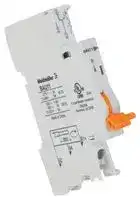


BAU11UC
BELL ALARM CONTACT MODULE, CKT BREAKER
- Manufacturer: WEIDMULLER
- Product type: Circuit Breaker Accessories
- For Use With: Weidmuller BR/SU Series Thermal Magnetic Miniature Circuit Breakers
- Accessory Type: Bell Alarm Contact Module
| Delivery and price | |
|---|---|
| Units per pack | 500 |
| Price | 35.84 € |
| Current stock | 10+ |
| Lead time | 7 days |

## **BR/SUxxxUC Series** UL 489 and UL 1077 – AC/DC Rated Miniature Circuit Breakers

**BR and SU Series** | Thermal Magnetic Miniature Circuit Breakers

## **Application Schematic**

**==> picture [534 x 585] intentionally omitted <==**

**----- Start of picture text -----**<br>
G L1 L2 L3<br>e e<br>Power Circuit<br>UL489<br>Boy BR2xxUC<br>UL489<br>BR3xxUC<br>Power Circuit<br>UL489 Power<br>BR2xxUC<br>Transformer<br>Control Circuit<br>Control Transformer<br>aE +<br>UL489<br>BR2xxUC<br>Power<br>Transformer<br>UL1077<br>SU1xxUC UL489<br>UL1077 BR1xxUC<br>SU2xxUC UL489<br>BR1xxUC<br>UL489<br>BR3xxUC<br>UL1077<br>SU1xxUC<br>UL489<br>BR1xxUC<br>M M<br>T | =a il l .<br>Outlet Fixed mounted<br>cabinet/panel heater<br>(resistive loads)<br>Sizing of main branch circuit protector according<br>to table 430.52 in NEC [®]<br>•  Dual Element (Time Delay) Fuse<br>Maximum fuse  = largest motor FLA x 175%<br>**----- End of picture text -----**<br>


      - + FLA of all other motors and general loads in group

- **Inverse Time Breaker**

   - Maximum circuit breaker

- = largest motor FLA x 250%

- + FLA of all other motors and general loads in group (for other fuse/breaker types see table 430.52)

**BR and SU Series** | Thermal Magnetic Miniature Circuit Breakers

## **UL 489 and UL 1077 DIN-Rail Miniature Circuit Breakers**

Weidmuller offers a complete line of thermal magnetic circuit breakers with its BRxxxUC product line engineered for either AC or DC branch circuit protection and the SUxxxUC product line designed for supplementary protection. These circuit breakers are proven solutions to protect your wires and cables from application or device malfunctions.

**Introduction** ......................................................................................................................................................... 2 Choose the Right Weidmuller BR/SUxxxUC Series Miniature Circuit Breaker  ...................... 2 Applications ............................................................................................................................................ 3 **BR and SU Series Product Overview** ........................................................................................................ 4 **UL 489 DIN-Rail Branch Circuit Breakers** ............................................................................................... 5 BRxxxUC Product Selection  ............................................................................................................... 6 **UL 1077 DIN-Rail Supplementary Circuit Breakers** ........................................................................... 7 SUxxxUC Product Selection . .............................................................................................................. 8 **Trip Curves** ........................................................................................................................................................... 9 **Accessories** .......................................................................................................................................................  11 Accessory Modules  ...........................................................................................................................  11 Auxiliary Contact  .........................................................................................................................  11 Bell Alarm Contact  ......................................................................................................................  12 Shunt Trip  ......................................................................................................................................  13 Accessory Modules Installation Diagram  .................................................................................... 14 Accessory Modules Mounting Instructions  ................................................................................ 15 Busbar and Busbar Accessories  ...................................................................................................... 16 Busbar UL 489 – Cuttable  ........................................................................................................ 16 Busbar UL 1077 – Cuttable  ...................................................................................................... 18 **Terms** ...................................................................................................................................................................  20 **Additional Technical Information** ........................................................................................................... 21 Operation and Components of BR/SUxxxUC MCBs  ................................................................. 21 Weidmuller UC Series Thermal Magnetic Definition  ................................................................ 22 Examples of Trip Curve Interpretation – Reading Trip Curves  ................................................ 23 Ambient Temperature Derating  ...................................................................................................... 24 UC Series D Curve Thermal Magnetic Tripping Characteristics vs K Curve  ........................ 25 **Additional Weidmuller Offerings** ........................................................................................................... 27 CB4200 Series Circuit Breakers  ..................................................................................................... 27

**1**

**BR and SU Series** | Thermal Magnetic Miniature Circuit Breakers

## **Introduction** Choose the Right Weidmuller BR/SUxxxUC Series Miniature Current Breaker (MCB) (Always refer to the NEC before installing any device.)

When considering the BR/SUxxxUC Series MCBs, always assess the application for the following: voltage rating, maximum interrupting capacity, continuous current rating, frequency, and atypical operating conditions (ambient temperature, moisture, vibration, altitude, installation or operation orientation, and field maintenance). The MCBs are intended to protect the circuit cables as well as motors, generators and transformers, thyristors and silicon rectifiers. They also provide additional protection of computers and their peripheral equipment, industrial process control systems, telecommunications equipment and power supplies.

## **Ask the following:**

- Is the application an AC or DC circuit? Good news here, BR/SUxxxUC MCBs are rated for both AC and DC.

- Is a branch or supplemental breaker needed for the application?

   - Branch devices may be used in place of supplemental but not vise versa.

- How many poles are needed for each circuit being protected? 3p – 3 phase no neutral, 2p – L1 and Neutral, 1p – L1 only.

- Calculate and/or measure the normal current for the circuit and follow NEC guidelines. Match the breaker amps based on the normal current load. Weidmuller’s BR/SUxxxUC run 1 to 63 amps (See Technical Data on page 4).

   - What are the functional requirements of the breaker? The BR/SUxxxUC are rail mountable, easy to visually inspect, switch manually (or remotely trip with shunt trip devices) and monitor using an auxiliary contact. Mechanically 20,000 cycles and electrically 6,000 cycles.

   - What is the wire size used? Can the breaker accept the wire sizes required? The BR/SUxxxUC are designed for ≤35mm².

   - What are the environmental factors: ambient temperature, moisture, vibration?

      - Check to determine if there are unusual conditions in which the breaker must operate. The BR/SUxxxUC are specified to IP20, -35°C ...70°C, and shock tested to IEC 60068-2-27.

- Determine potential failure mode(s). BR/SUxxxUC MCB thermal magnetic devices are designed for interrupt short-circuit and overload events.

- What is the interrupt capacity (IC)? Specify the breaker knowing the maximum fault current that can be repeatedly interrupted without failure of the breaker. BR/SUxxxUC MCBs have a maximum current at a given voltage that the breaker can interrupt safely without damage to surrounding components. (See Technical Data)

- What is the reaction time needed to a given fault condition? Specify a breaker by selecting a speed that avoids nuisance tripping but protects against component damage (B, C or D curve)

**2**

**BR and SU Series** | Thermal Magnetic Miniature Circuit Breakers

## **Applications**

- Automotive Manufacturing

- Chemical, Oil and Gas

- Renewable Energy

- Rail Vehicles

- Automation

- Pharmaceutical and Food

- Steel Production

- Telecom and Datacom

- Power-D-Box-Systems

- Lighting Equipment

- Process Control

**Pharmaceutical and Food**

**Automotive Manufacturing**

**Chemical, Oil and Gas**

**Rail Vehicles**

**3**

**BR and SU Series** | Thermal Magnetic Miniature Circuit Breakers

## **BR and SU Series**

## **Description**

1-, 2- and 3-pole thermal-magnetic miniature circuit breakers (MCBs) in accordance with EN 60947-2, UL 1077 and UL 489 for DIN-rail mounting, with toggle actuation, visual status indication and high rupture capacity. A positively trip-free snap action mechanism ensures reliable switching behavior. A range of trip characteristics and add-on modules allow a great variety of applications.

**BR Series UL 489 version**

## **Typical Applications**

- Protection of cables, motors, generators and transformers, thyristors and silicon rectifiers.

- Protection of computers and their peripheral equipment, industrial process control systems, telecommunications equipment, power supplies.

**SU Series IEC/EN60947-2 & UL 1077 version**

## **Technical Data**

|Degree of protection|IP20|
|---|---|
|Vibration (sinusoidal) test to<br>IEC 60068-2-6, test Fc|± 0.38 mm (10–57 Hz), 5 g (57–500 Hz)<br>10 frequency cycles per axis|
|Shock, test to<br>IEC 60068-2-27, test Ea<br>Corrosion, test to<br>IEC 60068-2-11, test Ka<br>Humidity, test to<br>IEC 60068-2-78, test Cab|30 g (11 ms)<br>96 hrs in 5% salt mist<br>48 hours at 95% RH, temperature +40°C|
|Terminals|screw terminals; Vertical connection|
||possible by means of busbars|
|Tightening torque|2 Nm max.|
|Cable cross section<br>Ambient temperature|≤35 mm²<br>-35°C...+70°C|
|Mounting|rail mounting|
|Mass|approx. 116 g per pole|
||(EN 60947-2/ UL 1077)<br>approx. 131 g per pole<br>(UL 489)|


|**Voltage rating and current rating range**|**Voltage rating and current rating range**|||Degree of protection|Degree of protection|Degree of protection|IP20|
|---|---|---|---|---|---|---|---|
|to IEC/EN 60947-2<br>1-pole: AC 240 V; 1 A…63 A;<br>2 and 3-pole: AC 415 V, 1 A…63 A||||Vibration (sinusoidal) test to<br>IEC 60068-2-6, test Fc|||± 0.38 mm (10–57 Hz), 5 g (57–500 Hz)<br>10 frequency cycles per axis|
|to UL 1077|1-pole: DC 80 V, 1 A...63 A<br>2-pole: (2 poles connected in series)<br>DC 125 V, 1...63 A<br>1-pole: AC 277 V; 1 A…63 A;<br>2 and 3-pole: AC 480Y/277 V, 1 A…63 A<br>1-pole: DC 60 V; 1 A...63 A|||Shock, test to<br>IEC 60068-2-27, test Ea<br>Corrosion, test to<br>IEC 60068-2-11, test Ka<br>Humidity, test to<br>IEC 60068-2-78, test Cab<br>Terminals|||30 g (11 ms)<br>96 hrs in 5% salt mist<br>48 hours at 95% RH, temperature +40°C<br>screw terminals; Vertical connection|
||2-pole (2 poles connected in series):||||||possible by means of busbars|
||DC 125 V; 1 A...63 A|||Tightening torque||Tightening torque|2 Nm max.|
|to UL 489|1-pole: AC 120 V; 1 A…63 A;<br>2 and 3-pole: AC 240 V, 1 A…63 A;<br>1-pole: AC 277 V; 1 A…32 A;<br>2 and 3-pole: AC 480Y/277 V; 1 A…32 A;|||Cable cross section<br>Ambient temperature<br>Mounting|||≤35 mm²<br>-35°C...+70°C<br>rail mounting|
||1-pole: DC 60 V; 1 A…63 A<br>2-pole (2 poles connected in series);<br>DC 125 V; 1 A…63 A|||Mass|||approx. 116 g per pole<br>(EN 60947-2/ UL 1077)<br>approx. 131 g per pole<br>(UL 489)|
|**Typical life**||||||||
|Mechanically|20,000 cycles|||||||
|Electrically|6,000 cycles|||**Approvals**||||
|**Interupt capacity**<br>to IEC/EN 60947-2 (Ics)<br>AC 7,500 A / DC 10,000 A||||**Approval**<br>**authority**||**Standard**|**Rated voltage**<br>**Current ratings**|
|to IEC/EN 60947-2 (Icu)<br>AC/DC 10,000 A||||TÜV||IEC/EN|AC 240/415 V<br>1...63 A|
|to UL 489|AC/DC 10,000 A|||||60947-2|DC 80 V<br>1...63 A (1-pole)|
||||||||DC 125 V<br>1...63 A|
|**to UL1077**|||||||(2 poles in series)|
|Number||||UL||UL 1077 /|AC 480Y/277 V<br>1...63 A|
|of poles|Un<br>In<br>TC<br>OL|SC||||CSA-C22.2|DC 60 V<br>1...63 A (1-pole)|
|1-pole<br>1-pole|AC 240 V<br>1...63 A<br>1<br>1<br>AC 277 V<br>1...63 A<br>1<br>0|7.5 kA, U1<br>5 kA, U1||||No. 235|DC 125 V<br>1...63 A<br>(2 poles in series)|
|2-, 3-pole|AC 480 V<br>1...63 A<br>1<br>1|5 kA, U1||UL||UL 489 /<br>CSA-C22.2|AC 240 V<br>AC 480Y/277 V<br>1...63 A<br>1...32 A|
|1-pole|DC 60 V<br>1...63 A<br>1<br>0|7.5 kA, U1||||No. 5|DC 60 V<br>1...63 A (1-pole)|
|2-pole in|DC 125 V<br>1...63 A<br>1<br>0|7.5 kA, U1|||||DC 125 V<br>1...63 A|
|series|||||||(2 poles in series)|
|Insulation coordination<br>6 kV/3 (reinforced insulation at operating area)||||||||


For information on Weidmuller’s UL Certifications, visit the UL Online Certifications Directory and search by the UL file numbers E359481, E362204 and E359964.

**4**

**BR and SU Series** | Thermal Magnetic Miniature Circuit Breakers

## **UL 489 DIN-Rail Branch Circuit Breakers BRxxxUC**

**==> picture [542 x 505] intentionally omitted <==**

**----- Start of picture text -----**<br>
BR Series Product Selection<br>Part Number Nomenclature<br>(Part Number found on the front of the breaker) BR 2 D 60 UC<br>AC/DC Rated<br>Rated Amps = 1, 1.2, 1.5, 1.6, 2, 3, 4, 5, 6, 7, 8, 10,<br>BR = Branch Rated Circuit Breakers 12, 13, 15, 16, 20, 25, 30, 32, 35, 40, 50, 60, 63<br>No. of Poles = 1, 2 or 3 Curve = B, C or D<br>__] | =<br>Schematic Diagrams Dimensions – UL 489 version<br>1-pole 2-pole 3-pole<br>1 1 3 1 3 5<br>fo ott FES =e<br>2 2 4 2 4 6<br>DC Application<br>When using the BR/SUxxxUC in DC applications, polarity does<br>9 ± 0.3<br>not have to be 1  obs PY erved.  Max O imum acce y pta ble voltage between  Hee<br>the conductors depends on the number of poles, circuitry and  3 P 52.9 ± 0.6 60.2 ± 0.3<br>relevant standard / approval. 2 P 35.3 ± 0.4 60.1 ± 0.3<br>1 P 17.6 ± 0.2<br>To UL 489:<br>Load Load<br>1 A 1 3 1 3 1 3 m -<br>2 2 4 2 4 2 4<br>60 V 0 V 125 V 0  V 125  V 0 V 60  V 0 V<br>(  ) 0 V 125 V (  ) (  )<br>5.5 ± 0.3<br>60 V<br>Load Load<br>116 ± 0.4 45 ± 0.3<br>Load<br>**----- End of picture text -----**<br>


All dimensions without tolerances are for reference only. Weidmuller reserves the right to change specifications at any time without notice in the interest of improved design, performance and cost effectiveness.

**5**

**BR and SU Series** | Thermal Magnetic Miniature Circuit Breakers

## **BR Series Product Selection**

## **x = B, C, or D Curve**

(See Curve Drawings on page 9 and 10)

**==> picture [542 x 378] intentionally omitted <==**

**----- Start of picture text -----**<br>
Amps 1 Pole 2 Pole 3 Pole<br>1 BR1x1UC MCB 489 1P  x  1A ACDC BR2x1UC MCB 489 2P  x  1A ACDC BR3x1UC MCB 489 3P  x  1A ACDC<br>1.2 BR1x1.2UC MCB 489 1P  x  1.2A ACDC  BR2x1.2UC MCB 489 2P  x  1.2A ACDC  BR3x1.2UC MCB 489 3P  x  1.2A ACDC<br>1.5 BR1x1.5UC MCB 489 1P  x  1.5A ACDC  BR2x1.5UC MCB 489 2P  x  1.5A ACDC  BR3x1.5UC MCB 489 3P  x  1.5A ACDC<br>1.6 BR1x1.6UC MCB 489 1P  x  1.6A ACDC  BR2x1.6UC MCB 489 2P  x  1.6A ACDC  BR3x1.6UC MCB 489 3P  x  1.6A ACDC<br>2 BR1x2UC MCB 489 1P  x  2A ACDC BR2x2UC MCB 489 2P  x  2A ACDC BR3x2UC MCB 489 3P  x  2A ACDC<br>3 BR1x3UC MCB 489 1P  x  3A ACDC BR2x3UC MCB 489 2P  x  3A ACDC BR3x3UC MCB 489 3P  x  3A ACDC<br>4 BR1x4UC MCB 489 1P  x  4A ACDC BR2x4UC MCB 489 2P  x  4A ACDC BR3x4UC MCB 489 3P  x  4A ACDC<br>5 BR1x5UC MCB 489 1P  x  5A ACDC BR2x5UC MCB 489 2P  x  5A ACDC BR3x5UC MCB 489 3P  x  5A ACDC<br>6 BR1x6UC MCB 489 1P  x  6A ACDC BR2x6UC MCB 489 2P  x  6A ACDC BR3x6UC MCB 489 3P  x  6A ACDC<br>7 BR1x7UC MCB 489 1P  x  7A ACDC BR2x7UC MCB 489 2P  x  7A ACDC BR3x7UC MCB 489 3P  x  7A ACDC<br>8 BR1x8UC MCB 489 1P  x  8A ACDC BR2x8UC MCB 489 2P  x  8A ACDC BR3x8UC MCB 489 3P  x  8A ACDC<br>10 BR1x10UC MCB 489 1P  x  10A ACDC BR2x10UC MCB 489 2P  x  10A ACDC BR3x10UC MCB 489 3P  x  10A ACDC<br>12 BR1x12UC MCB 489 1P  x  12A ACDC BR2x12UC MCB 489 2P  x  12A ACDC BR3x12UC MCB 489 3P  x  12A ACDC<br>13 BR1x13UC MCB 489 1P  x  13A ACDC BR2x13UC MCB 489 2P  x  13A ACDC BR3x13UC MCB 489 3P  x  13A ACDC<br>15 BR1x15UC MCB 489 1P  x  15A ACDC BR2x15UC MCB 489 2P  x  15A ACDC BR3x15UC MCB 489 3P  x  15A ACDC<br>16 BR1x16UC MCB 489 1P  x  16A ACDC BR2x16UC MCB 489 2P  x  16A ACDC BR3x16UC MCB 489 3P  x  16A ACDC<br>20 BR1x20UC MCB 489 1P  x  20A ACDC BR2x20UC MCB 489 2P  x  20A ACDC BR3x20UC MCB 489 3P  x  20A ACDC<br>25 BR1x25UC MCB 489 1P  x  25A ACDC BR2x25UC MCB 489 2P  x  25A ACDC BR3x25UC MCB 489 3P  x  25A ACDC<br>30 BR1x30UC MCB 489 1P  x  30A ACDC BR2x30UC MCB 489 2P  x  30A ACDC BR3x30UC MCB 489 3P  x  30A ACDC<br>32 BR1x32UC MCB 489 1P  x  32A ACDC BR2x32UC MCB 489 2P  x  32A ACDC BR3x32UC MCB 489 3P  x  32A ACDC<br>35 BR1x35UC MCB 489 1P  x  35A ACDC BR2x35UC MCB 489 2P  x  35A ACDC BR3x35UC MCB 489 3P  x  35A ACDC<br>40 BR1x40UC MCB 489 1P  x  40A ACDC BR2x40UC MCB 489 2P  x  40A ACDC BR3x40UC MCB 489 3P  x  40A ACDC<br>50 BR1x50UC MCB 489 1P  x  50A ACDC BR2x50UC MCB 489 2P  x  50A ACDC BR3x50UC MCB 489 3P  x  50A ACDC<br>60 BR1x60UC MCB 489 1P  x  60A ACDC BR2x60UC MCB 489 2P  x  60A ACDC BR3x60UC MCB 489 3P  x  60A ACDC<br>63 BR1x63UC MCB 489 1P  x  63A ACDC BR2x63UC MCB 489 2P  x  63A ACDC BR3x63UC MCB 489 3P  x  63A ACDC<br>**----- End of picture text -----**<br>


**6**

**BR and SU Series** | Thermal Magnetic Miniature Circuit Breakers

## **UL 1077 DIN-Rail Supplementary Circuit Breakers SUxxxUC**

**==> picture [541 x 275] intentionally omitted <==**

**----- Start of picture text -----**<br>
SU Series Product Selection<br>Part Number Nomenclature<br>(Part Number found on the front of the breaker)<br>SU 2 D 60 UC<br>AC/DC Rated<br>Rated Amps = 1, 1.2, 1.5, 1.6, 2, 3, 4, 5, 6, 7, 8, 10,<br>SU = Supplementary Protectors<br>12, 13, 15, 16, 20, 25, 30, 32, 35, 40, 50, 60, 63<br>No. of Poles = 1, 2 or 3 Curve = B, C or D<br>—J | | ——<br>Schematic Diagrams Dimensions – IEC/EN 60947-2 / UL1077 version<br>1-pole 2-pole 3-pole<br>1 1 3 1 3 5<br>i { { * f<br>Von RR<br>2 2 4 2 4 6<br>**----- End of picture text -----**<br>


## **DC Application**

When using the BR/SUxxxUC in DC applications, polarity does not have to be observed. Maximum acceptable voltage between the conductors depends on the number of poles, circuitry and relevant standard / approval.

**==> picture [214 x 199] intentionally omitted <==**

**----- Start of picture text -----**<br>
To IEC/EN 60947-2:<br>Load Load<br>1 1 3 1 3 1 3<br>Fl<br>2 2 4 2 4 2 4<br>80 V 0 V 125 V 0 V 125 V 0 V 80 V 0 V<br>(  ) 0 V 125 V (  ) (  )<br>To UL 1077:<br>Load Load<br>1 1 3 1 3 1 3<br>2 2 4 2 4 2 4<br>60 V 0 V 125 V 0 V 125 V 0 V 60 V 0 V<br>(  ) 0 V 125 V (  ) (  )<br>80 V<br>60 V<br>Load Load<br>Load<br>Load Load<br>Load<br>**----- End of picture text -----**<br>


**==> picture [216 x 159] intentionally omitted <==**

**----- Start of picture text -----**<br>
60.2 ± 0.3<br>9 ± 0.3<br>49.8 ± 0.3<br>3 P 52.9 ± 0.6<br>2 P 35.3 ± 0.4<br>1 P 17.6 ± 0.2<br>leis<br>5.5 ± 0.3<br>82 max. 45 ± 0.3<br>**----- End of picture text -----**<br>


All dimensions without tolerances are for reference only. Weidmuller reserves the right to change specifications at any time without notice in the interest of improved design, performance and cost effectiveness.

**7**

**BR and SU Series** | Thermal Magnetic Miniature Circuit Breakers

## **SU Series Product Selection**

## **x = B, C, or D Curve**

(See Curve Drawings on page 9 and 10)

**==> picture [542 x 378] intentionally omitted <==**

**----- Start of picture text -----**<br>
Amps 1 Pole 2 Pole 3 Pole<br>1 SU1x1UC MCB 1077 1P  x  1A ACDC SU2x1UC MCB 1077 2P  x  1A ACDC SU3x1UC MCB 1077 3P  x  1A ACDC<br>1.2 SU1x1.2UC MCB 1077 1P  x  1.2A ACDC  SU2x1.2UC MCB 1077 2P  x  1.2A ACDC  SU3x1.2UC MCB 1077 3P  x  1.2A ACDC<br>1.5 SU1x1.5UC MCB 1077 1P  x  1.5A ACDC  SU2x1.5UC MCB 1077 2P  x  1.5A ACDC  SU3x1.5UC MCB 1077 3P  x  1.5A ACDC<br>1.6 SU1x1.6UC MCB 1077 1P  x  1.6A ACDC  SU2x1.6UC MCB 1077 2P  x  1.6A ACDC  SU3x1.6UC MCB 1077 3P  x  1.6A ACDC<br>2 SU1x2UC MCB 1077 1P  x  2A ACDC SU2x2UC MCB 1077 2P  x  2A ACDC SU3x2UC MCB 1077 3P  x  2A ACDC<br>3 SU1x3UC MCB 1077 1P  x  3A ACDC SU2x3UC MCB 1077 2P  x  3A ACDC SU3x3UC MCB 1077 3P  x  3A ACDC<br>4 SU1x4UC MCB 1077 1P  x  4A ACDC SU2x4UC MCB 1077 2P  x  4A ACDC SU3x4UC MCB 1077 3P  x  4A ACDC<br>5 SU1x5UC MCB 1077 1P  x  5A ACDC SU2x5UC MCB 1077 2P  x  5A ACDC SU3x5UC MCB 1077 3P  x  5A ACDC<br>6 SU1x6UC MCB 1077 1P  x  6A ACDC SU2x6UC MCB 1077 2P  x  6A ACDC SU3x6UC MCB 1077 3P  x  6A ACDC<br>7 SU1x7UC MCB 1077 1P  x  7A ACDC SU2x7UC MCB 1077 2P  x  7A ACDC SU3x7UC MCB 1077 3P  x  7A ACDC<br>8 SU1x8UC MCB 1077 1P  x  8A ACDC SU2x8UC MCB 1077 2P  x  8A ACDC SU3x8UC MCB 1077 3P  x  8A ACDC<br>10 SU1x10UC MCB 1077 1P  x  10A ACDC SU2x10UC MCB 1077 2P  x  10A ACDC SU3x10UC MCB 1077 3P  x  10A ACDC<br>12 SU1x12UC MCB 1077 1P  x  12A ACDC SU2x12UC MCB 1077 2P  x  12A ACDC SU3x12UC MCB 1077 3P  x  12A ACDC<br>13 SU1x13UC MCB 1077 1P  x  13A ACDC SU2x13UC MCB 1077 2P  x  13A ACDC SU3x13UC MCB 1077 3P  x  13A ACDC<br>15 SU1x15UC MCB 1077 1P  x  15A ACDC SU2x15UC MCB 1077 2P  x  15A ACDC SU3x15UC MCB 1077 3P  x  15A ACDC<br>16 SU1x16UC MCB 1077 1P  x  16A ACDC SU2x16UC MCB 1077 2P  x  16A ACDC SU3x16UC MCB 1077 3P  x  16A ACDC<br>20 SU1x20UC MCB 1077 1P  x  20A ACDC SU2x20UC MCB 1077 2P  x  20A ACDC SU3x20UC MCB 1077 3P  x  20A ACDC<br>25 SU1x25UC MCB 1077 1P  x  25A ACDC SU2x25UC MCB 1077 2P  x  25A ACDC SU3x25UC MCB 1077 3P  x  25A ACDC<br>30 SU1x30UC MCB 1077 1P  x  30A ACDC SU2x30UC MCB 1077 2P  x  30A ACDC SU3x30UC MCB 1077 3P  x  30A ACDC<br>32 SU1x32UC MCB 1077 1P  x  32A ACDC SU2x32UC MCB 1077 2P  x  32A ACDC SU3x32UC MCB 1077 3P  x  32A ACDC<br>35 SU1x35UC MCB 1077 1P  x  35A ACDC SU2x35UC MCB 1077 2P  x  35A ACDC SU3x35UC MCB 1077 3P  x  35A ACDC<br>40 SU1x40UC MCB 1077 1P  x  40A ACDC SU2x40UC MCB 1077 2P  x  40A ACDC SU3x40UC MCB 1077 3P  x  40A ACDC<br>50 SU1x50UC MCB 1077 1P  x  50A ACDC SU2x50UC MCB 1077 2P  x  50A ACDC SU3x50UC MCB 1077 3P  x  50A ACDC<br>60 SU1x60UC MCB 1077 1P  x  60A ACDC SU2x60UC MCB 1077 2P  x  60A ACDC SU3x60UC MCB 1077 3P  x  60A ACDC<br>63 SU1x63UC MCB 1077 1P  x  63A ACDC SU2x63UC MCB 1077 2P  x  63A ACDC SU3x63UC MCB 1077 3P  x  63A ACDC<br>**----- End of picture text -----**<br>


**8**

**BR and SU Series** | Thermal Magnetic Miniature Circuit Breakers

## **Trip Curves**

## Trip Curves B, C, D – overcurrent protection of cables in accordance with IEC/EN 60898-1 and IEC 60947-2

## **Time/Current Characteristics**

**==> picture [186 x 280] intentionally omitted <==**

**----- Start of picture text -----**<br>
Curve B  / 1 ... 63 A<br>10000<br>1000<br>100<br>10<br>1<br>0,1<br>0,01<br>0,8 1 2 4 6 8 10 20 40<br>...times rated current<br>Magnetic tripping currents are increased by 30 % on DC supplies.<br>Ambient temperature 30 °C<br>Trip time in seconds<br>**----- End of picture text -----**<br>


## **Trip between 3-5X rated current (30-50 Amp for a 10 Amp device)**

Residential and light commercial applications such as:

- Resistive loads (low surge current)

- Low switching surge current

- Wire protection

- Lighting

- Appliances

**==> picture [188 x 282] intentionally omitted <==**

**----- Start of picture text -----**<br>
Curve C  / 1 ... 63 A<br>10000<br>1000<br>100<br>10<br>1<br>0,1<br>0,01<br>0,8 1 2 4 6 8 10 20 40<br>...times rated current<br>Magnetic tripping currents are increased by 30 % on DC supplies.<br>Ambient temperature 30 °C<br>Trip time in seconds<br>**----- End of picture text -----**<br>


## **Trip between 5-10X rated current (50-100 Amp for a 10 Amp device)**

Commercial applications such as:

- Inductive loads

- Motors (low inrush current)

- Control circuitry

- Lighting

- Appliances

**9**

**BR and SU Series** | Thermal Magnetic Miniature Circuit Breakers

**Curve D** / 1 ... 63 A

**==> picture [192 x 278] intentionally omitted <==**

**----- Start of picture text -----**<br>
10000<br>1000<br>100<br>10<br>1<br>0,1<br>0,01<br>0,8 1 2 4 6 8 10 20 40<br>...times rated current<br>Magnetic tripping currents are increased by 30 % on DC supplies.<br>Ambient temperature 30 °C<br>Trip time in seconds<br>**----- End of picture text -----**<br>


## **Trip between 10-20X rated current (100-200 Amp for a 10 Amp device)**

Industrial applications such as:

- High inductive and capacitive loads

- Motors (higher inrush current)

- Power supplies

- Transformers

- Heaters

- X-ray machines

- Reactive loads

**Current ratings and voltage drop at +25°C**

|**Voltage drop in V at 1 IN**|**Voltage drop in V at 1 IN**||||||
|---|---|---|---|---|---|---|
|IN(A)|1|1.2|1.5|1.6|2|3|
|V|1.50|1.50|0.80|0.80|0.80|0.60|
|IN(A)|4|5|6|7|8|10|
|V|0.60|0.20|0.20|0.20|0.15|0.15|
|IN(A)|12|13|15|16|20|25|
|V|0.15|0.10|0.10|0.10|0.08|0.08|
|IN(A)|30|32|35|40|50|60|
|V|0.07|0.07|0.07|0.07|0.06|0.06|
|IN(A)|63||||||
|V|0.06||||||


**Note:** When mounted side-by-side, the breakers can only carry up to 80% of their rated current or a higher rating has to be selected

**10**

**BR and SU Series** | Thermal Magnetic Miniature Circuit Breakers

## **Accessories**

## Accessory Modules

## **Auxiliary Contact**

## **Description**

Add-on module for circuit breaker type BR/SUxxxUC. The auxiliary switch has a change-over contact as signal contact and is operated with actuation of the MCB. The module has screw terminals and is rated for AC and DC voltages.

## **Typical Applications**

Status monitoring of MCB and/or the connected loads.

|**Description**||**Part Number**|
|---|---|---|
|MCB AUX Contact 1NC||**BAU10UC**|
||||
|**Technical Data**|||
|**Rated currents to IEC/EN 60947-5-1:**<br>Voltage<br>ratings:<br>AC 240 V<br>AC 415 V|DC 24 V|DC 48 V<br>DC 130 V|
|Current<br>ratings:<br>6 A<br>3 A|6 A|2 A<br>1 A|
|**Rated currents to UL 489:**|||
|Voltage<br>ratings:<br>AC 12<br>… 240 V<br>AC 277 V|DC 12<br>... 24 V|DC 48 V<br>DC 110<br>... 220 V|
|Current<br>ratings:<br>6 A<br>3 A<br>Typical life|6 A<br>3 A<br>1.5 A<br>20,000 cycles||
|Tightening torque|1 Nm max.||
|Ambient temperature<br>-35°C ...+70°C<br>Width<br>9 mm<br>Mass<br>approx. 29 g<br>**Approvals**<br>**Approval authority**<br>**Standard**<br>TÜV<br>IEC/EN 60947-5-1<br>UL<br>UL 489<br>~~OT~~<br>~~a~~<br>~~LS~~<br>~~FE~~<br>~~SE~~|||


## **Schematic Diagrams**

## **Note:**

**==> picture [36 x 63] intentionally omitted <==**

**----- Start of picture text -----**<br>
11<br>12 14<br>**----- End of picture text -----**<br>


As soon as the auxiliary contact module is mounted on the MCB, the terminals 11 and 14 are connected when the MCB is in ON condition. Terminals 11 and 12 are connected when the MCB is in OFF condition.

## **Dimensions (in millimeters)**

**==> picture [242 x 173] intentionally omitted <==**

**----- Start of picture text -----**<br>
66  ± 0.5<br>60.4  ± 0.5<br>} j= 9<br>_ oe<br>— 4<br>| ifs<br>a gen. ga MOI2 @«<br>Made in China. Richenand. VA 23236<br>SS. na<br>SSo|,,2 *& L—_—<br>85.8  ± 0.5 45  ± 0.5 81  ± 0.5<br>5.5  ± 0.5<br>**----- End of picture text -----**<br>


**11**

**BR and SU Series** | Thermal Magnetic Miniature Circuit Breakers

## **Bell Alarm Contact**

## **Description**

Add-on module for MCB type BR/SUxxxUC. The bell alarm contact has a change-over contact as signal contact. There will only be a signal when the MCB tripped on grounds of a failure (overload, short circuit), but and not when the MCB was switched on or off manually.

By actuating the reset lever on the front the tripping signal is acknowledged.

## **Typical Applications**

Status monitoring of MCB and/or the connected loads.

## **Mounting**

The add-on module is mounted on the left side of the MCB (seen from the front). For mounting, the MCB has to be in the OFF position.

|**Description**|||||**Part Number**|
|---|---|---|---|---|---|
|MCB Bell Alarm Contact 1NC/1NO|||||**BAU11UC**|
|**Technical Data**||||||
|**Rated currents to IEC/EN 60947-5-1:**||||||
|Voltage<br>ratings:<br>AC 240 V|AC 415 V||DC 24 V|DC 48 V|DC 130 V|
|Current<br>ratings:<br>6 A|3 A||6 A|2 A|1 A|
|**Rated currents to UL 489:**||||||
|Voltage<br>AC 12|AC 277 V||DC 12|DC 48 V|DC 110|
|ratings:<br>… 240 V|||... 24 V||... 220 V|
|Current<br>6 A|3 A||6 A|3 A|1.5 A|
|ratings:||||||
|Typical life||20,000 cycles||||
|Tightening torque<br>1 Nm max.<br>Ambient temperature<br>-35°C ...+70°C<br>Width<br>9 mm<br>~~ON~~<br>~~Oe~~||||||
|Mass<br>approx. 29 g<br>**Approvals**<br>**Approval authority**<br>**Standard**<br>~~OO~~<br>~~aCié<iS~~<br>~~oO~~||||||
|UL||||UL 489||


## **Schematic Diagrams**

## **Note:**

**==> picture [226 x 298] intentionally omitted <==**

**----- Start of picture text -----**<br>
91<br>As soon as the bell alarm contact module is<br>mounted on the MCB, the terminals 91 and<br>92 are connected when the MCB is in ON<br>condition; the terminals 91 and 94 are con-<br>nected when the MCB tripped electrically; the<br>94 92 terminals 91 and 92 are connected when the<br>MCB was tripped manually; at the same time<br>the terminals 91 and 94 do not have contact.<br>Dimensions (in millimeters)<br>66  ± 0.5<br>9<br>60.4  ± 0.5<br>pos BAU<br>i—_= ’ ‘le<br>|<br>= +.<br>ee 8 See<br>Ss & =<br>:<br>85.8  ± 0.5 45  ± 0.5 81  ± 0.5<br>5.5  ± 0.5<br>**----- End of picture text -----**<br>


## **Dimensions (in millimeters)**

**12**

**BR and SU Series** | Thermal Magnetic Miniature Circuit Breakers

## **Shunt Trip**

## **Description**

Add-on module for MCB type BR/SUxxxUC. The shunt trip module serves for remote trip of the MCB and for signalling whether the MCB was tripped electrically or manually.

## **Typical Applications**

Electrical remote trip of safety equipment with simultaneous monitoring of MCB status or its connected load.

## **Mounting**

The add-on module is mounted on the left side of the MCB (seen from the front). For mounting, the MCB has to be in the OFF position. When auxiliary contact module/bell alarm contact module and a shunt trip module are mounted at the same time, the shunt trip module always has to be mounted first.

|**Description**|**Part Number**|
|---|---|
|MCB SHUNT 1NC/1NO 12VDC<br>MCB SHUNT 1NC/1NO 24VDC|**BST12VDC**<br>**BST24VDC**|
|MCB SHUNT 1NC/1NO 48VDC|**BST48VDC**|
|MCB SHUNT 1NC/1NO 125VDC|**BST125VDC**|
|MCB SHUNT 1NC/1NO 120VAC|**BST120VAC**|
|MCB SHUNT 1NC/1NO 240VAC|**BST240VAC**|
|MCB SHUNT 1NC/1NO 277VAC|**BST277VAC**|


## **Schematic Diagrams**

**==> picture [85 x 60] intentionally omitted <==**

**----- Start of picture text -----**<br>
N / - L / +<br>C1 C2 11<br>FA<br>14 12<br>**----- End of picture text -----**<br>


## **Technical Data**

## **Dimensions (in millimeters)**

|Voltage ratings AC|AC 277 V|AC 240 V|AC 120 V||||||
|---|---|---|---|---|---|---|---|---|
|Min. trip voltage|AC 160 V|AC 160 V|AC 80 V||||66  ± 0.5||
|Power consumption|240 W|200 W|200 W||||60.1  ± 0.5||
|min. response power|35 W|35 W|35 W||||||
|Rated current of|3 A|6 A|6 A||||||
|auxiliary contact|||||||||
|Voltage ratings DC<br>DC 125 V<br>DC 48 V<br>DC 24 V<br>DC 12 V<br>Min. trip voltage<br>DC 80 V<br>DC 24 V<br>DC 16 V<br>DC 8 V<br>Power consumption<br>min. response power<br>200 W<br>30 VA<br>200 W<br>30 VA<br>200 W<br>30 VA<br>200 W<br>30 VA<br>Rated current of<br>auxiliary contact<br>1.5 A<br>2 A<br>6 A<br>6 A<br>Trip time<br>< 10 ms<br>Typical life<br>20,000 cycles<br>83  ± 0.5<br>~~——————————————_ ~~|<br>~~OO~~<br>~~—______1__— ~~||||||5.5  ± 0.5<br>ils<br>aL<br> ayn.||||
|Tightening torque<br>1 Nm max.<br>Ambient temperature<br>-35°C...+70°C<br>Width<br>18 mm<br>~~Oo~~<br>~~TT~~||||||=<br>HS<br>=|||
|Mass|approx. 60 g||||||||


**==> picture [229 x 116] intentionally omitted <==**

**----- Start of picture text -----**<br>
66  ± 0.5 18 max.<br>60.1  ± 0.5<br>ils<br>aL<br>83  ± 0.5 5.5  ± 0.5 45  ± 0.5 81  ± 0.5<br>**----- End of picture text -----**<br>


## **Approvals**

|**Approval authority**|**Approval authority**<br>**Standard**|
|---|---|
|UL|UL 489|


**13**

**BR and SU Series** | Thermal Magnetic Miniature Circuit Breakers

|**Accessories**||
|---|---|
|Accessory Modules Installation Diagram||
|**Shunt Trip**<br>**Bell Alarm**<br>**Bell Alarm**<br>**Auxiliary**<br>**Auxiliary**<br>**Auxiliary**<br>**Auxiliary**<br>**Auxiliary**<br>**Auxiliary**<br>**BR/SUxxxUC**<br>**Compatibility**<br>**Type**<br>**Part Number**<br>**Mount**<br>**Position***<br>**BRxxxUC**<br>Auxiliary Contact Module<br>**BAU10UC**<br>Left<br>X<br>Bell Alarm Contact Module<br>**BAU11UC**<br>Left<br>X<br>Shunt Trip Module<br>**BST12VDC**<br>Left<br>X<br>**BST24VDC**<br>Left<br>X<br>**BST48VDC**<br>Left<br>X<br>**BST125VDC**<br>Left<br>X<br>**BST120VAC**<br>Left<br>X<br>**BST240VAC**<br>Left<br>X<br>**BST277VAC**<br>Left<br>X<br>*Seen from the front<br>B~~E~~<br>~~—i~~<br>2|**SUxxxUC**<br>X<br>X<br>X<br>X<br>X<br>X<br>X<br>X<br>X|
|**Bell Alarm**<br>**Bell Alarm**||


**14**

**BR and SU Series** | Thermal Magnetic Miniature Circuit Breakers

## Mounting Instructions for the Accessory Modules

**==> picture [521 x 288] intentionally omitted <==**

**----- Start of picture text -----**<br>
C<br>A<br>B<br>F2<br>G2<br>@ E<br>F2<br>G1 G1<br>G2<br>D F1 F1<br>iat if ' 7 Z @® @®<br>Preparing the MCB to connect the Auxiliary Contact, Bell Alarm Contact or Shunt Trip Module<br>•  Use a small flat screwdriver to remove the clear plastic window (A) on the left side of the MCB (seen from the front). Do not<br>remove the clear plastic window on the right side.<br>**----- End of picture text -----**<br>


- Use the same screwdriver to remove the solid plastic cover (B) exposing the mechanical trip mechanism (C) beneath the window.

- For the BRxxxUCs only, slide the top and bottom fins forward and remove (D, E).

- For the BRxxxUCs, using small pliers remove the 2 plastic tabs on the fins (G1) and remove the 2 plugs from the breaker (F1) on the left side only.

   - For the SUxxxUCs, using small pliers remove the plugs from the breaker (F1).

   - G2 shows the plastic tabs removed and F2 shows the plugs removed.

- For the BRxxxUCs only, reattach the fins after installing the accessory module(s).

## **Accessory devices are left hand mounted only (seen from the front).**

## **Accessories for Branch and Supplementary Circuit Breakers**

## **Applies to BAU10UC, BAU11UC and BST:**

The accessory modules can be installed on the left side only (seen from the front).

## **Mounting**

1. Bring all orange levers of all devices into the “OFF” position

2. Insert guide pin into the lever handle notch (insertion depth approx. 7 mm)

3. Combine MCB and BAU10UC, BAU11UC or BST as outlined on page 14

4. Installation is complete when all snap together

**15**

**BR and SU Series** | Thermal Magnetic Miniature Circuit Breakers

## **Accessories**

## Busbar and Busbar Accessories

## **Busbars UL 489 – cuttable**

## **Description**

Busbars for the connection of circuit breakers type BRxxxUC to UL 489. The busbars of 1 meter length can individually be cut to a suitable length for the application and isolated with end caps. Depending on the control cabinet design, the supply is by means of supply terminals without increasing the installation width or by means of a terminal block directly on the rail without increasing the installation height.

Three busbar models are available for use with auxiliary contact modules with a width of 9 mm.

## **How to prepare the cuttable busbar**

**==> picture [254 x 80] intentionally omitted <==**

**----- Start of picture text -----**<br>
Lock-on, Lock-off Device<br>BR3C20UC<br>Protective Cap<br>Busbar<br>**----- End of picture text -----**<br>


1.  The busbar can be cut to individually required lengths for maximum flexibility

2.  After cutting, clean the cut face

**==> picture [228 x 42] intentionally omitted <==**

**----- Start of picture text -----**<br>
Bottom/Direct<br>Feeder Terminal<br>Endcap<br>Feeder Terminal<br>**----- End of picture text -----**<br>


3.  Attach an end cap for maximum finger safety

## **Technical Data**

|**Part Number**|**No. of Poles**|**No. of Devices**|**No. of Pins**<br>**Cross Section**|**Max. Amperage**|**Max. Voltage**<br>**Pitch**|
|---|---|---|---|---|---|
|BRBB157|1|57|57||1000 V AC/DC|
|BRBB256|2|28|56||600 V AC/DC|
|BRBB357|3|19|57||600 V AC/DC|
||||18 mm2|80 A|17.6 mm|
|BRBB137A*|1|37|37||1000 V AC/DC|
|BRBB246A**|2|23|46||600 V AC/DC|
|BRBB348A***|3|16|48||600 V AC/DC|


*,**,***See Ordering Data on page 17

|**Voltage Ratings**|**Single Phase**<br>**2 and 3 Phase**|**Single Phase**<br>**2 and 3 Phase**|
|---|---|---|
|Max. AC Voltage|1000 V AC|600 V AC|
|Max. DC Voltage|1000 V DC|600 V DC|
|Current Ratings|End Feed|Center Feed|
|Max. Current 18 mm2Cross Section|80 A|160 A†|
|Protection Class|IP20||
|kA Rating(J Fuse)|14kA||


†Note: Two 115 A Feeder Terminals required per phase

**16**

**BR and SU Series** | Thermal Magnetic Miniature Circuit Breakers

|**Ordering Data**<br>**No. of Poles**<br>**No. of**<br>**Devices**<br>**No. of**<br>**Pins**<br>**Description**<br>**Part Number**<br>1-Pole<br>12<br>12<br>MCB BUS BAR UL489<br>1 POLE 12 PIN<br>**BRBB112**<br>18<br>18<br>MCB BUS BAR UL489<br>1 POLE 18 PIN<br>**BRBB118**<br>57<br>57<br>MCB BUS BAR UL489<br>1 POLE 57 PIN<br>**BRBB157**<br>~~a~~|**Ordering Data**<br>**No. of Poles**<br>**No. of**<br>**Devices**<br>**No. of**<br>**Pins**<br>**Description**<br>**Part Number**<br>1-Pole<br>12<br>12<br>MCB BUS BAR UL489<br>1 POLE 12 PIN<br>**BRBB112**<br>18<br>18<br>MCB BUS BAR UL489<br>1 POLE 18 PIN<br>**BRBB118**<br>57<br>57<br>MCB BUS BAR UL489<br>1 POLE 57 PIN<br>**BRBB157**<br>~~a~~|**Ordering Data**<br>**No. of Poles**<br>**No. of**<br>**Devices**<br>**No. of**<br>**Pins**<br>**Description**<br>**Part Number**<br>1-Pole<br>12<br>12<br>MCB BUS BAR UL489<br>1 POLE 12 PIN<br>**BRBB112**<br>18<br>18<br>MCB BUS BAR UL489<br>1 POLE 18 PIN<br>**BRBB118**<br>57<br>57<br>MCB BUS BAR UL489<br>1 POLE 57 PIN<br>**BRBB157**<br>~~a~~|**Ordering Data**<br>**No. of Poles**<br>**No. of**<br>**Devices**<br>**No. of**<br>**Pins**<br>**Description**<br>**Part Number**<br>1-Pole<br>12<br>12<br>MCB BUS BAR UL489<br>1 POLE 12 PIN<br>**BRBB112**<br>18<br>18<br>MCB BUS BAR UL489<br>1 POLE 18 PIN<br>**BRBB118**<br>57<br>57<br>MCB BUS BAR UL489<br>1 POLE 57 PIN<br>**BRBB157**<br>~~a~~|**Ordering Data**<br>**No. of Poles**<br>**No. of**<br>**Devices**<br>**No. of**<br>**Pins**<br>**Description**<br>**Part Number**<br>1-Pole<br>12<br>12<br>MCB BUS BAR UL489<br>1 POLE 12 PIN<br>**BRBB112**<br>18<br>18<br>MCB BUS BAR UL489<br>1 POLE 18 PIN<br>**BRBB118**<br>57<br>57<br>MCB BUS BAR UL489<br>1 POLE 57 PIN<br>**BRBB157**<br>~~a~~|**Ordering Data**<br>**No. of Poles**<br>**No. of**<br>**Devices**<br>**No. of**<br>**Pins**<br>**Description**<br>**Part Number**<br>1-Pole<br>12<br>12<br>MCB BUS BAR UL489<br>1 POLE 12 PIN<br>**BRBB112**<br>18<br>18<br>MCB BUS BAR UL489<br>1 POLE 18 PIN<br>**BRBB118**<br>57<br>57<br>MCB BUS BAR UL489<br>1 POLE 57 PIN<br>**BRBB157**<br>~~a~~|al|
|---|---|---|---|---|---|---|
|2-Pole|6|12|MCB BUS BAR UL489|**BRBB212**|||
||||2 POLE 12 PIN||||
||9|18|MCB BUS BAR UL489|**BRBB218**|||
||||2 POLE 18 PIN||||
||28|56|MCB BUS BAR UL489|**BRBB256**|||
|3-Pole|4<br>6|12<br>18|2 POLE 56 PIN<br>MCB BUS BAR UL489<br>3 POLE 12 PIN<br>MCB BUS BAR UL489<br>3 POLE 18 PIN|**BRBB312**<br>**BRBB318**||nN|
||19|57|MCB BUS BAR UL489|**BRBB357**|||
||||3 POLE 57 PIN|||**Feeder Terminal**|
|*1-Pole with Auxiliary|37|37|MCB BUS BAR UL489|**BRBB137A**|||
|Module Spacing|||1 POLE 37 PIN AUX||||
|**2-Pole with Auxiliary|23|46|MCB BUS BAR UL489|**BRBB246A**|||
|Module Spacing|||2 POLE 46 PIN AUX||||
|***3-Pole with Auxiliary|***3-Pole with Auxiliary<br>16|48|MCB BUS BAR UL489|**BRBB348A**|||
|Module Spacing|||3 POLE 48 PIN AUX||||


**Bottom/Direct Feeder Terminal**

**Accessories for Busbars UL 489**

|**Description**<br>**Part Number**<br>Feeder Terminal, UL 489, 115 A<br>**BRBBPWR35**<br>**Description**<br>**Part Number**<br>~~——_~~|
|---|
|Bottom/Direct Feeder Terminal, UL 489, 115 A<br>**BRBBPWR50**|
|**Description**<br>**Part Number**<br>**Description**<br>**Part Number**<br>Endcap for UL 489 Cuttable Busbar<br>**BRBBECAP**<br>~~——~~|
|**Description**<br>**Part Number**<br>Lock-on, Lock-off Device<br>**LD10**<br>Protective Cap for UL 489 cuttable busbar, 3 caps per bar<br>**BRBBPCAP**<br>~~oe~~|


**Endcap**

**Protective Cap** —#*

**Lock-on, Lock-off Device**

**17**

**BR and SU Series** | Thermal Magnetic Miniature Circuit Breakers

## **Busbars UL 1077 – cuttable**

## **Description**

Busbars for the connection of circuit breakers type SUxxxUC to UL 1077. The busbars of 1 meter length can individually be cut to a suitable length for the application and isolated with end caps. Depending on the control cabinet design, the supply is by means of supply terminals without increasing the installation width or by means of a terminal block directly on the rail without increasing the installation height.

Three busbar models are available for use with auxiliary contact modules with a width of 9 mm.

## **How to prepare the cuttable busbar**

**==> picture [288 x 191] intentionally omitted <==**

**----- Start of picture text -----**<br>
Feeder Terminal<br>Protective Cap<br>Busbar<br>Endcap<br>Lock-on, Lock-off Device<br>SU3C20UC<br>Bottom/Direct<br>Feeder Terminal<br>**----- End of picture text -----**<br>


**==> picture [95 x 114] intentionally omitted <==**

**----- Start of picture text -----**<br>
1.  Use a saw to cut the busbar<br>to the desired length<br>2.  Slide the copper bars<br>from the insulation and<br>cut back the bars for proper<br>end clearances<br>**----- End of picture text -----**<br>


3.  Deburr the edges

4.  Use a stiff brush or compressed air to remove any copper or plastic filings and reassemble the busbar

## **Technical Data**

|**Technical Data**|||
|---|---|---|
|**Voltage Ratings**|**Single Phase**|**2 and 3 Phase**|
|Max. AC Voltage|1000 V AC|600 V AC|
|Max. DC Voltage|1000 V DC|600 V DC|
|Current Ratings<br>~~a~~|End Feed<br>~~a~~|Center Feed<br>~~a~~|
|Max. Current 18 mm2Cross Section|80 A|160 A†|
|Protection Class|IP20||
|kA Rating(J Fuse)|14kA||


5.  Attach endcaps Note: For safety purposes, all shortened busbars need to be covered with suitable endcaps

†Note: Two 115 A Feeder Terminals required per phase

**18**

**BR and SU Series** | Thermal Magnetic Miniature Circuit Breakers

**Endcap**

|**Ordering Data**<br>**No. of Poles**<br>**No. of**<br>**Devices**<br>**No. of**<br>**Pins**<br>**Description**<br>**Part**<br>**Number**<br>1-Pole<br>12<br>12<br>MCB BUS BAR UL1077<br>1 POLE 12 PIN<br>**SB112**<br>18<br>18<br>MCB BUS BAR UL1077<br>1 POLE 18 PIN<br>**SB118**<br>57<br>57<br>MCB BUS BAR UL1077<br>1 POLE 57 PIN<br>**SB157**<br>2-Pole<br>6<br>12<br>MCB BUS BAR UL1077<br>2 POLE 12 PIN<br>**SB212**<br>~~ee ~~|**Ordering Data**<br>**No. of Poles**<br>**No. of**<br>**Devices**<br>**No. of**<br>**Pins**<br>**Description**<br>**Part**<br>**Number**<br>1-Pole<br>12<br>12<br>MCB BUS BAR UL1077<br>1 POLE 12 PIN<br>**SB112**<br>18<br>18<br>MCB BUS BAR UL1077<br>1 POLE 18 PIN<br>**SB118**<br>57<br>57<br>MCB BUS BAR UL1077<br>1 POLE 57 PIN<br>**SB157**<br>2-Pole<br>6<br>12<br>MCB BUS BAR UL1077<br>2 POLE 12 PIN<br>**SB212**<br>~~ee ~~|**Ordering Data**<br>**No. of Poles**<br>**No. of**<br>**Devices**<br>**No. of**<br>**Pins**<br>**Description**<br>**Part**<br>**Number**<br>1-Pole<br>12<br>12<br>MCB BUS BAR UL1077<br>1 POLE 12 PIN<br>**SB112**<br>18<br>18<br>MCB BUS BAR UL1077<br>1 POLE 18 PIN<br>**SB118**<br>57<br>57<br>MCB BUS BAR UL1077<br>1 POLE 57 PIN<br>**SB157**<br>2-Pole<br>6<br>12<br>MCB BUS BAR UL1077<br>2 POLE 12 PIN<br>**SB212**<br>~~ee ~~|**Ordering Data**<br>**No. of Poles**<br>**No. of**<br>**Devices**<br>**No. of**<br>**Pins**<br>**Description**<br>**Part**<br>**Number**<br>1-Pole<br>12<br>12<br>MCB BUS BAR UL1077<br>1 POLE 12 PIN<br>**SB112**<br>18<br>18<br>MCB BUS BAR UL1077<br>1 POLE 18 PIN<br>**SB118**<br>57<br>57<br>MCB BUS BAR UL1077<br>1 POLE 57 PIN<br>**SB157**<br>2-Pole<br>6<br>12<br>MCB BUS BAR UL1077<br>2 POLE 12 PIN<br>**SB212**<br>~~ee ~~|**Ordering Data**<br>**No. of Poles**<br>**No. of**<br>**Devices**<br>**No. of**<br>**Pins**<br>**Description**<br>**Part**<br>**Number**<br>1-Pole<br>12<br>12<br>MCB BUS BAR UL1077<br>1 POLE 12 PIN<br>**SB112**<br>18<br>18<br>MCB BUS BAR UL1077<br>1 POLE 18 PIN<br>**SB118**<br>57<br>57<br>MCB BUS BAR UL1077<br>1 POLE 57 PIN<br>**SB157**<br>2-Pole<br>6<br>12<br>MCB BUS BAR UL1077<br>2 POLE 12 PIN<br>**SB212**<br>~~ee ~~|en|en|
|---|---|---|---|---|---|---|
||9|18|MCB BUS BAR UL1077|**SB218**|||
||||2 POLE 18 PIN||||
||28|56|MCB BUS BAR UL1077|**SB256**|||
||||2 POLE 56 PIN||||
|3-Pole<br>1-Pole with Auxiliary<br>Module Spacing|4<br>6<br>19<br>37|12<br>18<br>57<br>37|MCB BUS BAR UL1077<br>3 POLE 12 PIN<br>MCB BUS BAR UL1077<br>3 POLE 18 PIN<br>MCB BUS BAR UL1077<br>3 POLE 57 PIN<br>MCB BUS BAR UL1077<br>1 POLE 37 PIN AUX|**SB312**<br>**SB318**<br>**SB357**<br>**SB1A37**|**1P Top Feed**<br>DP|**2/3P Top Feed**<br> &|
|2-Pole with Auxiliary|23|46|MCB BUS BAR UL1077|**SB2A46**|**Terminal**|**Terminal**|
|Module Spacing|||2 POLE 46 PIN AUX||||
|3-Pole with Auxiliary|16|48|MCB BUS BAR UL1077|**SB3A48**|||
|Module Spacing|||3 POLE 48 PIN AUX||||


**==> picture [168 x 88] intentionally omitted <==**

**----- Start of picture text -----**<br>
DP 1P Top Feed  2/3P Top Feed  &<br>Terminal Terminal<br>**----- End of picture text -----**<br>


## **Top Feed Terminal**

|**Top Feed Terminal**||
|---|---|
|**Description**|**Part Number**|
|MCB BUS BAR UL1077 1P TERM TOP FEED|**SPF351P**|
|MCB BUS BAR UL1077 2/3P TERM TOP FEED|**SPF35**|


**Bottom/Direct Feeder Terminal**

**Bottom/Direct Feeder Terminal Description Part Number** MCB BUS BAR UL1077 1/2/3P TERM BOT FEED **SPF50** ~~SEE~~ **Endcap Description Part Number** MCB BUS BAR UL1077 1P END CAP **SEC1P** MCB BUS BAR UL1077 2/3P END CAP **SECMP** ~~ee~~

## **Protective Cap**

**Description Part Number** MCB BUS BAR UL1077 BUS CAP YEL (5 caps) **STPC Lock-on, Lock-off Device** ~~—___.~~ **Descriptionptiontion Part Number**

**Protective Cap**

™ **Lock-on, Lock-off Device**

**Descriptionptiontion Part Number** Lock-on, Lock-off Device **LD10**

**19**

**BR and SU Series** | Thermal Magnetic Miniature Circuit Breakers

## **Terms**

Weidmuller UC Series breakers are UL tested and certified as current limiting protective devices. Current limiting circuit breakers provide a higher level of circuit protection than a typical zero point external breakers.

## **Ampere Rating**

A rating of the amount of current a protective device will carry continuously without deteriorating or exceeding temperature rise limits.

## **Arc**

The effect generated when electrical current bridges the air gap between two conductors that are not touching.

## **Branch Circuit**

The conductor and components following the last over-current protective device protecting a load.

## **Circuit Breaker**

A device designed to open and close a circuit by non-automatic means, and to open the circuit automatically on a pre-determined overcurrent, without damage to itself when properly applied within its rating.

## **Current Limiting**

A type of supplementary protector which limits the amount of damaging short circuit current.

## **DIN-Rail**

A solidly mounted, rail-type device to which any number of circuit breakers can be mounted.

## **Double Pole**

Term used to describe a breaker that draws power from two poles of a load center or similar device.

## **Frame**

A component of a miniature circuit breaker. Its primary function is to provide a rigid, mechanically strong, insulated housing in which the other components are mounted.

## **IEC**

Abbreviation for International Electrotechnical Commission. This organization is associated with equipment used internationally.

## **IEC 60947-2 Current Limiting Circuit Breaker**

A circuit breaker with sufficiently short trip time to prevent the short circuit current from reaching the peak value which would otherwise be reached.

## **Interrupting Rating**

The highest current, at rated voltage, that a device is intended to interrupt under standard test conditions.

## **Let-through Current**

The maximum instantaneous or peak current which passes through a protective device.

## **Load Center**

A device that delivers electricity from a supply source to loads in light commercial or residential applications.

## **NEC**

Abbreviation for National Electrical Code. A standard for applying electrical equipment in the United States.

## **NEC240.2 Current Limiting**

A device that, when interrupting current in its current-limiting range, reduces the current flowing in the faulted circuit to a magnitude substantially less than that obtainable in the same circuit if the device were replaced with a solid conductor having comparable impedance.

## **Operating Mechanism**

A component of a miniature circuit breaker. Its function is to provide the means of opening and closing the circuit.

## **Overcurrent Protective Device**

A device such as a circuit breaker or fuse. In the event of an overload or short circuit, this device will quickly terminate power to the circuit.

## **Overload (or Overcurrent)**

A condition in which current is in excess of the normal load being drawn.

## **Short Circuit**

An electrical fault created when two exposed conductors touch.

## **Single Pole**

Term used to describe a breaker that draws power from one pole of a load center or similar device.

## **Supplementary Protector**

A device similar in function to a miniature circuit breaker, but not UL approved as a circuit breaker. Used in conjunction with circuit breakers.

## **Thermal Magnetic**

The predominant trip unit technology used in the domestic market. A bimetal and an electromagnet work together to provide overload and short circuit protection.

## **UL AC 60Hz Cycle**

UL defines an AC cycle as the potential energy of the wave form traveling from Zero-to-Positive amplitude, Positive-to-Zero amplitude, Zero-to-Negative amplitude, Negative-to-Zero amplitude 60 times in one second. One cycle is completed every 16.6 milliseconds.

## **UL Breaker Current Limiting**

UL defines breaker current limitation as a breaker that interrupts and isolates a fault in less than half of an AC cycle. Half a cycle is completed in 8.3 milliseconds **.**

## **Withstand Rating**

The maximum current that an unprotected electrical component can sustain for a specific period of time without the occurrence of extensive damage.

## **Miniature Circuit Breaker (MCB)**

A specific type of circuit breaker, used to switch and protect the lowest common distribution voltage in an electrical system. Generally used in a load center, panelboard or similar device.

**20**

**BR and SU Series** | Thermal Magnetic Miniature Circuit Breakers

## **Additional Technical Information**

## Operation and Components of BR/SUxxxUC MCBs

During normal operation and the MCB switch engaged, current flows in the line side terminal to a bimetallic strip, moving contact, fixed contact, current coil (magnetic trip coil) and out the load side terminal to complete a series path.

The MCB enclosure housing is a molded plastic material. This provides mechanical strength and insulation from the components inside. The switching system consists of a fixed and a moving contact plate to which incoming and outgoing conductors are connected. The current carrying components are made up of various metallic compounds depending on the rating of the circuit breaker.

The orange lever is used to manually engage/disengage the contact under normal ON/OFF conditions, as well as indicate status of the device. It also allows manual RESET of the latch after an overload or short circuit event.

The thermal overload configuration for the slow rising current over time consists of a strip of bimetal (two dissimilar metals). The rise in current causes a rise in temperature. The heat generated within the bimetal itself is enough to cause deflection due to thermal expansion of the dissimilar metals. This deflection further releases the trip latch mechanism and the contact faces separate.

The magnetic tripping configuration for short circuit conditions consists of a system that allow fast rise time current (too fast for the bimetal) to separate the contact faces using a spring loaded plunger. The current carrying coil in this trip configuration moves the plunger when a strong magnetic field produced by the coils releasing the plunger engaging the trip latch mechanism.

From the action of the fixed and moving contact faces separating in the event of an overload or short circuit situation, an electric arc in air is formed. The UC Series is designed to handle the arc interruption process where arc energy extraction and its cooling are provided by the arc runner and parallel arc splitter plates called the arc chute. These plates are held in position by the housing material. The operating mechanism consists of both magnetic tripping and thermal tripping arrangements.

**==> picture [497 x 223] intentionally omitted <==**

**----- Start of picture text -----**<br>
Lever<br>Manual Switch<br>Trip Latch<br>Magnetic Coil<br>e ae.<br>Fixed Contact<br>Plunger iE | J — =<br>- ir aN | Thermal Bimetal<br>Line Side Terminal<br>Load Side Terminal<br>Moving Contact<br>Arc Chute Arc Runner<br>**----- End of picture text -----**<br>


**21**

**BR and SU Series** | Thermal Magnetic Miniature Circuit Breakers

## Weidmuller UC Series Thermal Magnetic Definition

## **Thermal Overload**

A thermal overload is a slow and small overcurrent situation that causes the ampacity and temperature of the circuit to gradually increase. This type of event is characterized by a slight increase in the load (ampacity) on the circuit and is interrupted by the thermal trip unit of the breaker.

- **Thermal** Region of the trip curve representing the tripping characteristics of the bimetal trip unit. The tripping region is sloped due to the gradual overload, heating, and bending nature of the thermal element over time.

## **Short Circuit**

A short circuit is an intense overcurrent situation that causes the ampacity of the circuit to increase. This type of event is characterized by a dramatic increase in the load (ampacity) on the circuit and is interrupted by the magnetic trip unit of the breaker.

**Magnetic** Region of the trip curve representing the tripping characteristics of the magnetic trip unit. The tripping region is not sloped due to the instantaneous nature of the magnetic element during a short circuit.

MCBs’ tripping characteristics are represented graphically in a trip curve chart. The chart shows the response of the thermal and magnetic trip element to various overload and short circuit situations.

## **Time/Current Characteristics**

**==> picture [260 x 266] intentionally omitted <==**

**----- Start of picture text -----**<br>
10000<br>1000<br>100<br>10 Thermal<br>Area either event will trip CB<br>1<br>Magnetic<br>0.1<br>0.01<br>0.8 1 2 4 6 8 10 20 40<br>...times rated current<br>Trip time in seconds<br>**----- End of picture text -----**<br>


**22**

**BR and SU Series** | Thermal Magnetic Miniature Circuit Breakers

## Examples of Trip Curve Interpretation Reading Trip Curves

## _**Example 1: Thermal Tripping Characteristic**_

## **10 Amp B Curve Breaker**

## **Thermal Overload at 20 Amps**

To determine the time it takes for the breaker to trip with a 20 A load:

- Find 20 A on the bottom of the curve –10 A breaker at 2X current is 20 A

- Follow the ampacity line up to the “time” tripping region of the curve.

The breaker will trip under a thermal overload in the area between where 20 A intersects the bottom curve line and the intersection of the top curve. The breaker is guaranteed to trip in this time bandwidth.

## _**Example 2: Magnetic Tripping Characteristic**_

## **10 Amp B Curve Breaker**

## **Short Circuit at 70 Amps**

To determine the time it takes for the breaker to trip with a 70 A short circuit:

- Find 70 A on the bottom of the curve –10 A breaker at 7X current is 70 A

- Notice the “time” at the bottom left corner of the chart axis.

The breaker is guaranteed to trip no later than .01 seconds for any short circuit equal to 70 A.

**==> picture [197 x 253] intentionally omitted <==**

**----- Start of picture text -----**<br>
10000<br>1000<br>100<br>Time Bandwidth<br>10<br>1<br>0,1<br>0,01<br>0,8 1 2 4 6 8 10 20 40<br>...times rated current<br>Trip time in seconds<br>**----- End of picture text -----**<br>


**==> picture [173 x 253] intentionally omitted <==**

**----- Start of picture text -----**<br>
10000<br>1000<br>100<br>10<br>1<br>0,1<br>0,01<br>0,8 1 2 4 6 8 10 20 40<br>70 ...times rated current<br>Trip time in seconds<br>**----- End of picture text -----**<br>


**23**

**BR and SU Series** | Thermal Magnetic Miniature Circuit Breakers

## Ambient Temperature Derating

## **Maximum operating currents depending on ambient temperature**

**==> picture [542 x 27] intentionally omitted <==**

**----- Start of picture text -----**<br>
Rated current Max. operating currents depending on ambient temperature T (A)<br>IN (A) -35°C -30°C -25°C -20°C -15°C -10°C -5°C 0°C +5°C +10°C +15°C<br>**----- End of picture text -----**<br>


|**IN (A)**<br>|<br>**-35°C**<br>|<br>**-30°C**<br>|<br>**-25°C**<br>|<br>**-20°C**<br>|<br>**-15°C**<br>|<br>**-10°C**<br>|**-5°C**<br>|**0°C**<br>|**+5°C**<br>|**+10°C**<br>|**+15°C**<br>|
|---|---|---|---|---|---|---|---|---|---|---|---|
|1|1.27|1.25|1.23|1.21|1.19|1.17|1.15|1.13|1.10|1.08|1.06|
|2|2.87|2.81|2.74|2.68|2.62|2.55|2.48|2.42|2.35|2.28|2.20|
|3|3.89|3.83|3.76|3.70|3.64|3.57|3.50|3.44|3.37|3.30|3.22|
|4|4.91|4.83|4.76|4.70|4.64|4.57|4.50|4.44|4.37|4.30|4.22|
|5|6.68|6.56|6.44|6.32|6.19|6.07|5.94|5.81|5.68|5.54|5.40|
|6|7.70|7.58|7.46|7.34|7.21|7.09|6.96|6.83|6.70|6.56|6.42|
|7|8.78|8.66|8.54|8.42|8.29|8.17|8.04|7.91|7.78|7.64|7.50|
|8|9.80|9.68|9.56|9.44|9.31|9.19|9.06|8.93|9.80|8.66|8.52|
|10|13.89|13.62|13.35|13.07|12.81|12.53|12.23|11.93|11.63|11.33|11.01|
|12|15.91|15.64|15.37|15.09|14.83|14.55|14.25|13.95|13.65|13.35|13.03|
|13|16.92|16.65|16.38|16.10|15.84|15.56|15.26|14.96|14.66|14.36|14.04|
|15|19.77|19.42|19.07|18.74|18.39|18.04|17.69|17.32|16.95|16.57|16.19|
|16|20.78|20.43|20.08|19.75|19.40|19.05|18.70|18.33|17.96|17.58|17.20|
|20|25.67|25.28|24.88|24.47|24.06|23.64|23.22|22.78|22.34|21.89|21.43|
|25|32.21|31.72|31.22|30.70|30.18|29.65|29.10|28.55|27.98|27.41|26.82|
|30|39.00|38.42|37.78|37.13|36.47|35.80|35.11|34.43|33.71|32.99|32.26|
|32|41.04|40.46|39.82|39.17|38.51|37.84|37.15|36.47|35.75|35.03|34.30|
|35|44.08|43.50|42.86|42.21|41.55|40.88|40.19|39.51|38.79|38.07|37.34|
|40|51.63|50.86|50.04|49.21|48.37|47.51|46.63|45.74|44.83|43.90|42.95|
|50|64.92|63.97|62.92|61.86|60.77|59.67|58.54|57.40|56.23|55.05|53.81|
|60|80.45|79.03|77.61|76.16|74.69|73.19|71.67|70.11|68.51|66.88|65.21|
|63|83.48|82.06|80.71|79.19|77.72|76.22|74.70|73.14|71.54|69.91|68.24|


**==> picture [542 x 27] intentionally omitted <==**

**----- Start of picture text -----**<br>
Rated current Max. operating currents depending on ambient temperature T (A)<br>IN (A) +20°C +25°C +30°C +35°C +40°C +45°C +50°C +55°C +60°C +65°C +70°C<br>**----- End of picture text -----**<br>


|1|1.05|1.02|1.00|0.97|0.94|0.91|0.89|0.86|0.83|0.80|0.77|
|---|---|---|---|---|---|---|---|---|---|---|---|
|2|2.12|2.04|2.00|1.90|1.82|1.74|1.65|1.56|1.47|1.36|1.25|
|3|3.14|3.06|3.00|2.92|2.84|2.76|2.67|2.58|2.49|2.38|2.27|
|4|4.14|4.06|4.00|3.92|3.84|3.76|3.67|3.58|3.49|3.38|3.27|
|5|5.25|5.12|5.00|4.82|4.66|4.50|4.34|4.17|3.99|3.81|3.62|
|6|6.27|6.14|6.00|5.84|5.68|5.52|5.36|5.19|5.01|4.83|4.64|
|7|7.35|7.22|7.00|6.92|6.76|6.60|6.44|6.27|6.09|5.91|5.72|
|8|8.37|8.24|8.00|7.94|7.78|7.62|7.46|7.29|7.11|6.93|6.74|
|10|10.67|10.34|10.00|9.63|9.24|8.85|8.45|8.01|7.55|7.06|6.55|
|12|12.69|12.36|12.00|11.65|11.26|10.60|10.47|10.03|9.57|9.08|8.57|
|13|13.70|13.37|13.00|12.66|12.27|11.61|11.48|11.04|10.58|10.09|9.58|
|15|15.79|15.39|15.00|14.54|14.10|13.65|13.19|12.70|12.20|11.69|11.64|
|16|16.80|16.40|16.00|15.55|15.11|14.66|14.20|13.71|13.21|12.70|12.65|
|20|20.96|20.47|20.00|19.47|18.95|18.42|17.87|17.30|16.71|16.10|15.47|
|25|26.22|25.61|25.00|24.33|23.67|23.00|22.28|21.56|20.80|20.02|19.21|
|30|31.50|30.73|30.00|29.13|28.30|27.44|26.56|25.65|24.71|23.74|22.73|
|32|33.54|32.77|32.00|31.17|30.34|29.48|28.69|27.69|26.75|25.78|24.77|
|35|36.58|35.81|35.00|34.21|33.38|32.52|31.64|30.73|29.79|28.82|27.81|
|40|41.98|40.99|40.00|38.93|37.85|36.75|35.61|34.43|33.21|31.95|30.63|
|50|52.56|51.28|50.00|47.82|46.24|44.81|43.33|41.81|40.23|38.58|35.77|
|60|63.50|61.75|60.00|57.08|55.16|53.18|51.13|49.00|46.78|44.47|40.47|
|63|66.53|64.78|63.00|60.11|58.19|56.21|54.16|52.03|49.81|47.50|43.50|


**24**

**BR and SU Series** | Thermal Magnetic Miniature Circuit Breakers

## UC Series D Curve Thermal Magnetic Tripping Characteristics vs K Curve

The K and UC Series D curve breakers are both designed for motor applications where ampacity rises quickly and momentarily during “start-up”. Both curves can “ride through” the momentary inrush of current and prevent nuisance tripping while providing protection to the circuit.

Both curves have almost identical tripping characteristics. The magnetic element tripping characteristics are identical between the two curves and the thermal element tripping characteristics have a slight variation.

## **D Curve**

## _**Thermal Tripping Characteristics Comparison**_

- **Example: 10 Amp D Curve Breaker**

- **Thermal Overload at 20 Amps**

To determine the time it takes for the breaker to trip with a 20 A load:

- Find 20 A on the bottom of the curve –10 A breaker at 2X current is 20 A

- Follow the ampacity line up to the “time” tripping region of the curve.

The breaker will trip under a thermal overload in the area between where 20 A intersects the bottom curve line (~7.5s) and the intersection of the top curve (~150s). The breaker is guaranteed to trip in this time bandwidth.

**==> picture [190 x 244] intentionally omitted <==**

**----- Start of picture text -----**<br>
10000<br>eeee<br>ee<br>1000<br>HY= ——| EE |||<br>TAT Pe<br>COSye<br>100 enREE<br>Time Bandwidth<br>eeeee<br>10 WE INE INTE|<br>cS See<br>it} | | NE PING TE<br>1 Ht | | NG |<br>a a A NS |<br>0,1<br>Het |NE<br>a<br>————s..<br>A|<br>0,01 meNee<br>0,8 1 2 4 6 8 10 20 40<br>...times rated current<br>Trip time in seconds<br>**----- End of picture text -----**<br>


## **K Curve**

Similarly the K curve breaker will trip under a thermal overload between 6 and 350 seconds. The breaker is guaranteed to not trip before ~6 seconds and will not take longer than ~350 seconds to trip. The breaker may trip at any time in this time bandwidth.

**25**

**BR and SU Series** | Thermal Magnetic Miniature Circuit Breakers

## **D Curve**

## _**Short Circuit Tripping Characteristics Comparison**_

## **Example:**

## **10 Amp K Curve Breaker and UC Series 10 Amp D Curve Breaker**

## **Short Circuit at 100 Amps**

Both breakers have an element that will trip between 10 and 14 times rated current. Both breakers will trip under a short circuit before .01 seconds. And both breakers are guaranteed to trip no later than .01 seconds for any short circuit equal to 100 A or greater.

## _**K and UC Series D Curve Summary**_

## **Thermal Element Minimum Tripping**

The UC Series D curve MCB will interrupt an overload at 2X rated current in 7.5s or greater. The K curve MCB will interrupt an overload at 2X rated current in 6 seconds or greater. This additional time allows a circuit more time to “ride through” high inrush at start-up and prevent nuisance tripping.

**==> picture [183 x 267] intentionally omitted <==**

**----- Start of picture text -----**<br>
10000<br>0ee<br>1000<br>IME || TTT | |<br>Coo Ee<br>PTY Ty fT ET<br>100 UA |Ef|<br>ee ee<br>0<br>10 IS NG<br>ee ee<br>CoE SES oo<br>Hy | NING PT<br>1 (EEE NG<br>Co NET<br>a a ND |<br>0,1 it |||<br>fe<br>0,01 LNNee<br>0,8 1 2 4 6 8 10 20 40<br>...times rated current<br>Trip time in seconds<br>**----- End of picture text -----**<br>


## **K Curve**

## **Thermal Element Bandwidth**

The K curve tripping bandwidth at 2X rated current is between 6 and 350 seconds. The UC Series D curve tripping bandwidth at 2X rated current is between 7.5 and 150 seconds. The differences between the bandwidths demonstrate calibration and quality control accuracy. The UC Series D curve breaker from Weidmuller has a much smaller tolerance bandwidth and requires a higher level of adjustment during manufacturing and quality control validation.

## **Magnetic Element**

The magnetic element of the K curve and UC Series D curve MCBs are identical. Both breakers interrupt a short circuit at 10X the rated current (or greater) in no later than .01 seconds.

**26**

**BR and SU Series** | Thermal Magnetic Miniature Circuit Breakers

## **Additional Weidmuller Offerings**

## **CB4200 Series Circuit Breakers Thermal Magnetic Type**

- Rated from 0.05 to 16.0 amps

- Available in single or double pole configurations

- Features a tease free design to reduce contact damage

- Offers push button trip/reset function

- Trip free design means the breaker cannot be held closed against a fault

- Mounts on 32 mm[‡] or 35 mm DIN-rail

- UL 1077 recognized

- CSA C22.2 No. 235

## **Technical Data**

|Voltage rating|UL|AC 250 V, DC 65 V, 50/60 Hz||
|---|---|---|---|
|and current†||0.05…16 A||
||CSA|AC 250 V, DC 65 V, 50/60 Hz||
|||0.05…16 A||
||VDE|AC 250 V, DC 65 V, 50/60 Hz||
|||0.05…16 A||
|Creepage resistance<br>Dielectric strength<br>Insulation resistance<br>Interrupting capacity<br>(VDE 0660, Part 101, P-2)||PTI 600 to IEC 112<br>4,000 VAC;  IEC 664 & 664 A<br>> 100 MM  (DC 500 V)<br>4201-10<br>Maximum<br>capacity<br>0.05…0.8 A<br>Self-limiting<br>1…2 A<br>200 A<br>2.5…16 A<br>400 A<br>~~TEETER~~<br>~~a~~<br>~~a~~||
|Interrupting capacity<br>~~a~~|~~a~~|Rated<br>Rated<br>~~a~~|Maximum<br>~~a~~|
|4201 (UL 1077/EN 60934 PC1)|4201 (UL 1077/EN 60934 PC1)|current<br>voltage|capacity|
|||0.05…2.0 A<br>AC 250 V|200 A|
|||2.0…16 A<br>AC 250 V|200 A|
|||20 A<br>AC 125 V|400 A|
|Typical life at 2 x rated current<br>Shock||5,000 operations<br>25g (11 ms) to IEC 68-2-27, Test Ea||
|Torque<br>1.2 Nm<br>Vibration<br>5g (57 to 500 Hz / ±0.38 mm, 10 to 57 Hz) to IEC<br>68-2-6, Test Fc<br>Temperature range<br>-30°C…+55°C  (-22°F…+131°F)<br>Corrosion<br>96 hours at 5% salt spray, to IEC 68-2-11, Test Ka<br>~~Oo~~||||
|Humidity||240 hours at 95% RH, to IEC 68-2-3, Test Ca||
|Weight||60 g per pole||
|Wire size (UL)||#20…8 AWG | solid/0.5…6 mm2||


**Single Pole**

**Double Pole**

## **Trip Curves Thermal Magnetic Type Typical time/current characteristics at 23°C**

**==> picture [213 x 161] intentionally omitted <==**

**----- Start of picture text -----**<br>
M1+  0.05 to 7.5 A M1+  8 to 16 A<br>10,000 –30°C 10,000 –30°C<br>+23°C +23°C<br>1,000 | +55°C 1,000 | +55°C<br>100 i \. 100 I \<br>W\Y‘ \, \\ \\.<br>10 \eX 10<br>n<br>a\ XN ae<br>1 \ = \.\ 1 \XN\<br>v \ * \\<br>0.1 : \\ 0.1 \1 \\<br>0.01 \\. 0.01 \ \,<br>Q\X<br>0.001 0.001<br>0.8 1 2 3 4 6 8 10 20 30 50 70 100 0.8 1 2 3 4 6 8 10 20 30 50 70 100<br>… times rated current … times rated current<br>Trip time in seconds Trip time in seconds<br>**----- End of picture text -----**<br>


**==> picture [134 x 89] intentionally omitted <==**

**----- Start of picture text -----**<br>
‡Adapter foot – dimensions in mm (in.)<br>TT<br>—<br>=F __|<br>( y)<br>9102100000<br>TS32 adapter<br>20<br>(.787)<br>**----- End of picture text -----**<br>


†Note: Resistive and inductive loads (0.05 - 16 A)

**27**

**BR and SU Series** | Thermal Magnetic Miniature Circuit Breakers

## **Ordering Data**

|||||**Single Pole**||**Double Pole**|
|---|---|---|---|---|---|---|
|**Current Ratings**||||**Part No. TS 35**||**Part No. TS 35**|
||**(amps)**||**‡For TS 32 Rail, see adapter**|**For TS 32 Rail, see adapter**|**‡For TS 32 Rail, see adapter**|**For TS 32 Rail, see adapter**|
||0.05|||**9124083500**||**9124223500**|
|0.08<br>0.1<br>0.2<br>~~OO~~||||**9124653500**<br>**9104173500**<br>**9104183500**||**9124233500**<br>**9120353500**<br>**9124243500**|
||0.3|||**9129813500**||**9124263500**|
|0.4<br>0.5<br>~~ee~~<br>~~a~~||||**9124093500**<br>**9101003500**||**9124273500**<br>**9129583500**|
||0.6|||**9124113500**||**9124283500**|
|~~—_ pO]~~|~~YN\Nw\qwqx&q“xwx“uqoes_—~~|i i|~~qucx~~ ~~xc“x<qxxxyc~~ vr i<br>$< ~~owwq_wee-~~||~~_q_e#_iiqxixqxxwxr i~~<br>~~ow~~||
|~~Sn~~|0.7<br>~~Sn~~|~~Sn~~|~~Sn~~|**9129563500**<br>~~Sn~~|~~Sn~~|**9124293500**<br>~~Sn~~|
||0.8|||**9101103500**||**9129593500**|
||1.0|||**9101203500**||**9129613500**|
||1.2|||**9101303500**||**9129623500**|
||1.3|||**9124123500**||**9124313500**|
||1.4|||**9124133500**||**9124323500**|
||1.5|||**9101403500**||**9129633500**|
||1.8|||**9124143500**||**9124333500**|
||2.0|||**9101503500**||**9129643500**|
||2.5|||**9101603500**||**9129653500**|
||3.0|||**9101703500**||**9129663500**|
||3.5|||**9124163500**||**9124343500**|
||4.0|||**9104353500**||**9129713500**|
||4.5|||**9124173500**||**9124353500**|
|5.0<br>**9101803500**<br>**9129673500**<br>5.5<br>**9107833500**<br>**9124363500**<br>6.0<br>**9103813500**<br>**9124373500**<br>6.5<br>**9120043500**<br>**9124383500**<br>7.0<br>**9104153500**<br>**9124393500**<br>8.0<br>**9103003500**<br>**9104673500**<br>~~TT~~<br>~~AATA.T~~<br>~~TEETER~~|||||||
||9.0|||**9104613500**||**9124423500**|
||10.0|||**9101903500**||**9129683500**|
||11.0<br>12.0<br>13.0|||**9124183500**<br>**9107843500**<br>**9124193500**||**9124433500**<br>**9124443500**<br>**9124453500**|
||14.0|||**9107853500**||**9124463500**|
||15.0|||**9102003500**||**9129693500**|
|16.0<br>**9124213500**<br>**9124473500**<br>~~EEE~~|||||||
|**Accessories**<br>**Type**<br>**Part No.**<br>Jumpers<br>Daisy Chain 50*<br>BDC 50<br>**9970290000**<br>~~a~~<br>~~a~~|||||||
|||||CQB 2||**9970560000**|
|||||Straight CQB**<br>CQB 3||**9970570000**|
|||||insulated<br>CQB 4||**9970580000**|
|||||CQB 10||**9970590000**|
|||||CQB 2||**9970600000**|
|||||Angled CQB**<br>CQB 3||**9970610000**|
|||||insulated<br>CQB 4||**9970620000**|
|||||CQB 10||**9970630000**|
|Adapter foot (for TS 32 Rail)|Adapter foot (for TS 32 Rail)|||MCBAF/TS 32||**9102100000**|
|Busbar|||Single pole 1 meter|||**6720000227**|
|Busbar end cap for 6720000227||||||**6720000225**|
|Power lug for 6720000227||||||**6720000226**|
||||||||
|**Marking Tags**<br>Note: Part numbers are shown|||**Type**<br>Special print only<br>WS 8/5 MC|||**Part No.**<br>**1640750000*****|
|for a single card of pre-printed<br>tags numbered 1-50.|||Consecutive horizontal<br>DEK 5/5<br>Consecutive vertical<br>DEK 5/5|||**0473460001**<br>**0473560001**|


## **Single Pole**

**==> picture [56 x 8] intentionally omitted <==**

**----- Start of picture text -----**<br>
Dimensions<br>**----- End of picture text -----**<br>


**==> picture [42 x 6] intentionally omitted <==**

**----- Start of picture text -----**<br>
Dimensions in mm<br>**----- End of picture text -----**<br>


**==> picture [80 x 8] intentionally omitted <==**

**----- Start of picture text -----**<br>
Schematic Diagrams<br>**----- End of picture text -----**<br>


## **Double Pole**

## **Dimensions**

Dimensions in mm

**Schematic Diagrams**

*BDC will accommodate 20 A per pin, 20 A total

** CQB will accommodate 18 A per pin, 18 A total; dedicated to 4201 Series

- *** Please specify horizontal or vertical print when ordering. Standard quantity = 144 tags per card.

**28**

## **Weidmuller Catalogs at a Glance**

## **Catalog 1: Modular Terminal Blocks**

   - Stud Style (Screw clamp)

- P-Series (Push-in)

   - Z-Series (Tension clamp)

- I-Series (IDC)

   - W-Series (Screw clamp)

- Power Distribution Blocks and Fuse Blocks

- Multi-function Blocks

## **Catalog 6: Tools**

- Cutting

- Stripping

- Crimping

- Screwdrivers

- Automatic Machines

- Ferrules

## **Catalog 2: PCB Terminals and Connectors**

- Space Saving Technologies

- Wide Variety of Clamping Technologies

- Pitches Ranging from 3.50 mm to 15.00 mm

- Orientations Ranging from 90˚ to 270˚

## **Catalog 7: Marking Systems**

- Terminal Markers

- Wire and Cable Markers

- Device and Equipment Markers

- Printing Systems and Software

## **Catalog 3: RockStar[®] – Heavy Duty Connectors**

- Inserts

- Modular System

- Housings IP65 and IP68

- Cable Glands

## **Catalog 8: Sensor Actuator Interface**

- SAI Passive Blocks

- SAI Universal

- SAI ASI

- Cables and Connectors

## **Catalog 4.1: Analog Signal Conditioning**

- Intrinsically Safe Conditioners

- Signal Converters and Monitoring Devices

- Indicators and Configurable Displays

- Fieldbus Distribution Boxes

## **Catalog 9: Industrial Ethernet**

- Unmanaged Switches

- Managed Switches

- Routers

- Media Converters

- SteadyTEC[®]

- RJ45 Connectors

- Fiber Optic Connectors

- Accessories

## **Catalog 4.2: Relays and Optocouplers**

- Mechanical Relays

- Solid-State (Opto) Relays

- Power Solid-State Relays

- Multifunction Relays and Timers

## **Catalog 10: Short Form Catalog**

- Terminal Blocks

- Enclosures and Cable Glands

- Professional Tools

- Heavy Duty Connectors

- Power Supplies and Breakers

- Relays and Optos

- Analog Signal Conditioning

- Wireless and Ethernet

## **Catalog 4.3: Power Delivery**

- Power Supplies

- UPS Control Units

- Battery Back Up Units

## **Catalog 11: Circuit and Surge Protection**

- Surge Protection for Low Voltage

- Surge Protection for Instrumentation and Control

- Circuit Breakers and Protectors

- DIN-mountable AC Receptacles (DRAC)

## **Catalog 4.4: Surge Protection**

- Surge Protection for Low-Voltage

- Surge Protection for Instrumentation and Control

- Surge Protection for Data Interfaces

- Surge Protection for Photovoltaic Systems

## **Catalog 12: Wireless I/O and Ethernet Connectivity**

- Wireless I/O and Ethernet

- Wireless Gateways

- Wireless Transceivers

- Antennas and Accessories

## **Catalog 5: Enclosures and Cable Glands**

- Enclosures

- Cable Glands

- Cabtite (Cable Entry System)

## **Catalog u-remote: Distributed I/O Solutions**

- Field Bus Couplers

- Digital Input and Output Modules

   - Power Feed-in Modules

   - Temperature Modules

   - Functional Safety Modules

- Analog Input and Output Modules

## **Weidmuller – Your partner in Industrial Connectivity**

As experienced experts we support our customers and partners around the world with products, solutions and services in the industrial environment of power, signal and data. We are at home in their industries and markets and know the technological challenges of tomorrow. We are therefore continuously developing innovative, sustainable and useful solutions for their individual needs. Together we set standards in Industrial Connectivity.

Visit our BR/SUxxxUC Series Circuit Breakers website page for more information: **www.weidmuller.com/BRSUxxxUCSeries**

## **Weidmuller, Canada**

10 Spy Court Markham, Ontario L3R 5H6 Telephone: (800) 268-4080 Facsimile: (877) 300-5635 Email: info1@weidmuller.ca Website: www.weidmuller.ca

## **Weidmuller, Mexico**

Blvd. Hermanos Serdán 698, Col. San Rafael Oriente Puebla, Puebla, Mexico C.P. 72029 Telephone: 01 222 2686267 Facsimile: 01 222 2686219 Email: clientes@weidmuller.com.mx Website: www.weidmuller.com.mx

## **Weidmuller, United States**

821 Southlake Blvd. Richmond, Virginia 23236 Telephone: (800) 849-9343 Facsimile: (804) 379-2593 Email: info@weidmuller.com Website: www.weidmuller.com

**www.weidmuller.com**

08/17 • LIT1617E
Updated at February 9, 2023
Weidmüller is a leading international provider of advanced solutions for electrical connectivity, power transmission, and the conditioning of signals and data in industrial environments. Recognized globally for engineering excellence, the company develops innovative components designed to optimize automation, ensure reliable power distribution, and streamline complex control panel assemblies. Our extensive portfolio of Weidmüller components is strongly centered around their industry-leading connectivity solutions. We carry a vast selection of terminal blocks to suit any application, including pluggable terminal blocks, headers and sockets, wire-to-board solutions, and rugged DIN rail terminal blocks. To support complete and organized installations, we also provide a comprehensive range of standard and fused terminal blocks, power distribution blocks, interface modules, and essential accessories like terminal block markers. Beyond core connectivity, our offering includes critical Weidmüller components for system protection and control. We supply a robust selection of circuit breakers, featuring magnetic hydraulic, thermal, and electronic variants to safeguard sensitive equipment. Additionally, our inventory encompasses dependable power relays, solid-state relays, and AC/DC converters, equipping engineers with the high-quality parts needed to build secure, efficient, and fully integrated industrial automation systems.
About Novapart
Novapart is a B2B electronic component broker specialising in stock shortages and cost reduction. We source hard-to-find parts and identify compliant alternatives across a catalogue of 410,000+ components from 500+ manufacturers.
Learn more →Stock Shortage Specialist
When a component is unavailable, discontinued or has an unacceptable lead time, we tap into our network of vetted European and Asian distributors to source what you need — without compromising on quality or traceability.
Request a quote →Compliant Alternatives
We identify pin-to-pin, electrically equivalent substitutes that meet the same certifications (RoHS, AEC-Q100, REACH) as your original specification — validated against datasheets, not just part numbers. Often at a lower cost.
BOM Analysis service →