
Image not available
Illustrative purposes only

B82725A2202N001
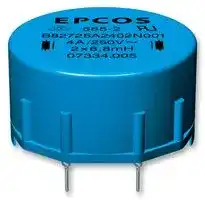
Choke, Power Line, Double, Ring Core, 18 mH, 2 A, B82725A Series
⚠️ Reference pricing provided. In case of supply shortages, we will connect you with our trusted procurement partners to ensure your project's continuity.
- Manufacturer: EPCOS
- Product type: Radial Leaded Common Mode Chokes / Filters
- Inductance: 18mH
- Product Range: B82725A Series
- DC Current Rating: 2A
| Delivery and price | |
|---|---|
| Units per pack | 25 |
| Price | 3.32 € |
| Current stock | 10+ |
| Lead time | 30 days |
Datasheet

## **Power line chokes** Current-compensated ring core double chokes 250 V AC, 1 … 16 A, 0.56 … 82 mH **Series/Type: B82725A** Date: July 2012 EPCOS AG 2012. Reproduction, publication and dissemination of this publication, enclosures hereto and the information contained therein without EPCOS’ prior express consent is prohibited. ## ~~ee~~ **Power line chokes B82725A Current-compensated ring core double chokes** **Rated voltage 250 V AC Rated current 1 ... 16 A Rated inductance 0.56 ... 82 mH** ## **Construction** - Current-compensated ring core double choke - Ferrite core wih epoxy coating (UL 94 V-0) - Polycarbonate case (UL 94 V-0) - Polyurethane potting (UL 94 V-0) - Sector winding ## **Features** - High resonance frequency due to special winding technique - Approx. 1% stray inductance for symmetrical interference suppression - Suitable for wave soldering - Design complies with EN 60938-2 (VDE 0565-2) and UL 1283 - UL[1) ] and/or ENEC (VDE) approvals AW Ko - RoHS-compatible ## **Applications** - Suppression of common-mode interferences - Switch-mode power applications - Electronic ballasts in lamps - Power inverters ## **Terminals** - Base material CuNi18Zn20 - Layer composition Ni, Sn - Hot-dipped - Pins 1 1 (mm) - Lead spacing 40 15 (mm) ## **Marking** - Manufacturer, approval signs and/or VDE standard number, ordering code, graphic symbol, rated current, rated voltage, rated inductance, date of manufacture (YYWWD.internal ID code) ## **Delivery mode** - Blister tray in cardboard box 1) UL approval with 300 V AC Please read _Cautions and warnings_ and _Important notes_ at the end of this document. **2** 07/12 ## ~~ee~~ **Power line chokes B82725A Current-compensated ring core double chokes** ## **Dimensional drawing and pin configuration** **==> picture [251 x 101] intentionally omitted <==** **----- Start of picture text -----**<br> 3.5 [_] 0.4<br>J<br>1 2 1 2<br>S E ) FN ae<br>4 3 4 3<br>fe 4+1 ) C 40±0.2 n<br>rl) 25 _0.5 44 max. IND0261-C<br>1.0 15±0.2<br>42.4 max.<br>**----- End of picture text -----**<br> Tolerances to ISO 2768-C unless otherwise noted. Dimensions in mm. ## **Technical data and measuring conditions** |Rated voltage VR|250 V AC (50/60 Hz)| |---|---| |Test voltage Vtest|1500 V AC, 2 s (line/line)| |Rated temperature TR|+40 °C / +45 °C / +55 °C / +60 °C/ +70 °C| |Rated current IR|Referred to 50 Hz and rated temperature| |Rated inductance LR|Measured with Agilent 4284A at 0.1 mA, +20 °C<br>Measuring frequency: LR 1 mH = 100 kHz<br>LR> 1 mH= 10 kHz<br>Inductance is specified per winding.| |Inductance tolerance|30% at +20 °C| |Inductance decreaseL/L0|< 10% at DC magnetic bias with IR, +20 °C| |Stray inductance Lstray,typ|Measured with Agilent 4284A at 5 mA, +20 °C, typical<br>values<br>Measuring frequency: LR 1 mH = 100 kHz<br>LR> 1 mH= 10 kHz| |DC resistance Rtyp|Measured at +20 °C, typical values, specified per winding| |Solderability (lead-free)|Sn96.5Ag3.0Cu0.5: +(2455) °C, (30.3) s<br>Wetting of soldering area95%<br>(to IEC 60068-2-20, test Ta)| |Resistance to soldering heat<br>(wave soldering)|+(2605) °C, (101) s<br>(to IEC 60068-2-20, test Tb)| |Climatic category|40/125/56 (to IEC 60068-1)| |Storage conditions (packaged)|–25 °C … +40 °C,75% RH| |Weight|Approx. 46g… 72g| |Approvals|EN 60938-2, UL 1283| Please read _Cautions and warnings_ and _Important notes_ at the end of this document. **3** |] 07/12 ## ~~ee~~ **Power line chokes B82725A Current-compensated ring core double chokes** ## **Characteristics and ordering codes** |IR<br>A|LR<br>mH|Lstray,typ<br>H|Rtyp<br>m|TR<br>°C|Ordering code|Approvals|Approvals| |---|---|---|---|---|---|---|---| |A<br>1<br>1.2<br>2<br>3.6<br>4<br>4<br>6<br>6.5<br>8<br>8<br>10<br>12<br>12<br>14<br>16|mH<br>68<br>82<br>18<br>27<br>14<br>6.8<br>3.9<br>4.1<br>3.9<br>2.7<br>1.8<br>3.3<br>1.0<br>1.2<br>0.56|H<br>850<br>800<br>220<br>210<br>100<br>75<br>40<br>40<br>35<br>25<br>20<br>16<br>14<br>12<br>6|m<br>1300<br>950<br>330<br>135<br>80<br>80<br>40<br>31<br>31<br>22<br>14<br>12<br>11<br>10<br>7|°C<br>+60<br>+60<br>+60<br>+60<br>+60<br>+60<br>+60<br>+70<br>+40<br>+60<br>+60<br>+60<br>+55<br>+45<br>+40|B82725A2102N001<br>B82725A2122N020<br>B82725A2202N001<br>B82725A2362N021<br>B82725A2402N020<br>B82725A2402N001<br>B82725A2602N001<br>B82725A2652N020<br>B82725A2802N020<br>B82725A2802N001<br>B82725A2103N001<br>B82725A2123N040<br>B82725A2123N001<br>B82725A2143N020<br>B82725A2163N020|<br><br><br><br><br><br><br><br><br><br><br><br><br><br>|<br><br><br><br><br><br><br><br><br><br><br><br><br><br>| = approval granted Please read _Cautions and warnings_ and _Important notes_ at the end of this document. **4** |] **4** 07/12 **Power line chokes Current-compensated ring core double chokes** **B82725A** **Impedance |Z| versus frequency f** measured with windings in parallel at +20 °C, typical values **Impedance |Z| versus frequency f** measured with windings in parallel at +20 °C, typical values **Current derating Iop/IR versus temperature TA** **5** 07/12 ## ~~ee~~ **Cautions and warnings Current-compensated ring core double chokes** - Please note the recommendations in our Inductors data book (latest edition) and in the data sheets. - Particular attention should be paid to the derating curves given there. Derating must be applied in case the ambient temperature in the application exceeds the rated temperature of the component. - Ensure the operation temperature (which is the sum of the ambient temperature and the temperature rise caused by losses / self-heating) of the component in the application does not exceed the maximum value specified in the climatic category. - The soldering conditions should also be observed. Temperatures quoted in relation to wave soldering refer to the pin, not the housing. - If the components are to be washed varnished it is necessary to check whether the washing varnish agent that is used has a negative effect on the wire insulation, any plastics that are used, or on glued joints. In particular, it is possible for washing varnish agent residues to have a negative effect in the long-term on wire insulation. - Washing processes may damage the product due to the possible static or cyclic mechanical loads (e.g. ultrasonic cleaning). They may cause cracks to develop on the product and its parts, which might lead to reduced reliability or lifetime. - The following points must be observed if the components are potted in customer applications: – Many potting materials shrink as they harden. They therefore exert a pressure on the plastic housing or core. This pressure can have a deleterious effect on electrical properties, and in extreme cases can damage the core or plastic housing mechanically. - It is necessary to check whether the potting material used attacks or destroys the wire insulation, plastics or glue. - The effect of the potting material can change the high-frequency behaviour of the components. - Ferrites are sensitive to direct impact. This can cause the core material to flake, or lead to breakage of the core. - Even for customer-specific products, conclusive validation of the component in the circuit can only be carried out by the customer. Please read _Cautions and warnings_ and _Important notes_ at the end of this document. **6** |] **6** 07/12 ## ~~ee~~ **Important notes Current-compensated ring core double chokes** The following applies to all products named in this publication: 1. Some parts of this publication contain **statements about the suitability of our products for certain areas of application** . These statements are based on our knowledge of typical requirements that are often placed on our products in the areas of application concerned. We nevertheless expressly point out **that such statements cannot be regarded as binding statements about the suitability of our products for a particular customer application.** As a rule, EPCOS is either unfamiliar with individual customer applications or less familiar with them than the customers themselves. For these reasons, it is always ultimately incumbent on the customer to check and decide whether an EPCOS product with the properties described in the product specification is suitable for use in a particular customer application. 2. We also point out that **in individual cases, a malfunction of electronic components or failure before the end of their usual service life cannot be completely ruled out in the current state of the art, even if they are operated as specified.** In customer applications requiring a very high level of operational safety and especially in customer applications in which the malfunction or failure of an electronic component could endanger human life or health (e.g. in accident prevention or life-saving systems), it must therefore be ensured by means of suitable design of the customer application or other action taken by the customer (e.g. installation of protective circuitry or redundancy) that no injury or damage is sustained by third parties in the event of malfunction or failure of an electronic component. 3. **The warnings, cautions and product-specific notes must be observed** . 4. In order to satisfy certain technical requirements, **some of the products described in this publication may contain substances subject to restrictions in certain jurisdictions (e.g. because they are classed as hazardous)** . Useful information on this will be found in our Material Data Sheets on the Internet (www.epcos.com/material). Should you have any more detailed questions, please contact our sales offices. 5. We constantly strive to improve our products. Consequently, **the products described in this publication may change from time to time** . The same is true of the corresponding product specifications. Please check therefore to what extent product descriptions and specifications contained in this publication are still applicable before or when you place an order. We also **reserve the right to discontinue production and delivery of products** . Consequently, we cannot guarantee that all products named in this publication will always be available. The aforementioned does not apply in the case of individual agreements deviating from the foregoing for customer-specific products. 6. Unless otherwise agreed in individual contracts, **all orders are subject to the current version of the “General Terms of Delivery for Products and Services in the Electrical Industry” published by the German Electrical and Electronics Industry Association (ZVEI)** . 7. The trade names EPCOS, BAOKE, Alu-X, CeraDiode, CeraLink, CSMP, CSSP, CTVS, DeltaCap, DigiSiMic, DSSP, FilterCap, FormFit, MiniBlue, MiniCell, MKD, MKK, MLSC, MotorCap, PCC, PhaseCap, PhaseCube, PhaseMod, PhiCap, SIFERRIT, SIFI, SIKOREL, SilverCap, SIMDAD, SiMic, SIMID, SineFormer, SIOV, SIP5D, SIP5K, ThermoFuse, WindCap are **trademarks registered or pending** in Europe and in other countries. Further information will be found on the Internet at www.epcos.com/trademarks. **7** |] **7** 07/12
Updated at February 9, 2023
About Novapart
Novapart is a B2B electronic component broker specialising in stock shortages and cost reduction. We source hard-to-find parts and identify compliant alternatives across a catalogue of 410,000+ components from 500+ manufacturers.
Learn more →Stock Shortage Specialist
When a component is unavailable, discontinued or has an unacceptable lead time, we tap into our network of vetted European and Asian distributors to source what you need — without compromising on quality or traceability.
Request a quote →Compliant Alternatives
We identify pin-to-pin, electrically equivalent substitutes that meet the same certifications (RoHS, AEC-Q100, REACH) as your original specification — validated against datasheets, not just part numbers. Often at a lower cost.
BOM Analysis service →