
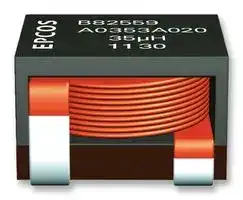
Image not available
Illustrative purposes only

B82559A5682A020
Power Inductor (SMD), 6.8 µH, Shielded, 19 A, ERU20 B82559 Series
⚠️ Reference pricing provided. In case of supply shortages, we will connect you with our trusted procurement partners to ensure your project's continuity.
- Manufacturer: EPCOS
- Product type: SMD Power Inductors
- Inductance:6.8µH; RMS Current (Irms):-; Inductor Construction:Shielded; Saturation Current (Isat):19A; Product Range:B82559 Series; Power Inductor Case:21.5mm x 21mm x 9.8mm; DC Resi
- SVHC: No SVHC (25-Jun-2025)
- Inductance: 6.8µH
- Product Range: ERU20 B82559 Series
- Product Width: 21mm
- Product Height: 9.8mm
- Product Length: 21.5mm
- DC Resistance Max: 2900µohm
- RMS Current (Irms): -
- Inductance Tolerance: ± 10%
- Inductor Construction: Shielded
- Saturation Current (Isat): 19A
| Delivery and price | |
|---|---|
| Units per pack | 260 |
| Price | 3.21 € |
| Current stock | 10+ |
| Lead time | 30 days |
Datasheet

## **ERU chokes**

## ERU 20, helically wound

**Series/Type: B82559*A020** Date: August 2018

�� EPCOS AG 2018. Reproduction, publication and dissemination of this publication, enclosures hereto and the information contained therein without EPCOS’ prior express consent is prohibited.

EPCOS AG is a TDK Group Company.

**ERU chokes B82559*A020** ~~|~~ **Helically wound ERU 20**

**Rated inductance 1.0 .... 35 µH Saturation current 9.3 ... 50 A**

## **Construction**

- High temperature ferrite core

- Magnetically shielded

- Helical winding

- Self-leaded construction

- Under body termination

- 3 pins for improved reliability

## **Features**

- High rated current

- Extremely low DC resistance

- Very low profile and extremely small footprint

- Suitable for pick-and-place processes

- RoHS-compatible

- Easily customized

- AEC-Q200 qualified

## **Applications**

Energy storage chokes for

- DC-DC converters

- VRM modules

- POL converters

- Solar converters

## **Terminals**

Lead-free tinned

## **Marking**

Manufacturer, ordering code, date of manufacture and production place (YYWWD/X),

## **Delivery mode and packing units**

- Blister tape

Please read _Cautions and warnings_ and _Important notes_ at the end of this document.

**2** 08/18 -

**B82559*A020 ERU 20**

## **ERU chokes Helically wound**

## **Dimensional drawing and layout recommendation**

**==> picture [281 x 266] intentionally omitted <==**

**==> picture [107 x 141] intentionally omitted <==**

**==> picture [94 x 9] intentionally omitted <==**

**----- Start of picture text -----**<br>
Dimensions in mm<br>**----- End of picture text -----**<br>


## **Circuit diagram**

**==> picture [46 x 86] intentionally omitted <==**

Please read _Cautions and warnings_ and _Important notes_ at the end of this document.

**3** 08/18

**B82559*A020 ERU 20**

**ERU chokes Helically wound**

## **Taping and packing Tape:**

**==> picture [440 x 230] intentionally omitted <==**

**==> picture [94 x 9] intentionally omitted <==**

**----- Start of picture text -----**<br>
Dimensions in mm<br>**----- End of picture text -----**<br>


## **Reel:**

**==> picture [189 x 133] intentionally omitted <==**

Dimensions in mm

|Height (mm)<br>component h<br>cavity H|Height (mm)<br>component h<br>cavity H|Packing unit<br>per reel|
|---|---|---|
|9.8|12.5|130|
|10.7|12.5|130|
|12.1|13.9|115|
|14.1|15.9|100|


Please read _Cautions and warnings_ and _Important notes_ at the end of this document.

**4** 08/18

|**B82559*A020**<br>**ERU chokes**|**B82559*A020**<br>**ERU chokes**|
|---|---|
|**ERU 20**<br>**Helically wound**||
|**Technical data and measuring conditions**||
|Rated inductance LR|Measured at 100 kHz, 0.1 V, +25 °C|
|Inductance tolerance|�10%|
|Saturation current ISat|Current that will result in an approximately 10% drop in<br>the inductance values at the specified temperature|
|DC resistance RDC|Measured at +25 °C|
|Self-resonant frequency|�2 MHz|
|High voltage: N1 - core|200 V DC, 1 s|
|Solderability<br>(test of wettability of the pins)|(245�5) °C, (3�0.3) s,<br>wetting of soldering area�95%<br>(based on IEC 60068-2-58, solder bath method)|
|Resistance to soldering heat|To JEDEC J-STD 020D (Tc: +245 °C on pin)|
|Operating temperature|�40 °C … +150 °C (component)|
|Storage conditions (packaged)|–25 °C … +40 °C,�75% RH|


## **Characteristics and ordering codes**

|LR<br>�H|Isat, 25°C<br>A|Isat, 100°C<br>A|RDC(max)<br>m�|RDC(typ)<br>m�|Height h<br>(nom.)<br>mm|Approx.<br>weight<br>g|Ordering code|
|---|---|---|---|---|---|---|---|
|1.0<br>1.5<br>2.2<br>3.3<br>4.7<br>6.8<br>10.0<br>15.0<br>20.0<br>29.0<br>35.0|50.0<br>50.0<br>43.0<br>34.0<br>22.0<br>19.0<br>18.3<br>15.3<br>14.3<br>11.0<br>9.3|45.0<br>43.0<br>38.0<br>29.0<br>19.0<br>16.5<br>16.0<br>13.5<br>12.0<br>9.5<br>7.5|0.65<br>0.90<br>1.20<br>1.50<br>2.40<br>2.90<br>3.90<br>4.95<br>6.40<br>7.10<br>7.10|0.55<br>0.80<br>1.00<br>1.30<br>2.15<br>2.70<br>3.70<br>4.65<br>5.70<br>6.65<br>6.65|9.8<br>10.7<br>12.1<br>14.1<br>9.8<br>9.8<br>10.7<br>12.1<br>14.1<br>14.1<br>14.1|15.7<br>17.6<br>19.8<br>22.5<br>15.7<br>16.3<br>18.1<br>19.7<br>22.5<br>23.9<br>23.9|B82559A2102A020<br>B82559A3152A020<br>B82559A4222A020<br>B82559A5332A020<br>B82559A4472A020<br>B82559A5682A020<br>B82559A7103A020<br>B82559A9153A020<br>B82559A0203A020<br>B82559A0293A020<br>B82559A0353A020|


Please read _Cautions and warnings_ and _Important notes_ at the end of this document.

**5** 08/18

**B82559*A020 ERU 20**

## **ERU chokes Helically wound**

## **Inductance L versus DC load current IDC**

The temperature rise � T is measured at an ambient temperature of +25 °C. A current is applied for 30 minutes and the temperature is measured via a thermocouple placed on top of the device. No forced air cooling is applied.

The inductance vs current curves are generated by measuring the inductors at +25 °C and +100 °C.

## B82559A3152A020

**==> picture [234 x 254] intentionally omitted <==**

## B82559A2102A020

## B82559A4222A020

**==> picture [485 x 255] intentionally omitted <==**

Please read _Cautions and warnings_ and _Important notes_ at the end of this document.

**6** 08/18

**B82559*A020 ERU 20**

## **ERU chokes**

## **Helically wound**

## B82559A5332A020

## B82559A5682A020

**==> picture [485 x 254] intentionally omitted <==**

## B82559A4472A020

**==> picture [232 x 254] intentionally omitted <==**

## B82559A7103A020

**==> picture [231 x 254] intentionally omitted <==**

Please read _Cautions and warnings_ and _Important notes_ at the end of this document.

**7** 08/18

**B82559*A020 ERU 20**

## **ERU chokes**

## **Helically wound**

## B82559A9153A020

**==> picture [235 x 254] intentionally omitted <==**

## B82559A0203A020

**==> picture [232 x 254] intentionally omitted <==**

## B82559A0293A020

**==> picture [231 x 254] intentionally omitted <==**

## B82559A0353A020

**==> picture [231 x 255] intentionally omitted <==**

Please read _Cautions and warnings_ and _Important notes_ at the end of this document.

**8** 08/18

## **Cautions and warnings**

**==> picture [490 x 37] intentionally omitted <==**

- Please note the recommendations in our Inductors data book (latest edition) and in the data sheets.

   - Particular attention should be paid to the derating curves given there.

   - The soldering conditions should also be observed. Temperatures quoted in relation to wave soldering refer to the pin, not the housing.

- If the components are to be washed varnished it is necessary to check whether the washing varnish agent that is used has a negative effect on the wire insulation, any plastics that are used, or on glued joints. In particular, it is possible for washing varnish agent residues to have a negative effect in the long-term on wire insulation.

   - Washing processes may damage the product due to the possible static or cyclic mechanical loads (e.g. ultrasonic cleaning). They may cause cracks to develop on the product and its parts, which might lead to reduced reliability or lifetime.

- The following points must be observed if the components are potted in customer applications: – Many potting materials shrink as they harden. They therefore exert a pressure on the plastic housing or core. This pressure can have a deleterious effect on electrical properties, and in extreme cases can damage the core or plastic housing mechanically.

   - It is necessary to check whether the potting material used attacks or destroys the wire insulation, plastics or glue.

   - The effect of the potting material can change the high-frequency behaviour of the components.

- Ferrites are sensitive to direct impact. This can cause the core material to flake, or lead to breakage of the core.

- Even for customer-specific products, conclusive validation of the component in the circuit can only be carried out by the customer.

## **Display of ordering codes for EPCOS products**

The ordering code for one and the same product can be represented differently in data sheets, data books, other publications and the website of EPCOS, or in order-related documents such as shipping notes, order confirmations and product labels. **The varying representations of the**

**ordering codes are due to different processes employed and do not affect the specifications of the respective products** . Detailed information can be found on the Internet under www.epcos.com/orderingcodes.

Please read _Cautions and warnings_ and _Important notes_ at the end of this document.

**9** 08/18

## **Important notes**

**==> picture [490 x 36] intentionally omitted <==**

The following applies to all products named in this publication:

1. Some parts of this publication contain **statements about the suitability of our products for certain areas of application** . These statements are based on our knowledge of typical requirements that are often placed on our products in the areas of application concerned. We nevertheless expressly point out **that such statements cannot be regarded as binding statements about the suitability of our products for a particular customer application.** As a rule, EPCOS is either unfamiliar with individual customer applications or less familiar with them than the customers themselves. For these reasons, it is always ultimately incumbent on the customer to check and decide whether an EPCOS product with the properties described in the product specification is suitable for use in a particular customer application.

2. We also point out that **in individual cases, a malfunction of electronic components or failure before the end of their usual service life cannot be completely ruled out in the current state of the art, even if they are operated as specified.** In customer applications requiring a very high level of operational safety and especially in customer applications in which the malfunction or failure of an electronic component could endanger human life or health (e.g. in accident prevention or life-saving systems), it must therefore be ensured by means of suitable design of the customer application or other action taken by the customer (e.g. installation of protective circuitry or redundancy) that no injury or damage is sustained by third parties in the event of malfunction or failure of an electronic component.

3. **The warnings, cautions and product-specific notes must be observed** .

4. In order to satisfy certain technical requirements, **some of the products described in this publication may contain substances subject to restrictions in certain jurisdictions (e.g. because they are classed as hazardous)** . Useful information on this will be found in our Material Data Sheets on the Internet (www.epcos.com/material). Should you have any more detailed questions, please contact our sales offices.

5. We constantly strive to improve our products. Consequently, **the products described in this publication may change from time to time** . The same is true of the corresponding product specifications. Please check therefore to what extent product descriptions and specifications contained in this publication are still applicable before or when you place an order.

We also **reserve the right to discontinue production and delivery of products** . Consequently, we cannot guarantee that all products named in this publication will always be available. The aforementioned does not apply in the case of individual agreements deviating from the foregoing for customer-specific products.

6. Unless otherwise agreed in individual contracts, **all orders are subject to the current version of the “General Terms of Delivery for Products and Services in the Electrical Industry” published by the German Electrical and Electronics Industry Association (ZVEI)** .

**10** 08/18

## **Important notes**

**==> picture [490 x 36] intentionally omitted <==**

7. **Our manufacturing sites serving the automotive business apply the IATF 16949 standard** . The IATF certifications confirm our compliance with requirements regarding the quality management system in the automotive industry. Referring to customer requirements and customer specific requirements (“CSR”) TDK always has and will continue to have the policy of respecting individual agreements. Even if IATF 16949 may appear to support the acceptance of unilateral requirements, we hereby like to emphasize that **only requirements mutually agreed upon can and will be implemented in our Quality Management System.** For clarification purposes we like to point out that obligations from IATF 16949 shall only become legally binding if individually agreed upon.

8. The trade names EPCOS, CeraCharge, CeraDiode, CeraLink, CeraPad, CeraPlas, CSMP, CTVS, DeltaCap, DigiSiMic, ExoCore, FilterCap, FormFit, LeaXield, MiniBlue, MiniCell, MKD, MKK, MotorCap, PCC, PhaseCap, PhaseCube, PhaseMod, PhiCap, PowerHap, PQSine, PQvar, SIFERRIT, SIFI, SIKOREL, SilverCap, SIMDAD, SiMic, SIMID, SineFormer, SIOV, ThermoFuse, WindCap are **trademarks registered or pending** in Europe and in other countries. Further information will be found on the Internet at www.epcos.com/trademarks.

Release 2018-06

**11** 08/18
Updated at March 28, 2026
About Novapart
Novapart is a B2B electronic component broker specialising in stock shortages and cost reduction. We source hard-to-find parts and identify compliant alternatives across a catalogue of 410,000+ components from 500+ manufacturers.
Learn more →Stock Shortage Specialist
When a component is unavailable, discontinued or has an unacceptable lead time, we tap into our network of vetted European and Asian distributors to source what you need — without compromising on quality or traceability.
Request a quote →Compliant Alternatives
We identify pin-to-pin, electrically equivalent substitutes that meet the same certifications (RoHS, AEC-Q100, REACH) as your original specification — validated against datasheets, not just part numbers. Often at a lower cost.
BOM Analysis service →