
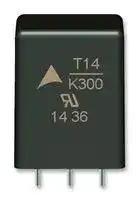
Image not available
Illustrative purposes only

B72214T2421K105
TVS Varistor, 420 V, 560 V, ThermoFuse T, 1.12 kV, SIP, Metal Oxide Varistor (MOV)
⚠️ Reference pricing provided. In case of supply shortages, we will connect you with our trusted procurement partners to ensure your project's continuity.
- Manufacturer: EPCOS
- Product type: TVS Varistors
- Product Range: ThermoFuse T
- Varistor Type: Metal Oxide Varistor (MOV)
- Voltage Rating VAC: 420V
- Voltage Rating VDC: 560V
- Varistor Case Style: SIP
- Clamping Voltage Vc Max: 1.12kV
- Peak Energy (10/1000uS): 136J
- Peak Surge Current @ 8/20µs: 6kA
| Delivery and price | |
|---|---|
| Units per pack | 9800 |
| Price | 0.719 € |
| Current stock | 10+ |
| Lead time | 30 days |
Datasheet

## **Housed Varistor** ## ThermoFuse Varistor **Series/Type: T14K130…420E2 Ordering code: B72214T2***K105** Date: 2013-01-019 Version: c EPCOS AG 2013. Reproduction, publication and dissemination of this publication, enclosures hereto and the information contained therein without EPCOS' prior express consent is prohibited. **B72214T2***K105 T14K130…420E2** **Housed Varistor ThermoFuse Varistor** ## **Applications** - Overvoltage protection with integrated thermal fuse - Suitable for use in industrial and household appliance applications ## **Features** - Three-leaded version for failure indication - UL approval to UL1449 3[rd] edition (File number E321126) - Approval pending to IEC61051 and VDE - High peak surge current rating of 6 kA at single 8/20us impulse - Meet thermal stability according to section 8.3.5.2 of IEC 61643-11 - Failure safe for abnormal over voltage (see “Reliability Data Electrical, Abnormal over voltage”) ## **Nomenclature** - T = EPCOS ThermoFuse varistor 14 = Rated disk diameter (mm) - K = Tolerance of VV at 1 mA: ±10% - *** = Max. AC voltage (see table on page 3) - E2 = Energy absorption characteristics, AdvanceD series ## **Dimensional drawing in mm** 2013-01-019 ZH FTZ PPD PD Please read _Cautions and warnings_ and _Important notes_ at the end of this document. Page 2 of 10 ~~LO~~ **Housed Varistor B72214T2***K105 ThermoFuse Varistor T14K130…420E2** ## **General technical data** |**General technical data**||| |---|---|---| |Climatic category|to IEC 60068-1|40 / 85 / 56| |Operating temperature|-40…+85 °C|-40…+85 °C| |Storage temperature||-40…+85 °C| |Electric strength|≥2.5 kV|≥2.5 kVRMS| |Insulation resistance|Insulation resistance<br>≥ 100 M|≥ 100 MΩ| |Response time||< 25 ns| ## **Electrical data** Maximum ratings (85 °C): |Max.<br>Max.<br>Surge<br>Nominal<br>Energy<br>Max.| |---| |Ordering code<br>Type<br>operating<br>AC voltage<br>VRMS<br>operating<br>DC<br>voltage<br>current<br>Imax<br>(8/20 µs)<br>discharge<br>current In1)<br>(8/20 µs)<br>absorption<br>(2 ms)<br>1 time<br>average<br>power<br>dissipation| |1 time<br>15 times<br>Pmax| |[V]<br>[V]<br>[A]<br>[A]<br>[J]<br>[W]| |B72214T2131K105<br>T14K130E2<br>130<br>170<br>6000<br>3000<br>50<br>0.6<br>~~a eG~~| |B72214T2151K105<br>T14K150E2<br>150<br>200<br>6000<br>3000<br>60<br>0.6<br>~~eG~~| |B72214T2171K105<br>T14K175E2<br>175<br>225<br>6000<br>3000<br>70<br>0.6<br>B72214T2231K105<br>T14K230E2<br>230<br>300<br>6000<br>3000<br>90<br>0.6<br>B72214T2251K105<br>T14K250E2<br>250<br>320<br>6000<br>3000<br>100<br>0.6<br>B72214T2271K105<br>T14K275E2<br>275<br>350<br>6000<br>3000<br>110<br>0.6<br>B72214T2301K105<br>T14K300E2<br>300<br>385<br>6000<br>3000<br>125<br>0.6<br>~~a GO~~<br>~~po~~<br>~~po~~<br>~~po~~<br>~~eG~~| |B72214T2321K105<br>T14K320E2<br>320<br>420<br>6000<br>3000<br>136<br>0.6<br>B72214T2351K105<br>T14K350E2<br>350<br>460<br>6000<br>3000<br>150<br>0.6<br>B72214T2381K105<br>T14K385E2<br>385<br>505<br>6000<br>3000<br>165<br>0.6<br>B72214T2421K105<br>T14K420E2<br>420<br>560<br>6000<br>3000<br>180<br>0.6<br>~~eG~~<br>~~eG~~<br>~~CO~~<br>~~po~~<br>~~GD~~| |Characteristics (25 °C):| |Varistor<br>Clamping voltage VC<br>Typ. capacitance Ctyp| |Ordering code<br>Type<br>voltage VV<br>at 1 mA<br>at 50 A<br>(8 / 20 µs)<br>at 1 kHz| |[V]<br>[V]<br>[ pF]| |B72214T2131K105<br>T14K130E2<br>205 ±10%<br>340<br>880<br>~~eG~~| |B72214T2151K105<br>T14K150E2<br>240 ±10%<br>395<br>750<br>~~GC~~| |B72214T2171K105<br>T14K175E2<br>270 ±10%<br>455<br>670<br>~~OD~~| |B72214T2231K105<br>T14K230E2<br>360 ±10%<br>595<br>530<br>~~OD~~| |B72214T2251K105<br>T14K250E2<br>390 ±10%<br>650<br>490<br>~~GO~~| |B72214T2271K105<br>T14K275E2<br>430 ±10%<br>710<br>440<br>~~pf~~| |B72214T2301K105<br>T14K300E2<br>470 ±10%<br>775<br>400<br>~~pf~~| |B72214T2321K105<br>T14K320E2<br>510 ±10%<br>840<br>370<br>~~GG~~| |B72214T2351K105<br>T14K350E2<br>560 ±10%<br>910<br>340<br>~~OO~~| |B72214T2381K105<br>T14K385E2<br>620 ±10%<br>1025<br>315<br>~~OO~~| |B72214T2421K105<br>T14K420E2<br>680 ±10%<br>1120<br>290<br>~~aGO~~| 1) Note: nominal discharge current is the specification defined in UL1449 3rd and tested with 8/20µs current waveform. 2013-01-019 ZH FTZ PPD PD Please read _Cautions and warnings_ and _Important notes_ at the end of this document. Page 3 of 10 **B72214T2***K105 T14K130…420E2** **Housed Varistor** **ThermoFuse Varistor** ## **v/i characteristic** ## **Derating curves** 2013-01-019 ZH FTZ PPD PD Please read _Cautions and warnings_ and _Important notes_ at the end of this document. Page 4 of 10 **B72214T2***K105 T14K130…420E2** **Housed Varistor** **ThermoFuse Varistor** ## **Typical application** The typical application below shows how the monitor lead on the device can be used to indicate that the thermal fuse has been opened. This denotes that the circuit will be no longer protected from surge currents by the MOV after the thermal fuse forms open circuit. ## **Typical wave soldering curve** Care must be taken when soldering the device into place because it contains a thermal fuse element. Two soldering methods are possible: (1) Manual soldering under max. 350℃ / 3s: it is recommended to heat-sink the leads of the device. (2) Wave soldering: it is very important that the temperatures of all preheat stages and the solder bath should be strictly controlled. 2013-01-019 ZH FTZ PPD PD Please read _Cautions and warnings_ and _Important notes_ at the end of this document. Page 5 of 10 **B72214T2***K105 T14K130…420E2** **Housed Varistor** **ThermoFuse Varistor** ## **Reliability Data Electrical** |**Characteristics**|**Test methods / Description**|**Specifications**| |---|---|---| |Varistor<br>voltage|The voltage between two terminals with the<br>specified measuring current applied is called Vv<br>(1 mADC@ 0.2 … 2 s).|To meet the<br>specified value.| |Clamping<br>voltage<br>~~|~~|The maximum voltage between two terminals<br>with the specified standard impulse current<br>(8/20 µs) illustrated below applied.<br>TSRise Time µs<br>TrDecay time to half value µs<br>O1Nominal start<br>ImPeak value<br>Peak<br>Trailing Edge<br>Leading<br>Edge<br>~~|~~|To meet the<br>specified value.<br>~~|~~| |Surge current<br>derating,<br>8/20 µs|10 surge currents (8/20 µs), unipolar, interval 30<br>s, amplitude corresponding to derating curve for<br>10 impulses at 20 µs||∆V/V (1 mA)|≤10%<br>(measured in<br>direction of surge<br>current)<br>No visible damage| |Surge current<br>derating,<br>2 ms|10 surge currents (2ms), unipolar, interval 120s,<br>amplitude corresponding to derating curve for 10<br>impulses at 2 ms||∆V/V (1 mA)|≤10%<br>(measured in<br>direction of surge<br>current)<br>No visible damage| 2013-01-019 ZH FTZ PPD PD Please read _Cautions and warnings_ and _Important notes_ at the end of this document. Page 6 of 10 **B72214T2***K105 T14K130…420E2** **Housed Varistor ThermoFuse Varistor** |**Characteristics**|**Test Methods/Description**|**Specifications**| |---|---|---| |Abnormal over<br>voltage|This device is designed to form open circuit in the event<br>of overheating due to the limited current abnormal over<br>voltage conditions as outlined in section 39.4 of UL1449<br>3rdedition.<br>The device (pin 1 & 3) is to be connected to a power<br>supply having an open circuit voltage equal to the test<br>voltage specified below. The power supply is to<br>incorporate a series variable resistor that can be<br>adjusted to obtain the short-circuit current (Isc). The<br>variable resistor is to be adjusted such that Iscequals<br>10A, 5A, 2.5A, 0.5A or 0.125A respectively (measured<br>without the device in the circuit). The device will be<br>energized for 7 hours, or until the device becomes<br>disconnected from the power supply, or until current to,<br>or temperature within the device attains equilibrium2).<br>The test result will be visually inspected.<br>Detailed test voltages applied onto the devices are as<br>below:<br>**Device rating**<br>**Test voltage **<br>**Type**<br>**( V ac)**<br>**( V ac)**<br>T14K130E2<br>130<br>260<br>T14K150E2<br>150<br>300<br>T14K175E2<br>175<br>350<br>T14K230E2<br>230<br>415<br>T14K250E2<br>250<br>500<br>T14K275E2<br>275<br>480<br>T14K300E2<br>300<br>600<br>T14K320E2<br>320<br>600<br>T14K350E2<br>350<br>600<br>T14K385E2<br>385<br>600<br>T14K420E2<br>420<br>600|Any of below<br>phenomena shall not be<br>observed, otherwise this<br>device will be judged as<br>failed part:<br>1. Emission of flame,<br>molten metal, glowing or<br>flaming particles through<br>any openings (pre-<br>existed or created as a<br>result of the test) in the<br>device.<br>2. Charring, glowing, or<br>flaming of the<br>supporting surface, or<br>cheesecloth draped on<br>the device.<br>3. Ignition of the<br>enclosure.<br>4. Creation of any<br>openings in the<br>enclosure that result in<br>accessibility of live<br>parts.| ## 2) Note: Thermal fuse may not form open circuit under low current [e.g. 0.125A] due to less heat generated by MOV, however the device will reach thermal equilibrium within 30 minutes under a low temperature which will not be able to cause any damage to the device. 2013-01-019 ZH FTZ PPD PD Please read _Cautions and warnings_ and _Important notes_ at the end of this document. Page 7 of 10 **Housed Varistor B72214T2***K105 ThermoFuse Varistor T14K130…420E2** ## **Cautions and warnings** ## **General** 1. EPCOS metal oxide varistors (SIOVs) are designed for specific applications and should not be used for purposes not identified in our specifications, application notes and data books unless otherwise agreed with EPCOS during the design-in-phase. 2. Ensure suitability of SIOVs through reliability testing during the design-in phase. The SIOVs should be evaluated taking into consideration worst-case conditions. 3. For applications of SIOVs in line-to ground circuits based on various international and local standards there are restrictions existing or additional safety measures required. ## **Storage** 1. Store SIOVs only in original packaging. Do not open the package before storage. 2. Storage conditions in original packaging: Storage temperature: -25 °C … +45 °C Relative humidity: <75% annual average, <95% on maximum 30 days a year. Dew precipitation: Is to be avoided. 3. Avoid contamination of SIOVs surface during storage, handling and processing. 4. Avoid storage of SIOVs in harmful environments which can affect the function during long-term operation (examples given under operation precautions). 5. The SIOV type series should be soldered within the time specified. SIOV-S, -Q, -LS 24 month T, ETFV and SFS types 12 month. ## **Handling** 1. SIOVs must not be dropped. 2. Components must not be touched with bare hands. Gloves are recommended. 3. Avoid contamination of the surface of SIOV electrodes during handling, be careful of the sharp edge of SIOV electrodes. 2013-01-019 ZH FTZ PPD PD Please read _Cautions and warnings_ and _Important notes_ at the end of this document. Page 8 of 10 |**Housed Varistor**|**B72214T2***K105**| |---|---| |**ThermoFuse Varistor**|**T14K130…420E2**| ## **Soldering (where applicable)** 1. Use rosin-type flux or non-activated flux. 2. Insufficient preheating may cause ceramic cracks. 3. Rapid cooling by dipping in solvent is not recommended. 4. Complete removal of flux is recommended. ## **Mounting** 1. Potting, sealing or adhesive compounds can produce chemical reactions in the SIOV ceramic that will degrade the component’s electrical characteristics. 2. Overloading SIOVs may result in ruptured packages and expulsion of hot materials. For this reason the SIOVs should be physically shielded from adjacent components. ## **Operation** 1. Use SIOVs only within the specified temperature operating range 2. Use SIOVs only within the specified voltage and current ranges. 3. Environmental conditions must not harm the SIOVs. Use SIOVs only in normal atmospheric conditions. Avoid use in the presence of deoxidizing gases (chlorine gas, hydrogen sulfide gas, ammonia gas, sulfuric acid gas, etc), corrosive agents, humid or salty conditions, Avoid contact with any liquids and solvents. 2013-01-019 ZH FTZ PPD PD Please read _Cautions and warnings_ and _Important notes_ at the end of this document. Page 9 of 10 ## **Important notes** The following applies to all products named in this publication: 1. Some parts of this publication contain **statements about the suitability of our products for certain areas of application** . These statements are based on our knowledge of typical requirements that are often placed on our products in the areas of application concerned. We nevertheless expressly point out **that such statements cannot be regarded as binding statements about the suitability of our products for a particular customer application.** As a rule, EPCOS is either unfamiliar with individual customer applications or less familiar with them than the customers themselves. For these reasons, it is always ultimately incumbent on the customer to check and decide whether an EPCOS product with the properties described in the product specification is suitable for use in a particular customer application. 2. We also point out that **in individual cases, a malfunction of electronic components or failure before the end of their usual service life cannot be completely ruled out in the current state of the art, even if they are operated as specified.** In customer applications requiring a very high level of operational safety and especially in customer applications in which the malfunction or failure of an electronic component could endanger human life or health (e.g. in accident prevention or life-saving systems), it must therefore be ensured by means of suitable design of the customer application or other action taken by the customer (e.g. installation of protective circuitry or redundancy) that no injury or damage is sustained by third parties in the event of malfunction or failure of an electronic component. 3. **The warnings, cautions and product-specific notes must be observed.** 4. In order to satisfy certain technical requirements, **some of the products described in this publication may contain substances subject to restrictions in certain jurisdictions (e.g. because they are classed as hazardous)** . Useful information on this will be found in our Material Data Sheets on the Internet (www.epcos.com/material). Should you have any more detailed questions, please contact our sales offices. 5. We constantly strive to improve our products. Consequently, **the products described in this publication may change from time to time** . The same is true of the corresponding product specifications. Please check therefore to what extent product descriptions and specifications contained in this publication are still applicable before or when you place an order. We also **reserve the right to discontinue production and delivery of products** . Consequently, we cannot guarantee that all products named in this publication will always be available. The aforementioned does not apply in the case of individual agreements deviating from the foregoing for customer-specific products. 6. Unless otherwise agreed in individual contracts, **all orders are subject to the current version of the “General Terms of Delivery for Products and Services in the Electrical Industry” published by the German Electrical and Electronics Industry Association (ZVEI)** . 7. The trade names EPCOS, BAOKE, Alu-X, CeraDiode, CeraLink, CSMP, CSSP, CTVS, DeltaCap, DigiSiMic, DSSP, FilterCap, FormFit, MiniBlue, MiniCell, MKD, MKK, MLSC, MotorCap, PCC, PhaseCap, PhaseCube, PhaseMod, PhiCap, SIFERRIT, SIFI, SIKOREL, SilverCap, SIMDAD, SiMic, SIMID, SineFormer, SIOV, SIP5D, SIP5K, ThermoFuse, WindCap are **trademarks registered or pending** in Europe and in other countries. Further information will be found on the Internet at www.epcos.com/trademarks. Page 10 of 10
Updated at February 9, 2023
About Novapart
Novapart is a B2B electronic component broker specialising in stock shortages and cost reduction. We source hard-to-find parts and identify compliant alternatives across a catalogue of 410,000+ components from 500+ manufacturers.
Learn more →Stock Shortage Specialist
When a component is unavailable, discontinued or has an unacceptable lead time, we tap into our network of vetted European and Asian distributors to source what you need — without compromising on quality or traceability.
Request a quote →Compliant Alternatives
We identify pin-to-pin, electrically equivalent substitutes that meet the same certifications (RoHS, AEC-Q100, REACH) as your original specification — validated against datasheets, not just part numbers. Often at a lower cost.
BOM Analysis service →