
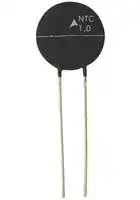
Image not available
Illustrative purposes only

B57153S150M
INRUSH CURRENT LIMITER
⚠️ Reference pricing provided. In case of supply shortages, we will connect you with our trusted procurement partners to ensure your project's continuity.
- Manufacturer: EPCOS
- Product type: Inrush Current Limiting (ICL) NTC Thermistors
- Approvals: UL
- Disc Size: 8.5mm
- Product Range: B57153S0 Series
- Zero Power Resistance at 25°C: 15ohm
- Maximum Steady State Current at 25°C: 1.8A
| Delivery and price | |
|---|---|
| Units per pack | 3000 |
| Price | 0.272 € |
| Current stock | 10+ |
| Lead time | 30 days |
Datasheet

## **NTC thermistors for inrush current limiting**

Leaded and coated disks

**Series/Type: B57153S0***M0**** Date: December 2011

© EPCOS AG 2011. Reproduction, publication and dissemination of this publication, enclosures hereto and the information contained therein without EPCOS' prior express consent is prohibited.

**B57153S0***M0** S153**

**Inrush current limiters**

**ICLs**

## **Applications**

Switch-mode power supplies

**==> picture [5 x 5] intentionally omitted <==**

## **Features**

- Useable in series connections up to 265 VRMS Coated thermistor disk

**==> picture [5 x 5] intentionally omitted <==**

**==> picture [5 x 5] intentionally omitted <==**

- Cost-effective NTC for low-power applications Kinked leads of tinned copper wire Small size UL approval (E69802)

**==> picture [5 x 5] intentionally omitted <==**

**==> picture [5 x 5] intentionally omitted <==**

**==> picture [5 x 5] intentionally omitted <==**

**==> picture [5 x 5] intentionally omitted <==**

## **Dimensional drawing**

**==> picture [42 x 79] intentionally omitted <==**

## **Options**

Resistance tolerance <20% and alternative lead configurations available on request

Dimensions in mm Approx. weight 0.6 g

## **Delivery mode**

Bulk (standard) or with cardboard tape on 350-mm reel

## **General technical data**

|Climatic category<br>(IEC 60068-1)<br>Max. power<br>(at 25°C)<br>Resistance tolerance<br>Rated temperature<br>Dissipation factor<br>(in air)<br>Thermal cooling time constant<br>(in air)<br>Heat capacity|Pmax<br><br>∆RR/RR<br><br>TR<br><br>δth<br> <br>τc<br> <br>Cth<br>|55/170/21<br>1.4<br>±20<br>25<br>approx. 8<br>approx. 30<br>approx. 240|W<br>%<br>°C<br>mW/K<br>s<br>mJ/K|
|---|---|---|---|


## **Electrical specification and ordering codes**

|R25<br>Ω|Imax<br>(0...65°C)<br>A|B25/100<br>K|Ctest1)<br>230 V AC<br>µF|Ctest1)<br>110 V AC<br>µF|Param.<br>for R(I)1)<br>k|Param.<br>for R(I)1)<br>n|Ordering code|
|---|---|---|---|---|---|---|---|
|4.7<br>8<br>10<br>15<br>16<br>20<br>33|3.0<br>2.2<br>2.0<br>1.8<br>1.7<br>1.6<br>1.3|2800<br>2800<br>2800<br>2900<br>2900<br>3000<br>3000|100<br>100<br>100<br>100<br>100<br>100<br>100|400<br>400<br>400<br>400<br>400<br>400<br>400|0.644<br>0.778<br>0.838<br>0.934<br>0.953<br>0.986<br>1.18|�1.30<br>�1.30<br>�1.30<br>�1.32<br>�1.32<br>�1.33<br>�1.33|B57153S0479M0**<br>B57153S0809M0**<br>B57153S0100M0**<br>B57153S0150M0**<br>B57153S0160M0**<br>B57153S0200M0**<br>B57153S0330M0**|


- ** = Delivery mode

   - 00 = Bulk

51 = Reel packing

1) For details on the capacitance Ctest as well as on the parameters k and n refer to "Application notes", chapters 1.6 and 1.7.

Please read _Cautions and warnings_ and _Important notes_ at the end of this document.

Page 2 of 14

|**Inrush current limiters**|**B57153S0***M0****|
|---|---|
|**ICLs**|**S153**|


## **Reliability data**

|Test|Standard|Test conditions|∆R25/R25<br>(typical)|Remarks|
|---|---|---|---|---|
|Storage in<br>dry heat|IEC<br>60068-2-2|Storage at upper<br>category temperature<br>T: 170°C<br>t: 1000 h|< 10%|No visible<br>damage|
|Storage in damp<br>heat, steady state|IEC<br>60068-2-78|Temperature of air: 40°C<br>Relative humidity of air: 93%<br>Duration: 21 days|< 5%|No visible<br>damage|
|Rapid temperature<br>cycling|IEC<br>60068-2-14|Lower test temperature:�55°C<br>Upper test temperature: 170°C<br>Number of cycles: 10|< 10%|No visible<br>damage|
|Endurance||I = Imax<br>t: 1000 h|< 10%|No visible<br>damage|
|Cyclic<br>endurance||I = Imax, 1000 cycles<br>On-time = 1 min<br>Coolingtime = 6 min|< 10%|No visible<br>damage|
|Transient<br>load||Capacitance = Ctest<br>Number of cycles: 1000|< 5%|No visible<br>damage|


## **Note**

**==> picture [5 x 5] intentionally omitted <==**

**==> picture [5 x 5] intentionally omitted <==**

**==> picture [5 x 5] intentionally omitted <==**

**==> picture [5 x 5] intentionally omitted <==**

- The self-heating of a thermistor during operation depends on the load applied and the applicable dissipation factor.

- When loaded with maximum allowable current/power and the specified dissipation factor is taken as a basis, the NTC thermistor may reach a mean temperature of up to 250 °C. The heat developed during operation will also be dissipated through the lead wires. So the contact areas, too, may become quite hot at maximum load.

- When mounting NTC thermistors you have to ensure that there is an adequate distance between the thermistor and all parts which are sensitive to heat or combustible.

Please read _Cautions and warnings_ and _Important notes_ at the end of this document.

Page 3 of 14

|**Inrush current limiters**|**B57153S0***M0****|
|---|---|
|**ICLs**|**S153**|


## **Taping and packing**

**1 Taping of radial leaded ICL NTC thermistors according to the specified lead spacing**

## **Dimensions and tolerances**

**Lead spacing F = 5.0 mm** (taping to IEC 60286-2)

**==> picture [313 x 121] intentionally omitted <==**

**Lead spacing F = 7.5 mm** (taping based on IEC 60286-2)

**==> picture [313 x 122] intentionally omitted <==**

Please read _Cautions and warnings_ and _Important notes_ at the end of this document.

Page 4 of 14

|**Inrush current limiters**|**B57153S0***M0****|
|---|---|
|**ICLs**|**S153**|


## **Dimensions (mm)**

||Lead<br>spacing<br>5 mm|Tolerance of<br>lead spacing<br>5 mm|Lead<br>spacing<br>7.5 mm|Tolerance of<br>lead spacing<br>7.5 mm|Remarks|
|---|---|---|---|---|---|
|w|≤12.0|max.|≥12.0|max.|please refer to dimensional<br>drawings|
|th|6.0|max.|7|max.|please refer to dimensional<br>drawings|
|d|0.5/0.6|±0.05|0.8/1.0|±0.05|please refer to dimensional<br>drawings|
|P0|12.7|±0.3|12.7|±0.3|±1 mm / 20 sprocket holes|
|P1|3.85|±0.7|8.95|±0.8||
|F|5.0|+0.6/�0.1|7.5|±0.8||
|∆h|0|±2.0|0|Depends on th|measured at top<br>of component body|
|∆p|0|±1.3|0|±2.0||
|W|18.0|±0.5|18.0|±0.5||
|W0|5.5|min.|11.0|min.|peel-off force≥5 N|
|W1|9.0|+0.75/�0.5|9.0|+0.75/�0.5||
|W2|3.0|max.|3.0|max.||
|H|18.0|+2.0/�0|18.0|+2.0/�0||
|H0|16.0|±0.5|16.0|±0.5||
|H1|32.2|max.|45.0|max.||
|D0|4.0|±0.2|4.0|±0.2||
|t|0.9|max.|0.9|max.|without wires|
|L|11.0|max.|11.0|max.||
|L1|4.0|max.|4.0|max.||


Please read _Cautions and warnings_ and _Important notes_ at the end of this document.

Page 5 of 14

|**Inrush current limiters**|**B57153S0***M0****|
|---|---|
|**ICLs**|**S153**|


## **Types of packing**

_Reel packing_

**==> picture [120 x 109] intentionally omitted <==**

**==> picture [107 x 101] intentionally omitted <==**

## **Reel dimensions (in mm)**

|Reel type|d|f|n|w|
|---|---|---|---|---|
|I|360 max.|31±1|approx. 45|54 max.|
|II|500 max.|23±1|approx. 59|72 max.|


## _Bulk packing_

The components are packed in cardboard boxes, the size of which depends on the order quantity.

Please read _Cautions and warnings_ and _Important notes_ at the end of this document.

Page 6 of 14

|**Inrush current limiters**|**B57153S0***M0****|
|---|---|
|**ICLs**|**S153**|


## **Mounting instructions**

## **1 Soldering**

## **1.1 Leaded NTC thermistors**

Leaded thermistors comply with the solderability requirements specified by CECC.

When soldering, care must be taken that the NTC thermistors are not damaged by excessive heat. The following maximum temperatures, maximum time spans and minimum distances have to be observed:

|to be observed:|||
|---|---|---|
||_Dip soldering_|_Iron soldering_|
|Bath temperature|max. 260°C|max. 360°C|
|Soldering time|max. 4 s|max. 2 s|
|Distance from thermistor|min. 6 mm|min. 6 mm|


Under more severe soldering conditions the resistance may change.

## **Solderability** (test to IEC 60068-2-20)

Preconditioning: Immersion into flux F-SW 32.

Evaluation criterion: Wetting of soldering areas ≥ 95%.

|Evaluation criterion: Wetting of soldering areas≥|95%.||
|---|---|---|
|Solder|Bath temperature(°C)|Dwell time(s)|
|SnAg (3.0 ... 4.0), Cu(0.5 ... 0.9)|245±3|3|


## **1.1.1 Resistance to soldering heat (test to IEC 60068-2-20)**

Preconditioning: Immersion into flux F-SW 32.

|Solder|Bath temperature(°C)|Dwell time(s)|
|---|---|---|
|SnAg (3.0 ... 4.0), Cu(0.5 ... 0.9)|260�5|10|


Please read _Cautions and warnings_ and _Important notes_ at the end of this document.

Page 7 of 14

|**Inrush current limiters**|**B57153S0***M0****|
|---|---|
|**ICLs**|**S153**|


## **Wave soldering**

Temperature characteristic at component terminal with dual wave soldering

**==> picture [301 x 158] intentionally omitted <==**

## **2 Robustness of terminations**

The leads meet the requirements of IEC 60068-2-21. They may not be bent closer than 4 mm from the solder joint on the thermistor body or from the point at which they leave the feedthroughs. During bending, any mechanical stress at the outlet of the leads must be removed. The bending radius should be at least 0.75 mm.

Tensile strength: Test Ua1: Leads 0.50 < ∅≤ 0.80 mm = 10.0 N 0.80 < ∅≤ 1.25 mm = 20.0 N

Bending strength: Test Ub:

Two 90 ° -bends in opposite directions at a weight of 0.25 kg.

Torsional strength: Test Uc: severity 2

The lead is bent by 90 ° at a distance of 6 to 6.5 mm from the thermistor body. The bending radius of the leads should be approx. 0.75 mm. Two torsions of 180 ° each (severity 2).

Please read _Cautions and warnings_ and _Important notes_ at the end of this document.

Page 8 of 14

|**Inrush current limiters**|**B57153S0***M0****|
|---|---|
|**ICLs**|**S153**|


When subjecting leads to mechanical stress, the following should be observed:

## _Tensile stress on leads_

During mounting and operation tensile forces on the leads are to be avoided.

## _Bending of leads_

Bending of the leads directly on the thermistor body is not permissible.

A lead may be bent at a minimum distance of twice the wire's diameter +2 mm from the solder joint on the thermistor body. During bending the wire must be mechanically relieved at its outlet. The bending radius should be at least 0.75 mm.

## _Twisting of leads_

The twisting (torsion) by 180 ° of a lead bent by 90 ° is permissible at 6 mm from the bottom of the thermistor body.

## **3 Sealing and potting**

When thermistors are sealed, potted or overmolded, there must be no mechanical stress caused by thermal expansion during the production process (curing / overmolding process) and during later operation. The upper category temperature of the thermistor must not be exceeded. Ensure that the materials used (sealing / potting compound and plastic material) are chemically neutral.

## **4 Cleaning**

If cleaning is necessary, mild cleaning agents such as ethyl alcohol and cleaning gasoline are recommended. Cleaning agents based on water are not allowed. Ultrasonic cleaning methods are permissible.

## **5 Storage**

In order to maintain their solderability, thermistors must be stored in a non-corrosive atmosphere. Humidity, temperature and container materials are critical factors.

The components should be left in the original packing. Touching the metallization of unsoldered thermistors may change their soldering properties.

Storage temperature: �25 ° C up to 45 ° C

Max. relative humidity (without condensation):

<95%, maximum 30 days per annum

Solder the thermistors listed in this data book after shipment from EPCOS within the time specified:

Leaded components: 24 months

Please read _Cautions and warnings_ and _Important notes_ at the end of this document.

Page 9 of 14

|**Inrush current limiters**|**B57153S0***M0****|
|---|---|
|**ICLs**|**S153**|


## **Cautions and warnings**

## **General**

See "Important notes" at the end of this document.

## **Storage**

**==> picture [5 x 5] intentionally omitted <==**

**==> picture [5 x 5] intentionally omitted <==**

**==> picture [5 x 5] intentionally omitted <==**

**==> picture [5 x 5] intentionally omitted <==**

**==> picture [5 x 5] intentionally omitted <==**

- Store thermistors only in original packaging. Do not open the package before storage. Storage conditions in original packaging: storage temperature � 25 °C ... +45 °C, relative humidity ≤75% annual mean, maximum 95%, dew precipitation is inadmissible. Avoid contamination of thermistors surface during storage, handling and processing. Avoid storage of thermistor in harmful environments like corrosive gases (SOx, Cl etc). Solder thermistors after shipment from EPCOS within the time specified:

- Leaded components: 24 months

## **Handling**

**==> picture [5 x 5] intentionally omitted <==**

**==> picture [5 x 5] intentionally omitted <==**

**==> picture [5 x 5] intentionally omitted <==**

**==> picture [5 x 5] intentionally omitted <==**

- NTC thermistors must not be dropped. Chip-offs must not be caused during handling of NTCs. Components must not be touched with bare hands. Gloves are recommended. Avoid contamination of thermistor surface during handling.

- In case of exposure of the NTC thermistors to water, electrolytes or other aggressive media, these media can penetrate the coating and reach the surface of the ceramic. Low-ohmic or high-ohmic behavior may occur due to the formation of an electrolyte with metals (silver/lead/tin from metallization or solder). Low-ohmic behavior is caused by electrochemical migration, high-ohmic behavior by dissolving of the electrode. Ineither case, the functionality of the NTC thermistors can not be assured.

## **Bending / twisting leads**

**==> picture [5 x 5] intentionally omitted <==**

**==> picture [5 x 5] intentionally omitted <==**

- A lead (wire) may be bent at a minimum distance of twice the wire’s diameter plus 4 mm from the component head or housing. When bending ensure the wire is mechanically relieved at the component head or housing. The bending radius should be at least 0.75 mm. Twisting (torsion) by 180 ° of a lead bent by 90 ° is permissible at 6 mm from the bottom of the thermistor body.

## **Soldering**

**==> picture [5 x 5] intentionally omitted <==**

**==> picture [5 x 5] intentionally omitted <==**

**==> picture [5 x 5] intentionally omitted <==**

**==> picture [5 x 5] intentionally omitted <==**

Use resin-type flux or non-activated flux.

- Insufficient preheating may cause ceramic cracks.

- Rapid cooling by dipping in solvent is not recommended. Complete removal of flux is recommended.

Please read _Cautions and warnings_ and _Important notes_ at the end of this document.

Page 10 of 14

|**Inrush current limiters**|**B57153S0***M0****|
|---|---|
|**ICLs**|**S153**|


## **Mounting**

**==> picture [5 x 5] intentionally omitted <==**

**==> picture [5 x 5] intentionally omitted <==**

**==> picture [5 x 5] intentionally omitted <==**

**==> picture [5 x 5] intentionally omitted <==**

**==> picture [5 x 5] intentionally omitted <==**

**==> picture [5 x 5] intentionally omitted <==**

**==> picture [5 x 5] intentionally omitted <==**

- When NTC thermistors are encapsulated with sealing material or overmolded with plastic material, the precautions given in chapter “Mounting instructions”, “Sealing and potting” must be observed.

- Electrode must not be scratched before/during/after the mounting process.

- Contacts and housings used for assembly with thermistor have to be clean before mounting. During operation, the inrush current limiters surface temperature can be very high. Ensure that adjacent components are placed at a sufficient distance from the thermistor to allow for proper cooling of the thermistors.

- Ensure that adjacent materials are designed for operation at temperatures comparable to the surface temperature of the thermistor. Be sure that surrounding parts and materials can withstand this temperature.

- Make sure that inrush current limiters are adequately ventilated to avoid overheating. Avoid contamination of thermistor surface during processing.

## **Operation**

**==> picture [5 x 5] intentionally omitted <==**

**==> picture [5 x 5] intentionally omitted <==**

**==> picture [5 x 5] intentionally omitted <==**

**==> picture [5 x 5] intentionally omitted <==**

**==> picture [5 x 5] intentionally omitted <==**

**==> picture [5 x 5] intentionally omitted <==**

Use thermistors only within the specified operating temperature range.

- Use inrush current limiters only within the specified voltage and current ranges.

- Environmental conditions must not harm the thermistors. Use thermistors only in normal atmospheric conditions.

- Contact of NTC thermistors with any liquids and solvents should be prevented. It must be ensured that no water enters the NTC thermistor (e.g. through plug terminals). For measurement purposes (checking the specified resistance vs. temperature), the component must not be immersed in water but in suitable liquids (e.g. Galden).

- In case of exposure of the NTC thermistors to water, electrolytes or other aggressive media, these media can penetrate the coating and reach the surface of the ceramic. Low-ohmic or high-ohmic behavior may occur due to the formation of an electrolyte with metals (silver/lead/tin from metallization or solder). Low-ohmic behavior is caused by electrochemical migration, high-ohmic behavior by dissolving of the electrode. Ineither case, the functionality of the NTC thermistorscannot be assured.

- Be sure to provide an appropriate fail-safe function to prevent secondary product damage caused by malfunction (e.g. use a metal oxide varistor for limitation of overvoltage condition).

Please read _Cautions and warnings_ and _Important notes_ at the end of this document.

Page 11 of 14

|**Inrush current limiters**|**B57153S0***M0****|
|---|---|
|**ICLs**|**S153**|


## **Symbols and terms**

|Symbol|English|German|
|---|---|---|
|Ctest<br>Cth<br>I<br>Imax<br>INTC<br>IR<br>P25<br>Pdiss<br>Pel<br>Pmax<br>RR<br>∆RR/RR<br>RT<br>T<br>t<br>TA<br>ta<br>Tmax<br>Tmin<br>TR<br>V<br>Vload<br>VNTC<br>α<br>∆<br>δth<br>τc|Test capacitance<br>Heat capacitance<br>Current<br>Maximum current within stated<br>temperature range<br>NTC current<br>Rated current<br>Maximum power at 25°C<br>Power dissipation<br>Electrical power<br>Maximum power within stated<br>temperature range<br>Rated resistance<br>Resistance tolerance<br>Resistance at temperature T<br>(e.g. R25= resistance at 25°C)<br>Temperature<br>Time<br>Ambient temperature<br>Thermal threshold time<br>Upper category temperature<br>Lower category temperature<br>Rated temperature<br>Voltage<br>Load voltage<br>Voltage drop across an NTC thermistor<br>Temperature coefficient<br>Tolerance, change<br>Dissipation factor<br>Thermal coolingtime constant|Prüfkapazität (elektrisch)<br>Wärmekapazität<br>Strom<br>Maximalstrom im angegebenen<br>Temperaturbereich<br>Heißleiter-Strom<br>Nennstrom<br>Maximale Leistung bei 25°C<br>Verlustleistung<br>Elektrische Leistung<br>Maximale Leistung im<br>angegebenenTemperaturbereich<br>Nennwiderstand<br>Widerstandstoleranz<br>Widerstand bei Temperatur T<br>(z.B. R25= Widerstand bei 25°C)<br>Temperatur<br>Zeit<br>Umgebungstemperatur<br>Thermische Ansprechzeit<br>Obere Grenztemperatur<br>(Kategorietemperatur)<br>Untere Grenztemperatur<br>(Kategorietemperatur)<br>Nenntemperatur<br>Spannung<br>Ladespannung<br>Spannungsabfall am Heißleiter<br>Temperaturkoeffizient<br>Toleranz, Änderung<br>Wärmeleitwert<br>Thermische Abkühlzeitkonstante|


Please read _Cautions and warnings_ and _Important notes_ at the end of this document.

Page 12 of 14

|**Inrush current limiters**|**B57153S0***M0****|
|---|---|
|**ICLs**|**S153**|


## **Abbreviations / Notes**

|Symbol|English|German|
|---|---|---|
|*<br>+|To be replaced by a number in ordering<br>codes, type designations etc.<br>To be replaced by a letter.<br>All dimensions are given in mm.<br>The commas used in numerical values<br>denote decimalpoints.|Platzhalter für Zahl im Bestellnummern-<br>code oder für die Typenbezeichnung.<br>Platzhalter für einen Buchstaben.<br>Alle Maße sind in mm angegeben.<br>Verwendete Kommas in Zahlenwerten<br>bezeichnen Dezimalpunkte.|


Please read _Cautions and warnings_ and _Important notes_ at the end of this document.

Page 13 of 14

## **Important notes**

The following applies to all products named in this publication:

1. Some parts of this publication contain **statements about the suitability of our products for certain areas of application** . These statements are based on our knowledge of typical requirements that are often placed on our products in the areas of application concerned. We nevertheless expressly point out **that such statements cannot be regarded as binding statements about the suitability of our products for a particular customer application** . As a rule, EPCOS is either unfamiliar with individual customer applications or less familiar with them than the customers themselves. For these reasons, it is always ultimately incumbent on the customer to check and decide whether an EPCOS product with the properties described in the product specification is suitable for use in a particular customer application.

2. We also point out that **in individual cases, a malfunction of electronic components or failure before the end of their usual service life cannot be completely ruled out in the current state of the art, even if they are operated as specified** . In customer applications requiring a very high level of operational safety and especially in customer applications in which the malfunction or failure of an electronic component could endanger human life or health (e.g. in accident prevention or lifesaving systems), it must therefore be ensured by means of suitable design of the customer application or other action taken by the customer (e.g. installation of protective circuitry or redundancy) that no injury or damage is sustained by third parties in the event of malfunction or failure of an electronic component.

3. **The warnings, cautions and product-specific notes must be observed.**

4. In order to satisfy certain technical requirements, **some of the products described in this publication may contain substances subject to restrictions in certain jurisdictions (e.g. because they are classed as hazardous)** . Useful information on this will be found in our Material Data Sheets on the Internet (www.epcos.com/material). Should you have any more detailed questions, please contact our sales offices.

5. We constantly strive to improve our products. Consequently, **the products described in this publication may change from time to time** . The same is true of the corresponding product specifications. Please check therefore to what extent product descriptions and specifications contained in this publication are still applicable before or when you place an order. We also **reserve the right to discontinue production and delivery of products** . Consequently, we cannot guarantee that all products named in this publication will always be available. The aforementioned does not apply in the case of individual agreements deviating from the foregoing for customer-specific products.

6. Unless otherwise agreed in individual contracts, **all orders are subject to the current version of the "General Terms of Delivery for Products and Services in the Electrical Industry" published by the German Electrical and Electronics Industry Association (ZVEI)** .

7. The trade names EPCOS, BAOKE, Alu-X, CeraDiode, CSMP, CSSP, CTVS, DeltaCap, DigiSiMic, DSSP, FormFit, MiniBlue, MiniCell, MKD, MKK, MLSC, MotorCap, PCC, PhaseCap, PhaseCube, PhaseMod, PhiCap, SIFERRIT, SIFI, SIKOREL, SilverCap, SIMDAD, SiMic, SIMID, SineFormer, SIOV, SIP5D, SIP5K, ThermoFuse, WindCap are **trademarks registered or pending** in Europe and in other countries. Further information will be found on the Internet at www.epcos.com/trademarks.

Page 14 of 14
Updated at February 9, 2023
About Novapart
Novapart is a B2B electronic component broker specialising in stock shortages and cost reduction. We source hard-to-find parts and identify compliant alternatives across a catalogue of 410,000+ components from 500+ manufacturers.
Learn more →Stock Shortage Specialist
When a component is unavailable, discontinued or has an unacceptable lead time, we tap into our network of vetted European and Asian distributors to source what you need — without compromising on quality or traceability.
Request a quote →Compliant Alternatives
We identify pin-to-pin, electrically equivalent substitutes that meet the same certifications (RoHS, AEC-Q100, REACH) as your original specification — validated against datasheets, not just part numbers. Often at a lower cost.
BOM Analysis service →