
Image not available
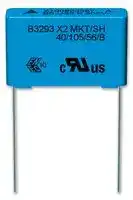
Illustrative purposes only

B32933A3824K189
Safety Capacitor, Metallized PET, Radial Box - 2 Pin, 0.82 µF, ± 10%, X2, Through Hole
⚠️ Reference pricing provided. In case of supply shortages, we will connect you with our trusted procurement partners to ensure your project's continuity.
- Manufacturer: EPCOS
- Product type: Noise Suppression & Safety Capacitors
- Capacitance:0.82µF; Product Range:B32933 Series; Capacitor Dielectric Type:PET (Polyester); Capacitance Tolerance:± 10%; Capacitor Case Style:-; Capacitor Terminals:Radial Leaded; Operating
- SVHC: No SVHC (17-Jan-2022)
- Capacitance: 0.82µF
- Lead Spacing: 22.5mm
- dv/dt Rating: 50V/µs
- Product Range: B32933 Series
- Qualification: AEC-Q200
- Dielectric Type: Metallized PET
- Humidity Rating: GRADE III (Test Condition B)
- Voltage Rating X: 305VAC
- Voltage Rating Y: -
- Suppression Class: X2
- Capacitor Mounting: Through Hole
- Capacitance Tolerance: ± 10%
- Capacitor Case / Package: Radial Box - 2 Pin
- Operating Temperature Max: 105°C
- Operating Temperature Min: -40°C
| Delivery and price | |
|---|---|
| Units per pack | 1 |
| Price | 0.344 € |
| Current stock | 200+ |
| Lead time | 7 days |
Datasheet

## **Film Capacitors**

Metallized Polyester Film Capacitors (MKT)

**Series/Type: B32932 ... B32936** Date: April 2013

© EPCOS AG 2013. Reproduction, publication and dissemination of this publication, enclosures hereto and the information contained therein without EPCOS' prior express consent is prohibited.

**Metallized Polyester Film Capacitors (MKT) AC applications (heavy duty series) / 305 V AC**

**B32932 ... B32936**

## **Typical applications**

For connection in series with the mains For severe ambient conditions Capacitive power supply applications Energy meters

**==> picture [5 x 5] intentionally omitted <==**

**==> picture [5 x 5] intentionally omitted <==**

**==> picture [5 x 5] intentionally omitted <==**

**==> picture [5 x 5] intentionally omitted <==**

## **Dimensional drawing**

## **Climatic**

**==> picture [5 x 5] intentionally omitted <==**

**==> picture [5 x 5] intentionally omitted <==**

Max. operating temperature: 105 ° C Climatic category (IEC 60068-1): 40/105/56

## **Features**

High stability of capacitance value X2 safety approval (up to 2.2 µ F) RoHS-compatible

**==> picture [5 x 5] intentionally omitted <==**

**==> picture [5 x 5] intentionally omitted <==**

**==> picture [5 x 5] intentionally omitted <==**

## **Construction**

Dielectric: metallized polyester Internal series connection Plastic case (UL 94 V-0) Epoxy resin sealing, flame-retardant

**==> picture [5 x 5] intentionally omitted <==**

**==> picture [5 x 5] intentionally omitted <==**

**==> picture [5 x 5] intentionally omitted <==**

**==> picture [5 x 5] intentionally omitted <==**

## **Terminals**

Parallel wire leads, lead-free tinned Standard lead lengths: 6 �1 mm Special lead lengths available on request

**==> picture [5 x 5] intentionally omitted <==**

**==> picture [5 x 5] intentionally omitted <==**

**==> picture [5 x 5] intentionally omitted <==**

## Dimensions in mm

|Lead<br>diameter<br>d1±0.05|Type|
|---|---|
|0.8|B32932|
|0.8|B32933|
|0.8|B32934|
|1.0|B32936|


## **Marking examples**

## **Marking**

Manufacturer's logo, lot number, date code, rated capacitance (coded), capacitance tolerance (code letter), rated AC voltage (IEC), series number, sub-class (X2), dielectric code (MKT), climatic category

**==> picture [65 x 48] intentionally omitted <==**

## **Delivery mode**

Bulk (untaped, lead length 6 - 1 mm) Taped (Ammo pack or reel)

## **Approvals**

|**pprovals**||
|---|---|
|pproval mark|Standards|
||EN 60384-14<br>IEC 60384-14|
||UL 60384-14|
||<br>CSA E60384-14:09|


Note: X2 safety approval for C ≤ 2.2 µ F

Please read _Cautions and warnings_ and _Important notes_ at the end of this document.

Page 2 of 16

## **B32932 ... B32936 AC applications (heavy duty series) / 305 V AC**

## **Overview of available types**

|Lead spacing|15 mm|22.5 mm|27.5 mm|37.5 mm|
|---|---|---|---|---|
|Type|B32932|B32933|B32934|B32936|
|CR (µF)|||||
|0.047|||||
|0.068|||||
|0.10|||||
|0.15|||||
|0.22|||||
|0.33|||||
|0.47|||||
|0.56|||||
|0.68|||||
|0.82|||||
|1.0|||||
|1.5|||||
|2.2|||||


Please read _Cautions and warnings_ and _Important notes_ at the end of this document.

Page 3 of 16

**B32932 ... B32936**

## **AC applications (heavy duty series) / 305 V AC**

## **Ordering codes and packing units**

|Lead<br>spacing<br>mm|CR<br>µF|Max. dimensions<br>w×h×l<br>mm|Ordering code<br>(composition see<br>below)|Ammo<br>pack<br>pcs./MOQ|Straight<br>terminals,<br>Reel<br>pcs./MOQ|Straight<br>terminals,<br>Untaped<br>pcs./MOQ|X2<br>safety<br>appr.|
|---|---|---|---|---|---|---|---|
|15|0.047<br>0.068<br>0.10<br>0.15<br>0.22<br>0.33<br>0.47|5.0×10.5×18.0<br>5.0×10.5×18.0<br>6.0×11.0×18.0<br>7.0×12.5×18.0<br>8.5×14.5×18.0<br>9.0×17.5×18.0<br>11.0×18.5×18.0|B32932A3473+***<br>B32932A3683+***<br>B32932A3104+***<br>B32932A3154+***<br>B32932A3224+***<br>B32932A3334+***<br>B32932A3474M***|4680<br>4680<br>3840<br>3320<br>2720<br>2560<br>–|5200<br>5200<br>4400<br>3600<br>2800<br>2800<br>2200|4000<br>4000<br>4000<br>4000<br>2000<br>2000<br>1200|X<br>X<br>X<br>X<br>X<br>X<br>X|
|22.5|0.10<br>0.15<br>0.22<br>0.33<br>0.47<br>0.47<br>0.56<br>0.68<br>0.82<br>1.0<br>1.0<br>1.5|6.0×15.0×26.5<br>6.0×15.0×26.5<br>7.0×16.0×26.5<br>7.0×16.0×26.5<br>8.5×16.5×26.5<br>10.5×16.5×26.5<br>10.5×16.5×26.5<br>10.5×18.5×26.5<br>12.0×22.0×26.5<br>12.0×22.0×26.5<br>14.5×29.5×26.5<br>14.5×29.5×26.5|B32933A3104+***<br>B32933A3154+***<br>B32933A3224+***<br>B32933A3334+***<br>B32933A3474M***<br>B32933B3474+***<br>B32933A3564+***<br>B32933A3684+***<br>B32933A3824+***<br>B32933A3105M***<br>B32933B3105+***<br>B32933A3155+***|2720<br>2720<br>2320<br>2320<br>1920<br>1560<br>1560<br>1560<br>–<br>–<br>–<br>–|2800<br>2800<br>2400<br>2400<br>2000<br>1600<br>1600<br>1600<br>–<br>–<br>–<br>–|2880<br>2880<br>2520<br>2520<br>2040<br>2160<br>2160<br>2160<br>1800<br>1800<br>1040<br>1040|X<br>X<br>X<br>X<br>X<br>X<br>X<br>X<br>X<br>X<br>X<br>X|


X = approval granted

MOQ = Minimum Order Quantity, consisting of 4 packing units. Further intermediate capacitance values on request.

## **Composition of ordering code**

- + = Capacitance tolerance code: M = ± 20% K = ± 10%

- *** = Packaging code: 289 = Straight terminals, Ammo pack 189 = Straight terminals, Reel

   - 000 = Straight terminals, Untaped (standard lead length 6 �1 mm)

Please read _Cautions and warnings_ and _Important notes_ at the end of this document.

Page 4 of 16

**B32932 ... B32936 AC applications (heavy duty series) / 305 V AC**

## **Ordering codes and packing units**

|Lead<br>spacing<br>mm|CR<br>µF|Max. dimensions<br>w×h×l<br>mm|Ordering code<br>(composition see<br>below)|Ammo<br>pack<br>pcs./MOQ|Straight<br>terminals,<br>Reel<br>pcs./MOQ|Straight<br>terminals,<br>Untaped<br>pcs./MOQ|X2<br>safety<br>appr.|
|---|---|---|---|---|---|---|---|
|27.5|0.47<br>0.56<br>0.68<br>0.82<br>1.0<br>1.0<br>1.5<br>1.5<br>2.2|11.0×19.0×31.5<br>11.0×19.0×31.5<br>11.0×19.0×31.5<br>11.0×19.0×31.5<br>11.0×19.0×31.5<br>11.0×21.0×31.5<br>13.5×23.0×31.5<br>14.0×24.5×31.5<br>18.0×27.5×31.5|B32934A3474+***<br>B32934A3564+***<br>B32934A3684+***<br>B32934A3824+***<br>B32934A3105M***<br>B32934B3105+***<br>B32934B3155M***<br>B32934D3155+***<br>B32934B3225+***|–<br>–<br>–<br>–<br>–<br>–<br>–<br>–<br>–|1400<br>1400<br>1400<br>1400<br>1400<br>1400<br>1200<br>–<br>–|1280<br>1280<br>1280<br>1280<br>1280<br>1280<br>1120<br>1040<br>800|X<br>X<br>X<br>X<br>X<br>X<br>X<br>X<br>X|
|37.5|1.0<br>1.5<br>2.2|12.0×22.0×41.5<br>12.0×22.0×41.5<br>14.0×25.0×41.5|B32936A3105+***<br>B32936A3155+***<br>B32936A3225+***|–<br>–<br>–|–<br>–<br>–|1620<br>1620<br>1380|X<br>X<br>X|


X = approval granted

MOQ = Minimum Order Quantity, consisting of 4 packing units. Further intermediate capacitance values on request.

## **Composition of ordering code**

- + = Capacitance tolerance code: *** = Packaging code: M = ± 20% 289 = K = ± 10% 189 = Straight terminals, Reel

   - 289 = Straight terminals, Ammo pack

   - 000 = Straight terminals, Untaped (standard lead length 6 �1 mm)

Please read _Cautions and warnings_ and _Important notes_ at the end of this document.

Page 5 of 16

**B32932 ... B32936 AC applications (heavy duty series) / 305 V AC**

## **Technical data**

|**Technical data**|||||
|---|---|---|---|---|
|Max. operating temperature Top,max<br>(Top= Tamb+ self-heating)|+105°C||||
|Dissipation factor tanδ(in 10-3)<br>at 20°C (upper limit values)|tanδ|1 kHz|10 kHz||
||C≤1 µF|8|15||
||C > 1 µF|8|�||
|Insulation resistance Rins<br>or time constantτ= CR�Rins<br>at 20°C,<br>rel. humidity≤65% (minimum<br>as-delivered values)|CR≤0.33 µF||CR> 0.33 µF||
||30000 MΩ||10000 s||
|DC test voltage|1312 V DC, 2 s(4.3�VRaccordingto IEC 60384-14)||||
|Passive flammability category<br>to IEC 40(CO)752|B||||
|Capacitance tolerances<br>(measured at 1 kHz)|±10% (K),±20% (M)||||
|Rated AC voltage(IEC 60384-14)|305 V(50/60 Hz)||||
|Operating voltage Vopat high<br>temperature|TA≤105°C||Vop= 1.25�VAC(1000 h)||
|Damp heat test<br>Limit values after damp heat test|Test conditions||||
||1. Temperature:<br>Relative humidity (RH):<br>Test duration:<br>Voltage value:<br>+85°C±2°C<br>85%±2%<br>1000 hours<br>240 V AC, 50 Hz<br>2. Temperature:<br>Relative humidity (RH):<br>Test duration:<br>Voltage value:<br>+40°C±2°C<br>93%±2%<br>1000 hours<br>240 V AC, 50 Hz<br>Capacitance change (∆C/C):<br>Dissipation factor change<br>(∆tanδ):<br>≤10%<br>≤5�10-3 (at 1 kHz)<br>Insulation resistance Rins<br>or time constantτ= CR�Rins:<br>≥50% of initial limit||||
|Reference standard|AEC-Q200||||


Please read _Cautions and warnings_ and _Important notes_ at the end of this document.

Page 6 of 16

**B32932 ... B32936 AC applications (heavy duty series) / 305 V AC**

## **Pulse handling capability**

"dV/dt" represents the maximum permissible voltage change per unit of time for non-sinusoidal voltages, expressed in V/ µ s.

"k0" represents the maximum permissible pulse characteristic of the waveform applied to the capacitor, expressed in V[2] / µ s.

## _Note:_

_The values of dV/dt and k0 provided below must not be exceeded in order to avoid damaging the capacitor._

## **dV/dt and k0 values**

|**dV/dt and k0 values**|||||
|---|---|---|---|---|
|Lead spacing (mm)|15|22.5|27.5|37.5|
|dV/dt(V/µs)|300|150|100|50|
|k0 (V2/µs)|360000|180000|120000|60000|


Please read _Cautions and warnings_ and _Important notes_ at the end of this document.

Page 7 of 16

**B32932 ... B32936 AC applications (heavy duty series) / 305 V AC**

## **Mounting guidelines**

## **1 Soldering**

## **1.1 Solderability of leads**

The solderability of terminal leads is tested to IEC 60068-2-20, test Ta, method 1.

Before a solderability test is carried out, terminals are subjected to accelerated ageing (to IEC 60068-2-2, test Ba: 4 h exposure to dry heat at 155 ° C). Since the ageing temperature is far higher than the upper category temperature of the capacitors, the terminal wires should be cut off from the capacitor before the ageing procedure to prevent the solderability being impaired by the products of any capacitor decomposition that might occur.

|Solder bath temperature|235±5°C|
|---|---|
|Solderingtime|2.0±0.5 s|
|Immersion depth|2.0 +0/�0.5 mm from capacitor bodyor seating plane|
|Evaluation criteria:<br>Visual inspection|Wettingof wire surface bynew solder≥90%, free-flowingsolder|


## **1.2 Resistance to soldering heat**

Resistance to soldering heat is tested to IEC 60068-2-20, test Tb, method 1A. Conditions:

|Series|Solder bath temperature|Solderingtime|
|---|---|---|
|MKT<br>boxed (except 2.5×6.5×7.2 mm)<br>coated<br>uncoated(lead spacing> 10 mm)|260±5°C|10±1 s|
|MFP<br>MKP<br>(lead spacing> 7.5 mm)|||
|MKT<br>boxed(case 2.5×6.5×7.2 mm)||5±1 s|
|MKP<br>MKT<br>(lead spacing≤7.5 mm)<br>uncoated (lead spacing≤10 mm)<br>insulated (B32559)||< 4 s<br>recommended soldering<br>profile for MKT uncoated<br>(lead spacing≤10 mm) and<br>insulated(B32559)|


Please read _Cautions and warnings_ and _Important notes_ at the end of this document.

Page 8 of 16

**B32932 ... B32936 AC applications (heavy duty series) / 305 V AC**

|Immersion depth|2.0 +0/�0.5 mm from capacitor bodyor seating plane|
|---|---|
|Shield|Heat-absorbing board, (1.5±0.5) mm thick, between capacitor<br>bodyand liquid solder|
|Evaluation criteria:<br>Visual inspection<br>∆C/C0<br>tanδ|No visible damage<br>2% for MKT/MKP/MFP<br>5% for EMI suppression capacitors<br>As specified in sectional specification|


Please read _Cautions and warnings_ and _Important notes_ at the end of this document.

Page 9 of 16

**B32932 ... B32936 AC applications (heavy duty series) / 305 V AC**

## **1.3 General notes on soldering**

Permissible heat exposure loads on film capacitors are primarily characterized by the upper category temperature Tmax. Long exposure to temperatures above this type-related temperature limit can lead to changes in the plastic dielectric and thus change irreversibly a capacitor's electrical characteristics. For short exposures (as in practical soldering processes) the heat load (and thus the possible effects on a capacitor) will also depend on other factors like:

**==> picture [5 x 5] intentionally omitted <==**

**==> picture [5 x 5] intentionally omitted <==**

**==> picture [5 x 5] intentionally omitted <==**

**==> picture [5 x 5] intentionally omitted <==**

**==> picture [5 x 5] intentionally omitted <==**

**==> picture [5 x 5] intentionally omitted <==**

**==> picture [5 x 5] intentionally omitted <==**

Pre-heating temperature and time

- Forced cooling immediately after soldering

- Terminal characteristics:

- diameter, length, thermal resistance, special configurations (e.g. crimping) Height of capacitor above solder bath

- Shadowing by neighboring components

- Additional heating due to heat dissipation by neighboring components Use of solder-resist coatings

The overheating associated with some of these factors can usually be reduced by suitable countermeasures. For example, if a pre-heating step cannot be avoided, an additional or reinforced cooling process may possibly have to be included.

EPCOS recommends the following conditions:

**==> picture [5 x 5] intentionally omitted <==**

**==> picture [5 x 5] intentionally omitted <==**

Pre-heating with a maximum temperature of 110 ° C

Temperature inside the capacitor should not exceed the following limits:

- MKP/MFP 110 ° C

- MKT 160 ° C

**==> picture [5 x 5] intentionally omitted <==**

**==> picture [5 x 5] intentionally omitted <==**

When SMD components are used together with leaded ones, the leaded film capacitors should not pass into the SMD adhesive curing oven. The leaded components should be assembled after the SMD curing step.

Leaded film capacitors are not suitable for reflow soldering.

## **Uncoated capacitors**

For uncoated MKT capacitors with lead spacings ≤ 10 mm (B32560/B32561) the following measures are recommended:

**==> picture [5 x 5] intentionally omitted <==**

**==> picture [5 x 5] intentionally omitted <==**

pre-heating to not more than 110 ° C in the preheater phase

rapid cooling after soldering

Please read _Cautions and warnings_ and _Important notes_ at the end of this document.

Page 10 of 16

**B32932 ... B32936 AC applications (heavy duty series) / 305 V AC**

## **Cautions and warnings**

**==> picture [5 x 5] intentionally omitted <==**

**==> picture [5 x 5] intentionally omitted <==**

**==> picture [5 x 5] intentionally omitted <==**

**==> picture [5 x 5] intentionally omitted <==**

**==> picture [5 x 4] intentionally omitted <==**

**==> picture [5 x 5] intentionally omitted <==**

**==> picture [5 x 5] intentionally omitted <==**

**==> picture [5 x 5] intentionally omitted <==**

**==> picture [5 x 4] intentionally omitted <==**

Do not exceed the upper category temperature (UCT). Do not apply any mechanical stress to the capacitor terminals. Avoid any compressive, tensile or flexural stress. Do not move the capacitor after it has been soldered to the PC board. Do not pick up the PC board by the soldered capacitor.

Do not place the capacitor on a PC board whose PTH hole spacing differs from the specified lead spacing.

Do not exceed the specified time or temperature limits during soldering. Avoid external energy inputs, such as fire or electricity. Avoid overload of the capacitors.

The table below summarizes the safety instructions that must always be observed. A detailed description can be found in the relevant sections of the chapters "General technical information" and "Mounting guidelines".

|Topic|Safety information|Reference chapter<br>"General technical<br>information"|
|---|---|---|
|Storage conditions|Make sure that capacitors are stored within the<br>specified range of time, temperature and humidity<br>conditions.|4.5<br>"Storage conditions"|
|Flammability|Avoid external energy, such as fire or electricity<br>(passive flammability), avoid overload of the<br>capacitors (active flammability) and consider the<br>flammabilityof materials.|5.3<br>"Flammability"|
|Resistance to<br>vibration|Do not exceed the tested ability to withstand<br>vibration. The capacitors are tested to<br>IEC 60068-2-6.<br>EPCOS offers film capacitors specially designed<br>for operation under more severe vibration regimes<br>such as those found in automotive applications.<br>Consult our catalog "Film Capacitors for<br>Automotive Electronics".|5.2<br>"Resistance to vibration"|


Please read _Cautions and warnings_ and _Important notes_ at the end of this document.

Page 11 of 16

**B32932 ... B32936 AC applications (heavy duty series) / 305 V AC**

|Topic|Safety information|Reference chapter<br>"Mounting guidelines"|
|---|---|---|
|Soldering|Do not exceed the specified time or temperature<br>limits duringsoldering.|1 "Soldering"|
|Cleaning|Use onlysuitable solvents for cleaningcapacitors.|2 "Cleaning"|
|Embedding of<br>capacitors in<br>finished assemblies|When embedding finished circuit assemblies in<br>plastic resins, chemical and thermal influences<br>must be taken into account.<br>Caution: Consult us first, if you also wish to<br>embed other uncoated component types!|3 "Embedding of<br>capacitors in finished<br>assemblies"|


Please read _Cautions and warnings_ and _Important notes_ at the end of this document.

Page 12 of 16

**B32932 ... B32936 AC applications (heavy duty series) / 305 V AC**

## **Symbols and terms**

|Symbol|English|German|
|---|---|---|
|α<br>αC<br>A<br>βC<br>C<br>CR<br>∆C<br>∆C/C<br>∆C/CR<br>dt<br>∆t<br>∆T<br>∆tanδ<br>∆V<br>dV/dt<br>∆V/∆t<br>E<br>ESL<br>ESR<br>f<br>f1<br>f2<br>fr<br>FD<br>FT<br>i<br>IC|Heat transfer coefficient<br>Temperature coefficient of capacitance<br>Capacitor surface area<br>Humidity coefficient of capacitance<br>Capacitance<br>Rated capacitance<br>Absolute capacitance change<br>Relative capacitance change (relative<br>deviation of actual value)<br>Capacitance tolerance (relative deviation<br>from rated capacitance)<br>Time differential<br>Time interval<br>Absolute temperature change<br>(self-heating)<br>Absolute change of dissipation factor<br>Absolute voltage change<br>Time differential of voltage function (rate<br>of voltage rise)<br>Voltage change per time interval<br>Activation energy for diffusion<br>Self-inductance<br>Equivalent series resistance<br>Frequency<br>Frequency limit for reducing permissible<br>AC voltage due to thermal limits<br>Frequency limit for reducing permissible<br>AC voltage due to current limit<br>Resonant frequency<br>Thermal acceleration factor for diffusion<br>Derating factor<br>Current (peak)<br>Category current (max. continuous<br>current)|Wärmeübergangszahl<br>Temperaturkoeffizient der Kapazität<br>Kondensatoroberfläche<br>Feuchtekoeffizient der Kapazität<br>Kapazität<br>Nennkapazität<br>Absolute Kapazitätsänderung<br>Relative Kapazitätsänderung (relative<br>Abweichung vom Ist-Wert)<br>Kapazitätstoleranz (relative Abweichung<br>vom Nennwert)<br>Differentielle Zeit<br>Zeitintervall<br>Absolute Temperaturänderung<br>(Selbsterwärmung)<br>Absolute Änderung des Verlustfaktors<br>Absolute Spannungsänderung<br>Differentielle Spannungsänderung<br>(Spannungsflankensteilheit)<br>Spannungsänderung pro Zeitintervall<br>Aktivierungsenergie zur Diffusion<br>Eigeninduktivität<br>Ersatz-Serienwiderstand<br>Frequenz<br>Grenzfrequenz für thermisch bedingte<br>Reduzierung der zulässigen<br>Wechselspannung<br>Grenzfrequenz für strombedingte<br>Reduzierung der zulässigen<br>Wechselspannung<br>Resonanzfrequenz<br>Therm. Beschleunigungsfaktor zur<br>Diffusion<br>Deratingfaktor<br>Stromspitze<br>Kategoriestrom (max. Dauerstrom)|


Please read _Cautions and warnings_ and _Important notes_ at the end of this document.

Page 13 of 16

## **B32932 ... B32936 AC applications (heavy duty series) / 305 V AC**

|Symbol|English|German|
|---|---|---|
|IRMS<br>iz<br>k0<br>LS<br>λ<br>λ0<br>λtest<br>Pdiss<br>Pgen<br>Q<br>ρ<br>R<br>R<br>Ri<br>Rins<br>RP<br>RS<br>S<br>t<br>T<br>τ<br>tanδ<br>tanδD<br>tanδP<br>tanδS<br>TA<br>Tmax<br>Tmin<br>tOL<br>Top<br>TR<br>Tref<br>tSL<br>VAC|(Sinusoidal) alternating current,<br>root-mean-square value<br>Capacitance drift<br>Pulse characteristic<br>Series inductance<br>Failure rate<br>Constant failure rate during useful<br>service life<br>Failure rate, determined by tests<br>Dissipated power<br>Generated power<br>Heat energy<br>Density of water vapor in air<br>Universal molar constant for gases<br>Ohmic resistance of discharge circuit<br>Internal resistance<br>Insulation resistance<br>Parallel resistance<br>Series resistance<br>severity (humidity test)<br>Time<br>Temperature<br>Time constant<br>Dissipation factor<br>Dielectric component of dissipation<br>factor<br>Parallel component of dissipation factor<br>Series component of dissipation factor<br>Ambient temperature<br>Upper category temperature<br>Lower category temperature<br>Operating life at operating temperature<br>and voltage<br>Operating temperature<br>Rated temperature<br>Reference temperature<br>Reference service life<br>AC voltage|(Sinusförmiger) Wechselstrom<br>Inkonstanz der Kapazität<br>Impulskennwert<br>Serieninduktivität<br>Ausfallrate<br>Konstante Ausfallrate in der<br>Nutzungsphase<br>Experimentell ermittelte Ausfallrate<br>Abgegebene Verlustleistung<br>Erzeugte Verlustleistung<br>Wärmeenergie<br>Dichte von Wasserdampf in Luft<br>Allg. Molarkonstante für Gas<br>Ohmscher Widerstand des<br>Entladekreises<br>Innenwiderstand<br>Isolationswiderstand<br>Parallelwiderstand<br>Serienwiderstand<br>Schärfegrad (Feuchtetest)<br>Zeit<br>Temperatur<br>Zeitkonstante<br>Verlustfaktor<br>Dielektrischer Anteil des Verlustfaktors<br>Parallelanteil des Verlfustfaktors<br>Serienanteil des Verlustfaktors<br>Umgebungstemperatur<br>Obere Kategorietemperatur<br>Untere Kategorietemperatur<br>Betriebszeit bei Betriebstemperatur und<br>-spannung<br>Beriebstemperatur<br>Nenntemperatur<br>Referenztemperatur<br>Referenz-Lebensdauer<br>Wechselspannung|


Please read _Cautions and warnings_ and _Important notes_ at the end of this document.

Page 14 of 16

## **B32932 ... B32936 AC applications (heavy duty series) / 305 V AC**

|Symbol|English|German|
|---|---|---|
|VC<br>VC,RMS<br>VCD<br>Vch<br>VDC<br>VFB<br>Vi<br>Vo<br>Vop<br>Vp<br>Vpp<br>VR<br>R<br>VRMS<br>VSC<br>Vsn<br>Z|Category voltage<br>Category AC voltage<br>Corona-discharge onset voltage<br>Charging voltage<br>DC voltage<br>Fly-back capacitor voltage<br>Input voltage<br>Output voltage<br>Operating voltage<br>Peak pulse voltage<br>Peak-to-peak voltage Impedance<br>Rated voltage<br>Amplitude of rated AC voltage<br>(Sinusoidal) alternating voltage,<br>root-mean-square value<br>S-correction voltage<br>Snubber capacitor voltage<br>Impedance<br>Lead spacing|Kategoriespannung<br>(Sinusförmige)<br>Kategorie-Wechselspannung<br>Teilentlade-Einsatzspannung<br>Ladespannung<br>Gleichspannung<br>Spannung (Flyback)<br>Eingangsspannung<br>Ausgangssspannung<br>Betriebsspannung<br>Impuls-Spitzenspannung<br>Spannungshub<br>Nennspannung<br>Amplitude der Nenn-Wechselspannung<br>(Sinusförmige) Wechselspannung<br>Spannung bei Anwendung "S-correction"<br>Spannung bei Anwendung<br>"Beschaltung"<br>Scheinwiderstand<br>Rastermaß|


Please read _Cautions and warnings_ and _Important notes_ at the end of this document.

Page 15 of 16

## **Important notes**

The following applies to all products named in this publication:

1. Some parts of this publication contain **statements about the suitability of our products for certain areas of application** . These statements are based on our knowledge of typical requirements that are often placed on our products in the areas of application concerned. We nevertheless expressly point out **that such statements cannot be regarded as binding statements about the suitability of our products for a particular customer application** . As a rule, EPCOS is either unfamiliar with individual customer applications or less familiar with them than the customers themselves. For these reasons, it is always ultimately incumbent on the customer to check and decide whether an EPCOS product with the properties described in the product specification is suitable for use in a particular customer application.

2. We also point out that **in individual cases, a malfunction of electronic components or failure before the end of their usual service life cannot be completely ruled out in the current state of the art, even if they are operated as specified** . In customer applications requiring a very high level of operational safety and especially in customer applications in which the malfunction or failure of an electronic component could endanger human life or health (e.g. in accident prevention or lifesaving systems), it must therefore be ensured by means of suitable design of the customer application or other action taken by the customer (e.g. installation of protective circuitry or redundancy) that no injury or damage is sustained by third parties in the event of malfunction or failure of an electronic component.

3. **The warnings, cautions and product-specific notes must be observed.**

4. In order to satisfy certain technical requirements, **some of the products described in this publication may contain substances subject to restrictions in certain jurisdictions (e.g. because they are classed as hazardous)** . Useful information on this will be found in our Material Data Sheets on the Internet (www.epcos.com/material). Should you have any more detailed questions, please contact our sales offices.

5. We constantly strive to improve our products. Consequently, **the products described in this publication may change from time to time** . The same is true of the corresponding product specifications. Please check therefore to what extent product descriptions and specifications contained in this publication are still applicable before or when you place an order. We also **reserve the right to discontinue production and delivery of products** . Consequently, we cannot guarantee that all products named in this publication will always be available. The aforementioned does not apply in the case of individual agreements deviating from the foregoing for customer-specific products.

6. Unless otherwise agreed in individual contracts, **all orders are subject to the current version of the "General Terms of Delivery for Products and Services in the Electrical Industry" published by the German Electrical and Electronics Industry Association (ZVEI)** .

7. The trade names EPCOS, BAOKE, Alu-X, CeraDiode, CeraLink, CSMP, CSSP, CTVS, DeltaCap, DigiSiMic, DSSP, FilterCap, FormFit, MiniBlue, MiniCell, MKD, MKK, MLSC, MotorCap, PCC, PhaseCap, PhaseCube, PhaseMod, PhiCap, SIFERRIT, SIFI, SIKOREL, SilverCap, SIMDAD, SiMic, SIMID, SineFormer, SIOV, SIP5D, SIP5K, ThermoFuse, WindCap are **trademarks registered or pending** in Europe and in other countries. Further information will be found on the Internet at www.epcos.com/trademarks.

Page 16 of 16
Updated at March 23, 2026
About Novapart
Novapart is a B2B electronic component broker specialising in stock shortages and cost reduction. We source hard-to-find parts and identify compliant alternatives across a catalogue of 410,000+ components from 500+ manufacturers.
Learn more →Stock Shortage Specialist
When a component is unavailable, discontinued or has an unacceptable lead time, we tap into our network of vetted European and Asian distributors to source what you need — without compromising on quality or traceability.
Request a quote →Compliant Alternatives
We identify pin-to-pin, electrically equivalent substitutes that meet the same certifications (RoHS, AEC-Q100, REACH) as your original specification — validated against datasheets, not just part numbers. Often at a lower cost.
BOM Analysis service →