
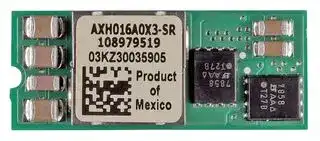
Image not available
Illustrative purposes only

AXH016A0X3-SRZ
Non Isolated POL DC/DC Converter, Austin SuperLynx, ITE, 58.08 W, 750 mV, 3.63 V, 16 A, Adjustable
⚠️ Reference pricing provided. In case of supply shortages, we will connect you with our trusted procurement partners to ensure your project's continuity.
- Manufacturer: GE CRITICAL POWER
- Product type: DC / DC Non Isolated Board Mount Converters - Adjustable Output
- Depth: 33mm
- Width: 13.5mm
- Height: 8.28mm
- Output Power Max: 58.08W
- Output Current Max: 16A
- Output Voltage Max: 3.63V
- Output Voltage Min: 750mV
- Input Voltage DC Max: 5.5V
- Input Voltage DC Min: 3V
- Power Supply Approvals: ITE
- DC / DC Converter Output Type: Adjustable
| Delivery and price | |
|---|---|
| Units per pack | 50 |
| Price | 12.29 € |
| Current stock | 10+ |
| Lead time | 30 days |
Datasheet

**Data Sheet October 2, 2009**

**Austin SuperLynx[TM] SMT Non-isolated Power Modules: 3.0Vdc – 5.5Vdc input; 0.75Vdc to 3.63Vdc Output; 16A Output Current**

## **RoHS Compliant**

## **Applications**

Distributed power architectures Intermediate bus voltage applications Telecommunications equipment Servers and storage applications Networking equipment

## **Features**

Compliant to RoHS EU Directive 2002/95/EC (- Z versions)

Compliant to ROHS EU Directive 2002/95/EC with lead solder exemption (non-Z versions) Delivers up to 16A of output current High efficiency – 95% at 3.3V full load (VIN = 5.0V) Small size and low profile: 33.00 mm x 13.46 mm x 8.28 mm (1.300 in x 0.530 in x 0.326 in) Low output ripple and noise High Reliability: Calculated MTBF > 6.8M hours at 25[o] C Fullload Output voltage programmable from 0.75 Vdc to 3.63Vdc via external resistor Line Regulation: 0.3% (typical) Load Regulation: 0.4% (typical) Temperature Regulation: 0.4% (typical) Remote On/Off Remote Sense Output overcurrent protection (non-latching) Overtemperature protection Wide operating temperature range (-40°C to 85°C)

_UL_ * 60950-1Recognized, _CSA_[†] C22.2 No. 60950-1-03 Certified, and _VDE_[‡] 0805:2001-12 (EN60950-1) Licensed

ISO** 9001 and ISO 14001 certified manufacturing facilities

## **Description**

Austin SuperLynx[TM] SMT (surface mount technology) power modules are non-isolated dc-dc converters that can deliver up to 16A of output current with full load efficiency of 95% at 3.3V output.  These modules provide a precisely regulated output voltage programmable via external resistor from 0.75Vdc to 3.63Vdc over a wide range of input voltage (VIN = 3.0 – 5.5Vdc).  Their open-frame construction and small footprint enable designers to develop cost- and space-efficient solutions.  Standard features include remote On/Off, remote sense, programmable output voltage, overcurrent and overtemperature protection.

> * _UL_ is a registered trademark of Underwriters Laboratories, Inc.

> † _CSA_ is a registered trademark of Canadian Standards Association.

> ‡ _VDE_ is a trademark of Verband Deutscher Elektrotechniker e.V.

> ** ISO is a registered trademark of the International Organization of Standards

Document No: DS03-081  ver. 1.44 PDF name: superlynx_smt_3v-5.5v.pdf

**Data Sheet Austin Superlynx[TM ] SMT Non-isolated Power Modules: October 2, 2009 3.0 – 5.5Vdc input; 0.75Vdc to 3.63Vdc Output; 16A output current**

## **Absolute Maximum Ratings**

Stresses in excess of the absolute maximum ratings can cause permanent damage to the device. These are absolute stress ratings only, functional operation of the device is not implied at these or any other conditions in excess of those given in the operations sections of the data sheet. Exposure to absolute maximum ratings for extended periods can adversely affect the device reliability.

|**Parameter**|**Device**|**Symbol**|**Min**|**Max**|**Unit**|
|---|---|---|---|---|---|
|Input Voltage<br>Continuous|All|VIN|-0.3|5.8|Vdc|
|Operating Ambient Temperature<br>(see Thermal Considerations section)|All|TA|-40|85|°C|
|Storage Temperature|All|Tstg|-55|125|°C|


## **Electrical Specifications**

Unless otherwise indicated, specifications apply over all operating input voltage, resistive load, and temperature conditions.

|**Parameter**|**Device**|**Symbol**|**Min**|**Typ**|**Max**|**Unit**|
|---|---|---|---|---|---|---|
|Operating Input Voltage|VO,set≤ VIN– 0.5V|VIN|3.0|⎯|5.5|Vdc|
|Maximum Input Current<br>(VIN= VIN, minto VIN, max, IO=IO, maxVO,set= 3.3Vdc)|All|IIN,max|||16.0|Adc|
|Input No Load Current<br>(VIN= 5.0Vdc, IO= 0, module enabled)|VO,set= 0.75 Vdc<br>VO,set= 3.3Vdc|IIN,No load<br>IIN,No load||70<br>70||mA<br>mA|
|Input Stand-by Current<br>(VIN= 5.0Vdc, module disabled)|All|IIN,stand-by||1.5||mA|
|Inrush Transient|All|I<br>2t|||0.1|A<br>2s|
|Input Reflected Ripple Current, peak-to-peak<br>(5Hz to 20MHz, 1μH source impedance; VIN, minto<br>VIN, max,IO= IOmax; See Test configuration section)|All|||100||mAp-p|
|Input Ripple Rejection (120Hz)|All|||30||dB|


## **CAUTION: This power module is not internally fused. An input line fuse must always be used.**

This power module can be used in a wide variety of applications, ranging from simple standalone operation to being part of a complex power architecture. To preserve maximum flexibility, internal fusing is not included, however, to achieve maximum safety and system protection, always use an input line fuse. The safety agencies require a fastacting fuse with a maximum rating of 20A (see Safety Considerations section). Based on the information provided in this data sheet on inrush energy and maximum dc input current, the same type of fuse with a lower rating can be used. Refer to the fuse manufacturer’s data sheet for further information.

**LINEAGE POWER**

2

**Austin Superlynx[[TM ]] SMT Non-isolated Power Modules:**

**Data Sheet Austin Superlynx[[TM ]] SMT Non-isolated Power Modules: October 2, 2009 3.0 – 5.5Vdc input; 0.75Vdc to 3.63Vdc Output; 16A output current**

## **Electrical Specifications** (continued)

|**Parameter**|**Device**|**Symbol**|**Min**|**Typ**|**Max**|**Unit**|
|---|---|---|---|---|---|---|
|Output Voltage Set-point<br>(VIN=IN, min, IO=IO, max, TA=25°C)|All|VO, set|–2.0|⎯|+2.0|% VO, set|
|Output Voltage<br>(Over all operating input voltage, resistive load,<br>and temperature conditions until end of life)|All|VO, set|–3%|⎯|+3%|% VO, set|
|Adjustment Range<br>Selected by an external resistor|All|VO|0.7525||3.63|Vdc|
|Output Regulation<br>Line (VIN=VIN, minto VIN, max)<br>Load (IO=IO, minto IO, max)<br>Temperature (Tref=TA, minto TA, max)|All<br>All<br>All||⎯<br>⎯<br>⎯|0.3<br>0.4<br>0.4||% VO, set<br>% VO, set<br>% VO, set|
|Output Ripple and Noise on nominal output<br>(VIN=VIN, nomand IO=IO, minto IO, max<br>Cout = 1μF ceramic//10μFtantalum capacitors)<br>RMS (5Hz to 20MHz bandwidth)<br>Peak-to-Peak (5Hz to 20MHz bandwidth)|All<br>All||⎯<br>⎯|8<br>25|15<br>50|mVrms<br>mVpk-pk|
|External Capacitance<br>ESR ≥ 1 mΩ<br>ESR ≥ 10 mΩ|All<br>All|CO, max<br>CO, max|⎯<br>⎯|⎯<br>⎯|1000<br>3000|μF<br>μF|
|Output Current|All|Io|0|⎯|16|Adc|
|Output Current Limit Inception (Hiccup Mode )|All|IO, lim|⎯|180|⎯|% Io|
|Output Short-Circuit Current<br>(VO≤250mV) ( Hiccup Mode )|All|IO, s/c|⎯|3.5|⎯|Adc|
|Efficiency<br>VIN= VIN, nom, TA=25°C<br>IO=IO, max ,VO= VO,set|VO,set= 0.75Vdc<br>VO, set= 1.2Vdc<br>VO,set= 1.5Vdc<br>VO,set= 1.8Vdc<br>VO,set= 2.5Vdc<br>VO,set= 3.3Vdc|η<br>η<br>η<br>η<br>η<br>η||82.0<br>87.0<br>89.0<br>90.0<br>92.5<br>95.0||%<br>%<br>%<br>%<br>%<br>%|
|Switching Frequency|All|fsw|⎯|300|⎯|kHz|
|Dynamic Load Response<br>(dIo/dt=2.5A/μs; VIN= VIN, nom; TA=25°C)<br>Load Change from Io= 50% to 100% of<br>Io,max; 1μF ceramic// 10 μF tantalum<br>Peak Deviation<br>Settling Time (Vo<10% peak deviation)<br>(dIo/dt=2.5A/μs; VIN= VIN, nom; TA=25°C)<br>Load Change from Io= 100% to 50%of Io,max:<br>1μF ceramic// 10 μF tantalum<br>Peak Deviation<br>Settling Time (Vo<10% peak deviation)|All<br>All<br>All<br>All|Vpk<br>ts<br>Vpk<br>ts|⎯<br>⎯<br>⎯<br>⎯|300<br>25<br>300<br>25|⎯<br>⎯<br>⎯<br>⎯|mV<br>μs<br>mV<br>μs|


**LINEAGE POWER**

3

**Austin Superlynx[[TM ]] SMT Non-isolated Power Modules:**

**Data Sheet Austin Superlynx[[TM ]] SMT Non-isolated Power Modules: October 2, 2009 3.0 – 5.5Vdc input; 0.75Vdc to 3.63Vdc Output; 16A output current**

## **Electrical Specifications** (continued)

|**Parameter**|**Device**|**Symbol**|**Min**|**Typ**|**Max**|**Unit**|
|---|---|---|---|---|---|---|
|Dynamic Load Response<br>(dIo/dt=2.5A/μs; V VIN= VIN, nom; TA=25°C)<br>Load Change from Io= 50% to 100% of Io,max;<br>Co = 2x150 μF polymer capacitors<br>Peak Deviation<br>Settling Time (Vo<10% peak deviation)<br>(dIo/dt=2.5A/μs; VIN= VIN, nom; TA=25°C)<br>Load Change from Io= 100% to 50%of Io,max:<br>Co = 2x150 μF polymer capacitors<br>Peak Deviation<br>Settling Time (Vo<10% peak deviation)|All<br>All<br>All<br>All|Vpk<br>ts<br>Vpk<br>ts|⎯<br>⎯<br>⎯<br>⎯|150<br>100<br>150<br>100|⎯<br>⎯<br>⎯<br>⎯|mV<br>μs<br>mV<br>μs|


## **General Specifications**

|**Parameter**|**Min**|**Typ**|**Max**|**Unit**|
|---|---|---|---|---|
|Calculated MTBF (IO=IO, max, TA=25°C)||6, 800,000||Hours|
|Weight|⎯|5.6 (0.2)|⎯|g (oz.)|


**LINEAGE POWER**

4

**Austin Superlynx[TM ] SMT Non-isolated Power Modules: 3.0 – 5.5Vdc input; 0.75Vdc to 3.63Vdc Output; 16A output current**

**Data Sheet October 2, 2009**

## **Feature Specifications**

Unless otherwise indicated, specifications apply over all operating input voltage, resistive load, and temperature conditions. See Feature Descriptions for additional information.

|**Parameter**|**Device**|**Symbol**|**Min**|**Typ**|**Max**|**Unit**|
|---|---|---|---|---|---|---|
|Remote On/Off Signal interface<br>(VIN=VIN, minto VIN, max; Open collector pnp or equivalent<br>Compatible, Von/off signal referenced to GND<br>See feature description section)<br>Input High Voltage (Module ON)<br>Input High Current<br>Input Low Voltage (Module OFF)<br>Input Low Current|All<br>All<br>All<br>All|VIH<br>IIH<br>VIL<br>IIL|―<br>―<br>-0.2<br>―|―<br>―<br>―<br>0.2|VIN, max<br>10<br>0.3<br>1|V<br>μA<br>V<br>mA|
|Turn-On Delay and Rise Times<br>(IO=IO, max ,VIN= VIN, nom,TA= 25<br>oC, )<br>Case 1: On/Off input is set to Logic Low (Module<br>ON) and then input power is applied (delay from<br>instant at  which VIN=VIN, minuntil Vo=10% of Vo,set)<br>Case 2: Input power is applied for at least one second<br>and then the On/Off input is set to logic Low (delay from<br>instant at which Von/Off=0.3V until Vo=10% of Vo, set)<br>Output voltage Rise time (time for Vo to rise from 10%<br>of Vo,setto 90% of Vo, set)|All<br>All<br>All|Tdelay<br>Tdelay<br>Trise|―|3.9<br>3.9<br>4.2|8,5|msec<br>msec<br>msec|
|Output voltage overshoot – Startup<br>IO= IO, max; VIN= 3.0 to 5.5Vdc, TA= 25<br>oC||||―|1|% VO, set|
|Overtemperature Protection<br>(See Thermal Consideration section)|All|Tref|⎯|125|⎯|°C|
|Input Undervoltage Lockout<br>Turn-on Threshold<br>Turn-off Threshold|All<br>All||⎯<br>⎯|2.2<br>2.0|⎯<br>⎯|V<br>V|


**LINEAGE POWER**

5

**Data Sheet Austin Superlynx[TM ] SMT Non-isolated Power Modules: October 2, 2009 3.0 – 5.5Vdc input; 0.75Vdc to 3.63Vdc Output; 16A output current**

## **Characteristic Curves**

The following figures provide typical characteristics for the Austin SuperLynx[TM] SMT modules at 25ºC.

**==> picture [202 x 140] intentionally omitted <==**

**----- Start of picture text -----**<br>
90<br>87<br>84<br>81<br>VIN = 3.0V<br>78<br>VIN = 5.0V<br>75<br>VIN = 5.5V<br>72<br>0 4 8 12 16<br>OUTPUT CURRENT, IO (A)<br>  (%)<br>η<br>EFFICIENCY,<br>**----- End of picture text -----**<br>


**Figure 1. Converter Efficiency versus Output Current (Vout = 0.75Vdc).**

**==> picture [204 x 137] intentionally omitted <==**

**----- Start of picture text -----**<br>
93<br>90<br>87<br>84<br>81<br>VIN = 3.0V<br>78<br>VIN = 5.0V<br>75<br>VIN = 5.5V<br>72<br>0 4 8 12 16<br>OUTPUT CURRENT, IO (A)<br>  (%)<br>η<br>EFFICIENCY,<br>**----- End of picture text -----**<br>


**Figure 2. Converter Efficiency versus Output Current (Vout = 1.2Vdc).**

**==> picture [205 x 143] intentionally omitted <==**

**----- Start of picture text -----**<br>
94<br>91<br>88<br>85<br>82<br>79<br>VIN = 3.0V<br>76<br>VIN = 5.0V<br>73<br>VIN = 5.5V<br>70<br>0 4 8 12 16<br>OUTPUT CURRENT, IO (A)<br>  (%)<br>η<br>EFFICIENCY,<br>**----- End of picture text -----**<br>


**Figure3. Converter Efficiency versus Output Current (Vout = 1.5Vdc).**

**==> picture [205 x 309] intentionally omitted <==**

**----- Start of picture text -----**<br>
96<br>93<br>90<br>87<br>84<br>81<br>VIN = 3.0V<br>78<br>VIN = 5.0V<br>75<br>VIN = 5.5V<br>72<br>0 4 8 12 16<br>OUTPUT CURRENT, IO (A)<br>Figure 4. Converter Efficiency versus Output Current<br>(Vout = 1.8Vdc).<br>100<br>97<br>94<br>91<br>88<br>85<br>82<br>VIN = 3.0V<br>79<br>VIN = 5.0V<br>76<br>VIN = 5.5V<br>73<br>0 4 8 12 16<br>OUTPUT CURRENT, IO (A)<br>  (%)<br>η<br>EFFICIENCY,<br>  (%)<br>η<br>EFFICIENCY,<br>**----- End of picture text -----**<br>


**Figure 4. Converter Efficiency versus Output Current (Vout = 1.8Vdc).**

**Figure 5. Converter Efficiency versus Output Current (Vout = 2.5Vdc).**

**==> picture [206 x 143] intentionally omitted <==**

**----- Start of picture text -----**<br>
100<br>97<br>94<br>91<br>88<br>85<br>VIN = 4.5V<br>82<br>VIN = 5.0V<br>79<br>VIN = 5.5V<br>76<br>0 4 8 12 16<br>OUTPUT CURRENT, IO (A)<br>  (%)<br>η<br>EFFICIENCY,<br>**----- End of picture text -----**<br>


**Figure 6. Converter Efficiency versus Output Current (Vout = 3.3Vdc).**

**LINEAGE POWER**

6

**Data Sheet Austin Superlynx[TM ] SMT Non-isolated Power Modules: October 2, 2009 3.0 – 5.5Vdc input; 0.75Vdc to 3.63Vdc Output; 16A output current**

## **Characteristic Curves** (continued)

The following figures provide typical characteristics for the Austin SuperLynx[TM] SMT modules at 25ºC.

**==> picture [449 x 500] intentionally omitted <==**

**----- Start of picture text -----**<br>
18<br>Io=0A<br>16<br>Io=8A<br>14<br>Io=16A Pe Ceene0 Pm Pe<br>12<br>TTA<br>10<br>yf NELALTTTET<br>8<br>6<br>a ee<br>4<br>Pe<br>2<br>0 fee ene ene xen nee ecu cue ee<br>0.5 1.5 2.5 3.5 4.5 5.5<br>INPUT VOLTAGE, VIN (V) TIME, t (5  μ s/div)<br>Figure 7. Input voltage vs. Input Current  Figure 10. Transient Response to Dynamic Load<br> (Vout = 2.5Vdc).  Change from 50% to 100% of full load (Vo = 3.3Vdc).<br>TTP LLLELLLL!#6| | U6LLDDURCELLLLL,<br>PP<br>Petts |) EINE<br>ripe ELL Oe<br>hatte temaravaeontlest a|ttt.<br>SF a<br>Se ne ee es<br>TIME, t (2 μ s/div)  TIME, t (5  μ s/div)<br>Figure 8.  Typical Output Ripple and Noise   Figure 11.  Transient Response to Dynamic Load<br>(Vin = 5.0V dc, Vo = 0.75 Vdc, Io=16A).  Change from 100% to 50% of full load (Vo = 3.3 Vdc).<br>OsSeeseene a ne CQ Ge2<br>Tli.thi ttt CU<br>thin)Os adh bh ca Mtl th ac nl Nana; 8WE0 En<br>oe eeaee ae ae ee eee eee<br>TIME, t (2 μ s/div)  TIME, t (10 μ s/div)<br>Figure 9.  Typical Output Ripple and Noise   Figure 12.  Transient Response to Dynamic Load<br>(Vin = 5.0V dc, Vo = 3.3 Vdc, Io=16A).  Change from 50% to 100% of full load (Vo = 5.0 Vdc,<br>Cext = 2x150 μF Polymer Capacitors).<br> (A)<br>IN<br> (V) (200mV/div)<br>O<br>INPUT CURRENT, I<br> (A) (5A/div)            V<br>O<br>OUTPUT CURRENT,  OUTPUT VOLTAGE      I<br> (V) (200mV/div)<br>O<br> (V) (20mV/div)<br>O<br> V<br>OUTPUT VOLTAGE<br> (A) (5A/div)            V<br>O<br>OUTPUT CURRENT,  OUTPUT VOLTAGE      I<br> (V) (200mV/div)<br>O<br> (V) (20mV/div)<br>O<br> (A) (5A/div)            V<br>O<br>                OUTPUT VOLTAGE                     V OUTPUT CURRENT,  OUTPUT VOLTAGE      I<br>**----- End of picture text -----**<br>


**Figure 7. Input voltage vs. Input Current (Vout = 2.5Vdc).**

**Figure 8.  Typical Output Ripple and Noise (Vin = 5.0V dc, Vo = 0.75 Vdc, Io=16A).**

**Figure 9.  Typical Output Ripple and Noise (Vin = 5.0V dc, Vo = 3.3 Vdc, Io=16A).**

**LINEAGE POWER**

7

**Data Sheet Austin Superlynx[TM ] SMT Non-isolated Power Modules: October 2, 2009 3.0 – 5.5Vdc input; 0.75Vdc to 3.63Vdc Output; 16A output current**

## **Characteristic Curves** (continued)

**==> picture [385 x 157] intentionally omitted <==**

**----- Start of picture text -----**<br>
The following figures provide typical characteristics for the Austin SuperLynx [TM]  SMT modules at 25ºC.<br>SRR EEETo CCPee BREEPee BREE BREE E<br>SSO<br>Ee<br>SS| {| | F | f Jf ft |<br>TEE Poo<br>oe ee PTC<br>TIME, t (10 μ s/div)  TIME, t (2 ms/div)<br> (V) (2V/div)<br>NN<br> (V) (200mV/div)<br>O<br>V) (1V/div)           V<br>O<br> (A) (5A/div)            V     V<br>OUTPUT CURRENT, OUTPUTVOLTAGE              IO OUTPUT VOLTAGE    INPUT VOLTAGE<br>**----- End of picture text -----**<br>


**==> picture [205 x 302] intentionally omitted <==**

**----- Start of picture text -----**<br>
CCPee BREEPee BREE BREE E E E S<br>FEEL<br>CCL<br>ECACC<br>Poo ee<br>PTC EECA<br>TIME, t (2 ms/div)<br>Figure 16. Typical Start-Up with application of Vin<br>(Vin = 5.0Vdc, Vo = 3.3Vdc, Io = 16A).<br>COT<br>ae<br>FCC ELE<br>MTC<br>CTT TEL<br>FEE<br>TIME, t (2 ms/div)<br> (V) (2V/div)<br>NN<br>V) (1V/div)           V<br>O<br>    V<br>OUTPUT VOLTAGE    INPUT VOLTAGE<br> (V) (2V/div)<br>On/off<br>V) (1V/div)           V<br>O<br>    V<br>  OUTPUT VOLTAGE    On/Off VOLTAGE<br>**----- End of picture text -----**<br>


**Figure 13.  Transient Response to Dynamic Load Change from 100% of 50% full load (Vo = 5.0 Vdc, Cext = 2x150 μF Polymer Capacitors).**

**==> picture [154 x 136] intentionally omitted <==**

**----- Start of picture text -----**<br>
a<br>TIME, t (2 ms/div)<br> (V) (2V/div)<br>On/off<br>V) (1V/div)           V<br>O<br>    V<br>  OUTPUT VOLTAGE    On/Off VOLTAGE<br>**----- End of picture text -----**<br>


**Figure 14. Typical Start-Up Using Remote On/Off (Vin = 5.0Vdc, Vo = 3.3Vdc, Io = 16.0A).**

**Figure 17 Typical Start-Up Using Remote On/Off with Prebias (Vin = 3.3Vdc, Vo = 1.8Vdc, Io = 1.0A, Vbias =1.0Vdc).**

**==> picture [449 x 158] intentionally omitted <==**

**----- Start of picture text -----**<br>
CUEEEEEEES TCO CELLLE<br>a Ee ln aa eG a Enea<br>FEE 2<br>cts bi pips<br>eS<br>COREE FHEEELE LLL,<br>TIME, t (2 ms/div)  TIME, t (10ms/div)<br>igure 15. Typical Start-Up Using Remote On/Off with  Figure 18.  Output short circuit Current (Vin = 5.0Vdc,<br>Low-ESR external capacitors (Vin = 5.5Vdc, Vo =  Vo = 0.75Vdc).<br> (V) (2V/div)<br>On/off<br> (A) (10A/div)<br>O<br>V) (1V/div)           V<br>O<br>OUTPUT VOLTAGE    On/Off VOLTAGE            V                      OUTPUT CURRENT,                             I<br>**----- End of picture text -----**<br>


**Figure 15. Typical Start-Up Using Remote On/Off with Low-ESR external capacitors (Vin = 5.5Vdc, Vo = 3.3Vdc, Io = 16.0A, Co = 1050** μ **F).**

**LINEAGE POWER**

8

**Data Sheet Austin Superlynx[TM ] SMT Non-isolated Power Modules: October 2, 2009 3.0 – 5.5Vdc input; 0.75Vdc to 3.63Vdc Output; 16A output current**

## **Characteristic Curves** (continued)

The following figures provide thermal derating curves for the Austin SuperLynx[TM] SMT modules.

**==> picture [200 x 313] intentionally omitted <==**

**----- Start of picture text -----**<br>
18<br>16<br>14<br>12<br>10<br>NC<br>8<br>100 LFM<br>6<br>200 LFM<br>4<br>300 LFM<br>2<br>400 LFM<br>0<br>20 30 40 50 60 70 80 90<br>AMBIENT TEMPERATURE, TA [O] C<br>Figure 19. Derating Output Current versus Local<br>Ambient Temperature and Airflow (Vin = 5.0,<br>18<br>16<br>14<br>12<br>10<br>NC<br>8<br>100 LFM<br>6<br>200 LFM<br>4<br>300 LFM<br>2<br>400 LFM<br>0<br>20 30 40 50 60 70 80 90<br>AMBIENT TEMPERATURE, TA [O] C<br>OUTPUT CURRENT, Io  (A)<br>OUTPUT CURRENT, Io  (A)<br>**----- End of picture text -----**<br>


**Figure 19. Derating Output Current versus Local Ambient Temperature and Airflow (Vin = 5.0, Vo=3.3Vdc).**

**==> picture [198 x 135] intentionally omitted <==**

**----- Start of picture text -----**<br>
18<br>16<br>14<br>12<br>10<br>NC<br>8<br>100 LFM<br>6<br>200 LFM<br>4<br>300 LFM<br>2<br>400 LFM<br>0<br>20 30 40 50 60 70 80 90<br>AMBIENT TEMPERATURE, TA [O] C<br>OUTPUT CURRENT, Io  (A)<br>**----- End of picture text -----**<br>


**Figure 22.   Derating Output Current versus Local Ambient Temperature and Airflow (Vin = 3.3dc, Vo=0.75 Vdc).**

**Figure 20.  Derating Output Current versus Local Ambient Temperature and Airflow (Vin = 5.0Vdc, Vo=0.75 Vdc).**

**==> picture [199 x 138] intentionally omitted <==**

**----- Start of picture text -----**<br>
18<br>16<br>14<br>12<br>10<br>NC<br>8<br>100 LFM<br>6<br>200 LFM<br>4<br>300 LFM<br>2<br>400 LFM<br>0<br>20 30 40 50 60 70 80 90<br>AMBIENT TEMPERATURE, TA [O] C<br>OUTPUT CURRENT, Io  (A)<br>**----- End of picture text -----**<br>


**Figure 21.  Derating Output Current versus Local Ambient Temperature and Airflow (Vin = 3.3Vdc, Vo=2.5 Vdc).**

**LINEAGE POWER**

9

**Austin Superlynx[TM ] SMT Non-isolated Power Modules: 3.0 – 5.5Vdc input; 0.75Vdc to 3.63Vdc Output; 16A output current**

**Data Sheet October 2, 2009**

## **Test Configurations**

**==> picture [182 x 132] intentionally omitted <==**

**----- Start of picture text -----**<br>
TO OSCILLOSCOPE  CURRENT PROBE<br>LTEST<br>VIN(+)<br>1μH<br>CS  1000μF  CIN<br>Electrolytic<br>E.S.R.<0.1 Ω Tantalum 2x100μF<br>@ 20°C 100kHz<br>COM<br>NOTE: Measure input reflected ripple current with a simulated<br>source inductance (LTEST) of 1μH. Capacitor CS offsets<br>possible battery impedance. Measure current as shown<br>above.<br>BATTERY<br>**----- End of picture text -----**<br>


**Figure 23. Input Reflected Ripple Current Test Setup.**

**==> picture [164 x 113] intentionally omitted <==**

**----- Start of picture text -----**<br>
COPPER STRIP<br>VO (+) RESISTIVE<br>LOAD<br>1uF . 10uF SCOPE<br>COM<br>GROUND PLANE<br>NOTE: All voltage measurements to be taken at the module<br>terminals, as shown above. If sockets are used then<br>Kelvin connections are required at the module terminals<br>to avoid measurement errors due to socket contact<br>resistance.<br>**----- End of picture text -----**<br>


**Figure 24. Output Ripple and Noise Test Setup.**

**==> picture [173 x 126] intentionally omitted <==**

**----- Start of picture text -----**<br>
Rdistribution  Rcontact  Rcontact Rdistribution<br>VIN(+)  VO<br>VIN  VO  RLOAD<br>Rdistribution  Rcontact  Rcontact Rdistribution<br>COM  COM<br>NOTE: All voltage measurements to be taken at the module<br>terminals, as shown above. If sockets are used then<br>Kelvin connections are required at the module terminals<br>to avoid measurement errors due to socket contact<br>resistance.<br>**----- End of picture text -----**<br>


**Figure 25. Output Voltage and Efficiency Test Setup.**

**==> picture [141 x 22] intentionally omitted <==**

## **Design Considerations**

## **Input Filtering**

The Austin SuperLynx[TM] SMT module should be connected to a low-impedance source.  A highly inductive source can affect the stability of the module.  An input capacitance must be placed directly adjacent to the input pin of the module, to minimize input ripple voltage and ensure module stability.

To minimize input voltage ripple, low-ESR polymer and ceramic capacitors are recommended at the input of the module.   Figure 26 shows the input ripple voltage (mVpp) for various outputs with 1x150 µF polymer capacitors (Panasonic p/n: EEFUE0J151R, Sanyo p/n: 6TPE150M) in parallel with 1 x 47 µF ceramic capacitor (Panasonic p/n: ECJ-5YB0J476M, Taiyo- Yuden p/n:

CEJMK432BJ476MMT) at full load.   Figure 27 shows the input ripple with 2x150 µF polymer capacitors in parallel with 2 x 47 µF ceramic capacitor at full load.

**==> picture [184 x 129] intentionally omitted <==**

**----- Start of picture text -----**<br>
400<br>350<br>300<br>250<br>200<br>150<br>100 3.3Vin<br>50 5Vin<br>0<br>0 0.5 1 1.5 2 2.5 3 3.5<br>**----- End of picture text -----**<br>


**==> picture [9 x 113] intentionally omitted <==**

**----- Start of picture text -----**<br>
Input Ripple Voltage (mVp-p)<br>**----- End of picture text -----**<br>


**==> picture [82 x 9] intentionally omitted <==**

**----- Start of picture text -----**<br>
Output Voltage (Vdc)<br>**----- End of picture text -----**<br>


**Figure 26.  Input ripple voltage for various output with 1x150 µF polymer and 1x47 µF ceramic capacitors at the input (full load).**

**==> picture [212 x 146] intentionally omitted <==**

**----- Start of picture text -----**<br>
250<br>200<br>150<br>100<br>3.3Vin<br>50<br>5Vin<br>0<br>0 0.5 1 1.5 2 2.5 3 3.5<br>Output Voltage (Vdc)<br>Input Ripple Voltage (mVp-p)<br>**----- End of picture text -----**<br>


**Figure 27.  Input ripple voltage for various output with 2x150 µF polymer and 2x47 µF ceramic capacitors at the input (full load).**

**LINEAGE POWER**

10

**Austin Superlynx[TM ] SMT Non-isolated Power Modules: 3.0 – 5.5Vdc input; 0.75Vdc to 3.63Vdc Output; 16A output current**

**Data Sheet October 2, 2009**

## **Design Considerations** (continued)

## **Output Filtering**

The Austin SuperLynx[TM] SMT module is designed for low output ripple voltage and will meet the maximum output ripple specification with 1 µF ceramic and 10 µF tantalum capacitors at the output of the module.  However, additional output filtering may be required by the system designer for a number of reasons.  First, there may be a need to further reduce the output ripple and noise of the module.  Second, the dynamic response characteristics may need to be customized to a particular load step change.

To reduce the output ripple and improve the dynamic response to a step load change, additional capacitance at the output can be used.  Low ESR polymer and ceramic capacitors are recommended to improve the dynamic response of the module.  For stable operation of the module, limit the capacitance to less than the maximum output capacitance as specified in the electrical specification table.

## **Safety Considerations**

For safety agency approval the power module must be installed in compliance with the spacing and separation requirements of the end-use safety agency standards, i.e., UL 60950-1, CSA C22.2 No. 60950-1-03, and VDE 0850:2001-12 (EN60950-1) Licensed.

For the converter output to be considered meeting the requirements of safety extra-low voltage (SELV), the input must meet SELV requirements.  The power module has extra-low voltage (ELV) outputs when all inputs are ELV.

The input to these units is to be provided with a fastacting fuse with a maximum rating of 20A in the positive input lead.

**LINEAGE POWER**

11

**Austin Superlynx[TM ] SMT Non-isolated Power Modules: 3.0 – 5.5Vdc input; 0.75Vdc to 3.63Vdc Output; 16A output current**

**Data Sheet October 2, 2009**

## **Feature Description**

## **Remote On/Off**

The Austin SuperLynx[TM] SMT power modules feature an On/Off pin for remote On/Off operation of the module. The circuit configuration for using the On/Off pin is shown in Figure 28.  The On/Off pin is an open collector/drain logic input signal (Von/Off) that is referenced to ground. During a logic-high (On/Off pin is pulled high internal to the module) when the transistor Q1 is in the Off state, the power module is ON.  Maximum allowable leakage current of the transistor when Von/off = VIN,max is 10µA. Applying a logic-low when the transistor Q1 is turned-On, the power module is OFF.  During this state VOn/Off must be less than 0.3V.  When not using positive logic On/off pin, leave the pin unconnected or tie to VIN.

**==> picture [205 x 163] intentionally omitted <==**

**----- Start of picture text -----**<br>
VIN+ MODULE<br>R2<br>ON/OFF<br>Q2<br>+ R1<br>V<br>ON/OFF<br>I<br>ON/OFF PWM Enable<br>R3<br>Q1<br>Q3 CSS<br>R4<br>GND _<br>**----- End of picture text -----**<br>


**Figure 28.  Remote On/Off Implementation.**

## **Overcurrent Protection**

To provide protection in a fault (output overload) condition, the unit is equipped with internal current-limiting circuitry and can endure current limiting continuously. At the point of current-limit inception, the unit enters hiccup mode. The unit operates normally once the output current is brought back into its specified range. The typical average output current during hiccup is 3.5A.

## **Input Undervoltage Lockout**

At input voltages below the input undervoltage lockout limit, module operation is disabled.  The module will begin to operate at an input voltage above the undervoltage lockout turn-on threshold.

## **Overtemperature Protection**

To provide over temperature protection in a fault condition, the unit relies upon the thermal protection feature of the controller IC.   The unit will shutdown if the thermal reference point Tref, exceeds 125[o] C (typical), but the thermal shutdown is not intended as a guarantee that

the unit will survive temperatures beyond its rating.  The module will automatically restart after it cools down.

## **Output Voltage Programming**

The output voltage of the Austin SuperLynx[TM] SMT can be programmed to any voltage from 0.75 Vdc  to 3.63 Vdc by connecting a single resistor (shown as Rtrim in Figure 29) between the TRIM and GND pins of the module.  Without an external resistor between TRIM pin and the ground, the output voltage of the module is 0.7525 Vdc.  To calculate the value of the resistor _Rtrim_ for a particular output voltage Vo, use the following equation:

**==> picture [120 x 24] intentionally omitted <==**

For example, to program the output voltage of the Austin SuperLynx[TM ] module to 1.8 Vdc, _Rtrim_ is calculated is follows:

**==> picture [201 x 162] intentionally omitted <==**

**----- Start of picture text -----**<br>
Rtrim = ⎡ 21070 − 5110 ⎤<br>⎢⎣ 8.1 − .07525 ⎥⎦<br>Rtrim = 15.004 k Ω<br>Vout<br>VIN(+) VO(+)<br>ON/OFF<br>LOAD<br>TRIM<br>Rtrim<br>GND<br>**----- End of picture text -----**<br>


**Figure 29.  Circuit configuration for programming output voltage using an external resistor.**

The Austin SuperLynx[TM] can also be programmed by applying a voltage between the TRIM and the GND pins (Figure 30).   The following equation can be used to determine the value of _Vtrim_ needed to obtain a desired output voltage Vo:

_Vtrim_ = (7.0 − .01698×{ _Vo_ − .07525})

For example, to program the output voltage of a SuperLynx[TM] module to 3.3 Vdc, _Vtrim_ is calculated as follows:

_Vtrim_ = (7.0 − .01698×{3.3 − .07525}) _Vtrim_ = .02670 _V_

**LINEAGE POWER**

12

**Austin Superlynx[TM ] SMT Non-isolated Power Modules: 3.0 – 5.5Vdc input; 0.75Vdc to 3.63Vdc Output; 16A output current**

**Data Sheet October 2, 2009**

## **Feature Descriptions** (continued)

**==> picture [201 x 107] intentionally omitted <==**

**----- Start of picture text -----**<br>
VIN(+) VO(+)<br>ON/OFF<br>LOAD<br>TRIM<br> +  V  trim<br>  -<br>GND<br>**----- End of picture text -----**<br>


**Figure 30.  Circuit Configuration for programming Output voltage using external voltage source.**

Table 1 provides _Rtrim_ values required for some common output voltages, while Table 2 provides values of the external voltage source, _Vtrim_ for the same common output voltages.

## **Table 1**

|**Table 1**||
|---|---|
|**VO, set (V)**|**_Rtrim (_KΩ)**|
|0.7525|Open|
|1.2|41.973|
|1.5|23.077|
|1.8|15.004|
|2.5|6.947|
|3.3|3.160|


## **Table 2**

|**Table 2**||
|---|---|
|**VO, set (V)**|**_Vtrim_(V)**|
|0.7525|Open|
|1.2|0.6240|
|1.5|0.5731|
|1.8|0.5221|
|2.5|0.4033|
|3.3|0.2674|


The amount of power delivered by the module is defined as the voltage at the output terminals multiplied by the output current. When using the trim feature, the output voltage of the module can be increased, which at the same output current would increase the power output of the module. Care should be taken to ensure that the maximum output power of the module remains at or below the maximum rated power (Pmax = Vo,set x Io,max).

## **Voltage Margining**

Output voltage margining can be implemented in the Austin SuperLynx[TM] modules by connecting a resistor, Rmargin-up, from the Trim pin to the ground pin for margining-up the output voltage and by connecting a resistor, Rmargin-down, from the Trim pin to the Output pin for margining-down.  Figure 31 shows the circuit configuration for output voltage margining.  The POL Programming Tool, available at www.lineagepower.com under the Design Tools section, also calculates the values of Rmargin-up and Rmargin-down for a specific output voltage and % margin.  Please consult your local Lineage Power technical representative for additional details.

**==> picture [156 x 167] intentionally omitted <==**

**----- Start of picture text -----**<br>
Vo<br>Rmargin-down<br>Austin Lynx or<br>Lynx II Series<br>Q2<br>Trim<br>Rmargin-up<br>Rtrim<br>Q1<br>GND<br>**----- End of picture text -----**<br>


**Figure 31.  Circuit Configuration for margining Output voltage.**

By using a 1% tolerance trim resistor, set point tolerance of ±2% is achieved as specified in the electrical specification.  The POL Programming Tool, available at www.lineagepower.com under the Design Tools section, helps determine the required external trim resistor needed for a specific output voltage.

**LINEAGE POWER**

13

**Data Sheet Austin Superlynx[TM ] SMT Non-isolated Power Modules: October 2, 2009 3.0 – 5.5Vdc input; 0.75Vdc to 3.63Vdc Output; 16A output current**

## **Feature Descriptions** (continued)

## **Remote Sense**

The Austin SuperLynx[TM] SMT power modules have a Remote Sense feature to minimize the effects of distribution losses by regulating the voltage at the Remote Sense pin (See Figure 32).  The voltage between the Sense pin and Vo pin must not exceed 0.5V.

The amount of power delivered by the module is defined as the output voltage multiplied by the output current (Vo x Io).  When using Remote Sense, the output voltage of the module can increase, which if the same output is maintained, increases the power output by the module. Make sure that the maximum output power of the module remains at or below the maximum rated power.  When the Remote Sense feature is not being used, connect the Remote Sense pin to the output pin.

**==> picture [179 x 76] intentionally omitted <==**

**----- Start of picture text -----**<br>
R distribution  R contact  R contact  R distribution<br>V IN(+) V O<br>Sense<br>R LO AD<br>R distribution  R contact  R contact  R distribution<br>C O M  CO M<br>**----- End of picture text -----**<br>


**Figure 32. Remote sense circuit configuration**

**LINEAGE POWER**

14

**Austin Superlynx[TM ] SMT Non-isolated Power Modules: 3.0 – 5.5Vdc input; 0.75Vdc to 3.63Vdc Output; 16A output current**

**Data Sheet October 2, 2009**

## **Thermal Considerations**

Power modules operate in a variety of thermal environments; however, sufficient cooling should always be provided to help ensure reliable operation.

Considerations include ambient temperature, airflow, module power dissipation, and the need for increased reliability. A reduction in the operating temperature of the module will result in an increase in reliability.  The thermal data presented here is based on physical measurements taken in a wind tunnel.  The test set-up is shown in Figure 34.  Note that the airflow is parallel to the short axis of the module as shown in figure 33.  The derating data applies to airflow in either direction of the module’s short axis.

**==> picture [42 x 9] intentionally omitted <==**

**----- Start of picture text -----**<br>
Top View<br>**----- End of picture text -----**<br>


**==> picture [139 x 117] intentionally omitted <==**

**----- Start of picture text -----**<br>
T<br>Bottom View ref<br>Air Flow<br>**----- End of picture text -----**<br>


**Figure 33. Tref Temperature measurement location.**

The thermal reference point, Tref  used in the specifications is shown in Figure 33.  For reliable operation this temperature should not exceed 115[o] C.

The output power of the module should not exceed the rated power of the module (Vo,set x Io,max).

Mounted Power Modules” for a detailed discussion of thermal aspects including maximum device temperatures.

**==> picture [213 x 208] intentionally omitted <==**

**----- Start of picture text -----**<br>
25.4_<br>Wind Tunnel (1.0)<br>PWBs<br>Power Module<br>76.2_<br>(3.0)<br>x<br>Probe Location<br>for measuring<br>5.97_ airflow and<br>(0.235) ambient<br>temperature<br>Air<br>flow<br>**----- End of picture text -----**<br>


**Figure 34. Thermal Test Set-up.**

## **Heat Transfer via Convection**

Increased airflow over the module enhances the heat transfer via convection.  Thermal derating curves showing the maximum output current that can be delivered at different local ambient temperatures (TA) for airflow conditions ranging from natural convection and up to 2m/s (400 ft./min) are shown in the Characteristics Curves section.

## **Layout Considerations**

Copper paths must not be routed beneath the power module. For additional layout guide-lines, refer to the FLTR100V10 application note.

Please refer to the Application Note “Thermal Characterization Process For Open-Frame Board-

**LINEAGE POWER**

15

**Data Sheet Austin Superlynx[TM ] SMT Non-isolated Power Modules: October 2, 2009 3.0 – 5.5Vdc input; 0.75Vdc to 3.63Vdc Output; 16A output current**

## **Mechanical Outline**

Dimensions are in millimeters and (inches).

Tolerances: x.x mm ± 0.5 mm (x.xx in. ± 0.02 in.) [unless otherwise indicated]

x.xx mm ± 0.25 mm (x.xxx in ± 0.010 in.)

**LINEAGE POWER**

16

**Data Sheet Austin Superlynx[TM ] SMT Non-isolated Power Modules: October 2, 2009 3.0 – 5.5Vdc input; 0.75Vdc to 3.63Vdc Output; 16A output current**

## **Recommended Pad Layout**

Dimensions are in millimeters and (inches).

Tolerances: x.x mm ± 0.5 mm (x.xx in. ± 0.02 in.) [unless otherwise indicated]

x.xx mm ± 0.25 mm (x.xxx in ± 0.010 in.)

**LINEAGE POWER**

17

**Data Sheet Austin Superlynx[TM ] SMT Non-isolated Power Modules: October 2, 2009 3.0 – 5.5Vdc input; 0.75Vdc to 3.63Vdc Output; 16A output current**

## **Packaging Details**

The Austin SuperLynx[TM] SMT version is supplied in tape & reel as standard.   Modules are shipped in quantities of 250 modules per reel.

All Dimensions are in millimeters and (in inches).

Reel Dimensions: Outside Dimensions: 330.2 mm (13.00) Inside Dimensions: 177.8 mm (7.00”) Tape Width: 44.00 mm (1.732”)

**LINEAGE POWER**

18

**Austin Superlynx[TM ] SMT Non-isolated Power Modules: 3.0 – 5.5Vdc input; 0.75Vdc to 3.63Vdc Output; 16A output current**

**Data Sheet October 2, 2009**

## **Surface Mount Information**

## **Pick and Place**

The Austin SuperLynx[TM] SMT modules use an open frame construction and are designed for a fully automated assembly process.  The modules are fitted with a label designed to provide a large surface area for pick and place operations.  The label meets all the requirements for surface mount processing, as well as safety standards, and is able to withstand reflow temperatures of up to 300[o] C.  The label also carries product information such as product code, serial number and the location of manufacture.

## **Reflow Soldering Information**

The Austin SuperLynx[TM] SMT power modules are large mass, low thermal resistance devices and typically heat up slower than other SMT components. It is recommended that the customer review data sheets in order to customize the solder reflow profile for each application board assembly.  The following instructions must be observed when soldering these units.  Failure to observe these instructions may result in the failure of or cause damage to the modules, and can adversely affect long-term reliability.

Typically, the eutectic solder melts at 183[o] C, wets the land, and subsequently wicks the device connection. Sufficient time must be allowed to fuse the plating on the connection to ensure a reliable solder joint.  There are several types of SMT reflow technologies currently used in the industry.  These surface mount power modules can be reliably soldered using natural forced convection, IR (radiant infrared), or a combination of convection/IR.  For reliable soldering the solder reflow profile should be established by accurately measuring the modules pin temperatures.

**Figure 35.  Pick and Place Location.**

## **Nozzle Recommendations**

The module weight has been kept to a minimum by using open frame construction.  Even so, these modules have a relatively large mass when compared to conventional SMT components.  Variables such as nozzle size, tip style, vacuum pressure and placement speed should be considered to optimize this process. The minimum recommended nozzle diameter for reliable operation is 6mm. The maximum nozzle outer diameter, which will safely fit within the allowable component spacing, is 9 mm.

Oblong or oval nozzles up to 11 x 9 mm may also be used within the space available.

## **Figure 36.  Reflow Profile.**

An example of a reflow profile (using 63/37 solder) for the Austin SuperLynx[TM ] SMT power module is :

- Pre-heating zone: room temperature to 183[o] C (2.0 to 4.0 minutes maximum)

- Initial ramp rate < 2.5[o] C per second

- Soaking Zone: 155[o] C to 183[o] C – 60 to 90 seconds typical (2.0 minutes maximum)

- Reflow zone ramp rate:1.3[o] C to 1.6[o] C per second

- • Reflow zone: 210[o] C to 235[o] C peak temperature – 30 to 60 seconds (90 seconds maximum

**LINEAGE POWER**

19

**Austin Superlynx[TM ] SMT Non-isolated Power Modules: 3.0 – 5.5Vdc input; 0.75Vdc to 3.63Vdc Output; 16A output current**

**Data Sheet October 2, 2009**

## **Surface Mount Information** (continued)

## **Lead Free Soldering**

The –Z version Austin SuperLynx SMT modules are lead-free (Pb-free) and RoHS compliant and are both forward and backward compatible in a Pb-free and a SnPb soldering process.  Failure to observe the instructions below may result in the failure of or cause damage to the modules and can adversely affect long-term reliability.

## **Pb-free Reflow Profile**

Power Systems will comply with J-STD-020 Rev. C (Moisture/Reflow Sensitivity Classification for Nonhermetic Solid State Surface Mount Devices) for both Pb-free solder profiles and MSL classification procedures.  This standard provides a recommended forced-air-convection reflow profile based on the volume and thickness of the package (table 4-2).  The suggested Pb-free solder paste is Sn/Ag/Cu (SAC). The recommended linear reflow profile using Sn/Ag/Cu solder is shown in Fig. 37.

## **MSL Rating**

The Austin SuperLynx SMT modules have a MSL rating of 1.

## **Storage and Handling**

The recommended storage environment and handling procedures for moisture-sensitive surface mount packages is detailed in J-STD-033 Rev. A (Handling, Packing, Shipping and Use of Moisture/Reflow Sensitive Surface Mount Devices). Moisture barrier bags (MBB) with desiccant are required for MSL ratings of 2 or greater.  These

sealed packages should not be broken until time of use.  Once the original package is broken, the floor life of the product at conditions of ≤ 30°C and 60% relative humidity varies according to the MSL rating (see J-STD-033A).  The shelf life for dry packed SMT packages will be a minimum of 12 months from the bag seal date, when stored at the following conditions:  < 40° C, < 90% relative humidity.

## **Post Solder Cleaning and Drying Considerations**

Post solder cleaning is usually the final circuit-board assembly process prior to electrical board testing. The result of inadequate cleaning and drying can affect both the reliability of a power module and the testability of the finished circuit-board assembly. For guidance on appropriate soldering, cleaning and drying procedures, refer to _Board Mounted Power Modules: Soldering and Cleaning_ Application Note (AN04-001).

**==> picture [200 x 127] intentionally omitted <==**

**----- Start of picture text -----**<br>
300<br>Per J-STD-020 Rev. C<br>Peak Temp 260°C<br>250<br>Cooling<br>200 Zone<br>* Min. Time Above 235°C<br>              15 Seconds<br>150<br>Heating Zone *Time Above 217°C<br>  1°C/Second         60 Seconds<br>100<br>50<br>0<br>Reflow Time (Seconds)<br>Reflow Temp (°C)<br>**----- End of picture text -----**<br>


**Figure 37. Recommended linear reflow profile using Sn/Ag/Cu solder.**

**LINEAGE POWER**

20

**Data Sheet Austin Superlynx[TM ] SMT Non-isolated Power Modules: October 2, 2009 3.0 – 5.5Vdc input; 0.75Vdc to 3.63Vdc Output; 16A output current**

## **Ordering Information**

Please contact your Lineage Power Sales Representative for pricing, availability and optional features. **Table 3. Device Codes**

|**Product codes**|**Input**<br>**Voltage**|**Output**<br>**Voltage**|**Output**<br>**Current**|**Efficiency**<br>**3.3V @ 16A **|**Connector**<br>**Type**|**Comcodes**|
|---|---|---|---|---|---|---|
|AXH016A0X3-SR|3.0 – 5.5Vdc|0.75 – 3.63Vdc|16A|95.0%|SMT|108979519|
|AXH016A0X3-SRZ|3.0 – 5.5Vdc|0.75 – 3.63Vdc|16A|95.0%|SMT|108995180|
|AXH016A0X3-SR12*|3.0 – 5.5Vdc|0.75 – 3.63Vdc|16A|95.0%|SMT|108993416|
|AXH016A0X3-SR12Z*|3.0 – 5.5Vdc|0.75 – 3.63Vdc|16A|95.0%|SMT|CC109104477|


- -12 code has 100Ω resistor between sense and output pins, internal to the module. Standard code, without –12 suffix, has 10Ω resistor between sense and output pins.

- -Z refers to RoHS-compliant parts

**Asia-Pacific Headquarters** Tel: +65 6593 7211

**World Wide Headquarters Lineage Power Corporation** 601 Shiloh Road, Plano, TX 75074, USA

**+1-800-526-7819**

(Outside U.S.A.: **+1-972-244-9428** ) **www.lineagepower.com e-mail: techsupport1@lineagepower.com**

**Europe, Middle-East and Africa Headquarters** Tel: +49 898 780 672 80

**India Headquarters** Tel: +91 80 28411633

Lineage Power reserves the right to make changes to the product(s) or information contained herein without notice. No liability is assumed as a result of their use or application. No rights under any patent accompany the sale of any such product(s) or information.

Lineage Power DC-DC products are protected under various patents. Information on these patents is available at www.lineagepower.com/patents.

© 2009 Lineage Power Corporation, (Plano, Texas) All International Rights Reserved.

**LINEAGE POWER**

21

Document No: DS03-081  ver. 1.44 PDF name: superlynx_smt_3v-5.5v.pdf
Updated at February 9, 2023
About Novapart
Novapart is a B2B electronic component broker specialising in stock shortages and cost reduction. We source hard-to-find parts and identify compliant alternatives across a catalogue of 410,000+ components from 500+ manufacturers.
Learn more →Stock Shortage Specialist
When a component is unavailable, discontinued or has an unacceptable lead time, we tap into our network of vetted European and Asian distributors to source what you need — without compromising on quality or traceability.
Request a quote →Compliant Alternatives
We identify pin-to-pin, electrically equivalent substitutes that meet the same certifications (RoHS, AEC-Q100, REACH) as your original specification — validated against datasheets, not just part numbers. Often at a lower cost.
BOM Analysis service →