
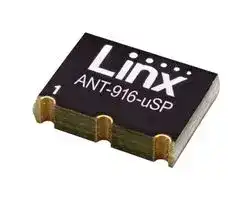
Image not available
Illustrative purposes only

ANT-403-USP-T
RF Antenna, 400 to 406MHz, -8.7dBi, Bluetooth / Zigbee, 50ohm, Linear, SMD
⚠️ Reference pricing provided. In case of supply shortages, we will connect you with our trusted procurement partners to ensure your project's continuity.
- Manufacturer: TE CONNECTIVITY - LINX
- Product type:
- Gain: -8.7dBi
- SVHC: To Be Advised
- VSWR: 2
- Input Power: -
- Frequency Max: 406MHz
- Frequency Min: 400MHz
- Product Range: uSP Series
- Input Impedance: 50ohm
- Antenna Mounting: SMD
- Antenna Polarisation: Linear
| Delivery and price | |
|---|---|
| Units per pack | 5000 |
| Price | 0.8 € |
| Current stock | 10+ |
| Lead time | 30 days |
Datasheet

## **ANT-403-USP Data Sheet**

## Product Description

The µSplatch™ uses a grounded-line technique to achieve outstanding performance from a tiny surface-mount element. This unique antenna is designed for hand or reflow-mounting directly to a product’s circuit board. Its low cost makes it ideal for volume applications. Unlike many compact antennas, the µSplatch™ exhibits good proximity performance, making it an appropriate choice for handheld applications such as remote controls, pagers and alert devices.

## Features

- Very low cost

- Ultra-compact package

- Direct PCB attachment

- Ideal for concealed / internal mounting

- Perfect for compact portable devices

- Suitable for hand- or reflow-assembly

- Resistant to proximity effects

## Electrical Specifications

Center Frequency: 403MHz Recom. Freq. Range: 400 – 406MHz Bandwidth: 6MHz Wavelength: ¼-wave VSWR: ≤ 2.0 typical at center Peak Gain: –8.7dBi Impedance: 50-ohms Connection: Surface-mount Oper. Temp. Range: –40°C to +130°C

Electrical specifications and plots measured on 3.88 cm x 8.00 cm (1.53” x 3.15”) reference ground plane.

## Ordering Information

ANT-403-USP (supplied in tubes of 63 pieces) ANT-403-USP-T (Tape and reel of 1,000 pieces)

## by

**==> picture [185 x 124] intentionally omitted <==**

**----- Start of picture text -----**<br>
12.70 mm<br>(0.5")<br>9.14 mm<br>(0.36")<br>2.62 mm M A AR A<br>(0.103") ee 5.1 mm ee 1.27 mm<br>(0.20") (0.05")<br>**----- End of picture text -----**<br>


## Recommended Footprint

**==> picture [223 x 373] intentionally omitted <==**

**----- Start of picture text -----**<br>
5.1 mm<br>(0.20")<br>2.54 mm<br>(0.10")<br>io<br>2.03 mm<br>(0.08")<br>Recommended Mounting<br>40.37 mm<br>(1.59”)<br>7.11 mm<br>(0.28”)<br>No ground plane or traces<br>10.54 mm under the antenna<br>(0.42”)<br>PCB pads for the µSplatch<br>Vias to ground plane<br>Ground plane on bottom<br>layer for counterpoise<br>50-ohm microstrip line<br>(0.21” minimum)<br>91.82 mm 79.88 mm<br>(3.62”) (3.15”)<br>J 7.62 mm(0.03”) a 38.86 mm n 7.62 mm(0.03”)<br>(1.53”)<br>**----- End of picture text -----**<br>


Please see AN-00502 for more details on PCB layout.

Revised 1/3/2017

– **1** –

## Counterpoise

Quarter-wave or monopole antennas require an associated ground plane counterpoise for proper operation. The size and location of the ground plane relative to the antenna will affect the overall performance of the antenna in the final design. When used in conjunction with a ground plane smaller than that used to tune the antenna, the center frequency typically will shift higher in frequency and the bandwidth will decrease. The proximity of other circuit elements and packaging near the antenna will also affect the final performance. For further discussion and guidance on the importance of the ground plane counterpoise, please refer to Linx Application Note AN-00501: Understanding Antenna Specifications and Operation.

## VSWR Graph

**==> picture [359 x 139] intentionally omitted <==**

**----- Start of picture text -----**<br>
VSWR 1.38 Reflected Power<br>3:1 25%<br>2:1<br>1:1 0%<br>353MHz 403MHz 453MHz<br>**----- End of picture text -----**<br>


## What is VSWR?

The Voltage Standing Wave Ratio (VSWR) is a measurement of how well an antenna is matched to a source impedance, typically 50-ohms. It is calculated by measuring the voltage wave that is headed toward the load versus the voltage wave that is reflected back from the load. A perfect match has a VSWR of 1:1. The higher the first number, the worse the match, and the more inefficient the system. Since a perfect match cannot ever be obtained, some benchmark for performance needs to be set. In the case of antenna VSWR, this is usually 2:1. At this point, 88.9% of the energy sent to the antenna by the transmitter is radiated into free space and 11.1% is either reflected back into the source or lost as heat on the structure of the antenna. In the other direction, 88.9% of the energy recovered by the antenna is transferred into the receiver. As a side note, since the “:1” is always implied, many data sheets will remove it and just display the first number.

## How to Read a VSWR Graph

VSWR is usually displayed graphically versus frequency. The lowest point on the graph is the antenna’s operational center frequency. In most cases, this is different than the designed center frequency due to fabrication tolerances. The VSWR at that point denotes how close to 50-ohms the antenna gets. Linx specifies the recommended bandwidth as the range where the typical antenna VSWR is less than 2:1.

ANT-403-USP Data Sheet

**– 2** –

by

## Gain Plots

**==> picture [416 x 187] intentionally omitted <==**

**----- Start of picture text -----**<br>
E / Vertical Gain<br>H / Horizontal Gain<br>Total Gain<br>XZ-Plane Gain YZ-Plane Gain XY-Plane Gain<br>**----- End of picture text -----**<br>


## About Gain Plots

The true measure of the effectiveness of an antenna in any given application is determined by the gain and radiation pattern measurement. For antennas gain is typically measured relative to a perfect (isotropic) radiator having the same source power as the antenna under test, the units of gain in this case will be decibels isotropic (dBi). The radiation pattern is a graphical representation of signal strength measured at fixed distance from the antenna.

Gain when applied to antennas is a measure of how the antenna radiates and focuses energy into free space. Much like a flashlight focuses light from a bulb in a specific direction, antennas focus RF energy into specific directions. Gain in this sense refers to an increase in energy in one direction over others.

It should also be understood that gain is not “free”, gain above 0dBi in one direction means that there must be less gain in another direction. Pictorially this can be pictured as shown in the figures to the right. The orange pattern represents the radiation pattern for a perfect dipole antenna, which is shaped like a donut. The pattern for an omnidirectional antenna with gain is shown in blue. The gain antenna is able to work with a device located further from the center along the axis of the pattern, but not with devices closer to the center when they are off the axis – the donut has been squished.

Gain is also related to the overall physical size of the antenna, as well as

surrounding materials. As the geometry of the antenna is reduced below the effective wavelength (considered an electrically small antenna) the gain decreases. Also, the relative distance between an electrically small antenna and its associated ground impacts antenna gain.

Copyright © 2017 Linx Technologies

159 Ort Lane, Merlin, OR 97532 Phone: +1 541 471 6256 Fax: +1 541 471 6251 www.linxtechnologies.com

ANT-403-USP Data Sheet

– **3** –

by
Updated at June 9, 2026
About Novapart
Novapart is a B2B electronic component broker specialising in stock shortages and cost reduction. We source hard-to-find parts and identify compliant alternatives across a catalogue of 410,000+ components from 500+ manufacturers.
Learn more →Stock Shortage Specialist
When a component is unavailable, discontinued or has an unacceptable lead time, we tap into our network of vetted European and Asian distributors to source what you need — without compromising on quality or traceability.
Request a quote →Compliant Alternatives
We identify pin-to-pin, electrically equivalent substitutes that meet the same certifications (RoHS, AEC-Q100, REACH) as your original specification — validated against datasheets, not just part numbers. Often at a lower cost.
BOM Analysis service →