
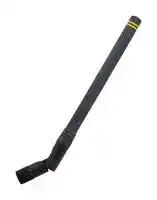
Image not available
Illustrative purposes only

ANT-2.4-CW-HWR-RPS
RF Antenna, 2.3 to 2.6MHz, 3.2dBi, WiFi / Bluetooth / Zigbee, 50ohm, Linear, RP SMA Connector
⚠️ Reference pricing provided. In case of supply shortages, we will connect you with our trusted procurement partners to ensure your project's continuity.
- Manufacturer: TE CONNECTIVITY - LINX
- Product type:
- Gain: 3.2dBi
- SVHC: Lead (21-Jan-2025)
- VSWR: 2
- Input Power: -
- Antenna Type: WiFi / Bluetooth / Zigbee
- Frequency Max: 2.6MHz
- Frequency Min: 2.3MHz
- Product Range: HWR Series
- Input Impedance: 50ohm
- Antenna Mounting: RP SMA Connector
- Antenna Polarisation: Linear
| Delivery and price | |
|---|---|
| Units per pack | 250 |
| Price | 10.88 € |
| Current stock | 10+ |
| Lead time | 30 days |
Datasheet

## **ANT-2.4-CW-HWR-ccc Data Sheet**

## Product Description

HWR Series ½-wave center-fed dipole antennas deliver outstanding performance in a rugged and cosmetically attractive package. The articulating base allows the antenna to tilt 90 degrees and rotate 360 degrees. The antenna’s internal counterpoise eliminates external ground plane dependence and maximizes performance. HWR Series antennas attach via a standard SMA or Part 15 compliant RP-SMA connector. Custom colors and connectors are available for volume OEM customers.

## Features

- Internal counterpoise

- Low cost

- Tilts and rotates

- Omni-directional pattern

- Outstanding VSWR

- Rugged & damage-resistant

- Standard SMA or Part 15 compliant RP-SMA connector

- Custom colors and terminations for volume OEMs

- Internal O-ring seal on connector

## Electrical Specifications

Center Frequency: 2.4GHz Recom. Freq. Range: 2.3–2.6GHz Bandwidth: 300MHz Wavelength: ½-wave VSWR: ≤ 2.0 typical Peak Gain: 3.2dBi Impedance: 50-ohms Connection: RP-SMA or SMA Oper. Temp. Range: –30°C to +80°C Electrical specifications and plots measured with a 10.16 cm x 10.16 cm (4.00” x 4.00”) reference ground plane

**==> picture [16 x 14] intentionally omitted <==**

**----- Start of picture text -----**<br>
by<br>**----- End of picture text -----**<br>


**==> picture [28 x 18] intentionally omitted <==**

**----- Start of picture text -----**<br>
8.2 mm<br>(0.32")<br>**----- End of picture text -----**<br>


**==> picture [203 x 223] intentionally omitted <==**

**----- Start of picture text -----**<br>
116 mm<br>(4.57")<br>142 mm<br>(5.59")<br>26 mm<br>(1.02")<br>10 mm 30 mm<br>(0.39") (1.18")<br>**----- End of picture text -----**<br>


## Ordering Information

ANT-2.4-CW-HWR-RPS (with RP-SMA connector) ANT-2.4-CW-HWR-SMA (with SMA connector)

Revised 8/1/2017

– **1** –

## VSWR Graph

**==> picture [366 x 143] intentionally omitted <==**

**----- Start of picture text -----**<br>
VSWR 1.084 Reflected Power<br>3:1 25%<br>2:1 11%<br>1:1 0%<br>2.3GHz 2.45GHz 2.6GHz<br>**----- End of picture text -----**<br>


## What is VSWR?

The Voltage Standing Wave Ratio (VSWR) is a measurement of how well an antenna is matched to a source impedance, typically 50-ohms. It is calculated by measuring the voltage wave that is headed toward the load versus the voltage wave that is reflected back from the load. A perfect match has a VSWR of 1:1. The higher the first number, the worse the match, and the more inefficient the system. Since a perfect match cannot ever be obtained, some benchmark for performance needs to be set. In the case of antenna VSWR, this is usually 2:1. At this point, 88.9% of the energy sent to the antenna by the transmitter is radiated into free space and 11.1% is either reflected back into the source or lost as heat on the structure of the antenna. In the other direction, 88.9% of the energy recovered by the antenna is transferred into the receiver. As a side note, since the “:1” is always implied, many data sheets will remove it and just display the first number.

## How to Read a VSWR Graph

VSWR is usually displayed graphically versus frequency. The lowest point on the graph is the antenna’s operational center frequency. In most cases, this is different than the designed center frequency due to fabrication tolerances. The VSWR at that point denotes how close to 50-ohms the antenna gets. Linx specifies the recommended bandwidth as the range where the typical antenna VSWR is less than 2:1.

Copyright © 2017 Linx Technologies

159 Ort Lane, Merlin, OR 97532 Phone: +1 541 471 6256 Fax: +1 541 471 6251 www.linxtechnologies.com

**– 2** – ANT-2.4-CW-HWR-ccc Data Sheet

by
Updated at June 9, 2026
About Novapart
Novapart is a B2B electronic component broker specialising in stock shortages and cost reduction. We source hard-to-find parts and identify compliant alternatives across a catalogue of 410,000+ components from 500+ manufacturers.
Learn more →Stock Shortage Specialist
When a component is unavailable, discontinued or has an unacceptable lead time, we tap into our network of vetted European and Asian distributors to source what you need — without compromising on quality or traceability.
Request a quote →Compliant Alternatives
We identify pin-to-pin, electrically equivalent substitutes that meet the same certifications (RoHS, AEC-Q100, REACH) as your original specification — validated against datasheets, not just part numbers. Often at a lower cost.
BOM Analysis service →