
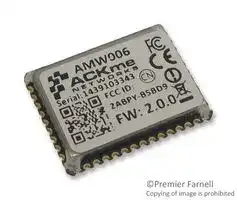


AMW006
Wi-Fi Networking Module, Ultra-Low Power, Battery Powered Applications, TCP/IP Networking Stack
- Manufacturer: SILICON LABS
- Product type: WLAN Modules & USB Adaptors
- Frequency RF: 2.4GHz
- Module Interface: SPI, UART
- Module Applications: Consumer, Health & Fitness, Industrial, M2M & Home Automation, Security
| Delivery and price | |
|---|---|
| Units per pack | 100 |
| Price | 11.91 € |
| Current stock | 10+ |
| Lead time | 30 days |

**AMW006** **`•` Embedded Wi-Fi Networking Solution**

## **AMW006 Data Sheet**

ADS-MW006-100R `•` Preliminary Data Sheet _©2014 ACKme Networks. http://ack.me_

October 20, 2014

AMW006 `•` Embedded Wi-Fi Networking Solution

## **Disclaimer**

While the information provided in this document is believed to be accurate, it is under development and ACKme Networks reserves the right to make changes without further notice to the product described herein to improve reliability, function, or design, and makes no guarantee or warranty concerning the accuracy of said information, nor shall it be responsible for any loss or damage of whatever nature resulting from the use of, or reliance upon, such information. ACKme Networks makes no warranties of any kind, whether express, implied or arising by custom or course of trade or performance, and specifically disclaims the implied warranties of title, non-infringement, merchantability, or fitness for a particular purpose.

No part of this document may be copied, reproduced, stored in a retrieval system, or transmitted, in any form or by any means, electronic, mechanical, photographic, or otherwise, or used as the basis for manufacture or sale of any items without the prior written consent of ACKme Networks.

## **Contact**

http://ack.me/contact

## **About this Data Sheet**

This document provides information on the AMW006 802.11b/g/n Wi-Fi networking module from ACKme Networks.  Specifications for the module I/O and peripherals are taken from MCU datasheet. Specifications for the WLAN subsystem were compiled from measured data unless otherwise noted.

## **Organization**

This data sheet is organized into the following sections:

- Features & Applications

- General Description, Section 1

- Block Diagram, Section 2

- Electrical Specifications, Section 3

- WLAN RF Specifications, Section 4

- Pinout and Signal Descriptions, Section 5

- Design Guidelines, Section 6

## **Trademarks**

ACKme Networks and the ACKme Networks logo are trademarks of ACKme Networks. Other trademarks in this document belong to their respective owners.

- Regulatory Certification, Section 7

- Packaging, Handling & Storage, RoHS, Section 8

- Ordering Information, Section 9

- Revision History & Glossary, Section 10

- References, Section 11

Copyright © 2014 ACKme Networks.

All rights reserved.

Document Number: ADS-MW006 Release Date: October 20, 2014

ADS-MW006-100R `•` Preliminary Data Sheet _©2014 ACKme Networks. http://ack.me_

October 20, 2014

## **AMW006 Data Sheet Embedded Wi-Fi Networking Solution**

## **Features**

- Self-contained ultra-low power Wi-Fi module with microcontroller and secure TCP network stack.

- Integrated SPI-serial flash for software upgrades and user accessible read/write file system

- Maximum RF transmit power `-` 802.11b/g : +19 dBm

   - 802.11n : +14 dBm

- Minimum Receive sensitivity

   - 802.11b/g : -94 dBm

   - 802.11n : -86 dBm

## Wi-Fi

- Broadcom single band 2.4GHz IEEE 802.11b/g/n 1x1 Wi-Fi transceiver

- Includes support for all Wi-Fi security modes including Open, WEP, WPA, and WPA2-PSK

## Microprocessor

- ARM Cortex M4 based microprocessor operating at up to 84MHz for 105 DMIPs

## Interfaces*

- UART: 2 x 4-wire up to 10.5Mbit/s

- SPI : SPI-Master (42Mbit/s), SPI-Slave (21Mbit/s)

- GPIO: Up to 21 GPIOs (overlaid with peripherals)

- A/D converter: 9 channel input, 12-bit resolution, 2.4MSPS sampling in single-shot or scan mode

- PWM: Up to 14 PWM outputs

- Wake-up: Wake pin for ultra-low power operation

- Two external antennas for diversity and improved range

- Sustained TCP throughput : 10 Mbit/s

## **Applications**

- Industrial, M2M and Home Automation

   - Environmental monitoring

   - Energy monitoring

   - Wireless sensing, remote data logging

   - HVAC, power, light, & thermostat control

   - Appliance control

- Security

   - Cameras, Doors/Window monitoring

   - Alarms, Smoke Detectors

   - Door and entry control

- Health & Fitness

   - Fitness Equipment

   - Home health monitoring e.g. weight scales

- Consumer

   - Audio, Toys, Robots

> _[*] Some interfaces share module pins_

## **Operational & Radio**

- Single operating voltage : 3.3V (typical)

- Operational Temperature Range: -30°C to +85°C

- Size : 20.3 x 15.2 x 2.7mm (0.80” x 0.60” x 0.11”)

- Weight : 0.07 oz (2g)

- Current consumption @ 3.3V, 25°C

   - VBAT : 0.97µA (with 32k RTC)

   - Standby : 2.8µA (3.8uA with 32k RTC)

   - Stop : 10µA with RAM retention (113µs wake)

   - Wi-Fi Powersave : 0.77mA (DTIM = 3)

   - Active receive : 5.7mA @ 1Mbit/s UDP

   - Active transmit : 11.4mA @ 1Mbit/s UDP

ADS-MW006-100R `•` Preliminary Data Sheet _©2014 ACKme Networks. http://ack.me_

October 20, 2014

AMW006 `•` Embedded Wi-Fi Networking Solution

## **Contents**

|1|General Description ............................................... 1|
|---|---|
|2|Block Diagram ........................................................ 2|
|3|Electrical Specifications .......................................... 3|
||3.1<br>Absolute Maximum Ratings ............................ 3|
||3.2<br>Recommended Operating Conditions ............ 3|
||DC Operating Conditions ........................ 3<br>301|
||Environmental Conditions ...................... 4<br>3290|
||3.3<br>Power Consumption ....................................... 4|
||3.4<br>32kHz Crystal .................................................. 4|
|4|WLAN RF Specifications ......................................... 5|
||4.1<br>Summary WLAN Specifications ....................... 5|
||4.2<br>WLAN Receiver Specifications ........................ 5|
||4.3<br>WLAN Transmitter Specifications ................... 6|
|5|Pinout and Signal Descriptions .............................. 7|
||5.1<br>Pinout.............................................................. 7<br>5.2<br>Pin Description ................................................ 7|
|6|Design Guidelines ................................................... 9|
||6.1<br>Recommended PCB Footprint ........................ 9|
||6.2<br>Routing Recommendations ............................ 9|
||6.3<br>Soldering Information ..................................... 9|
||6.4<br>Module Photograph ........................................ 9|
||6.5<br>External Antennas ......................................... 10<br>PCB Trace Antenna ............................... 10<br>6.5.1|
||Wire Antenna ........................................ 10<br>6.5.2|
||Whip Antenna ....................................... 10<br>6.5.3|
||6.6<br>Application Examples .................................... 11|
||Operation using WiConnect ................. 11<br>6.6.1|
|7|Regulatory Certification ....................................... 12|
||7.1<br>United States ................................................ 12|
||Labeling<br>and<br>User<br>Information<br>7.1.1|
||Requirements ....................................................... 12|
||RF Exposure .......................................... 13<br>7.1.2|


||Approved External Antenna Types ....... 13<br>7.1.3|
|---|---|
||Further Information .............................. 13<br>7.1.4|
||7.2<br>Canada .......................................................... 13|
||Labeling<br>and<br>User<br>Information<br>7.2.4|
||Requirements....................................................... 13|
||External Antenna Types ........................ 15<br>7.2.2|
||Further Information .............................. 15<br>7.2.3|
||7.3<br>Europe .......................................................... 15|
||Labeling<br>and<br>User<br>Information<br>7.3.1|
||Requirements....................................................... 16|
||External Antenna Requirements .......... 16<br>7.3.1|
||Further Information .............................. 16<br>7.3.2|
||7.4<br>Australia ........................................................ 17|
||External Antenna Requirements .......... 17<br>7.4.1|
||Further Information .............................. 17<br>7.4.2|
||7.5<br>New Zealand ................................................. 17|
||External Antenna Requirements .......... 17<br>7.5.1|
||Further Information .............................. 17<br>7.5.2|
|8|Packaging, Handling &  Storage, RoHS ................. 18|
||8.1<br>Packaging ...................................................... 18|
||8.2<br>Handling & Storage ....................................... 18|
||8.3<br>RoHS Directive .............................................. 18|
|9|Ordering Information ........................................... 19|
|10|10<br>Revision History & Glossary ................................. 20|
||10.1<br>Revision History ............................................ 20|
||10.2<br>Glossary ........................................................ 20|
|11|11<br>References ........................................................... 21|


ADS-MW006-100R `•` Preliminary Data Sheet _©2014 ACKme Networks. http://ack.me_

October 20, 2014

General Description, Section 1

AMW006 `•` Embedded Wi-Fi Networking Solution

## **1 General Description**

The AMW006 module from ACKme Networks combines a microcontroller with a BCM43362 Wi-Fi device to provide an advanced stand-alone Wi-Fi and networking solution.

An integrated module avoids difficult RF layout and enables designers to rapidly embed Wi-Fi and secure networking functionality into virtually any device.

The ACKme Networks WiConnect serial-to-Wi-Fi application, pre-programmed into all modules, may be used to fast-track module integration into end-products.

With dimensions of just 20.3mm x 15.2mm and a wide temperature range, the module is suitable for integration into most embedded applications.

The Wi-Fi device from Broadcom includes an integrated RF transmit power amplifier and provides superior Wi-Fi performance and full compatibility with all 2.4GHz 802.11b/g/n Wi-Fi networks. Connections for two external antennas provide applications with maximum radio range and mechanical design flexibility.

The module is powered by a 3.3V power supply, a  separate WLAN power supply pin is provided to minimize noise coupling into the WLAN subsystem.

Various powersave modes offer ultra-low power operation. Wake from low power sleep mode is possible using IO pins or the internal real-time clock, and wake from ultra-low power standby mode is achieved using the dedicated wake pin.

The module incorporates a 32.768kHz crystal to maintain an accurate real time clock. A 32kHz clock output is available on a dedicated module pin in both active power save modes. The 32kHz clock output may be used to drive the clock input of other system devices. This avoids the need for an additional crystal thereby minimizing total system cost.

The module has FCC & IC modular approval for use in the United States and Canada, and CE approval for use in Europe and other countries.

The microprocessor is based on a high-performance ARM® 32-bit Cortex™-M4 operating at a frequency up to 84MHz providing 1.25 DMIPS/MHz. An extensive range of enhanced I/Os and peripherals are also available.

The AMW006 module offers extensive I/O and peripheral interfaces listed below, and provides additional interface combinations by leveraging multiplexing and alternate function capabilities.

- 2 x 4-Wire UART interfaces

- 2 x SPI interfaces (1 master, 1 slave)

- 21 x GPIOs

- 9 x 12-bit A/D converters

- 14 x PWM outputs

- 1 x ultra-low power wake input

ADS-MW006-100R `•` Preliminary Data Sheet _©2014 ACKme Networks. http://ack.me_

October 20, 2014

Block Diagram, Section 2

AMW006 `•` Embedded Wi-Fi Networking Solution

## **2 Block Diagram**

Figure 1 is a block diagram of the AMW006 module. The main components of the module are a microprocessor and BCM43362 Wi-Fi System-on-Chip (SoC). The processor and peripherals are driven by a 26MHz crystal. The integrated real-time clock (RTC) is driven by a 32.768kHz crystal.  An on-board 1MByte serial flash chip may be used to store user data and configuration, additional applications, and firmware images as part of the ACKme secure over the air (OTA) update process.

The WLAN subsystem is controlled by WiConnect enabling the module to achieve minimum power consumption when the Wi-Fi networking interface is not required.

The module includes an antenna diversity switch. The switch enables static or dynamic control of the external antenna(s).

**Figure 1.  AMW006 Architecture**

**==> picture [418 x 212] intentionally omitted <==**

**----- Start of picture text -----**<br>
32kHz 26MHz<br>VBAT<br>3v3 MCU 1 MByte<br>3v3 Wi-Fi Serial Flash<br>ARM<br>32kHz Out Cortex M4  Antenna<br>ADC 84 MHz  Switch<br>PWM Antenna 1<br>BCM43362<br>UART  512 kB Flash<br>Wi-Fi<br>SPI 96 kB RAM Antenna 2<br>GPIO<br>Reset<br>AMW006<br>**----- End of picture text -----**<br>


ADS-MW006-100R `•` Preliminary Data Sheet _©2014 ACKme Networks. http://ack.me_

October 20, 2014

Electrical Specifications, Section 3

AMW006 `•` Embedded Wi-Fi Networking Solution

## **3 Electrical Specifications**

## **3.1 Absolute Maximum Ratings**

CAUTION! The absolute maximum ratings in Table 1 and Table 2 indicate levels where permanent damage to the device can occur, even if these limits are exceeded for only a brief duration. Functional operation is not guaranteed under these conditions. Operation at absolute maximum conditions for extended periods can adversely affect longterm reliability of the device.

The values in Table 1 reflect absolute maximum ratings from the respective microprocessor and BCM43362 datasheets.

**Table 1.  Absolute Maximum Voltage Ratings**

|**Symbol**|**Ratings**|**Min**|**Max**|**Unit**|
|---|---|---|---|---|
|VBAT|External power supply voltage to MCU VBAT pin|-0.3|4.0|V|
|VDD_3V3|External power supply voltage to MCU subsystem|-0.3|4.0||
|VDD_3V3_WIFI|External power supply voltage to WLAN subsystem|-0.5|6.0||
|Vin|Input voltage on any other MCU pin|GND - 0.3|VDD_3V3 + 4.0||


**Table 2.  Absolute Maximum Environmental Ratings**

|**Characteristic**|**Note**|**Min**|**Max**|**Unit**|
|---|---|---|---|---|
|Storage Temperature|–|-40|+125|°C|
|Relative Humidity|Non-condensing (storage)|–|65|%|


## **3.2 Recommended Operating Conditions**

Functional operation is not guaranteed outside the limits shown in Table 3 and Table 4, and operation outside these limits for extended periods can adversely affect long-term reliability of the device.

## **DC Operating Conditions**

**Table 3.  Recommended DC Operating Conditions**

|**Symbol**|**Ratings**|**Min**|**Typ**|**Max**|**Unit**|
|---|---|---|---|---|---|
|VBAT|External power supply voltage to MCU VBAT pin|3.0|3.3|3.6|V|
|VDD_3V31|External power supply voltage to MCU subsystem|3.0|3.3|3.6||
|VDD_3V3_WIFI1,2|External power supply voltage to WLAN subsystem|3.0|3.3|3.6||


## _**Notes** :_

_1. VDD_3V3 and VDD_3V3_WIFI must be at the same voltage when using the Wi-Fi subsystem_

_2. The performance of the Wi-Fi subsystem is degraded significantly at low voltages_

ADS-MW006-100R `•` Preliminary Data Sheet _©2014 ACKme Networks. http://ack.me_

October 20, 2014

Electrical Specifications, Section 3

AMW006 `•` Embedded Wi-Fi Networking Solution

## **Environmental Conditions**

**Table 4.  Recommended Environmental Conditions**

|**Characteristic**|**Note**|**Min**|**Max**|**Unit**|
|---|---|---|---|---|
|Ambient Temperature|Limited by WLAN chip specification|-30|+85|°C|
|Relative Humidity|Non-condensing (operating)|–|85|%|


## **3.3 Power Consumption**

**Table 5.  Power consumption (VDD_3V3, VDD_3V3_WIFI, VBAT @ 3.3V)**

|**Operational State**<br>~~ee~~<br>~~TTT~~|**Note**<br>~~ee~~<br>~~TTT~~|**Typ1**<br>~~eee~~|**Max1**<br>~~eee~~|**Max1**<br>~~eee~~|**Unit**<br>~~eee~~<br>~~TTT~~|
|---|---|---|---|---|---|
|||~~eee~~<br>~~TTT~~|**TA =**<br>**25**°**C**<br>~~eee~~<br>~~TTT~~|**TA =**<br>**85**°**C**<br>~~eee~~<br>~~TTT~~||
|VBAT<br>~~ee~~<br>~~TTT~~|MCU VBAT Mode, RTC on, Wi-Fi powered off<br>~~ee ~~<br>~~TTT~~|0.97<br> ~~eee~~<br>~~TTT~~|–<br>~~eee~~<br>~~TTT~~<br>~~—~~|3.0<br>~~eee~~<br>~~TTT~~<br>~~—~~|µA<br>~~eee~~<br>~~TTT~~|
|Standby|MCU Standby Mode, RTC on, Wi-Fi powered off|3.8|5.0<br>~~—~~|17.0<br>~~—~~|µA|
|Stop3<br>~~oo~~|MCU Stop Mode, Wi-Fi powered off<br>~~oo~~|10<br>~~oo~~|28<br>~~—~~<br>~~oo~~|230<br>~~—~~<br>~~oo~~|µA<br>~~oo~~|
|Wi-Fi Powersave2,3<br>~~oo~~<br>~~A~~|MCU Stop mode, Wi-Fi in powersave<br>~~oo~~<br>~~A~~|0.77<br>~~oo~~<br>~~A~~|–<br>~~oo~~<br>~~A~~|–<br>~~oo~~<br>~~A~~|mA<br>~~oo~~<br>~~A~~|
|Active Receive2,3,4<br>~~OO~~|MCU Stop mode, Wi-Fi active receive<br>~~OO~~|5.7<br>~~OO~~|–<br>~~OO~~<br>~~—~~|–<br>~~OO~~<br>~~—~~|mA<br>~~OO~~|
|Active Transmit2,3,5|MCU Stop mode, Wi-Fi active transmit|11.4|–<br>~~—~~|–<br>~~—~~|mA|
|Wi-Fi Tx Test Mode6<br>~~i~~|MCU Stop mode, Wi-Fi active transmit<br>~~i~~|–<br>~~i~~|320<br>~~—~~<br>~~i~~|–<br>~~—~~<br>~~i~~|mA<br>~~i~~|


## _**Notes** :_

_1. Total combined current consumed by all power supplies: VBAT, VDD_3V3, VDD_3V3_WIFI._

_2. 802.11 beacon Interval = 102.4ms, DTIM=3, Beacon Duration = 1ms @ 1Mbps._

_3. MCU Stop Mode with 113µs wakeup latency (flash in deep power down mode)_

_4. Average current receiving 1Mbit/s UDP at 802.11n MCS7_

_5. Average current transmitting 1Mbit/s UDP at 802.11n MCS7_

_6. Wi-Fi Transmitting at +18dBm CCK 11Mbit/s with maximum duty cycle_

## **3.4 32kHz Crystal**

**Table 6.  32kHz Crystal Specifications[1]**

|**Operational State**|**Note**|**Min**|**Typical**|**Max**|**Unit**|
|---|---|---|---|---|---|
|Frequency||–|32768|–|Hz|
|Frequency Tolerance||–|20|–|ppm|
|Frequency Ageing|Measured @25°C ±3°C|-3|–|+3|ppm|


## _**Notes** :_

1. _Reproduced from manufacturer’s datasheet._

ADS-MW006-100R `•` Preliminary Data Sheet _©2014 ACKme Networks. http://ack.me_

October 20, 2014

WLAN RF Specifications, Section 4

AMW006 `•` Embedded Wi-Fi Networking Solution

## **4 WLAN RF Specifications**

The AMW006 WLAN radio specifications are derived from the Broadcom BCM43362 WLAN radio specifications.

Unless otherwise stated, the specifications in this section apply when the operating conditions are within the limits specified in Section 3.2, Recommended Operating Conditions. Functional operation outside these limits is not guaranteed.

All specifications are measured by connecting directly to either of the antenna ports via a short PCB trace with the other antenna port terminated in 50 ohms.

## **4.1 Summary WLAN Specifications**

**Table 7.  Summary WLAN Specifications**

|**Feature Supported**|**Description**|
|---|---|
|WLAN Standard|IEEE 802.11b/g/n 1x1 SISO|
|Frequency Band|2.400 GHz  – 2.484 GHz|
|WLAN Channels|Channels 1 – 13|
|Data Rates|802.11b (1, 2, 5.5, 11 Mbps)<br>802.11g (6, 9, 12, 24, 36, 48, 54 Mbps)<br>802.11n (HT20 MCS0-MCS7)|
|Maximum Receive level<br>@ 2.4GHz|-2.5 dBm @ 1, 2 Mbps (8% PER, 1024 octets)<br>-8.5 dBm @ 5.5, 11 Mbps (8% PER, 1024 Octets)<br>-12 dBm @ 6-54 Mbps (10% PER, 1000 Octets)|
|Maximum RF Tx Output Power|+19 dBm @ 802.11b (EVM < -9 dB)<br>+14 dBm @ 802.11n MCS7 (EVM < -28 dB)|
|Carrier Frequency Accuracy|±20 ppm (26MHz crystal with ±10 ppm @ 25C)|


## **4.2 WLAN Receiver Specifications**

**Table 8.  WLAN Receiver Performance Specifications**

|**Parameter**|**Condition/Notes**|**Min**|**Typical**|**Max**|**Unit**|
|---|---|---|---|---|---|
|Frequency Range|–|2400|–|2500|MHz|
|Operating Temperature1|–|-30|–|+85|°C|
|Receive Sensitivity2<br>(8% PER for 1024 octet PSDU)<br>at either antenna port3|1 Mbps DSSS|–|-94|-91|dBm|
||11 Mbps CCK|–|-87|-83||
|Receive Sensitivity2<br>(10% PER for 1000 octet<br>PSDU) at either antenna port3|6 Mbps OFDM|–|-86|-81|dBm|
||54 Mbps OFDM|–|-73|-69||


ADS-MW006-100R `•` Preliminary Data Sheet _©2014 ACKme Networks. http://ack.me_

October 20, 2014

WLAN RF Specifications, Section 4

AMW006 `•` Embedded Wi-Fi Networking Solution

|**Parameter**|**Condition/Notes**|**Min**|**Typical**|**Max**|**Unit**|
|---|---|---|---|---|---|
|Receive Sensitivity2<br>(10% PER for 4096 octet<br>PSDU) at either antenna port3.<br>Defined for default parame-<br>ters: GF, 800ns GI, and non-<br>STBC|65 Mbps MCS0, HT20|–|-86|-81|dBm|
||65 Mbps MCS7, HT20|–|-70|-65||
|Max. Receive Level @ 2.4GHz|@ 1, 2 Mbps (8% PER, 1024 octets)|-2|–|–|dBm|
||@ 5.5, 11 Mbps (8% PER, 1024 Octets)|-8|–|–||
||@ 6-54 Mbps (10% PER, 1000 Octets)|-11.5|–|–||


## _**Notes** :_

_1. Operation below -20°C and above +65°C with parameter derating per Note 2_

_2. Derate receive sensitivity by 1.5dB for operation between temperatures of -30°C to -20°C and 65°C to 85°C_

_3. All measurements performed with the other antenna port terminated in 50 ohms_

## **4.3 WLAN Transmitter Specifications**

**Table 9.  WLAN Transmitter Performance Specifications**

|**Parameter**<br>~~a~~|**Condition/Notes**<br>~~O~~|**Condition/Notes**<br>~~O~~|**Min**<br>~~O~~|**Typical**|**Max**|**Unit**|
|---|---|---|---|---|---|---|
|Frequency Range<br>~~a~~|–<br>~~a~~||2400<br>~~a~~|–<br>~~a~~|2500<br>~~a~~|MHz<br>~~a~~|
|Operating Temperature1<br>~~a~~<br>~~a~~|–<br>~~a~~<br>~~a~~||-30<br>~~a~~<br>~~a~~|–<br>~~a~~<br>~~a~~|+85<br>~~a~~<br>~~a~~|°C<br>~~a~~<br>~~a~~|
|Transmit power2measured at<br>either antenna port3for high-<br>est power level setting at<br>25°C, VDD-3V3_RF_IN=3.3V<br>with spectral mask and EVM<br>compliance|**EVM does NOT exceed :**<br>~~a~~||~~a~~||||
||1 Mbps DSSS<br>~~a~~|-11 dB<br>~~a~~|+15<br>~~a~~|+17<br>~~a~~|+19<br>~~a~~|dBm<br>~~a~~<br>~~a~~<br>~~a~~<br>~~a~~<br>~~a~~<br>~~a~~|
||11 Mbps CCK<br>~~a~~|-11 dB<br>~~a~~|+15<br>~~a~~|+17<br>~~a~~|+19<br>~~a~~||
||6 Mbps OFDM<br>~~a~~<br>~~a~~|-22 dB<br>~~a~~<br>~~a~~|+12<br>~~a~~<br>~~a~~|+14<br>~~a~~<br>~~a~~|+16<br>~~a~~<br>~~a~~||
||54 Mbps OFDM<br>~~a~~<br>~~a~~|-25 dB<br>~~a~~<br>~~a~~|+12<br>~~a~~<br>~~a~~|+14<br>~~a~~<br>~~a~~|+16<br>~~a~~<br>~~a~~||
||MCS0, HT20<br>~~a~~|-22 dB<br>~~a~~|+10<br>~~a~~|+12<br>~~a~~|+14<br>~~a~~||
||MCS7, HT20<br>~~a~~<br>~~a~~|-28 dB<br>~~a~~<br>~~a~~|+10<br>~~a~~<br>~~a~~|+12<br>~~a~~<br>~~a~~|+14<br>~~a~~<br>~~a~~||


## _**Notes** :_

_1. Operation below -20°C and above +65°C with parameter derating per Note 2_

_2. Derate transmit power by 1.5dB for operation between temperatures of -30°C to -20°C and 65°C to 85°C_

_3. All measurements performed with the other antenna port terminated in 50 ohms_

ADS-MW006-100R `•` Preliminary Data Sheet _©2014 ACKme Networks. http://ack.me_

October 20, 2014

Pinout and Signal Descriptions, Section 5

AMW006 `•` Embedded Wi-Fi Networking Solution

## **5 Pinout and Signal Descriptions**

## **5.1 Pinout**

A top view of the AMW006 pinout is depicted in Figure 2. All dimensions are in thousands of an inch. A recommended footprint is provided in Section 6.1.

**Figure 2.  AMW006 Pinout (TOP View – Pins NOT visible from top!)**

## **5.2 Pin Description**

**Table 10.  AMW006 WiConnect Pin Definitions**

|**Pin**<br>~~a~~|**Name**<br>~~ee~~|**Type1**<br>~~ee~~|**Primary Function**<br>~~ee~~|**Alternate & Other Function(s)**|
|---|---|---|---|---|
|1-2<br>~~a~~<br>~~ee~~<br>~~a~~<br>~~a~~|GND<br>~~ee~~<br>~~ee~~<br>~~es~~|S<br>~~ee ~~<br>~~ee~~<br>~~es es~~<br>~~es~~|Ground<br> ~~ee~~<br>~~ee~~<br>~~es~~<br>~~es~~|-<br>~~ee~~|
|3<br>~~a~~<br>~~a~~<br>~~a~~|VBAT<br>~~es~~<br>~~es~~|S<br>~~es es~~<br>~~es~~<br>~~es~~|VBAT MCU supply<br>~~es~~<br>~~es~~<br>~~es~~|-|
|4<br>~~a~~<br>~~a~~<br>~~a~~|GPIO_0<br>~~es~~<br>~~es~~<br>~~es~~|I/O<br>~~es ~~<br>~~es~~<br>~~es~~|Factory Reset**2**<br> ~~es~~<br>~~es~~<br>~~es~~|SPI1_MISO (S), GPIO|
|5<br>~~a~~<br>~~a~~<br>~~a~~|GPIO_1<br>~~es~~<br>~~es~~<br>~~es~~|I/O<br>~~es ~~<br>~~es~~<br>~~es~~|GPIO<br> ~~es~~<br>~~es~~<br>~~es~~|-|
|6<br>~~a~~<br>~~a~~<br>~~a~~|GPIO_2<br>~~es~~<br>~~es~~<br>~~ee~~|I/O<br>~~es ~~<br>~~es~~<br>~~es~~|GPIO<br> ~~es~~<br>~~es~~<br>~~es~~|SPI1_SCK (S), ADC|
|7<br>~~a~~<br>~~a~~<br>~~a~~|GPIO_3<br>~~es~~<br>~~ee~~<br>~~ee~~|I/O<br>~~es ~~<br>~~es~~<br>~~es es~~|GPIO<br> ~~es~~<br>~~es~~<br>~~es~~|SPI1_CS (S), ADC|
|8<br>~~a~~<br>~~a~~<br>~~a~~|GPIO_4<br>~~ee ~~<br>~~ee~~<br>~~ee~~|I/O<br> ~~es ~~<br>~~es es~~<br>~~es es~~|GPIO<br> ~~es~~<br>~~es~~<br>~~es~~|ADC|
|9<br>~~a~~<br>~~a~~<br>~~a~~|OSC_32K_OUT<br>~~ee ~~<br>~~ee~~<br>~~ee~~|O<br> ~~es es~~<br>~~es es~~<br>~~es es~~|OSC_32K_OUT<br>~~es~~<br>~~es~~<br>~~es~~|-|
|10<br>~~a~~<br>~~a~~<br>~~a~~|VDD_3V3<br>~~ee ~~<br>~~ee~~<br>~~**e**e~~|I/O<br> ~~es es~~<br>~~es es~~<br>~~es es~~|3.3V MCU supply<br>~~es~~<br>~~es~~<br>~~es~~||
|11-12<br>~~a~~<br>~~a~~|GND<br>~~ee ~~<br>~~**e**e~~<br>~~s~~|S<br> ~~es es~~<br>~~es es~~<br>~~s~~|Ground<br>~~es~~<br>~~es~~<br>~~es~~|-|
|13<br>~~a~~|GPIO_5<br>~~**e**e ~~<br>~~s~~|I/O<br> ~~es es~~<br>~~s~~|GPIO<br>~~es~~<br>~~es~~|SPI1_MOSI (slave), PWM|


ADS-MW006-100R `•` Preliminary Data Sheet _©2014 ACKme Networks. http://ack.me_

October 20, 2014

AMW006 `•` Embedded Wi-Fi Networking Solution

Pinout and Signal Descriptions, Section 5

|**Pin**<br>~~a~~|**Name**|**Type1**|**Primary Function**|**Alternate & Other Function(s)**|
|---|---|---|---|---|
|14<br>~~>~~|GPIO_6<br>~~OT~~|I/O<br>~~OT~~|SPI0_MISO (M)<br>~~TTSt.-mNWw.”-.~~|-<br>~~TTSt.-mNWw.”-.~~|
|15<br>~~STE~~<br>~~Ss~~|GPIO_7<br>~~STE~~<br>~~OC~~|I/O<br>~~STE~~<br>~~OC~~|SPI0_SCK (M)<br>~~STE~~<br>~~OC~~|-<br>~~STE~~<br>~~OC~~|
|16<br>~~Ss~~<br>~~Ss~~|GPIO_8<br>~~OC~~<br>~~OC~~|I/O<br>~~OC~~<br>~~OC~~|SPI0_MOSI (M)<br>~~OC~~<br>~~OC~~|-<br>~~OC~~<br>~~OC~~|
|17<br>~~Ss~~<br>~~Ss~~<br>~~Ss~~|GPIO_9<br>~~OC~~<br>~~OC~~<br>~~OC~~|I/O<br>~~OC~~<br>~~OC~~<br>~~OC~~|GPIO<br>~~OC~~<br>~~OC~~<br>~~OC~~|UART0_RTS<br>~~OC~~<br>~~OC~~<br>~~OC~~|
|18<br>~~Ss~~<br>~~Ss~~<br>~~Ss~~|GPIO_10<br>~~OC~~<br>~~OC~~<br>~~OC~~|I/O<br>~~OC~~<br>~~OC~~<br>~~OC~~|GPIO<br>~~OC~~<br>~~OC~~<br>~~OC~~|UART0_CTS, PWM<br>~~OC~~<br>~~OC~~<br>~~OC~~|
|19<br>~~Ss~~<br>~~Ss~~<br>~~Ss~~|GPIO_11<br>~~OC~~<br>~~OC~~<br>~~OC~~|I/O<br>~~OC~~<br>~~OC~~<br>~~OC~~|UART0_RX<br>~~OC~~<br>~~OC~~<br>~~OC~~|GPIO, PWM<br>~~OC~~<br>~~OC~~<br>~~OC~~|
|20<br>~~Ss~~<br>~~Ss~~<br>~~Ss~~|GPIO_12<br>~~OC~~<br>~~OC~~<br>~~CC~~|I/O<br>~~OC~~<br>~~OC~~<br>~~CC~~|UART0_TX<br>~~OC~~<br>~~OC~~<br>~~CC~~|GPIO, PWM<br>~~OC~~<br>~~OC~~<br>~~CC~~|
|21<br>~~Ss~~<br>~~Ss~~<br>~~Ss~~|GPIO_13<br>~~OC~~<br>~~CC~~<br>~~a~~|I/O<br>~~OC~~<br>~~CC~~<br>~~a~~|GPIO<br>~~OC~~<br>~~CC~~<br>~~a~~|PWM<br>~~OC~~<br>~~CC~~|
|22<br>~~Ss~~<br>~~Ss~~|GPIO_14<br>~~CC~~<br>~~a~~|I/O<br>~~CC~~<br>~~a~~|GPIO<br>~~CC~~<br>~~a~~|PWM<br>~~CC~~|
|23<br>~~Ss ~~<br>~~fe~~|GPIO_15<br> ~~a~~<br>~~fe~~|I/O<br>~~a ~~<br>~~fe~~|GPIO<br> ~~a~~<br>~~fe~~|PWM<br>~~fe~~|
|24<br>~~fe~~<br>~~fe~~|GPIO_16<br>~~fe~~<br>~~fe~~|I/O<br>~~fe~~<br>~~fe~~|GPIO<br>~~fe~~<br>~~fe~~|PWM<br>~~fe~~<br>~~fe~~|
|25<br>~~fe~~<br>~~fe~~|GPIO_17<br>~~fe~~<br>~~fe~~|I/O<br>~~fe~~<br>~~fe~~|GPIO<br>~~fe~~<br>~~fe~~|UART1_RX, ADC, PWM<br>~~fe~~<br>~~fe~~|
|26-27<br>~~fe~~<br>~~fe~~|GND<br>~~fe~~<br>~~fe~~|I/O<br>~~fe~~<br>~~fe~~|Ground<br>~~fe~~<br>~~fe~~|-<br>~~fe~~<br>~~fe~~|
|28<br>~~fe~~<br>~~fe~~|GPIO_18<br>~~fe~~<br>~~fe~~|I/O<br>~~fe~~<br>~~fe~~|GPIO<br>~~fe~~<br>~~fe~~|-<br>~~fe~~<br>~~fe~~|
|29<br>~~fe~~<br>~~fe~~|GPIO_19<br>~~fe~~<br>~~fe~~|I/O<br>~~fe~~<br>~~fe~~|GPIO<br>~~fe~~<br>~~fe~~|UART1_TX, ADC, PWM<br>~~fe~~<br>~~fe~~|
|30<br>~~fe~~<br>~~fe~~|GPIO_20<br>~~fe~~<br>~~fe~~|I/O<br>~~fe~~<br>~~fe~~|GPIO<br>~~fe~~<br>~~fe~~|ADC, PWM<br>~~fe~~<br>~~fe~~|
|31<br>~~fe~~<br>~~fe~~|GPIO_21<br>~~fe~~<br>~~fe~~|I/O<br>~~fe~~<br>~~fe~~|GPIO<br>~~fe~~<br>~~fe~~|ADC, PWM<br>~~fe~~<br>~~fe~~|
|32<br>~~fe~~<br>~~of~~|GPIO_22<br>~~fe~~<br>~~of~~|I/O<br>~~fe~~<br>~~of~~|GPIO<br>~~fe~~<br>~~of~~<br>~~|S€~~|UART1_CTS, WAKE, ADC, PWM<br>~~fe~~<br>~~of~~<br>~~|S€~~|
|33<br>~~TT~~|GPIO_23<br>~~TT~~|I/O<br>~~TT~~|GPIO<br>~~TT~~<br>~~|S€~~<br>~~|S€~~|UART1_RTS, ADC, PWM<br>~~TT~~<br>~~|S€~~<br>~~|S€~~|
|34<br>~~TT~~|RESET_N<br>~~TT~~|I<br>~~TT~~|System Reset<br>~~|S€~~<br>~~TT~~<br>~~|S€~~<br>~~|S€~~|-<br>~~|S€~~<br>~~TT~~<br>~~|S€~~<br>~~|S€~~|
|35<br>~~TT~~|VDD_WIFI<br>~~TT~~|S<br>~~TT~~|3.3V WLAN supply<br>~~|S€~~<br>~~TT~~<br>~~|S€~~<br>~~|S€~~|-<br>~~|S€~~<br>~~TT~~<br>~~|S€~~<br>~~|S€~~|
|36-42<br>~~TT~~|GND<br>~~TT~~|S<br>~~TT~~|Ground<br>~~|S€~~<br>~~TT~~<br>~~|S€~~<br>~~|S€~~|-<br>~~|S€~~<br>~~TT~~<br>~~|S€~~<br>~~|S€~~|
|43<br>~~TT~~|ANTENNA_1<br>~~TT~~|O<br>~~TT~~|Wi-Fi Antenna**3**<br>~~|S€~~<br>~~TT~~<br>~~|S€~~<br>~~|S€~~|-<br>~~|S€~~<br>~~TT~~<br>~~|S€~~<br>~~|S€~~|
|44-46<br>~~TT~~|GND<br>~~TT~~|S<br>~~TT~~|Ground<br>~~|S€~~<br>~~TT~~<br>~~|S€~~<br>~~|S€~~|-<br>~~|S€~~<br>~~TT~~<br>~~|S€~~<br>~~|S€~~|
|47<br>~~TT~~|ANTENNA_2<br>~~TT~~|O<br>~~TT~~|Wi-Fi Antenna**3**<br>~~|S€~~<br>~~TT~~<br>~~|S€~~|-<br>~~|S€~~<br>~~TT~~<br>~~|S€~~|
|48-52<br>~~To”~~|GND<br>~~To”~~|S<br>~~To”~~|Ground<br>~~|S€~~<br>~~To”~~|-<br>~~|S€~~<br>~~To”~~|


## _**Notes:**_

## _1. I = Input, O = Output, S = Supply_

2. _Wi-Fi Antenna pins are AC-coupled and have a nominal 50 ohms output impedance._

3. _Factory reset is sampled at power-on-reset and available for other purposes thereafter._

ADS-MW006-100R `•` Preliminary Data Sheet _©2014 ACKme Networks. http://ack.me_

October 20, 2014

Design Guidelines, Section 6

AMW006 `•` Embedded Wi-Fi Networking Solution

## **6 Design Guidelines**

## **6.1 Recommended PCB Footprint**

All dimensions in Figure 3 are in thousands of an inch unless otherwise marked.

**Figure 3.  AMW006 Recommended Footprint (Top)**

## **6.2 Routing Recommendations**

When designing a carrier board, the addition of ground fill directly underneath the AMW006 module, rather than signal or power traces, is recommended. If traces must be routed directly beneath the module, avoid routing directly underneath keepout areas. All ground pads adjacent to antenna pins must be connected to a solid ground plane. Failure to comply with these recommendations may result in degraded performance of WLAN functionality.

## **6.4 Module Photograph**

**Figure 4.  AMW006 Photograph (Top)**

## **6.3 Soldering Information**

## TBA

ADS-MW006-100R `•` Preliminary Data Sheet _©2014 ACKme Networks. http://ack.me_

October 20, 2014

Design Guidelines, Section 6

AMW006 `•` Embedded Wi-Fi Networking Solution

## **6.5 External Antennas**

The AMW006 module supports two external antennas and per-packet antenna diversity to achieve maximum range. Antenna selection is available by setting WiConnect variables.

## **Wire Antenna**

A suitable wire antenna is an 18-gauge wire with a length of 25.4mm ± 2mm. The wire antenna should be perpendicular to a generous ground plane.

**NOTE!** BOTH antenna ports must be terminated in 50 ohms. If a single antenna is used, the other antenna port must be terminated with a 50 ohm load. Failure to terminate both antenna ports will result in degraded radio performance.

**Table 11 - Tested External Antenna Types**

|**Type **|**Gain(dBi)**|
|---|---|
|PCB Trace|0|
|Wire|0|
|Whip|2.2|


Note 1: An antenna type comprises antennas having similar in-band and out-of-band radiation patterns.

**Figure 6 - AMW006-A01 adaptor with wire antennas**

## **Whip Antenna**

Any whip antenna may be used with the AMW006 provided the gain is no greater than 2.2 dBi. A u.FL connector layout such as the one shown below can be used to connect the whip antenna(s).

## **PCB Trace Antenna**

This 2.4 GHz PCB antenna can fit in an area smaller than 21mm x 10mm, and as small as 15mm x 6mm. To achieve optimum performance, make an exact copy of this reference design.

**Figure 7 - u.FL connector layout**

Suitable whip antennas include the ACA_1SSRPP_2400 and ACA_4HSRPP_2458, both of which are available online at http://ack.me.

**Figure 5 - Trace Antenna**

**Figure 8 - ACA-1SSRPP-2400 Figure 9 - ACA-4HSRPP-2458**

ADS-MW006-100R `•` Preliminary Data Sheet _©2014 ACKme Networks. http://ack.me_

October 20, 2014

Design Guidelines, Section 6

AMW006 `•` Embedded Wi-Fi Networking Solution

## **6.6 Application Examples**

TBD

## **Operation using WiConnect**

To use ACKme’s easy-to-use WiConnect serial-to-Wi-Fi application, the module only requires an external connection to power and a UART serial interface. A host processor connects to UART0 (pins 19/20) or UART1 (pins 25/29) as shown in Figure 10.

**Figure 10. Using the AMW006 Module with WiConnect and a UART serial interface**

ADS-MW006-100R `•` Preliminary Data Sheet _©2014 ACKme Networks. http://ack.me_

October 20, 2014

Regulatory Certification, Section 7

AMW006 `•` Embedded Wi-Fi Networking Solution

## **7 Regulatory Certification**

The AMW006 module has been certified for operation in various regulatory domains. This section outlines certification information specific to the following countries and regions:

- United States

- Canada

- Europe

- Australia

## **Labeling and User Information Requirements**

The AMW006 module has been labelled with a unique FCC ID number, and if the FCC ID is not visible when the module is installed inside another device, then the outside of the finished product into which the module is installed must also display a label referring to the enclosed module. This exterior label can use wording as follows:

- New Zealand

Should you require regulatory certification for the AMW006 module in a country or region not listed, please contact your local ACKme Networks sales office or create a support request via our website at http://ack.me/contact.

## **7.1 United States**

The ACKme Networks AMW006 module has received Federal Communications Commission (FCC) CFR47 Telecommunications, Part 15 Sub-part C “Intentional Radiators” modular approval in accordance with Part 15.212 Modular Transmitter approval. Modular approval allows the end user to integrate the AMW006 module into a finished product without obtaining subsequent and separate FCC approvals for intentional radiation, provided no changes or modifications are made to the module circuitry. Changes or modifications could void the user’s authority to operate the equipment. The end user must comply with all of the instructions provided by the Grantee which indicate installation and/or operating conditions necessary for compliance.

The finished product is required to comply with all applicable FCC equipment authorization, regulations, requirements, and equipment functions not associated with the transmitter module portion. For example, compliance must be demonstrated to regulations for other transmitter components within the host product; to requirements for unintentional radiators (Part 15 Sub-part B “Unintentional Radiators”), such as digital devices, computer peripherals, radio receivers, etc.; and to additional authorization requirements for nontransmitter functions on the transmitter module (i.e. Verification, or Declaration of Conformity) (e.g., transmitter modules may also contain digital logic functions) as appropriate.

Contains FCC ID: 2ABPY-B5BD9

This device complies with Part 15 of the FCC Rules. Operation is subject to the following two conditions: (1) this device may not cause harmful interference, and (2) this device must accept any interference received, including interference that may cause undesired operation.

The user manual for the product should include the following statement:

This equipment has been tested and found to comply with the limits for a Class B digital device, pursuant to part 15 of the FCC Rules. These limits are designed to provide reasonable protection against harmful interference in a residential installation. This equipment generates, uses and can radiate radio frequency energy and if not installed and used in accordance with the instructions, may cause harmful interference to radio communications. However, there is no guarantee that interference will not occur in a particular installation. If this equipment does cause harmful interference to radio or television reception, which can be determined by turning the equipment off and on, the user is encouraged to try to correct the interference by one or more of the following measures:

- Reorient or relocate the receiving antenna.

- Increase the separation between the equipment and receiver.

- Connect the equipment into an outlet on a circuit different from that to which the receiver is connected.

- Consult the dealer or an experienced radio/TV technician for help.

ADS-MW006-100R `•` Preliminary Data Sheet _©2014 ACKme Networks. http://ack.me_

October 20, 2014

Regulatory Certification, Section 7

AMW006 `•` Embedded Wi-Fi Networking Solution

## **Approved External Antenna Types**

Additional information on labeling and user information requirements for Part 15 devices can be found in KDB Publication 784748 available at the FCC Office of Engineering and Technology (OET) Laboratory Division Knowledge Database (KDB) at the following website: https://apps.fcc.gov/oetcf/kdb/index.cfm

Modular approval testing of the AMW006 was performed with the antenna types listed in Table 11 - Tested External Antenna Types.

To maintain modular approval in the United States, only the tested antenna types shall be used. It is permissible to use different antenna manufacturers provided the antenna types match: in-band and out-of-band radiation patterns and antenna gain must be similar to those tested.

## **RF Exposure**

All transmitters regulated by FCC must comply with RF exposure requirements. OET Bulletin 65, Evaluating Compliance with FCC Guidelines for Human Exposure to Radio Frequency Electromagnetic Fields, provides assistance in determining whether proposed or existing transmitting facilities, operations or devices comply with limits for human exposure to Radio Frequency (RF) fields adopted by the Federal Communications Commission (FCC). The bulletin offers guidelines and suggestions for evaluating compliance.

## **Further Information**

Additional information regarding FCC certification and use of the AMW006 module in the United States is available from the following sources.

- Federal Communications Commission (FCC) http://www.fcc.gov.au

If appropriate, compliance with exposure guidelines for mobile and unlicensed devices can be accomplished by the use of warning labels and by providing users with information concerning minimum separation distances from transmitting structures and proper installation of antennas.

- FCC Office of Engineering and Technology (OET) Laboratory Division Knowledge Database (KDB) http://apps.fcc.gov/oetcf/kdb/index.cfm

## **7.2 Canada**

The AMW006 module has been certified for use in Canada under Industry Canada (IC) Radio Standards Specification (RSS) RSS-210 and RSSGen. Modular approval permits the installation of a module in a host device without the need to recertify the device.

The following statement must be included as a CAUTION statement in manuals and OEM products to alert ada under Industry Canada (IC) Radio Standards Specifiusers of FCC RF exposure compliance: cation (RSS) RSS-210 and RSSGen. Modular approval permits the installation of a module in a host device To satisfy FCC RF Exposure requirements for mobile without the need to recertify the device. and base station transmission devices, a separation distance of 20 cm or more should be maintained **Labeling and User Information** between the antenna of this device and persons **Requirements** during operation. To ensure compliance, operation at closer than this distance is not recommended. Labeling Requirements for the Host Device (from SecThe antenna(s) used for this transmitter must not tion 3.2.1, RSS-Gen, Issue 3, December 2010): The host be co-located or operating in conjunction with any device shall be properly labeled to identify the module other antenna or transmitter within the host device. oo : The Industry Canada certification label of a module If the AMW006 module is used in a portable application shall be clearly visible at all times when installed in the (i.e., the antenna is less than 20 cm from persons durhost device, otherwise the host device must be labeled ing operation), the integrator is responsible for perto display the Industry Canada certification number of forming Specific Absorption Rate (SAR) testing in acthe module, preceded by the words “Contains transmitcordance with FCC rules 2.1091.

Labeling Requirements for the Host Device (from Section 3.2.1, RSS-Gen, Issue 3, December 2010): The host device shall be properly labeled to identify the module within the host device.

The Industry Canada certification label of a module shall be clearly visible at all times when installed in the host device, otherwise the host device must be labeled to display the Industry Canada certification number of the module, preceded by the words “Contains transmitter module”, or the word “Contains”, or similar wording expressing the same meaning, as follows:

ADS-MW006-100R `•` Preliminary Data Sheet _©2014 ACKme Networks. http://ack.me_

October 20, 2014

Regulatory Certification, Section 7

AMW006 `•` Embedded Wi-Fi Networking Solution

## Contains transmitter module IC: 11685A-61F8D

User Manual Notice for License-Exempt Radio Apparatus (from Section 7.1.3 RSS-Gen, Issue 3, December 2010): User manuals for license-exempt radio apparatus shall contain the following or equivalent notice in a conspicuous location in the user manual or alternatively on the device or both:

This device complies with Industry Canada licenseexempt RSS standard(s). Operation is subject to the following two conditions: (1) this device may not cause interference, and (2) this device must accept any interference, including interference that may cause undesired operation of the device.

Le présent appareil est conforme aux CNR d'Industrie Canada applicables aux appareils radio exempts de licence. L'exploitation est autorisée aux deux onditions suivantes: (1) l'appareil ne doit pas produire de brouillage, et (2) l'utilisateur de l'appareil doit accepter tout brouillage radioélectrique subi, meme si le brouillage est susceptible d'en compromettre le fonctionnement.

Transmitter Antenna Notification (from Section 7.1.2 RSS-Gen, Issue 3, December 2010): User manuals for transmitters shall display the following notice in a conspicuous location:

Under Industry Canada regulations, this radio transmitter may only operate using an antenna of a type and maximum (or lesser) gain approved for the transmitter by Industry Canada. To reduce potential radio interference to other users, the antenna type and its gain should be so chosen that the equivalent isotropically radiated power (EIRP) is not more than that necessary for successful communication.

Conformément à la réglementation d'Industrie Canada, le présent émetteur radio peut fonctionner avec une antenne d'un type et d'un gain maximal (ou inférieur) approuvé pour l'émetteur par Industrie Canada. Dans le but de réduire les risques de brouil-lage radioélectrique à l'intention des autres utilisa-teurs, il faut choisir le type d'antenne et son gain de sorte que la puissance isotrope rayonnée équivalente (p.i.r.e.) ne dépasse pas l'intensité nécessaire à l'établissement d'une communication satisfaisante.

The above notice may be affixed to the device instead of displayed in the user manual.

User manuals for transmitters equipped with detachable antennas shall also contain the following notice in a conspicuous location:

ADS-MW006-100R `•` Preliminary Data Sheet _©2014 ACKme Networks. http://ack.me_

October 20, 2014

AMW006 `•` Embedded Wi-Fi Networking Solution

Regulatory Certification, Section 7 AMW006 `•` Embedded Wi-Fi Networking Solution will also be considered approved with the transmitter, and may be used and marketed with the transmitter. This radio transmitter (identify the device by certification number, or model number if Category II) has When a measurement at the antenna connector is used been approved by Industry Canada to operate with to determine RF output power, the effective gain of the the antenna types listed below with the maximum device's antenna shall be stated, based on measurepermissible gain and required antenna impedance ment or on data from the antenna manufacturer. for each antenna type indicated. Antenna types not For transmitters of output power greater than 10 milliincluded in this list, having a gain greater than the watts, the total antenna gain shall be added to the maximum gain indicated for that type, are strictly measured RF output power to demonstrate compliance prohibited for use with this device. to the specified radiated power limits. Le présent émetteur radio (identifier le dispositif par son numéro de certification ou son numéro de **Further Information** modèle s'il fait partie du matériel de catégorie I) a Additional information may be obtained from the Inété approuvé par Industrie Canada pour fonctionner dustry Canada website at http://www.ic.gc.ca avec les types d'antenne énumérés ci-dessous et ayant un gain admissible maximal et l'impédance requise pour chaque type d'antenne. Les types d'an- **7.3 Europe** tenne non inclus dans cette liste, ou dont le gain est The AMW006 module is an R&TTE Directive assessed supérieur au gain maximal indiqué, sont strictement radio module that is CE marked and has been manufacinterdits pour l'exploitation de l'émetteur. tured and tested with the intention of being integrated -_ into a final product. Immediately following the above notice, the manufacThe AMW006 module has been tested to R&TTE Diturer shall provide a list of all antenna types approved rective 1999/5/EC Essential Requirements for Health for use with the transmitter, indicating the maximum and Safety Article 3.1(a), Electromagnetic Compatibility permissible antenna gain (in dBi) and required imped(EMC) Article 3.1(b), and Radio Article 3.2 and the reance for each.

will also be considered approved with the transmitter, and may be used and marketed with the transmitter.

For transmitters of output power greater than 10 milliwatts, the total antenna gain shall be added to the measured RF output power to demonstrate compliance to the specified radiated power limits.

The AMW006 module is an R&TTE Directive assessed radio module that is CE marked and has been manufactured and tested with the intention of being integrated into a final product.

The AMW006 module has been tested to R&TTE Directive 1999/5/EC Essential Requirements for Health and Safety Article 3.1(a), Electromagnetic Compatibility (EMC) Article 3.1(b), and Radio Article 3.2 and the results are summarized in Table 12. European Compliance Testing. Opinion has also been issued. All AMW006 test reports are available on the ACKme Networks website at http://ack.me/contact.

## **External Antenna Types**

Modular approval testing of the AMW006 was performed with the antenna types listed in Table 11 - Tested External Antenna Types.

The R&TTE Compliance Association provides guidance on modular devices in the document titled Technical Guidance Note 01 available on the website at http://www.rtteca.com/html/download_area.htm.

Transmitter Antenna (from Section 7.1.2 RSS-Gen, Issue 3, December 2010):

The AMW006 module can only be sold or operated with antennas with which it was approved. Transmitter may be approved with multiple antenna types. An antenna type comprises antennas having similar in-band and out-of-band radiation patterns. Testing shall be performed using the highest gain antenna of each combination of transmitter and antenna type for which approval is being sought, with the transmitter output power set at the maximum level. Any antenna of the same type having equal or lesser gain as an antenna that had been successfully tested with the transmitter,

ADS-MW006-100R `•` Preliminary Data Sheet _©2014 ACKme Networks. http://ack.me_

October 20, 2014

Regulatory Certification, Section 7

AMW006 `•` Embedded Wi-Fi Networking Solution

**NOTE** : To maintain conformance to the testing listed in Table 12. European Compliance Testing, the module shall be installed in accordance with the installation instructions in this data sheet and shall not be modified. When integrating a radio module into a completed product the integrator becomes the manufacturer of the final product and is therefore responsible for demonstrating compliance of the final product with the essential requirements of the R&TTE Directive. oe 7.3.1 **Labeling and User Information Requirements** The label on the final product which contains the AMW006 module must follow CE marking requirements. The R&TTE Compliance Association Technical Guidance Note 01 provides guidance on final product CE marking

## **External Antenna Requirements**

From R&TTE Compliance Association document Technical Guidance Note 01:

## **Further Information**

A document that can be used as a starting point in understanding the use of Short Range Devices (SRD) in Europe is the European Radio Communications Committee (ERC) Recommendation 70-03 E, which can be downloaded from the European Radio Communications Office (ERO) at: http://www.ero.dk.

Further information may be obtained from the following websites:

- Radio and Telecommunications Terminal Equipment (R&TTE)

http://ec.europa.eu/enterprise/rtte/index_en.htm

- European Conference of Postal and Telecommunications Administrations (CEPT) http://www.cept.org

- European Telecommunications Standards Institute (ETSI)

http://www.etsi.org

- European Radio Communications Office (ERO) http://www.ero.dk

- The Radio and Telecommunications Terminal Equipment Compliance Association (R&TTE CA) http://www.rtteca.com/

Provided the integrator installing an assessed radio module with an integral or specific antenna and installed in conformance with the radio module manufacturer’s installation instructions requires no further evaluation under Article 3.2 of the R&TTE Directive and does not require further involvement of an R&TTE Directive Notified Body for the final product. [Section 2.2.4]

The European Compliance Testing listed in Table 12. European Compliance Testing was performed using antenna types listed in Table 11 - Tested External Antenna Types.

ADS-MW006-100R `•` Preliminary Data Sheet _©2014 ACKme Networks. http://ack.me_

October 20, 2014

Regulatory Certification, Section 7

AMW006 `•` Embedded Wi-Fi Networking Solution

**Table 12. European Compliance Testing**

|**Certification**|**Standard**|**Article**|**Laboratory**|**Report Number**|**Date**|
|---|---|---|---|---|---|
|Safety|EN 60950-<br>1:2006+A11:2009+A1:2010|3.1(a)|Worldwide Testing<br>Services (Taiwan)|<TBD>|<TBD>|
|Health|EN 50371:2002-03|||<TBD>|<TBD>|
|EMC|EN 301 489-1 v1.81 (2008-04)|3.1(b)||<TBD>|<TBD>|
||EN301 489-17 v2.1.1 (2009-05)|||||
|Radio|EN 300 328 v1.7.1 (2006-10)|3.2||<TBD>|<TBD>|
|Notified Body<br>Opinion|<MARK TBD>||Eurofins|<TBD>|<TBD>|


## **7.4 Australia**

Australian radio regulations do not provide a modular approval policy similar to the United States (FCC) and Canada (IC). However, AMW006 module test reports may be used in part to demonstrate compliance in accordance with ACMA Radio communications “Short Range Devices” Standard 2004 which references Australia/New Zealand industry standard AS/NZS4268:2012. AMW006 RF transmitter test reports may be used as part of the product certification and compliance folder. For further information regarding the availability of RF test reports, please contact ACKme Networks via our website at http://ack.me/contact.

## **7.5 New Zealand**

New Zealand radio regulations do not provide a modular approval policy similar to the United States (FCC) and Canada (IC). However, AMW006 module test reports may be used in part to demonstrate compliance with the New Zealand “General User Radio License for Short Range Devices”. New Zealand Radio communications (Radio Standards) Notice 2010 references Australia/New Zealand industry standard AS/NZS-4268:2012. AMW006 RF transmitter test reports may be used as part of the product certification and compliance folder. For further information regarding the availability of RF test reports, please contact ACKme Networks via our website at http://ack.me/contact.

## **External Antenna Requirements**

Compliance tests were performed using antenna types listed in Table 11 - Tested External Antenna Types.

If an external antenna is used with the AMW006 module, additional testing of the end product is needed to meet Australian regulatory requirements.

## **External Antenna Requirements**

Compliance tests were performed using antenna types listed in Table 11 - Tested External Antenna Types.

If an external antenna is used with the AMW006 module, additional testing of the end product is needed to meet New Zealand regulatory requirements.

## **Further Information**

Additional information may be obtained from the Australian Communications and Media Authority website at http://www.acma.gov.au.

## **Further Information**

Additional information may be obtained from the New Zealand Radio Spectrum Ministry of Economic Development website at http://www.rsm.govt.nz.

ADS-MW006-100R `•` Preliminary Data Sheet _©2014 ACKme Networks. http://ack.me_

October 20, 2014

Packaging, Handling & Storage, RoHS, Section 8

AMW006 `•` Embedded Wi-Fi Networking Solution

## **8 Packaging, Handling & Storage, RoHS**

## **8.1 Packaging**

The AMW006 module is shipped in a moisture resistant sealed bag. The shelf life of the sealed bag is 12 months at 40°C and <90% Relative Humidity (RH). Please refer to the bag seal date.

## **8.2 Handling & Storage**

## **CAUTION MSL3 Sensitive Device!**

The AMW006 module is a moisture sensitive device rated at Moisture Sensitive Level 3 (MSL3) per **IPC/JEDEC J-STD-20** .

After opening the moisture sealed storage bag, modules that will be subjected to reflow solder or other high temperature processes must be:

1. mounted to a circuit board within 168 hours at factory conditions (≤30°C and <60% RH)

## **OR**

2. continuously stored per **IPC/JEDEC J-STD-033**

Modules that have been exposed to moisture and environmental conditions exceeding packaging and storage conditions MUST be baked before mounting according to **IPC/JEDEC J-STD-033** .

Failure to meet packaging and storage conditions will result in irreparable damage to modules during solder reflow.

## **8.3 RoHS Directive**

The AMW006 module is produced according to the RoHS (Restriction of the use of certain Hazardous Substances in electrical and electronic equipment) directive and complies with the directive.

ADS-MW006-100R `•` Preliminary Data Sheet _©2014 ACKme Networks. http://ack.me_

October 20, 2014

Ordering Information, Section 9

AMW006 `•` Embedded Wi-Fi Networking Solution

## **9 Ordering Information**

The AMW006 module is available individually or in a bulk tray of 32 units as described in Table 13.

**Table 13.  Ordering Information**

|**Part Number**|**Description**|
|---|---|
|AMW006/S|1 x AMW006 module with WiConnect pre-installed. Each module is individually packaged in<br>an ESD and MSL3-rated moisture sensitive bag.|
|AMW006/T|A single tray containing 32 x AMW006 modules, each with WiConnect pre-installed. The entire<br>tray is packaged in an ESD and MSL3-rated moisture sensitive bag.|


ADS-MW006-100R `•` Preliminary Data Sheet _©2014 ACKme Networks. http://ack.me_

October 20, 2014

AMW006 `•` Embedded Wi-Fi Networking Solution

Revision History, Section 10

## **10 Revision History & Glossary**

## **10.1 Revision History**

**Table 14: Document Revision History**

|**Revision**|**Date**|**Change Description**|
|---|---|---|
|ADS-MW006-100R|Oct 20, 2014|Initial preliminary release|


## **10.2 Glossary**

In most cases, acronyms and abbreviations are defined on first use. A comprehensive list of acronyms and other terms used in ACKme Networks documents are provided on the ACKme Networks website at http://ack.me/FAQs/Glossary.

ADS-MW006-100R `•` Preliminary Data Sheet _©2014 ACKme Networks. http://ack.me_

October 20, 2014

References, Section 11

AMW006 `•` Embedded Wi-Fi Networking Solution

## **11 References**

Throughout this data sheet, references to other documents are listed. The following documents provide additional material:

1. IEEE 802.11 Standard – 2012

   - Institute of Electrical and Electronics Engineers. http://standards.ieee.org

ADS-MW006-100R `•` Preliminary Data Sheet _©2014 ACKme Networks. http://ack.me_

October 20, 2014

AMW006 `•` Embedded Wi-Fi Networking Solution

**ACKme reserves the right to make changes without further notice to any products or data herein to improve reliability, function, or design. Information furnished by ACKme is believed to be accurate and reliable. However, ACKme does not assume any liability arising out of the application or use of this information, nor the application or use of any product described herein, neither does it convey any license under its patent rights nor the rights of others.**

ACKme Networks US Headquarters: 2 North Santa Cruz Ave Suite #207 Los Gatos CA 95030

**Contact Information** +1 (408) 402 5708 http://ack.me/contact

© 2014 ACKme Networks Inc.  All rights reserved.

ADS-MW006-100R `•` Preliminary Data Sheet October 20, 2014
Updated at February 9, 2023
Silicon Labs is a recognized industry leader in secure, intelligent wireless technology and precision timing solutions. Renowned for driving innovation in the Internet of Things (IoT) and industrial automation, the company develops electronic components that deliver the performance, energy savings, and design simplicity required to build a seamlessly connected world. Our extensive portfolio of Silicon Labs components prominently features their robust wireless connectivity and timing products. This includes a comprehensive selection of Bluetooth modules and adaptors engineered for reliable, low-power communication in smart devices. Complementing these wireless offerings is a broad array of precision timing devices, particularly standard and advanced MEMS oscillators, which are critical for ensuring exact synchronization and stable frequency control in demanding circuit designs. To support a wider spectrum of networking and communication requirements, the lineup also encompasses versatile WLAN modules and USB adaptors. Additionally, engineers will find highly integrated sub-2.4GHz ISM band RF transceivers, available as both standalone integrated circuits and complete RF modules, providing exceptional range and signal resilience for complex wireless deployments.
About Novapart
Novapart is a B2B electronic component broker specialising in stock shortages and cost reduction. We source hard-to-find parts and identify compliant alternatives across a catalogue of 410,000+ components from 500+ manufacturers.
Learn more →Stock Shortage Specialist
When a component is unavailable, discontinued or has an unacceptable lead time, we tap into our network of vetted European and Asian distributors to source what you need — without compromising on quality or traceability.
Request a quote →Compliant Alternatives
We identify pin-to-pin, electrically equivalent substitutes that meet the same certifications (RoHS, AEC-Q100, REACH) as your original specification — validated against datasheets, not just part numbers. Often at a lower cost.
BOM Analysis service →