
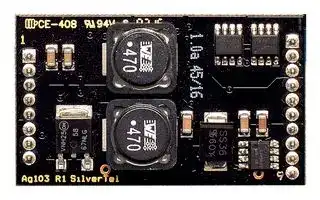
Image not available
Illustrative purposes only


AG103
Solar Battery Charger Module, Sealed Lead Acid, 1.2 to 12 Ah, 9 to 36 V Supply, 12 V Out, DIL
⚠️ Reference pricing provided. In case of supply shortages, we will connect you with our trusted procurement partners to ensure your project's continuity.
- Manufacturer: SILVERTEL
- Product type:
- SVHC: No SVHC (27-Jun-2024)
- Plug Type: -
- Product Range: -
- Charge Current: -
- Output Voltage: 12V
- Supply Voltage: 36V
- Battery Size Code: -
- Battery Charger Type: Solar Powered
- No. of Cells Charged: -
- Battery Technologies Supported: Lead Acid
| Delivery and price | |
|---|---|
| Units per pack | 50 |
| Price | 9.86 € |
| Current stock | 100+ |
| Lead time | 30 days |
Datasheet

V1.4 January 2021 Datasheet ## _Silvertel_ ## **Ag103 Intelligent Sealed Lead Acid Solar Battery Charger Module** ## **Features** - Multi-Stage Charging - Solar Panel or DC Input **==> picture [89 x 21] intentionally omitted <==** **----- Start of picture text -----**<br> i ae ai - a<br>**----- End of picture text -----**<br> - Maximum Power Point Tracking (MPPT) - Very Low Power Consumption - Wide DC Input Voltage Range - High Efficiency DC-DC Converter - Intelligent ‘Top-up’ Float Charge - Programmable Charge Current - Battery Condition Indicator - Temperature Compensation - Overload & Short-circuit Protection - Simple Integration ## **Description** The Ag103 is a micro-processor based intelligent, low cost, sealed lead acid (SLA) battery charging module designed to be used with solar panels. It uses digital technology to optimise the charging of 12V sealed lead acid batteries between 1.2Ah and 12Ah capacity. Using intelligent charging techniques, including maximum power point tracking, the Ag103 technology maximises both battery lifetime and the amount of power derived from the solar panel. The Ag103 can take a dc input range of 9 to 36VDC, this gives great flexibility allowing the system and charger to use a variety of power levels of solar panels, or a low cost power supply. lifetime and usable capacity. © Silver Telecom 2021 **Ag103** Datasheet **Sealed Lead Acid Solar Battery Charger Module** V1.4 January 2021 ## **Table of Contents** |**1**|**Product Overview ................................................................................................................................... 3**|**Product Overview ................................................................................................................................... 3**| |---|---|---| ||1.1|Ag103 Product Selector ................................................................................................................... 3| ||1.2|Package Format ............................................................................................................................... 3| ||1.3|Pin Description ................................................................................................................................. 4| |**2**|**Functional Description ........................................................................................................................... 5**|| ||2.1|Operation .......................................................................................................................................... 5| ||2.2|Input .................................................................................................................................................. 6| ||2.3|Capacity Select ................................................................................................................................ 7| ||2.4|Load Enable ..................................................................................................................................... 8| ||2.5|Thermal Compensation .................................................................................................................... 8| ||2.6|Status Output ................................................................................................................................... 9| ||2.6.1|Mode 0 – Bulk Charge Operation .......................................................................................... 10| ||2.6.2|Mode 1– Float Charge ........................................................................................................... 10| ||2.6.3|Mode 2 – Over Current .......................................................................................................... 10| ||2.6.4|Mode 3 – Over Temperature .................................................................................................. 10| ||2.6.5|Mode 4 – Disconnected battery ............................................................................................. 10| ||2.6.6|Mode 5 - Input Voltage Removed/ No Solar Power ............................................................... 10| |**3**|**Typical Application ............................................................................................................................... 12**|| |**4**|**Operating Temperature Range ............................................................................................................ 14**|| |**5**|**Protection .............................................................................................................................................. 14**|| ||5.1|Over Current & Short Circuit Protection ......................................................................................... 14| ||5.2|Over Temperature Protection ......................................................................................................... 14| ||5.3|Low Battery Terminal Voltage Protection ....................................................................................... 14| ||5.4|Deep Discharge Protection ............................................................................................................ 14| ||5.5|Battery Reversal ............................................................................................................................. 14| |**6**|**Features ................................................................................................................................................. 15**|| ||6.1|MPPT- Maximum Power Point Tracking ........................................................................................ 15| |**7**|**Electrical Characteristics ..................................................................................................................... 16**|| ||7.1|Absolute Maximum Ratings* .......................................................................................................... 16| ||7.2|Recommended Operating Conditions ............................................................................................ 16| ||7.3|DC Electrical Characteristics* ........................................................................................................ 16| |**8**|**Package .................................................................................................................................................. 17**|| ## Table of Figures Figure 1: Block Diagram with External Components ......................................................................................... 3 Figure 2: Ag103 DIL Package Format ............................................................................................................... 3 Figure 3: Basic Ag103 Charge Profile ............................................................................................................... 5 Figure 4: Input Connections – Solar, DC or AC Input ....................................................................................... 6 Figure 5: Capacity Select................................................................................................................................... 7 Figure 6: Output Adjustment .............................................................................................................................. 8 Figure 7: STAT Output Configurations .............................................................................................................. 9 Figure 8: STAT Output Timing ......................................................................................................................... 11 Figure 9: Typical Application - Permanent Load ............................................................................................. 12 Figure 10: Typical Application - Battery Back Up ............................................................................................ 13 Figure 11: MPPT of a 20W solar panel ........................................................................................................... 15 Figure 12: Package Dimensions ...................................................................................................................... 17 © Silver Telecom 2021 2 **Ag103** Datasheet V1.4 January 2021 **Sealed Lead Acid Solar Battery Charger Module** ## **1 Product Overview** ## **Ag103 Product Selector** |**Part**<br>**Number**|**Input**<br>**Voltage**|**Output**<br>**Voltage**|**Battery**<br>**Capacity**|**Marking**|**Package**| |---|---|---|---|---|---| |Ag103|9-36V|12V|1.2-12Ah|Ag103|DIL| Note: Complies with the European Directive 2011/65/EU for the Restriction of use of certain Hazardous Substances (RoHS) including Directive 2015/863 published in 2015, amending Annex II of Directive 2011/65/EU. Moisture Sensitive Level 1 and HBM 1. **Table 1: Ordering Information** **==> picture [409 x 466] intentionally omitted <==** **----- Start of picture text -----**<br> Load switch<br>Load<br>Ag103 through<br>Input PWR Vin+ Bat+<br>DC:DC<br>Battery Monitor<br>+ Internal Converter<br>Reference<br>470uF ce Voltage |<br>Input GND GND Current Sense Bat-<br>CS<br>Capacity Select μ-Controller<br>Thermal THERM<br>Management<br>LE Load Enable STAT<br>a<br>Figure 1: Block Diagram with External Components<br>Package Format<br>J2<br>1 J1<br>Ag103<br>9<br>**----- End of picture text -----**<br> ## **Package Format** **Figure 2: Ag103 DIL Package Format** © Silver Telecom 2021 3 **Ag103** Datasheet **Sealed Lead Acid Solar Battery Charger Module** V1.4 January 2021 ## **Pin Description** |**Pin**|**Name**|**Description**| |---|---|---| |1|VIN+|**Positive Supply (Input).**This pin connects to a positive dc supply (9V to 36V).| |2|VIN+|**Positive Supply (Input).**This pin connects to a positive dc supply (9V to 36V).| |3|CS|**Capacity Select (Input).**This pin connects to an external resistor to set the<br>capacity of the battery to be charged (1.2Ah to 12Ah).| |4|STAT|**Charge Status (Output).**This output pin is used to indicate the system status.| |5|LE|**Load Enable (Input).**Connect this pin to GND via a 2k resistor to permanently<br>connect the battery to the load. Leave open circuit for battery back-up mode.| |6|GND|**Ground Return (Input).**This pin connects to the ground return of the power<br>supply.| |7|GND|**Ground Return (Input).**This pin connects to the ground return of the power<br>supply.| |8|GND|**Ground Return (Input).**This pin connects to the ground return of the power<br>supply.| |||| |9|BAT-|**Battery Negative (Output).**The output pin connects to the battery negative<br>terminal. It must NOT be connected directly to the GND pin.| |10|BAT-|**Battery Negative (Output).**The output pin connects to the battery negative<br>terminal. It must NOT be connected directly to the GND pin.| |11|BAT-|**Battery Negative (Output).**The output pin connects to the battery negative<br>terminal. It must NOT be connected directly to the GND pin.| |12|THER<br>M|**Thermistor (Input).**The pin can be connected to an external thermistor to add<br>temperature compensation (if required).| |13|BAT+|**Battery Positive (Output).**The output pin connects to the battery positive<br>terminal.| |14|BAT+|**Battery Positive (Output).**The output pin connects to the battery positive<br>terminal.| |15|BAT+|**Battery Positive (Output).**The output pin connects to the battery positive<br>terminal.| |16|Load<br>Output|**Load Output (Output).**The Load output pin connects the battery positive<br>terminal to the users load.| |17|Load<br>Output|**Load Output (Output).**The Load output pin connects the battery positive<br>terminal to the users load.| |18|Load<br>Output|**Load Output (Output).**The Load output pin connects the battery positive<br>terminal to the users load.| © Silver Telecom 2021 4 **Ag103** Datasheet V1.4 January 2021 **Sealed Lead Acid Solar Battery Charger Module** ## **2 Functional Description** ## **Operation** In many safety critical systems it is essential that the battery is charged quickly with no stress or damage. Battery manufacturers also recommend using multi-stage charging to reduce the stress on the battery while giving the shortest possible charge time. The Ag103 achieves this using an optimum multi-stage charge cycle, shown in Figure 3. **==> picture [427 x 227] intentionally omitted <==** **----- Start of picture text -----**<br> Constant Current Two Stage Constant Voltage<br>(Bulk Charge) (Absorption/Float Charge) Float Charge<br>Charge Voltage<br>Charge Current<br>Charging Time<br>Battery Voltage / Charge Current<br>**----- End of picture text -----**<br> **Figure 3: Basic Ag103 Charge Profile** The Ag103 implements the ideal charging cycle by applying a higher bulk charge voltage for 70% - 80% of the charge cycle and a lower absorption charge voltage for the remaining 20% - 30%. This is done to prevent the battery from gassing as it approaches full charge. Once the battery has reached the optimum level, the Ag103 will maintain an accurate float voltage to keep the battery topped up. The charge profile can be further optimised by using thermal compensation (see Section 2.5: Thermal Compensation). © Silver Telecom 2021 5 **Ag103** Datasheet V1.4 January 2021 **Sealed Lead Acid Solar Battery Charger Module** ## **Input** The Ag103 can take either a solar panel input or a very wide dc input range of 9Vdc to 36Vdc, making this module extremely flexible. For stable operation it is recommended to fit a 470μF capacitor across the input pins, this should be placed as close to these pins as possible. The Ag103 can also be powered from an AC power supply with the addition of an external bridge rectifier. It is important that the rectified voltage across the input pins is within the 9Vdc to 36Vdc limits, Figure 4 shows examples of these inputs. **==> picture [373 x 282] intentionally omitted <==** **----- Start of picture text -----**<br> Ag103<br>+Vdc VIN+<br>+<br>470uF<br>-Vdc GND<br>Solar Input<br>Ag103 Ag103<br>Vac<br>~<br>+Vdc VIN+ - + VIN+<br>+ Vac ~ +<br>470uF 470uF<br>-Vdc GND GND<br>DC Input AC Input<br>**----- End of picture text -----**<br> **Figure 4: Input Connections – Solar, DC or AC Input** For a solar panel input Table 2 below shows various 12V* panel sizes that can be chosen to charge different size batteries. |**Panel Power**<br>**(W)**|**Panel**<br>**Current (A)**|**Matched battery**<br>**Size (optimum)**|**Maximum battery size**<br>**panel can charge**| |---|---|---|---| |5W|0.29|1.2Ah|2.8Ah| |10W|0.58|2.3Ah or less|5.8Ah| |20W|1.14|4Ah or less|11Ah| |30W|1.74|7Ah or less|17Ah| |40W|2.33|9Ah or less|23Ah| |50W|2.85|12Ah or less|28Ah| ## **Table 2: Panel Selection** * Majority of panels are referred to as 12V panels but their open circuit voltage is 21V. © Silver Telecom 2021 6 **Ag103** Datasheet **Sealed Lead Acid Solar Battery Charger Module** V1.4 January 2021 ## **Capacity Select** The Ag103 is capable of being programmed to charge a range of SLA batteries from 1.2Ah up to 12Ah, by connecting a resistor between the CS pin and the GND pin, see Figure 5. **==> picture [227 x 227] intentionally omitted <==** **----- Start of picture text -----**<br> Ag103<br>CS<br>RCS<br>GND<br>Capacity Select<br>**----- End of picture text -----**<br> **Figure 5: Capacity Select** The CS pin has an internal pull up resistor to a voltage reference which sets the voltage on this pin. This voltage is measured at start-up and the optimum charge profile for the battery is programmed. The value of RCS is shown in Table 3. |**Battery**<br>**Capacity (Ah)**|**RCS Resistance**<br>**(Ohms)***|**Min Input**<br>**Voltage (V)**|**Voltage at the**<br>**CS Pin (V)**|**Bulk Charge Current**<br>**Limit (A) ±10%**| |---|---|---|---|---| |1.2|1K ±1%|9|0.3|0.3| |2|2K ±1%|9|.55|0.5| |2.1|3K ±1%|9|.76|0.525| |2.3|3K9 ±1%|9|.93|0.575| |2.8|4K7 ±1%|9|1.05|0.7| |3.2|6K2 ±1%|12|1.26|0.8| |4|6K8 ±1%|12|1.30|1| |7|7K5 ±1%|12|1.37|1.2| |12|9K1 ±1%|12|1.52|1.2| **Table 3: Value of RCS** * To prevent damaging the battery it is important that the correct value of RCS is set. If RCS is not fitted, then the Ag103 will default to 1.2Ah capacity. © Silver Telecom 2021 7 **Ag103** Datasheet V1.4 January 2021 **Sealed Lead Acid Solar Battery Charger Module** ## **Load Enable** The Ag103 can either connect the battery constantly to the load by connecting a 2k resistor between LE and GND, see Figure 9, or it can be used in a battery back-up mode* where the battery is only connected to the load if the internal μ-controller detects the input has been disconnected, or the panel voltage has dropped below 9V. This mode is selected by leaving the LE open circuit, see Figure 10. *If the potential across the load terminal can go higher than the battery potential, a blocking diode should be fitted on the Load Output connection. ## **Thermal Compensation** The optimum terminal voltage for the charging process is also dependent on battery temperature. This is because the electrochemical activity is affected by temperature changes. Therefore, as the temperature rises, the charging voltage should be reduced to prevent overcharge. Likewise as the temperature falls, the charge voltage should be increased to avoid undercharge. In order to maximise the life of the battery the use of temperature compensation is recommended. The Ag103 makes this easy to implement with only the addition of a low cost Thermistor. The Ag103 measures the THERM pin and will automatically adjust the charge profile to compensate for any changes in battery temperature. A typical recommended value for TH1 as shown in Figure 6 is a 47K NTC (Negative Temperature Coefficient) resistor with B25/50 ~4000K. These are inexpensive and readily available in surface mount or bead format. For correct operation the Thermistor must be in physical contact with the battery. **==> picture [270 x 271] intentionally omitted <==** **----- Start of picture text -----**<br> Ag103<br>THERM<br>Bat+<br>TH1<br>Bat-<br>(Input) GND<br>**----- End of picture text -----**<br> ## **Figure 6: Output Adjustment** When using thermal compensation, if the battery temperature exceeds 50˚C, the Ag103 will shut-down the DC-DC converter and the output status indicator (STAT) will report an over temperature error. © Silver Telecom 2021 8 **Ag103** Datasheet V1.4 January 2021 **Sealed Lead Acid Solar Battery Charger Module** The Ag103 will default to a 25˚C charge profile if TH1 is not fitted. ## **Status Output** The Ag103 has a status indication output pin ‘STAT’; that can be connected to a μ- controller input for full status monitoring or can be used with an LED as an indicator (as shown in Figure 7). **==> picture [443 x 188] intentionally omitted <==** **----- Start of picture text -----**<br> Ag103 Ag103<br>VIN+<br>LED<br>Internal Internal<br>Reference Reference<br>Voltage (+3V3) Voltage (+3V3)<br>μ-controller μ-controller<br>1K 1K<br>To μ-controller<br>STAT STAT<br>BC846W<br>10K<br>330R<br>10K<br>**----- End of picture text -----**<br> **(Input) GND** **Figure 7: STAT Output Configurations** Table 4, shows the different mode conditions of the Ag103: - |Table 4,|shows the different mode conditions of the Ag103: -|| |---|---|---| |**Mode**|**Status Mode**|**STAT Output**| |0|Bulk Charge Operation|Steady State ‘Logic 1’| |1|Float Charge|50% ‘Logic 1’ 50% ‘Logic 0’| |2|Over Current Error|1 Pulse| |3|Over Temperature Error|2 Pulses| |4|Disconnected Battery Error|3 Pulses| |5|Input Voltage Removed / No Solar Power|Steady State ‘Logic 0’| **Table 4: STAT Output Conditions** © Silver Telecom 2021 9 **Ag103** Datasheet **Sealed Lead Acid Solar Battery Charger Module** V1.4 January 2021 ## 2.6.1 **Mode 0 – Bulk Charge Operation** Once the Ag103 has checked the battery capacity and sees a 12V battery connected it will power up and the ‘STAT’ pin will output a steady state 'logic 1'. The Ag103 will continue to output this state until the battery has reached 80% charge before switching to float charge and entering Mode 1. ## 2.6.2 **Mode 1– Float Charge** After the battery has reached 80% charge the Ag103 will change its charging status to float charge by dropping its terminal voltage down to ~13.65V. The 'STAT' pin will drop to logic 0 for 1s and then back to logic 1 for 1s. This cycle will repeat itself over the period of its float charge. ## 2.6.3 **Mode 2 – Over Current** If an output over current condition is detected, the Ag103 will shut down its DC-DC converter and will go into Mode 2. The STAT pin will drop to logic 0 for 100ms, followed by logic 1 for 100ms before returning to logic 0. The Ag103 will then reset and wait 2 seconds before re-attempting to power up. If the over current is still there when trying to power up, the Ag103 will immediately shut back down and repeat the process. Once the over current has been removed the Ag103 will return to Mode 0 (bulk charge operation). ## 2.6.4 **Mode 3 – Over Temperature** If a battery over temperature condition occurs, the Ag103 will shut down its DC-DC converter to protect the battery and enter Mode 3. The STAT pin will drop to logic 0 for 100ms before generating two logic 1 pulses, with a 100ms mark and 100ms space. This will repeat over a 2s period until the battery temperature has dropped below 50˚C (the maximum operating temperature). Once the battery temperature has dropped below 50˚C the Ag103 will return to Mode 0 (bulk charge operation). ## 2.6.5 **Mode 4 – Disconnected battery** If the battery is disconnected or there is no battery present at power up, the Ag103 will shut down its DC-DC converter, go into Mode 4 and output three 100ms logic 1 pulses, with a 100ms mark and 100ms space. This will repeat over a 2s period until a 12V battery is connected. When a 12v battery is connected the Ag103 will go into Mode 0 (bulk charge operation). ## 2.6.6 **Mode 5 - Input Voltage Removed/ No Solar Power** When the input voltage is removed or the solar panel can no longer provide any power to the Ag103, the STAT pin will output logic 0 until power has been reconnected or the panel can provide enough power to charge the connected battery. Figure 8 shows the timing of the STAT output in more detail: - © Silver Telecom 2021 10 **Ag103** Datasheet **Sealed Lead Acid Solar Battery Charger Module** V1.4 January 2021 **==> picture [480 x 522] intentionally omitted <==** **----- Start of picture text -----**<br> Working Operation<br>Logic 1<br>Mode 0<br>Logic 0<br>2s<br>Power up<br>Logic 1<br>Mode 1 1s 1s<br>Logic 0<br>Error Events<br>2s 2s 2s<br>Logic 1<br>Mode 2<br>Logic 0<br>Attempt Re-power<br>100ms<br>2s 2s 2s<br>Logic 1<br>Mode 3<br>Logic 0<br>100ms<br>2s 2s 2s<br>Logic 1<br>Mode 4<br>Logic 0<br>Start of error events<br>100ms<br>Logic 1<br>Mode 5<br>Logic 0<br>Input power<br>removed<br>**----- End of picture text -----**<br> **Figure 8: STAT Output Timing** © Silver Telecom 2021 11 **Ag103** Datasheet **Sealed Lead Acid Solar Battery Charger Module** V1.4 January 2021 ## **3 Typical Application** The Ag103 is ideal for solar powered applications such as roadside warnings, parking meters and LED street lighting. Figure 9 shows a very simple method of connecting the Ag103 for this application where the power is permanently connected to the load. However if your application requires only to be used as a battery back-up system, for example emergency lighting, alarm systems, door access control and UPS, then a typical application is shown in Figure 10. C1 should be positioned as close to the input pins as possible and TH1 should be in physical contact with the battery. It is also very important that the GND and Bat- pins are not connected together as this could permanently damage the battery. **==> picture [334 x 283] intentionally omitted <==** **----- Start of picture text -----**<br> Permanent Load<br>Solar Input<br>. Load<br>Ag103 Output<br>FUSE<br>Input PWR<br>Bat +<br>+Vdc VIN+ THERM +<br>TH1<br>+<br>C 1 D1<br>470uF<br>Bat -<br>-Vdc<br>GND<br>Input GND LE<br>2K<br>TT<br> * Note: TH1 = 47K NTC, B(K) = 4000<br>Load Over-current /Battery reversal protection:<br>D1 = SK154 or Equivalent<br>Fuse = 10A Slow Blow<br>**----- End of picture text -----**<br> **Figure 9: Typical Application - Permanent Load** © Silver Telecom 2021 12 **Ag103** Datasheet **Sealed Lead Acid Solar Battery Charger Module** V1.4 January 2021 **==> picture [328 x 289] intentionally omitted <==** **----- Start of picture text -----**<br> Battery Back Up<br>D2<br>Ag103 Output Load<br>D3<br>Input PWR Bat +<br>FUSE<br>+Vdc VIN+ THERM +<br>TH1<br>+<br>C 1 D1<br>470uF<br>Bat -<br>-Vdc GND<br>Input GND<br>Co<br> * Note: TH1 = 47K NTC, B(K) = 4000<br>Load Over-current /Battery reversal protection:<br>D1,D2,D3 = SK154 or Equivalent<br>Fuse = 10A Slow Blow<br>**----- End of picture text -----**<br> **Figure 10: Typical Application - Battery Back Up** © Silver Telecom 2021 13 **Ag103** Datasheet **Sealed Lead Acid Solar Battery Charger Module** V1.4 January 2021 ## **4 Operating Temperature Range** For most applications the Ag103 will be positioned close to the battery and the maximum operating temperature will be limited by the battery to 50˚C. However if the battery is being charged remotely, then the Ag103 can be operated from -20˚C to +70˚C. ## **5 Protection** The Ag103 offers four primary protection circuits: - ## **Over Current & Short Circuit Protection** The Ag103 output has over current and short circuit protection. This is triggered when the output current exceeds 200mA above the bulk charge current shown in Table 3. If an over current fault is detected, the Ag103 will shut-down the DC-DC converter and the STAT output will report an over current error. ## **Over Temperature Protection** This can only be activated if the thermal compensation thermistor is fitted. If the battery temperature exceeds 50˚C, the Ag103 will shut-down the DC-DC converter and the STAT output will report an over temperature error. ## **Low Battery Terminal Voltage Protection** If the battery terminal voltage is <7V, the Ag103 Status output will report Mode 4 and the Ag103 will remain idle and wait until a 12V battery has been connected. This is primarily to protect the user from accidentally connecting a 6V battery to the Ag103. It also protects the Ag103 from being connected to a damaged or a deep discharged battery. ## **Deep Discharge Protection** The Ag103 constantly monitors the terminal voltage of the battery. If the load connected draws too much power or has been constantly drawing power from the battery causing the terminal voltage to fall below 10.5V, the Ag103 will disconnect the load from the battery to stop it being deep discharged. The Ag103 will only allow the load to be reconnected once the terminal voltage on the battery recovers to 12.5V or higher. ## **Battery Reversal** The Ag103 does not provide battery reversal protection, however Figure 9 shows a simple method of providing this safety feature. This also provides protection for an over-current or short on the Load Output pin. © Silver Telecom 2021 14 **Ag103** Datasheet **Sealed Lead Acid Solar Battery Charger Module** V1.4 January 2021 ## **6 Features** ## **MPPT- Maximum Power Point Tracking** The Ag103 has MPPT built in which keeps the solar panel in a state where it can produce the maximum amount of power it is capable of. This optimises the amount of power harvesting from a solar panel, such that the maximum power is being delivered to charge the battery. The Ag103 constantly monitors the terminal voltage of a 12V solar panel and the amount of current it is drawing. If there is a cloudy day or limited amount of sun the solar panels voltage automatically folds over and the power output drops. The Ag103 tracks this drop and alters its charging profile/power to ensure it gets the maximum power out of the solar panel, thereby providing the maximum charge to the battery that can be achieved. Figure 11 below shows an example of the Maximum Power Point of a 20W panel. **Figure 11: MPPT of a 20W solar panel** © Silver Telecom 2021 15 **Ag103** Datasheet V1.4 January 2021 **Sealed Lead Acid Solar Battery Charger Module** ## **7 Electrical Characteristics Absolute Maximum Ratings*** ||**Absolute Maximum Ratings***||||| |---|---|---|---|---|---| ||**Parameter**|**Symbol**|**Min**|**Max**|**Units**| |1|DC Supply Voltage|VCC|-0.3|40|V| |2|Storage Temperature|TS|-40|+100|°C| *Exceeding the above ratings may cause permanent damage to the product. Functional operation under these conditions is not implied. Maximum ratings assume free airflow. ## **Recommended Operating Conditions** ||**Parameter**|**Symbol**|**Min**|**Typ**|**Max**|**Units**| |---|---|---|---|---|---|---| |1|DC Input Supply Voltage|VIN|9|12|36|V| |2|Solar Input Voltage (open circuit)|VIN||21||VOC| |3|Operating Temperature|TOP|-20|25|70†|Ta /°C| †See Section Operating Temperature Range ## **DC Electrical Characteristics*** ||**DC Characteristic**|**DC Characteristic**|**Sym**|**Min**|**Typ***|**Max**|**Units**|**Test Comments**| |---|---|---|---|---|---|---|---|---| |1|Bulk Charge Constant<br>Current||IOUT||See<br>Table<br>3||A|| |2|Input Current - Idle||IIN||17||mA|Disconnected<br>battery| |3|Battery Standby Current||IBAT||10||mA|No Input Voltage| |4|Absorption Charge Voltage<br>1||VOUT1‡|14.2|14.4|14.6|V|| |5|Float|Charge Voltage|VOUT2‡|13.5|13.65|13.8|V|| |6|STAT|Output Low<br>Voltage|VOL|||0.5|V|| |||Output High<br>Voltage|VOH|3.3||||| |7|Output Ripple and Noise (at<br>the battery terminal)||VRN||50||mVp-p|12Ah battery| |8|DC-DC Converter Efficiency||EFFDC||87||%|At 12V-18V input| |9|Charger Efficiency||EFFBAT||82||%|| |10|Short-Circuit Duration||TSC|||∞|sec|| |11|Load Output||ILOUT|||7|A|10A Fuse**| *Typical figures are at 25°C with a nominal input voltage = 12V and are for design aid only. Not Guaranteed ** Fuse to be fitted for protection against over current on the Load output pin. (see Figure 9) - ‡Measured between the GND and the BAT+ pins © Silver Telecom 2021 16 **Ag103** Datasheet **Sealed Lead Acid Solar Battery Charger Module** V1.4 January 2021 ## **8 Package** **==> picture [353 x 484] intentionally omitted <==** **----- Start of picture text -----**<br> 50.60<br>2.4 45.72<br>J2<br>1 J1<br>Top<br>View<br>Ag103<br>9<br>0.64<br>(Recommended PCB hole diameter = 1.1 ± 0.05)<br>Dimensions (in mm) are nominal ± 0.25 unless otherwise stated<br>7.38<br>30<br>2.54 TYP<br>6.60 MAX<br>.60<br>.54 1<br>2<br>3.00<br>**----- End of picture text -----**<br> **Figure 12: Package Dimensions** Information published in this datasheet is believed to be correct and accurate. Silver Telecom assumes no liability for errors which may occur or for liability otherwise arising out of use of this information or infringement of patents which may occur as a result of such use. No license is granted by this document under patents owned by Silver Telecom or licensed from third parties by Silver Telecom. The products, their specification and information appearing in this document are subject to change by Silver Telecom without notice. © Silver Telecom 2021 17
Updated at April 28, 2026
About Novapart
Novapart is a B2B electronic component broker specialising in stock shortages and cost reduction. We source hard-to-find parts and identify compliant alternatives across a catalogue of 410,000+ components from 500+ manufacturers.
Learn more →Stock Shortage Specialist
When a component is unavailable, discontinued or has an unacceptable lead time, we tap into our network of vetted European and Asian distributors to source what you need — without compromising on quality or traceability.
Request a quote →Compliant Alternatives
We identify pin-to-pin, electrically equivalent substitutes that meet the same certifications (RoHS, AEC-Q100, REACH) as your original specification — validated against datasheets, not just part numbers. Often at a lower cost.
BOM Analysis service →