
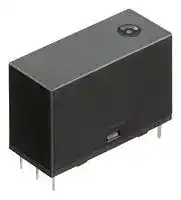


ADW1109YLW
Power Relay, High Inrush Type, SPST-NO, 9 VDC, 20 A, DW-YLW Series, Through Hole
- Manufacturer: PANASONIC
- Product type: Power Relays
- SVHC: No SVHC (25-Jun-2025)
- Coil Type: Latching Single Coil
- Coil Voltage: 9VDC
- Product Range: DW-YLW Series
- Relay Mounting: Through Hole
- Coil Resistance: 405ohm
- Contact Current: 20A
- Relay Terminals: PC Pin
- Contact Material: Silver Tin Oxide
- Contact Voltage VAC: 250V
- Contact Voltage VDC: -
- Contact Configuration: SPST-NO
| Delivery and price | |
|---|---|
| Units per pack | 50 |
| Price | 2.16 € |
| Current stock | 10+ |
| Lead time | 30 days |

**==> picture [231 x 25] intentionally omitted <==**

**----- Start of picture text -----**<br>
IN Your Future<br>**----- End of picture text -----**<br>


## DW-YLW Relay

Low profile high inrush type PC board through hole terminal (flux-resistant)

## **Ordering information (type no.)**

**==> picture [501 x 158] intentionally omitted <==**

**----- Start of picture text -----**<br>
ADW Y L W<br>DW relay<br>Packing style<br>W: Carton packing*<br>Contact capacity<br>Contact/teminal arrangement<br>Y:  High inrush type<br>1:  1a single pin type<br>20A, 5A 277V AC<br>8: 1a double pin type<br>Electronic ballast (inrush 320A)<br>by UL certified<br>Operating function Rated voltage Type classification<br>1 : 1 coil latching type Part no. 03 05 06 09 12 24 L: Low profile type<br>2: 2 coil latching type<br>Rated voltage (V) 3 5 6 9 12 24<br>**----- End of picture text -----**<br>


*Note: Carton packing symbol „W“ is not marked on the relay. The „W“ at the end of the part number only appears on the inner and outer packing.

## **Specifications**

## **Coil data (1 coil latching type)**

|Part No.|Rated voltage<br>(V DC)|Rated operating current<br>(DC, mA, ±10%, at 20°C)|Coil resistance<br>(Ω,  ±10%, at 20°C|Rated operating<br>power(mW)|
|---|---|---|---|---|
|ADW1103YLW  / ADW8103YLW<br>ADW1105YLW / ADW8105YLW<br>ADW1106YLW / ADW8106YLW<br>ADW1109YLW / ADW8109YLW<br>ADW1112YLW / ADW8112YLW<br>ADW1124YLW / ADW8124YLW|3|66.7|45|200|
||5|40.0|125||
||6|33.3|180||
||9|22.2|405||
||12<br>24|16.7<br>8.3|720<br>2880||
|Set voltage (initial)|Max. 80% of rated voltage (at 20°C) (square, pulse drive)||||
|Reset voltage (initial)|Max. 80% of rated voltage (at 20°C) (square, pulse drive)||||
|Max. allowable voltage|200% of rated voltage (Max. 100ms, at 20°C)||||
|Coil applied voltage and set/reset pulse time|100% of rated voltage: Min. 30ms / 200% of rated voltage: Max. 100ms||||


## **Coil data (2 coil latching type)**

|Part No.|Rated voltage<br>(V DC)|Rated operating current<br>(DC, mA, ±10%, at 20°C)|Coil resistance<br>(Ω,  ±10%, at 20°C|Rated operating<br>power(mW)|
|---|---|---|---|---|
|ADW1203YLW  / ADW8203YLW|3|133.3|22.5|400|
|ADW1205YLW  / ADW8205YLW|5|80.0|62.5||
|ADW1206YLW  / ADW8206YLW|6|66.7|90||
|ADW1209YLW  / ADW8209YLW|9|44.4|202.5||
|ADW1212YLW  / ADW8212YLW|12|33.3|360||
|ADW1224YLW / ADW8224YLW|24|16.7|1440||
|Set voltage (initial)|Max. 80% of rated voltage (at 20°C) (square, pulse drive)||||
|Reset voltage (initial)|Max. 80% of rated voltage (at 20°C) (square, pulse drive)||||
|Max. allowable voltage|200% of rated voltage (Max. 100ms, at 20°C)||||
|Coil applied voltage and set/reset pulse time|100% of rated voltage: Min. 30ms / 200% of rated voltage: Max. 100ms||||


## **Contact data**

|Arrangement<br>Contact material|1a<br>AgSn02type|
|---|---|
|Contact resistance (initial)|Max. 100mΩ(byvoltage drop6V DC 1A)|
|Max. switching power (resistive)|5000VA|
|Max. switching voltage|277V AC|
|Max. switching current||
|Resisitve|20A AC|
|Inrush|320 A0-P(Pulse width 1. 20ms, I2t 205 A2s)|
|Max. carrying current|20A AC|
|Contact rating (resistive)|20A 250V AC|
|Min. switching load|100mA 5V DC(reference value)|


## **Expected life**

|20A 250V AC (resistive)|Min. 1 x 10⁴ope (ON: OFF = 1 s : 5 s)|
|---|---|
|16A 277V AC (resistive)|Min. 2 x 10⁴ope. (ON: OFF = 1  s:5  s)|
|8A 250V AC (resistive)|Min. 5 x 10⁴ope. (at 20 times/min.)|
|600W (120V AC) Tungsten|Min. 2.5 x 10⁴ope.|
|Condition (Tungsten load)<br>- Switching voltage<br>- Switchingcurrent|120V AC (Hz)<br>Inrush 100A0-P/ Steady5.0Arms|
|Cycle rate<br>Mechanical life|ON : OFF = 1 s : 59s<br>Min. 1 x 10⁶ope. (at 180 time/min.)|


## **Circuit diagram**

## **Current wave form**

|Dielectric strength (initial, detection current: 10mA)||
|---|---|
|Between open contacts|1000Vrms for 1 min.|
|Between contact and coil|5000Vrms for 1 min|
|Surge withstand voltage (initial)||
|Between contact and coil|12000V|
||Surge voltage is a standard impulse voltage that continues for ± (1.2 x 50) µs|
||as specified in JEC-212-1981|
|Insulation resistance||
|Initial|Min. 1000MΩ at 500V DC|
||Measured portion is the same as the case of dielectric voltage|
|Vibration  resistance||
|Functional|10Hz to 55Hz at double amplitude of 2.0mm(detection time: 10µs)|
|Destructive|10Hz to 55Hz at double amplitude of 3.0mm|
|Shock  resistance||
|Functional|100m/s2(half-sine shockpulse: 11ms(detection time: 10µs)|
|Destructive|100m/s2(half-sine shock pulse: 6ms)|
|Set time(initial)||
|At rated voltage without bounce|Max. 10ms (at 20°C)|
|Reset time(initial)||
|At rated voltage, without bounce|Max. 10ms (at 20°C)|
|Unit weight|Approx. 7.5g|


## **Usage, storage and transport conditions**

Following is the conditions of ambient temperature, humidity and air pressure in case of operation, transport and storage:

Ambient temperature: -40°C to 85°C (Allowable temperature is from -40°C to 70°C at our standard packing condition) Humidity: 5% RH to 85% RH In addition the humidity range depends on temperature. The allowable ranges are as shown in the below figure Air pressure: 86kPa to 106 kPa, allowable range of ambient temperature and humidity for operation, transport and storage.

Avoid icing when used at temperatures lower than 0°C

**==> picture [304 x 150] intentionally omitted <==**

**----- Start of picture text -----**<br>
Humidity (%RH)<br>L L GS LiLJf ; WfUyfy Vhs , Z Avoid condensation when used at<br>; temperatures higher than 0°C<br>Gi“fyGe<br>~ Yj<br>,<br>SVLPLLLT LEI T Mg<br>Q 85<br>Ambient temperature (t)<br>**----- End of picture text -----**<br>


## Water condensation

Water condensation occurs when the ambient temperature drops suddenly from a high temperature and humidity, or the relay is suddenly transferred from a low ambient temperature to a high temperature and humidity. Condensation causes the failures like insulation deterioration, wire disconnection and rust etc. Panasonic Industry Co., Ltd. does not guarantee the failures caused by condensation. The heat conduction by the equipment may accelerate the cooling of relay itself, and the condensation may occur. Please confirm no condensation in the worst condition of the actual usage. (Special attention should be paid when high temperature heating parts are close to the relay. Also, please consider the condensation may occur inside of the relay.)

## Icing

Please check the icing when an ambient temperature is lower than 0°C. Water drop adheres to the relay by the condensation or the abnormal high humidity and is frozen to the ice when the ambient temperature becomes lower than 0°C. The icing causes the sticking of movable portion, the operation delay and the contact conduction failure etc. Panasonic Industry Co., Ltd. does not guarantee the failures caused by the icing. The heat conduction by the equipment may accelerate the cooling of relay itself and the icing may occur. Please confirm no icing in the worst condition of the actual usage.

## Low-temperature, low-humidity atmosphere

If the relay is exposed to a low-temperature, low-humidity atmosphere for a long time, its plastic parts may become brittle and fragile.

## **Soldering and cleaning**

In case of flow and manual soldering, following conditions should be observed.

## Flow soldering

Preheating: Max. 120°C, within 120s Measurement area: Solder surface on the terminal portion Soldering: 260°C ±5°C, within 6s Measurement area: Solder surface Manual soldering Soldering: Max. 350°C, within 3s Please check the effect with the actual board, because the effect is changed by the PCB type.

## Other cautions

1.    When soldering condition is out of recommendation, the relay performance may be adversely affected. If soldering conditions are out of recommendation, please contact us before operation.

2.   Please check the effect at the actual soldering because heat stress to relay is changed by PCB, manufacturing process condition and process condition.

3.   Solder creepage, wettability, or soldering strength will be affected by the mounting condition or soldering material. Please check the actual production condition in detail.

4.   Do not clean the relay by immersion, because the relay is not fully sealed. Do not penetrate the flux or cleaning solvent into the relay.

- 5 . Do not coat the relay since the coating material may penetrate into the relay and cause contact failure.

## **Approved standards**

This relay has been approved by UL, C-UL and VDE standard.

UL rating 20A 250V AC R 6 x 10[3] at 85°C 16A 277V AC R 6 x 10[4] at 85°C 5A 277V AC Electronic ballast 6 x 10[3] at 40°C TV-8 (240V AC) 2.5 x 10[4] at 40°C C-UL rating: 20A 250V AC R 6 x 10[3] at 85°C 16A 277V AC R 6 x 10[4] at 85°C VDE rating: 16A 277V AC R (cos Ø = 1.0) 5 x 10[4] at 70°C 16A 277V AC R (cos Ø = 1.0) 2 x 10[4] at 85°C 8A 250V AC (cos Ø = 1.0) 5 x 10[4] at 85°C 5A 30V DC (0ms) 5 x 10[4] at 85°C

## Cautions for use

Please use our products in the conditions described in our specification sheets. Panasonic Industry Co., Ltd. does not guarantee any failure caused by the usage in the conditions beyond the specifications.

**1.** Please visit our Automation Controls Products web site and refer to the caution for use and the explanations of technical terms.

**2.** Please check the internal connection diagram in the catalog or specification and connect the terminals correctly. If any wrong connection is made, it may cause circuit damage by unexpected malfunction, abnormal heat, fire etc.

**3.** When the voltage is applied to the relay coil exceeding ±5% range of the rated voltage, relay operation cannot be assured. Additionally, the ambient temperature and condition of the application should be considered under the worst condition of the actual usage because they may change the relay set and reset voltage. It is not allowed to apply the continuous maximum voltage to the coil in order to obtain the specified performance, please apply the rated voltage.

**4.** The rated voltage ripple factor should be max. 5%. When ripple current increases, the relay performance may be adversely affected, for example, the operation sound may increase. The change of ambient temperature and condition affect the relay performance, please evaluate in the worst condition of the actual usage.

**5.** Lifetime is specified under the standard test conditions in JIS C 5442 (1996). (temperature: 15°C to 35°C, humidity 25% RH to 75% RH) Lifetime is dependent on the coil driving circuit, load type, operation frequency, on/off phase, and ambient conditions. Check lifetime under the actual condition. The following load conditions may reduce lifetime:

- If the on/off phase is synchronized with the AC load, contact lockup or welding may occur due to the material transfer of

- contact.

- When switching loads that cause contact spark discharge at high frequencies, the resulting spark energy may synthesize HN03 which causes contact corrosion. To prevent this, take one or more of the following actions:

1.  Use a spark suppressor across the contacts.

2.  Reduce the operation frequency.

3.  Reduce the ambient humidity.

- When „Dry-switching“ without current conduction is used, please contact us. (Dry switching can reduce the consumption of contact material without current conduction. On the other hand, as the contact cleaning effect disappears, conduction failure may occur. This dry-switching condition is not recommended in applying our relay.)

**6.** If the relay is dropped, it should not be used again.

**7.** When a source of silicone gas (silicone rubber, silicone oil, silicone coating materials and silicone filling materials etc.) is used around the relay, the silicone gas (low molecular weight siloxane etc.) may be produced. The produced silicone gas may penetrate the plastic case and enter the inside of the relay. When the relay is kept and used in this condition, silicone compound may adhere to the relay contacts. The silicon compound may be changed to the insulator which may cause the contact failure. Do not use any source of silicone gas around the relay.

**8.** Do not use the relay in areas where flammable or explosive gases from gasoline and thinner etc. may be present.

**9.** Minimum switching load is a guide to the lower current limit of switching under the micro-load. This parameter is changed by the condition, such as switching times, environment condition, and expected reliability. Therefore, Panasonic Industry Co., Ltd. cannot assure the reliability. When the relay is used lower than minimum switching load, reliability is attrition. Please use the relay over minimum switching load.

**10.** Please check the insulation distance between each terminal and ground.

**11.** Please evaluate the relay under the actual worst condition to enhance the reliability for actual usage.

**12.** Please absolutely avoid the ultrasonic and high frequency vibration to the relay that adversely affects its performance.

**13.** The relays are shipped from the factory in the reset state. A shock to the relay during shipping or installation may change it to the set state. Therefore, it is recommended to use the relay in a circuit which initializes the relay to the required state (set or reset) whenever the power is turned on.

## Warranty

Panasonic Industry Co., Ltd. will do our utmost to keep our product to be free from defects. However,

1.    To avoid uses of the product not in accordance with its specifications, Panasonic Industry Co., Ltd. asks the purchaser to present the purchaser‘ s specification, the final destination, application of the final product and the method of installation of the product.

2.   Please adopt the dual circuit (protection or redundant circuit) and conduct safety test when the relay is used under the following condition.

- When the significant damage to life and property is expected.

- When the relay is used in instruments required high safety.

3.   Panasonic Industry Co., Ltd. will either repair or replace any product or part after mutual consultation if it is proven to be defective against only the items written in this specification within one year from the date of products acceptance at the site of delivery unless another contract defined each other.

## The following are excluded from the warranty conditions:

1.   Any consequential damage or loss of profit is resulted from malfunctions or defects of the product.

2.   The products are affected by the situation out of the specification at handling, the storage and the transport, etc. after the delivery.

3.  An unforeseen situation arises which was unable to be predicted technically at the time of shipment.

4.   A natural or man-made disaster which is beyond Panasonic Industry Co., Ltd.‘ s control occurs such as earthquake, flood, fire or social strife.

Please visit our Automation Controls Products website and refer to the caution for use and the explanations of technical terms. https://www3.panasonic.biz/ac/e/control/relay/cautions_use/index.jsp

Dimensions

## Dimensions

Datasheet: DW relay Low Profile High Inrush Type Date: June  2024

Contact: Panasonic Industry Europe GmbH, relays@eu.panasonic.com Note: Data and descriptions in this document are subject to change without notice.
Updated at June 7, 2026
Panasonic Industry is a global leader in the design and manufacture of high-quality electronic components. Renowned for a commitment to continuous innovation, the company provides the essential building blocks that empower modern engineering. From industrial automation to consumer electronics, Panasonic's components are trusted worldwide for their outstanding reliability, efficiency, and long-term performance. The extensive portfolio is anchored by a massive selection of passive components, featuring an industry-leading range of aluminium electrolytic, film, and polymer capacitors. Alongside these advanced capacitance solutions, engineers rely on Panasonic's robust power inductors and a highly versatile array of electromechanical devices, including solid-state, power, and signal relays engineered to excel in demanding environments. Beyond core passives and switching solutions, the offering encompasses critical circuit protection devices such as TVS varistors and NTC thermistors, as well as sophisticated thermal management materials. Panasonic also delivers precision light and motion sensors, highly reliable batteries, and advanced Bluetooth and WLAN connectivity modules, providing a comprehensive ecosystem of components to support next-generation technological design.
About Novapart
Novapart is a B2B electronic component broker specialising in stock shortages and cost reduction. We source hard-to-find parts and identify compliant alternatives across a catalogue of 540,000+ components from 500+ manufacturers.
Learn more →Stock Shortage Specialist
When a component is unavailable, discontinued or has an unacceptable lead time, we tap into our network of vetted European and Asian distributors to source what you need — without compromising on quality or traceability.
Request a quote →Compliant Alternatives
We identify pin-to-pin, electrically equivalent substitutes that meet the same certifications (RoHS, AEC-Q100, REACH) as your original specification — validated against datasheets, not just part numbers. Often at a lower cost.
BOM Analysis service →