
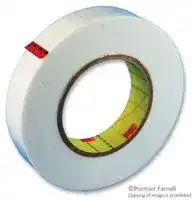


9890 (1X36YDS)
THERMALLY CONDUCTIVE TAPE
- Manufacturer: 3M
- Product type: Thermally Conductive Materials
- Thermal Conductivity:0.6W/m.K; Conductive Material:Polymer; Thickness:0.127mm; Thermal Impedance:-; Dielectric Strength:-; External Length:32.918mm; External Width:25.4mm; P 41T5552
- Thermal Conductivity: 0.6W/m.K
| Delivery and price | |
|---|---|
| Units per pack | 10 |
| Price | 107.06 € |
| Current stock | 10+ |
| Lead time | 7 days |

## 3 Technical Bulletin **System Design and Performance for 3M** TM **Thermally Conductive Tapes 9882, 9885, 9890**

**April, 1999**

## **Notes on System Design and Performance**

This publication is intended to aid the user in optimizing the design and performance of systems using 3Mª Thermally Conductive Tapes 9882, 9885, and 9890.

Note: this information presented should be considered representative or typical and should not be used for specification purposes. The user is responsible for evaluating the tape under actual conditions of use and with the substrates intended for the userÕs application, to determine whether the tape is suitable for a particular use and method of application.

The information of this bulletin is organized in three sections:

## **I. Thermal and Mechanical Performance Optimization**

- ¥ Thermal impedance of the assembly

- ¥ Mechanical performance

- ¥ Minimizing entrapped air

## **II. Performance at High and Low Temperatures**

- ¥ Short term exposure

- ¥ Long term exposure

- ¥ Limiting factors

- ¥ Heat and humidity

- ¥ Temperature cycling

## **III. Bond Building / Rework**

- ¥ The bond building effect

- ¥ Bond building on ceramic

- ¥ Bond building on anodized aluminum

- ¥ Rework procedures

Additional information on these topics or others not covered may be requested by calling the toll free number on the last page.

Technical Bulletin **System Design and Performance for 3M** TM **Thermally Conductive Tapes 9882, 9885, 9890**

## **I. Thermal/Mechanical Performance Optimization**

Optimized thermal and mechanical performance of systems assembled with 3Mª Thermally Conductive Adhesive Transfer Tapes 9882, 9885 and 9890 depends, among other things, on an balance of the material properties of the adhesive and the substrates and the use of assembly conditions appropriate to the parts.

## **Thermal Impedance of the Assembly**

In an ideal case, substrates are perfectly flat and the bond is made without air entrapment:

Adhesive tC“(;std ~~+~~ Ideal, Flat Substrates

In this case, thermal impedance of the bond area, Rtot (¡C/W), would be equal to the adhesive thermal resistance (¡C/in[2] /W) divided by the bond area, Atot (in[2] ). (Thermal resistance values typical of the 3Mª Thermally Conductive Tapes can be found in the Data Page.) To optimize thermal performance one would simply use the thinnest adhesive available.

Substrates often will have several thousands of an inch (mils) runout of flatness of their surfaces and using the thinnest adhesive may lead to air gaps in the bond line of the assembly as represented in the edge-on view below. When both substrates are rigid materials this effect is especially likely to occur.

**==> picture [34 x 7] intentionally omitted <==**

**----- Start of picture text -----**<br>
Adhesive<br>**----- End of picture text -----**<br>


**==> picture [73 x 7] intentionally omitted <==**

**----- Start of picture text -----**<br>
Non-Flat Substrates<br>**----- End of picture text -----**<br>


Now the adhesive no longer covers the entire area, Atot, rather it covers a contact area smaller than Atot and air fills the rest of the area. Calculation of total thermal impedance Rtot in the case of parallel adhesive and air thermal impedances is much more complicated, but suffice to say the thermal impedance of the assembly is higher because of air pockets. (Please see the 3M Technical Bulletin ÒHeat Flow Calculation for 3M Thermally Conductive Tapes [9882, 9885, 9890]Ó for a method to determine the total thermal impedance.) Choice of an adhesive layer much thicker than the flatness runout can help reduce the air, as portrayed the bond area cross-sections

Bond Area Using 2 mil Adhesive (30% Contact, 70% Entrapped Air)

Bond Area Using 10 mil Adhesive (85% Contact, 15% Entrapped Air)

- 2 -

Technical Bulletin **System Design and Performance for 3M** TM **Thermally Conductive Tapes 9882, 9885, 9890**

- **I. Thermal/Mechanical Performance Optimization** _**(continued)**_

Depending on the thickness of the air layer, the reduction of entrapped air by using a thicker adhesive may be enough to compensate for the increased thermal resistance of the thicker adhesive layer. Optimized thermal performance may be found in a trade-off between entrapped air and adhesive thickness. As a rule of thumb, the flatness runout of both parts should be one half the thickness of the adhesive layer or less.

## **Mechanical Performance**

Entrapped air is detrimental to mechanical performance as well as thermal performance; shear strength, for example, is proportional to the actual adhesive contact area. Maximizing the contact area of the bond by minimizing entrapped air can be beneficial for mechanical reliability during assembly as well as long term reliability of the finished product.

In addition, incomplete contact over the bond area can affect the long term reliability of the adhesive at high temperatures (e.g. ³ 125¡C). As discussed in Section II, an air gap that extends to the edge of the parts, as pictured above left, will facilitate oxidation of the adhesive at high temperatures and reduce the long term reliability of the assembly.

## **Minimizing Entrapped Air**

One way to determine if parts or assembly methods are likely to entrap air is to bond the substrates individually to a glass plate with the adhesive, and then inspect the bond area through the opposite side of the glass. Methods to reduce entrapped air include A) cleaning parts to remove particulate contamination, B) choosing an adhesive with thickness significantly greater than the flatness runout of the parts, C) using sufficient assembly force to compress the adhesive and fill the gaps, D) applying force sequentially to corners or edges rather than just to the center of the part, and E) heating the adhesive and parts during bonding, which softens the adhesive and facilitates

**II. High/Low Temperature Performance**

Some performance considerations for use of the 3Mª Thermally Conductive Tapes 9882, 9885, and 9890 under extremes of high and low temperatures are presented below. Data pertain to temperature extremes seen by the bonded assembly, rather than a roll or face of the adhesive. At any temperature the bond strength is dependent on the area bonded, which in turn requires flat, clean surfaces and assembly conditions (temperatures, pressures, dwell times) optimized by the user to the parts and equipment. Thermal properties have not been directly measured as a function of environmental condition, though it is believed that wetting of the surfaces by the adhesive and strong adhesion levels are conditions that contribute to stable thermal properties.

## **High Temperatures (> 85¡C)**

## Short Term (Minutes)

Testing has shown excellent stability of the product in assemblies subject to temperatures up to 260¡C (such as solder - reflow process) for several minutes.

- 3 -

## Technical Bulletin

## **System Design and Performance for 3M** TM **Thermally Conductive Tapes 9882, 9885, 9890**

**II. High/Low Temperature Performance** _**(continued)**_

## Long Term (Days - Weeks)

The limiting factor for long term performance at high temperatures (e.g. 125¡C) is an oxidation phenomenon which affects those portions of the adhesive having A) exposure to air (oxygen) and B) as route for the reaction products to escape. The process is diffusion limited and therefore the oxidation affects a small portion of adhesive around the perimeter of the bond line. Small parts or poorly bonded parts having air gaps extending to the edge of the bond area (see cross section below, left) are more susceptible to oxidation-related failure than well bonded assemblies (below, right).

Choice of adhesive thickness well exceeding the runout of flatness on the part (especially rigid substrates), coupled with optimal assembly methods can help reduce air gaps (as discussed in Section I) and increase the high temperature reliability.

The problem of gap filling or air entrapment in pairs of rigid parts assembled with the adhesive also makes these parts more susceptible to the oxidation phenomenon. Flexible materials having fully contacted bond areas are less susceptible to reduced adhesion from the oxidation. the graph below displays data (lbs./in. peel adhesion vs. time at condition) from peel tests with one-inch wide anodized aluminum foil bonded with the adhesive to ceramic substrates. These samples showed no net peel adhesion loss despite a few millimeters of oxidation around the perimeter of the bond line.

**==> picture [349 x 168] intentionally omitted <==**

**----- Start of picture text -----**<br>
Peel Adhesion, 150°C Aging Condition<br>16<br>14<br>12<br>10<br>8 O-——— O<br>6 9890 Tape<br>9885 Tape<br>4<br>9882 Tape<br>2<br>0<br>1 d 3 d 1 wk 3 wk 6 wk<br>lbs.   /   in.<br>**----- End of picture text -----**<br>


- 4 -

Technical Bulletin **System Design and Performance for 3M** TM **Thermally Conductive Tapes 9882, 9885, 9890**

## **II. High/Low Temperature Performance** _**(continued)**_

## **Heat and Humidity**

The adhesive absorbs very little moisture (< 0.2% by weight), therefore the presence of humidity does not in itself lead to loss of adhesion. However, metal substrates prone to formation of loosely bound oxides may suffer accelerated mechanical failure when in contact with Tapes 9882, 9885, and 9890 Tapes under these conditions. Examples of such metals include copper, iron, and in some cases, untreated aluminum. Therefore it is advised that such metals be passivated with appropriate coatings or treatments before applying the adhesive.

## **Low Temperatures (² 20¡C)**

Temperatures below the glass transition temperature, Tg (-20¡C to 30¡C), cause the adhesive to become a glassy, rigid material, compared to its rubbery state above Tg. Low temperatures do not in themselves harm the adhesive or the bond strength. However, below Tg the bonded parts are more prone to delamination from applied stresses such as high frequency shock, or from internal stresses such as those due to mismatched coefficients of thermal expansion of the substrates (e.g. ceramic bonded to aluminum). Vibration damping, a useful property of the adhesive in the rubber state, it is also reduced at low temperatures.

## **Temperature Cycling**

Temperature cycles that drop below -20¡C or dwell well above 85¡C may cause failures as described in the other section above. Delaminations from coefficient of thermal expansion mismatch may combine with the oxidation effect to cause additional failures not found when the conditions act separately. For moderate temperature cycles the adhesive actually can be beneficial to stress relief of rigid assemblies. Because its modulus is below that of metals or ceramics, some of the shear stress from temperature cycling may be taken up in strain of the adhesive, helping to protect the bonded parts.

## **III. Bond Building/ Rework**

Information is presented below on the rates of bond building of the 3Mª Thermally Conductive Tapes 9882, 9885, and 9890 on various material surfaces and a general procedure for rework.

In general the adhesion strength of bonds made with these tapes increases over time (the Òdwell periodÓ) a process called bond building. The bond building effect is not due to a curing reaction, since the adhesive is a fully cured material. Rather the cause is due to a combination of mechanical and chemical forces that act over time. Mechanical interlocking occurs from the flow of the adhesive on a microscopic scale into pores of the substrate. Surface forces establish in a wetting phenomenon the rate and extent of which depends on the chemistry of the substrate. The degree of bond building therefore depends on the details of the substrate surface and chemical makeup. Examples of quite different bond building characteristics on ceramic and anodized aluminum substrates are give on the following page.

- 5 -

Technical Bulletin **System Design and Performance for 3M** TM **Thermally Conductive Tapes 9882, 9885, 9890**

## **III. Bond Building/ Rework** _**(continued)**_

At any temperature the bond strength is dependent, among other things, on the contact area of the bond, which in turn requires flat, clean surfaces and assembly conditions (temperatures, pressures, dwell times) optimized by the user to the parts and equipment. The data below were taken from peel test measurements using 1 in. wide anodized aluminum foil, bonded at room temperature with Tape 9885 to either ceramic or anodized aluminum substrates. The samples were allow to dwell for various times at either room temperatures or 70¡C prior to the peel test. Similar trends were seen in data taken with the 9882 and 9890 Tapes. (Note: The results should be considered representative or typical and not be used for specification purposes.

## **Ceramic Substrates**

As shown in the data below, the initial room temperature bond to ceramic substrates is typically only about 40% of the final levels, 85% of which is reached after about three days dwell. The final values of the two conditions differ Ð the final bond strength approached at 70¡C appears to be 40% higher than that approached at room temperature. Perhaps due to the higher final levels, the bond building process is accelerated by heat: after 30 minutes to an hour at 70¡C the bond strength is equivalent to that obtained after a one day dwell at room temperature. One day at 70¡C corresponds to three days at room temperature.

**==> picture [372 x 192] intentionally omitted <==**

**----- Start of picture text -----**<br>
Peel Strength (lbs./in.) of 9885 Tape on Ceramic<br>10<br>8<br>6<br>RT Dwell<br>4<br>70°C Dwell<br>2<br>0<br>Init 0.5 h 1 h 24 h 72 h 1 wk<br>**----- End of picture text -----**<br>


- 6 -

Technical Bulletin **System Design and Performance for 3M** TM **Thermally Conductive Tapes 9882, 9885, 9890**

## **III. Bond Building/ Rework** _**(continued)**_

## **Anodized Aluminum Substrates**

As one can see from the data below, anodized aluminum substrates show very rapid building of the peel strength. The initial bond is nearly 80% of the final levels and the effect of elevated temperatures is diminished. Both the final peel strengths obtained, as well as the rate of bond building appear to be the same for either room temperature dwells or 70¡C dwell.

**==> picture [372 x 192] intentionally omitted <==**

**----- Start of picture text -----**<br>
Peel Strength (lbs./in.) of 9885 Tape on Ceramic<br>10<br>8<br>6<br>RT Dwell<br>4<br>70°C Dwell<br>2<br>0<br>Init 0.5 h 1 h 24 h 72 h 1 wk<br>**----- End of picture text -----**<br>


## **Effect on Thermal Resistance**

In a spot check over a 24 hour period, the thermal properties of the adhesive did not appear to change beyond the 20% - 25% margin of error of our experiments. However it is believed that wetting of the surfaces by the adhesive and strong adhesion levels contribute to yield optimum thermal properties.

## **Rework**

The procedure for reworking bonds made with the adhesive.

- A) Mechanically separate the parts, using torque for rigid parts and peel for flexible ones. The amount of force required will depend on the bond area and the extent to which the bond has built, as described above. Heating the substrates and adhesive (with a hot air gun or other means) to 70¡C - 100¡C will soften the adhesive bond and allow the amount of force to be reduced.

- B) Remove the adhesive by rubbing if off with a tool. Use solvent only as a last (messy) resort.

- C) Clean the surfaces using isopropyl alcohol. If gross contamination exists, use another solvent such as acetone or methyl ethyl ketone, followed by isopropyl alcohol (to remove the solvent residue).

- D) Apply fresh adhesive and repeat the bonding procedure.

- **Note:** Carefully read and follow the manufacturerÕs precautions and directions for use when using solvents.

- 7 -

**System Design and Performance for 3M** TM **Thermally Conductive Tapes 9882, 9885, 9890**

## Technical Bulletin

**For Additional** To request additional product information or to arrange for sales assistance, call toll free 1-800-362-3550. **Information** Address correspondence to: 3M Bonding Systems Division, 3M Center, Building 220-7E-01, St. Paul, MN 55144-1000. Our fax number is 612-733-9175. In Canada, phone: 1-800-364-3577. In Puerto Rico, phone: 1-809-750-3000. In Mexico, phone: 5-728-2180.

## **Important Notice**

3M MAKES NO WARRANTIES, EXPRESS OR IMPLIED, INCLUDING, BUT NOT LIMITED TO, ANY IMPLIED WARRANTY OF MERCHANTABILITY OR FITNESS FOR A PARTICULAR PURPOSE. User is responsible for determining whether the 3M product is fit for a particular purpose and suitable for user’s method of application. Please remember that many factors can affect the use and performance of a 3M product in a particular application. The materials to be bonded with the product, the surface preparation of those materials, the product selected for use, the conditions in which the product is used, and the time and environmental conditions in which the product is expected to perform are among the many factors that can affect the use and performance of a 3M product. Given the variety of factors that can affect the use and performance of a 3M product, some of which are uniquely within the user’s knowledge and control, it is essential that the user evaluate the 3M product to determine whether it is fit for a particular purpose and suitable for the user’s method of application.

## **Limitation of Remedies and Liability**

If the 3M product is proved to be defective, THE EXCLUSIVE REMEDY, AT 3M’S OPTION, SHALL BE TO REFUND THE PURCHASE PRICE OF OR TO REPAIR OR REPLACE THE DEFECTIVE 3M PRODUCT. 3M shall not otherwise be liable for loss or damages, whether direct, indirect, special, incidental, or consequential, regardless of the legal theory asserted, including negligence, warranty, or strict liability.

## ~~**ISO 9002**~~

This Bonding Systems Division product was manufactured under a 3M quality system registered to ISO 9002 standards.

## 3

**Bonding Systems Division** 3M Center, Building 220-7E-01 St. Paul, MN 55144-1000

_Recycled Paper 40% pre-consumer 10% post-consumer_

Printed in U.S.A. ©3M 1999 70-0704-8798-1

- 8 -
Updated at March 9, 2026
Founded in 1902, 3M is a globally recognized powerhouse of innovation, leveraging decades of scientific research to develop advanced solutions across numerous industries. Within the electronics sector, the company is highly regarded for its precision-engineered materials and reliable components that enhance device performance, safety, and longevity. A primary focus of our 3M portfolio is advanced cooling and thermal management. The brand excels in producing high-performance thermal interface materials, offering premium thermally conductive solutions designed to efficiently dissipate heat from critical electronic assemblies. These materials are essential for maintaining optimal operating temperatures and ensuring the stability of modern, densely packed electronic systems. Beyond thermal solutions, 3M also provides specialized components for signal integrity and electrical safety. The selection includes advanced shielding gaskets and materials for effective EMC and RFI suppression, safeguarding sensitive circuits from electromagnetic interference. Additionally, 3M manufactures robust fuse holders, delivering secure and dependable circuit protection for a diverse range of industrial and commercial applications.
About Novapart
Novapart is a B2B electronic component broker specialising in stock shortages and cost reduction. We source hard-to-find parts and identify compliant alternatives across a catalogue of 410,000+ components from 500+ manufacturers.
Learn more →Stock Shortage Specialist
When a component is unavailable, discontinued or has an unacceptable lead time, we tap into our network of vetted European and Asian distributors to source what you need — without compromising on quality or traceability.
Request a quote →Compliant Alternatives
We identify pin-to-pin, electrically equivalent substitutes that meet the same certifications (RoHS, AEC-Q100, REACH) as your original specification — validated against datasheets, not just part numbers. Often at a lower cost.
BOM Analysis service →