
Image not available
Illustrative purposes only

88 886 016
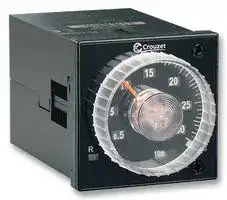
Analogue Timer, TMR 48 U, Multifunction, 14 Ranges, 0.02 s, 300 h, 2 Changeover Relays
⚠️ Reference pricing provided. In case of supply shortages, we will connect you with our trusted procurement partners to ensure your project's continuity.
- Manufacturer: CROUZET
- Product type: Analogue Timers
- Product Range:TMR 48 U Series; Timer Functions:Multifunction; No. of Timing Ranges:14Ranges; Time Min:0.02s; Time Max:300h; Timer Output:2 Changeover Relays; Supply Voltage Max:240V; Current Rating
- Time Max: 300h
- Time Min: 0.02s
- Timer Output: 2 Changeover Relays
- Product Range: TMR 48 U
- Timer Functions: Multifunction
- Current Rating Nom: 5A
- Panel Cutout Width: 45mm
- Supply Voltage Max: 240V
- Panel Cutout Height: 45mm
- No. of Timing Ranges: 14Ranges
- Connection / Termination: Plug-In
| Delivery and price | |
|---|---|
| Units per pack | 1 |
| Price | 105.67 € |
| Current stock | 10+ |
| Lead time | 30 days |
Datasheet

## Function diagrams

## Generic functions

**• A function: Delay on energisation • AM function: Delay on energisation • H function: Timing on energisation - • P and Pe functions: Impulse counter (delay on)** 1 relay **Pulse output (adjustable) U** : Supply ~~2~~ Latching during the time delay. **U** : Supply 1 relay U **P function: R  T** :  Output relay  : Timingor load RU - Single shot timing which starts  on energisation. 1 ~~-~~ 39 ~~--~~ 45 {jf ~~Se~~ [jfC4} ~~of~~ [| ~~J,}~~ **T R** :  Output relay  : Timingor load UR On energisation, the output relay  "R" (or the load) changes state, and  stays there for the whole duration of R ~~T~~ p ~~.~~ At the end of timing, the output relay "R" (or the load) changes Timing starts on energisation. ∞[: Infinity] 8 ~~-~~ 9 ~~-~~ 11 [ |} pty ~~PT~~ ∞[: Infinity] T. the time delay and drops out at the P = 500 ms state for approximately 500 ms. **C (y1)** : Command ~~hl~~ **• Ac function: Timing after closing and opening** ~~BEeeeecola~~ **C (y1)** : Command end of the single shot cycle. **Pe function: of control contact** tl t2 tT T=tl+2 U On energisation. 1 relay **• Ht function: Delay on energisation with memory** At the end of timing, the output CcU After energisation, closing of the  control contact results in starting  of the time delay T. PF **• AMt function: Delay on energisation** Latching during and after ~~Po~~ 1 relay Adds up the total opening time R ~~T~~ tP= ~~p~~ 1s relay "R" (or the load) changes state for approximately 1 s. ~~=~~ Output relay "R" (or the load) 2) ~~chEE~~ the time delay. U of a contact. changes state at the end of  this time delay. After opening of 2 ~~-~~ 5 ~~a~~ C+j—{ ss! Cc ~~R~~ On energisation, the output relay  "R" (or the load) contact C (Y1), relay "R" drops out ~~|~~ changes state, and stays there for after a second time delay T. 8 ~~-~~ 9 ~~-~~ 11 pl ~~yyy yt~~ T _=tl+t2 the whole duration of the time delay  and drops out at the end of the ~~Fo~~ **• Pt function: Impulse counter (delay on)** t1 2 T T=tt+t2 single shot cycle. **• Ad function: Delay on energisation** Adds up the total opening time —— **(cannot be reset)** ~~a~~ **• B function: Timing on impulse (one shot) -Shaping (cannot be reset) • K function:** ~~_~~ **Delay on de-energisationTrue delay off** ~~°»~«©«;«©~~ CcU of a contact.At the end of timing, the output is 1 relay R excited for approximately 500 ms. U After energisation, a control pulse 1 relay **(without auxiliary power supply)** t1 t2. CR or latching contact starts timing. At the end of timing, the output  is excited. The output will be reset cU After energisation, an impulse  (causes a change in state of the ≥ 50 ms) or a latching contact 1 relay U On energisation, the output relay  "R" (or the load) changes state. T=tr4t2 <Tr! j<To ~~!~~ when a new control pulse or  latching contact occurs. R loo T output relay "R" (or the load)  which drops out at the end R ~~T~~ On de-energisation timing starts  and the relay "R" will only drop out ~~Po~~ **• Q function: "Star-delta" starting** of timing. at the end of this time delay. On energisation, the "star" **• Bw function: Pulse output (adjustable)** ~~....©}.}©6~~ **• L function: Asymmetrical flashing** 8 contact closes instantaneously ~~EU~~ ——k:k U T Ti and timing starts. 1 relay 1 relay At the end of timing the Ti "star" ~~hi~~ **• Ah function:** 2 timers or2 relays including  1 instantaneous **Single shot flip-flop(cannot be reset)** After energisation, a control pulse CcUR T- T. On closing and opening  of the control contact C (Y1),  the output relay "R" (or the  load) changes state for as long 2 timers or UR ~~1eT2.~~ Repetitive cycle with two times  which can be set independently.  Each time delay alternates with a  different state of the output relay closes.contact opens. After a pause  of 40 to 100 ms the "delta" contact or latching contact starts timing. as the time delay lasts. 2 relays including "R" (or the load). U At the end of timing, the output is 2 timers or 1 instantaneous c excited. The time delay is then  reset. At the end of this new time 2 relays including 1 instantaneous _Note: The cycle starts with  the relay_ " _R_ " _in the rest position._ **• TL function: Impulse relay** R1/R2 ~~Ua}~~ RIUR2U ~~=<“<“——_~~ °&°~&©;*7°&° ° °° ~~°°”~~ delay, the output reverts to its initial ~~——— T1472~~ R2 Inst. TehaTe value. Rue ~~rs~~ After energisation, a control pulse MeTee R2 Inst. ~~lets etal Po~~ **• Li function: Asymmetrical flashing** U or latching contact closes the 1 relay Cc relay. A second control pulse opens the relay. **• C function: Timing after impulse** Repetitive cycle with two times ~~EU~~ **• At function: Timing on energisation** ~~PY~~ **True delay off** R which can be set independently. R **with memory (without auxiliary power supply)** ~~a1¢T2.~~ — 1 relay 1 relay **• N function: "Safe-guard"** CcU Adds up the opening time  of a contact. CcU After energisation, closing of the  control contact C (Y1) results in  the change of state of output relay U On the first control pulse, ~~=_“<_~~ **• Tt function: Timed impulse relay** ~~°°~~ ° ° °»°»~« © R t1 12 Output relay "R" (or the load) R ~~0 T~~ "R" (or the load). Cc the output is excited.  If the interval between two U After energisation, a control pulse or latching contact closes the relay T=t1+t2 changes state at the end of timing. Timing will only start when this R impulses is longer than the timing Cc and starts timing. contact opens. value, this occurs normally and the The relay opens at the end of timing ~~=_<_~~ **• A1 function: Delay on energisation** ~~°°~~ ,°,~°~«©«© ioe) T. output relay "R" (or the load) R e ~~T~~ t or on a second control pulse. will change state at the end of 2 ~~-~~ 10 ~~Lo~~ **• D or Di functions: Symmetrical flashing** timing. Otherwise, relay "R" stays 1 ~~-~~ 3 ~~-~~ 4 1 timer1 instantaneous relay Repetitive cycle which alternately sets the output relay "R"  (or the load) to operating and rest position for equal periods in its original state until the  condition is fulfilled. 8 ~~-~~ 9 ~~-~~ 11 of time. **• O function: "Delayed safe-guard"** t1<T t2<T ~~T~~ 1 relay PF **• W function: Timing after pulse on control contact • A2 function: Delay on energisation** UR **D function:** The cycle starts with relay  "R" in rest position. ° runs and the output relay "R"  (or the load) changes state.On energisation, a first timer After energisation, opening of the control contact results in a change 2 ~~-~~ 10 1 relay R oe) « ioe) On the appearance of a control pulse, relay "R" returns to its initial Cc in the state of output "R" (or the load) and timing starting. 1 ~~-~~ 3 ~~-~~ 4 2 timers. U **Di function:** The cycle starts with relay the time interval between 2 impulses is less than the timing value. TOT T position and stays there as long as R ~~=~~ 8 ~~-~~ 9 ~~-~~ 11 R "R" in operating position. Otherwise, relay "R" will change state at the end of timing.
Updated at April 29, 2026
About Novapart
Novapart is a B2B electronic component broker specialising in stock shortages and cost reduction. We source hard-to-find parts and identify compliant alternatives across a catalogue of 410,000+ components from 500+ manufacturers.
Learn more →Stock Shortage Specialist
When a component is unavailable, discontinued or has an unacceptable lead time, we tap into our network of vetted European and Asian distributors to source what you need — without compromising on quality or traceability.
Request a quote →Compliant Alternatives
We identify pin-to-pin, electrically equivalent substitutes that meet the same certifications (RoHS, AEC-Q100, REACH) as your original specification — validated against datasheets, not just part numbers. Often at a lower cost.
BOM Analysis service →