
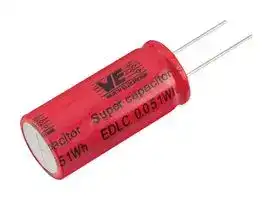


850617030001
Supercapacitor, 3 F, 2.7 V, PC Pin, -10%, +30%, 3.5 mm, 1000 hours @ 65°C
- Manufacturer: WURTH ELEKTRONIK
- Product type: EDLC - Electric Double Layer Capacitors
- Capacitance:3F; Voltage Rating:2.7V; Capacitor Terminals:Radial Leaded; Product Range:WCAP-STSC Series; Capacitance Tolerance:+30%, -10%; Lead Spacing:3.5mm; Lifetime @ Temperature:1000
- ESR: 0.06ohm
- SVHC: No SVHC (25-Jun-2025)
- Capacitance: 3F
- Voltage(DC): 2.7V
- Lead Spacing: 5mm
- Product Range: WCAP-STSC Series
- Product Width: -
- Qualification: -
- Product Height: 20mm
- Product Length: -
- Product Diameter: 8mm
- Capacitor Mounting: Through Hole
- Capacitor Terminals: PC Pin
- Capacitance Tolerance: -10%, +30%
- Lifetime @ Temperature: 1000 hours @ 65°C
- Capacitor Case / Package: Can
- Operating Temperature Max: 65°C
- Operating Temperature Min: -40°C
| Delivery and price | |
|---|---|
| Units per pack | 500 |
| Price | 1.82 € |
| Current stock | 50+ |
| Lead time | 30 days |

**==> picture [608 x 337] intentionally omitted <==**

**----- Start of picture text -----**<br>
Dimensions: [mm] Recommended Hole Pattern: [mm] Electrical Properties:<br>Properties<br>Capacitance<br>Rated Voltage<br>©) ee Rated Voltage<br>W F<br>P Surge Voltage<br>ESR<br>ESR<br>Rated Discharge Current<br>p<br>— arcn Max. Discharge Current<br>z Ve<br>Leakage Current<br>Bt e Power Density s<br>5 5<br>Energy Density<br>Schematic:<br>-<br>+ General Information:<br>OF<br>Storage Conditions<br>tL ae (in original packaging)<br>M ee Operating Temperature<br>Vent<br>Moisture Sensitivity Level (MSL)<br>v ed Life Cycle<br>Of<br>L<br>min.<br>min.<br>4,0 15,0<br>D<br>O<br>**----- End of picture text -----**<br>


**Electrical Properties:** ~~po~~ **Properties Test conditions Value Unit Tol.** ~~es~~ **Capacitance** C 10 mA/ F 3 F +30%/-10% **Rated Voltage** VR @ 65 °C 2.7 V (DC) max. ~~ee~~ **Rated Voltage** ~~es~~ VR @ 85 °C 2.3 V (DC) max. ~~ss~~ **Surge Voltage** VS @ 65 °C 2.85 V (DC) max. **ESR** RESR DC 10 ms 70 mΩ max. **ESR** RESR AC 5 mV @ 1 kHz 60 mΩ max. **Rated Discharge Current** IRated 0.7 A typ. ~~ss~~ **Max. Discharge Current** IMax 3.3 A typ. ~~es~~ **Leakage Current** ILeak 72 hrs. @ VR 0.008 mA typ. ~~**e**~~ **Power Density** ~~s~~ P 18.08 kW/ kg typ. ~~s~~ **Energy Density** E 2.1 Wh/ kg typ.

|||||Vent<br>~~tL~~|Vent<br>~~tL~~|OD<br>~~tL~~|~~tL~~|||~~ae~~<br>M~~ee~~<br>v~~ed~~|~~ae~~<br>M~~ee~~<br>v~~ed~~|~~ae~~<br>M~~ee~~<br>v~~ed~~|~~ae~~<br>M~~ee~~<br>v~~ed~~|~~ae~~<br>M~~ee~~<br>v~~ed~~|~~ae~~<br>M~~ee~~<br>v~~ed~~|~~ae~~<br>M~~ee~~<br>v~~ed~~|~~ae~~<br>M~~ee~~<br>v~~ed~~|~~ae~~<br>M~~ee~~<br>v~~ed~~|~~ae~~<br>M~~ee~~<br>v~~ed~~|~~ae~~<br>M~~ee~~<br>v~~ed~~|~~ae~~<br>M~~ee~~<br>v~~ed~~|~~ae~~<br>M~~ee~~<br>v~~ed~~|~~ae~~<br>M~~ee~~<br>v~~ed~~|~~ae~~<br>M~~ee~~<br>v~~ed~~|||||||||||||**Storage Conditions**<br>**(in original packaging)**<br>**Operating Temperature**<br>**Moisture Sensitivity Level (MSL)**<br>**Life Cycle**<br>**Weight**<br>m||15 °C up to + 35 °C; 10 % up to 75 % RH<br>-40 up to +65 °C<br>1<br>500000<br>1.4|Cycles<br>g|
|---|---|---|---|---|---|---|---|---|---|---|---|---|---|---|---|---|---|---|---|---|---|---|---|---|---|---|---|---|---|---|---|---|---|---|---|---|---|---|---|---|
||||||||||||||||||||||||||||||||||||||Test conditions of Electrical Properties: +20 °C, 35 % RH if not specified differently||||
||||||||||||||||||||||||||||||||||||||Component conform to REACh and RoHS requirements and standards||Component conform to REACh and RoHS requirements and standards||
||||||||||||||||||||||||||||||||||||||||||
|**Dimensions:**|**Dimensions:**|**Dimensions:**|**Dimensions:**||||||||||||||||||||||||||||||||||||||
|**Properties**<br>**Diameter**<br>**Length**<br>**Pitch**||||||||Ø D<br>L<br>P|**Value**<br>8<br>20<br>3.5||||||||||||||**Unit**<br>mm<br>mm<br>mm||||**Tol.**<br>±1.5<br>±1.5<br>±0.5|~~@gg~~~|||||||||CHECKED<br>REVISION<br>DATE (YYYY-MM-DD)<br>GENERAL TOLERANCE<br>PROJECTION<br>METHOD<br>ReKa<br>002.002<br>2022-04-11<br>DIN ISO 2768-1m<br>DESCRIPTION<br>TECHNICAL REFERENCE<br>**WCAP-STSC Supercapacitors**<br>STP0820305Q2R7DSPB15000<br>~~[LL~~<br>~~_|] se~~||||
|**Pin Diameter**<br>**Pitch**<br>**Hole Diameter**||||||||Ø F<br>p<br>Ø f|0.6<br>3.5<br>0.9||||||||||||||mm<br>mm<br>mm||||±0.02<br>±0.5<br>±0.02||||||||Würth Elektronik eiSos GmbH & Co. KG<br>EMC & Inductive Solutions<br>Max-Eyth-Str. 1<br>74638 Waldenburg<br>Germany<br>Tel. +49 (0) 79 42 945 - 0||**(EDLC‘s)**<br>SIZE/TYPE||ORDER CODE<br>**850617030001**<br>BUSINESS UNIT<br>STATUS|PAGE|
||||||||||||||||||||||||||||||||||||www.we-online.com<br>eiSos@we-online.com||8.0 x 20.0||eiCap<br>Valid|1/10|


## **Dimensions:**

This electronic component has been designed and developed for usage in general electronic equipment only. This product is not authorized for use in equipment where a higher safety standard and reliability standard is especially required or where a failure of the product is reasonably expected to cause severe personal injury or death, unless the parties have executed an agreement specifically governing such use. Moreover Würth Elektronik eiSos GmbH & Co KG products are neither designed nor intended for use in areas such as military, aerospace, aviation, nuclear control, submarine, transportation (automotive control, train control, ship control), transportation signal, disaster prevention, medical, public information network etc.. Würth Elektronik eiSos GmbH & Co KG must be informed about the intent of such usage before the design-in stage. In addition, sufficient reliability evaluation checks for safety must be performed on every electronic component which is used in electrical circuits that require high safety and reliability functions or performance.

## **Component Marking:**

|**Component Marking:**|||
|---|---|---|
|**2nd Horizontal Line**<br>~~—————~~|Supercapacitor<br>~~—————~~|~~—————~~|
|**3rd Horizontal Line**<br>~~—————~~|EDLC Energy Capacity: 0.003 Wh<br>~~—————~~|EDLC Energy Capacity: 0.003 Wh<br>~~—————~~|
|**3rd Line**<br>~~—————~~|Rated Voltage: 2.7 V (DC) , Capacitance Value: 3 F , max. Temp. 65 °C<br>~~—————~~|Rated Voltage: 2.7 V (DC) , Capacitance Value: 3 F , max. Temp. 65 °C<br>~~—————~~|
|**5th Horizontal Line**<br>~~—————~~|WCAP-STSC<br>~~—————~~|~~—————~~|
|**6th Line**<br>~~—————~~|RU<br>~~—————~~|~~—————~~|


## **Lifetime Performance:**

|**Test Condition**|**Shelf Life**|**Cycle Life**|**Endurance**|
|---|---|---|---|
|**Lifetime**|up to 2 years|after 500000 cycles|1000 h, @65°C|
|**Voltage**|None|VRapplied|VRapplied|
|**Current**|None|IR|IR|
|**Δ C**|≤ 10% of initial value|≤ 30 % of initial measured value|≤ 30 % of initial measured value|
|**Δ ESR**|≤ 50% of specified value|≤ 2 x ESR|≤ 2 x ESR|
|**Comments**|25°C ± 10°C / 60% ±15% RH (dry and cool<br>condition); discharged ≤ 0.2 V|||


## **Certification:**

|**Certification:**|||
|---|---|---|
|**RoHS Approval**|Compliant [2011/65/EU&2015/863]|Compliant [2011/65/EU&2015/863]|
|**REACh Approval**|Conform or declared [(EC)1907/2006]|Conform or declared [(EC)1907/2006]|
|**Halogen Free**|Conform [IEC 61249-2-21]||
|**UL Approval**|810A||


## **Additional Information:**

|EDLC Energy Capacity: 0.003 Wh<br>Rated Voltage: 2.7 V (DC) , Capacitance Value: 3 F , max. Temp. 65 °C<br>**Endurance**<br>1000 h, @65°C<br>VRapplied<br>IR<br>≤ 30 % of initial measured value<br>≤ 2 x ESR<br>Compliant [2011/65/EU&2015/863]<br>Conform or declared [(EC)1907/2006]<br>~~—————~~|**Additional Information:**<br>**Properties**<br>**Description**<br>**Formula**<br>Max. Discharge Current<br>Imax– [A]<br>Current to discharge from VRto VR/2within 1<br>sec.<br>𝐼𝑚𝑎𝑥=<br>𝑉𝑅<br>2<br>⁄<br>1 𝑠𝑒𝑐<br>𝐶+ 𝑅𝑠<br>⁄<br>Rated Discharge Current<br>IRated– [A]<br>Current to discharge from VRto VR/2within 5<br>sec.<br>𝐼𝑅𝑎𝑡𝑒𝑑=<br>~~𝑉~~𝑅2<br>⁄<br>5 𝑠𝑒𝑐𝐶+ 𝑅𝑠<br>⁄<br>Leakage Current<br>ILeak– [mA]<br>is measured at 25°C (after holding 72 h at<br>VR)<br>Power Density<br>P – [W/kg]<br>impedance matched with m (kg) as net<br>weight for Capacitor<br>𝑃𝑚𝑎𝑥=<br>𝑉𝑅<br>2<br>4 ∗ 𝑅𝑠∗𝑚<br>Energy Density<br>E – [Wh/kg]<br>with m(kg) as net weight for Capacitor<br>𝐸=<br>𝐶∗𝑉𝑅<br>2<br>3600∗2 ∗𝑚<br>ESR<br>RESR– [mΩ]<br>**RESR AC**: measured by contact resistance<br>meter, conditions: Amplitude: 5 mV<br>Frequency 1 kHz<br>**RESR DC**: Measured by constant current<br>discharge method (i.a.w. IEC62391), deltaV:<br>Voltage drop during <20 ms<br>**ICC:**constant discharge current<br>𝑅𝐷𝐶=∆𝑉<br>𝐼𝑐𝑐<br>Capacitance<br>C – [F]<br>ICC[A]: constant discharge current<br>V1[V]: VRx 0.8<br>V2[V]: VRx 0.4<br>t1[sec]: time at V1<br>t2[sec]: time at V2<br>𝐶=<br>𝑑𝑄<br>𝑑𝑉<br>= 𝐼𝑐𝑐∗<br>𝑡2−𝑡1<br>𝑉1−𝑉2|**Additional Information:**<br>**Properties**<br>**Description**<br>**Formula**<br>Max. Discharge Current<br>Imax– [A]<br>Current to discharge from VRto VR/2within 1<br>sec.<br>𝐼𝑚𝑎𝑥=<br>𝑉𝑅<br>2<br>⁄<br>1 𝑠𝑒𝑐<br>𝐶+ 𝑅𝑠<br>⁄<br>Rated Discharge Current<br>IRated– [A]<br>Current to discharge from VRto VR/2within 5<br>sec.<br>𝐼𝑅𝑎𝑡𝑒𝑑=<br>~~𝑉~~𝑅2<br>⁄<br>5 𝑠𝑒𝑐𝐶+ 𝑅𝑠<br>⁄<br>Leakage Current<br>ILeak– [mA]<br>is measured at 25°C (after holding 72 h at<br>VR)<br>Power Density<br>P – [W/kg]<br>impedance matched with m (kg) as net<br>weight for Capacitor<br>𝑃𝑚𝑎𝑥=<br>𝑉𝑅<br>2<br>4 ∗ 𝑅𝑠∗𝑚<br>Energy Density<br>E – [Wh/kg]<br>with m(kg) as net weight for Capacitor<br>𝐸=<br>𝐶∗𝑉𝑅<br>2<br>3600∗2 ∗𝑚<br>ESR<br>RESR– [mΩ]<br>**RESR AC**: measured by contact resistance<br>meter, conditions: Amplitude: 5 mV<br>Frequency 1 kHz<br>**RESR DC**: Measured by constant current<br>discharge method (i.a.w. IEC62391), deltaV:<br>Voltage drop during <20 ms<br>**ICC:**constant discharge current<br>𝑅𝐷𝐶=∆𝑉<br>𝐼𝑐𝑐<br>Capacitance<br>C – [F]<br>ICC[A]: constant discharge current<br>V1[V]: VRx 0.8<br>V2[V]: VRx 0.4<br>t1[sec]: time at V1<br>t2[sec]: time at V2<br>𝐶=<br>𝑑𝑄<br>𝑑𝑉<br>= 𝐼𝑐𝑐∗<br>𝑡2−𝑡1<br>𝑉1−𝑉2|**Additional Information:**<br>**Properties**<br>**Description**<br>**Formula**<br>Max. Discharge Current<br>Imax– [A]<br>Current to discharge from VRto VR/2within 1<br>sec.<br>𝐼𝑚𝑎𝑥=<br>𝑉𝑅<br>2<br>⁄<br>1 𝑠𝑒𝑐<br>𝐶+ 𝑅𝑠<br>⁄<br>Rated Discharge Current<br>IRated– [A]<br>Current to discharge from VRto VR/2within 5<br>sec.<br>𝐼𝑅𝑎𝑡𝑒𝑑=<br>~~𝑉~~𝑅2<br>⁄<br>5 𝑠𝑒𝑐𝐶+ 𝑅𝑠<br>⁄<br>Leakage Current<br>ILeak– [mA]<br>is measured at 25°C (after holding 72 h at<br>VR)<br>Power Density<br>P – [W/kg]<br>impedance matched with m (kg) as net<br>weight for Capacitor<br>𝑃𝑚𝑎𝑥=<br>𝑉𝑅<br>2<br>4 ∗ 𝑅𝑠∗𝑚<br>Energy Density<br>E – [Wh/kg]<br>with m(kg) as net weight for Capacitor<br>𝐸=<br>𝐶∗𝑉𝑅<br>2<br>3600∗2 ∗𝑚<br>ESR<br>RESR– [mΩ]<br>**RESR AC**: measured by contact resistance<br>meter, conditions: Amplitude: 5 mV<br>Frequency 1 kHz<br>**RESR DC**: Measured by constant current<br>discharge method (i.a.w. IEC62391), deltaV:<br>Voltage drop during <20 ms<br>**ICC:**constant discharge current<br>𝑅𝐷𝐶=∆𝑉<br>𝐼𝑐𝑐<br>Capacitance<br>C – [F]<br>ICC[A]: constant discharge current<br>V1[V]: VRx 0.8<br>V2[V]: VRx 0.4<br>t1[sec]: time at V1<br>t2[sec]: time at V2<br>𝐶=<br>𝑑𝑄<br>𝑑𝑉<br>= 𝐼𝑐𝑐∗<br>𝑡2−𝑡1<br>𝑉1−𝑉2|**Additional Information:**<br>**Properties**<br>**Description**<br>**Formula**<br>Max. Discharge Current<br>Imax– [A]<br>Current to discharge from VRto VR/2within 1<br>sec.<br>𝐼𝑚𝑎𝑥=<br>𝑉𝑅<br>2<br>⁄<br>1 𝑠𝑒𝑐<br>𝐶+ 𝑅𝑠<br>⁄<br>Rated Discharge Current<br>IRated– [A]<br>Current to discharge from VRto VR/2within 5<br>sec.<br>𝐼𝑅𝑎𝑡𝑒𝑑=<br>~~𝑉~~𝑅2<br>⁄<br>5 𝑠𝑒𝑐𝐶+ 𝑅𝑠<br>⁄<br>Leakage Current<br>ILeak– [mA]<br>is measured at 25°C (after holding 72 h at<br>VR)<br>Power Density<br>P – [W/kg]<br>impedance matched with m (kg) as net<br>weight for Capacitor<br>𝑃𝑚𝑎𝑥=<br>𝑉𝑅<br>2<br>4 ∗ 𝑅𝑠∗𝑚<br>Energy Density<br>E – [Wh/kg]<br>with m(kg) as net weight for Capacitor<br>𝐸=<br>𝐶∗𝑉𝑅<br>2<br>3600∗2 ∗𝑚<br>ESR<br>RESR– [mΩ]<br>**RESR AC**: measured by contact resistance<br>meter, conditions: Amplitude: 5 mV<br>Frequency 1 kHz<br>**RESR DC**: Measured by constant current<br>discharge method (i.a.w. IEC62391), deltaV:<br>Voltage drop during <20 ms<br>**ICC:**constant discharge current<br>𝑅𝐷𝐶=∆𝑉<br>𝐼𝑐𝑐<br>Capacitance<br>C – [F]<br>ICC[A]: constant discharge current<br>V1[V]: VRx 0.8<br>V2[V]: VRx 0.4<br>t1[sec]: time at V1<br>t2[sec]: time at V2<br>𝐶=<br>𝑑𝑄<br>𝑑𝑉<br>= 𝐼𝑐𝑐∗<br>𝑡2−𝑡1<br>𝑉1−𝑉2|**Additional Information:**<br>**Properties**<br>**Description**<br>**Formula**<br>Max. Discharge Current<br>Imax– [A]<br>Current to discharge from VRto VR/2within 1<br>sec.<br>𝐼𝑚𝑎𝑥=<br>𝑉𝑅<br>2<br>⁄<br>1 𝑠𝑒𝑐<br>𝐶+ 𝑅𝑠<br>⁄<br>Rated Discharge Current<br>IRated– [A]<br>Current to discharge from VRto VR/2within 5<br>sec.<br>𝐼𝑅𝑎𝑡𝑒𝑑=<br>~~𝑉~~𝑅2<br>⁄<br>5 𝑠𝑒𝑐𝐶+ 𝑅𝑠<br>⁄<br>Leakage Current<br>ILeak– [mA]<br>is measured at 25°C (after holding 72 h at<br>VR)<br>Power Density<br>P – [W/kg]<br>impedance matched with m (kg) as net<br>weight for Capacitor<br>𝑃𝑚𝑎𝑥=<br>𝑉𝑅<br>2<br>4 ∗ 𝑅𝑠∗𝑚<br>Energy Density<br>E – [Wh/kg]<br>with m(kg) as net weight for Capacitor<br>𝐸=<br>𝐶∗𝑉𝑅<br>2<br>3600∗2 ∗𝑚<br>ESR<br>RESR– [mΩ]<br>**RESR AC**: measured by contact resistance<br>meter, conditions: Amplitude: 5 mV<br>Frequency 1 kHz<br>**RESR DC**: Measured by constant current<br>discharge method (i.a.w. IEC62391), deltaV:<br>Voltage drop during <20 ms<br>**ICC:**constant discharge current<br>𝑅𝐷𝐶=∆𝑉<br>𝐼𝑐𝑐<br>Capacitance<br>C – [F]<br>ICC[A]: constant discharge current<br>V1[V]: VRx 0.8<br>V2[V]: VRx 0.4<br>t1[sec]: time at V1<br>t2[sec]: time at V2<br>𝐶=<br>𝑑𝑄<br>𝑑𝑉<br>= 𝐼𝑐𝑐∗<br>𝑡2−𝑡1<br>𝑉1−𝑉2|**Additional Information:**<br>**Properties**<br>**Description**<br>**Formula**<br>Max. Discharge Current<br>Imax– [A]<br>Current to discharge from VRto VR/2within 1<br>sec.<br>𝐼𝑚𝑎𝑥=<br>𝑉𝑅<br>2<br>⁄<br>1 𝑠𝑒𝑐<br>𝐶+ 𝑅𝑠<br>⁄<br>Rated Discharge Current<br>IRated– [A]<br>Current to discharge from VRto VR/2within 5<br>sec.<br>𝐼𝑅𝑎𝑡𝑒𝑑=<br>~~𝑉~~𝑅2<br>⁄<br>5 𝑠𝑒𝑐𝐶+ 𝑅𝑠<br>⁄<br>Leakage Current<br>ILeak– [mA]<br>is measured at 25°C (after holding 72 h at<br>VR)<br>Power Density<br>P – [W/kg]<br>impedance matched with m (kg) as net<br>weight for Capacitor<br>𝑃𝑚𝑎𝑥=<br>𝑉𝑅<br>2<br>4 ∗ 𝑅𝑠∗𝑚<br>Energy Density<br>E – [Wh/kg]<br>with m(kg) as net weight for Capacitor<br>𝐸=<br>𝐶∗𝑉𝑅<br>2<br>3600∗2 ∗𝑚<br>ESR<br>RESR– [mΩ]<br>**RESR AC**: measured by contact resistance<br>meter, conditions: Amplitude: 5 mV<br>Frequency 1 kHz<br>**RESR DC**: Measured by constant current<br>discharge method (i.a.w. IEC62391), deltaV:<br>Voltage drop during <20 ms<br>**ICC:**constant discharge current<br>𝑅𝐷𝐶=∆𝑉<br>𝐼𝑐𝑐<br>Capacitance<br>C – [F]<br>ICC[A]: constant discharge current<br>V1[V]: VRx 0.8<br>V2[V]: VRx 0.4<br>t1[sec]: time at V1<br>t2[sec]: time at V2<br>𝐶=<br>𝑑𝑄<br>𝑑𝑉<br>= 𝐼𝑐𝑐∗<br>𝑡2−𝑡1<br>𝑉1−𝑉2|**Additional Information:**<br>**Properties**<br>**Description**<br>**Formula**<br>Max. Discharge Current<br>Imax– [A]<br>Current to discharge from VRto VR/2within 1<br>sec.<br>𝐼𝑚𝑎𝑥=<br>𝑉𝑅<br>2<br>⁄<br>1 𝑠𝑒𝑐<br>𝐶+ 𝑅𝑠<br>⁄<br>Rated Discharge Current<br>IRated– [A]<br>Current to discharge from VRto VR/2within 5<br>sec.<br>𝐼𝑅𝑎𝑡𝑒𝑑=<br>~~𝑉~~𝑅2<br>⁄<br>5 𝑠𝑒𝑐𝐶+ 𝑅𝑠<br>⁄<br>Leakage Current<br>ILeak– [mA]<br>is measured at 25°C (after holding 72 h at<br>VR)<br>Power Density<br>P – [W/kg]<br>impedance matched with m (kg) as net<br>weight for Capacitor<br>𝑃𝑚𝑎𝑥=<br>𝑉𝑅<br>2<br>4 ∗ 𝑅𝑠∗𝑚<br>Energy Density<br>E – [Wh/kg]<br>with m(kg) as net weight for Capacitor<br>𝐸=<br>𝐶∗𝑉𝑅<br>2<br>3600∗2 ∗𝑚<br>ESR<br>RESR– [mΩ]<br>**RESR AC**: measured by contact resistance<br>meter, conditions: Amplitude: 5 mV<br>Frequency 1 kHz<br>**RESR DC**: Measured by constant current<br>discharge method (i.a.w. IEC62391), deltaV:<br>Voltage drop during <20 ms<br>**ICC:**constant discharge current<br>𝑅𝐷𝐶=∆𝑉<br>𝐼𝑐𝑐<br>Capacitance<br>C – [F]<br>ICC[A]: constant discharge current<br>V1[V]: VRx 0.8<br>V2[V]: VRx 0.4<br>t1[sec]: time at V1<br>t2[sec]: time at V2<br>𝐶=<br>𝑑𝑄<br>𝑑𝑉<br>= 𝐼𝑐𝑐∗<br>𝑡2−𝑡1<br>𝑉1−𝑉2|**Additional Information:**<br>**Properties**<br>**Description**<br>**Formula**<br>Max. Discharge Current<br>Imax– [A]<br>Current to discharge from VRto VR/2within 1<br>sec.<br>𝐼𝑚𝑎𝑥=<br>𝑉𝑅<br>2<br>⁄<br>1 𝑠𝑒𝑐<br>𝐶+ 𝑅𝑠<br>⁄<br>Rated Discharge Current<br>IRated– [A]<br>Current to discharge from VRto VR/2within 5<br>sec.<br>𝐼𝑅𝑎𝑡𝑒𝑑=<br>~~𝑉~~𝑅2<br>⁄<br>5 𝑠𝑒𝑐𝐶+ 𝑅𝑠<br>⁄<br>Leakage Current<br>ILeak– [mA]<br>is measured at 25°C (after holding 72 h at<br>VR)<br>Power Density<br>P – [W/kg]<br>impedance matched with m (kg) as net<br>weight for Capacitor<br>𝑃𝑚𝑎𝑥=<br>𝑉𝑅<br>2<br>4 ∗ 𝑅𝑠∗𝑚<br>Energy Density<br>E – [Wh/kg]<br>with m(kg) as net weight for Capacitor<br>𝐸=<br>𝐶∗𝑉𝑅<br>2<br>3600∗2 ∗𝑚<br>ESR<br>RESR– [mΩ]<br>**RESR AC**: measured by contact resistance<br>meter, conditions: Amplitude: 5 mV<br>Frequency 1 kHz<br>**RESR DC**: Measured by constant current<br>discharge method (i.a.w. IEC62391), deltaV:<br>Voltage drop during <20 ms<br>**ICC:**constant discharge current<br>𝑅𝐷𝐶=∆𝑉<br>𝐼𝑐𝑐<br>Capacitance<br>C – [F]<br>ICC[A]: constant discharge current<br>V1[V]: VRx 0.8<br>V2[V]: VRx 0.4<br>t1[sec]: time at V1<br>t2[sec]: time at V2<br>𝐶=<br>𝑑𝑄<br>𝑑𝑉<br>= 𝐼𝑐𝑐∗<br>𝑡2−𝑡1<br>𝑉1−𝑉2|
|---|---|---|---|---|---|---|---|---|
|||CHECKED<br>ReKa|REVISION<br>002.002|DATE (YYYY-MM-DD)<br>2022-04-11|GENERAL TOLERANCE<br>DIN ISO 2768-1m||PROJECTION<br>METHOD||
|||DESCRIPTION<br>**WCAP-STSC Supercapacitors**<br>**(EDLC‘s)**||||TECHNICAL REFERENCE<br>STP0820305Q2R7DSPB15000|||
|Würth Elektronik eiSos GmbH & Co. KG<br>EMC & Inductive Solutions<br>Max-Eyth-Str. 1<br>74638 Waldenburg<br>Germany<br>Tel. +49 (0) 79 42 945 - 0<br>www.we-online.com<br>eiSos@we-online.com<br>ELEKTRONIK<br>MORE THAN|||||||||
|||||||ORDER CODE<br>**850617030001**|||
|||SIZE/TYPE<br>8.0 x 20.0|||BUSINESS UNIT<br>eiCap|STATUS<br>Valid||PAGE<br>2/10|


This electronic component has been designed and developed for usage in general electronic equipment only. This product is not authorized for use in equipment where a higher safety standard and reliability standard is especially required or where a failure of the product is reasonably expected to cause severe personal injury or death, unless the parties have executed an agreement specifically governing such use. Moreover Würth Elektronik eiSos GmbH & Co KG products are neither designed nor intended for use in areas such as military, aerospace, aviation, nuclear control, submarine, transportation (automotive control, train control, ship control), transportation signal, disaster prevention, medical, public information network etc.. Würth Elektronik eiSos GmbH & Co KG must be informed about the intent of such usage before the design-in stage. In addition, sufficient reliability evaluation checks for safety must be performed on every electronic component which is used in electrical circuits that require high safety and reliability functions or performance.

## **Charge & Discharge Characterictis:**

**==> picture [267 x 162] intentionally omitted <==**

**----- Start of picture text -----**<br>
𝑉𝑅<br>/ I Δ𝑉<br>𝑉1<br>𝑉2<br>Charge Rest Discharge<br>𝑡1 𝑡2<br>Time [sec]<br>Voltage [V]<br>**----- End of picture text -----**<br>


> 𝑉1 () 𝑡1 = 0.8 × 𝑉𝑅

> 𝑉2 ( 𝑡2 ) = 0.4 × 𝑉𝑅

CHECKED REVISION DATE (YYYY-MM-DD) GENERAL TOLERANCE PROJECTION METHOD ReKa 002.002 2022-04-11 DIN ISO 2768-1m ~~ee~~ DESCRIPTION TECHNICAL REFERENCE ~~=~~ **WCAP-STSC Supercapacitors** STP0820305Q2R7DSPB15000 Würth Elektronik eiSos GmbH & Co. KG EMC & Inductive Solutions **(EDLC‘s)** ORDER CODE Max-Eyth-Str. 174638 Waldenburg **850617030001** Germany Tel. +49 (0) 79 42 945 - 0 SIZE/TYPE BUSINESS UNIT STATUS PAGE www.we-online.com eiSos@we-online.com 8.0 x 20.0 eiCap Valid 3/10

This electronic component has been designed and developed for usage in general electronic equipment only. This product is not authorized for use in equipment where a higher safety standard and reliability standard is especially required or where a failure of the product is reasonably expected to cause severe personal injury or death, unless the parties have executed an agreement specifically governing such use. Moreover Würth Elektronik eiSos GmbH

- & Co KG products are neither designed nor intended for use in areas such as military, aerospace, aviation, nuclear control, submarine, transportation (automotive control, train control, ship control), transportation signal, disaster prevention, medical, public information network etc.. Würth Elektronik eiSos GmbH & Co KG must be informed about the intent of such usage before the design-in stage. In addition, sufficient reliability evaluation checks for safety must be performed on every electronic component which is used in electrical circuits that require high safety and reliability functions or performance.

## **Packaging Specification - Bag and Carton: [mm]**

**==> picture [778 x 488] intentionally omitted <==**

**----- Start of picture text -----**<br>
Bag<br>Liggett<br>7 ° .<br>><br>Ni a<br>LIC (mm) WIC (mm) HIC (mm) PackagingUnit Material<br>LBAG (mm) WBAG (mm) PackagingUnit Material ee typ. typ. ee typ. ee pcs. ee ee<br>287,00 202,00 195,00 3000 Paper<br>typ. typ. pcs.<br>250,00 300,00 500 PE<br>ee a<br>CHECKED REVISION DATE (YYYY-MM-DD) GENERAL TOLERANCE PROJECTION<br>METHOD<br>ReKa 002.002 2022-04-11 DIN ISO 2768-1m<br>DESCRIPTION TECHNICAL REFERENCE<br>@igig~ [ttt | STP0820305Q2R7DSPB15000 se<br>WCAP-STSC Supercapacitors<br>Würth Elektronik eiSos GmbH & Co. KG<br>EMC & Inductive Solutions (EDLC‘s) ORDER CODE<br>Max-Eyth-Str. 174638 Waldenburg 850617030001<br>MORE THAN GermanyTel. +49 (0) 79 42 945 - 0 SIZE/TYPE BUSINESS UNIT STATUS PAGE<br>www.we-online.com<br>eiSos@we-online.com 8.0 x 20.0 eiCap Valid 4/10<br>W<br>BAG<br>L BAG<br>L IC<br>W<br>IC<br>IC<br>H<br>**----- End of picture text -----**<br>


This electronic component has been designed and developed for usage in general electronic equipment only. This product is not authorized for use in equipment where a higher safety standard and reliability standard is especially required or where a failure of the product is reasonably expected to cause severe personal injury or death, unless the parties have executed an agreement specifically governing such use. Moreover Würth Elektronik eiSos GmbH & Co KG products are neither designed nor intended for use in areas such as military, aerospace, aviation, nuclear control, submarine, transportation (automotive control, train control, ship control), transportation signal, disaster prevention, medical, public information network etc.. Würth Elektronik eiSos GmbH & Co KG must be informed about the intent of such usage before the design-in stage. In addition, sufficient reliability evaluation checks for safety must be performed on every electronic component which is used in electrical circuits that require high safety and reliability functions or performance.

**==> picture [399 x 167] intentionally omitted <==**

**----- Start of picture text -----**<br>
LC (mm) WC (mm) HC (mm) No. ofinner Carton PackagingUnit Material<br>typ. typ. typ. pcs. pcs.<br>404,00 305,00 229,00 2 6000 Paper<br>W L C<br>C<br>C<br>H<br>**----- End of picture text -----**<br>


||CHECKED|REVISION||DATE (YYYY-MM-DD)|GENERAL TOLERANCE|PROJECTION||
|---|---|---|---|---|---|---|---|
|||||||METHOD||
||ReKa|002.002||2022-04-11|DIN ISO 2768-1m|||
||DESCRIPTION|||||TECHNICAL REFERENCE||
||**WCAP-STSC Supercapacitors**||**WCAP-STSC Supercapacitors**|||STP0820305Q2R7DSPB15000||
|Würth Elektronik eiSos GmbH & Co. KG<br>EMC & Inductive Solutions<br>Max-Eyth-Str. 1<br>74638 Waldenburg<br>Germany<br>Tel. +49 (0) 79 42 945 - 0|**(EDLC‘s)**<br>SIZE/TYPE||||BUSINESS UNIT|ORDER CODE<br>**850617030001**<br>STATUS|PAGE|
|www.we-online.com<br>eiSos@we-online.com|8.0 x 20.0||||eiCap|Valid|5/10|


This electronic component has been designed and developed for usage in general electronic equipment only. This product is not authorized for use in equipment where a higher safety standard and reliability standard is especially required or where a failure of the product is reasonably expected to cause severe personal injury or death, unless the parties have executed an agreement specifically governing such use. Moreover Würth Elektronik eiSos GmbH & Co KG products are neither designed nor intended for use in areas such as military, aerospace, aviation, nuclear control, submarine, transportation (automotive control, train control, ship control), transportation signal, disaster prevention, medical, public information network etc.. Würth Elektronik eiSos GmbH & Co KG must be informed about the intent of such usage before the design-in stage. In addition, sufficient reliability evaluation checks for safety must be performed on every electronic component which is used in electrical circuits that require high safety and reliability functions or performance.

## **Classification Wave Soldering Profile:**

**==> picture [226 x 204] intentionally omitted <==**

**----- Start of picture text -----**<br>
t<br>p<br>T<br>p<br>First Wave Second Wave<br>Ay<br>\.\.‘\\.<br>1\*\<br>‘\e‘'..<br>i \ .<br>.<br>i \O<br>1 .<br>.<br>.<br>.<br>Ts max ag ; ‘ ._<br>T<br>s typical . ' ‘ .<br>Ts min ° . . .<br>og o* %<br>° agig oe °°? o * Pad _ . se*.<br>Preheat area Cool down area<br>**----- End of picture text -----**<br>


**==> picture [11 x 58] intentionally omitted <==**

**----- Start of picture text -----**<br>
Temperature<br>**----- End of picture text -----**<br>


## **Classification Wave Soldering Profile:**

|**Profile Feature**||**Pb-Free Assembly**|**Sn-Pb Assembly**||
|---|---|---|---|---|
|**Preheat Temperature Min**|Ts min|100 °C|100 °C||
|**Preheat Temperature Typical**<br>~~a~~|Ts typical<br>~~Ge~~|120 °C|120 °C||
|**Preheat Temperature Max**<br>~~a~~<br>~~a~~|Ts max<br>~~Ge~~<br>~~Ge~~|130 °C|130 °C||
|**Preheat Time ts from Ts min to Ts max**<br>~~a~~<br>~~a~~|ts<br>~~Ge~~<br>~~Ge~~|70 seconds|70 seconds||
|**Ramp-up Rate**<br>~~a~~<br>~~GG~~<br>~~pO~~|Δ T<br>~~Ge~~<br>~~GG~~|150 °C max.<br>~~GG~~|150 °C max.<br>~~GG~~|~~GG~~|
|**Peak Temperature**<br>~~pO~~|Tp|250 °C - 260 °C|235 °C - 260 °C||
|**Time of actual peak temperature**<br>~~pO~~|tp|max. 10 seconds<br>max. 5 seconds each wave|max. 10 seconds<br>max. 5 seconds each wave||
|**Ramp-down Rate, Min**<br>~~Ge~~|~~Ge~~|~ 2 K/ second<br>~~Ge~~|~ 2 K/ second<br>~~Ge~~|~~Ge~~|
|**Ramp-down Rate, Typical**<br>~~Ge~~|~~Ge~~|~ 3.5 K/ second<br>~~Ge~~|~ 3.5 K/ second<br>~~Ge~~|~~Ge~~|
|**Ramp-down Rate, Max**||~ 5 K/ second|~ 5 K/ second||
|**Time 25 °C to 25 °C**||4 minutes|4 minutes||


## **Time**

typical temperature procedure min temperature procedure max temperature procedure

||||||||!|
|---|---|---|---|---|---|---|---|
||CHECKED|REVISION||DATE (YYYY-MM-DD)|GENERAL TOLERANCE|PROJECTION|!|
|||||||METHOD||
||ReKa|002.002||2022-04-11|DIN ISO 2768-1m|||
||DESCRIPTION|||||TECHNICAL REFERENCE||
||**WCAP-STSC Supercapacitors**||**WCAP-STSC Supercapacitors**|||STP0820305Q2R7DSPB15000||
|Würth Elektronik eiSos GmbH & Co. KG<br>EMC & Inductive Solutions<br>Max-Eyth-Str. 1<br>74638 Waldenburg<br>Germany<br>Tel. +49 (0) 79 42 945 - 0<br>www.we-online.com<br>eiSos@we-online.com|**(EDLC‘s)**<br>SIZE/TYPE<br>8.0 x 20.0||||BUSINESS UNIT<br>eiCap|ORDER CODE<br>**850617030001**<br>STATUS<br>Valid|PAGE<br>6/10|


This electronic component has been designed and developed for usage in general electronic equipment only. This product is not authorized for use in equipment where a higher safety standard and reliability standard is especially required or where a failure of the product is reasonably expected to cause severe personal injury or death, unless the parties have executed an agreement specifically governing such use. Moreover Würth Elektronik eiSos GmbH

& Co KG products are neither designed nor intended for use in areas such as military, aerospace, aviation, nuclear control, submarine, transportation (automotive control, train control, ship control), transportation signal, disaster prevention, medical, public information network etc.. Würth Elektronik eiSos GmbH & Co KG must be informed about the intent of such usage before the design-in stage. In addition, sufficient reliability evaluation checks for safety must be performed on every electronic component which is used in electrical circuits that require high safety and reliability functions or performance.

## **The following conditions apply to all goods within the product series of Super Capacitors of Würth Elektronik eiSos GmbH & Co. KG:**

## **General:**

The capacitor shall not be operated above the operating temperature, which is stated within this datasheet of the specific capacitor. The achievable lifetime of the capacitor is correlating to the applied temperature. In order to achieve the maximum lifetime, the capacitor should be operated by the lowest possible temperature conditions within the application. During charging and discharging in a short cycles, selfheating is generated by internal resistance. The operating temperature should not exceed the above stated operating temperature, including any self-heating.

- This electronic component was designed and manufactured for use in general electronic equipment.

- Würth Elektronik must be asked for a written approval (following the certain PPAP level procedure) before incorporating the components into any equipment in the field such as military, aerospace, aviation, nuclear control, submarine, transportation (automotive control, train control, ship control), transportation signal, disaster prevention, medical, public information network etc. where higher safety and reliability are especially required and/or if there is the possibility of direct damage or human injury.

## **Charge and Discharge:**

Frequent and quick charge / discharge cycles may generate heat inside the capacitor. Do not exceed the above stated discharge current. Exceeding the maximal current, stated above, can cause a decrease of capacitance, an increase of leakage current or breakdown. For assistance with your application please consult our technical support.

- Electronic components that will be used in safety-critical or high-reliability applications, should be pre-evaluated by the customer.

- Direct mechanical impact to the product shall be prevented   as material of the body, pins or termination could flake or in the worst case it could break.

- Avoid any water or heavy dust on capacitors surface, which may cause electrical leakage, damage, overheating or corrosion.

- • Würth Elektronik products are qualified according to international standards, which are listed in each product reliability report. Würth Elektronik does not guarantee any customer qualified product characteristic, beyond Würth Elektronik specifications, for its validity and sustainability over time.

- The customer is responsible for the functionality of their own products. All technical specifications for standard products also apply to customer specific products.

- The component was designed and manufactured to be used within the datasheet specified values. If the usage and operation conditions specified in the datasheet are not met, the body, pins or termination may be damaged or dissolved.

- Do not apply any kind of flexural or compressive force onto soldered or unsoldered component.

- The capacitance tolerance as specified within the datasheet is only valid on the date of delivery and according specified measurement criteria.

## **Product specific:**

## **Polarity:**

The product has a polarity. In operation this polarity needs to be considered and adhered. Reverse voltage can damage or destroy the product. The polarity is marked with a stripe and the word NEG as well as a negative sign on the lateral surface of the capacitor.

## **Storage Conditions:**

The storage conditions for a capacitor are recommended to be as given above. Do not expose the capacitor to environments with hazardous gas, ozone, ultraviolet rays or any kind of radiation. Avoid any contact of the capacitor with direct sunshine, saltwater, spray of water or types of oil during storage. A storage of Würth Elektronik products for longer than 12 months is not recommended. Within other effects, the terminals may suffer degradation, resulting in bad solderability. Therefore, all products shall be used within the period of 12 months based on the day of shipment.

## **Packaging:**

- The packaging specifications apply only to purchase orders comprising whole packaging units. If the ordered quantity exceeds or is lower than the specified packaging unit, packaging in accordance with the packaging specifications cannot be ensured.

## **Soldering:**

The solder profile must comply with the Würth Elektronik technical soldering specification. All other profiles will void the warranty.All other soldering methods are at the customers’ own risk.Strong forces which may affect the coplanarity of the components’ electrical connection with the PCB (i.e. pins), can damage the part, resulting in avoid of the warranty.Do not use excessive nor insufficient flux.Provide enough washing when water-soluble flux is used.During wave soldering only the pins / terminals should have contact with hot solder bath / wave. Assure that no direct contact of capacitor body with hot solder bath / wave or any other component will happen. Soldering must be done from the opposite PCB side where capacitor body is placed.

## **Overvoltage:**

## **Dangerous Goods and Handling:**

Avoid any overvoltage and do not apply a continuous overvoltage. If an overvoltage is applied to the capacitor, the leakage current can increase drastically. The applied working voltage is not allowed to exceed the rated working voltage of the specific capacitor.

## **Operating Temperature:**

Due to the European agreement concerning the international carriage of dangerous good by road (ADR) capacitors with an energy storage capacity of 0.3 Wh or more are considered as dangerous goods. Refer to special provision 361 for detailed information. Each capacitor should be protected against unintended short circuit or be fitted with a metal strap connecting the terminals, if transported. Capacitors installed in equipment shall be either in an uncharged state or protected against short circuit. A fully charged capacitor shall not be short circuited without a protective resistor of at least 1 kΩ.

|on|CHECKED<br>ReKa<br>~~i~~|REVISION<br>002.002<br>~~|~~|DATE (YYYY-MM-DD)<br>2022-04-11<br>~~|~~|GENERAL TOLERANCE<br>DIN ISO 2768-1m<br>~~|~~|GENERAL TOLERANCE<br>DIN ISO 2768-1m<br>~~|~~|PROJECTION<br>METHOD<br>~~ae]~~|PROJECTION<br>METHOD<br>~~ae]~~|
|---|---|---|---|---|---|---|---|
||DESCRIPTION<br>**WCAP-STSC Supercapacitors**<br>**(EDLC‘s)**<br>~~i~~<br>~~|~~<br>~~|~~||||TECHNICAL REFERENCE<br>STP0820305Q2R7DSPB15000<br>~~|~~<br>~~ae]~~|||
|Würth Elektronik eiSos GmbH & Co. KG<br>EMC & Inductive Solutions<br>Max-Eyth-Str. 1<br>74638 Waldenburg<br>Germany<br>Tel. +49 (0) 79 42 945 - 0<br>www.we-online.com<br>eiSos@we-online.com<br>ELEKTRONIK<br>MORE THAN||||||||
||||||ORDER CODE<br>**850617030001**|||
||SIZE/TYPE<br>8.0 x 20.0|||BUSINESS UNIT<br>eiCap|STATUS<br>Valid||PAGE<br>7/10|


This electronic component has been designed and developed for usage in general electronic equipment only. This product is not authorized for use in equipment where a higher safety standard and reliability standard is especially required or where a failure of the product is reasonably expected to cause severe personal injury or death, unless the parties have executed an agreement specifically governing such use. Moreover Würth Elektronik eiSos GmbH

& Co KG products are neither designed nor intended for use in areas such as military, aerospace, aviation, nuclear control, submarine, transportation (automotive control, train control, ship control), transportation signal, disaster prevention, medical, public information network etc.. Würth Elektronik eiSos GmbH & Co KG must be informed about the intent of such usage before the design-in stage. In addition, sufficient reliability evaluation checks for safety must be performed on every electronic component which is used in electrical circuits that require high safety and reliability functions or performance.

## **Cleaning:**

## **Mechanical Stress on lead wire and terminal:**

Do not wash the assembled capacitors with the following cleaning agents:

- Petroleum system solvents: may cause degeneration of the rubber seal material

- Alkali system solvents: may cause corrosion and dissolve of the casing

- Halogenated solvents: may cause corrosion and failure of the capacitor

- Acetone: component marking may be erased

Do not stress the capacitor with the following actions:

   - Applying any excessive force to the lead wire or terminal.

   - Move or turn the capacitor after soldering to the PCB.

   - Bending pins after soldering.

   - Carrying the PCB by picking / holding the board via a capacitor.

- Aromatic solvents like xylene: may cause deterioration of the rubber seal material

- Verify the following points when washing is are applied to capacitors:

- Please monitor conductivity, ph-value, specific gravity and the water content of cleaning agents. Contamination adversely affects these characteristics.

- Be sure to not expose the capacitors under solvent rich conditions or keep capacitors inside a closed container. In addition, please dry the solvents on the PCB and the capacitor sufficiently with an air knife (temperature should be less than the maximum rated category temperature of the capacitor) for 10 minutes.

- Capacitors can be characteristically and catastrophically damaged by halogen ions, particularly by chlorine ions. The degree of the damage mainly depends upon the characteristics of the electrolyte and rubber seal material. When halogen ions come into contact with the inside of the capacitors, the foil may corrode, when a voltage is applied. This corrosion causes an extremely high leakage current, which results in venting and an open circuit defect.

All other cleaning processes and cleaning agents are not approved by Würth Elektronik eiSos. All cleaning methods need to be tested and validated by the customer.

## **Operation and Usage of the Capacitor:**

In operation and usage take care about the following points.Do not use the capacitor within the following environmental conditions:

- Environment with high mechanical stress / shocks or vibration (please see this specific datasheet for permitted limits).

- • Environment with high amount of damp condensation, water or types of oil.

- Direct sunlight, ozone, any kind of radiation or ultraviolet rays.

- Toxic gases (e.g. ammonium, chlorine and compounds, bromine and compounds, hydrogen sulfide, sulfuric acid).

User should never touch the terminals of the capacitor directly.Avoid short circuit between terminals with any kind of conductive material (e. g. metal, fluid, acid, alkaline solution).

## **Maintenance:**

## **Adhesives and Coating Materials:**

The usage of any adhesive or coating material, which is containing halogenated solvents, is not allowed.Before applying adhesives or coating materials, make sure that the following points are fulfilled:

For industrial applications it is recommended to perform periodic inspections. Power supplies shall be turned off before inspection to discharge the capacitor. Check the following points in case of an inspection:

   - Visual inspection of the capacitor to see, if the vent operated for pressure relief and if any leakage of electrolyte has taken place.

   - Measurement of electrical characteristics of the capacitor (according to datasheet, especially leakage current, capacitance and ESR).

- Take care that the surface and capacitor is dry and clean before applying adhesive or coating, to avoid any contamination with flux residues or cleaning solvents.

In case of deviation or failure according to the specified characteristics, take care to start appropriate actions (e.g. replacement of capacitor).

- Assure that no flux residue or spot is left between the rubber seal material of the capacitor and the PCB.

- Do not fully cover the entire rubber seal surface with adhesive, coating or molding materials. Otherwise the covering of the full rubber seal surface may restrain the natural diffusion of hydrogen gas. Block maximum 80% of the sealed section of a capacitor.

- If the used adhesive, coating or molding material is containing halogen ions in a large amount, the halogen ions can diffuse and creep into the capacitor and can damage the capacitor. Both above explained circumstances can result in serious failures.

- Follow the specified heating and curing instructions given by supplier of the used adhesive or coating material. Avoid excessive pressure or heat on the capacitor by applying coating or adhesive.

- Take care that hardening of adhesive, coating material was correctly done, so that no solvents do remain.

- Be aware, that used solvents within adhesive and coating materials can damage the sleeve of the capacitor and can result in changes of the appearance of the sleeve (color, shine and marking).

## **Emergency Case:**

In case of excessive pressure within the capacitor the vent may operate and release this pressure. In case of vent operation gas becomes visible, when the component is in operation. If so, directly turn off the application and disconnect it from the power source. If the application will not be turned off, a possible short circuit of capacitor or a short circuit due to bridging of liquefied gas can possibly damage the circuit and in worst case the application may be dramatically damaged.Do not stay or position body or face above or in direction of the vent, because in the event of any vent operation, the releasing gas temperature may have over 100 °C.In case of contact with the electrolyte on skin, wash the skin immediately with soap and water. If the eyes will get in contact with the releasing gas, immediately wash the eyes with

water. Whether the gas was inhaled, directly use gargle.

|on|CHECKED<br>ReKa<br>~~i~~|REVISION<br>002.002<br>~~|~~|DATE (YYYY-MM-DD)<br>2022-04-11<br>~~|~~|GENERAL TOLERANCE<br>DIN ISO 2768-1m<br>~~|~~|GENERAL TOLERANCE<br>DIN ISO 2768-1m<br>~~|~~|PROJECTION<br>METHOD<br>~~ae]~~|PROJECTION<br>METHOD<br>~~ae]~~|
|---|---|---|---|---|---|---|---|
||DESCRIPTION<br>**WCAP-STSC Supercapacitors**<br>**(EDLC‘s)**<br>~~i~~<br>~~|~~<br>~~|~~||||TECHNICAL REFERENCE<br>STP0820305Q2R7DSPB15000<br>~~|~~<br>~~ae]~~|||
|Würth Elektronik eiSos GmbH & Co. KG<br>EMC & Inductive Solutions<br>Max-Eyth-Str. 1<br>74638 Waldenburg<br>Germany<br>Tel. +49 (0) 79 42 945 - 0<br>www.we-online.com<br>eiSos@we-online.com<br>ELEKTRONIK<br>MORE THAN||||||||
||||||ORDER CODE<br>**850617030001**|||
||SIZE/TYPE<br>8.0 x 20.0|||BUSINESS UNIT<br>eiCap|STATUS<br>Valid||PAGE<br>8/10|


This electronic component has been designed and developed for usage in general electronic equipment only. This product is not authorized for use in equipment where a higher safety standard and reliability standard is especially required or where a failure of the product is reasonably expected to cause severe personal injury or death, unless the parties have executed an agreement specifically governing such use. Moreover Würth Elektronik eiSos GmbH

& Co KG products are neither designed nor intended for use in areas such as military, aerospace, aviation, nuclear control, submarine, transportation (automotive control, train control, ship control), transportation signal, disaster prevention, medical, public information network etc.. Würth Elektronik eiSos GmbH & Co KG must be informed about the intent of such usage before the design-in stage. In addition, sufficient reliability evaluation checks for safety must be performed on every electronic component which is used in electrical circuits that require high safety and reliability functions or performance.

## **Disposal:**

This capacitor shall be disposed of as industrial waste in accordance with local laws and regulations. Discharge capacitor before disposal. Never throw this device into fire. To avoid any explosion of capacitor, punch holes into the can or crush the capacitor before industrial waste incineration.

These cautions and warnings comply with the state of the scientific and technical knowledge and are believed to be accurate and reliable. However, no responsibility is assumed for inaccuracies or incompleteness.

|on|~~i~~|~~|~~|~~|~~|~~|~~|~~|~~|~~ae]~~|~~ae]~~|
|---|---|---|---|---|---|---|---|
|on|CHECKED<br>ReKa<br>~~i~~|REVISION<br>002.002<br>~~|~~|DATE (YYYY-MM-DD)<br>2022-04-11<br>~~|~~|GENERAL TOLERANCE<br>DIN ISO 2768-1m<br>~~|~~||PROJECTION<br>METHOD<br>~~ae]~~||
||DESCRIPTION<br>**WCAP-STSC Supercapacitors**<br>**(EDLC‘s)**<br>~~i~~<br>~~|~~<br>~~|~~||||TECHNICAL REFERENCE<br>STP0820305Q2R7DSPB15000<br>~~|~~<br>~~ae]~~|||
|Würth Elektronik eiSos GmbH & Co. KG<br>EMC & Inductive Solutions<br>Max-Eyth-Str. 1<br>74638 Waldenburg<br>Germany<br>Tel. +49 (0) 79 42 945 - 0<br>www.we-online.com<br>eiSos@we-online.com<br>ELEKTRONIK<br>MORE THAN||||||||
||||||ORDER CODE<br>**850617030001**|||
||SIZE/TYPE<br>8.0 x 20.0|||BUSINESS UNIT<br>eiCap|STATUS<br>Valid||PAGE<br>9/10|


This electronic component has been designed and developed for usage in general electronic equipment only. This product is not authorized for use in equipment where a higher safety standard and reliability standard is especially required or where a failure of the product is reasonably expected to cause severe personal injury or death, unless the parties have executed an agreement specifically governing such use. Moreover Würth Elektronik eiSos GmbH

& Co KG products are neither designed nor intended for use in areas such as military, aerospace, aviation, nuclear control, submarine, transportation (automotive control, train control, ship control), transportation signal, disaster prevention, medical, public information network etc.. Würth Elektronik eiSos GmbH & Co KG must be informed about the intent of such usage before the design-in stage. In addition, sufficient reliability evaluation checks for safety must be performed on every electronic component which is used in electrical circuits that require high safety and reliability functions or performance.

## **Important Notes**

## **The following conditions apply to all goods within the product range of Würth Elektronik eiSos GmbH & Co. KG:**

## **1. General Customer Responsibility**

Some goods within the product range of Würth Elektronik eiSos GmbH & Co. KG contain statements regarding general suitability for certain application areas. These statements about suitability are based on our knowledge and experience of typical requirements concerning the areas, serve as general guidance and cannot be estimated as binding statements about the suitability for a customer application. The responsibility for the applicability and use in a particular customer design is always solely within the authority of the customer. Due to this fact it is up to the customer to evaluate, where appropriate to investigate and decide whether the device with the specific product characteristics described in the product specification is valid and suitable for the respective customer application or not.

## **2. Customer Responsibility related to Specific, in particular Safety-Relevant Applications**

## **6. Product Life Cycle**

Due to technical progress and economical evaluation we also reserve the right to discontinue production and delivery of products. As a standard reporting procedure of the Product Termination Notification (PTN) according to the JEDEC-Standard we will inform at an early stage about inevitable product discontinuance. According to this we cannot guarantee that all products within our product range will always be available. Therefore it needs to be verified with the field sales engineer or the internal sales person in charge about the current product availability expectancy before or when the product for application design-in disposal is considered. The approach named above does not apply in the case of individual agreements deviating from the foregoing for customer-specific products.

## **7. Property Rights**

All the rights for contractual products produced by Würth Elektronik eiSos GmbH & Co. KG on the basis of ideas, development contracts as well as models or templates that are subject to copyright, patent or commercial protection supplied to the customer will remain with Würth Elektronik eiSos GmbH & Co. KG. Würth Elektronik eiSos GmbH & Co. KG does not warrant or represent that any license, either expressed or implied, is granted under any patent right, copyright, mask work right, or other intellectual property right relating to any combination, application, or process in which Würth Elektronik eiSos GmbH & Co. KG components or services are used.

It has to be clearly pointed out that the possibility of a malfunction of electronic components or failure before the end of the usual lifetime cannot be completely eliminated in the current state of the art, even if the products are operated within the range of the specifications. In certain customer applications requiring a very high level of safety and especially in customer applications in which the malfunction or failure of an electronic component could endanger human life or health it must be ensured by most advanced technological aid of suitable design of the customer application that no injury or damage is caused to third parties in the event of malfunction or failure of an electronic component. Therefore, customer is cautioned to verify that data sheets are current before placing orders. The current data sheets can be downloaded at www.we-online.com.

## **8. General Terms and Conditions**

Unless otherwise agreed in individual contracts, all orders are subject to the current version of the “General Terms and Conditions of Würth Elektronik eiSos Group”, last version available at www.we-online.com.

## **3. Best Care and Attention**

Any product-specific notes, cautions and warnings must be strictly observed. Any disregard will result in the loss of warranty.

## **4. Customer Support for Product Specifications**

Some products within the product range may contain substances which are subject to restrictions in certain jurisdictions in order to serve specific technical requirements. Necessary information is available on request. In this case the field sales engineer or the internal sales person in charge should be contacted who will be happy to support in this matter.

## **5. Product R&D**

Due to constant product improvement product specifications may change from time to time. As a standard reporting procedure of the Product Change Notification (PCN) according to the JEDEC-Standard inform about minor and major changes. In case of further queries regarding the PCN, the field sales engineer or the internal sales person in charge should be contacted. The basic responsibility of the customer as per Section 1 and 2 remains unaffected.

|on|CHECKED<br>ReKa<br>~~i~~|REVISION<br>002.002<br>~~|~~|DATE (YYYY-MM-DD)<br>2022-04-11<br>~~|~~|GENERAL TOLERANCE<br>DIN ISO 2768-1m<br>~~|~~|GENERAL TOLERANCE<br>DIN ISO 2768-1m<br>~~|~~|PROJECTION<br>METHOD<br>~~ae]~~|PROJECTION<br>METHOD<br>~~ae]~~|
|---|---|---|---|---|---|---|---|
||DESCRIPTION<br>**WCAP-STSC Supercapacitors**<br>**(EDLC‘s)**<br>~~i~~<br>~~|~~<br>~~|~~||||TECHNICAL REFERENCE<br>STP0820305Q2R7DSPB15000<br>~~|~~<br>~~ae]~~|||
|Würth Elektronik eiSos GmbH & Co. KG<br>EMC & Inductive Solutions<br>Max-Eyth-Str. 1<br>74638 Waldenburg<br>Germany<br>Tel. +49 (0) 79 42 945 - 0<br>www.we-online.com<br>eiSos@we-online.com<br>ELEKTRONIK<br>MORE THAN||||||||
||||||ORDER CODE<br>**850617030001**|||
||SIZE/TYPE<br>8.0 x 20.0|||BUSINESS UNIT<br>eiCap|STATUS<br>Valid||PAGE<br>10/10|


This electronic component has been designed and developed for usage in general electronic equipment only. This product is not authorized for use in equipment where a higher safety standard and reliability standard is especially required or where a failure of the product is reasonably expected to cause severe personal injury or death, unless the parties have executed an agreement specifically governing such use. Moreover Würth Elektronik eiSos GmbH & Co KG products are neither designed nor intended for use in areas such as military, aerospace, aviation, nuclear control, submarine, transportation (automotive control, train control, ship control), transportation signal, disaster prevention, medical, public information network etc.. Würth Elektronik eiSos GmbH & Co KG must be informed about the intent of such usage before the design-in stage. In addition, sufficient reliability evaluation checks for safety must be performed on every electronic component which is used in electrical circuits that require high safety and reliability functions or performance.
Updated at April 29, 2026
Würth Elektronik is a globally recognized leader in the manufacture of electronic and electromechanical components, renowned for its exacting quality standards and reliable supply chain. Supported by an extensive international network of manufacturing facilities, the company provides robust, high-performance solutions designed to add value and durability to demanding engineering projects across a wide range of industries. Our comprehensive selection of Würth Elektronik components is strongly driven by their industry-leading passive technologies. The portfolio features an exceptional variety of magnetic components, highlighted by thousands of power and RF inductors engineered for maximum efficiency. This is complemented by a massive array of advanced capacitance solutions, including aluminium electrolytic, film, and polymer capacitors, built to satisfy the rigorous requirements of modern power management and high-frequency circuit designs. Beyond foundational passives, the offering encompasses critical solutions for signal integrity and circuit protection, such as common mode chokes, EMI shielding materials, and transient voltage suppressors like TVS diodes and varistors. Engineers will also find a highly reliable selection of electromechanical components, notably wire-to-board and pluggable terminal blocks, alongside specialized additions like wireless communication modules and thermal interface materials to complete complex system architectures.
About Novapart
Novapart is a B2B electronic component broker specialising in stock shortages and cost reduction. We source hard-to-find parts and identify compliant alternatives across a catalogue of 410,000+ components from 500+ manufacturers.
Learn more →Stock Shortage Specialist
When a component is unavailable, discontinued or has an unacceptable lead time, we tap into our network of vetted European and Asian distributors to source what you need — without compromising on quality or traceability.
Request a quote →Compliant Alternatives
We identify pin-to-pin, electrically equivalent substitutes that meet the same certifications (RoHS, AEC-Q100, REACH) as your original specification — validated against datasheets, not just part numbers. Often at a lower cost.
BOM Analysis service →