
Image not available
Illustrative purposes only

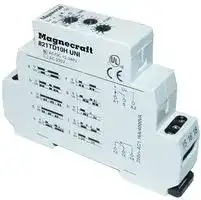
821TD10H-UNI
TIME DELAY RELAY, SPDT, 10DAYS, 240VAC
⚠️ Reference pricing provided. In case of supply shortages, we will connect you with our trusted procurement partners to ensure your project's continuity.
- Manufacturer: SCHNEIDER ELECTRIC/LEGACY RELAY
- Product type: Time Delay Relays - Electromechanical
- Contact Voltage VDC:24V; Time Min:0.1s; Time Max:10Days; Product Range:820 Series; Contact Configuration:SPDT; Contact Current:15A; Relay Mounting:DIN Rail; Con 10M6579
- Time Max: 10Days
- Time Min: 0.1s
- Product Range: 820 Series
- Relay Mounting: DIN Rail
- Contact Current: 15A
- Relay Terminals: Screw
- Nom Input Voltage: 240V
- Timing Adjustment: Screwdriver Slot
- Contact Voltage VAC: 240V
- Contact Voltage VDC: 24V
- Contact Configuration: SPDT
| Delivery and price | |
|---|---|
| Units per pack | 1 |
| Price | 154.87 € |
| Current stock | 200+ |
| Lead time | 30 days |
Datasheet

## Time Delay Relays – Application Data

## Definition:

Time Delay is defined as the controlled period between the functioning of two events.  A Time Delay relay is a combination of an electromechanical output relay and a control circuit.  The control circuit is comprised of solid state components and timing circuits that control operation of the relay and timing range. Typical time delay functions include On-Delay, Repeat cycle (starting off), Interval, Off-Delay, Retriggerable One Shot, Repeat cycle (starting on), Pulse Generator, One Shot, On/Off Delay, and Memory Latch. Each function is explained in the table below.  Time delay relays have a broad choice of timing ranges from less than one second to many days. There are many choices of timing adjustments from calibrated external knobs, DIP switches, thumbwheel switches, or recessed potentiometer.  The output contacts on the electromechanical output relay are direct wired to the output terminals. The contact load ratings are specified for each specific type of time delay relay.

Understanding the differences between all the functions available in time delay relays can sometimes be a daunting task. When designing circuits using time delay relays questions such as:

“What initiates a time delay relay?”

“Does the timing start with the application or release of voltage?”

“When does the output relay come on?”

must be asked.

Time delay relays are simply control relays with a time delay built in. Their purpose is to control an event based on time. The difference between relays and time delay relays is when the output contacts open & close: on a control relay, it happens when voltage is applied and removed from the coil; on time delay relays, the contacts will open or close before or after a pre-selected, timed interval.

Typically, time delay relays are initiated or triggered by one of two methods:

•[ application of input voltage (On Delay, Interval On, Flasher, Repeat Cycle, Delayed Interval & Interval/Flasher). ]

- [ opening or closing of a trigger signal (Off Delay, Single Shot & Watchdog).]

These trigger signals can be one of two designs:

- [ a control switch (dry contact), i.e., limit switch, push button, float switch, etc. ]

- [ voltage (commonly known as a power trigger).]

To help understand, some definitions are important:

Input Voltage:  Control voltage applied to the input terminals (see wiring diagrams below). Depending on the function, input voltage will either initiate the unit or make it ready to initiate when a trigger signal is applied.

Trigger Signal:  On certain timing functions, a trigger signal is used to initiate the unit after input voltage has been applied. As noted above, this trigger signal can either be a control switch (dry contact switch) or a power trigger (voltage).

Output (Load):  Every time delay relay has an internal relay (usually mechanical) with contacts that open & close to control the load. They are represented by the dotted lines in the wiring diagrams. Note that the user must provide the voltage to power the load being switched by the output contacts of the time delay relay.

The following tables contain both written and visual descriptions on how the common timing functions operate. A Timing Chart shows the relationship between Input Voltage, Trigger Signal (if present) and Output Contacts.

5/2

Magnecraft Solution Guide 105A

## FUNCTION DEFINITION TABLE

**==> picture [508 x 628] intentionally omitted <==**

**----- Start of picture text -----**<br>
Function Operation Timing Chart<br>A. When the input voltage U is applied, timing delay t begins. Relay contacts R U<br>ON DELAYPower On change state after time delay is complete. Contacts when input voltage U is removed. Trigger switch is not used in this function.R return to their shelf state  R offon t am t<br>B.<br>When input voltage U is applied, time delay t begins. When time delay t is  U<br>REPEAT CYCLE<br>complete, relay contacts R change state for time delay t. This cycle will repeat  t t t<br>Starting Off on<br>until input voltage U is removed. Trigger switch is not used in this function. R off t t t<br>C. When input voltage U is applied, relay contacts R change state immediately<br>U<br>INTERVAL and timing cycle begins. When time delay is complete, contacts return to shelf<br>Power On state. When input voltage U is removed, contacts will also return to their shelf  t t<br>R lUmelU<br>state. Trigger switch is not used in this function.<br>D. Input voltage U must be applied continuously. When trigger switch S is closed,<br>OFF DELAY relay contacts R change state. When trigger switch S is opened, delay t begins.  U<br>S Break When delay t is complete, contacts R return to their shelf state. If trigger switch  close<br>S is closed before time delay t is complete, then time is reset. When trigger  S open 2<br>switch S is opened, the delay begins again, and relay contacts R remain in  on t t<br>their energized state. If input voltage U is removed, relay contacts R return to  R off a<br>their shelf state.<br>E. Upon application of input voltage U, the relay is ready to accept trigger signal S.<br>RETRIGGERABLE Upon application of the trigger signal S, the relay contacts R transfer and the  U ee<br>ONE SHOT preset time t begins. At the end of the preset time t, the relay contacts R return to  close<br>their normal condition unless the trigger switch S is opened and closed prior to  S open<br>time out t (before preset time elapses). Continuous cycling of the trigger switch S  on t t<br>at a rate faster than the preset time will cause the relay contacts R to remain  R off 2. [LLU]<br>closed. If input voltage U is removed, relay contacts R return to their shelf state.<br>F. When input voltage U is applied, relay contacts R change state immediately  U<br>REPEAT CYCLE and time delay t begins. When time delay t is complete, contacts return to<br>t t t<br>Starting On their shelf state for time delay t. This cycle will repeat until input voltage U is  on t t<br>removed.  Trigger switch is not used in this function. R off<br>G. Upon application of input voltage U, a single output pulse of 0.5 seconds is  U<br>PULSEGENERATOR delivered to relay after time delay repeat pulse. Trigger switch is not used in this function.t. Power must be removed and reapplied to  R offon t Pulse t Pulse<br>i a<br>H. Upon application of input voltage U, the relay is ready to accept trigger signal  U<br>ONE SHOT<br>S. Upon application of the trigger signal S, the relay contacts R transfer and  close<br>the preset time t begins. During time-out, the trigger signal S is ignored. The  S open EE mE<br>t t<br>relay resets by applying the trigger switch S when the relay is not energized. on<br>R off hy<br>I. Input voltage U must be applied continuously. When trigger switch S is closed,  U<br>ON/OFF DELAY time delay t begins. When time delay t is complete, relay contacts R change  close<br>S Make/Break state and remain transferred until trigger switch S is opened. If input voltage U S open lm<br>is removed, relay contacts R return to their shelf state. R offon lu t t t t<br>J. U ee<br>MEMORY LATCH Input voltage U must be applied continuously. Output changes state with every  close<br>S Make trigger switch S closure. If input voltage U is removed, relay contacts R return to  S open<br>their shelf state. on<br>R off<br>2 [lc]<br>==. U = Input Voltage     S = Trigger Switch    R = Relay Contacts     t = Time Delay<br>**----- End of picture text -----**<br>


5/3

Magnecraft Solution Guide 105A

## Advantages of the 820 Series Time Delay Relays

**==> picture [456 x 191] intentionally omitted <==**

**----- Start of picture text -----**<br>
Output Indication<br>Red LED Light.<br>Time Setting<br>Select Between 10 Different Time Scales.<br>Input Indication<br>Green LED Light. Fine Time Setting<br>Ultimate Control in Accuracy.<br>Function<br>Choose Between 10<br>Input Terminals Different Functions.<br>Accepts up to a<br>14 AWG Wire.<br>**----- End of picture text -----**<br>


DIN Rail Mounting Mounts Directly On a DIN Rail.

5/4 ]

Magnecraft Solution Guide 105A

The new 820 Series Time Delay Relays are DIN rail mountable products offering 10 different timing functions, 2 status LEDs, ultra-wide timing range (0.1 sec to 10 days) and a universal voltage input (12-240 VAC/VDC) all in one  modular package.

The 821 is available as a 15 amp SPDT timer while its counterpart 822 is available as a DPDT timer also capable of switching up to 15 amps per pole.

- Offers a “one stop solution” for your power management system.

Solid State Circuitry Used for Time and function Control.

- Available in both SPDT and DPDT contact configuration.

- The two LED status indicators indicate status at a glance.

- The Green LED is on when power is applied to the input terminals. The Red LED blinks during time-out, and is ON when the output is energized.

- Color and appearance designed for high visibility in all environments.

Output Terminals Accepts up to a 14 AWG Wire.

- Only 17.5 mm wide making it ideal for tight spaces.

- Engineering availability allows for customized relay solutions.

Optional Panel Adapter (16-788C1) See Section 3 p.18

www.magnecraft.com    847-441-2540

5/5

Magnecraft Solution Guide 105A

## 820 Series Time Delay Relays/SPDT, DPDT 15 Amp Rating

Output Indication Red LED

Input Indication Green LED Time Setting

c® UL Listed US File No. E234203

Supply Terminals

Fine Time Setting Function

Output Terminals DPDT (822 Version Only)

Output Terminals

DIN Mount

**General Specifications (@ 25°C)** (UL 508)

**==> picture [568 x 442] intentionally omitted <==**

**----- Start of picture text -----**<br>
|||||||
|---|---|---|---|---|---|
|rere|Output Characteristics|Units|821TD10H-UNI|822TD10H-UNI|
|Number and type of Contacts|SPDT|DPDT|
|Contact Material|po|Silver Alloy|Silver Alloy|
|Current rating|@ 240 VAC, 24 VDC|po|A|15|15|
|Switching voltage|ee|V|240 AC, 50/60 Hz|240 AC, 50/60 Hz|
|ee|V|24 DC|24 DC|
|pO|HP|1/2 @ 120VAC|1/2 @ 120VAC|
|a|HP|1 @ 240 VAC|1 @ 240 VAC|
|ee|Pilot Duty|B300|B300|
|Minimum Switching Requirement|mA|100|100|
|Indication|LED|On = EnergizedBlinks = Timing|ee|Red|Red|
|Input Characteristics|
|Voltage Range|po|VAC / VDC|12….240|12….240|
|Operating Range|% of Nominal|85% to 110%|85% to 110%|
|Maximum consumption|AC|VA|3|3|
|DC|W|Se|1.7|1.7|
|Indication|LED|Green|Green|
|Timing Characteristics|
|Functions Available|(See page 5/3)|a|A,B,C,D,E,F,G,H,I,J|A,B,C,D,E,F,G,H,I,J|
|Time Scales|10|10|
|Time Ranges Available|0.1….1|0.1….1|
|sec|a|1….10|1….10|
|0.1….1|0.1….1|
|min|1….10|1….10|
|0.1….1|0.1….1|
|hr|1….10|1….10|
|0.1….1|0.1….1|
|day|1….10|1….10|
|Tolerance|Mechanical Setting|po|%|5|5|
|Repeatability|Constant Voltage and Temperature|es|%|0.2|0.2|
|Reset Time|Maximum|ms|150|150|
|Trigger Pulse Length|Minimum|ms|ee|50|50|
|Performance Characteristics|
|Electrical Life|Operations @ Rated Current (Resistive)|es|100,000|100,000|
|Mechanical Life|Unpowered|es|10,000,000|10,000,000|
|Dielectric strength|Input to Contacts|a|V|2500 AC|2500 AC|
|Between Open Contacts|pT|V|1000 AC|1000 AC|
|Terminal Wire Capacity|AWG (mm2)|14 (2.1)|14 (2.1)|
|Terminal Torque (maximum)|in lb (Nm)|ee|7.1 (0.8)|7.1 (0.8)|
|Environment|
|Product certifcations|Standard version|ee|UL, CE|UL, CE|
|Ambient air temperature|Storage|ee|°C|-30…+70|-30…+70|
|around the device|Operation|ee|°C|-20…+55|-20…+55|
|Degree of protection|po|IP 20|IP 20|
|Weight|grams|65|65|

**----- End of picture text -----**<br>


5/6

Magnecraft Solution Guide 105A

www.magnecraft.com    847-441-2540

;

**==> picture [299 x 61] intentionally omitted <==**

**----- Start of picture text -----**<br>
Optional Panel Adapter<br>(16-788C1)<br>See Section 3 p.18<br>821 822<br>**----- End of picture text -----**<br>


## **Standard Part Numbers**

**==> picture [520 x 481] intentionally omitted <==**

**----- Start of picture text -----**<br>
BOLD-FACED PART NUMBERS ARE NORMALLY STOCKED<br>Part Number Input Voltage Timing Range Functions Available Contact Configuration Rated Load Current<br>821TD10H-UNI 12...240 VAC/VDC 0.1s...10d A,B,C,D,E,F,G,H,I,J SPDT 15 Amps<br>822TD10H-UNI 12...240 VAC/VDC 0.1s...10d A,B,C,D,E,F,G,H,I,J DPDT 15 Amps<br>FUNCTION DEFINITIONS<br>7 See Section 5 p.3<br>Part Number Builder<br>Series Relay Style Number of Functions – Input Voltage<br>821 = SPDT TD - Time Delay 10H = 10 Functions UNI = 12...240 VAC/VDC<br>822 = DPDT<br>2.6 MAX<br>(65) 0.7<br>1.35<br>(17.6)<br>(34.2) 40 0.6<br>0.63 0.13 (14.2)<br>(16) (3.4)<br>= Gon)<br>7 . UW 0.2<br>(5)<br>3.5<br>7 . Se CF oC<br>(90) 1.8 1.4<br>(45.3) (35)<br>2.7<br>(67.5) 0.7<br>ELa oe (16.71)<br>0.3<br>(7.4)<br>a iB ess =<br>q 7<br>WIRING DIAGRAMS<br>INPUT INPUT<br>VOLTAGE VOLTAGE<br>U n U n<br>| T E I + - EXTERNAL + -<br>0.6<br>CONTROL<br>0.236 (16) SWITCH 15 - COMMON<br>(6) J f A1 h S r A2 h A1 l S A2 16 - NORMALLY CLOSED<br>18 - NORMALLY OPEN<br>R<br>25 - COMMON<br>25 26 28 26 - NORMALLY CLOSED<br>R R 28 - NORMALLY OPEN<br>1.3<br>B t i (34) 15 Sse 16 18 15 ialial 16 18<br>**----- End of picture text -----**<br>


**821TD10H-UNI 822TD10H-UNI**

5/7

Magnecraft Solution Guide 105A
Updated at June 6, 2026
About Novapart
Novapart is a B2B electronic component broker specialising in stock shortages and cost reduction. We source hard-to-find parts and identify compliant alternatives across a catalogue of 410,000+ components from 500+ manufacturers.
Learn more →Stock Shortage Specialist
When a component is unavailable, discontinued or has an unacceptable lead time, we tap into our network of vetted European and Asian distributors to source what you need — without compromising on quality or traceability.
Request a quote →Compliant Alternatives
We identify pin-to-pin, electrically equivalent substitutes that meet the same certifications (RoHS, AEC-Q100, REACH) as your original specification — validated against datasheets, not just part numbers. Often at a lower cost.
BOM Analysis service →