
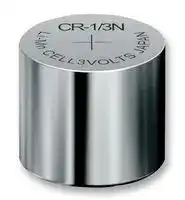
Image not available
Illustrative purposes only

6131101501
Battery, Single Cell, 3 V, CR11108, Lithium Manganese Dioxide, 170 mAh, Pressure Contact, 1
⚠️ Reference pricing provided. In case of supply shortages, we will connect you with our trusted procurement partners to ensure your project's continuity.
- Manufacturer: VARTA
- Product type: Batteries - Non-Rechargeable
- SVHC: No SVHC (27-Jun-2024)
- Weight: 3g
- Pack Quantity: 1
- Product Range: CR 1/3 N Series
- Battery Voltage: 3V
- Battery Capacity: 170mAh
- Battery IEC Code: CR11108
- Battery NEDA Code: -
- Battery Size Code: CR11108
- Battery Terminals: Pressure Contact
- Battery Compliance: -
- Battery Technology: Lithium Manganese Dioxide
- Battery Type / Size: CR11108
| Delivery and price | |
|---|---|
| Units per pack | 3 |
| Price | 1086.63 € |
| Current stock | 10+ |
| Lead time | 30 days |
Datasheet

# **Safety Data Sheet MSDS 2.001.008**

## **Primary Lithium cylindrical cell**

## **1 Identification of the product and of the company undertaking**

## **Product details**

Trade name

Lithium primary cylindrical cell

Electrochemical system: Lithium metal _|_ organic electrolyte _|_ manganese dioxide

Anode (negative): Lithium metal Cathode (positive): Manganese dioxide

This MSDS applies to the following cell and battery types and batteries assembled from these types.

|**Type**|**Lithium content**|**Nominal voltage**|
|---|---|---|
|CR 1/2 AA|0.30 g|3.0 V|
|CR 2/3 AA|0.44 g|3.0 V|
|CR AA|0.58 g|3.0 V|
|CR 2 NP|0.52 g|3.0 V|


## **Supplier details**

Address:

VARTA Microbattery GmbH VARTA-Platz 1 73479 Ellwangen Germany

Emergency Phone Number: +49 7961 921 110 (VAC)

## **General remark**

This information is provided as a service to our customers. The details presented are in accordance with our present knowledge and experiences. They are no contractual assurances of product attributes.

## **Legal remark (EU)**

These batteries are no _“substances”_ or _“mixtures”_ according to Regulation (EC) No 1907/2006 EC. Instead they have to be regarded as _“articles”_ , no substances are intended to be released during handling. Therefore there is no obligation to supply a safety data sheet according to Regulation (EC) 1907/2006, Article 31.

## **Legal remark (USA)**

Safety Data Sheets are a sub-requirement of the Occupational Safety and Health Administration (OSHA) Hazard Communication Standard, 29 CFR Subpart 1910.1200. This Hazard Communication Standard does not apply to various subcategories including anything defined by OSHA as an _“article”_ . According to OSHA, Article means a manufactured item other than a fluid or particle: (i) which is formed to a specific shape or design during manufacture; (ii) which has end use function(s) dependent in whole or in part

Page no.: **1** of **8** Edition: **10.01.2020** Version: **15**

VARTA Microbattery GmbH VARTA-Platz 1 73479 Ellwangen Germany

Electronically generated document - no signature required.

**Safety Data Sheet MSDS 2.001.008**

upon its shape or design during end use; and (iii) which under normal conditions of use does not release more than very small quantities, e.g., minute or trace amounts of a hazardous chemical (as determined under paragraph (d) of this section), and does not pose a physical hazard or health risk to employees.

Because all of our batteries are defined as _“articles”_ , they are exempted from the requirements of the Hazard Communication Standard.

## **2**

The battery is sealed hermetically. Thus, the ingredients have no hazard potential, except the battery is violated or dismantled.

If in case of mistreatment the ingredients are released, a spontaneously flammable gas mixture may be released under certain circumstances (measures according to sections 4 to 6).

Attention: If batteries are treated wrong the danger of burns or bursts occurs. Batteries must not be heated above 100 _[◦]_ C or incinerated. The battery contents must not get in contact with water. If the negative electrode gets in contact with water or humidity hydrogen gas is formed, which may inflame spontaneously.

## **3 Composition/information on ingredients**

## **Ingredients**

|**Content**|**CAS no.**|**EC no.**|**Material**|**Hazard**|**Hazard**|
|---|---|---|---|---|---|
|||||**Categories**|**Statements**|
|33 – 74 %|confdential|confdential|Steel and nickel|||
|13 – 40 %|1313-13-9|215-202-6|Manganese dioxide|Acute Tox. 4|H302, H332|
|3 – 10 %|confdential|confdential|Polymers|||
|_<_10 %|108-32-7|203-572-1|Propylene carbonate|Eye Irrit. 2|H319|
|_<_10 %|110-71-4|203-794-9|1,2-Dimethoxy ethane|Flam. Liq. 2,|H225, H332,|
|||||Repr. 1B,|H360-FD|
|||||Acute Tox. 4||
|_<_5 %|7791-03-9|232-237-2|Lithium perchlorate|Ox. Sol. 2,|H272, H315,|
|||||Skin Irrit. 2,|H319, H335|
|||||Eye Irrit. 2,||
|||||STOT SE 3||
|1 – 3 %|7439-93-2|231-102-5|Lithium|Water-react. 1,|H260, H314|
|||||Skin Corr. 1B||


For full text of hazard statements see section 16.

## **Substances relevant for Battery Directive 2006/66/EC**

|**Content**|**CAS no.**|**EC no.**|**Material**|
|---|---|---|---|
|_<_10 mg/kg|7439-92-1|231-100-4|Lead|
|_<_1 mg/kg|7439-97-6|231-106-7|Mercury (none intentionally introduced, see section 12)|
|_<_1 mg/kg|7440-43-9|231-152-8|Cadmium|


Page no.: **2** of **8** Edition: **10.01.2020** Version: **15**

Electronically generated document - no signature required.

VARTA Microbattery GmbH VARTA-Platz 1 73479 Ellwangen Germany

**Safety Data Sheet MSDS 2.001.008**

## **SVHC substances according to REACH (Article 33)**

|**Content**|||**CAS no.**|**EC no.**|**Material**|
|---|---|---|---|---|---|
|_>_|0.1|%|110-71-4|203-794-9|1,2-Dimethoxy ethane|


For information to allow safe use: see section 7.

## **4 First-aid measures**

|After|inhalation:|Fresh air. Seek for medical assistance.|
|---|---|---|
|After|skin contact:|Remove solid particles immediately. Flush affected areas with plenty of water (at least|
|||15 min). Remove contaminated cloth immediately. Seek for medical assistance.|
|After|eye contact:|Flush the eye gently with plenty of water (at least 15 min). Seek for medical assistance.|
|After|ingestion of battery components:|Drink plenty of water. Avoid vomiting. Seek for medical assistance.|
|||No trials for neutralization.|
|After|ingestion of battery:|In the event of battery ingestion, seek immediate medical attention at a hospital emer-|
|||gency room. Do not let the person who ingested the battery eat or drink until an X-ray|
|||can determine if a battery is present. If you still have the battery packaging or the de-|
|||vice containing the battery take this with you to help the physician identify the battery|
|||type and chemistry.|
|||**Warning:** Swallowing may lead to burns, perforation of soft tissue, and death. Severe|
|||burns can occur within 2 h of ingestion. In case of ingestion of a cell or battery, seek|
|||medical assistance promptly.|
|||See also section 7.|
|**5**|**Fire-fghting measures**||
|Suitable extinguishing media:||Metal fre extinction powder, rock salt or dry sand shall be used.|
|||In case only water is available, it can be used in large amounts.|
|Extinguishing media with limited||Carbon dioxide (CO2) is not suitable.|
|suitability:||Water in small quantities may have adverse effects.|
|Special protection equipment during||Contamination cloth including breathing apparatus.|
|fre-fghting:|||
|Special hazard:||Cells may explode and release metal parts.|
|||At contact of electrolyte with water traces of hydrofuoric acid may be formed. In this|
|||case avoid contact and take care for good ventilation.|
|||At contact of charged anode material with water extremely fammable hydrogen gas is|
|||generated.|
|Attention:||Do not let used extinguishing media penetrate into surface water or ground water. If|
|||necessary, thicken water or foam with suitable solids. Dispose of properly.|


VARTA Microbattery GmbH VARTA-Platz 1 73479 Ellwangen Germany

Page no.: **3** of **8** Edition: **10.01.2020** Version: **15**

Electronically generated document - no signature required.

**Safety Data Sheet MSDS 2.001.008**

## **6 Accidental release measures**

Person related measures:

Environment protection measures:

Treatment for cleaning:

Wear personal protective equipment adapted to the situation (protection gloves, face protection, breathing protection).

In the event of battery rupture, prevent skin contact and collect all released material in a plastic lined container. Bind released ingredients with powder (rock salt, sand). Dispose of according to the local law and rules. Avoid leached substances to penetrate into the earth, canalization or water.

If battery casing is dismantled, small amounts of electrolyte may leak. Package the battery tightly including ingredients together with lime, sand or rock salt. Then clean with water.

## **7 Handling and storage**

Guideline for safe handling:

- Always follow the warning information on the batteries and in the manuals of devices. Only use the recommended battery types.

- Keep batteries away from children. Keep small cells and batteries which are considered swallowable out of the reach of children.

- For devices to be used by children, the battery casing should be protected against unauthorized access.

- Unpacked batteries shall not lie about in bulk.

- In case of battery change always replace all batteries by new ones of identical type and brand.

- Do not swallow batteries. Swallowing may lead to burns, perforation of soft tissue, and death. Severe burns can occur within 2 h of ingestion. In case of ingestion of a cell or battery, seek medical assistance promptly.

- Do not throw batteries into water.

-

- Avoid deep discharge.

- Do not short-circuit batteries.

- Do not recharge primary batteries.

- Do not open or disassemble batteries.

Storage:

Storage preferably at room temperature (approx. 20 _[◦]_ C). Avoid large temperature changes. Do not store close to heating devices. Avoid direct sunlight. At higher temperature the electrical performance may be reduced.

Storage of unpacked batteries can cause short circuit and heat generation.

Storage category according to TRGS 510:

Storage of large amounts:

It is recommended to consider the _“Technical Rule for Hazardous Substances TRGS 510 - Storage of hazardous substances in nonstationary containers”_ and to handle lithium primary cells and batteries according to storage category 11 ( _“combustible solids”_ ).

Follow the recommendations of the German Insurance Association (GDV - _“Gesamtverband der Deutschen Versicherungswirtschaft e.V.”_ ) concerning lithium batteries: https://vds.de/fileadmin/vds ~~p~~ ublikationen/vds ~~3~~ 103en ~~w~~ eb.pdf

In case of storage of large amounts (used storage volume _>_ 7 m[3] and/or more than 6 pallets) batteries shall be stored in fire-resistant or separated rooms or areas (e.g. warehouse or container for hazardous materials). Mixed storage with other products is not allowed. The storage area shall be monitored by an automatic fire detection system, connected to a permanently manned place. A fire-extinguishing system shall reflect the extinguishing agents mentioned in section 5.

VARTA Microbattery GmbH VARTA-Platz 1 73479 Ellwangen Germany

Page no.: **4** of **8** Edition: **10.01.2020** Version: **15**

Electronically generated document - no signature required.

**Safety Data Sheet MSDS 2.001.008**

## **8 Exposure controls/personal protection**

Under normal conditions (discharge) release of ingredients does not occur. Avoid prolonged deep discharge.

## **9 Physical and chemical properties**

Not applicable if closed.

## **10 Stability and reactivity**

Dangerous reactions:

When heated above 100 _[◦]_ C the risk of rupture occurs.

## **11 Toxicological information**

Under normal conditions (during discharge) release of ingredients does not occur. In case of accidental release see information in sections 2 to 4 and 6.

Swallowing of a battery can be harmful. Call the local Poison Control Centre for advice and follow-up. See section 4.

## **12 Ecological information**

VARTA primary Lithium cylindrical cells do not contain heavy metals as defined by the European directives 2006/66/EC Article 21; they comply with the chemical composition requirements of this Directive.

Mercury has not been _“intentionally introduced (as distinguished from mercury that may be incidentally present in other materials)”_ in the sense of the U.S.A. _“Mercury-Containing and Rechargeable Battery Management Act”_ (May 13 1996).

The Regulation on Mercury Content Limitation for Batteries promulgated on 1997-12-31 by the China authorities including the State Administration of Light Industry and the State Environmental Protection Administration defines _“low mercury”_ as _“mercury content by weight in battery as less than 0.025 %”_ , and _“mercury free”_ as _“mercury content by weight in battery as less than 0.0001 %”_ . And therefore: VARTA primary Lithium cylindrical cells belong to the category of mercury-free battery (mercury content lower than 0.0001 %).

## **13 Disposal considerations**

In order to avoid short circuit and heating, used VARTA primary Lithium cylindrical cells should never be stored or transported in bulk. Proper measures against short circuit are:

- Storage of batteries in original packaging

- Coverage of the terminals

- Embedding in dry sand

## **European Union**

In the European Union, manufacturing, handling and disposal of batteries is regulated on the basis of the DIRECTIVE 2006/66/EC OF THE EUROPEAN PARLIAMENT AND OF THE COUNCIL of 6 September 2006 on batteries and accumulators and waste batteries and accumulators and repealing Directive 91/157/EEC. Customers find detailed information on disposal in their specific countries using the web site of the European Portable Batteries Association (www.epbaeurope.net/legislation ~~n~~ ational.html).

Page no.: **5** of **8** Edition: **10.01.2020** Version: **15**

VARTA Microbattery GmbH VARTA-Platz 1 73479 Ellwangen Germany

Electronically generated document - no signature required.

**Safety Data Sheet MSDS 2.001.008**

Importers and users outside EU should consider the local law and rules.

## **USA**

VARTA primary Lithium cylindrical cells are classified by the federal government as non-hazardous waste and are safe for disposal in the normal municipal waste stream. These batteries, however, do contain recyclable materials and are accepted for recycling by Call2Recycle, Inc. Please go to their website at www.call2recycle.org for additional information.

## **14 Transport information**

## **General considerations**

VARTA primary Lithium cylindrical cells are considered to be UN 3090 Lithium Metal Batteries and are tested according to subsection 38.3 of the _“UN Manual of Tests and Criteria”_ for compliance with the requirements of special provisions ADR 188, IMDG 188, as well as the requirements of DOT / 49 CFR § 173.185, and the requirements of IATA DGR packing instruction 968. Test results as well as other relevant information required for transportation are given in dedicated _“Supplier’s Test Summaries”_ .

Transportations of cells or batteries packed with equipment or contained in equipment have to follow the appropriate regulations for UN 3091.

During the transportation of large amounts of batteries by ship, trailer or railway, do not store them in places of high temperature and do not allow them to be exposed to condensation. During the transportation do not allow the packaging to be damaged, as a damage of the packaging may cause fire. In the event packaging is damaged, special procedures must be used including inspection and repackaging if necessary and handle with care.

Compilations of transport requirements for Lithium batteries can be found in: https://www.lithium-batterie-service.de/en/ https://www.iata.org/whatwedo/cargo/dgr/Documents/lithium-battery-shipping-guidelines.pdf

Each cell or battery is manufactured under a quality management program according to IATA DGR clause 3.9.2.6, ADR clause 2.2.9.1.7 e), and IMDG code clause 2.9.4.5.

## **IEC 60086-1**

Code of practice for packaging and shipment of primary batteries given in IEC 60086-1:

_“The packaging shall be adequate to avoid mechanical damage during transport, handling and stacking. The materials and pack design shall be chosen so as to prevent the development of unintentional electrical conduction, corrosion of the terminals and ingress of moisture.”_

_“Shock and vibration shall be kept to a minimum. For instance, boxes should not be thrown off trucks, slammed into position or piled so high as to overload battery containers below. Protection from inclement weather should be provided.”_

## **15 Regulatory information**

## **Marking consideration**

European Union: According to _“DIRECTIVE 2006/66/EC OF THE EUROPEAN PARLIAMENT AND OF THE COUNCIL of 6 September 2006 on batteries and accumulators and waste batteries and accumulators and repealing Directive 91/157/EEC”_ the batteries have to be marked with the crossed bin.

For the state of California these batteries have to be marked as _“containing perchlorate”_ .

Page no.: **6** of **8** Edition: **10.01.2020** Version: **15**

Electronically generated document - no signature required.

VARTA Microbattery GmbH VARTA-Platz 1 73479 Ellwangen Germany

**Safety Data Sheet MSDS 2.001.008**

## **International safety standards**

For UL recognition of the basis cells according to UL 1642 see: BBCV2.MH13654

## **Water hazard class**

The regulations of the German Federal Water Management Act (WHG) are not applicable as VARTA primary Lithium cylindrical cells are articles and not substances, thus there is no risk of water pollution, except the batteries are violated or dismantled.

## **16 Other information**

## **Full text of Hazard Statements referred to under section 3**

|H225|Highly fammable liquid and vapour.|
|---|---|
|H228|Flammable solid.|
|H250|Catches fre spontaneously if exposed to air.|
|H260|In contact with water releases fammable gases which may ignite spontaneously.|
|H271|May cause fre or explosion; strong oxidiser.|
|H272|May intensify fre; oxidiser.|
|H301|Toxic if swallowed.|
|H302|Harmful if swallowed.|
|H312|Harmful in contact with skin.|
|H314|Causes severe skin burns and eye damage.|
|H315|Causes skin irritation.|
|H317|May cause an allergic skin reaction.|
|H318|Causes serious eye damage.|
|H319|Causes serious eye irritation.|
|H330|Fatal if inhaled.|
|H332|Harmful if inhaled.|
|H334|May cause allergy or asthma symptoms or breathing diffculties if inhaled.|
|H335|May cause respiratory irritation.|
|H341|Suspected of causing genetic defects.|
|H350|May cause cancer|
|H350i|May cause cancer by inhalation.|
|H351|Suspected of causing cancer.|
|H360D|May damage the unborn child.|
|H360FD|May damage fertility. May damage the unborn child.|
|H372|Causes damage to organs through prolonged or repeated exposure.|
|H373|May cause damage to organs through prolonged or repeated exposure.|
|H400|Very toxic to aquatic life.|
|H410|Very toxic to aquatic life with long lasting effects.|


continued on next page

VARTA Microbattery GmbH VARTA-Platz 1 73479 Ellwangen Germany

Page no.: **7** of **8** Edition: **10.01.2020** Version: **15**

Electronically generated document - no signature required.

**Safety Data Sheet MSDS 2.001.008**

**Full text of Hazard Statements referred to under section 3** (continued) H411 Toxic to aquatic life with long lasting effects. H412 Harmful to aquatic life with long lasting effects. Note: Date of issue of the transport regulations: ADR 2019, RID 2019, IATA DGR 2020 (61[st] edition), IMDG Code 2018, DOT / 49 CFR 2019. Latest covered modification of the European Battery Directive 2006/66/EC: Directive (EU) 2018/849. RoHS: See special Declaration REACH: See special Declaration Issued by: VARTA Microbattery GmbH Quality / Environmental Management Contact: https://www.varta-microbattery.com/contact/?lang=en Updates: Current SDS can be downloaded from VARTA’s web page https://products.varta-microbattery.com/en/news-downloads/document-search.html (select Document Type “MATERIAL SAFETY DATA SHEET”).

VARTA Microbattery GmbH VARTA-Platz 1 73479 Ellwangen Germany

Page no.: **8** of **8** Edition: **10.01.2020** Version: **15**

Electronically generated document - no signature required.
Updated at April 28, 2026
About Novapart
Novapart is a B2B electronic component broker specialising in stock shortages and cost reduction. We source hard-to-find parts and identify compliant alternatives across a catalogue of 410,000+ components from 500+ manufacturers.
Learn more →Stock Shortage Specialist
When a component is unavailable, discontinued or has an unacceptable lead time, we tap into our network of vetted European and Asian distributors to source what you need — without compromising on quality or traceability.
Request a quote →Compliant Alternatives
We identify pin-to-pin, electrically equivalent substitutes that meet the same certifications (RoHS, AEC-Q100, REACH) as your original specification — validated against datasheets, not just part numbers. Often at a lower cost.
BOM Analysis service →