
Image not available
Illustrative purposes only


6069-410-006
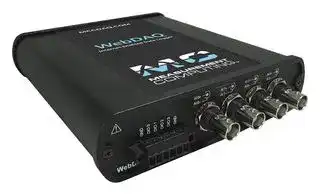
Data Logger, MCCWebDAQ, Acoustic & Vibration, 4 Channel, Current, Voltage, Ethernet, USB, Wi-Fi
⚠️ Reference pricing provided. In case of supply shortages, we will connect you with our trusted procurement partners to ensure your project's continuity.
- Manufacturer: DIGILENT
- Product type:
- SVHC: No SVHC (21-Jan-2025)
- Display Type: LED
- Product Range: -
- Data Interface: Ethernet, USB, Wi-Fi
- Maximum Samples: -
- Data Logger Type: Acoustic & Vibration
- No. of Channels / Inputs: 4 Channel
- Sensor / Measurement Type: Current, Voltage
| Delivery and price | |
|---|---|
| Units per pack | 1 |
| Price | 1297.17 € |
| Current stock | 10+ |
| Lead time | 30 days |
Datasheet

e ) - * . | E i i P a F . ‘J - =. ki . . * y é | so y i . . | ; ; + a ra is = **WebDAQ 504** . . . = a * i | . . **Internet Enabled Vibration/Acoustic Logger**

**Remote Configuration and Monitoring**

**Virtually Unlimited Storage**

**Integrated HW and SW**

**Flexible Triggers, Alarms, Emails, and SMS Texts**

**Built-in Web Server, Easy-to-Use**

**Simultaneous ADC Sampling**

## WebDAQ 504

## Internet Enabled Vibration/Acoustic Logger

## **Features**

- **Four simultaneous analog inputs**

- **AC/DC coupling**

- **IEPE excitation current**

- **Real-time FFTs for continuous monitoring and analysis**

_The WebDAQ 504 intelligent logger features remote monitoring and control of real-time acoustic and vibration data._

## **Overview**

The WebDAQ 504 is a stand-alone, acoustic and vibration logger designed for remote monitoring and control. All the intelligence is built into the WebDAQ, eliminating the need for a PC or additional software. By using the embedded WebDAQ web server, users can easily configure simple or sophisticated applications, log vibration data, update digital outputs and/or send notifications based on alarm conditions, and view real-time data from any location and any device with a web browser.

The WebDAQ 504 performs high-accuracy measurements from up to four IEPE (Integrated Electronic Piezoelectric) sensors. Housed in a heavy-duty chassis, the WebDAQ 504 is rugged enough for industrial applications such as noise and vibration testing.

## **Remote Access and Control**

## **Integrated Software and Hardware**

Install the WebDAQ 504 on any network and access it using any device with a web browser to remotely monitor and control all operations.

The WebDAQ Series embedded OS and web server provides an all-in-one package for stand-alone data logging and alarming. Users can monitor and control their applications from anywhere with a web browser.

## **Wireless communication**

After the WebDAQ is detected on a wired network , users can connect an approved WiFi adapter to the rear panel and communicate with the WebDAQ over a wireless network. Refer to our website for a list of the WiFi adapters approved for use with WebDAQ Series hardware.

The WebDAQ web server is optimized for both desktop and mobile use. Users can perform data acquisition tasks from phones, tablets and laptops with a single, intuitive user interface.

- **Four isolated DIO for triggers and alarms**

- **Log data to internal storage or mapped network storage**

- **Share folders to view files over a local network**

- **Configurable read/write access**

- **Convert data to binary or csv**

- **No driver software to install**

- **Built-in web server**

- **Easy, flexible task scheduling**

- **Remote monitoring and control**

- **Alarming and notifications with email and SMS messaging**

- **Export data to csv, UFF, or binary for use in other applications**

- **WiFi support**

## **Flexible Triggering**

Start or stop the acquisition based on FFT, analog, or digital thresholds, alarm states, or date/time values. On-demand push button triggering is also supported.

## **WebDAQ Web Interface**

An embedded web server provides a clean, intuitive interface to access all configuration and data management tasks.

Hardware, trigger and alarm settings are contained in a single task, or “job”. Multiple “jobs” can be run in a “schedule” for more complex data logging applications.

For example, users can create a schedule of jobs in which one job automatically runs after an alarm condition is triggered on a different job, such as when a digital input changes.

_Device-independent operation lets you remotely monitor and control the WebDAQ 504 from any device with a web browser._

**(508) 946-5100**

**info@mccdaq.com**

**mccdaq.com**

**Measurement Computing**

**2**

## WebDAQ 504 Introduction

## **Easy Setup – Powerful Capabilities**

Jobs are the building block of WebDAQ. The ability to define different data logging jobs, or tasks, and add them to a schedule unleashes flexibility not seen in any other data logger.

Whether you want to set up a simple logging task or a complex task, jobs and a schedule make it easy and straightforward.

## **What is a Job?**

The basic building block of WebDAQ, a job defines channel configuration, logging options, start and stop conditions, and alarming.

## **What is a Schedule?**

A schedule is a collection of jobs that gives flexibility to dynamically change data logging attributes, such as sampling rate, active channels configuration, or alarm levels.

## **Example:**

**Switching from static acquisition to dynamic acquisition.**

## **1 Schedule and 2 Jobs**

**Users can easily setup a job for a slow, static acquisition and a fast dynamic acquisition. When a trigger condition is met (i.e. over/under alarm), Job 1 (slow acquisition) ends and Job 2 (fast acquisition) begins. When the trigger condition returns to normal, Job 1 can be restarted.**

## **Clear, Concise, Data Displays**

**WebDAQ users don’t need to rely on the small screens and difficult to navigate displays of most other loggers. With WebDAQ’s intuitive web interface, users can easily see their data and alarm conditions in real time or after the acquisition is complete.**

(508) 946-5100

info@mccdaq.com

mccdaq.com

Measurement Computing

**3**

## WebDAQ 504 Features

## **Alarm and Event Notifications**

Create multiple alarms using analog or digital channel sources. Configure alarms to reset and re-arm when the condition clears, or reset them remotely with your browser. View the alarm status on the web interface. Receive event and alarm notifications on one or more addresses using email and SMS messaging.

## **Virtually Unlimited Storage**

Store data files and configuration settings locally in internal flash memory, or save to external media or network folders.

Users can map a network drive or FTP server as the location to

log data or store files.

**==> picture [96 x 55] intentionally omitted <==**

## **FFT Display**

An FFT is displayed for each active channel in a job on a single FFT plot. The WebDAQ 504 performs a spectrum function on the time-domain data, and displays the amplitude of the frequency response. The data is scaled in dB based on the full-scale range of the sensor for that channel.

Users can configure the window type to apply to the FFT data for each channel. The following window types are supported: Hann, Hamming, Blackman-Harris, Blackman, Flattop, or None (Uniform).

The peak amplitude and frequency can be shown or hidden, as desired.

Easily transfer files between WebDAQ storage locations and

mapped network storage locations.

## **Share Folders**

Users can share a WebDAQ storage location or specific folder

over a local network.

## **Real-Time Data Display**

View data as it is acquired or from a stored file. Data can be plotted on strip chart and FFT displays. Users can specify a range of data to view. Real-time FFTs allow continuous monitoring and analysis. Users can apply windowing parameters with software.

## **Control Read and Write Access**

Users can control who can view and modify job settings by defining a password and setting the security level.

## **Run the Schedule on Startup**

Automatically run the schedule when the system starts up. Multiple jobs in the schedule are run consecutively.

## **Real-Time Clock**

A real-time clock provides an absolute time reference for timestamping data. The clock can be set to any timezone, and may be synchronized to the internet time server.

## **Simultaneous Sampling**

The WebDAQ performs simultaneous measurements from up to four analog inputs at rates of up to 51.2 kS/s per channel. Users can configure each input for voltage or IEPE sensor measurements.

## **Sensor Measurements**

Users can configure IEPE channels to measure acceleration, sound pressure, velocity, and force. AC coupling is automatically enabled for IEPE channels. WebDAQ provides a minimum of 4 mA excitation current and IEPE compliance voltage up to 19 V to drive internal circuitry. Users can configure voltage channels for AC or DC coupling.

## **FFT Triggering**

An FFT trigger can be used for starting or stopping an acquisition.

Users can configure the channel to use as the FFT trigger source, the FFT size, and the window type to apply to the FFT data for the trigger. The following window types are supported for the FFT trigger: Hann, Hamming, Blackman-Harris, Blackman, Flattop, or None (Uniform).

The WebDAQ 504 performs a Power Spectrum function on the time-domain data of the selected FFT trigger source.

The power frequency band and the total power in band threshold level to use for the FFT trigger are user-configurable.

Users can also specify the number of samples to acquire before the trigger occurs.

## **Anti-alias Filtering**

Built-in anti-alias filters automatically adjust to the sampling rate. Analog and digital filtering accurately represents in-band and out-of-band signals. Signals within the passband have frequencydependent gain. A stopband filter attenuates all signals above the stopband frequency.

## **Isolated Digital I/O**

The four isolated digital I/O lines can be used either as triggers to start or stop the acquisition or as alarm outputs.

## **Flexible Power Requirements**

Provide power with the 9 volt, 1.67 amp supply that ships with the device, or connect any 6 to 16 DC supply.

## **Firmware Updates**

Device firmware is bundled with the operating system and web server in one update file. This allows the WebDAQ to be updated in the field.

## **Calibration**

The WebDAQ is factory-calibrated using a NIST-traceable calibration process. Specifications are guaranteed for one year. Return the device to the factory for recalibration.

(508) 946-5100

info@mccdaq.com

mccdaq.com

Measurement Computing

**4**

## WebDAQ 504

## Functional Block Diagram

**==> picture [96 x 55] intentionally omitted <==**

**==> picture [541 x 400] intentionally omitted <==**

**----- Start of picture text -----**<br>
Real-time<br>Buttons/<br>Clock with<br>LEDs<br>Battery<br>Microprocessor,<br>RAM, and Flash<br>4 Isolated SD<br>DIO Connector<br>Raspberry Pi<br>Compute<br>Module<br>USB Hub<br>Sound and  RJ-45<br>4 and<br>Vibration Ethernet<br>10/100 Ethernet<br>Measurement Connector<br>Controller<br>Module<br>Dual USB Power Power<br>Connectors Supplies Input<br>Ext Pwr<br>+9 VDC/1.67 A<br>Screw Terminals<br>BNC Connectors<br>**----- End of picture text -----**<br>


(508) 946-5100

info@mccdaq.com

mccdaq.com

Measurement Computing

**5**

## WebDAQ 504 Front and Rear Panels

## **Front Panel**

BNC connectors and detachable screw terminals allow quick sensor and digital connections.

## **Rear Panel**

The rear panel provides Ethernet and power connections, LED indicators, dual USB ports, one SD card slot, buttons, and a ground connector.

(508) 946-5100

info@mccdaq.com

mccdaq.com

Measurement Computing

**6**

## WebDAQ 504 Specifications

All specifications are subject to change without notice. Typical for 0 °C to 50 °C unless otherwise specified.

## **Analog Input**

Number of channels: 4 analog input channels ADC resolution: 24 bits

Type of ADC: Delta-Sigma (with analog prefiltering) Sampling mode: Simultaneous Internal master timebase (fM)

- Frequency: 13.1072 MHz

- Accuracy: ±50 ppm max

Data rate range (fs): 1.652 kS/s min, 51.2 kS/s max. The data rate must remain within the appropriate data range.

Data rates (fs): (fM ÷ 256)/n, where n = 1, 2, ..., 31.

Input coupling: AC/DC, software-selectable AC cutoff frequency

- –3 dB: 0.5 Hz

- –0.1 dB: 4.6 Hz max

Input range: ±5 V

AC voltage full-scale range: ±5 Vpk min, ±5.1 Vpk typ,  ±5.2 Vpk max Common-mode voltage range, AI- to earth ground: ±2 V max IEPE excitation current; software selectable on/off: 2.0 mA min, 2.1 mA typ Power-on glitch: 90 μA for 10 μs

IEPE compliance voltage: 19 V max

Overvoltage protection, with respect to chassis ground

- Signal source connected to AI+ and AI–:±30 V

Low-impedance source connected to AI+ and AI–: –6 V to 30 V

Input delay: (40 + 5/512)/fs + 2.6 μs

Gain drift: 0.14 mdB/°C (16 ppm/°C) typ, 0.45 mdB/°C (52 ppm/°C) max Offset drift: 19.2 μV/°C typ, 118 μV/°C max Channel-to-channel matching

Phase (fin in kHz): fin × 0.045° + 0.04 max

Gain 0.01: dB typ, 0.04 dB max Passband

- Frequency: 0.45 × fs

Flatness (fs = 51.2 kS/s): ±40 mdB (pk-to-pk max) Phase nonlinearity, fs = 51.2 kS/s: ±0.45° max Stopband

- Frequency: 0.55 × fs

Rejection: 100 dB Alias-free bandwidth: 0.45 × fOversample rate: 64 × fs s Crosstalk (1 kHz): –110 dB CMRR, fin ≤ 1 kHz, 40 dB min: 47 dB typ SFDR , fin = 1 kHz, –60 dBFS: 120 dB Input impedance

- Differential: 305 k Ω AI– (shield) to chassis ground: 50 Ω

|**Measurement Accuracy**|**Measurement Accuracy**|**Measurement Accuracy**|**Measurement Accuracy**|
|---|---|---|---|
|**Measurement Conditions**||**% Reading**<br>**(Gain Error)**|**% Reading**<br>**(Offset Error)**1|
|Calibrated|0 °C to 50 °C max|±0.34%, ±0.03 dB|±0.14%, ±7.1 mV|
||25 °C ±5 °C typ|±0.07%, ±0.006 dB|±0.01%, ±0.5 mV|


1 Range = 5.1 Vpk.

||**Idle Channel and Noise Density**|**Idle Channel and Noise Density**|**Idle Channel and Noise Density**|
|---|---|---|---|
|**Idle Channel**|**51.2 kS/s**|**25.6 kS/s**|**2.048 kS/s**|
|Noise|97 dBFS|99 dBFS|103 dBFS|
||50 μVrms|40 μVrms|25 μVrms|
|Noise density|310 nV/√Hz|350 nV/√Hz|780 nV/√Hz|


**==> picture [96 x 55] intentionally omitted <==**

**==> picture [263 x 32] intentionally omitted <==**

**----- Start of picture text -----**<br>
 Total Harmonic Distortion (THD)<br>Input Amplitude Condition Specification<br>**----- End of picture text -----**<br>


|**Total Harmonic Distortion(THD)**|**Total Harmonic Distortion(THD)**|**Total Harmonic Distortion(THD)**|
|---|---|---|
|**Input Amplitude**|**Condition**|**Specifcation**|
||||
|Input amplitude|–1 dBFS|1 kHz: –95 dB<br>8 kHz: –87 dB|
||–20 dBFS|1 kHz: –95 dB<br>8 kHz: –80 dB|
|Intermodulation<br>distortion (–1 dBFS)|DIN 250 Hz/8 kHz<br>4:1 amplitude ratio|–80 dB|
||CCIF 11 kHz/12 kHz 1:1<br>amplitude ratio|–93 dB|


## **Digital input/output**

Digital type: CMOS (Schmitt trigger) input / open drain output Number of I/O: One port of 4 bits Configuration: Bit configurable for input or output

Power on conditions: Power on reset is input mode

Pull-up configuration: Each bit is pulled up to 5 V with a 100 k Ω resistor Input frequency range: DC – 10 kHz.

Input high voltage threshold: 1.9 V min, 3.6 V max Input low voltage threshold: 2.3 V max, 1.0 V min Schmitt trigger hysteresis: 0.6 V min, 1.7 V max Input high voltage limit: 15 V absolute max

Input low voltage limit: –0.5 V absolute min, 0 V recommended min Output off state leakage current: 10 μA max

Output sink current capability: 100 mA max (continuous) per output pin Output transistor on-resistance (drain to source): 1.6 Ω

## **Network**

Ethernet type: 100 Base-TX, 10 Base-T Communication rates: 10/100 Mbps, auto-negotiated Connector: RJ-45, 8 position

Cable length: 100 meters (328 feet) max

## **Network configuration**

Network IP configuration: DHCP, link-local, static

DHCP may be disabled by the user and a static IP address assigned If DHCP is enabled but is unsuccessful at obtaining an IP address the device will fall back to link-local and request the IP address 169.254.100.100.

Network device name: The name used for detecting the device using mDNS (zero-conf). This name may be changed using the web interface. Network name publication: By mDNS

User accounts: _admin_ and _share_ . These accounts are case-sensitive and cannot be changed using the web interface.

## **Factory default settings**

Factory default IP address: 192.168.0.101 Factory default subnet mask: 255.255.255.0 Factory default Gateway: 192.168.0.1

Factory default DHCP setting: DHCP + link-local enabled

Factory default password for admin account: _admin_ . Passwords are case sensitive and can be changed using the web interface.

Factory default password for share account: _share_ . Passwords are case sensitive and can be changed using the web interface.

Factory default device name: _webdaq-xxxxxx_ , where xxxxxx is the last 6 digits of the MAC address (printed on the label on the underside of the device).

**Note** : When factory defaults are restored, any shared folders or mapped drives are reset.

## **USB ports**

Number of USB ports: Two, for connection to a mass storage device or approved WiFi adapter.

USB device type: USB 2.0 (high-speed) Device compatibility: USB 1.1, USB 2.0, USB 3.0

## **SD memory card slot**

Memory card type: SD, SDHC, SDXC, MMC, TransFlash File systems supported: FAT16, FAT32, exFAT, ext2/3/4, NTFS

(508) 946-5100

info@mccdaq.com

mccdaq.com

Measurement Computing

**7**

## WebDAQ 504 Ordering

## **Push buttons**

Power (POWER): W1 jumper installed (factory default): Turns device on or off. W1 jumper removed (device on when power is applied): Reboots the device. Function (FUNC): Unmounts external media, or starts/stops an acquisition Reset (CONFIG RESET): Restores network and alarm settings to factory default values.

## **Ground connector**

Connector port for the #6-32 ground screw.

## **Power**

Input voltage: Center positive. 6 VDC to 16 VDC Input wattage: 4 W typ, 10 W max External AC adapter: 9 VDC, 1.67 amps, 110 VAC to 240 VAC input range Battery: One 3 V button cell lithium battery (BR1225 or CR1225); replaceable

## **Order Information**

## **Hardware**

## **Description**

**Part No. Description** WebDAQ 504 Internet enabled vibration and acoustic logger with four analog inputs, simultaneous sampling, IEPE signal conditioning, embedded operating system and web server; includes the PS-9V1AEPS230V power supply with USA, UK, and Europe plugs.

**==> picture [96 x 55] intentionally omitted <==**

## **Shock**

Operating shock: 30 g, 11 ms half sine; 18 shocks at 6 orientations

## **Mechanical**

Dimensions (L × W × H): 158.8 × 146.1 × 38.1 mm (6.25 × 5.75 × 1.50 in.) With BNC connectors: 178.8 × 146.1 × 38.1 mm (7.04 × 5.75 × 1.50 in.) Weight: 680 g (1.5 lb)

## **Environmental**

Temperature range: 0 °C to 50 °C max operating, –40 °C to 85 °C storage Ingress protection: IP 30

Humidity: 10- 90% RH, noncondensing (Operating), 5-95% RH (Storage) Maximum altitude: 2,000 m (6,562 ft) Pollution Degree: 2

The WebDAQ 504 is intended for indoor use only but may be used outdoors if installed in a suitable enclosure.

## **Accessories**

**Part No. Description** ACC-205 DIN-rail mounting kit; requires the ACC-404 panel/ wall mounting kit. ACC-403 6-position detachable screw terminal (2). ACC-404 Panel/wall mounting bracket; use with the ACC-205 to mount on a DIN rail. PS-9V1AEPS230V 9 VDC, 1.67 A replacement power supply. Interchangeable power plugs are available separately.

(508) 946-5100

info@mccdaq.com

mccdaq.com September 2019. Rev 3 © Measurement Computing Corporation

Measurement Computing DS WebDAQ-504

**8**
Updated at June 4, 2026
About Novapart
Novapart is a B2B electronic component broker specialising in stock shortages and cost reduction. We source hard-to-find parts and identify compliant alternatives across a catalogue of 410,000+ components from 500+ manufacturers.
Learn more →Stock Shortage Specialist
When a component is unavailable, discontinued or has an unacceptable lead time, we tap into our network of vetted European and Asian distributors to source what you need — without compromising on quality or traceability.
Request a quote →Compliant Alternatives
We identify pin-to-pin, electrically equivalent substitutes that meet the same certifications (RoHS, AEC-Q100, REACH) as your original specification — validated against datasheets, not just part numbers. Often at a lower cost.
BOM Analysis service →