
Image not available
Illustrative purposes only

574
No. of Digits / Alpha:3
⚠️ Reference pricing provided. In case of supply shortages, we will connect you with our trusted procurement partners to ensure your project's continuity.
- Manufacturer: ADAFRUIT
- Product type: Digital Panel Meters
- Meter Function:DC Current; Meter Range:0.01A to 9.99A; Digit Height:14.23mm; Panel Cutout Height:29mm; Panel Cutout Width:21mm; Supply Voltage Min:4.5V; Supply Voltage Max:30V 88W2486
- Meter Range: 0.01A to 9.99A
- Digit Height: 14.23mm
- Product Range: -
- Meter Function: DC Current
- Panel Cutout Width: 21mm
- Supply Voltage Max: 30V
- Supply Voltage Min: 4.5V
- Panel Cutout Height: 29mm
- No. of Digits / Alpha: 3
- Operating Temperature Max: -
- Operating Temperature Min: -
| Delivery and price | |
|---|---|
| Units per pack | 1 |
| Price | 7.91 € |
| Current stock | 10+ |
| Lead time | 30 days |
Datasheet

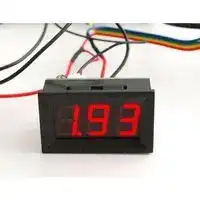
## **Adafruit 574** DESCRIPTION Put a current meter anywhere with this very handy display. This panel meter requires a DC voltage to run, and then has two thick gauge wires to measure current draw. A shunt is already on board so its very easy to hook up! Since current sensors are a little more complex than volt meters, and its easy to confuse the wires, please read carefully to understand how to wire it together! The current meter has two sets of wires, one thin (red and black) and one thick (red or white, and black). The thin wire set is for powering the meter itself and must be 4.5-30VDC. There is reverse-polarity protection on these wires. The thick wire set is for the in-line current sensing. The black sensing wire is tied to the black power wire internally, so depending on how you want to use the meter, you may need a separate power circuit (see the next paragraph) The easiest and safest way to use the meter is to have no electrical connection between the powering and sensing current. That is, connect something like a 9V battery to the thin power wires and you can put the current sensor in anywhere you want. As long as the circuits are totally separate this will work great. Another option is to have one circuit power the meter while it is sensing the same circuit. To do this, you'll need to make sure that you are low-side sensing. This is because the ground power wire is connected to the black current sense wire. To make sure you don't accidentally short your power supply, you'll need to arrange your circuit so that the ammeter sits 'right below' the "ground" of whatever you are sensing. See the image above for a diagram showing how to measure motor current, for example. Make sure the DC power is between 4.5V and 30V in this case. The display has a microcontroller that will read the current through the shunt resistance, compare it to a stable reference and display the current in Amps on a 3-digit 0.56" tall 7-segment display. It works from 4.5V up to 30V and is reverse-polarity protected so it will be good for nearly any electronic project! The meter itself draws about 20mA to power the microcontroller and display. This particular LED display is a nice contrast red, which we found very readable. To mount to your enclosure, simply cut a 45.5mm × 26.5mm rectangle and snap it in. ## TECHNICAL DETAILS Dimensions: - Dimensions: 48x29x21mm - Digit size: 0.56" high, red LEDs - Refresh rate: about 2 Hz Power specifications: - 4.5V to 30V DC power - 0.01-9.99 Amp DC current sensing - 14cm long wires, 26 AWG for power wires, 20 AWG for current wires - 0.01 ohm shunt - 15-25mA draw - Accuracy is about 4%, better at currents over 2A - Red LED display - Reverse polarity protected - The mini trim potentiometer on the back is for calibration of the current measurement, you shouldn't have to adjust it unless the measurements are off and you have calibration equipment
Updated at June 9, 2026
About Novapart
Novapart is a B2B electronic component broker specialising in stock shortages and cost reduction. We source hard-to-find parts and identify compliant alternatives across a catalogue of 410,000+ components from 500+ manufacturers.
Learn more →Stock Shortage Specialist
When a component is unavailable, discontinued or has an unacceptable lead time, we tap into our network of vetted European and Asian distributors to source what you need — without compromising on quality or traceability.
Request a quote →Compliant Alternatives
We identify pin-to-pin, electrically equivalent substitutes that meet the same certifications (RoHS, AEC-Q100, REACH) as your original specification — validated against datasheets, not just part numbers. Often at a lower cost.
BOM Analysis service →