
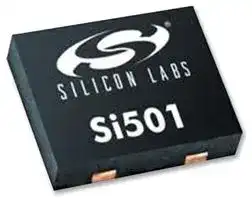


501JCAM032768CAF
MEMS Oscillator, CMEMS®, 32.768 kHz, SMD, 3.2mm x 2.5mm, 20 ppm, 3.3 V, CMOS
- Manufacturer: SILICON LABS
- Product type: MEMS Oscillators
- Frequency Nom: 32.768kHz
- Oscillator Case: SMD, 3.2mm x 2.5mm
- Supply Voltage Nom: 3.3V
- Frequency Stability + / -: 20ppm
- Operating Temperature Max: 70°C
- Operating Temperature Min: -20°C
- Oscillator Output Compatibility: CMOS
| Delivery and price | |
|---|---|
| Units per pack | 100 |
| Price | 0.723 € |
| Current stock | 10+ |
| Lead time | 30 days |

**Si501/2/3/4** **LVCMOS CMEMS[®] Programmable Oscillator Series** ## **Description** The Si501/2/3/4 CMEMS programmable oscillator series combines standard CMOS + MEMS in a single, monolithic IC to provide high-quality and high-reliability oscillators. Each device is specified for guaranteed performance across voltage, process, temperature, shock, vibration and aging for 10 years. More information on CMEMS available at www.silabs.com/cmems. ## **Features** - Any frequency oscillator from 32 kHz to 100 MHz - Contact Silicon Labs Marketing for frequencies above 100 MHz - Frequency stability: ±20/±30/±50 ppm including 10-year aging - -20 to +70 °C: Extended Commercial - -40 to +85 °C: Industrial **Applications** : General purpose microcontrollers, industrial control, IP cameras, surveillance systems, metering, home and office automation, security systems, sleep clocking, 10/100 Ethernet/EtherCAT, SPI, SAS3.0 / SATA3.0, PCIe ref clock, NVMe, HDD, SSD, hybrid storage, DDR3/3L, USB2.0, USB OTG/2.0, M2M, HDMI **Not recommended** : Wi-Fi, Bluetooth, USB 3.0, Gigabit Ethernet - Highly configurable: low power vs. low jitter, frequency, FSTAB, TR/TF, VDD, OE/FS functionality (see ordering guide below) - In-circuit programmable via C1D 1-pin interface (Si504) - Seamless VDD from +1.71 to +3.63 V - Low period jitter mode / low power mode - Glitchless start and stop - RoHS compliant, Pb-free ## **Product Selector Guide Pin-out** ## **Pin Description** |**Part**<br>**Number**|**Description**|**Control**| |---|---|---| |Si501|Single frequency|OE| |Si502|Dual frequency|FS/OE| |Si503|Quad frequency|FS| |Si504|Programmable for any<br>supported frequency<br>or configuration|C1D 1-pin interface<br>(see Si504 data sheet<br>for details)| ||||||**Pin**|**Description**| |---|---|---|---|---|---|---| ||||||**Number**|| ||||||1|FS = Frequency Select| |||||||OE = Output Enable| |||||||C1D = Single wire interface| ||||||2|GND = Ground| ||||||3|CLK = Clock out| |(top view)|(top view)|(top view)|||4|VDD = Power Supply| **Ordering Guide** **==> picture [473 x 268] intentionally omitted <==** **----- Start of picture text -----**<br> TYP Jitter vs 501 502 [6]<br>VDD<br>TR/TF Power OE OE Internal OE Internal<br>A 1.7‐3.6 0.7 ns [1] High Low Pull Resistor Low Pull Resistor<br>a B 3.3V 1.3 ns [2] UP A Stop A Stop<br>C 2.5V 1.3 ns [2] B Enable Doze Pull‐Up B Doze Pull‐Up<br>Low<br>D 1.8V 1.3 ns [2] C Sleep C Sleep<br>Power<br>E 1.7‐3.6 3 ns [3] D Stop D Stop<br>F 1.7‐3.6 5 ns [3] E Doze Enable Pull‐Down E Doze None<br>pes G 1.7‐3.6 8 ns [3] F Sleep F Sleep 504 only [5]<br>= H 1.7‐3.6 0.7 ns [1] | AS G Stop Maximum FOUT<br>503<br>J 3.3V 1.3 ns [2] H Enable Doze A 0.032 – 80 MHz<br>KL 1.8V2.5V 1.1.33 n nss [2][2] Low Jitter oa KJ Stop Sleep n None AB =a PNuoll‐nUpe B 0.032 – 100 MHz<br>M 1.7‐3.6 3 ns [3] L Doze Enable 504 Temp<br>N 1.7‐3.6 5 ns [3] M Sleep A Pull‐Up only Range<br>P 1.7‐3.6 8 ns [3] F ‐20 to 70 °C<br>G ‐40 to 85 °C<br>OPN<br>Prefix Description 50X ‐ ‐ ‐ ‐ ‐ ‐ ‐ ‐ ‐ ‐ ‐ A ‐ R<br>501 Single frequency Reel<br>502 Dual frequency<br>503 Quad frequency R Reel<br>2 504 Any frequency A OPN PECEEEO, CodeFreq Description E T Cut Tape<br>Mxxxxxx fOUT < 1 MHz Package<br>ppm 501 only xMxxxxx 1 MHz ≤ fOUT < 10 MHz Dimension<br>A ± 50 xxMxxxx 10 MHz ≤ fOUT < 100 MHz B 3.2 x 5 mm [4]<br>B ± 30 100M000 fOUT = 100 MHz C 2.5 x 3.2 mm<br>C ± 20 501/2/3/4 xxxxxx Silicon Labs 6‐digit code for 502/3/4, or >6‐decimal freq on 501 D 2 x 2.5 mm<br>**----- End of picture text -----**<br> ## Ordering Guide Notes: 1. Series termination resistor (RS – see Apps Circuits section) is recommended for this configuration. 2. Series termination resistor (RS) is not needed for this configuration. Output impedance is 50Ω for the indicated supply condition. 3. Series termination resistor (RS) is not needed for this configuration. Reduced EMI setting. 4. 3.2 x 5 mm package is delivered as 3.2 x 4 mm and accommodates the industry-standard 3.2 x 5 mm footprint. 5. Select option to support maximum anticipated frequency needed. 6. The Si502 OE pin has three (3) states: OE High = Freq 1; OE Weak High = Freq 2; OE Low is configurable. This information applies to a product under development. Its characteristics and specifications are subject to change without notice. **Copyright© 2013 by Silicon Labs** **Si501/2/3/4 CMEMS Oscillator Series** **Revision 0.72** CGMEMS **www.silabs.com/cmems** **Si501/2/3/4 LVCMOS CMEMS[®] Programmable Oscillator Series** ## **Selected Electrical Specifications** VDD = +1.71 V to +3.63 V, TA = -40 to 85 ºC unless stated otherwise. |**Parameter**<br>~~TL~~|**Symbol**<br>~~TL~~|**Test Condition/Comment**<br>~~TL~~<br>~~eeTT,:r®rr”l?l,},r_e__—»_~~|**Min**<br>~~TL~~<br>~~_ eDeyD;lr®rereeeeeom~~|**Typ**<br>~~TL~~<br>~~eDeyD;lr®rereeeeeom~~|**Max**<br>~~TL~~<br>~~eDeyD;lr®rereeeeeom~~|**Unit**<br>~~TL~~<br>~~eDeyD;lr®rereeeeeom~~| |---|---|---|---|---|---|---| |Frequency Range<br>~~TL~~<br>~~a~~<br>~~st.~~|FCLK<br>~~TL~~<br>~~a~~<br>~~t.~~|Programmable family range<br>~~TL~~<br>~~eeTT,:r®r r ”l?l ,},r_e_ _—» _~~<br>~~a~~<br>~~t.~~|0.032<br>~~TL~~<br>~~_ eDeyD;lr®rereeeeeom~~<br>~~a~~<br>~~OE~~|—<br>~~TL~~<br>~~eDeyD;lr®rereeeeeom~~<br>~~a~~<br>~~OE~~|100<br>~~TL~~<br>~~eDeyD;lr®rereeeeeom~~<br>~~a~~<br>~~OE~~|MHz<br>~~TL~~<br>~~eDeyD;lr®rereeeeeom~~<br>~~a~~<br>~~OE~~| |Supply Voltage<br>~~a~~<br>~~st.~~|VDD<br>~~a~~<br>~~t.~~|Supports continuous VDDfrom Min to Max<br>~~a~~<br>~~t.~~|1.71<br>~~a~~<br>~~OE~~|—<br>~~a~~<br>~~OE~~|3.63<br>~~a~~<br>~~OE~~|V<br>~~a~~<br>~~OE~~| |Supply Current<br>~~st.~~<br>~~a~~<br>~~ee~~|IDD1<br>~~t.~~<br>~~ee~~<br>~~ee~~<br>~~—SS=_=S===_=_~~|3.3 VDD, FCLK =1 MHz, 4 pF, Low Power mode<br>~~t.~~<br>~~ee~~|—<br>~~OE~~|1.7<br>~~OE~~<br>~~oe~~|2.5<br>~~OE~~<br>~~oe~~|mA<br>~~OE~~<br>~~oe~~| |||3.3 VDD, FCLK =1 MHz, 4 pF, Low Jitter mode<br>~~ee~~<br>~~—SS=_=S===_=_~~|—<br>~~—SS=_=S===_=_~~|3.9<br>~~oe~~<br>~~—SS=_=S===_=_~~|4.9<br>~~oe~~<br>~~—SS=_=S===_=_~~|mA<br>~~oe~~<br>~~—SS=_=S===_=_~~| |Static Supply Current<br>1<br>~~a~~<br>~~ee~~<br>~~rr~~|IDD2<br>~~ee~~<br>~~ee~~<br>~~—SS=_=S===_=_~~<br>~~a~~<br>~~a~~<br>~~rr~~|Stop mode, FCLK =1 MHz, Low Power mode<br>~~ee~~<br>~~—SS=_=S===_=_~~|—<br>~~—SS=_=S===_=_~~|1.7<br>~~oe~~<br>~~—SS=_=S===_=_~~|2.5<br>~~oe~~<br>~~—SS=_=S===_=_~~|mA<br>~~oe~~<br>~~—SS=_=S===_=_~~| |||Stop mode, FCLK =1 MHz, Low Jitter mode<br>~~—SS=_=S===_=_~~|—<br>~~—SS=_=S===_=_~~|3.9<br>~~—SS=_=S===_=_~~|4.9<br>~~—SS=_=S===_=_~~|mA<br>~~—SS=_=S===_=_~~| |||Doze mode<br>~~—SS=_=S===_=_~~<br>~~a~~<br>~~————~~|—<br>~~—SS=_=S===_=_~~<br>~~a~~<br>~~————~~|670<br>~~—SS=_=S===_=_~~<br>~~a~~<br>~~————~~|890<br>~~—SS=_=S===_=_~~<br>~~a~~<br>~~————~~|A<br>~~—SS=_=S===_=_~~<br>~~a~~<br>~~————~~| |||Sleepmode<br>~~—SS=_=S===_=_~~<br>~~a~~<br>~~————~~|—<br>~~—SS=_=S===_=_~~<br>~~a~~<br>~~————~~|0.3<br>~~—SS=_=S===_=_~~<br>~~a~~<br>~~————~~|1<br>~~—SS=_=S===_=_~~<br>~~a~~<br>~~————~~|A<br>~~—SS=_=S===_=_~~<br>~~a~~<br>~~————~~| |Frequency Stability<br>2<br>~~ee~~<br>~~rr~~|FSTAB<br>~~ee~~<br>~~—SS=_=S===_=_~~<br>~~rr~~|TA = -20 ºC to +70 ºC, -40 ºC to +85 ºC<br>~~—SS=_=S===_=_~~<br>~~————~~|-20<br>~~—SS=_=S===_=_~~<br>~~————~~|—<br>~~—SS=_=S===_=_~~<br>~~————~~|+20<br>~~—SS=_=S===_=_~~<br>~~————~~|ppm<br>~~—SS=_=S===_=_~~<br>~~————~~| ||||-30<br>~~————~~|—<br>~~————~~|+30<br>~~————~~|ppm<br>~~————~~| ||||-50<br>~~————~~<br>~~i~~|—<br>~~————~~|+50<br>~~————~~|ppm<br>~~————~~| |CMOS Rise/Fall Time<br>3<br>~~rr~~<br>~~==~~<br>~~ee ee~~|TR/TF<br>~~rr~~<br>~~==~~<br>~~a~~<br>~~a~~<br>~~a~~<br>~~ee~~|1<br>stoption code=A<br>4or H<br>4<br>~~————~~<br>~~==~~|0.4<br>~~————~~<br>~~i~~<br>~~==~~|0.7<br>~~————~~<br>~~==~~|1.2<br>~~————~~<br>~~==~~|ns<br>~~————~~<br>~~==~~| |||1<br>stoption code=B, C, D, J, K, L<br>~~————~~<br>~~==~~<br>~~a~~|1<br>~~————~~<br>~~==~~<br>~~a~~|1.3<br>~~————~~<br>~~==~~<br>~~a~~|1.6<br>~~————~~<br>~~==~~<br>~~a~~|ns<br>~~————~~<br>~~==~~<br>~~a~~| |||1<br>stoption code=E, M<br>~~==~~|2<br>~~==~~|3<br>~~==~~|4<br>~~==~~|ns<br>~~==~~| |||1<br>stoption code=F, N<br>~~==~~<br>~~a~~|4<br>~~==~~<br>~~a~~|5<br>~~==~~<br>~~a~~|7<br>~~==~~<br>~~a~~|ns<br>~~==~~<br>~~a~~| |||1<br>stoption code=G, P<br>~~==~~<br>~~a~~|7<br>~~==~~<br>~~a~~|8<br>~~==~~<br>~~a~~|11<br>~~==~~<br>~~a~~|ns<br>~~==~~<br>~~a~~| |Cycle-to-Cycle Jitter<br>~~==~~<br>~~ee ee~~<br>~~ee~~|JCCPP<br>~~==~~<br>~~a~~<br>~~ee~~|FCLK= 100 MHz, Low Jitter mode<br>1<br>stoption code=H<br>~~==~~<br>~~a~~|—<br>~~==~~<br>~~a~~|14<br>~~==~~<br>~~a~~|25<br>~~==~~<br>~~a~~|ps pk-pk<br>~~==~~<br>~~a~~| |Period Jitter Pk-Pk<br>~~ee ee~~<br>~~ee~~<br>~~a~~|JPPKPK<br>~~ee~~<br>|FCLK= 100 MHz, Low Jitter mode<br>1<br>stoption code=H<br>~~rs~~<br>|—<br>~~I~~<br>|9<br>~~I~~<br>|13<br>|ps pk-pk<br>| |Period Jitter<br>~~ee~~<br>~~ee~~<br>~~a~~<br>~~ee~~|JPRMS<br>~~ee~~<br><br>|FCLK= 100 MHz, Low Jitter mode<br>1<br>stoption code=H<br>~~ee~~<br>~~rs~~<br>|—<br>~~ee~~<br>~~I~~<br><br>~~I~~|1<br>~~ee~~<br>~~I~~<br>|1.6<br>~~ee~~<br>|ps rms<br>~~ee~~<br>| |Phase Jitter<br>5<br>~~ee~~<br>~~a~~<br>~~ee ee~~|<br>~~ee~~<br>~~es~~<br>~~ee~~|FCLK= 75 MHz, FOFFSET= 900 kHz - 7.5 MHz<br>Low Jitter mode, 1<br>stoption code=H<br>~~ee~~<br>~~rs~~<br>~~es~~|—<br>~~ee~~<br>~~I~~<br>~~es~~<br>~~I~~|1<br>~~ee~~<br>~~I~~<br>~~es~~|1.3<br>~~ee~~<br>~~es~~|ps rms<br>~~ee~~<br>~~es~~| |Duty Cycle<br>~~a ~~<br>~~ee ee~~|DC<br> ~~es~~<br>~~ee~~|Drive strength selected such that TR/TF<br>(20% to 80%)<10 % of period<br>~~rs ~~<br>~~es~~|45<br> ~~I~~<br>~~es~~<br>~~I~~|50<br>~~I~~<br>~~es~~|55<br>~~es~~|%<br>~~es~~| |Input High Voltage<br>~~ee ee~~<br>~~i~~|VIH<br>~~ee~~<br>~~i~~|~~i~~|0.7 x VDD<br>~~I~~<br>~~i~~|—<br>~~i~~|—<br>~~i~~|V<br>~~i~~| |Input Low Voltage<br>~~i~~|VIL<br>~~i~~|~~i~~|—<br>~~i~~|—<br>~~i~~|0.3x VDD<br>~~i~~|V<br>~~i~~| |Output High Voltage<br>~~i~~<br>~~**a**~~|VOH<br>~~i~~<br>~~**a**~~|~~i~~<br>~~**a**~~|0.9 x VDD<br>~~i~~<br>~~**a**~~|—<br>~~i~~<br>~~**a**~~|—<br>~~i~~<br>~~**a**~~|V<br>~~i~~<br>~~**a**~~| |Output Low Voltage<br>~~**a**~~|VOL<br>~~**a**~~|~~**a**~~|—<br>~~**a**~~|—<br>~~**a**~~|0.1 x VDD<br>~~**a**~~|V<br>~~**a**~~| |1.<br>Si501 supports OE/mode functionality. Si502 supports OE/mode and FS functionality. Si503 supports only FS functionality. See data<br>sheet functional description section for more information.<br>2.<br>Frequency stability includes initial tolerance, solder shift, operating temp range, rated power supply voltage change, load change, 10-year<br>aging, shock, and vibration.<br>3.<br>CL= 15 pF, TR/TF(20% to 80%), 3.3 V unless otherwise stated. See datasheet for additional TR/TFoptions.<br>4.<br>Recommended series termination resistor (RS) = 24.9for Z0=50.<br>5.<br>Integratedphasejitter exceeds some high-performance data communications system requirements. See AN783 for more information.||||||| 1. Si501 supports OE/mode functionality. Si502 supports OE/mode and FS functionality. Si503 supports only FS functionality. See data sheet functional description section for more information. 2. Frequency stability includes initial tolerance, solder shift, operating temp range, rated power supply voltage change, load change, 10-year aging, shock, and vibration. 3. CL = 15 pF, TR/TF (20% to 80%), 3.3 V unless otherwise stated. See datasheet for additional TR/TF options. 4. Recommended series termination resistor (RS) = 24.9 for Z0=50 . 5. Integrated phase jitter exceeds some high-performance data communications system requirements. See AN783 for more information. **Absolute Maximum Ratings[1 ]** |**Parameter**<br>~~a~~<br>~~ee~~|**Symbol**<br>~~a~~|**Condition**<br>~~a~~|**Rating**<br>~~a~~|**Unit**<br>~~a~~| |---|---|---|---|---| |Storage Temperature<br>~~a~~<br>~~ee~~|TS<br>~~a~~|~~a~~|-55 to 125<br>~~a~~|ºC<br>~~a~~| |SupplyVoltage<br>~~ee~~<br>~~en~~|VDD<br>~~en~~|~~en~~|-0.5 to 3.8<br>~~en~~|ºC<br>~~en~~| |Input Voltage<br>~~en~~|VIN<br>~~en~~|~~en~~|0.5 to VDD+0.3<br>~~en~~|V<br>~~en~~| |ESD HBM(JESD22-A114)<br>~~en~~|HBM<br>~~en~~|~~en~~|2000<br>~~en~~|V<br>~~en~~| |ESD CDM<br>~~en~~<br>~~en~~|CDM<br>~~en~~<br>~~en~~|~~en~~<br>~~en~~|500<br>~~en~~<br>~~en~~|V<br>~~en~~<br>~~en~~| |Solder Temp<br>2<br>~~en~~|TPEAK<br>~~en~~|~~en~~|260<br>~~en~~|ºC<br>~~en~~| |Solder Time at TPEAK<br>2<br>~~es~~|TP<br>~~es~~|~~es~~|20-40<br>~~es~~|s<br>~~es~~| |Max Junction Temp<br>~~es~~<br>~~Re~~|TJ<br>~~es~~<br>~~Re~~|~~es~~<br>~~Re~~|125<br>~~es~~<br>~~Re~~|ºC<br>~~es~~<br>~~Re~~| |1. Stresses beyond those listed in this table may cause permanent damage to the device. Functional operation specification compliance is not<br>implied at these conditions. Exposure to maximum rating conditions for extended periods may affect device reliability.<br>2. The device is compliant with JEDEC J-STD-020.<br>~~Re~~||||| ~~GMEMS~~ **2** **Revision 0.72** **www.silabs.com/cmems** ## **Si501/2/3/4** **LVCMOS CMEMS[®] Programmable Oscillator Series** ## **Environmental Compliance and Package Information** |**Parameter**|**Test Condition**| |---|---| |Mechanical Shock|MIL-STD-883, M2002 Cond B. (1,500g)| |Mechanical Shock High g MIL|Mechanical Shock High g MIL-STD-883, M2002, Cond. E (10,000g)| |Mechanical Vibration|MIL-STD-883, Method 2007| |Solderability|MIL-STD-883, Method 2003| |Temperature Cycle|JESD22, Method A104| |Resistance to Solder Heat|Resistance to Solder Heat<br>MIL-STD-883, Method 2036| |Contact Pads|Gold over Nickel/Palladium| ## **Thermal Conditions** |**Parameter**|**Symbol**|**Test Condition**|**Value**|**Unit**| |---|---|---|---|---| |Thermal<br>Impedance|JA|3.2 x 5 mm, still air|187|ºC/W| |||2.5 x 3.2 mm, still air|239|| |||2 x 2.5 mm,still air|241|| ## **Clock Timing Characteristics** VDD = +1.71 V to +3.63 V, TA = -40 to 85 ºC unless stated otherwise. |**Parameter**<br>~~1~~<br>~~a~~<br>~~a~~|**Symbol**|**Test Condition/Comment**<br>~~a~~|**Min**<br>~~a~~|**Typ**<br>~~a~~|**Max**<br>~~a~~|**Unit**<br>~~a~~| |---|---|---|---|---|---|---| |Startup Time<br>~~1~~<br>~~a~~|TSU|From VDDcrossing 1.71 to first clock<br>~~a~~|—<br>~~a~~|2.5<br>~~a~~|4<br>~~a~~|ms<br>~~a~~| |Resume Time<br>2, 3<br>~~a~~<br>~~ee~~|TRUN<br>~~ee~~|From Stop mode<br>~~a~~|—<br>~~a~~|—<br>~~a~~|1.5 x TCLK +35<br>~~a~~|ns<br>~~a~~| |||From Sleep mode<br>~~a~~<br>~~BF~~|—<br>~~a~~<br>~~BF~~|2.5<br>~~a~~<br>~~BF~~|5<br>~~a~~|ms<br>~~a~~<br>~~————————————————~~| |||From Doze mode<br>~~BF~~<br>~~I~~<br>~~————————————————~~|—<br>~~BF~~<br>~~I~~<br>~~————————————————~~|—<br>~~BF~~<br>~~I~~<br>~~————————————————~~|2.55<br>~~I~~<br>~~————————————————~~|| |Output Disable Time<br>2, 3<br>~~ee~~|TD<br>~~ee~~|To Stop<br>~~I~~<br>~~————————————————~~|—<br>~~I~~<br>~~————————————————~~|—<br>~~I~~<br>~~————————————————~~|1.5 x TCLK +35<br>~~I~~<br>~~————————————————~~|ns<br>~~————————————————~~| |||To Sleep/Doze<br>~~————————————————~~|—<br>~~————————————————~~|—<br>~~————————————————~~|225<br>~~————————————————~~|s<br>~~————————————————~~| |FrequencyUpdate Time<br>2<br>~~ee~~<br>~~I~~|TNEW_FREQ<br>~~ee~~<br>~~I~~|To New Frequency<br>~~————————————————~~<br>~~I~~|—<br>~~————————————————~~<br>~~I~~|—<br>~~————————————————~~<br>~~I~~|5<br>~~————————————————~~<br>~~I~~|ms<br>~~————————————————~~<br>~~I~~| |1.<br>Hold FS/OE high (strong or weak) during powerup for fastest time to clock.<br>2.<br>Si501 and Si502 only. Si503 has frequency select (FS) only and does not support Stop, Doze or Sleep.<br>3.<br>TCLK= clockperiod = 1/ FCLK.<br>~~I~~||||||| ## **AC Waveforms** ## **Si501/2/3 Power On Time** **==> picture [107 x 122] intentionally omitted <==** **----- Start of picture text -----**<br> Si501/2 AC Waveform<br>Si503 AC Waveform<br>**----- End of picture text -----**<br> ry **Revision 0.72** **3** **www.silabs.com/cmems** ## **Si501/2/3/4** ## **LVCMOS CMEMS[®] Programmable Oscillator Series** ## **Applications Circuits** ## **Si501/2 Apps Circuit w/ Optional Series Resistor** ## **Si503 Apps Circuit w/ Configurable Options** Notes: 1. Dotted line boxes show optional components depending on configuration options. See data sheet for additional information and for applications using a microcontroller. Data sheet is available at www.silabs.com/cmems. 2. Recommended series termination resistor (RS) = 24.9 for Z0 = 50 . ## **Si502 FS/OE States and Resistor Values** ## **Si503 FS States and Resistor Values** |**FS/OE State**|**RUP**|**Clock Output**||**FS/OE State**|**RUP**|**RDOWN**|**Clock Output**| |---|---|---|---|---|---|---|---| |StrongHigh|0 ≤RUP ≤1 k|Frequency1||StrongHigh|0 ≤RUP ≤1 k|Nopop|Frequency1| |Weak High|20 k≤ RUP≤ 200 k|Frequency2||Weak High|20 k ≤RUP ≤200 k|Nopop|Frequency2| |Low|—|Hi-Z||Weak Low|Nopop|20 k ≤RDOWN ≤200 k|Frequency3| |||||Low|Nopop|0≤ RDOWN≤ 1 k|Frequency4| ## Notes for both FS/OE tables above: 1. If the internal pull-up resistor order option is NOT selected, an MCU internal pull-up resistor or an external pull-up resistor should be used. See data sheet for more information. 2. The parallel combination of all pull-up resistors on the FS/OE pin including the optional internal pull-up resistor must be > 20 k to select Weak High. 3. If the Si50x internal pull-up resistor is enabled with no other external OE connections, the OE state will be detected as “Weak High”, selecting Frequency 2 by default. 7 **4** **Revision 0.72** **www.silabs.com/cmems** **Si501/2/3/4** **LVCMOS CMEMS[®] Programmable Oscillator Series** ## **Package Dimensions and Landing Patterns** ## **3.2 mm x 5 mm 4-pin DFN Dimensions** ## **3.2 mm x 5 mm 4-pin DFN Landing Pattern** Note: The 3.2 x 5 mm package is delivered as a 3.2 x 4 mm package and is drop-in compatible to industry-standard 3.2 x 5 landing patterns. ## **2.5 mm x 3.2 mm 4-pin DFN Dimensions** ## **2.5 mm x 3.2 mm 4-pin DFN Landing Pattern** ## **2 mm x 2.5 mm 4-pin DFN Dimensions** ## **2 mm x 2.5 mm 4-pin DFN Landing Pattern** **==> picture [225 x 108] intentionally omitted <==** **----- Start of picture text -----**<br> 2.50 ±0.15<br>#4 #3<br>2.00±0.15 0.70<br>b 0.55<br>#1 #2<br>: - 1. 00 0.65<br>0.90 Max (top view)<br>**----- End of picture text -----**<br> ~~———i—‘“_COSOSOSOSOSOSOOOSSSSS~~ **Revision 0.72 5 www.silabs.com/cmems** ~~GMEMS~~ **Si501/2/3/4** **LVCMOS CMEMS[®] Programmable Oscillator Series** ## **Package Top Marks and Explanations** ## **3.2 mm x 5 mm Top Mark** ## **3.2 mm x 5 mm Top Mark Explanation** |**Mark**<br>**Method:**|Laser|| |---|---|---| |**Font:**|0.66 mm<br>Right‐Justified|| |**Line 1**<br>**Marking:**|TTTTTT=Trace Code|Manufacturing Code from the<br>Assembly Purchase Order form.| |**Line 2**<br>**Marking:**|Circle=0.5mm<br>diameter<br>Left‐Justified|Pin 1 Indicator| ||YY = Year<br>WW = Work Week|Assigned by the Assembly House.<br>Corresponds to the year and work<br>week of the build date.| . ## **2.5 mm x 3.2 mm Top Mark** ## **2.5 mm x 3.2 mm Top Mark Explanation** |**Mark**<br>**Method:**|Laser|| |---|---|---| |**Font:**|0.50 mm<br>Right‐Justified|| |**Line 1**<br>**Marking:**|TTTTT=Trace Code|Manufacturing Code from the<br>Assembly Purchase Order form.| |**Line 2**<br>**Marking:**|Circle=0.3 mm<br>diameter<br>Left‐Justified<br>YY = Year|Pin 1 Indicator<br>Assigned by the Assembly House.| ||WW = Work Week|Corresponds to the year and work<br>week of the build date.| ## **2 mm x 2.5 mm Top Mark** ## **2 mm x 2.5 mm Top Mark Explanation** **Mark** Laser **Method: Font:** 0.50 mm Right‐Justified **Line 1** TTTT=Trace Code Manufacturing Code from the **Marking:** Assembly Purchase Order form. **Line 2** Circle=0.3 mm Pin 1 Indicator **Marking:** diameter Left‐Justified Y = Year Assigned by the Assembly House. WW = Work Week Corresponds to the year and work week of the build date. ~~——~~ **6 Revision 0.72** ~~ENS~~ **www.silabs.com/cmems** **Si501/2/3/4 LVCMOS CMEMS[®] Programmable Oscillator Series** ## **CONTACT INFORMATION** ## **Silicon Laboratories Inc.** 400 West Cesar Chavez Austin, TX 78701 Tel: 1+(512) 416-8500 Fax: 1+(512) 416-9669 Toll Free: 1+(877) 444-3032 Please visit the Silicon Labs Technical Support web page: https://www.silabs.com/support/pages/contacttechnicalsupport.aspx and register to submit a technical support request. ## Patent Notice Silicon Labs invests in research and development to help our customers differentiate in the market with innovative low-power, small size, analog-intensive mixed-signal solutions. Silicon Labs' extensive patent portfolio is a testament to our unique approach and world-class engineering team. The information in this document is believed to be accurate in all respects at the time of publication but is subject to change without notice. Silicon Laboratories assumes no responsibility for errors and omissions, and disclaims responsibility for any consequences resulting from the use of information included herein. Additionally, Silicon Laboratories assumes no responsibility for the functioning of undescribed features or parameters. Silicon Laboratories reserves the right to make changes without further notice. Silicon Laboratories makes no warranty, representation or guarantee regarding the suitability of its products for any particular purpose, nor does Silicon Laboratories assume any liability arising out of the application or use of any product or circuit, and specifically disclaims any and all liability, including without limitation consequential or incidental damages. Silicon Laboratories products are not designed, intended, or authorized for use in applications intended to support or sustain life, or for any other application in which the failure of the Silicon Laboratories product could create a situation where personal injury or death may occur. Should Buyer purchase or use Silicon Laboratories products for any such unintended or unauthorized application, Buyer shall indemnify and hold Silicon Laboratories harmless against all claims and damages. Silicon Laboratories and Silicon Labs are trademarks of Silicon Laboratories Inc. Other products or brandnames mentioned herein are trademarks or registered trademarks of their respective holders. ~~GMEMS~~ **Revision 0.72** **7** **www.silabs.com/cmems**
Updated at February 9, 2023
Silicon Labs is a recognized industry leader in secure, intelligent wireless technology and precision timing solutions. Renowned for driving innovation in the Internet of Things (IoT) and industrial automation, the company develops electronic components that deliver the performance, energy savings, and design simplicity required to build a seamlessly connected world. Our extensive portfolio of Silicon Labs components prominently features their robust wireless connectivity and timing products. This includes a comprehensive selection of Bluetooth modules and adaptors engineered for reliable, low-power communication in smart devices. Complementing these wireless offerings is a broad array of precision timing devices, particularly standard and advanced MEMS oscillators, which are critical for ensuring exact synchronization and stable frequency control in demanding circuit designs. To support a wider spectrum of networking and communication requirements, the lineup also encompasses versatile WLAN modules and USB adaptors. Additionally, engineers will find highly integrated sub-2.4GHz ISM band RF transceivers, available as both standalone integrated circuits and complete RF modules, providing exceptional range and signal resilience for complex wireless deployments.
About Novapart
Novapart is a B2B electronic component broker specialising in stock shortages and cost reduction. We source hard-to-find parts and identify compliant alternatives across a catalogue of 420,000+ components from 500+ manufacturers.
Learn more →Stock Shortage Specialist
When a component is unavailable, discontinued or has an unacceptable lead time, we tap into our network of vetted European and Asian distributors to source what you need — without compromising on quality or traceability.
Request a quote →Compliant Alternatives
We identify pin-to-pin, electrically equivalent substitutes that meet the same certifications (RoHS, AEC-Q100, REACH) as your original specification — validated against datasheets, not just part numbers. Often at a lower cost.
BOM Analysis service →