
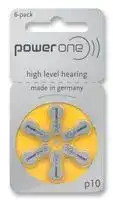
Image not available
Illustrative purposes only

4610210416.
Battery, 1.45 V, PR70, Zinc Air, 100 mAh, Pressure Contact, 6
⚠️ Reference pricing provided. In case of supply shortages, we will connect you with our trusted procurement partners to ensure your project's continuity.
- Manufacturer: VARTA
- Product type: Batteries - Non-Rechargeable
- Battery Voltage:1.45V; Battery Size Code:PR70; Battery Technology:Zinc Air; Battery Capacity:100mAh; Battery Terminals:Pressure Con; Available until stocks are exhausted Alternative available
- SVHC: To Be Advised
- Weight: 0.3g
- Pack Quantity: 6
- Product Range: Hearing Aid Battery Series
- External Depth: -
- External Width: -
- Battery Voltage: 1.45V
- External Height: 3.6mm
- Battery Capacity: 100mAh
- Battery IEC Code: PR70
- Battery NEDA Code: 7005ZD
- Battery Size Code: PR70
- Battery Terminals: Pressure Contact
- External Diameter: 5.8mm
- Battery Compliance: -
- Battery Technology: Zinc Air
- Battery Type / Size: Button Cell
| Delivery and price | |
|---|---|
| Units per pack | 50 |
| Price | 4.36 € |
| Current stock | 200+ |
| Lead time | 30 days |
Datasheet

**Material Safety Data Sheet MSDS 2.001.011**

**Primary zinc/air button cell (series** _**p...**_ **)**

## **1. Identification of the product and of the company undertaking**

## **Product details**

Trade name: Primary zinc/air button cell Product types p 675 IEC PR 44 p 13 IEC PR 48 p 312 IEC PR 41 p 10 IEC PR 70 Voltage: 1.4 V Electrochemical system: Zinc/mercury | KOH electrolyte | oxygen Anode (negative electrode): Zinc/mercury Cathode (positive electrode): MnOx catalyst

## **Supplier details**

Address: VARTA Microbattery GmbH Daimlerstr. 1 D-73479 Ellwangen/Jagst Germany Emergency telephone number: +49 7961 921 110 (VAC)

## **Legal Remark (U.S.A.)**

Material Safety Data Sheets (MSDS) are a sub-requirement of the Occupational Safety and Health Administration (OSHA) Hazard Communication Standard, 29 CFR Subpart 1910.1200. This Hazard Communication Standard does not apply to various subcategories including anything defined by OSHA as an "article". OSHA has defined "article" as a manufactured item other than a fluid or particle; (i) which is formed to a specific shape or design during manufacture; (ii) which has end use function(s) dependent in whole or in part upon its shape or design during end use; and (iii) which under normal conditions of use does not release more than very small quantities, e.g. minute or trace amounts of a hazardous chemical, and does not pose a physical hazard or health risk to employees.

Because all of our batteries are defined as "articles", they are exempted from the requirements of the Hazard Communication Standard.

## **Legal remark (EU)**

These batteries are no “substances” or “preparations” according to Regulation (EC) No 1907/2006 EC. Instead they have to be regarded as “articles”, no substances are intended to be released during handling. Therefore there is no obligation to supply a MSDS according to Regulation (EC) 1907/2006, Article 31.

## **General remark**

This “Safety Information” is provided as a service to our customers. The details presented are in accordance with our present knowledge and experiences. They are no contractual assurances of product attributes.

Page no.: **1** of **5**

Electronically generated document - no signature required.

VARTA Microbattery GmbH Daimlerstraße 1 73479 Ellwangen Germany

F o

Edition: **30.09.2009**

_1 7 5

Version: **03**

**Material Safety Data Sheet MSDS 2.001.011**

## **2. Hazards identification**

A sealed zinc/air button cell is not hazardous in normal use (as defined in chapter 7).

In case of mistreatment (prolonged deep discharge, charge, reverse charge, external short circuit…) and in case of fault, some electrolyte can leak from the cell through the air holes. In these cases refer to the risk of potassium hydroxide solution (corrosive, pH > 14). Charging may cause rupture. The electrode materials are only hazardous, if the materials are released by mechanical damaging of the cell or if exposed to fire.

## **3. Composition/information on ingredients**

## **Ingredients**

**Contents CAS No. Hazard Symbols R Phrases Material** 0 - 14 % 1313-13-9 Xn R 20/22 Manganese oxide 18 - 44 % 7440-66-6 N R 50/53 Zinc 1 - 3 % 1310-58-3 C R 22-35 Potassium hydroxide 0,5 – 1,3 % 7439-97-6 T, N R 23-33-50/53 Mercury (in zinc alloy) < 25 mg/cell

Full text of Classification and R-phrases: see section 16.

## **Heavy Metals**

**Contents CAS No. Material** 0,01 - 0,03 % 7439-92-1 Lead < 5 mg/kg 7440-43-9 Cadmium **Contents CAS No. Material** 27 - 70 % Nickel plated steel 2 - 5 % Copper 2 - 7 % Polymers

## **Other Ingredients**

## **4. First aid measures**

## **Measures at accidental release**

After inhalation: Fresh air. Seek for medical assistance. After skin contact: Flush affected areas with plenty of water. Remove contaminated cloth immediately. Seek for medical assistance. After eye contact: Flush the eye gently with plenty of water (at least 15 minutes). Seek for medical assistance. After ingestion: Drink plenty of water. Avoid vomiting. Seek for medical assistance. No trials for neutralization.

## **5. Fire fighting measures**

Suitable extinguishing media: Use foam, water, or CO2, as appropriate. Extinguishing media with limited (none) suitability: Special protection equipment during Contamination cloth including breathing apparatus. fire-fighting: Special hazard: (none)

Page no.: **2** of **5** Edition: **30.09.2009**

Electronically generated document - no signature required.

VARTA Microbattery GmbH Daimlerstraße 1 73479 Ellwangen Germany

F o

_1 7 5

Version: **03**

**Material Safety Data Sheet MSDS 2.001.011**

## **6. Accidental release measures**

Person related measures: Wear personal protective equipment adapted to the situation (protection gloves, cloth). Environment protection measures: In the event of battery rupture, prevent skin contact and collect all released material in a plastic lined container. Dispose off according to the local law and rules. Avoid leached substances to get into the earth, canalization or waters. Treatment for cleaning: If battery casing is dismantled, small amounts of electrolyte may leak. Pack the battery including ingredients as described above. Then clean with water (diluted acetic acid may be helpful).

## **7. Handling and storage**

Guideline for safe handling: Always follow the warning information on the batteries and in the manuals of devices. Only use the recommended battery types. Keep batteries away from children. For devices to be used by children, the battery casing should be protected against unauthorized access. Unpacked batteries shall not lie about in bulk. In case of battery change always replace all batteries by new ones of identical type and brand. Do not swallow batteries. Do not throw batteries into water. Do not throw batteries into fire. Do not short-circuit batteries. Do not recharge primary batteries. Storage: Storage preferably at room temperature (approx. 20°C). Avoid large temperature changes. Avoid direct sunlight. At higher temperature the electrical performance may be reduced. Storage of unpacked batteries can cause short circuit and heat generation. Storage of large amounts: If possible, store the batteries in original packaging (short circuit protection); A fire alarm is recommended; For automatic fire extinction consider chapter 5 “Fire fighting measures”. VCI storage category: It is recommended to consider the “VCI Guideline for the mixed storage of chemicals” and to handle primary zinc/air button cells according to storage category 11 (“combustible solids“).

## **8. Exposure controls/personal protection**

Under normal conditions (discharge, avoid prolonged deep discharge) release of ingredients does not occur.

## **9. Physical and chemical properties**

Not applicable if closed.

## **10. Stability and reactivity**

Dangerous reactions: When heated above 60°C the risk of rupture occurs.

## **11. Toxicological information**

Under normal conditions (during charge and discharge) release of ingredients does not occur. If accidental release occurs see information in section 2, 3, and 4.

Swallowing of a battery can be harmful. Call the local Poison Control Centre for advice and follow-up.

Page no.: **3** of **5**

Edition: **30.09.2009**

Electronically generated document - no signature required.

VARTA Microbattery GmbH Daimlerstraße 1 73479 Ellwangen Germany

F o

_1 7 5

Version: **03**

**Material Safety Data Sheet MSDS 2.001.011**

## **12. Ecological information**

Primary zinc/air button cells do contain mercury and lead, and do not contain cadmium as defined by the European directive 2006/66/EC Article 21. The mercury content is in accordance with the ‘‘Mercury-Containing and Rechargeable Battery Management Act’’ (U.S.A.).

## **13. Disposal considerations**

USA: Primary zinc/air button cells are classified by the federal government as non-hazardous waste and are safe for disposal in the normal municipal waste stream.

In the European Union, manufacturing, handling and disposal of batteries is regulated on the basis of the DIRECTIVE 2006/66/EC OF THE EUROPEAN PARLIAMENT AND OF THE COUNCIL of 6 September 2006 on batteries and accumulators and waste batteries and accumulators and repealing Directive 91/157/EEC. Customers find detailed information on disposal in their specific countries using the web site of the European Portable Batteries Association (http://www.epbaeurope.net/legislation_national.html).

Importers and users outside EU should consider the local law and rules.

In order to avoid short circuit and heating, used zinc/air button cells should never be stored or transported in bulk. Proper measures against short circuit are:

- Storage of batteries in original packaging

- Coverage of the terminals

## **14.**

## **Transport information**

VARTA primary zinc/air button cells are considered to be “dry cell” batteries and are unregulated for purposes of transportation by the U.S. Department of Transportation (DOT), International Civic Aviation Administration (ICAO), International Air Transport Association (IATA), the International Maritime Organization (IMO), the Accord Europeén Relatif au Transport International des Marchandises Dangereuses par Route (ADR) and the Règlement concernant le transport international ferroviaire de marchandises Dangereuses (RID).

IATA DGR: Special Provision A123: _“Examples of such batteries are: alkali-manganese, zinc-carbon,, nickel-metal hydride and nickel-cadmium batteries. Any electrical battery ... having the potential of a dangerous evolution of heat must be prepared for transport as to prevent (a) a short-circuit (e.g. in the case of batteries, by the effective insulation of exposed terminals...) is forbidden from transport; and (b) accidental activation. The words “Not Restricted” and the Special Provision number must be included in the description of the substance on the Air Waybill as required by 8.2.6, when an Air Waybill is issued.”_

EU: Special Provision 304 (ADR/RID): _“Batteries, dry, containing corrosive electrolyte which will not flow out of the battery if the battery case is cracked are not subject to the requirements of RID/ADR provided the batteries are securely packed and protected against short-circuits. Examples of such batteries are: alkali-manganese, zinc-carbon, nickel-metal hydride and nickel-cadmium batteries.”_

USA: 49 CFR § 172.102 Special Provision 130: _“For other than a dry battery specifically covered by another entry in the § 172.101 Table, “Batteries, dry” are not subject to the requirements of this subchapter when they are securely packaged and offered for transportation in a manner that prevents the dangerous evolution of heat (for example, by the effective insulation of exposed terminals) and protects against short circuits.”_

Page no.: **4** of **5**

VARTA Microbattery GmbH F Daimlerstraße 1 o 73479 Ellwangen _1 Germany 7 5

Electronically generated document - no signature required.

Edition: **30.09.2009**

Version: **03**

**Material Safety Data Sheet MSDS 2.001.011**

## **15. Regulatory information**

**Marking consideration:**

VARTA primary zinc/air button cells conform with the requirements of the Medical Devices Directive 93/42/EEC class 1 and are thus marked with the CE symbol.

According to DIRECTIVE 2006/66/EC OF THE EUROPEAN PARLIAMENT AND OF THE COUNCIL of 6 September 2006 on batteries and accumulators and waste batteries and accumulators and repealing Directive 91/157/EEC all batteries have to be marked with the crossed bin; according to Article 21 of this directive primary zinc/air button cells have to be marked with the element symbols “Hg” and “Pb”. Due to the size of the battery, this marking has to be placed on the packaging.

**International safety standards: Water hazard class:**

IEC 60086-5.

(according to German Federal Water Management Act) non-water pollution according to VwVwS Appendix 1 (No. 1443 and 766)

## **16. Other information**

**Full text of Classification and R Phrases referred to under sections 2 and 3**

|**Classification**|Xn|Harmful|
|---|---|---|
||T|Toxic|
||C|Corrosive|
||N|Dangerous for the environment|
||||
|**R Phrases**|20/22|Harmful byinhalation and if swallowed.|
||22|Harmful if swallowed.|
||23|Toxic byinhalation.|
||33|Danger of cumulative effects.|
||35|Causes severe burns.|
||50/53|Very toxic to aquatic organisms, may cause long-term adverse effects in|
|||the aquatic environment.|


## **Note:**

**Issued by:**

**Contact person:**

Date of issue of the transport regulations: ADR 2009, IATA 2009, IMDG 2006, DOT / 49 CFR 2009.

VARTA Microbattery GmbH Quality/Environmental Management Dr. Rainer Jostes Tel. +49-7961-921-680 Fax +49-7961-921-73680 E-Mail: rainer.jostes@varta-microbattery.com

Page no.: **5** of **5**

VARTA Microbattery GmbH Daimlerstraße 1 73479 Ellwangen Germany

F o

Electronically generated document - no signature required.

Edition: **30.09.2009**

_1 7 5

Version: **03**
Updated at April 28, 2026
About Novapart
Novapart is a B2B electronic component broker specialising in stock shortages and cost reduction. We source hard-to-find parts and identify compliant alternatives across a catalogue of 410,000+ components from 500+ manufacturers.
Learn more →Stock Shortage Specialist
When a component is unavailable, discontinued or has an unacceptable lead time, we tap into our network of vetted European and Asian distributors to source what you need — without compromising on quality or traceability.
Request a quote →Compliant Alternatives
We identify pin-to-pin, electrically equivalent substitutes that meet the same certifications (RoHS, AEC-Q100, REACH) as your original specification — validated against datasheets, not just part numbers. Often at a lower cost.
BOM Analysis service →