
Image not available
Illustrative purposes only

2447-3031-20
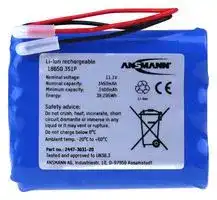
Rechargeable Battery, 10.9 V, Lithium Ion, 3.5 Ah, Wire Leads, 1
⚠️ Reference pricing provided. In case of supply shortages, we will connect you with our trusted procurement partners to ensure your project's continuity.
- Manufacturer: ANSMANN
- Product type: Batteries - Rechargeable
- Battery Voltage:10.9V; Battery Technology:Lithium Ion; Battery Capacity:3.5Ah; Battery Size Code:-; Battery Terminals:Wire Leads; External Diameter:-; Ext; Available until stocks are exhausted
- SVHC: No SVHC (21-Jan-2025)
- Weight: 151g
- Pack Quantity: 1
- Product Range: -
- External Depth: 19mm
- External Width: 60mm
- Battery Voltage: 10.9V
- External Height: 73mm
- Battery Capacity: 3.5Ah
- Battery IEC Code: -
- Battery NEDA Code: -
- Battery Size Code: -
- Battery Terminals: Wire Leads
- Battery Compliance: -
- Battery Technology: Lithium Ion
- Battery Type / Size: -
| Delivery and price | |
|---|---|
| Units per pack | 1 |
| Price | 61.8 € |
| Current stock | 10+ |
| Lead time | 30 days |
Datasheet

||**Material - Safety - Data Sheet (MSDS)**<br>for<br>single cells and multi-cell battery packs<br>**Ansmann Lithium-Ion Batteries**|No.5<br>1/7|
|---|---|---|
|Date of issue:<br>2011 - 06 - 10<br>Revision no:<br>13<br>Revision date: 2021 - 03 - 26<br>Editor:<br>Ansmann AG|The information contained within is provided as a service to our customers and<br>for their information only. The information and recommendations set forth herein<br>are made in good faith and are believed to be accurate at the date of preparation.<br>ANSMANN AG makes no warranty expressed or implied.||
|**1.**<br>**Product and Supplier Identification**<br>Product name:<br>Ansmann Li-Ion Battery; Ansmann Li-Polymer Battery<br>Type:<br>Rechargeable Li-Ion battery<br>Models / types:<br>Prismatic and round cells<br>Electrochemical system:<br>negative electrode: graphite; positive electrode: metall oxide (proprietary)<br>Supplier:<br>Germany<br>ANSMANN AG<br>Address:<br>Industriestraße 10;  97959 Assamstadt;  Germany<br>Phone / Fax:<br>+ 49 (0) 6294 42040 /  + 49 (0) 6294 420444<br>Home / email:<br>ansmann.de  /  info@ansmann.de<br>Subsidiaries:<br>United Kingdom<br>ANSMANN UK LTD.<br>Address:<br>Units 11-12, RO24, Harlow Business Park, Harlow, Essex. CM19 5QB. UK<br>Phone / Facsimile:<br>+44 (0) 870 609 2233  /  +44 (0) 870609 2234<br>email:<br>UK@ansmann.de<br>Hong Kong<br>ANSMANN Energy Int. LTD.<br>Address:<br>Unit 3117-18, 31/F; Tower 1; Millenium City 1; No. 388 Kwun Tong Road;<br>Kwun Tong, kowloon; Hong-Kong<br>hongkong@ansmann.de<br>China<br>HuiZhou City ANSMANN Trading Co. LTD<br>Address:<br>Da Lian Industrial Park, Rengtu Village Ruhu Town Huicheng District,<br>516169 Huizhou City Guangdong, China<br>china@ansmann.de<br>Sweden<br>ANSMANN Nordic AB<br>Address:<br>Victor Hasselblads Gata 11, 421 31 Västra Frölunda, Sweden<br>nordic@ansmann.de<br>France<br>Ansmann Energy France<br>Address:<br>5, Place Copernic; Immeuble Boréal - Courcouronnes; F-91023 Evry Cedex;<br>France<br>**EMERGENCY CONTACT:**<br>For chemical emergency (spill, leak, fire, exposure or accident)<br>call phone no.:<br>+49 6294 4204 0<br>**2.**<br>**Hazards Identification**<br>The rechargeable lithium-ion batteries described in this Product Safety Data Sheet are sealed units which are<br>not hazardous when used according to the recommendations of the manufacturer and as long as their integrity<br>is maintained.<br>Do not short circuit, puncture, incinerate, crush, immerse in water, force discharge or expose to temperatures<br>above the declared operating temperature range of the product. Risk of fire or explosion.<br>Under normal conditions of use, the active materials and liquid electrolyte contained in the cells and batteries<br>are not exposed to the outside, provided the battery integrity is maintained and seals remain intact. Risk of<br>exposure only in case of abuse (mechanical, thermal, electrical) which leads to the activation of safety valves<br>and/or the rupture of the battery container. Electrolyte leakage, electrode materials reaction with moisture/water<br>or battery vent/explosion/fire may follow, depending upon the circumstances.|||


## **2. Hazards Identification**

The rechargeable lithium-ion batteries described in this Product Safety Data Sheet are sealed units which are not hazardous when used according to the recommendations of the manufacturer and as long as their integrity is maintained.

Do not short circuit, puncture, incinerate, crush, immerse in water, force discharge or expose to temperatures above the declared operating temperature range of the product. Risk of fire or explosion. Under normal conditions of use, the active materials and liquid electrolyte contained in the cells and batteries are not exposed to the outside, provided the battery integrity is maintained and seals remain intact. Risk of exposure only in case of abuse (mechanical, thermal, electrical) which leads to the activation of safety valves and/or the rupture of the battery container. Electrolyte leakage, electrode materials reaction with moisture/water or battery vent/explosion/fire may follow, depending upon the circumstances.

## **Material - Safety - Data Sheet (MSDS)** No.5 for **Ansmann Lithium-Ion Batteries** single cells and multi-cell battery packs 2/7 ~~as~~

**3. Composition and Informations on Ingredients** Each cell consists of a hermetically sealed metallic container containing a number of chemicals and materials of construction of which the following could potentially be hazardous upon release.

|**Ingredient**|**Content**|**CAS No.**|**Hazard Categories**|**Hazard Statements**|
|---|---|---|---|---|
|e.g. Li-Ni, Li-Mn,<br>Li-Co, Li-FePo<br>compounds<br>metal oxide|20 - 50%|(proprietary)|Skin Sens. 1; Acute Tox. 1<br>Resp. Sens. 1; Carc. 1B<br>STOT RE 1; Aquatic Chronic 3|H372, H412<br>H317, H330<br>H334, H350|
|EMC (Ethyl Methyl Carb.)<br>DEC (Diethylcarbonate)<br>DMC (Di Methyl Carbonate<br>EC (Ethylene Carbonate)<br>EA (Ethyl-Acetate)<br>Organic Solvents<br>~~re~~|DMC (Di Methyl Carbonate<br>10 - 20%<br>|623-53-0<br>105-58-8<br>96-49-1<br>141-78-6<br>616-38-6<br>|H226<br>H225<br>H225<br>Flam. Liq 1; Eye Irrit. 2; STOT SE 3      H225, H319, H336<br>Acute Tox. 4; Eye Irrit. 2; STOT RE 2    H302, H319, H373<br>Flam. Liq. 2<br>Flam. Liq. 3<br>Flam. Liq. 2<br>~~ee~~<br>||
|Phosphate (LiPF6)<br>Lithium-Hexa-Fluoro<br>~~ee~~<br>~~re~~<br>~~re~~|1 - 3%<br>~~ee~~<br>~~**eee**~~<br>|21324-40-3<br>~~ee~~<br>~~**eee**~~<br>|Acute Tox. 3; Asp. TOX. 1<br>~~ee~~<br>~~**eee**~~<br>|H301, H314<br>~~ee~~<br>~~ee~~<br>~~**ee**~~<br>|
|Fluoride (PVDF)<br>Polyvinylidene<br>~~re~~<br>~~re~~|< 5%<br>~~**eee**~~<br>|24937-79-9<br>~~**eee**~~<br>|n/a<br>~~**eee**~~<br>|n/a<br>~~ee~~<br>~~**ee**~~<br>|
|Styrene Butadiene<br>Rubber (SBR)<br>~~re ~~<br>~~re~~<br>~~a~~|< 5%<br> ~~**eee**~~<br>|9003-55-8<br>~~**eee**~~<br>|n/a<br>~~**eee**~~<br><br>~~eee~~|n/a<br>~~ee~~<br>~~**ee**~~<br><br>~~ee~~|
|Copper (Cu)<br> <br>~~reee~~<br>~~a~~<br>~~re~~|2 - 11%<br> ~~**eee**~~<br>~~ee~~<br>~~ee~~<br>|7440-50-8<br>~~**eee** ~~<br>~~ee~~<br>~~ee~~<br>|Flam. Sol. 1<br> ~~**eee** ~~<br>~~ee~~<br>~~eee~~<br>~~ee~~<br>|H228<br> ~~**ee**~~<br>~~ee~~<br>~~ee~~<br>~~ee~~<br>|
|Aluminium (Al)<br>~~a~~<br>~~re~~<br>~~a~~|2 - 10%<br>~~ee~~<br>~~eee~~<br>|7429-90-5<br>~~ee~~<br>~~eee~~|Flam Sol.1; Water-react. 3<br>~~eee~~<br>~~ee~~<br>~~eee~~|H228, H261<br>~~ee~~<br>~~ee~~<br>~~ee~~|
|Carbon (C)<br>(Graphite)<br>~~re~~<br>~~a~~|10 - 30%<br>~~ee~~<br>~~eee~~<br>~~a~~|7440-44-0<br>~~ee~~<br>~~eee~~|n/a<br>~~ee~~<br>~~eee~~<br>~~ee~~|n/a<br>~~ee~~<br>~~ee~~|
|stainless steel<br>~~re ~~<br>~~a ~~|0 - 35%<br>~~ee ~~<br> ~~eee~~<br> ~~a~~|n/a<br> ~~ee ~~<br>~~eee ~~|n/a<br> ~~ee ~~<br> ~~eee ~~<br>~~ee~~|n/a<br> ~~ee~~<br> ~~ee~~|


In case of accumulator breakage or burst, please evacuate employees from the contaminated area and ensure maximal ventilation in order to break-up corrosive gas, smoke and unpleasant odors. If it occurs, by accident, following measures must be taken:

**Inhalation**

Remove from exposure, rest and keep warm. In severe cases obtain medical attention.

**Skin Contact** Wash off skin thoroughly with water. Remove contaminated clothing and wash before re-use. In severe cases obtain medical attention. **Eye Contact** Irrigate thoroughly with water for at least 15 minutes. Obtain medical attention.

**Ingestion** Wash out mouth thoroughly with water and give plenty of water to drink. Obtain medical attention.

**Further treatment** All cases of eye contamination, persistent skin irritation and casualities who have swallowed this substance or been affected by breathing its vapours should be seen by a doctor.

||**Material - Safety - Data Sheet (MSDS)**<br>for<br>single cells and multi-cell battery packs<br>**Ansmann Lithium-Ion Batteries**|No.5<br>3/7|
|---|---|---|
|**5.**<br>**Fire Fighting Measures**<br>**Suitable extinguishing**<br>Dry powder is applicable for burning lithium ion batteries. Metal fire extinction<br>**media:**<br>powder, rock salt or dry sand are suitable if only a few batteries are involved.<br>**Extinguishing media with**<br>Carbon dioxide (CO2) is only applicable for incipient fire. Do not use water.<br>**limited suitability:**<br>**Special protection equip-**<br>Contamination cloth including self-contained breathing apparatus.<br>**ment during fire-fighting:**<br>**Special hazard:**<br>Cells may explode and release metal parts.<br>At contact of electrolyte with water traces of hydrofluoric acid may be formed.<br>In this case avoid contact and take care for good ventilation.<br>At contact of changed anode material with water extremely flammable hydrogen<br>gas is generated.<br>**Attention:**<br>Do not let used extinguishing media penetrate into surface water or ground water.<br>If necessary, thicken water or foam with suitable solids. Dispose off properly.<br>**6.**<br>**Accidental Release Measures**<br>**Person related measures:**<br>Wear personal protective equipment adapted to the situation (protection gloves,<br>face protection, breathing protection).<br>**Environmental protection**<br>Bind released ingredients with powder (rock salt, sand).<br>**measures:**<br>Dispose off according to the local law and rules.<br>Avoid leached substances to penetrate into the earth, canalization or water.<br>**Treatment for cleaning:**<br>If battery casing is dismantled, small amounts of electrolyte may leak.<br>Package the battery tightly including ingredients together with lime, sand or<br>rock salt. Then clean with water.<br>**7.**<br>**Precautions for safe Handling and Use**<br>**Storage:**<br>Store in a cool (preferable below 30°C), well ventilated area, away from<br>moisture, sources of heat, open flames, food and drink.<br>Elevated temperatures can result in shortened battery life. Temperautes above<br>70°C may result in battery leakage and rupture.<br>Keep adequate clearance between walls and batteries.<br>Since short circuit can cause burn, leakage and rupture hazard,<br>keep batteries in original packaging until use and do not jumble them.<br>Preferred storage at 30... 50% of nominal battery capacity.<br>A fire alarm is recommended in case of storage of large amounts.<br>**Handling:**<br>Do not crush, pierce, short (+) and (-) battery terminals with conductive (i.e. metal)<br>goods, which would end up into excessive heating.<br>Do not directly heat or solder. Do not throw batteries into fire or water.<br>Do not mix batteries of different types and brands. Do not mix new and used<br>batteries. Keep batteries in non conductive (i.e. plastic) trays.<br>Do not disassemble, mutilate or mechanically abuse cells and batteries.<br>Avoid deep discharge.<br>Follow manufacturers recommendations regarding maximum recommended<br>currents and operating temperature range.<br>**Other:**<br>Applying pressure on deforming the battery may lead to disassembly followed by<br>eye, skin and throat irritation.<br>The Li-ion cells and batteries are not designed to be recharged from external<br>power sources besides specific Li-ion charger models approved by Ansmann.<br>Connecting to inappropriate power supplies can result in fire or explosion.<br>**Disposal:**<br>Dispose in accordance with all applicable federal, state and local regulations.|||


||**Material - Safety - Data Sheet (MSDS)**<br>**Ansmann Lithium-Ion Batteries**<br>single cells and multi-cell battery packs<br>for|No.5<br>4/7|
|---|---|---|
|**8.**<br>**Special Protection Information**<br>Ventilation Requirements:<br>Not necessary under normal conditions. Room ventilation may be required in<br>areas where there are open or leaking batteries.<br>Respiratory<br>Not necessary under normal conditions. Avoid exposure to electrolyte fumes from<br>Protection:<br>open or leaking battery. In all fire situations, use self-contained breathing<br>apparatus<br>Eye Protection:<br>Not necessary under normal conditions. Wear safety glasses with side shields<br>if handling an open or leaking battery.<br>Hand Protection:<br>Not necessary under normal conditions. Use neoprene or natural rubber gloves<br>if handling an open or leaking battery<br>**9.**<br>**Physical and Chemical Properties**<br>**Note: The following points are not applicable unless in case of leaking or damaged batteries with exposed**<br>**internal components.**<br>**Appearance:**<br>Cylindrical or prismatic shape<br>**Odour:**<br>Odourless (unless in case of damaged product with leaking electrolyte)<br>**Flashpoint:**<br>Not applicable<br>**Flammability:**<br>Not applicable<br>**Relative density:**<br>> 2 g/cm3<br>**Solubility (water):**<br>Not applicable unless individual components exposed<br>**Solubility (other):**<br>Not applicable<br>**10.**<br>**Stability and Reactivity**<br>Product is stable under conditions described in Section 7.<br>**Conditions to avoid:**<br>Heat above 70° or incinerate. Deform. Mutilate. Crush. Pierce. Disassemble.<br>Short circuit. Expose over a long period to humid conditions.<br>**Materials to avoid:**<br>Strong mineral acids, alkali solutions, strong oxidising materials and conductive<br>materials<br>**Hazardous decomposition**<br>**products:**<br>HF, CO, CO2<br>**11.**<br>**Toxicological Information**<br>**Signs & symptoms:**<br>None, unless battery ruptures. In the event of exposure to internal contents,<br>corrosive fumes will be very irritating to skin, eyes and mucous membranes.<br>Overexposure can cause symptoms of non-fibrotic lung injury and membrane<br>irritation.<br>**Inhalation:**<br>Lung irritant<br>**Skin contact:**<br>Skin irritant<br>**Eye contact:**<br>Eye irritant<br>**Ingestion:**<br>Tissue damage to throat and gastro-respiratory tract if swallowed<br>**Medical conditions generally**<br>**aggravated by exposure:**<br>In the event of exposure to internal contents, eczema, skin allergies,<br>lung injuries, asthma and other respiratory disorders may occure.<br>~~—s~~|||


|**Material - Safety - Data Sheet (MSDS)**|No.5|
|---|---|
|for||
|**Ansmann Lithium-Ion Batteries**||
|single cells and multi-cell battery packs|5/7|


## **12. Ecological Information**

Ansmann lithium ion batteries do not contain heavy metals as defined by the European directives 2006/66/EC Article 21.

Mercury has not been "intentionally introduced ( as distinguished from mercury that may be incidentally present in other materials)" in the sense of the U.S.A. "Mercury-Containing and Rechargeable Battery Management Act" (May 13, 1996)

The Regulation on MercuryContent Limitation for Batteries promulgated on 1997-12-31 by the China authorities including the State Administration of Light Industry and the State Environmental Protection Administration defines 'low mercury' as 'mercury content by weight in battery as less than 0.025%', and 'mercury free' as mercury content by weight in battery as less than 0.0001%'. And therefore: Ansmann lithium ion batteries belong to the category mercury-free battery (mercury content lower than 0.0001%).

## **13. Disposal Considerations**

USA: Lithium-Ion batteries are classified by the federal government as non-hazardous waste and are safe for disposal in the normal municipal waste stream. These batteries, however, do contain recyclable materials and are accepted for recycling by the Rechargeable Battery Recycling Corporation's (RPBC) Battery Recycling Program. Please go to the RPBC website at www.rbrc.org ( www.call2recycle.org) for additional information.

In the European Union, manufacturing, handling and disposal of batteries is regulated on the basis of the DIRECTIVE 2006/66/EC OF THE EUROPEAN PARLIAMENT AND OF THE COUNCIL of 6 September 2006 on batteries and accumulators and waste batteries and accumulators and repealing Directive 91/157/EEC. Customers find detailed information on disposal in their specific countries using the web site of the European Portable Batteries Association (http://www.epbaeurope.net/legislation_national.html)

Importers and users outside EU should consider the local law and rules

In order to avoid short circuit and heating, used lithium ion batteries should never be stored or transported in - bulk. Proper measures against short circuit are: Storage of batteries in original packaging - Coverage of the terminals - Embedding in dry sand

## **14. Transport Information**

## **ADR**

UN-Number: 3480 description Lithium ion batteries class: 9 packaging order: P903 special provision: 188; 230; 310; 348; 376; 377;387; 636 tunnel forbitten code: E UN-Number: 3481 description Lithium ion batteries contained in equipment / packed with equipment class: 9 packaging order: P903 special provision: 188; 230; 310; 348; 360; 376; 377; 387; 390; 670 tunnel forbitten code: E

## **IATA**

UN-Number: 3480 description Lithium ion batteries class: 9 packaging order: 965 section: II, IB,IA special provision: A88; A99; A154; A164; A183; A201; A206; A213; A331; A334; A802 UN-Number: 3481 description Lithium ion batteries contained in equipment class: 9

||**Material - Safety - Data Sheet (MSDS)**|No.5|
|---|---|---|
||for||
||**Ansmann Lithium-Ion Batteries**||
||single cells and multi-cell battery packs|6/7|
|packaging order:|967||
|section:|II, I||
|special provision:|A48; A88; A99; A154; A164; A181; A185; A206; A213||
|UN-Number:|3481||
|description|Lithium ion batteries packed with equipment||
|class:|9||
|packaging order:|966||
|section:|II, I||
|special provision:|A88; A99; A154; A164; A181; A185; A206; A213||
|**IMDG-Code**|||
|UN-Number:|3480||
|description|Lithium ion batteries||
|class:|9||
|packaging order:|P903||
|special provision:|188; 230; 310; 348; 376; 377; 384; 387||
|UN-Number:|3481||
|description|Lithium ion batteries contained in equipment / packed with equipment||
|class:|9||
|packaging order:|P903||
|special provision:|188; 230; 310; 348; 360; 376; 377; 384; 387; 390||


Since 1[st] of January 2013 it is necessary to produce both, lithium cells and lithium batteries under an existing quality assurance program.

The quality assurance program is detailed in following parts of the international dangerous goods laws:

- ADR (2021):

- IATA (2021, 62[nd] edition):

- IMDG-Code 2021 (Amendment 40-20):

- 2.2.9.1.7 (e)

- 3.9.2.6 (e) 2.9.4 (5.)

Ansmann hereby declare that all lithium cells and batteries of the Ansmann product range are produced according the above named quality assurance program.

## **15. Regulatory Information**

Regulations specifically applicable to the product:

- ACGIH and OSHA: see exposure limits of the internal ingredients of the battery in section 3.

- IATA/ICAO (air transportation): UN 3480 or UN 3481

- Transportation within the US-DOT, 49 Code of Federal Regulations (special provision 188

- IMDG (sea transportation) : UN 3480 or UN 3481(special provision 188, 230)

## **REACH regulation (1907/2006/EC)**

**Duty to communicate information on substances in articles (REACH, Article 33):**

The product contain the following substance of very high concern (SVHC) in a concentration below 0.1wt%: 1,3-propanesultone (CAS 1120-71-4), 0.04wt%

Thus, our product fulfill the requirements of REACH annex XVII (limitations)

||**Material - Safety - Data Sheet (MSDS)**|No.5|
|---|---|---|
||for||
||**Ansmann Lithium-Ion Batteries**||
||single cells and multi-cell battery packs|7/7|
|**Other Information**|||
|**Full text of Hazard Statements referred to under section 3**|||
|H225|Highly flammable liquid and vapour||
|H226|Flammable liquid and vapour||
|H228|Flammable solid||
|H261|In contact with water releases flammable gases||
|H301|Toxic if swallowed||
|H302|Harmful if swallowed||
|H314|Causes severe skin burns and eye damage||
|H317|May cause an allergig skin reaction||
|H319|Causes serious eye irritation||
|H330|Fatal if inhaled||
|H334|May cause allergy or asthma symptoms or breating difficulties if inhaled||
|H350|May cause cancer||
|H372|Causes damage to organs||
|H412|Harmful to aquatic life with long lasting effects||


## **16. Other Information**

This information has been compiled from sources considered to be dependable and is, to the best of our knowledge and belief, accurate and reliable as of the date compiled. However, no representation, warranty (either expressed or implied ) or guarantee is made to the accuracy, reliability or completeness of the information contained herein.

This information relates to the specific materials designated and may not be valid for such material used in combination with any other materials or in any process. It is the user’s responsibility to satisfy himself as to the suitability and completeness of this information for his particular use.

Ansmann AG does not accept liability for any loss or damage that may occur, whether direct, indirect, incidental or consequential, from the use of this information. Ansmann AG does not offer warranty against patent infringement.
Updated at June 4, 2026
About Novapart
Novapart is a B2B electronic component broker specialising in stock shortages and cost reduction. We source hard-to-find parts and identify compliant alternatives across a catalogue of 410,000+ components from 500+ manufacturers.
Learn more →Stock Shortage Specialist
When a component is unavailable, discontinued or has an unacceptable lead time, we tap into our network of vetted European and Asian distributors to source what you need — without compromising on quality or traceability.
Request a quote →Compliant Alternatives
We identify pin-to-pin, electrically equivalent substitutes that meet the same certifications (RoHS, AEC-Q100, REACH) as your original specification — validated against datasheets, not just part numbers. Often at a lower cost.
BOM Analysis service →